
Windows file
opengl32.dll: genuine Windows OpenGL file, or a copy that a program loads instead?
opengl32.dll is the OpenGL Client DLL, the Windows library every OpenGL game and 3D program loads. The copies in System32 and SysWOW64 are genuine and safe. An opengl32.dll next to a program's .exe is never Windows' copy: a software renderer, a graphics wrapper or an injector put it there, and it runs inside that program.
Prefer to do it yourself? The manual steps follow.
opengl32.dll in C:\Windows\System32 (and C:\Windows\SysWOW64 on 64-bit Windows) is a genuine Microsoft file and is safe. Every program that draws with OpenGL loads it, and it hands the drawing to your graphics driver. Do not delete or replace it: OpenGL games, 3D tools and emulators would stop starting.
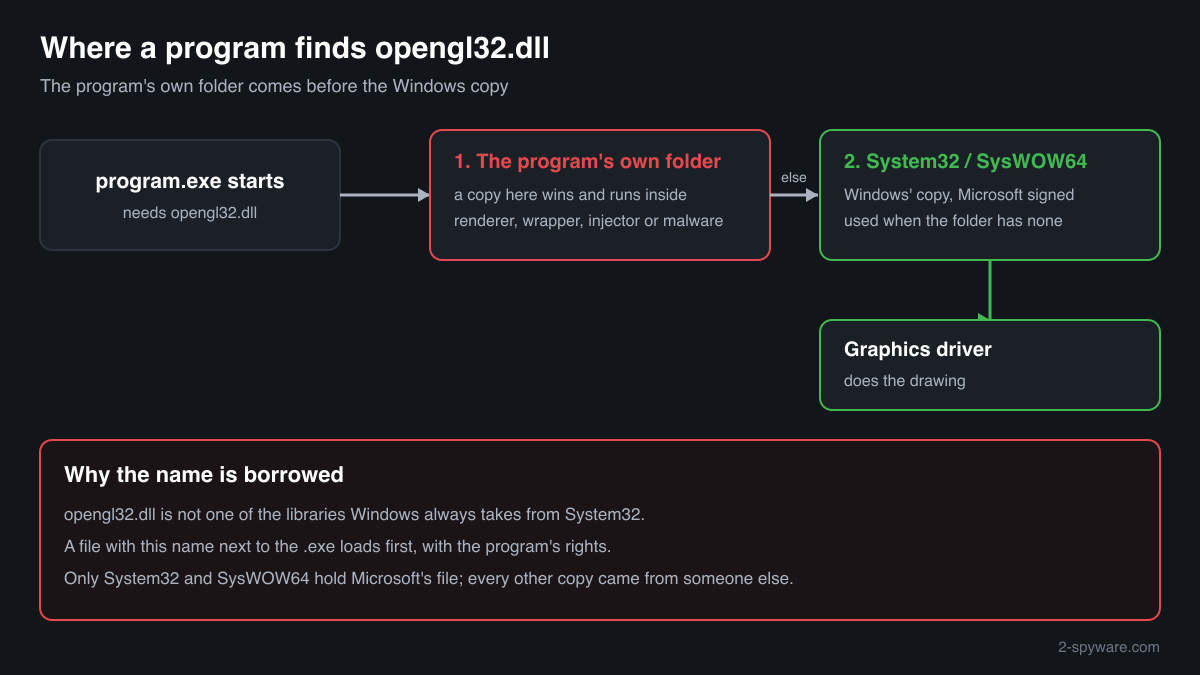
Programs look for opengl32.dll in their own folder before System32, so any file with this name next to a program's .exe is loaded and run by that program. Software renderers and graphics tools use this on purpose; injectors and malicious repacks can carry harmful code the same way. Check the folder, the signature and the hash.
- Description in the file
- OpenGL Client DLL
- What it is
- Microsoft's OpenGL library: the entry point for OpenGL programs, which loads the graphics driver's OpenGL and offers only OpenGL 1.1 in software on its own
- Genuine folders
- C:\Windows\System32\opengl32.dll and, on 64-bit Windows, C:\Windows\SysWOW64\opengl32.dll for 32-bit programs
- Not genuine by location
- Any opengl32.dll next to a program's .exe, in a game folder, in Downloads, Temp or AppData. Windows never puts it there
- Size of the genuine file
- Windows 11 24H2 and 25H2: 983,040 bytes (64-bit), 798,208 bytes (32-bit). Windows 10 22H2: 1,076,224 bytes (64-bit), 932,864 bytes (32-bit)
- Newest indexed build
- Windows 11 26H1: 10.0.28000.2336, delivered by KB5101649 on 14 July 2026
- Known Microsoft builds
- 171 builds across 20 Windows releases in Winbindex
- Is it a process
- No. It is a library loaded into the programs that use OpenGL, so it never appears on its own in Task Manager
What opengl32.dll does, and why programs load other copies of it
opengl32.dll is Microsoft's OpenGL library for Windows. OpenGL is a graphics interface for 2D and 3D drawing, used by games, CAD and 3D software, emulators and creative tools. Microsoft documents its own OpenGL implementation as version 1.1. A program that uses OpenGL loads opengl32.dll, which loads the OpenGL driver of the graphics card and passes the work to it. Newer OpenGL functions are not exported by opengl32.dll at all: programs ask the driver for them through wglGetProcAddress. Without a graphics driver, the file draws with its own software renderer, which programs report as GDI Generic.
Because opengl32.dll is not one of the libraries Windows always takes from System32, a program looks in its own folder first. That makes the name useful to anyone who wants to run code inside an OpenGL program. A file with the same name and the same exported functions, put next to the .exe, is loaded at start in place of Windows' copy.
Several kinds of legitimate tools do this. Software OpenGL renderers are built as opengl32.dll so that a program can run on a PC or virtual machine without a working graphics driver. Graphics wrappers for old games and post-processing injectors use the name to add effects or translate calls to another graphics interface. Some programs ship such a file in their own folder for the same reason.
The same position is open to harmful code. A copy in a program folder runs with the rights of that program and your user account: it can read and write files, open network connections and start other programs, while still passing the drawing on so that the program looks normal. So the question is never whether opengl32.dll is a virus, but which opengl32.dll you are looking at. The two copies in the Windows folders are Microsoft's; any other copy is whatever the person who made it put into it.
About .dll files. A .dll file is a library: it cannot run on its own and is loaded into a program's process. It does not appear in Task Manager under its own name; Process Explorer shows which process loaded it.
How to tell a program folder opengl32.dll from Windows' copy
A DLL is not listed in Task Manager as a process, so use the folder, the file properties, PowerShell or Process Explorer.
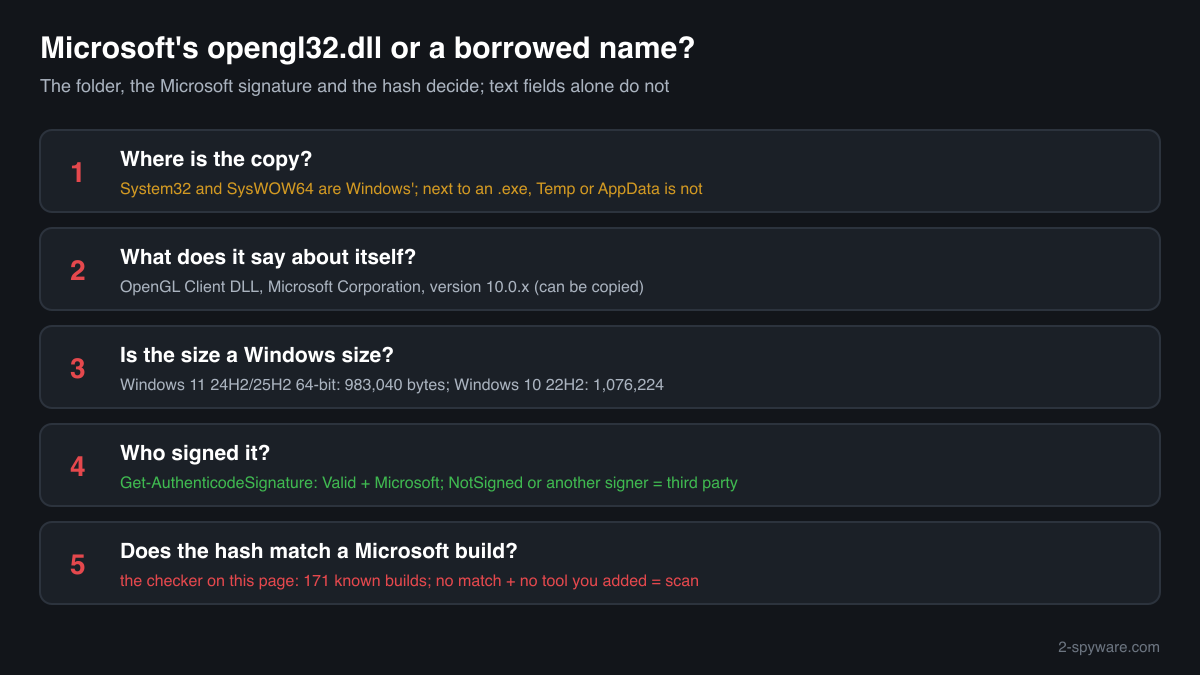
- Where the file is. List every copy with the command below. C:\Windows\System32 and C:\Windows\SysWOW64 are Windows' copies. Every other path, usually a program or game folder, is a file that something added. If you did not install a renderer, wrapper or graphics tool for that program, and the program's own installer did not put it there, find out what did.
Get-ChildItem C:\ -Recurse -Filter opengl32.dll -ErrorAction SilentlyContinue | Select-Object FullName, Length, @{n='Description';e={$_.VersionInfo.FileDescription}} - The Description field and the size. Right-click the file, Properties, Details. The genuine file says OpenGL Client DLL, with Microsoft Corporation as the company and a Windows version number such as 10.0.26100. A third-party copy usually shows another description, another company or a version that is not a Windows build, and a size that matches no Windows release in the facts table. These fields can be copied, so this check only rules files out.
- The digital signature. Windows' copy is signed by Microsoft through a catalog rather than inside the file, so the Properties window shows no Digital Signatures tab. PowerShell reads both kinds. Valid with a Microsoft signer means genuine; NotSigned or another signer on a program folder copy means a third-party file.
Get-AuthenticodeSignature 'C:\path\to\program\opengl32.dll' | Format-List Status, SignatureType, SignerCertificate - What the program loads. Start the program, then open Process Explorer from Microsoft Sysinternals, choose Find > Find Handle or DLL, type opengl32.dll and press Search. The path column shows which copy each process really loaded. A program folder path means that copy is running inside the program.
- Compare the hash with Microsoft's builds. Use the checker on this page: it computes the SHA-256 in your browser and compares it with the known Microsoft builds. A program folder copy that matches is an unneeded Windows copy; one that does not match is a third-party file.
- Scan before you trust or delete. Run Microsoft Defender's full scan, and the offline scan if a detection keeps coming back. A detection on a program folder opengl32.dll is not proof either way, because injectors are flagged for how they work, so weigh it with where the file came from.
A match to a Microsoft build proves the file is Microsoft's. A file that does not match is not automatically malicious: most program folder copies are renderers or graphics tools that do what their authors say. What decides is whether you or the program's installer chose to add that file, from where, and whether it is the one its author published.
Check your opengl32.dll
Choose the opengl32.dll you are unsure about. Its SHA-256 checksum is calculated in your browser and compared with the 189 Microsoft builds indexed from Windows releases and updates.
The file stays on your computer. Nothing is uploaded: the checksum is computed locally.
Warning signs and what they mean
| What you see | What it means |
|---|---|
| opengl32.dll next to a program although you never added a renderer, wrapper or graphics tool, and the program did not come with it | Something else put it there: a repackaged or cracked program, a bundled installer, or malware that uses the program as a launcher. Treat it as not genuine and scan. |
| opengl32.dll in Downloads, Temp, AppData or another folder with no program in it | No program will load it from there by accident. A copy outside a program folder and outside the Windows folders has no normal reason to exist. |
| The file came from a DLL download site, a repack or a link in a chat, not from the tool's own project page | Files with this name are easy to repackage with extra code. Get renderers and wrappers only from their authors' own release pages. |
| The Description is not OpenGL Client DLL, but the file claims Microsoft Corporation and has no valid Microsoft signature | A file that pretends to be Windows' copy. Legitimate tools do not need to hide; one that imitates Microsoft's details deserves a close look. |
| Accounts logged out, new sign-in alerts or password resets after adding a graphics tool or a repacked game | Possible theft of browser sessions or saved passwords. Remove the file and the tool, scan, and change passwords from another device. |
| An online game is blocked by its anti-cheat with the file present | Anti-cheat software watches for injected graphics libraries in game folders. Remove the file before playing online, or your account can be restricted. |
| Microsoft Defender names opengl32.dll in System32 or SysWOW64 | Rare. Check the hash with the checker on this page and run the offline scan before anything else. |
Everyday problems with opengl32.dll
My security software flagged opengl32.dll in a program folder
A detection on a graphics injector or wrapper is common, because a library that runs code inside another program behaves the way malware does. It is not automatically a false alarm either: repackaged games and malicious tools use the same file name.
Decide by origin. If you added a known tool from its author's own release page and the file matches what was published there, the detection is about the technique. If you do not know where the file came from, leave it quarantined.
Removing a program folder copy never harms Windows: the program falls back to the genuine copy in System32 or SysWOW64.
I want to remove a tool that uses opengl32.dll
Delete or rename opengl32.dll in the program folder, together with the files that came with it, usually an .ini file or a folder of shaders or settings. A launcher's verify option often leaves extra files in place, so do this by hand.
If the tool had an installer, uninstall it from Settings, Apps first. Then scan with Microsoft Defender.
Two opengl32.dll files are in the Windows folders
That is normal on 64-bit Windows: System32 holds the 64-bit library and SysWOW64 the 32-bit one. Both are genuine Microsoft files with different sizes and hashes.
opengl32.dll versions by Windows release
The newest build indexed for each release, and the update that delivered it. 171 Microsoft builds in total are known.
| Windows release | File version | Delivered by | Size, 64-bit |
|---|---|---|---|
| Windows 11 26H1 | 10.0.28000.2336 | KB5101649, Jul 14, 2026 | 995,328 bytes |
| Windows 11 25H2 | 10.0.26100.9278 | KB5127648, Oct 13, 2026 | 983,040 bytes |
| Windows 11 24H2 | 10.0.26100.9278 | KB5127648, Oct 13, 2026 | 983,040 bytes |
| Windows 11 23H2 | 10.0.22621.5415 | KB5066793, Oct 14, 2025 | 933,888 bytes |
| Windows 11 22H2 | 10.0.22621.5415 | KB5066793, Oct 14, 2025 | 933,888 bytes |
| Windows 11 21H2 | 10.0.22000.2600 | KB5044280, Oct 8, 2024 | 937,984 bytes |
| Windows 10 22H2 | 10.0.19041.7725 | KB5129236, Sep 14, 2026 | 1,076,224 bytes |
| Windows 10 21H2 | 10.0.19041.7725 | KB5129236, Sep 14, 2026 | 1,076,224 bytes |
| Windows 10 21H1 | 10.0.19041.7725 | KB5129236, Sep 14, 2026 | 1,076,224 bytes |
| Windows 10 20H2 | 10.0.19041.7725 | KB5129236, Sep 14, 2026 | 1,076,224 bytes |
Known versions of opengl32.dll
A public DLL catalogue lists 18 versions of opengl32.dll, from 5.1.2600.2180 to 10.0.17134.1, by Microsoft Corporation. Its copies are uploaded by users and not verified, so a checksum match identifies the version, while the digital signature tells you whether the file is genuine. Even a genuine file clears only the file, not the folder: attackers ship genuine libraries next to a program they abuse, so where the copy sits still decides whether it is safe.
Every version with its checksums, and how to fix opengl32.dll errors on uGetFix
Questions people ask
Is opengl32.dll a virus?
No, not the Windows copy. opengl32.dll is the OpenGL Client DLL, and the files in System32 and SysWOW64 are genuine Windows libraries. An opengl32.dll next to a program is a different file with the same name, usually a software renderer or a graphics tool. Most are harmless, but repacks and injectors can carry harmful code under this name, so check where it came from and compare its hash.
Why is there an opengl32.dll in my program folder?
Because a software renderer, a graphics wrapper, an injector or the program's own installer put it there. Programs load opengl32.dll from their own folder before the Windows copy, so tools use the name to change how the program draws or to run their code inside it. If you did not add anything like that and the program did not come with it, treat the file as suspicious and scan the PC.
Can I delete opengl32.dll?
Delete or rename a copy in a program folder whenever you like: the program falls back to Windows' own copy and your graphics driver, and only the tool that relied on the file stops working. Do not delete the copies in System32 or SysWOW64. Every OpenGL program needs them, and Windows treats them as protected system files.
What can a malicious opengl32.dll do?
Anything the program that loads it can do. The copy runs inside that program with your user account's rights, so it can read and write your files, read browser data and saved passwords, open network connections and start other programs, while still passing the drawing on to Windows so the program looks normal. That is why the origin of the file matters more than its name.
How do I check if my opengl32.dll is genuine?
Check three things. The folder: only System32 and SysWOW64 hold Windows' copy. The signature: Get-AuthenticodeSignature in PowerShell shows Valid with a Microsoft signer for the genuine file. The hash: the checker on this page compares the SHA-256 with 171 known Microsoft builds. A program folder file that fails these checks is a third-party file, not Windows' one.
Why does Windows show GDI Generic as my graphics renderer?
GDI Generic is the software renderer built into Windows' opengl32.dll. A program sees it when no graphics driver offers OpenGL for it, for example with Microsoft Basic Display Adapter in Device Manager or in a virtual machine without 3D support. It is the genuine Windows file working as designed, not a sign of a fake copy.
Sources
- Microsoft Learn: OpenGL (Win32 apps)
- Microsoft Learn: wglGetProcAddress function
- Microsoft Learn: Dynamic-link library search order
- Microsoft Sysinternals: Process Explorer
- MITRE ATT&CK T1574.001: DLL Search Order Hijacking
- Winbindex, the Windows binaries index (m417z)
- Winbindex, the Windows binaries index (m417z)
Version data read on Oct 17, 2026.
Questions and experiences
Ask about this page: members and our editors answer. Reading is open; writing needs a free account.
…