
Scam Likely streamer calls and texts on iPhone and Android: what it means and what to do
"Scam Likely streamer" is what people search after a phone call or text flagged Scam Likely mentions a streamer, a streaming sponsorship or a streaming prize. The label is a carrier warning, not a virus: do not answer or tap anything, block the number, report it, and never pay or share codes. This guide is for iPhone and Android.
Facts checked October 18, 2026. Steps checked against Apple's and Google's current documentation and the reports we cite. We have not run the app or the link on a phone ourselves.
Do it yourself · free Remove scam likely streamer calls yourself 8 steps, about 24 minutes, no software needed.
Start the steps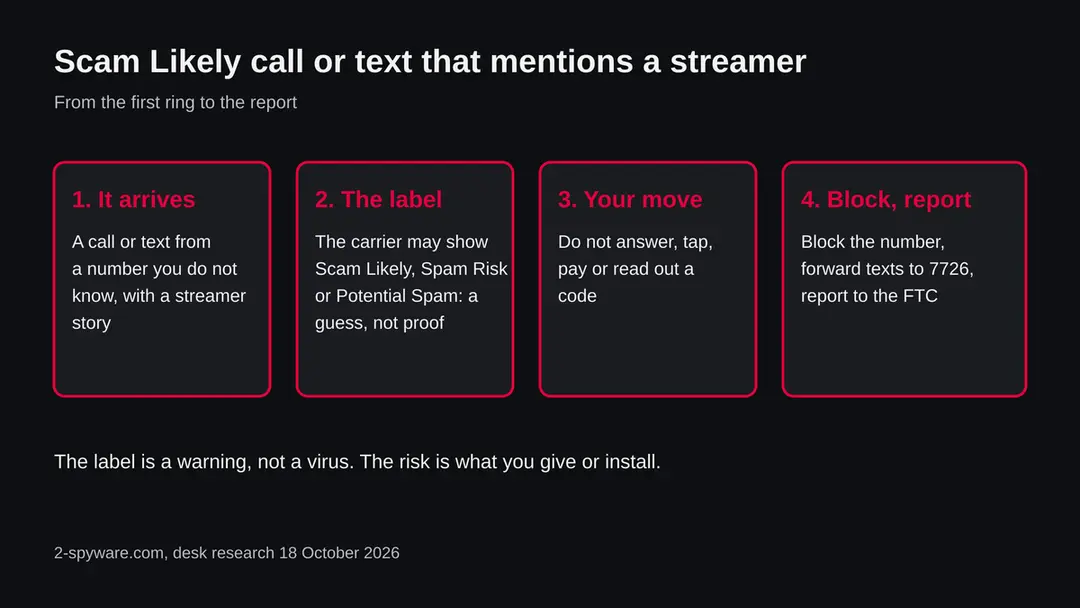
Scam likely streamer calls: summary
| Name | "Scam Likely" call label tied to a streamer or streaming offer (no single known scam by this name) |
|---|---|
| Type | Phone scam warning and impersonation scams that use streamers' names; not a program |
| Risk | Low if you ignore it. High if you give out codes, card details, access to your device, or pay a fee |
| Symptoms | A call showing Scam Likely, or a text about a streamer, a sponsorship, a prize or a channel problem |
| How to get rid of it | Do not answer or tap; block and report the number; change passwords if you gave any; nothing to uninstall unless you installed something |
| Our check (18 October 2026) | No address or file to test; desk research only; no URLhaus entry, because there is no address |
Show 8 more facts
| Devices | iPhone and Android phones |
|---|---|
| Microsoft detection | No Microsoft detection name is known: this is a phone call label and a scam pattern, not a Windows threat |
| Evidence | 0 write-ups by security sites; details still limited |
| Program | A call or text labelled Scam Likely that mentions a streamer |
| First seen | 18 October 2026 |
| Distribution | Typically ad scripts on free streaming, file-hosting and adult sites, typo domains and hacked websites |
| Damage | Redirects to scam pages, fake updates and tech support scams |
| Facts checked | 18 October 2026 |
Facts checked on 18 October 2026 against the FTC's advice on spam texts and security write ups on the Scam Likely label and on scams that target streamers. There is no address or file to test, so this is desk research only. We found no official notice about one scam called scam likely streamer.
What "scam likely streamer" means
"Scam Likely" is a warning shown by a phone carrier on an incoming call. "Streamer" is the part we could not tie to one thing, and we say so plainly. There is no known malware, no single known scam and no named person behind the phrase in anything we could verify.
Our reading is that people who search this phrase got a call or a text that the carrier flagged and that had something to do with streaming. That can mean three things. The caller said they were a streamer or worked for one.
The call or text was about a sponsorship, a giveaway or a channel problem. Or the message was about a streaming service such as a subscription that is about to be charged. Each of these has a safe way to handle it, and all three are covered below.
We are saying "our reading" because we found no official page, vendor write up or regulator notice for this exact phrase. What we found is the general description of the label and several reports of scams that use streamers' names, and we give both.
If you have the number, the exact words of the message or a screenshot, keep it, because it is the best evidence you can give when you report it.
- What the words are
- A carrier label (Scam Likely) plus the word streamer, which we could not tie to one known scam
- Seen as
- A call with Scam Likely on the screen, a text, a direct message or a voicemail
- Where it comes from
- Your carrier's network rules; the streamer part comes from the caller or the message
- Not the same as
- A virus, a hacked phone, or proof that a named streamer is a scammer
- What is unknown
- Who the callers are, how many people got them, and whether one campaign is behind the searches
What the Scam Likely label is and who shows it
Scam Likely is a caller ID warning. T-Mobile and Metro were the first to use it, and other carriers use their own words: AT&T shows Spam Risk and Verizon shows Potential Spam for the same kind of call.
A carrier decides with patterns, not with a human who listened to the call. It looks at things such as bursts of many short calls, numbers that many people have complained about, and calling habits that look like a robot dialler. The label is therefore a probability, not a verdict. Some honest calls get flagged, and plenty of scam calls arrive with no label at all.
That matters for the streamer question. A call labelled Scam Likely that says it is from a streamer is not made safe or unsafe by the label alone.
Treat the label as the carrier's guess and the content of the call as your own test. A call that asks you for a code, a payment, a gift card, a download or access to your device is a scam whatever the screen said.
Is a Scam Likely streamer call a virus or dangerous?
No, the label is not a virus and a call cannot install one by itself. The danger is in what you do after it: answering and giving details, tapping a link, installing an app or letting a stranger connect to your device.
If you only saw the label and let the call ring out, nothing happened and there is nothing to clean. If you answered and hung up, the most that usually happens is that your number is marked as live, so more calls may come. That is annoying, and blocking helps.
The cases that matter are the ones where you acted. Giving a sign in code lets a stranger into an account. Giving card details lets them charge you. Tapping a link in a text can open a page that copies a real login page.
The FTC page we read says some links lead to a spoofed website that looks real but is not, and that some messages can install malware that steals personal or financial information. The sections below tell you what to do for each of these.
We found no record of one named malware family or one named scam for this phrase, so we do not give detection names. A quiet search result does not clear every call you may get, so the advice here is about behaviour, not about a promise.
Is scam likely streamer calls dangerous?
What we checked for this guide, and what we could not
The phrase is not an address or a file, so there was nothing to request from our server and nothing to scan. This guide is desk research from five pages and our own reading of them.
scam likely streamer · desk check · 18 October 2026
- Malware address listsNo URLhaus entry exists for the phrase, because it is not an address. We list no address for you to block.
- What the label isDescribed in the carrier pages and security write ups returned by our searches as a carrier caller ID warning, with different words at AT&T and Verizon.
- Scams that use streamersSeveral older and newer reports describe fake sponsorships, fake platform support, impersonated creators and cloned channels. None of them is an official notice about calls labelled Scam Likely.
- The exact phraseWe found no official page, vendor analysis or regulator notice about one scam called scam likely streamer. We do not claim one exists.
- Your callWe could not see the number, the voice or the text you received. Only you can judge the content, using the red flags below.
A warning label, not malware; the scam content decides the risk A Scam Likely label is a carrier's guess and the streamer part is not tied to one known scam. Ignore, block and report; give nothing and pay nothing.
Scams that use streamers' names
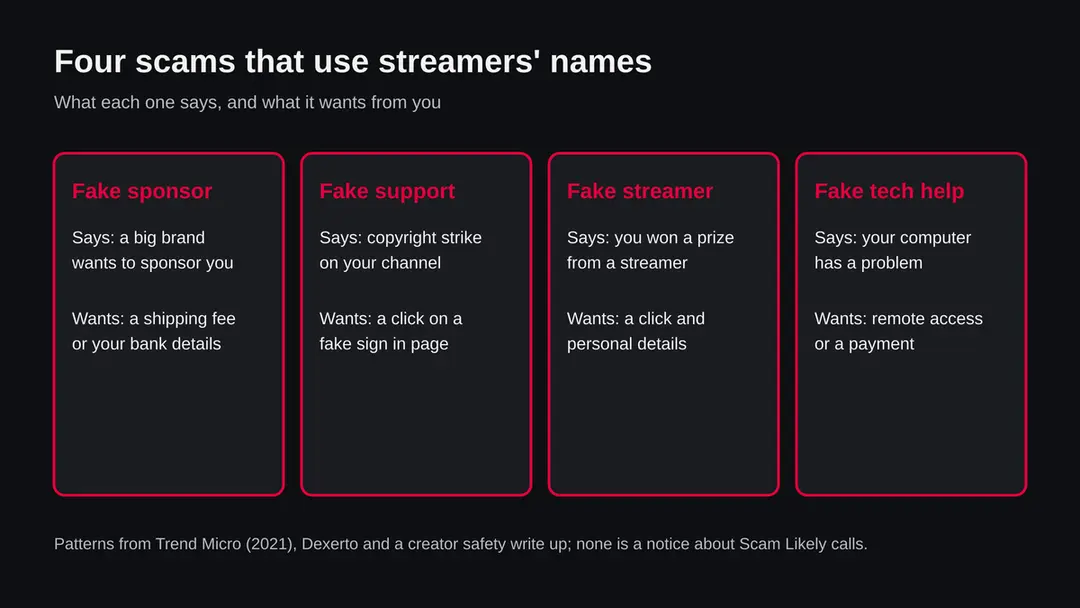
The reports we read describe scammers who pose as streamers, as brands that want to sponsor a streamer, or as the platform's support. They want your money, your login or access to your computer.
One expert write up for creators describes people posing as marketing representatives from known brands who offer too good to be true deals. They send official looking contracts that need an upfront fee for product shipping, or they ask for banking information for payment processing.
The same piece describes fake emails or messages that claim to be from Twitch or YouTube, warn about a copyright strike or a guideline breach, and push an urgent verification link to a fake login page.
A Trend Micro report from 2021 describes users on Twitch who pretended to be Twitch technical support and convinced live streamers that there were problems on their computers that needed urgent fixing.
An older report about YouTube describes messages that appeared to come from well known YouTubers and asked people to click a link to receive a prize. A Dexerto opinion piece says scammers copy the biggest names in streaming and come back within an hour or so of being shut down.
None of these is about a phone call labelled Scam Likely, and most are several years old. We use them to show the pattern: the streamer's name is a way to make a stranger look trustworthy, and the request is always money, a code or control.
| Pattern | What it says | What it wants |
|---|---|---|
| Fake brand sponsorship | A famous brand wants to sponsor you and sends a contract | An upfront fee for shipping, or your bank details |
| Fake platform support | Your channel has a copyright strike or a guideline problem | A click on a link to a fake sign in page |
| Impersonated streamer | You won a prize from a streamer you follow | A click, personal details or a small fee |
| Fake tech support | Your computer has a problem and we can fix it | Remote access to your device or a payment |
| Flagged call or text with a streamer story | A caller says they are, or work for, a streamer | Unknown; assume money, a code or control |
Red flags in a call or text that mentions a streamer
Any one of these is enough to stop: pressure to act now, a request for money or a code, a link or number you did not ask for, and a move to another app.
- High
Asks for a code you received
A sign in or verification code is the key to your account. No streamer, brand or platform support needs you to read it out.
- High
Asks for a fee to claim a prize or deal
Real prizes and sponsorships do not ask you to pay first for shipping, taxes or processing.
- High
Asks to install an app or share your screen
This gives a stranger control of the phone. Do not do it for a caller.
- Medium
Urgent threat about your channel or account
A strike, a ban or a charge that must be handled in minutes is a pressure tactic. Open the platform yourself instead of the link.
- Medium
Unknown number that says it is the streamer
A streamer's official contact is published on their own channel page. A stranger's text is not that.
- Low
A flagged call that leaves no message
Likely an automatic dialler checking whether the number answers. Ignore and block.
How scam likely streamer calls got onto your phone
Why you got this call or text
We cannot say why your number was called. Scam callers buy or guess lists of numbers and dial them in bulk, and a streaming theme is one story among many that makes a stranger sound interesting.
Common ways a number ends up on such a list are a data leak from some service, a number you entered on a prize or giveaway page, a public profile that shows it, or plain random dialling of number ranges.
In our reading, a streaming theme works because many people, young people in particular, follow streamers and expect offers, giveaways and brand messages. We have no data on how many people received such calls.
A number can also be faked by the caller. A caller can show a number that is not theirs, which is why a call that looks local or familiar is not proof of who is calling. If a call claims to be from someone you know, hang up and ring them on the number you already have.
If a real call or message got labelled Scam Likely
Labels can be wrong. If you expect a call from a person or company, check it by a route you already trust, and do not call back a number that appeared on the screen.
- 1
You expected the call
Check the number against the official website or the app of the company or the channel page of the person. If it matches a published contact, the call may be genuine and the label a mistake.
- 2
You are the one calling
If your own calls are flagged, such as a small business, school or creator team, ask your phone provider or calling service about number reputation and registration. Avoid dialling many numbers in a few minutes.
- 3
You are not sure
Let it go to voicemail. A real caller leaves a message or tries another way, and a scam caller usually does not.
How to remove scam likely streamer calls
There is nothing to uninstall, because a call label is not a program.
You stop the contact, protect your accounts and report it. Menu names are from iOS 26 and Android 14 and can differ on your phone.
Step 1: Do not answer, press or call back
Let the call ring out or decline it. If you did answer, say nothing that identifies you, press no key the voice asks for and hang up.
Warning: Do not call the number back, and do not reply to the text.
Scam senders count a reply as proof that your number is live.
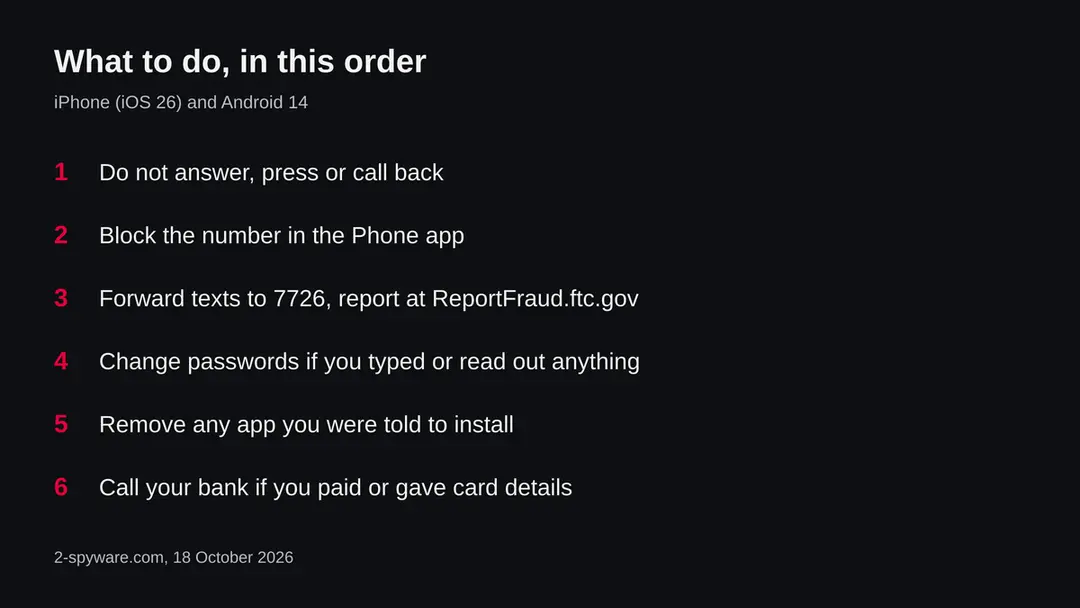
The order of actions after a Scam Likely call or text that mentions a streamer. Step 2: Block the number
On iPhone (iOS 26) open Phone > Recents, tap the info button beside the number and choose Block this Caller. You can also open Settings > Apps > Phone and look for the option to silence unknown callers.
On Android 14 open the Phone app, open the number in your call list and choose Block or Report spam. Names differ by maker, so search Settings for spam if you do not see them.
Step 3: Report the text or call
Forward a scam text to 7726 (SPAM); the FTC says this helps your wireless provider spot and block similar messages. You can also use the report junk option in your messaging app, or report to the FTC at ReportFraud.ftc.gov.
Outside the United States use your national consumer or police fraud service. Keep the number, the time and a screenshot until you have reported it.
Step 4: Do not tap links in the message
If you already tapped one, close the page and enter nothing. The FTC says some links lead to spoofed websites that look real, so logging in there lets scammers steal your username and password.
In Safari keep the fraud warning on under Settings > Apps > Safari. If you must check a streamer's offer, open their channel or the platform yourself and look there.
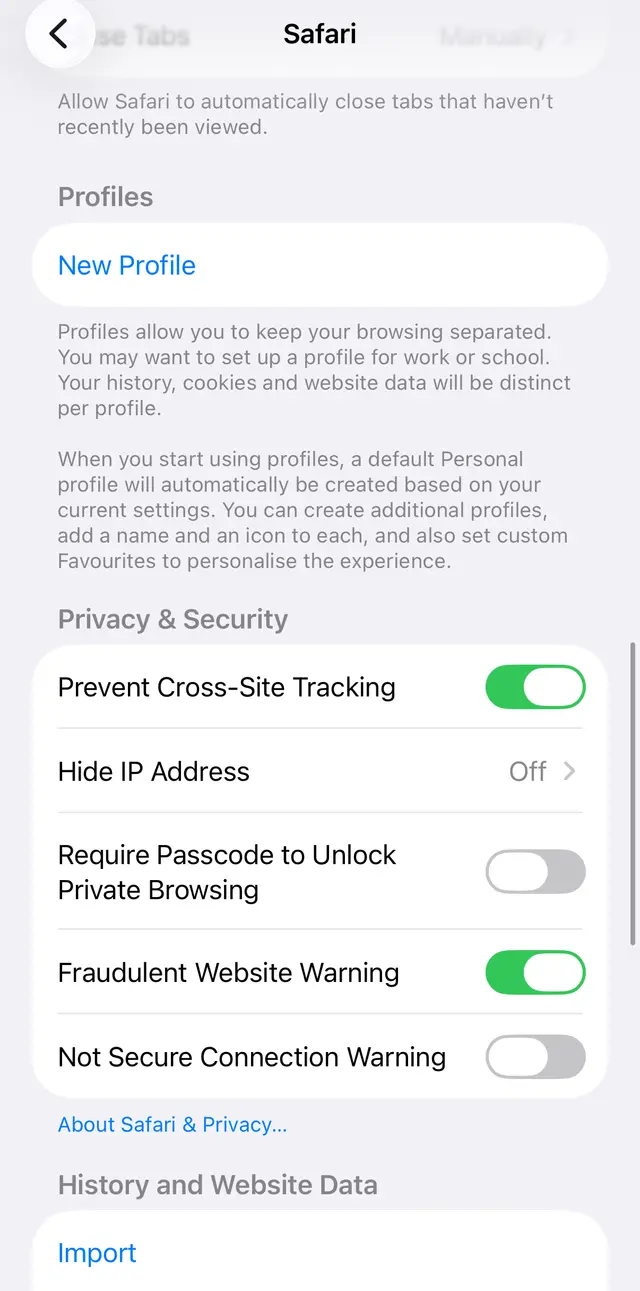
iOS 26: Settings, Apps, Safari. Keep Fraudulent Website Warning on. Step 5: Change passwords if you gave any
If you typed a password or read out a code, go to the real site or app yourself and change the password. Do it for every site where you reused it.
Turn on two step sign in, and sign out of all other devices if the site offers it. Then check that the recovery e-mail and phone number on the account are still yours.
Step 6: Remove anything you installed
If a caller or a text made you install an app, remove it. On iPhone touch and hold the icon and choose Remove App.
On Android touch and hold the icon and choose Uninstall. Search Settings for Install unknown apps and switch it off for your browser and messengers.
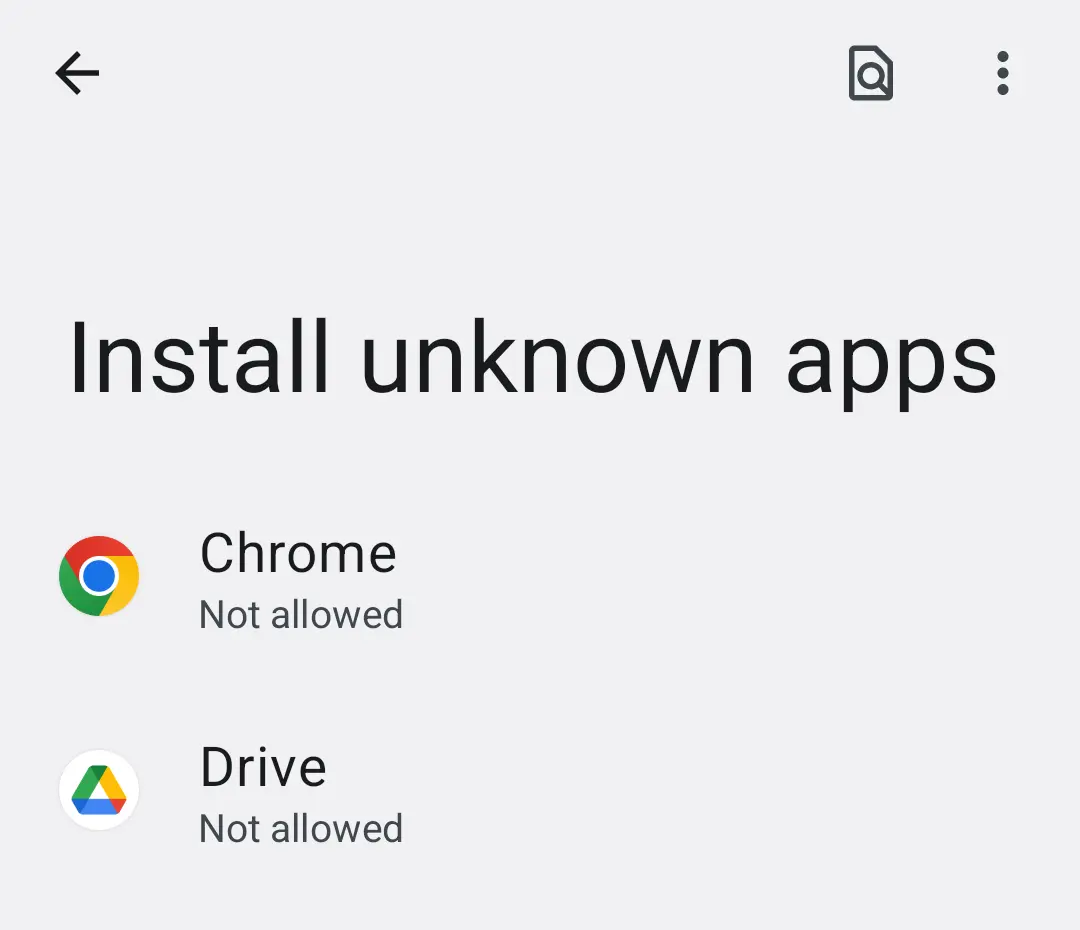
Android 14: Settings, Install unknown apps. Keep it off for apps you do not need. Step 7: Call your bank if you paid
If you gave card details or paid a fee, call your bank on the number printed on your card or shown in its app. Ask to block the card or the payment and to watch for new charges.
Report the loss to the FTC or to your national fraud service. Do not pay anyone who offers to get the money back for a fee.
Step 8: Ignore removal tools that offer to fix it
No tool is needed for a call label. An ad or a caller who sells a Scam Likely remover is selling you something.
The free steps above are what carriers and the FTC point to. If a page after a call asks for a payment or an install, close it.
After removal: keep the ads from coming back
If you answered, tapped or paid
What you do depends on what you gave. Answering alone costs nothing; codes, card details, installs and payments need action the same day.
- 1
You only answered or heard the voice
Nothing to repair. Block the number, do not call back and do not press any key a recording tells you to press.
- 2
You tapped a link in a text
Close the page. If you typed nothing, you are fine. If you typed a password, change it on the real site and on any site where you reused it, and turn on two step sign in. The FTC warns that links may lead to a spoofed website or install malware.
- 3
You gave card or bank details
Call your bank on the number printed on your card, ask to block the card or the payment, and watch the statements. Report the loss to the FTC at ReportFraud.ftc.gov or to your national fraud service.
- 4
You read out a code
Sign in to that account from the official app or site, change the password and sign out of all devices. Then check the recovery e-mail and phone number were not changed.
- 5
You installed an app or let someone see your screen
Uninstall the app, restart the phone, switch off any permission the app asked for, and change the passwords you used while the screen was shared. If a streaming or banking account was open, treat it as exposed.
If you are a streamer and your name is being used
You cannot stop scammers from using a famous name, but you can make it easy for your audience to tell the real you from the copies.
Pin a short notice on your channel and profile with the only accounts and contact addresses you use, and say you never ask followers for money, codes or a download. Ask moderators to repeat it. Report each impersonating account through the platform's own report form, and keep screenshots with dates, because the Dexerto piece describes copies returning within about an hour after a takedown.
For business offers, the expert advice we read is to check any brand deal on the brand's own website and to refuse a fee for shipping or a request for banking details for payment processing. Never give a login code to someone who says they are Twitch or YouTube support, and open your channel dashboard yourself instead of using a link.
How to keep these calls and texts away
Do
- Let unknown numbers go to voicemail and check the message later.
- Use the block and report spam options in your Phone and Messages apps.
- Check any prize, sponsorship or support claim on the official channel page or website you opened yourself.
- Turn on two step sign in for your streaming, e-mail and bank accounts, and use an authenticator app if offered.
- Forward scam texts to 7726 (SPAM) and report them at ReportFraud.ftc.gov.
Don't
- Read out a code you received to anyone who called you.
- Pay a fee to claim a prize, a deal or a channel fix.
- Install an app or share your screen because a caller asked.
- Call back a number from a text or a missed call you do not know.
- Trust a caller ID, a label or a name as proof of who is calling.
Questions about scam likely streamer calls
What does "scam likely streamer" mean?
We found no single official meaning. The words "Scam Likely" are a warning that some phone carriers, first T-Mobile and Metro, show on the screen for an incoming call their network judges to be probable fraud. "Streamer" is most likely what the person searching saw next to it:
- a caller who claimed to be a streamer
- a call about a streaming sponsorship
- a text tied to a streaming service
In our reading, searches for this phrase come from people who got a flagged call or message that mentioned streaming and want to know if it is safe. Nothing in our research ties the phrase to one named person or one malware.
Is "Scam Likely" from a streamer a virus?
No. A Scam Likely label is text on your call screen, and a phone call cannot install a virus by itself. The risk is in what you do next:
- answering and giving out codes or card details
- tapping a link in a follow up text
- installing an app the caller names
- letting someone connect to your phone or computer
If you only saw the label and let the call ring out, nothing happened to your device. If you did one of those other things, use the steps in this guide for your case. We cannot say what a specific call you got was after, because we have no recording or number.
Should I answer a call labelled Scam Likely?
Do not answer if you do not know the number. The label comes from patterns such as bursts of many short calls or numbers with a history of complaints, and it is a warning, not proof. If the call matters, it will leave a voicemail or reach you another way.
If you do pick up by mistake, say nothing that identifies you, do not press any key the voice tells you to, and hang up. Then contact the real company or person using a number or account you already know, never the number that called you.
Why did a real call get labelled Scam Likely?
Carriers decide with automatic rules, and the rules sometimes catch honest callers. A small business, a school, a pharmacy or a creator team that dials many people in a short time can look like a scam caller to the network.
The label is not a guarantee either way: plenty of scam calls arrive with no label at all. If you expect a call from a known person or company, check it through a number you already have. If you are the one being flagged, ask your phone provider or your calling service about number reputation and registration.
How do I block Scam Likely calls on iPhone and Android?
On iPhone (iOS 26), open Settings, then Apps, then Phone, and look for the option to silence unknown callers; touch and hold a number in Recents and use the info button to block it.
On Android (version 14 on our reference phone), open the Phone app, open its settings, and look for Caller ID and spam; from the call list, open a number and choose Block or Report spam.
Menu names vary by phone maker and version, so search your Settings for "spam" if you do not see them. Your carrier may also offer its own free call blocking.
I tapped a link in a text about a streamer or a streaming prize. What now?
Close the page and do not enter anything. The FTC says some links lead to a spoofed website that looks real but is not, and that some messages can install malware that steals personal or financial information.
If you typed a password, change it at once from the real site and anywhere you reused it, and turn on two step sign in. If you typed card details, call your bank.
If a page asked you to install an app or a profile, remove it and run your phone's built in app scan. Forward the text to 7726 afterwards.
How do I report a scam call or text?
The FTC page we read lists three ways for texts: forward the message to 7726 (SPAM), which the FTC says helps your wireless provider spot and block similar messages; use the report junk or spam option in your messaging app; or report it to the FTC at ReportFraud.ftc.gov.
For calls, the same FTC site takes reports, and your carrier's spam report option helps its labels get better. Outside the United States, use your national consumer protection or police fraud service. Keep the number, the time and a screenshot until you have reported it.
Someone pretending to be a streamer wrote to me. Is it real?
Treat it as fake until you prove otherwise. Reports we read describe scammers who pose as well known YouTubers and offer a prize through a link, and cloned channels that return within an hour of being shut down.
A real streamer will not ask you to pay to claim a prize, to move to another app to collect it, or to scan a code.
Check the channel's own page for the exact account name and the link the streamer publishes. If the message came by text from a number you do not know, it is not the streamer's official contact.
I am a streamer and calls or messages use my name. What should I do?
Collect proof first:
- screenshots
- the numbers
- times
- links
Post a pinned notice on your channel naming your only official accounts, and tell your mods to answer questions with it. Report the impersonating accounts through the platform's report form, and report the calls and texts as in the question above.
For sponsorship requests, the expert advice we read is to check any brand deal on the brand's own site and to refuse upfront fees for shipping or banking details for payment processing. Never confirm a login code to anyone who says they are platform support.
Sources
- FTC Consumer Advice: How to recognize and report spam text messages (read October 18, 2026)
- NordVPN: Scam likely calls, what they are and how to block them (read October 18, 2026)
- ESET WeLiveSecurity: What is Scam Likely and putting the phone down on unwanted calls (read October 18, 2026)
- Trend Micro: 4 popular scams targeting gamers, live streamers and viewers (2021) (read October 18, 2026)
- Dexerto: Twitch is failing its users with scam streams (read October 18, 2026)