
Adobe FTC Lawsuit: 2026 Settlement Explained
- Adobe and the FTC in 2026: the short answer
- Timeline: from Figma to a $150 million settlement
- What changed since 2024
- Risks around subscription traps (our analysis)
- Steps if you have an Adobe or similar subscription
- What is still unknown
- Our original 2024 report
- Cancellation fees are hidden behind fine print
- Deceptive practices when users decide to cancel their subscriptions
- FTC seeks appropriate actions from Adobe
- Adobe denies the allegations
- Related guides on 2-Spyware
Adobe and the FTC in 2026: the short answer
The FTC case against Adobe ended in a settlement. On March 13, 2026 the Justice Department announced that Adobe agreed to pay $75 million in civil penalties and offer customers $75 million in free services, a total of $150 million, to resolve claims that it hid an early termination fee and made cancelling hard.[7][8] Adobe said it disagrees with the government's claims and denies any wrongdoing.[8]
The deal comes as a proposed stipulated order that still needs a court to enter it, according to the Justice Department.[7] We found no later page that says whether the court has entered it, so check the case docket if you need the final status. The case also named two Adobe executives, Maninder Sawhney and David Wadhwani, and the same order is meant to resolve the claims against them.[7]
| Question | Answer |
|---|---|
| What was alleged | Hiding the early termination fee (ETF) and making cancellation hard, a violation of ROSCA[1][2] |
| The ETF | 50 percent of the remaining monthly payments if you cancel in the first year of an annual plan paid monthly[2] |
| Outcome | Proposed settlement announced March 13, 2026[7] |
| Money | $75 million civil penalty plus $75 million in free services[7] |
| Adobe's position | Disagrees with the claims and denies wrongdoing[8] |
| Court | U.S. District Court for the Northern District of California[7] |
Timeline: from Figma to a $150 million settlement
| Date | Event |
|---|---|
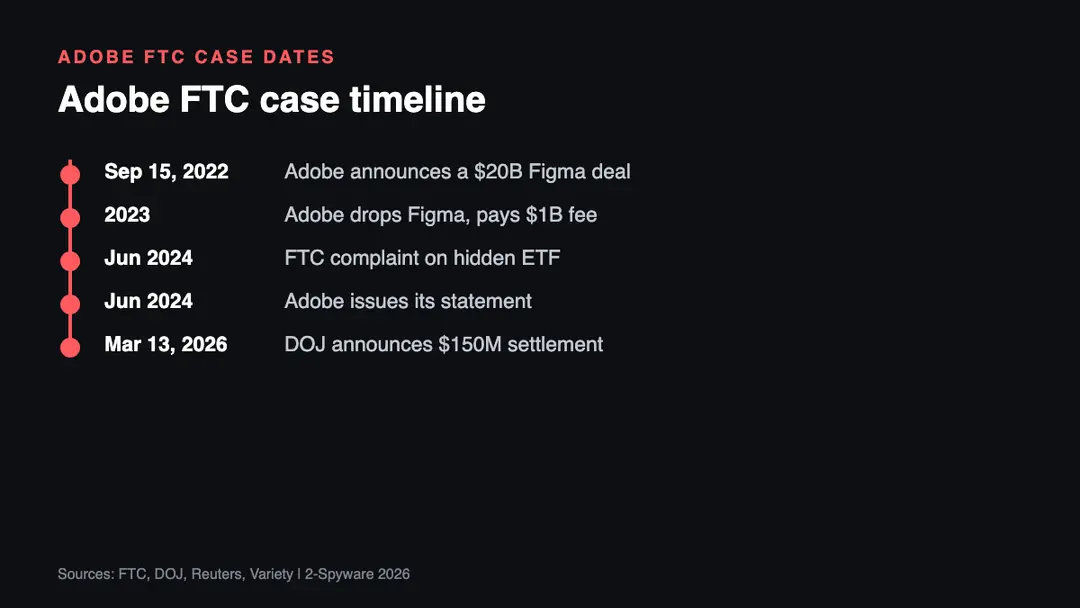
| September 15, 2022 | The Verge reports Adobe will buy Figma in a deal worth $20 billion[5] |
| Late 2023 | Adobe drops the Figma bid citing regulatory opposition and pays a $1 billion breakup fee[6] |
| June 2024 | The FTC takes action against Adobe and two executives over the hidden ETF and cancellation process[2] |
| June 2024 | Adobe publishes a statement responding to the complaint[4] |
| March 13, 2026 | The Justice Department announces the $150 million settlement and injunction[7] |
What changed since 2024
In 2024 this was an allegation. The 2024 complaint said Adobe showed the monthly price clearly but buried the ETF in fine print and behind small icons.[2] Now there is a negotiated outcome, with money and rules attached.
The Justice Department says the order requires Adobe to give subscribers easy ways to cancel. Adobe must also clearly disclose any ETF and how it is calculated before enrolling customers. It must remind customers before a free trial longer than seven days turns into a paid plan with an ETF.[7]
Reuters reports that Adobe said it was pleased to resolve the matter while denying wrongdoing.[8] Nothing in the sources we read says Adobe admitted fault. Our original report below describes the complaint as filed in 2024 and is kept unchanged.
Risks around subscription traps (our analysis)
Our analysis is that the Adobe case is a pattern, and the same traps appear in many apps. Watch for these.
- Plans that look monthly but are annual. The headline price says monthly while the contract runs for a year, as the FTC described.[2]
- Cancellation fees in small print. Look for an early termination fee line before you press buy and note how it is calculated.
- Free trials that turn paid. The settlement terms include a reminder before a long trial converts to a paid plan with an ETF.[7] Set your own calendar reminder anyway.
- Fake cancellation or refund pages. Scammers imitate subscription support and ask for card details. Always cancel from the official account page and read our phishing report guide.
Steps if you have an Adobe or similar subscription
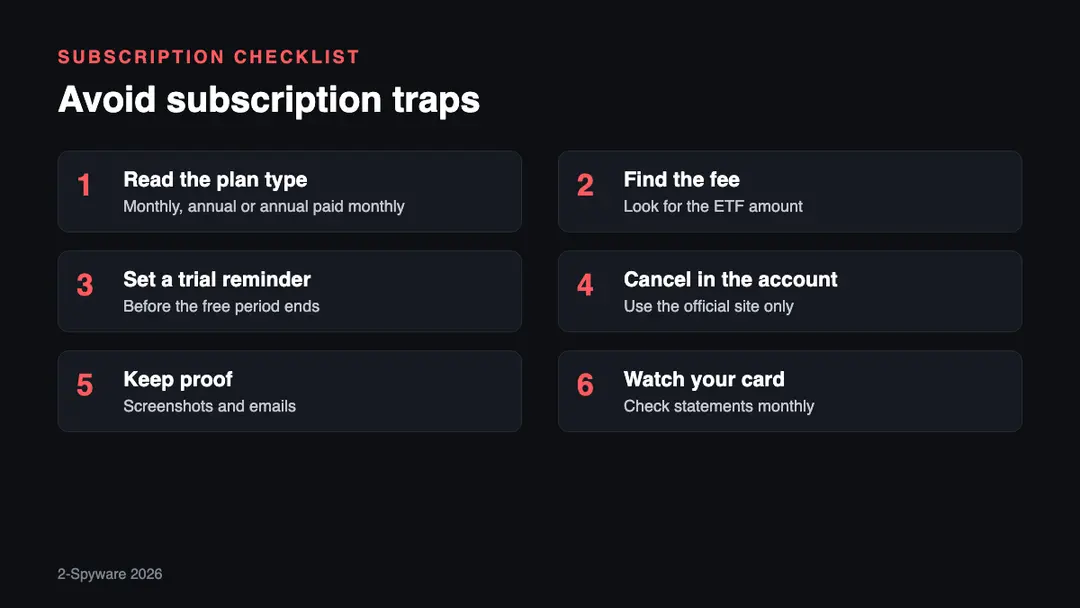
1. Read the plan type. Check whether a monthly price hides a year-long commitment. Adobe's own page explains its subscription terms and refund policy.[3]
2. Find the fee. Look for any early termination fee. In the FTC complaint, it was 50 percent of the remaining monthly payments when cancelling in year one.[2]
3. Set a trial reminder. Put the end date of any free trial in your calendar. Do not rely on the company to remind you.
4. Cancel in your account. Use the company's own account page. Do not follow links from emails or ads that claim to cancel for you.
5. Keep proof. Save the cancellation confirmation email and take screenshots of each page.
6. Watch your statements. If billing continues after you cancelled, contact the company in writing and then your card issuer. You can also check if your email was exposed with our leak check.
What is still unknown
- Whether the court has entered the proposed order. We found no confirmation after March 13, 2026.
- How customers will receive the $75 million in free services. The pages we read do not describe the process.
- Whether other subscription companies face similar cases. We found nothing we could confirm.
Our original 2024 report
The text below is our report as first published in 2024. We keep it unchanged for the record; the sections above bring it up to date.
Federal Trade Commission (FTC) has filed a complaint[1] against Adobe and two of its executives, Maninder Sawhney and David Wadhwani, in the U.S. District Court for the Northern District of California.
The complaint accuses Adobe of deceptive practices related to its subscription plans, specifically failing to disclose early termination fees (ETFs) and making the cancellation process unnecessarily complicated.[2]
FTC alleges that these practices violate the Restore Online Shoppers' Confidence Act (ROSCA), which requires clear disclosure of all terms and a straightforward cancellation mechanism.
Cancellation fees are hidden behind fine print
Adobe transitioned to a subscription model in 2012, requiring users to pay regularly for access to its software, including popular products like Photoshop and Acrobat.
FTC's complaint details how Adobe steers consumers towards its "annual paid monthly" subscription plan without adequately informing them about the ETF, which can be as much as 50 percent of the remaining monthly payments if canceled within the first year.[3]
This fee is often hidden in fine print or behind small icons on Adobe's website. Consumers reported to FTC and the Better Business Bureau that they were unaware of the ETF or the requirement to keep the subscription for a year. Adobe's failure to disclose these terms clearly is central to FTC's allegations.
Deceptive practices when users decide to cancel their subscriptions
The complaint also describes Adobe's cancellation process as intentionally complex, designed to deter consumers from canceling their subscriptions.
When attempting to cancel, consumers must navigate through multiple pages on Adobe's website, starting with locating the account management page, clicking on "Manage Plan," and then selecting "Cancel Your Plan."
Even after reaching this point, users are often forced to re-enter their password and complete a mandatory feedback page that prominently displays the ETF, effectively discouraging cancellation.
Furthermore, FTC alleges that Adobe's customer service adds to the difficulties by frequently dropping calls, disconnecting chats, and transferring customers between representatives, forcing them to re-explain their cancellation request each time. Consumers also reported continued billing despite believing they had canceled their subscriptions, further exacerbating their frustration.
FTC seeks appropriate actions from Adobe
FTC's complaint seeks several forms of relief to address these issues. These include a permanent injunction to stop ongoing violations, monetary civil penalties for ROSCA violations, restitution for affected consumers, and the cancellation or modification of existing contracts entered into under deceptive terms.
The complaint also targets Adobe executives Sawhney, Senior Vice President of Digital Go To Market & Sales, and Wadhwani, President of Digital Media Business, accusing them of being aware of and continuing the unlawful practices.
Commission voted 3-0 to refer the civil penalty complaint to the Department of Justice (DOJ) for filing. The DOJ then filed the complaint, which will be decided by the court.
Adobe denies the allegations
In response to FTC's action, Adobe has disputed the allegations. Dana Rao, Adobe's General Counsel and Chief Trust Officer, stated:[4]
We are transparent with the terms and conditions of our subscription agreements and have a simple cancellation process. We will refute FTC's claims in court.
Adobe maintains that its subscription services are convenient, flexible, and cost-effective, allowing users to choose the plan that best fits their needs, timeline, and budget.
The lawsuit against Adobe highlights the broader regulatory scrutiny of subscription practices and consumer protection. The federal government began investigating Adobe's cancellation practices late last year, and this case is part of a larger effort to ensure companies do not use deceptive tactics to trap consumers in long-term subscriptions.
Adobe's recent attempt to acquire the product design platform Figma for $20 billion[5] faced antitrust scrutiny, reflecting continued regulatory challenges for the company.[6]
FTC's Bureau of Consumer Protection Director Samuel Levine said that deceptive cancellation fees should stop being practiced, saying:
Americans are tired of companies hiding the ball during subscription signup and then putting up roadblocks when they try to cancel. FTC will continue working to protect Americans from these illegal business practices.
Related guides on 2-Spyware
Frequently asked questions
Was Adobe sued by the FTC?
Yes. The FTC took action against Adobe and two executives in June 2024, alleging a hidden early termination fee and a hard cancellation process.{2} The case later ended in a proposed settlement that the Justice Department announced on March 13, 2026.{7}
How much is the Adobe settlement?
It is $150 million in total. The Justice Department says the proposed order requires $75 million in civil penalties and $75 million in free services for customers.{7} Adobe says it denies any wrongdoing.{8}
What is the Adobe hidden cancellation fee?
It is the early termination fee on the annual paid monthly plan. The FTC said it equals 50 percent of the remaining monthly payments if you cancel during the first year, and that Adobe buried it in fine print.{2}
What does the settlement require Adobe to do?
Adobe must give subscribers easy ways to cancel and clearly disclose any early termination fee and how it is calculated before enrolling them. For free trials longer than seven days, it must also send a reminder before the paid plan starts.{7}
What happened to the Adobe executives in the case?
The case named Maninder Sawhney and David Wadhwani, and the Justice Department says the proposed stipulated order is meant to resolve the case against Adobe and both employees.{7} We found no further detail on them.
Did Adobe admit wrongdoing?
No, not in the sources we read. Reuters quotes Adobe as saying it disagrees with the government's claims and denies any wrongdoing, while being pleased to resolve the matter.{8}
Log in to comment
No comments yet. Be the first.