
Stabilizeconnection.co.in ads: what they are and how to stop them
Stabilizeconnection.co.in is a web address that asks visitors to click Allow in the browser's notification prompt, after which adverts and fake alerts arrive on the screen. Nothing is installed on your PC; take the notification permission back in your browser, as shown below.
Facts checked October 14, 2026. Removal steps tested on Windows 11 (26H2) and checked against Microsoft's and the browser makers' current documentation.
Automatic
Get a free scan and check if your PC is infected.
Fortect finds malware, unwanted programs and the Windows damage they leave behind, and repairs it in one pass.
If notifications from stabilizeconnection.co.in led you to download something, a free scan can check the PC for anything that came with it.
Do it yourself · free Remove Stabilizeconnection.co.in yourself 2 steps, about 6 minutes, no software needed.
Stabilizeconnection.co.in: summary
| Type | Website that serves notification ads; no installed program |
|---|---|
| Risk | Medium: the permission installs nothing, yet the ads can lead to scam pages and fake downloads |
| Symptoms | Ads in a screen corner at random times; false virus alerts, giveaways and rewards; detours to odd addresses |
| How to get rid of it | Delete its entry from the browser's notification list; scan only after running an advert's file or if detours persist |
| Our check (6 October 2026) | The name would not resolve on our one visit, so no prompt could be checked; that clears nothing |
| First seen | Our report is dated 7 May 2025; no registration date is available |
| Removal | Scan the PC with security software to find and remove the malware and anything installed with it. Fortect scans Windows for malware and repairs the system files and settings it damaged. Remove it nowTo use the full-featured product, you have to purchase a license for Fortect. The scan is free. |
Show 10 more facts
| Distribution | Redirects from file-sharing and other dubious sites, deceptive adverts, cracked-software pages (our 2025 report) |
|---|---|
| Name | Stabilizeconnection.co.in |
| Evidence | One write-up by a security site; details still limited |
| Domains | stabilizeconnection.co.in |
| Ads shown as | Desktop notifications |
| Browsers | Chrome, Edge and Firefox |
| Installed on the PC | Nothing; a browser notification permission only |
| Damage | Notification ads that lead to scam pages, fake virus alerts and unwanted downloads |
| Detection names | None: nothing is installed on the PC, so Microsoft Defender and other antivirus programs have no file to detect |
| Facts checked | 6 October 2026 |
Facts checked on 6 October 2026 against our own test of stabilizeconnection.co.in in desktop Chromium from Lithuania (the name did not resolve) and our 2025 report.
What Stabilizeconnection.co.in is and how its notifications reach you
Stabilizeconnection.co.in is an address on the web that asks visitors to press Allow in a browser prompt, so that it can send them adverts. It is a website, not software: pressing Allow stores a permission in your browser and installs nothing. Our 2025 report called it a push notification scam site, and its pages of that time are shown below.
- 1
You arrive without meaning to
Our 2025 report says most visitors are sent here from another questionable site, such as a file-sharing page or one lined with deceptive adverts. If you never typed this name yourself, a redirect of that kind is the likely route.
- 2
A browser box asks for Allow
The little window with Allow and Block belongs to the browser, and the page cannot restyle it. Its question is only whether the site may send you notifications. The words printed on the page give another excuse, for example a stalled video or a robot check.
- 3
Your answer is stored
Chrome keeps the permission under the site's address until you delete it (Chrome Help). Closing the tab does not change it.
- 4
Adverts appear on your screen
Its server passes messages to the browser's push service, and they surface in a screen corner at odd moments, with no page of the site open. The old report warned that such messages can carry false virus alerts, bogus giveaways and bogus financial rewards, and that the links in them can lead to scam, phishing or malware pages.
- Address
- stabilizeconnection.co.in, a .co.in domain
- Registration
- Not known: the registry lookup we ran on 6 October 2026 returned no record for this name, so we cannot give a creation date
- Our report
- Published 7 May 2025
- Our visit on 6 October 2026
- The name did not resolve, so no page loaded
- What the site needs from you
- A single press of Allow; no file, no installer
Is stabilenetwork.co.in the same as Stabilizeconnection.co.in?
We found no reliable public source that says stabilenetwork.co.in and Stabilizeconnection.co.in belong together.
We have no registration record, owner name or technical link between the two, so we cannot confirm that they are the same service or run by the same people.
Our reading is that stabilenetwork.co.in is a similar looking name of the same kind, a web address that shows a fake prompt asking you to click Allow. The names are close, and sites of this type often use several look-alike addresses. That is a guess, not a finding.
If you reached stabilenetwork.co.in and pressed Allow, treat it like the case described above. Open your browser's notification settings, find that address in the Allowed list and remove it. The steps in this guide for Chrome, Edge, Firefox and Safari work for any address in that list.
If you see ads from either name, do not click them, and do not enter personal details on the page they open. Scan your PC only if you ran a file from one of these adverts or the redirects continue after you removed the permission.
Is Stabilizeconnection.co.in dangerous?
Our test on 6 October 2026
We tried to load stabilizeconnection.co.in as an ordinary visitor would, in a fresh desktop Chromium from Lithuania, one visit. The browser could not find the address at all, so there was nothing to record about prompts, redirects or ad networks.
Stabilizeconnection.co.in · desktop Chromium · Lithuania · 6 October 2026
- AddressThe browser reported ERR_NAME_NOT_RESOLVED: the name did not lead to any server on this visit. We do not know when it stopped answering, because we have no earlier test of our own, and a name that is missing today can be registered again or answer elsewhere.
- Notification requestNone seen, because no page loaded. The 2025 prompt could not be checked.
- Redirects and pop-upsNone seen, because no page loaded.
- Ad networks and service workerNone seen, because no page loaded.
- Permission you gave earlierA site that no longer answers does not take back a permission you gave it. The entry stays in your browser's notification list until you delete it, and we cannot tell whether its sender can still reach you.
- Not testedOther countries, phones, a return visit, a click inside the page. Sites of this kind change what they show by country, device and referrer, and may come back under a new address.
Medium risk We saw nothing on this one visit because there was nothing to load; that is not proof that the operator has stopped. The page described in 2025 asked for notification permission, and we treat the address as a risk until the permission is gone from your browser.
What changed since our 2025 report
7 May 2025
Our report
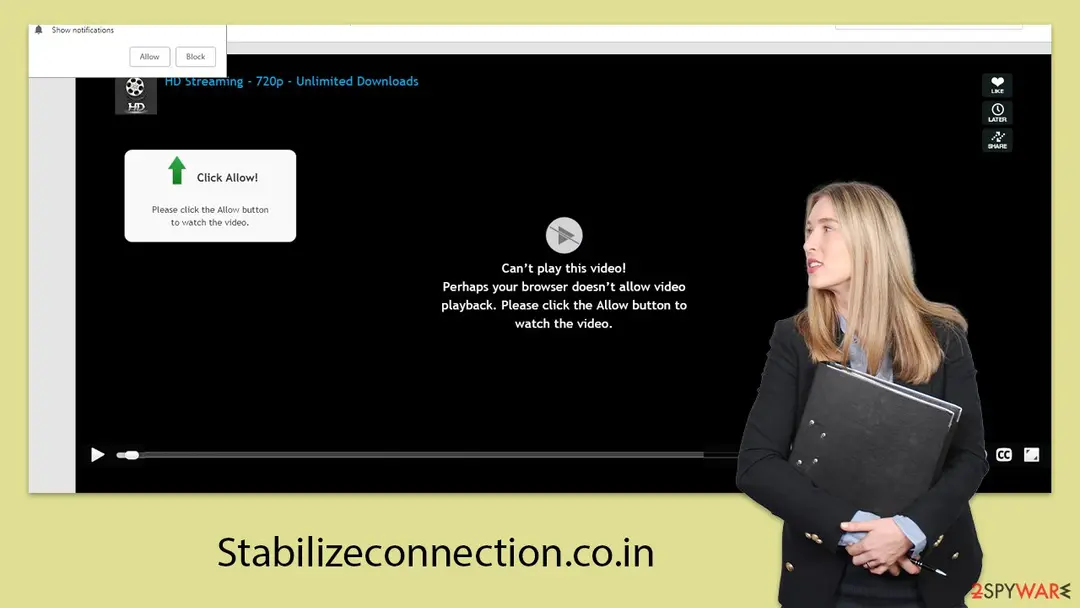
We described a site that tries to get visitors to accept push notifications and then floods the screen with unwanted adverts. The picture shows the video-style page of that time: a player that claims it cannot play and asks you to press Allow.
Illustration from our 2025 guide: a fake video player asking you to press Allow. It is not a capture from our 2026 test, where the address did not load. 6 October 2026
Our new check
The address did not resolve in our browser, so no page appeared and no prompt could be checked. Alerts you still receive under this name come from a permission granted earlier, which only you can remove.
The wording of the fake prompts
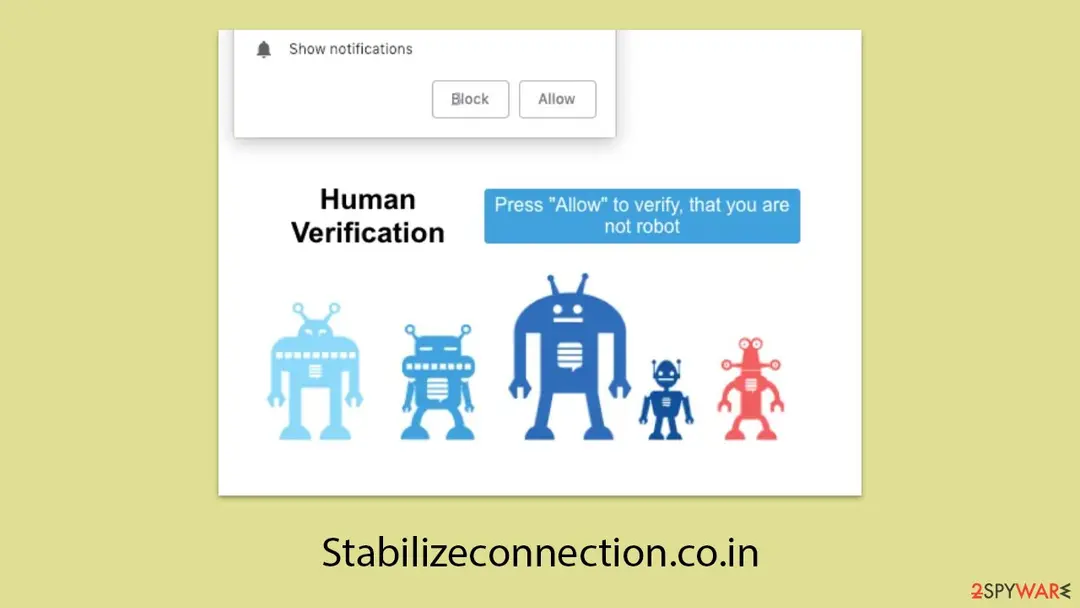
The 2025 report lists the lines this site used to make pressing Allow feel routine. None of them is a real check; each one asks the browser for the same notification permission.
| Line on the page | What it imitates | What pressing Allow does |
|---|---|---|
| If you're over 18, click Allow | An age check | Grants the site the right to send notifications |
| Click Allow to confirm you're not a robot | A CAPTCHA | Grants the site the right to send notifications |
| Press Allow to claim your prize and redeem it in our shop | A prize or reward page | Grants the site the right to send notifications; no prize follows |
| Can't play this video: please click the Allow button to watch the video | A video player | Grants the site the right to send notifications; the video never resumes |
| Press Allow to start downloading | A download page | Grants the site the right to send notifications; no file is the point |
Notifications or redirects: which are you seeing?
The old report blamed adware for the detours that bring people to this kind of site; adware is one cause, not the only one. Different causes look alike and need different fixes.
| Symptom | Probable cause | Fix |
|---|---|---|
| Alerts pop up in a corner of the screen now and then, though you are not on the site | You gave the site notification permission at some point | Remove or block its entry in the browser's notification list (browser steps above) |
| You press play or download on a free-video or file page and land on this or another odd address | The page you left hands visitors on to an ad network, and this address sits in the chain | Close the tab and decline the prompt; no program is involved |
| Odd detours happen on every site you visit | An extension you never wanted, or a program that arrived inside another installer (adware) | Go through extensions and installed apps, then reset the browser |
| The start page or search engine is no longer what you set | A browser hijacker, which is a separate problem from a permission | Reset the browser |
The real risks, from most to least serious
Granting the notification permission installs nothing. The dangers below come from what the adverts that follow lead you to do.
- High
Running a file an advert offers
The old report warns that clicking can end with malware on your system. Fake updates and installers are a common carrier for adware, and such programs usually bring friends.
- High
Handing over personal details or money
False virus alerts, giveaways and rewards are used to defraud people. Whatever you type into the page an advert opens reaches whoever runs it, and a payment made there is lost.
- Medium
Phishing and scam pages
Links inside the notifications can lead to phishing pages made to copy a login or a card number.
- Low
The permission by itself
It only lets the site show alerts. As the old report put it, enabling notifications does not directly harm; it opens the door to a steady stream of questionable ads, and it lasts until you delete it.
How Stabilizeconnection.co.in got into your browser
Hardly anyone looks these pages up. The internet is full of useful things, and unwanted pages spread quickly through it: the old report puts the blame on poorly moderated advertising pages and pages that allow questionable third-party content.
Routes named in our 2025 report
- Deceptive ads
- Fake system alerts
- Download buttons disguised as real actions
- Pirated programs and cracked-software sites
- Redirects from file-sharing sites
- Adware already on the computer
Cracked-software and file-sharing pages are the riskiest of these: the report says they raise the chance of landing on pages like this and can lead to malicious software being installed, which hijacks the device and its data. Adware, a program that adds adverts, redirects traffic or inserts links into pages, makes each deceptive promotion more likely to reach you. We did not test which route leads to this address. Staying away from suspicious sites and unexpected pop-ups reduces the exposure.
How to remove Stabilizeconnection.co.in
How to stop Stabilizeconnection.co.in notifications
Do this in every browser you use, and in every profile inside it: each keeps its own list of sites allowed to send notifications.
Nothing has to be uninstalled for the notifications themselves.
Which browser shows the ads?
Step 1: Remove stabilizeconnection.co.in from Chrome's notification list
Chrome keeps a list of every site you once allowed to send notifications, and
stabilizeconnection.co.inis on it. Pastechrome://settings/content/notificationsinto the address bar, find stabilizeconnection.co.in under Allowed to send notifications, open the three-dot menu next to it and pick Remove.Then click Add next to Not allowed to send notifications and type stabilizeconnection.co.in, so the site cannot ask a second time. Repeat it in every Chrome profile you use on Windows 11 or Windows 10, since each profile has its own list.
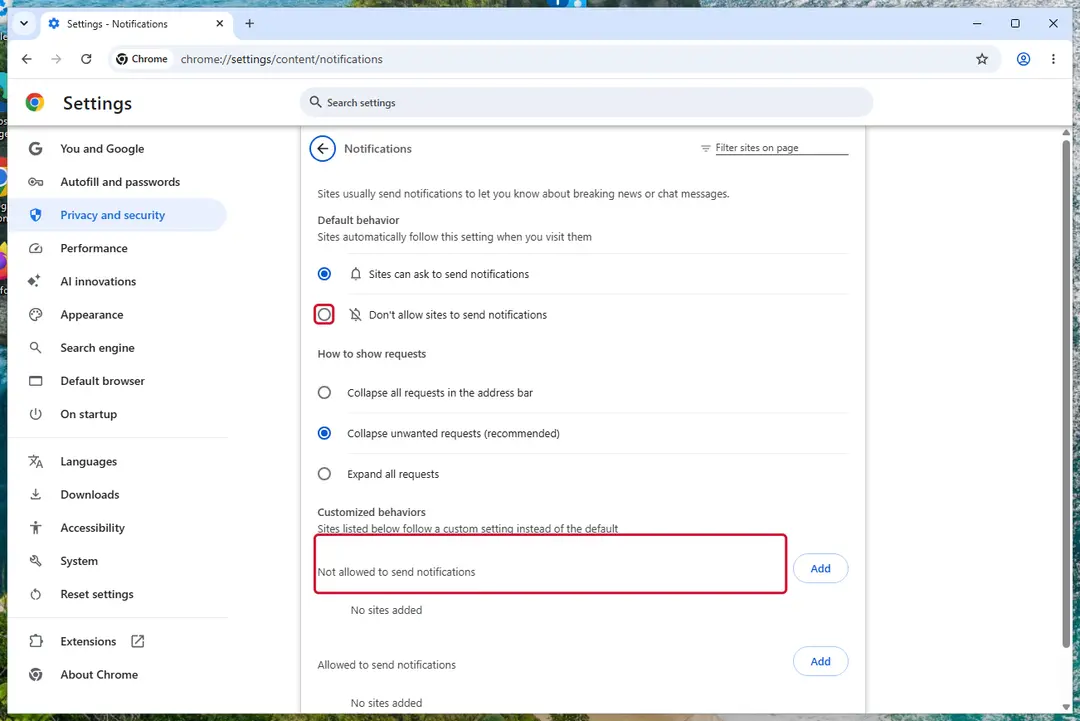
Chrome on Windows 11: Settings > Privacy and security > Site settings > Notifications. Full procedure with screenshots: Stop website notifications and pop-ups
Still there? More for Google Chrome
On an Android phone
In Chrome tap the three dots, then Settings > Site settings > Notifications. Every site listed under Allowed that you do not know gets Reset permissions; or switch Notifications off altogether. Afterwards open Settings > Apps on the phone and uninstall anything you cannot remember adding.
Check the extensions list
Type
chrome://extensionsin the address bar. Any extension you did not add yourself (video downloaders, PDF or "search" helpers that appeared lately) gets Remove.Full procedure with screenshots: Remove a browser extension
Reset Chrome if the redirects go on
Choose Settings > Reset settings > Restore settings to their original defaults > Reset settings. The start page, search engine and pinned tabs return to default and extensions are switched off; bookmarks and saved passwords are kept. To end alerts arriving after the last window is closed, also turn off Settings > System > Continue running background apps when Google Chrome is closed.
Full procedure with screenshots: Reset a browser and fix a hijacked search engine
Step 1: Remove stabilizeconnection.co.in from Edge's notification list
Open Settings and more (the three dots) > Settings > Privacy, search, and services > Site permissions > All permissions > Notifications. Remove
stabilizeconnection.co.infrom the Allowed list, then click Add site next to Not allowed to send notifications and enter it there.Edge is built into both Windows 11 and Windows 10, so check it even if you normally use another browser. If the notifications came with the Edge logo, this is the browser that holds the permission.
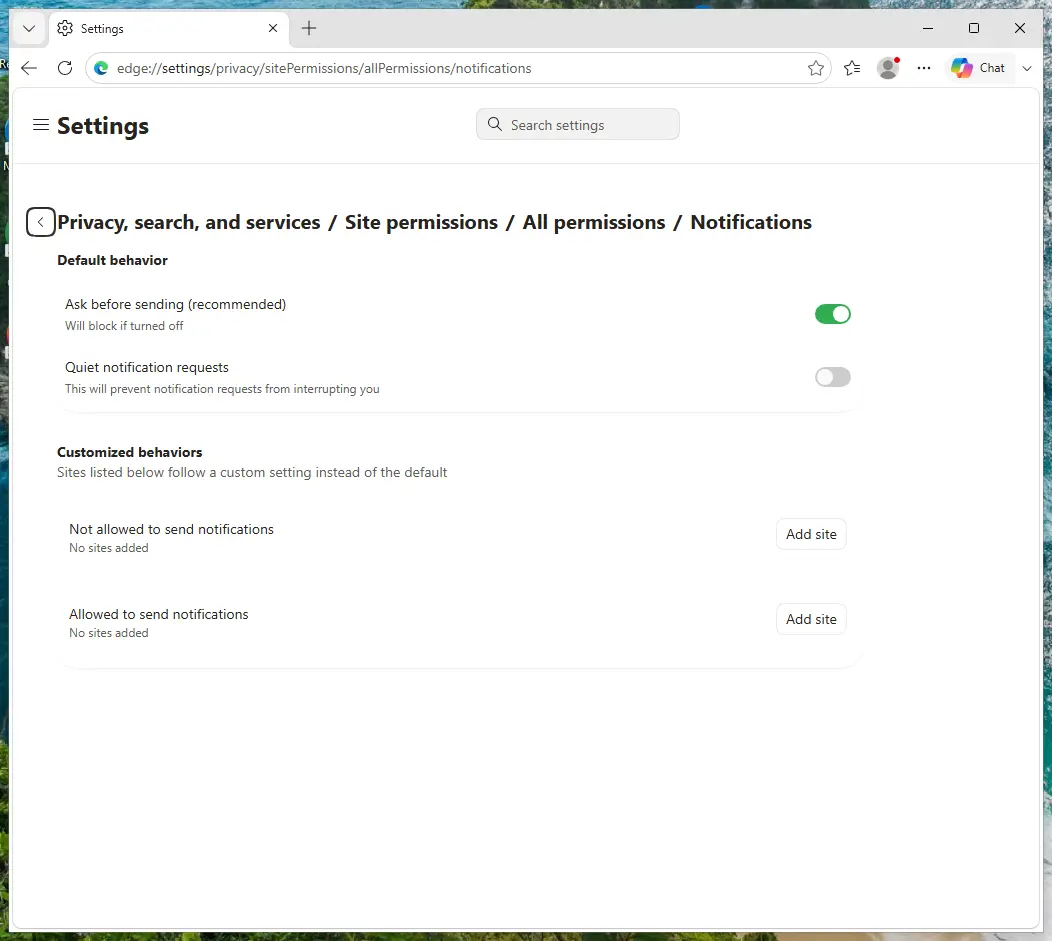
Edge on Windows 11: Site permissions > All permissions > Notifications. Full procedure with screenshots: Stop website notifications and pop-ups
Still there? More for Microsoft Edge
Check the extensions list
Type
edge://extensionsin the address bar and use Remove on any extension that you did not install on purpose.Full procedure with screenshots: Remove a browser extension
Reset Edge if the redirects go on
Go to Settings > Reset settings > Restore settings to their default values > Reset. Extensions are switched off and the start page returns to default; favourites, history and saved passwords are kept. To stop alerts after Edge is closed, turn off Settings > System and performance > Continue running background extensions and apps when Microsoft Edge is closed.
Full procedure with screenshots: Reset a browser and fix a hijacked search engine
Step 1: Remove stabilizeconnection.co.in from Firefox's notification permissions
Open the menu (three lines) > Settings and click Permissions and data in the left list, then Notifications. Select
stabilizeconnection.co.in, click Remove Website and confirm with Save Changes.In versions older than Firefox 152 the same list sits under Privacy & Security, behind a Settings button next to Notifications. Firefox shows these notifications only while it is running, on Windows 11 and Windows 10 alike.
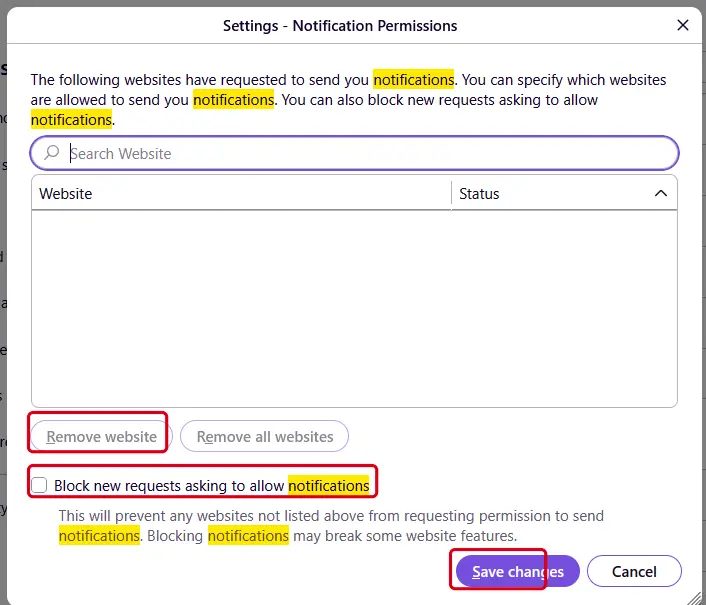
Firefox on Windows 11: the Notification Permissions window. Full procedure with screenshots: Stop website notifications and pop-ups
Still there? More for Mozilla Firefox
Check the add-ons list
Type
about:addonsin the address bar, open Extensions, and from the three-dot menu beside any add-on you did not install yourself pick Remove.Full procedure with screenshots: Remove a browser extension
Clear cookies and site data
In Settings > Privacy & Security > Cookies and Site Data press Clear Data, tick both options and confirm with Clear.
Refresh Firefox if the redirects go on
Open the menu > Help > More troubleshooting information and press Refresh Firefox. Add-ons and custom settings go and the home page returns to default; bookmarks, history and passwords are kept.
Full procedure with screenshots: Reset a browser and fix a hijacked search engine
Take back the notification permission
On macOS with Safari 18 or later, choose Safari > Settings > Websites > Notifications, pick any site you do not recognise, such as
stabilizeconnection.co.in, and set it to Deny or press Remove. Untick Allow websites to ask for permission to send notifications at the foot of the list so that no site can ask again.Check the extensions
In Safari > Settings > Extensions, select anything you did not install yourself and press Uninstall.
Clear the website data
Open Safari > Settings > Privacy > Manage Website Data and remove what the site stored, or use History > Clear History > all history. To empty the cache too, enable Show features for web developers in Settings > Advanced and pick Develop > Empty Caches.
Look for apps that came with the ads
Fake players and "cleaners" are pushed to Mac users as well. In Finder > Applications drag anything unknown to the Bin, and in System Settings > General > Login Items & Extensions switch off unknown items. Then use Go > Go to Folder to inspect
/Library/LaunchAgents,~/Library/LaunchAgents,/Library/LaunchDaemonsand/Library/Application Supportfor entries with the same unknown names, and empty the Bin.
Then, whichever browser you use
Step 2: Scan the PC if you downloaded anything from the ads
If you only saw the notifications and clicked nothing, you can stop before this step. If a notification led you to download or run something, delete that file, then scan Windows.
In Windows Security > Virus & threat protection > Scan options, run a Full scan, then choose Microsoft Defender Antivirus (offline scan) and Scan now. The offline scan restarts the PC and takes about 15 minutes on Windows 11 and Windows 10.

Windows 11: Windows Security > Virus & threat protection > Scan options. Full procedure with screenshots: Run a Microsoft Defender Offline scan
After removal: keep the ads from coming back
If you clicked a download or the redirects keep coming
Pressing Allow alone needs only the browser steps. The three steps below are for the case where you also opened something an advert handed you, or where the detours carry on after the permission is gone.
- 1
Uninstall what you never chose
Open Settings > Apps > Installed apps (Windows 11) or Apps & features (Windows 10), sort by install date, and remove any entry that appeared around the day of the click (Uninstall a program or app in Windows On uGetFix). Do it ahead of any scan: adware that is still installed can fetch more programs.
- 2
Run both Defender scans
First a Microsoft Defender Full scan, then Microsoft Defender Antivirus (offline scan), which restarts the PC and examines it before Windows is fully running, where hidden threats cannot hide as easily (Microsoft Learn). Either scan only helps with programs that were installed; the notification permission lives in the browser and no scan touches it. Mac owners should read through Applications and Login Items, as in the Safari steps.
- 3
Reset the browser, then wipe its site data
Unwanted programs often change the start page, the search engine or the extensions, and the reset step for your browser above puts them back. Separately, the browser's site data (cookies and cached files) holds the trackers that ad networks leave; deleting it is a browser job, and a security scan will not do it for you.
If you typed a password, card number or other personal details into a page that an advert opened, change that password straight away and call your bank about the card.
How to keep it from happening again
Do
- Stop sites from asking: in Chrome, Settings > Privacy and security > Site settings > Notifications > Don't allow sites to send notifications. Allow alerts only from sites you picked on purpose, such as a news outlet you read.
- Download software from its maker or the Microsoft Store, and stay away from cracked-software and file-sharing pages.
- In every installer pick Custom or Advanced, and untick each extra program offered alongside the one you wanted.
- Keep Microsoft Defender and SmartScreen on, or turn on Chrome's Enhanced protection, so that known bad pages and downloads trigger a warning. Windows already carries a security tool; staying safe online does not call for a purchase.
- Keep a current backup of your files, so that a bad download can never cost you them; Windows has File History and OneDrive built in.
- If you want to hide your address from sites and ad networks, a VPN does that; it does not stop a notification prompt.
Don't
- Press Allow because a page says it will prove you are human, let a video play or start a download.
- Tap adverts that offer a prize or a virus warning; the page they open often has nothing to do with the promise.
- Run an
.exe,.msior script that a notification calls an update.
Questions about Stabilizeconnection.co.in
What is Stabilizeconnection.co.in?
Stabilizeconnection.co.in is a web address that asks visitors to press Allow in the browser's notification prompt so that it can send them adverts. Our 2025 report called it a push notification scam site and described pages telling visitors to click Allow to prove they are not a robot, to watch a video or to claim a prize.
It is not software, and loading it installs nothing. When we tried it on 6 October 2026 the name did not resolve, so no page loaded and we could not check the prompt. One visit says nothing certain about what other visitors, or the same site at another time, would see.
Is Stabilizeconnection.co.in a virus?
No, Stabilizeconnection.co.in is not a virus. It is a website, and loading a website does not by itself put a program on your computer. The real danger is the permission it asks for.
After you press Allow, the browser stores a notification permission and the site can send adverts to your screen. Those adverts may carry false virus alerts, bogus giveaways or financial rewards, and the links in them can lead to scam, phishing or malware pages.
Opening a file from one of them is how genuine adware arrives. Our single October 2026 visit loaded nothing, which does not clear the site.
How do I stop Stabilizeconnection.co.in notifications?
Take the permission back inside the browser. In Chrome open Settings > Privacy and security > Site settings > Notifications, find stabilizeconnection.co.in or any other name you do not know under the allowed sites, and block or delete it. Edge has the same list at Settings > Cookies and site permissions > Notifications.
Firefox keeps it at Settings > Privacy & Security > Permissions > Notifications > Settings, where the entry is set to Block and saved. Safari on a Mac uses Safari > Settings > Websites > Notifications, set to Deny. Each browser is walked through in the steps above.
Why am I redirected to Stabilizeconnection.co.in?
Whatever page you were on passed you along, and unwanted software is just one explanation. Our 2025 report says most visitors come from other dubious sites, file-sharing pages and pages crowded with deceptive ads, so the video, download or link page you used may simply have sold your click to an ad network.
When odd detours follow you across unrelated sites, check browser extensions and installed apps and reset the browser. When they come from a single site, leave it and never press Allow. Pirated and cracked software sites raise the odds sharply.
Why do I see these ads when the browser is closed?
Because they are notifications, not page content, they do not depend on any tab. After you press Allow the browser remembers it, and the site can post through the browser's push service whenever it likes.
Chrome and Edge stay alive in the background once you close the last window, unless that option is off, so the adverts keep arriving; Firefox shows them only while it is open. Delete the permission to stop them, and in Chrome or Edge also disable background running after close (see the browser steps).
I pressed Allow on Stabilizeconnection.co.in. What now?
Remove the permission first, then ask whether anything else happened. Open your browser's notification list and block the entry. If Allow was your only click, no program was installed and the browser steps are all you need.
If you went on to open a file from an advert, uninstall unfamiliar programs by install date, run both Microsoft Defender scans and change any password you entered on the page. Tell your bank if you typed card details. While you work, ignore further adverts from the alerts.
Do I need antivirus to remove Stabilizeconnection.co.in?
No, not to end the notifications; the permission is a setting inside the browser and goes when you delete it there. A scan earns its place when the detours continue, when the start page or search engine has been altered, or when you opened a file that an advert supplied.
Windows 11 and 10 already contain Microsoft Defender, which offers a full and an offline scan, and resetting the browser handles changed settings and extensions you did not choose. Nothing on the PC belongs to this address, so no product can be said to remove it. Cookies are deleted through the browser's site data instead.
Can these adverts show up on a phone?
They can, if Chrome on an Android phone was given the permission. Tap the three dots in Chrome, then Settings > Site settings > Notifications. Pick every unfamiliar site under Allowed and reset it, or switch notifications off for all sites.
After that, scan Settings > Apps for anything you do not recall installing, since an advert that offers an app can lead to one. We never tested this address on a phone, and it did not load in our desktop test, so what it shows there is unknown.
How can I avoid sites like Stabilizeconnection.co.in?
Say yes to a notification prompt only for a site whose alerts you actually want, like a news outlet you follow. A real CAPTCHA, age check or video player never needs that permission.
To stop the prompts altogether, open Chrome Settings > Privacy and security > Site settings > Notifications and choose the option that stops sites from asking. These pages mostly turn up through adverts on shady, file-sharing or cracked-software sites, so leaving the tab is the best reply. Download programs from their makers and use Custom setup in installers.
Will Fortect remove Stabilizeconnection.co.in?
No program removes Stabilizeconnection.co.in itself, because there is nothing on the PC to remove: the notifications come through a permission saved in the browser, and only the browser's settings take it away, as the steps above show.
What Fortect can do is check the rest of Windows. Its free scan looks for malware, unwanted programs and damaged system files, which is useful if you clicked the ads, downloaded something from the pages they opened, or are not sure what else changed on the PC.
If the scan finds nothing and the notifications stopped after you removed the permission, this problem is solved. Use Microsoft Defender as a second opinion whenever you have downloaded files from pages like these.
Sources
- Google Chrome Help: Use notifications to get alerts (no longer online) (read October 6, 2026)
- Google Chrome Help: Change site permissions (no longer online) (read October 6, 2026)
- Mozilla Support: Firefox push notifications (read October 6, 2026)
- MDN: Push API (read October 6, 2026)
- Apple Support: Customize website notifications in Safari (read October 6, 2026)
- Microsoft Learn: Microsoft Defender Offline (read October 6, 2026)
- Microsoft: Stay protected with the Windows Security app (read October 6, 2026)
- FTC: How to recognize, remove and avoid malware (read October 6, 2026)
- Registry RDAP lookup: stabilizeconnection.co.in (no record returned) (no longer online) (read October 6, 2026)