
Xresolver, XboX IP Resolver, Xresolver: what it is and how to remove it
Xresolver is a database that links Xbox Live player Gamertags to their IP addresses, enabling DDoS attacks and extortion schemes. You can remove your data manually or use a VPN to prevent future linkage.
Facts checked October 9, 2026. Removal steps tested on Windows 11 (26H2) and checked against Microsoft's and the browser makers' current documentation. Sections marked as our earlier report are the original text: they describe the threat as it was then and have not been reviewed since. The 2026 status, the removal steps and the questions are current.
Automatic
Get a free scan and check if your PC is infected.
Fortect finds malware, unwanted programs and the Windows damage they leave behind, and repairs it in one pass.
An automatic scan checks installed programs, startup items and browser extensions for anything that came with Xresolver, XboX IP Resolver, Xresolver.
Do it yourself · free Remove Xresolver, XboX IP Resolver, Xresolver yourself 5 steps, about 15 minutes, no software needed.
Start the steps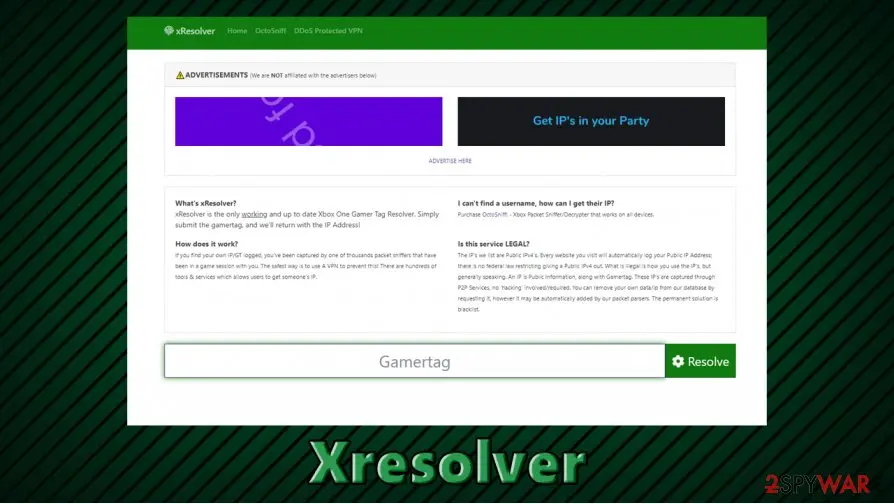
Xresolver, XboX IP Resolver, Xresolver: summary
| Name | Xresolver, XboX IP Resolver, Xresolver |
|---|---|
| Type | Rogue website |
| Activity | Sells "Octo Sniff" packages to players that can detect user IPs based on their Gamertags on Xbox Live. This data is then used by malicious actors to deliver DDoS attacks to drop victims from the game, ruining their experience. As a "resolution," Xresolver offers victims to be removed from the list, gaining more profits in the process |
| Dangers | DDoS attacks, information compromise |
| Resolutions | Use a VPN, such as Private Internet AccessPrivate Internet Access For more, check below |
| Detection names | No Microsoft detection name is known |
| Removal | Scan the PC with security software to find and remove the malware and anything installed with it. Fortect scans Windows for malware and repairs the system files and settings it damaged. Remove it nowTo use the full-featured product, you have to purchase a license for Fortect. The scan is free. |
Show 7 more facts
| Distribution | Not recorded in the old report |
|---|---|
| Damage | Not recorded in the old report |
| Symptoms | An unknown program in Installed apps |
| Evidence | 4 write-ups by security sites; details still limited |
| Program | Xresolver, XboX IP Resolver, Xresolver |
| First seen | 6 October 2020 |
| Facts checked | 5 October 2026 |
Is Xresolver, XboX IP Resolver, Xresolver a real security program?
Xreslover, xresovler, xresover and other spellings of Xresolver
Xreslover, xreaolver, xresolber, xresovler and xresover are misspellings of Xresolver, the Gamertag to IP address lookup site this guide describes.
People type these names when they search for the site after a disconnect or a threat in an Xbox party. Every fact on this page applies to them: the site links Gamertags to IP addresses, and that data can be used for DDoS attacks that drop a player from a game.
Xrrsolver, xredolver and xresoler are also typos of Xresolver. We found no reliable source for a separate service with any of these exact names. Our reading is that they are simple keyboard slips for the same site.
If a page under one of these names asks for money to remove your IP address or to sell a lookup, treat it as Xresolver or a copy of it and do not pay.
You can check any such name yourself before you trust it. Compare the spelling in the address bar letter by letter, because a lookalike address can belong to anyone. Do not sign in with your Microsoft account on such a page.
If you think your IP address was listed, follow the section on removing Xresolver IP tracking above and use a VPN while you play, so your real address is not shown to other players.
From our report of Oct 2026 · outdated details corrected in October 2026
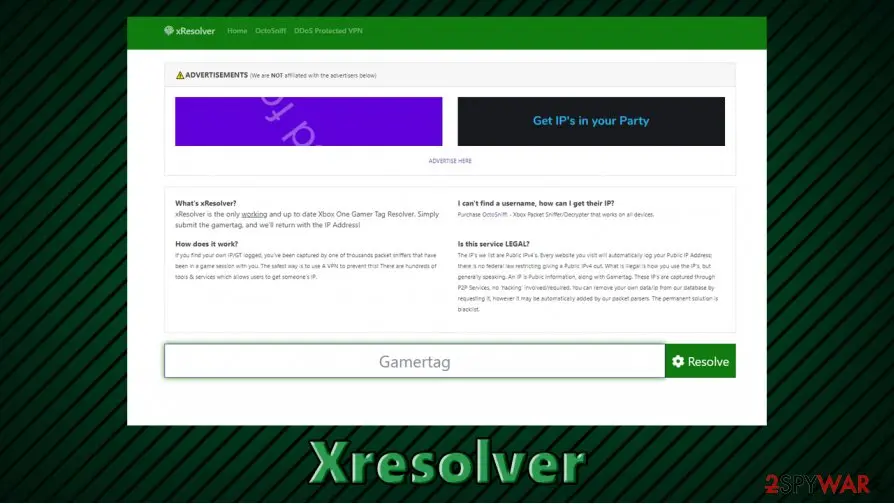
Xresolver - a website that provides Xbox players' IPs based on a Gamertag, that might result in third party illegal activities against them
Xresolver is a website that uses publicly available information to profit from players who use Xbox Live to play games online.
In October 2020, Microsoft forums had been flooded with posts about the website, as it allows almost anybody to access the IP of a player based on his or her Gamertag.
Based on these details, malicious actors can deliver Distributed Denial-of-Service (DDoS) attacks, drop victims from the game, which allows unfair advantage within a particular game. Many users reported that the most affected games are Rainbow Six Siege and Call of Duty Black Ops 4.
And while developers claim that they are doing nothing wrong as they are only providing information that is generally available to everyone, they might get profit from users who are being attacked due to their service.
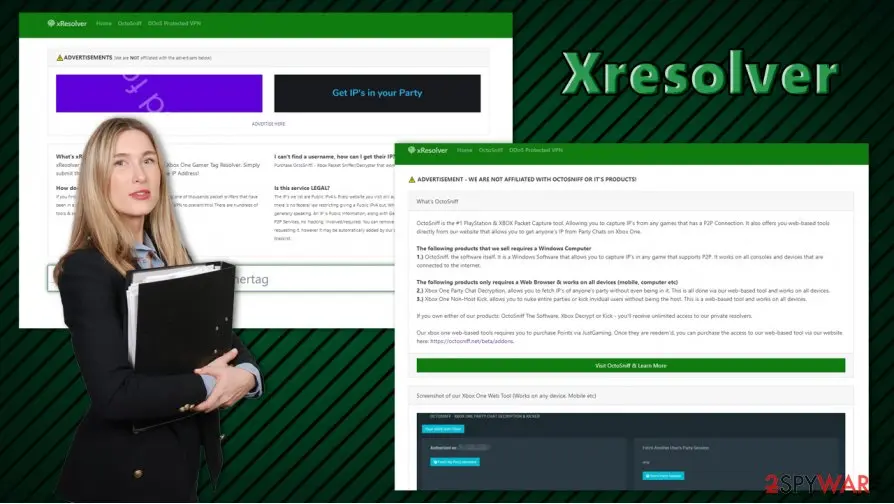
The scheme revolves around Xresolver selling "OctoSniff" packages to gamers and compiling a database of Xbox Live players, which includes the IPs of everyone on it. The site then offers the gamers to purchase a "boot" or "blacklist" from this database, although even after the payment, there is no guarantee that the IP will not be leaked once again.
Despite many complaints from users of ruined gaming experience, there have been no resolutions provided by Microsoft, a developer of Xbox Live. Likewise, the site has created a lot of frustration to users, as they claim they should not be subjected to DDoS attacks in an already paid service.
Fortunately, there are several ways and tips that could help you to resolve Xresolver schemes and prevent the IP leak from happening again. Note, you should not give in to the site and pay them to "blacklist" your IP address. Instead, check the alternative solutions we provide below.
Xresolver is not a unique service, and Xbox Live is also not a single platform that is being abused by malicious actors. While the scheme may seem elaborate, it is relatively simple and is not actually that effective. Nonetheless, for those who are indeed affected, it can create a rather frustrating gaming experience.
Xbox Live had almost 90 million users as of April 2020. While the precise number of the IP database that the site holds is unknown, it is speculated that it should be no more than one million. In other words, the database size depends on how many cheaters are willing to use the tool in order to "sniff out" the IPs of other players.
Therefore, just because you are playing games on Xbox Live, it does not mean that your IP is within the database of Xresolver. To acquire an IP of the player, somebody who has OctoSniff packet installed needs to join the game with him or her.
This way, the IP and the Gamertag are logged directly into the database. This data can later be used by anyone who has access to it to send DDoS attacks and terminate the internet connection of the user, dropping them from the game.
Since this information is pulled directly from the current IP that the target player is connected from, this information can often be mismatched and outdated. Those who use dynamic IPs are not in danger, as frequent changes render this data useless. Nonetheless, there are plenty of users who use a static IP, and it never changes.
While it is true that your IP address is relatively public information (for example, any website you visit can read it), as it is not private, but using this data to negatively impact the user experience of a gaming platform is not legal.
It damages Microsoft's service quality and makes the gaming experience for players a true nightmare. Xresolver simply says that it takes no responsibility for the service it provides, and it is up to gamers to use the data accordingly.
Nonetheless, players are not supposed to be pulled into this circle of IP address and gamer tag combinations that can be used against them. Essentially, Xresolver runs an extortion scheme, saying "pay up of you do not wish to get booted out of the game due to DDoS once again." In the meantime, they are ones selling information to malicious actors.
The website was previously taken down due to suspicious activity. Nonetheless, there are hundreds of similar sites that seek to exploit the internet and gamers' fun for their own financial gain. Luckily, there are several steps you can take to remove Xresolver related issues without paying for the "blacklist" service.
How to remove Xresolver, XboX IP Resolver, Xresolver
Nothing it reports is real.
These steps remove it and undo a payment if you made one.
Step 1: Do not pay, and undo a payment if you made one
Xresolver, XboX IP Resolver, Xresolver reports problems to sell a licence: the "threats" or "errors" it lists are invented or harmless leftovers.
If you already paid, ask your card issuer to dispute the charge and cancel the subscription both in the seller's account and through your bank.
If you called a phone number it showed and let someone connect, treat the PC as remotely accessed and remove the remote tool. Uninstalling it from Windows 11 or Windows 10 does not cancel a subscription by itself.
Full procedure with screenshots: What to do after paying a scammer
Step 2: Uninstall Xresolver, XboX IP Resolver, Xresolver
Open Settings > Apps > Installed apps in Windows 11, or Settings > Apps > Apps & features in Windows 10.
Sort the list by install date and find Xresolver, XboX IP Resolver, Xresolver, then choose Uninstall from the three-dot menu next to it (in Windows 10, click the entry and then Uninstall).
Remove anything else installed on the same day that you do not recognise, because such programs usually arrive together in one installer. If the uninstaller opens a browser page with an offer or a survey, close it: the program is removed either way.
Full procedure with screenshots: Uninstall a program or app in Windows On uGetFix
Step 3: Remove it from startup
Whatever Xresolver, XboX IP Resolver, Xresolver installed usually starts with Windows.
Open Task Manager with Ctrl + Shift + Esc, go to Startup apps in Windows 11 or the Startup tab in Windows 10, and disable what you do not know, starting with entries that have an empty Publisher column.
Open file location on the right-click menu shows the file, which helps you decide and tells you what to delete later. Disabling is safe: if something you need stops working, switch it back on.
Full procedure with screenshots: Stop apps from opening at startup On uGetFix
Step 4: Delete the folders left behind
What the uninstaller leaves behind is usually in the user folders. Open File Explorer, switch on View > Show > Hidden items (in Windows 10 View > Hidden items), and go through
%LocalAppData%,%AppData%, %ProgramData% and the two Program Files folders.Sort by Date modified and delete folders that appeared together with the problem and belong to no program you use. Folders with random names that hold
.exe,.dll, .js or .ps1 files are the strongest sign.Full procedure with screenshots: Remove what malware leaves behind in Windows
Step 5: Scan the PC, then run the offline scan
Open Windows Security > Virus & threat protection > Scan options, run a Full scan and remove everything it finds. Then select Microsoft Defender Antivirus (offline scan) and click Scan now: the PC restarts and scans before Windows loads, which finds files that hide while Windows runs.
Save your work first, because the offline scan takes about 15 minutes. Both scans are built into Windows 11 and Windows 10, and a second scanner from another vendor is a useful extra opinion.

Windows 11: Windows Security > Virus & threat protection > Scan options. Full procedure with screenshots: Run a Microsoft Defender Offline scan
Do not let government spy on you
The government has many issues in regards to tracking users' data and spying on citizens, so you should take this into consideration and learn more about shady information gathering practices.
Avoid any unwanted government tracking or spying by going totally anonymous on the internet.
You can choose a different location when you go online and access any material you want without particular content restrictions. You can easily enjoy internet connection without any risks of being hacked by using VPN.
Control the information that can be accessed by government any other unwanted party and surf online without being spied on. Even if you are not involved in illegal activities or trust your selection of services, platforms, be suspicious for your own security and take precautionary measures by using the VPN service.
Backup files for the later use, in case of the malware attack
Computer users can suffer from data losses due to cyber infections or their own faulty doings.
Ransomware can encrypt and hold files hostage, while unforeseen power cuts might cause a loss of important documents. If you have proper up-to-date backups, you can easily recover after such an incident and get back to work. It is also equally important to update backups on a regular basis so that the newest information remains intact - you can set this process to be performed automatically.
When you have the previous version of every important document or project you can avoid frustration and breakdowns. It comes in handy when malware strikes out of nowhere. Use for the data restoration process.
From our report of Oct 2026 · not reviewed since
Remove Xresolver IP tracking
You should not pay Xresolver for your IP to be blacklisted, which would essentially prevent your Gamertag and IP from being linked together.
However, as soon as you join a game with a stranger, your IP can be linked again (if it is not a static IP).
So, how do you blacklist your IP without paying Xresolver? Luckily, there are few methods that could help you avoid you being booted from the game and getting included in the database in the future.
- Use a VPN. A Virtual Private Network, such as , can establish a connection via a remote server, masking the original IP address with a new one. You can also pick a location and the server that suits you the best, avoiding low connection speeds.
- Contact your ISP to change your IP address. If you are using a static IP, you can change by calling your internet provider. If you are using a dynamic IP, you can attempt to change it by restarting your router several times or accessing the Administrative Console provided by your ISP (you should find it on a sticker on your router - it should be under the "GUI address").
- Avoid joining games with people you don't know.
- Remove suspicious people from your friend list. If one person on your friend list has OctoSniff, he/she can leak your IP address, and everybody's in the party.
- Remove your IP manually via Data Removal Form on Xresolver official website (simply search "Xresolver legal." If you are already listed, this action should remove your data from the database. However, use other tips to prevent being added again in the future.
From our report of Oct 2026 · not reviewed since
Use additional tools for your online protection
DDoS attacks and cheaters are not the only malicious acts you can find during your time on the internet.
Cybercriminals are also looking for ways to steal your personal information and use it for financial gain. In some cases, they can gain direct access to your bank account and empty it completely. Thus, you should ensure that your PC is protected from all types of threats, including malware.
As evident, your number one protection (along with careful online behavior) is security software, such as or . It can prevent trojans, ransomware, rootkits, backdoors, and other high-impact malware from accessing your device and also removing the currently present threats.
Questions about Xresolver, XboX IP Resolver, Xresolver
What is Xresolver?
Xresolver is a website that compiles Xbox Live players' IP addresses based on their Gamertags and sells data-harvesting tools to exploit this information. The site uses a service called OctoSniff, which players can use to detect IP addresses when joining online games.
According to 2020 reports, Xresolver compiled a database of Xbox Live player IPs for resale, enabling malicious actors to conduct DDoS attacks against victims. While the precise database size remains unknown, researchers estimate it contains data on no more than one million players out of Xbox Live's approximately 90 million users.
Can Xresolver harm me?
Yes. If your IP is in Xresolver's database, attackers with the data can launch Denial-of-Service attacks, forcibly disconnecting you from online games and creating an unfair advantage for cheaters. Malicious actors can obtain your Gamertag and IP combination by joining games with players who have OctoSniff installed.
Once linked, this data persists in Xresolver's database even after you change your IP, and attackers can use it to repeatedly target you. The most commonly affected games reported in 2020 were Rainbow Six Siege and Call of Duty Black Ops 4, though the threat extends to all Xbox Live games.
Is my IP address truly safe online?
Your IP address is technically semi-public information visible to websites you visit, but its misuse for attacks is illegal. Using IP data to disrupt gaming services damages service quality and violates laws protecting consumers and platform integrity.
Xresolver operates under the premise that it accepts no responsibility for how others use the data it distributes. However, courts and regulators recognize that selling IP-harvesting tools specifically designed to enable attacks constitutes illegal activity, making Xresolver's extortion scheme—offering to remove your IP for a fee—fundamentally unlawful and predatory.
Should I pay Xresolver to remove my IP?
No. Paying Xresolver is inadvisable and unnecessary. Their removal service does not permanently protect you; the moment you join a new game with someone using OctoSniff, your IP can be re-linked to your Gamertag.
Doing so rewards criminal extortion, encourages further exploitation, and may expose you to financial fraud or identity theft from criminals. Instead, remove your IP manually through Xresolver's legal data removal form by searching 'Xresolver legal,' or take preventive steps outlined below.
How can I remove my IP from Xresolver?
Three legitimate methods exist. First, access Xresolver's official website, search 'Xresolver legal,' and submit a data removal request through their legal form; this action may remove your existing data.
Second, contact your ISP to change your IP address; if you use a static IP, call your provider directly. Third, use a reputable VPN service to mask your real IP with a remote server's address, preventing future IP-address-to-Gamertag linkages. These steps address the root cause without rewarding criminals.
What is Xbox Resolver, and is it different from Xresolver?
Xbox Resolver is a generic term referring to any tool or service that resolves Xbox Live Gamertags to IP addresses, of which Xresolver is the most notorious example. The term encompasses various sites offering similar data-harvesting capabilities.
All such resolvers operate on the same predatory principle: compiling and selling player IP data to enable attacks. While they may have different names or slightly different interfaces, they all pose identical security risks and should be avoided equally. Xresolver remains the most widely documented case due to its scale and persistence.
What are VPNs, and do they really help?
A Virtual Private Network (VPN) routes your internet connection through an encrypted remote server, masking your actual IP address and replacing it with the VPN provider's IP. This prevents Xresolver and other trackers from linking your Gamertag directly to your home network's IP.
A reputable VPN allows you to select server locations, potentially improving connection speeds while maintaining protection. For gaming, choose a VPN with low latency and a server geographically close to you to minimize lag, ensuring both security and playability.
Why do people care about IP addresses in gaming?
Controlling an opponent's IP in online games provides attackers with a cheat mechanism:
- DDoS attacks temporarily disconnect victims from matches
- granting unfair advantage to cheaters
- ransom opportunities for extortionists
This creates an arms race where players feel compelled to either accept defeat from cheaters or pay criminals for protection, degrading the experience for millions of legitimate players. The public outcry against Xresolver stems from the ecosystem it enabled, where cheating became commodified and gaming security was privatized through extortion rather than addressed by platform security.
Will Fortect remove Xresolver, XboX IP Resolver, Xresolver?
Fortect scans Windows for malware and unwanted programs and repairs the system files and settings they change, and its free scan shows what it finds on your PC before you decide anything.
For Xresolver, XboX IP Resolver, Xresolver, follow the plan above as well: the browser steps take back permissions and settings that no scanner treats as a threat, and uninstalling the program that brought it removes the source.
Run Microsoft Defender's full scan and, if anything was found, its offline scan as a second opinion. If the symptoms are gone after the plan and both scans are clean, there is nothing more to do.
Sources
- Imperva: Distributed Denial of Service (DDoS) (read October 5, 2026)
- Microsoft: So I have to pay Xresolver to use my Xbox now? (read October 5, 2026)
- CSO Online: Ransomware explained: How it works and how to remove it (read October 5, 2026)
- FTC: How to recognize, remove and avoid malware (read October 5, 2026)
- Microsoft Learn: Microsoft Defender Offline (read October 5, 2026)