
FuelSync scam? What we found, and what to do on iPhone and Android if you paid
FuelSync is the name of a plug-in gadget sold online as a gas saver, and people search for it because the savings claims look too good and some reviews warn about billing. We found no regulator ruling and no independent test, so the honest answer is: treat the claims as unproven, and if you paid, check your card, unplug the device and ask for your money back.
Facts checked October 12, 2026. Steps checked against Apple's and Google's current documentation and the reports we cite. We have not run the app or the link on a phone ourselves.
Do it yourself · free Remove FuelSync gas saver scam yourself 7 steps, about 21 minutes, no software needed.
Start the steps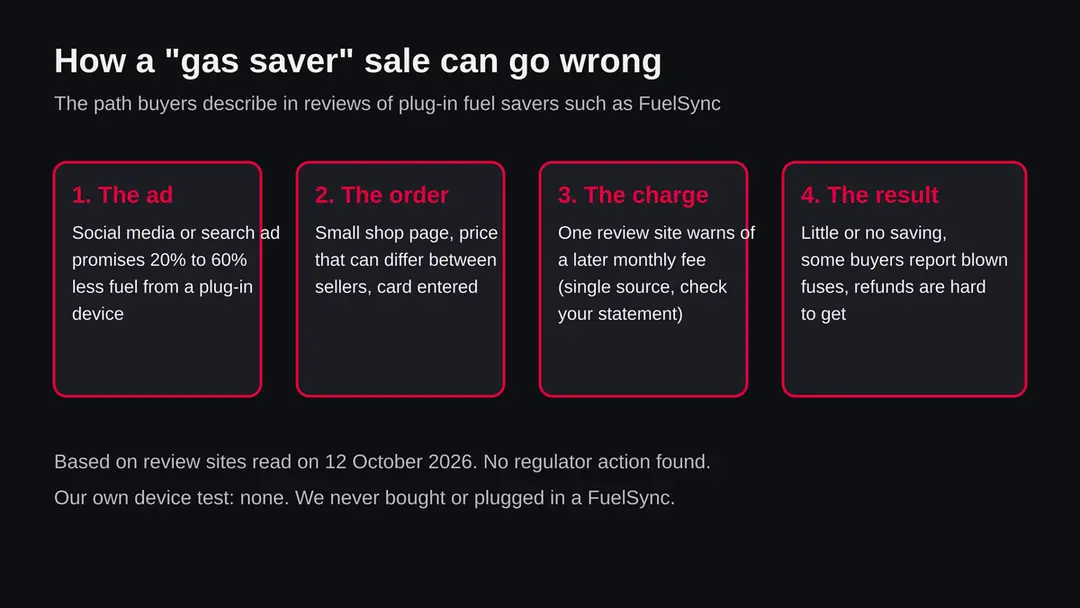
FuelSync gas saver scam: summary
| Name | FuelSync (also written Fuel Sync, FuelSync Gas Saver, FuelSync Pro) |
|---|---|
| Type | Online sale of a plug-in fuel saving gadget; possible billing and refund problems. Not a computer virus |
| Risk | Money lost on a product with unproven claims; one review site warns of a recurring charge; some buyers report blown fuses |
| Symptoms | A charge you did not expect, a device that changes nothing at the pump, a car fuse that blows after plugging it in |
| How to get rid of it | Unplug the device, keep the proof, check your statement, ask the seller and your card issuer for a refund, cancel any subscription |
| Our check (12 October 2026) | Desk research only: five pages and search results. No device bought or tested, no web address tested, no URLhaus entry |
Show 6 more facts
| Microsoft detection | No Microsoft detection name is known (no Trojan:Win32/... entry): this is a product sale, not a program on a computer or phone |
|---|---|
| First seen | Radar of search trends, 11 October 2026; the review pages we found date from 2026 |
| Evidence | 0 write-ups by security sites; details still limited |
| Distribution | Typically fake installers, cracked programs, e-mail attachments, fake "verify you are human" pages and ads for popular apps |
| Damage | Installs other malware, often several programs at once |
| Facts checked | 12 October 2026 |
Facts checked on 12 October 2026 from search results and review pages. We could not open every page in full, so each source below says what we saw. We never bought or plugged in a FuelSync device, and our server made no request because the subject is a name, not a web address.
What FuelSync is
FuelSync is most likely a loader: a program that runs hidden on Windows and works for someone else.
The sign people reported is A FuelSync gas saver purchase in the list of installed apps.
No analysis has been published yet, so its family and payload are not known. The first steps do not depend on it:
- remove what starts it
- scan offline
- secure the accounts
How programs of this kind get in and what they usually bring along: trojans and loaders explained.
Is FuelSync a scam? The short answer
We cannot prove that FuelSync is a scam, and no regulator or court that we could find has said so. We can say that it is sold with savings claims that nobody has tested independently, that review sites warn about it, and that you should treat the purchase as risky until the seller proves otherwise.
FuelSync is, in the sources we read, a plug-in gas saver: a small gadget advertised to cut the fuel a car uses without any change in how you drive.
About 2,400 people a month search for it with a security question, such as whether it is a scam, which is why this page exists. The question is fair, and the answer has three parts: what the reviews report, what they do not prove, and what you can do now.
This page is not about a virus. There is nothing to scan or uninstall. The harm that is discussed in the reviews is financial and electrical: a payment for a product that may do nothing, a possible repeat charge, and fuses that may blow. We write this guide for that reality, and we say plainly where our knowledge stops.
- What it is
- A plug-in gas saver gadget sold online, described in reviews as FuelSync or FuelSync Gas Saver
- The claim
- Fuel savings of roughly 20% to 60%, according to the review sites we read
- Independent test
- None found
- Regulator action
- None found in our sources
- Billing warning
- One blog warns of a hidden $49.99 subscription; single source, unconfirmed
- Not the same as
- A computer virus, a phone app, or the FUEL Points Program crypto site
What FuelSync gas saver scam does on an infected phone
FuelSync: what victims saw
Information on FuelSync is still thin: 0 write-ups by security sites, checked on 12 October 2026.
We explain what that one observation means and what to do about it, without guessing the rest.
- A program called a FuelSync gas saver purchase appeared in Installed apps without anyone installing it.
What a FuelSync gas saver purchase in Installed apps means
A program that appears in Installed apps without your choice, such as a FuelSync gas saver purchase, most often came in through a bundled installer: you installed one free program and the setup added others on pages most people click through.
That does not make it malware, but it does make it something you never agreed to in any meaningful way. How bundling works and why it is legal: potentially unwanted programs.
What we checked for this guide, and what we could not
This guide rests on desk research of 12 October 2026. We did not buy a FuelSync, we did not test one in a car, and our server made no request, because the subject is a name and not a plain web address. There is no site test screenshot, so the three pictures on this page are our own diagrams.
FuelSync · desk research · 12 October 2026
- Savings claimThe sources describe advertised savings of about 20% to 60%. One reviewer calls this far beyond what the hardware could support. We did not measure anything.
- Independent testingWe found no lab test and no test by a regulator. A July 2026 article on FuelSync Pro says plainly that its product claims were not independently tested by the article, the FTC or the EPA.
- BillingOne site, Malware Tips, warns of a hidden $49.99 subscription. It is a single source and we could not confirm the details.
- Reliability of the reviewsMost pages we found are consumer review blogs and affiliate content. The July 2026 FuelSync Pro article is a paid advertorial, so we give it no weight as praise.
- Malware listsThe URLhaus list our server reads holds no entry for this name on 12 October 2026.
- Seller identityWe could not establish who sells the device, where from, or whether the sellers are one company. Registration data was not available for a name.
- Plain request to a web addressNot made. The subject is a name, so there is no address to ask.
Unproven claims and billing warnings, not a confirmed scam Nothing we read proves a crime, and nothing proves that the device works. A quiet record is not a clean record: the absence of a regulator action does not clear a seller.
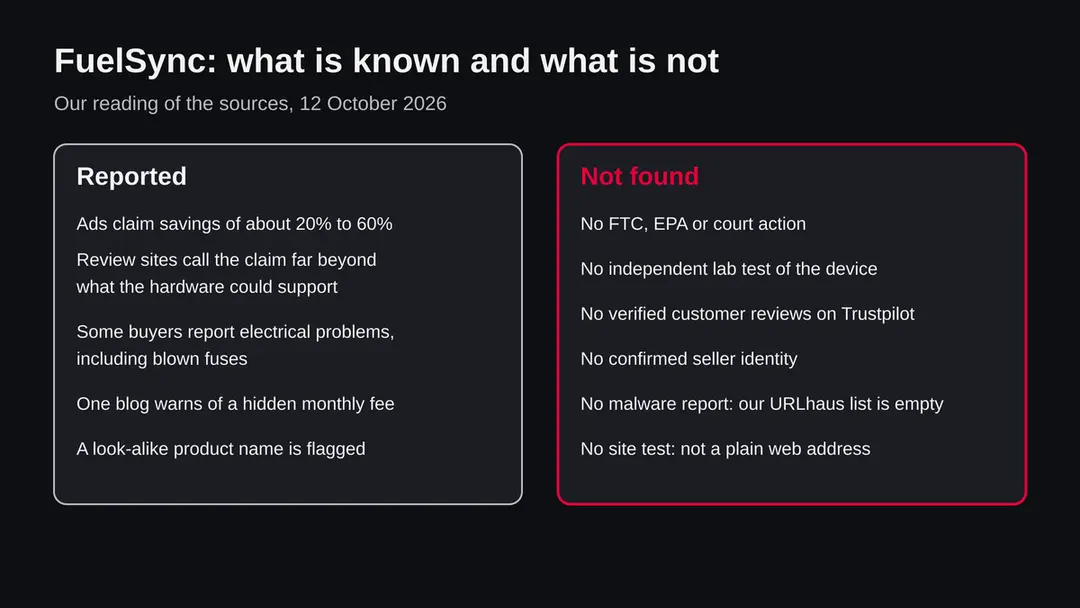
What the reviews report
The reviews fall into four groups: the size of the savings claim, whether the device works, electrical trouble and billing. None of them comes from an independent laboratory.
Malware Tips has published several pieces on the name. One is titled as a review of the plug-in gas saver, setting its claims against what it calls the real truth.
A second warns of a hidden $49.99 subscription, and a third is an investigation asking whether the device is a scam or legit. These are articles from one publisher with an interest in warning readers, so we read them as leads, not as proof.
ShopSavvy publishes a short summary that is more mixed. It says some users found the product works as intended without immediate issues, and its list of drawbacks includes reports from several users of electrical problems, including blown fuses. A summary of user opinions is not a measurement, and we cannot tell how many users it covers.
Last, a July 2026 article on a product named FuelSync Pro looks like a paid advertorial, and it says that the claims belong to the brand and were not independently tested.
The same article warns about a look-alike product with a near identical name that it describes as already flagged as a scam. Names that differ by one word are a common way to confuse buyers and reviewers, so a good review of one name tells you little about the other.
| Source type | What it says | How much weight we give it |
|---|---|---|
| Malware Tips review and warnings | Claims far beyond the hardware; hidden $49.99 subscription; asks whether it is a scam | A lead to check, from one publisher |
| ShopSavvy summary | Works for some users; several report electrical problems and blown fuses | A summary of opinions, not a test |
| July 2026 FuelSync Pro article | Claims not independently tested; look-alike product to avoid | A paid advertorial, so only its own admissions count |
| Trustpilot listings for FuelSync Pro | Score 0, no reviews; describes a fleet monitoring solution | Shows there is no verified customer record |
| Regulators (FTC, EPA) | Nothing found on this name | Not a clearance |
FuelSync, FuelSync Pro and the FUEL Points Program: three different things
The names look alike, but the sources describe three different things: a plug-in gas saver, a fleet monitoring product, and a fake crypto rewards site. Do not assume that a warning about one applies to the others.
| Name | What the sources say it is | What to do |
|---|---|---|
| FuelSync, FuelSync Gas Saver | A plug-in gadget sold with large fuel saving claims | Treat the claims as unproven; follow the steps on this page if you paid |
| FuelSync Pro | A product described on Trustpilot as a smart fuel management and fleet monitoring solution; a July 2026 advertorial exists | Check the seller's name on your receipt; the sources do not say it is the same seller |
| FUEL Points Program (PCrisk) | A fake rewards site linked to the Fuel Network name, a crypto drainer | Never connect a crypto wallet to claim points |
| Free gas card texts | A known scam type with a link and a small fee | Delete the message; do not enter card details |
- 1
Find the exact name on your receipt
Open the order email or the card statement and read the seller's name. Compare it with the name on the product page. If they differ, write both down and send both to your card issuer.
- 2
Search for the seller's contact details
A real seller gives a postal address, a phone number and a return policy. A shop that gives only a contact form leaves you with little to go on.
- 3
Do not follow links in messages
A message that says your fuel order failed, or that offers free gas, may be a different scam that uses the same names. Open your bank's app yourself instead.
A scam text or ad about free gas: the same name, a different trick
If your message offers a free gas card, a fuel rebate or a government fuel relief program, it is a different scam from the FuelSync device, and the facts about it are well documented.
The District of Columbia's insurance and banking regulator, in its consumer alert on free gas card scams, says that fraudsters use texts, emails, calls and pop up ads to send people to fraudulent websites.
A common offer is a $200 gas card for a small shipping fee. The fee is really a charge to your credit card, and the victim later finds hundreds or thousands of dollars of unauthorised purchases, while the card never arrives.
ConsumerAffairs, in a July 2022 report, describes the Fuel Relief Program scam, a message that claims a government program will pay for high gas prices, and notes that the Federal Trade Commission warned that no such program exists.
The Better Business Bureau has also warned of fake gas cards sent by text with a link to a contest. The offers change with the price of fuel, but the shape is the same:
- a prize
- a link
- a request for card details
The rule that follows is simple. A prize you did not enter for costs nothing to receive, so any fee, however small, is the sign of a fraud. Delete the message, and if you paid, treat it as a card compromise and call your issuer.
Do
- Delete the text or email without opening the link.
- Look up a company's or agency's number yourself before calling.
- Report the message to your phone carrier and to the FTC at reportfraud.ftc.gov.
- Call your card issuer at once if you entered card details.
Don't
- Pay a shipping fee for a prize.
- Enter your card number to claim a free gas card.
- Reply to a number that asks for personal details.
- Connect a crypto wallet to claim fuel points.
What FuelSync gas saver scam can steal or download
Before you settle on loader, compare with these look-alikes:
- Unwanted programs (bundler, system optimizer, download manager or utility): Programs that appear without a clear install are usually bundled with free software and are unwanted rather than malicious.
- Pop-ups & adware (ad-supported program): If ads or pop-ups started at the same time, the program is likely ad-supported.
How FuelSync gas saver scam got on your phone
The likely entry point
The distribution of FuelSync has not been documented.
Most loader infections on home PCs, though, start with something the user ran:
- a cracked program
- a fake update
- an installer from a look-alike site
- a command copied from a web page
That file can install FuelSync again, so look in Downloads and Temp for files from the day before A FuelSync gas saver purchase in the list of installed apps started.
Why so many infections begin with a free download: cracked software and what it installs.
How a gas saver sale can cost you money
The money is lost at the checkout, not in the car. A buyer pays for a device on the strength of an ad, and the later problems are the ones a small online shop can cause: a price that differs by seller, a charge that repeats, a refund that never comes.
The pattern is common to many gadget sales. An ad promises a large saving from a small device, with a countdown, a stock warning or a famous brand logo. The order page asks for a card number.
Behind the page may be one company or several that share the same product photos. When the device arrives, it is a plastic part with a plug, and it changes nothing you can see at the pump.
The FuelSync Pro article we read mentions a pricing mismatch between sellers and a seller identity that is hard to establish. We use that as a prompt, not a finding:
- check on your receipt who charged your card
- whether the name on the statement matches the shop you ordered from
- whether the shop gives a postal address and a working contact
Why does an ad like this work? Fuel is a cost people feel every week, and a small gadget with a big promise is easy to try.
The seller also knows that few buyers will measure their fuel use before and after, and that those who do will find it hard to separate the device from weather, speed and tyre pressure. That is why independent testing matters, and why its absence is a warning.
- High
Unproven savings
No independent test found. A claim of 20% to 60% is far above what review sites think a small plug-in device could do.
- Medium
Recurring charge
One blog warns of a $49.99 subscription. Look for a second charge a month after the order.
- Medium
Electrical fault
Reports of blown fuses. A fuse that blows can switch off a socket or other parts of the car's circuit.
- Medium
Hard refunds
A seller that is hard to identify is hard to reach. Your card issuer is then your best route.
- Low
Look-alike names
FuelSync, Fuel Sync, FuelSync Pro and others may be different sellers or products.
How to check the phone for FuelSync gas saver scam
Open Settings > Apps > Installed apps, set Sort by to Install date and find a FuelSync gas saver purchase.
Everything installed in the same few minutes probably came from the same setup.
Then check Task Manager's Startup apps tab and each browser's extensions page for anything new from that day. Keep the list; it is your checklist for the removal steps.
How to remove FuelSync gas saver scam
What you need before you start
Plan for 30 to 60 minutes and an account with administrator rights.
Microsoft Defender is enough for the scans; check in Windows Security that it is on and up to date. Keep a phone or a second computer at hand for reading these steps and for changing passwords later.
Before you change anything, write down what you see:
- A FuelSync gas saver purchase in the list of installed apps
- the detection name
- the date it started
If this is a work or school PC, stop and call your IT team instead.
If you are unsure whether cleaning is enough or a reset would be safer, read clean up or reset Windows after malware first.
What to do about a FuelSync purchase on iPhone and Android
There is no program to remove, because FuelSync is a product sold online.
The work is to stop the device, stop any charges and get your money back, and your phone is the tool for the last two.
Step 1: Unplug the device and keep it
Take the gadget out of the car's socket or port. Keep the box, the device and its packaging, because a seller or a card issuer may ask for them.
Some buyers report blown fuses after plugging in a device like this, so if the car's accessory socket stopped working, look at the fuse list in the owner's manual or ask a garage.
Do not plug the device into another car to see whether it works.
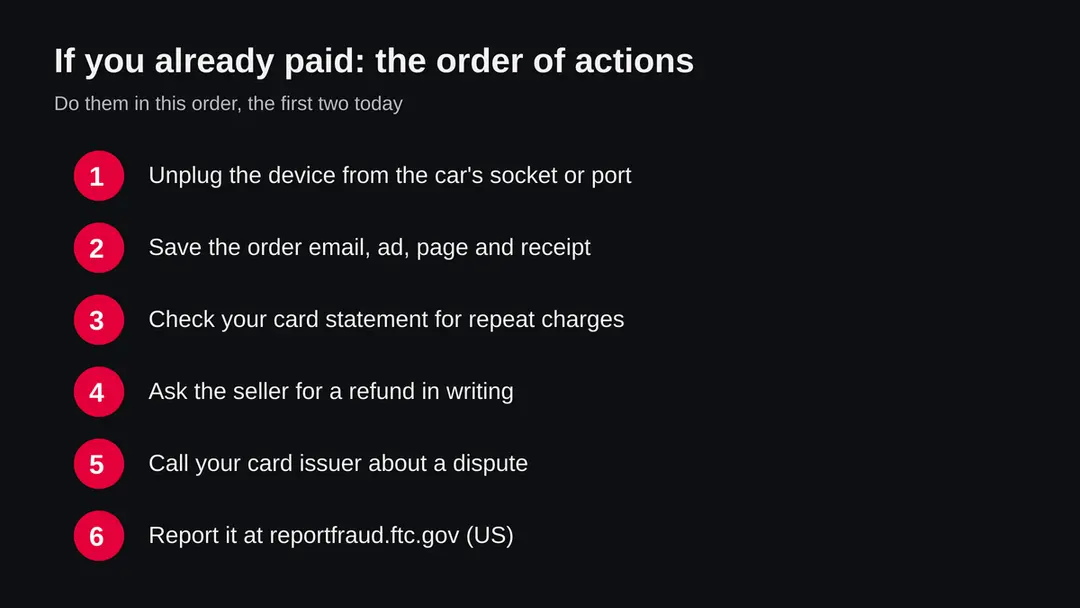
The order of actions after paying for a FuelSync device. Steps 3 to 5 are done on a phone or a card app. Step 2: Save the proof on your phone
Take screenshots of the order email, the ad you clicked, the product page and the receipt, and note the seller's name and the date of the charge. Pages of small shops disappear.
On iPhone, a screenshot is saved in the Photos app. On Android, press the power and volume down buttons together, which works on most phones. Without proof, a dispute is much harder.
Step 3: Look for a subscription on iPhone
If you paid through Apple, open Settings, tap your name, then Subscriptions (iOS 26) and cancel anything you do not know.
A device sold on a web page is usually paid by card, not through Apple, so an empty list does not clear the sale. The real check is your card statement, which your bank's app shows.
Step 4: Look for a subscription on Android
Open Google Play, tap your profile picture, then Payments & subscriptions and Subscriptions and cancel what you do not recognise. As on iPhone, a web sale shows up on the card, not here.
Open your bank's app and look for the seller's name, a small test charge, or a monthly amount after the first order.
Step 5: Ask for a refund in writing, then call your card issuer
Write to the seller by email, quote the order number and ask for a refund and for any recurring charge to be cancelled. Keep the reply.
If there is no answer or the seller refuses, call the number on the back of your card and ask about disputing the charge as a product not as described.
Card issuers set deadlines, so do this soon rather than later. The card issuer decides the outcome, we cannot promise a refund.
Step 6: Report the sale
In the United States you can report a fraud or a misleading sale at reportfraud.ftc.gov, as the consumer pages of the Federal Trade Commission describe.
Elsewhere, use your national consumer agency. A report does not return money by itself, but it adds to the record, and agencies act on patterns.
Step 7: Do not pay a recovery service
After a loss, messages may arrive that promise to recover your money for a fee. Those are a second scam.
A refund comes from the seller, your card issuer or a court, not from a company that contacts you first and asks for money in advance.
The plan in short
- Disconnect the PC from the internet while you work.
- End the program in Task Manager and note its file location.
- Remove its startup entries and scheduled tasks: Stop apps from opening at startup On uGetFix.
- Uninstall programs added on the day the trouble began: Uninstall a program or app in Windows On uGetFix.
- Run a Microsoft Defender offline scan: Run a Microsoft Defender Offline scan.
- Change passwords from another device, e-mail first.
Check again that A FuelSync gas saver purchase in the list of installed apps is gone. If it returns, read when a reset is the better choice.
Clean up after a FuelSync gas saver purchase
Remove a FuelSync gas saver purchase and its companions in one go: sort Installed apps by date and uninstall everything you did not choose (Uninstall a program or app in Windows On uGetFix).
Then disable unfamiliar startup entries (Stop apps from opening at startup On uGetFix), remove unwanted extensions (Remove a browser extension) and run a Defender scan (Run a Microsoft Defender Offline scan) to confirm the carrier left nothing more harmful. Restart at the end and look at the app list once more; nothing you removed should be back.
After removal: passwords, accounts and prevention
Secure your accounts after the clean-up
Assume that whatever was saved in the browsers on this PC while the PC showed A FuelSync gas saver purchase in the list of installed apps has been copied:
- passwords
- cookies
- autofill data
Work from a clean device, or from this PC once the offline scan finds nothing.
Start with your main e-mail account, because it can reset everything else, then banking and payment, then social and gaming accounts. Change each password, sign out of all sessions and turn on two-step verification: Turn on two-step verification / secure a hacked account.
The full order, including crypto wallets and card replacement, is in securing your accounts after malware.
Is a clean-up enough?
For most PCs, yes, provided the offline scan comes back clean and you do not see A FuelSync gas saver purchase in the list of installed apps again within a few days. A reset is the safer choice when an attacker could control the PC, when new detections appear after every scan, or when Windows Security settings keep switching off.
Windows 11 can reinstall itself without a USB stick: Settings > System > Recovery > Reset this PC. Windows 10 has the same option under Update & Security > Recovery.
Our guide to choosing between a clean-up and a reset lists the signs in more detail.
If you already bought a FuelSync: what to check, in order
Stop the device first, then the money. The steps below are the ones in the removal plan above, with the reasons.
Unplug the device because a fuse that blows is the one physical harm reported, and because a seller can ask you to prove the product was faulty. Save the proof because the shop page may vanish, and a dispute needs the ad, the order and the statement.
Check the card because a repeat charge is the one financial harm a blog warned of, and the first repeat usually comes about a month after the order.
Then ask for a refund in writing. A written request does two things: it gives the seller a chance to fix the matter, and it gives your card issuer a record that you tried.
If the seller does not answer within a few days, or answers with a refusal, call your issuer and ask about disputing the charge. Do not wait for the end of a long refund window the seller offers, because issuers set their own time limits.
Day 0
Stop the device and save proof
Unplug the device, save the ad, the page, the order email and the receipt.
Day 0 to 1
Check the charge
Open your bank app and look at the charge: seller name, amount, date. Cancel any subscription you find.
Day 1 to 2
Ask the seller
Email the seller for a refund and for any recurring charge to be stopped. Keep the reply.
Day 3 to 7
Call the card issuer
No answer or a refusal: call the card issuer and ask about a dispute.
About a month later
Check again
Check the statement again for a second charge.
What we do not know
We do not know who sells the device, how many people have bought it, whether it saves any fuel, or whether the billing warning is true. A page that pretended to know these things would be worse than one that says so.
We did not buy a unit, and our check was a reading of five sources, some of them opened only as search excerpts. Where we quote a number, such as the $49.99 figure or the 20% to 60% range, we are quoting the sources, not confirming them.
If you bought a unit and have a receipt, a statement or a photo of the device, those facts are better than anything here, and a card issuer will want them.
We will update this page if a regulator, a laboratory or the seller publishes something we can read. The date at the top of the page is the day we last checked.
Tell the authorities
Police rarely recover money from one report, but reports are how operations against groups like the one behind FuelSync start, and the reference number matters to banks.
Describe A FuelSync gas saver purchase in the list of installed apps and attach screenshots.
US readers use IC3 and ReportFraud.ftc.gov; UK readers Report Fraud or Police Scotland on 101; Canadian readers the CAFC at 1-888-495-8501; Australian readers ReportCyber. Organisations may also have to notify a data protection authority.
For the EU list and evidence checklists, see where to report ransomware, scams and cybercrime.
How to buy fuel saving products safely, and how to save fuel without them
The best ways to save fuel cost nothing: steady speed, correct tyre pressure and less weight. For any gadget, ask for an independent test before you pay.
A claim of savings in a range as wide as 20% to 60% is itself a warning. Honest products give a small figure with the conditions under which it was measured.
Ask who tested it, with which car, and whether the report can be read. If the only evidence is a testimonial, a before and after photo of a dashboard, or an article that is marked as an advertisement, it is not evidence.
Pay by credit card or another method that has a dispute process, and not by bank transfer, gift card or crypto. Read the terms for a trial or a plan that starts after a few days. Use a prepaid or virtual card number if your bank offers one, so that a repeat charge cannot pull more than you set.
Do
- Ask for an independent test report before you buy a fuel saving gadget.
- Pay with a card that has a dispute process.
- Read the terms for trials and monthly plans before you enter the card.
- Check the seller's name, address and return policy on a second site.
Don't
- Trust a savings range such as 20% to 60% from an ad.
- Trust a review that is marked as an advertisement or sponsored.
- Plug an unknown device into the car's socket and leave it.
- Pay a stranger who offers to recover lost money.
Questions about FuelSync gas saver scam
Is FuelSync a scam?
We cannot call it a scam with certainty, and we do not know of any court or regulator that has.
What we found is a plug-in gas saver sold with fuel saving claims of roughly 20% to 60%, review sites that call such claims far beyond what the hardware could support, and one site that warns of a hidden monthly fee.
We found no independent lab test and no regulator action. Treat the claims as unproven and the purchase as risky, and check your card statement if you bought one.
Does the FuelSync gas saver really save fuel?
There is no independent test that we could find showing it does. The claims come from the advertising and from the sellers, and the reviews we read say figures of 20% to 60% are far beyond what a small device could deliver.
A ShopSavvy summary also notes that some users said it works as intended without immediate problems, which tells us about experience, not about measured fuel use. Only a controlled test with the same car, route and fuel could show a saving, and we have not run one.
Is FuelSync dangerous for my car?
The risk reported is electrical, not a virus. A ShopSavvy summary says several users reported electrical problems, including blown fuses. We cannot confirm the cause, and we did not test the device.
If you plugged one in, unplug it, check the fuse for the socket in your owner's manual and tell a garage what you used if anything stopped working. Keep the device, because a seller or an issuer may ask for it, and do not plug it into another vehicle.
Does FuelSync charge a hidden subscription?
One review site, Malware Tips, published a warning headed Hidden $49.99 Subscription. That is a claim from a single blog, and we could not open the full page to check the details, so we treat it as a reason to look at your statement, not as established fact.
If you bought a device from any small web shop, read the order page again, look for a plan or a trial in the terms, and check your card for a second charge a month later.
What is FuelSync Pro, and is it the same product?
Probably not. FuelSync Pro is described on Trustpilot listings as a smart fuel management and fleet monitoring solution, and those listings show a score of 0 and no reviews.
A July 2026 article on FuelSync Pro is a paid advertorial that says the claims were not independently tested and warns about a look-alike product with a near identical name. The names are close enough that buyers can mix them up, so check the seller's name on your receipt.
Is the FUEL Points Program connected to FuelSync?
No connection is known. The PCrisk page on the FUEL Points Program describes a fake rewards site tied to the name of the Fuel Network, a crypto drainer, which is a different kind of fraud from a plug-in device.
We mention it only because the names are close and people search for both. If a site asks you to connect a crypto wallet to claim fuel points, close it and do not sign anything.
I got a text about free gas or a fuel card. Is that FuelSync?
There is no evidence that it is. Free gas card messages are a known scam type.
The District of Columbia's consumer agency says scammers use texts, emails, calls and pop up ads that lead to fake sites, often offering a $200 gas card for a small shipping fee that is really a charge to your credit card, after which the card never arrives.
Do not tap the link, do not enter card details, delete the message and report it.
How do I get my money back after buying FuelSync?
Ask the seller in writing for a refund and for any recurring charge to stop, then contact your card issuer to dispute the charge if the seller does not answer. Keep screenshots of the ad, the product page, the order email and the statement.
Issuers set time limits, so act soon. We cannot promise the outcome, because the issuer decides. In the United States you can also report the sale at reportfraud.ftc.gov.
Can FuelSync steal my data or infect my phone?
We found no report of that. Our URLhaus list holds no entry for the name, and the device is described as plugging into the car, not as an app. The practical data risk is the one from any web purchase: the shop gets your name, address and card number.
If you entered them on a page you now distrust, watch your statement, and ask your bank about replacing the card if you see a charge you do not know.
Sources
- Malware Tips: FuelSync Fuel Saver Device Review (claims versus the real truth); page blocked our fetch, read as a search excerpt (read October 12, 2026)
- ShopSavvy: TLDR Review of FuelSync Gas Saver (user opinions, electrical problems), read as a search excerpt (read October 12, 2026)
- Webull news: FuelSync Pro Reviews and Complaints 2026 (paid advertorial, July 2026), read as a search excerpt (read October 12, 2026)
- District of Columbia Department of Insurance, Securities and Banking: Beware of gas card scams, read as a search excerpt (read October 12, 2026)
- ConsumerAffairs: Consumers need to beware of the Fuel Relief Program scam (July 2022), read as a search excerpt (read October 12, 2026)