
gitview.sbs: a server handing out a PowerShell script, a 7-Zip tool and a locked zip tagged RedHiveStealer, and what to do on Windows
gitview.sbs is a web address that URLhaus lists three times in two days for a PowerShell script on its home page (tagged RedHiveStealer), a 7-Zip tool called 7za.exe and a zip file with a password in its tag. It is not a program on your PC and not a site anyone visits on purpose; a command that is already running on a Windows PC fetches from it.
If you only saw the name in a log or a warning, nothing is proven. If you ran a command or pasted something into PowerShell or the Run box that pointed here, treat the PC as watched: change your passwords from another device, then scan and clean or reset Windows.
Facts checked October 18, 2026. Removal steps tested on Windows 11 (26H2) and checked against Microsoft's and the browser makers' current documentation.
Automatic
Get a free scan and check if your PC is infected.
Fortect finds malware, unwanted programs and the Windows damage they leave behind, and repairs it in one pass.
If a script, command or program that downloads files from gitview.sbs keeps coming back after uninstalling, a scan can find what reinstalls it.
Do it yourself · free Remove gitview.sbs (RedHiveStealer, PowerShell loader) yourself 5 steps, about 15 minutes, no software needed.
Start the steps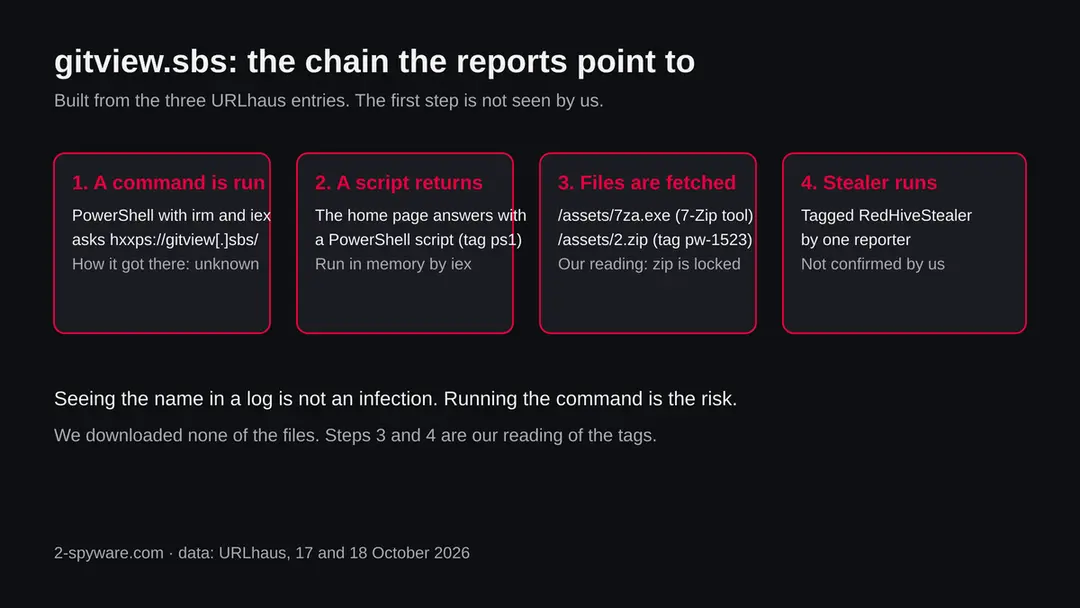
Gitview.sbs (RedHiveStealer, PowerShell loader): summary
| Type | A malware server: URLhaus lists a PowerShell script tagged RedHiveStealer, a 7-Zip tool (7za.exe) and a zip tagged pw-1523 |
|---|---|
| Risk | High if a PowerShell command pointing here was run on your PC: passwords, sessions, wallets and files may be taken. Low if you only saw the name |
| Symptoms | Often none. A suspicious entry in the Run box history, an unknown 7za.exe or zip, or a Defender detection are the signs we can point to |
| How to get rid of it | Change passwords from another device, run Microsoft Defender Offline, check startup entries, and reset Windows if you are not sure |
| Our check (18 October 2026) | One plain request from our server: status 200 from nginx, no redirect. A quiet answer clears nothing; the danger rating comes from URLhaus |
| Running since / first seen | Domain registered 11 September 2026; first URLhaus report 17 October 2026 |
| Removal | Scan the PC with security software to find and remove the malware and anything installed with it. Fortect scans Windows for malware and repairs the system files and settings it damaged. Remove it nowTo use the full-featured product, you have to purchase a license for Fortect. The scan is free. |
Show 9 more facts
| Platform | Windows. Nothing we read says Mac or phones are affected |
|---|---|
| Detection names | No Microsoft detection name is known for the files on this server, because we did not open them |
| Name | Gitview.sbs |
| Domain registered | 11 September 2026 |
| Evidence | 3 write-ups by security sites; details still limited |
| First seen | 17 October 2026 |
| Distribution | Typically fake installers, cracked programs, e-mail attachments, fake "verify you are human" pages and ads for popular apps |
| Damage | Installs other malware, often several programs at once |
| Facts checked | 18 October 2026 |
Facts checked on 18 October 2026 against the URLhaus data for gitview.sbs held in our database (the abuse.ch host page itself was not fetched), RDAP, one plain request from our server, and pages by Microsoft, Arctic Wolf, SOC Prime and the FTC.
The Arctic Wolf and SOC Prime points come from search result summaries, not a full read of each page. We found no public report on the name RedHiveStealer. We did not download the files and we infected no PC; the removal steps follow Microsoft and FTC advice and were not tried on a live infection.
What gitview.sbs is, and what we know about it
gitview.sbs is not a program on your PC. It is a web address that the abuse.ch project URLhaus lists as a place where malware was served. We found no public write-up of this address or of the name RedHiveStealer, so what follows is what URLhaus shows, what our own request showed, and what Microsoft and other security vendors have published about the way such PowerShell chains reach a PC.
- 1
What URLhaus lists
Three addresses on gitview.sbs, all marked online with the threat label malware_download. The home page https://gitview.sbs/ was added on 17 October 2026 at about 16:24 UTC. The file /assets/2.zip was added on 18 October at about 13:04 UTC and /assets/7za.exe one minute later. The home page was reported by one person and the two files by another, so two people saw it independently.
- 2
What the tags mean
The home page carries the tags powershell, ps1, iex-irm, mops_to and RedHiveStealer. powershell and ps1 say that the page answers with a PowerShell script. iex-irm names a common one line pattern: irm (Invoke-RestMethod) downloads text and iex (Invoke-Expression) runs it at once, so nothing is saved as a file first. RedHiveStealer is the name the reporter gave the payload. We do not know what mops_to means. The zip carries zip and pw-1523; the tool carries exe.
- 3
What we could not confirm
We downloaded none of the files and we did not read the script, so we cannot tell you what it does, what RedHiveStealer takes or where it sends data. We found no vendor report for that name. A tag is a reporter's label, not a proof. We also do not know how a victim's PC is made to ask for the home page.
- 4
What this means for you
If you only saw the name in a firewall log, a blocked request or a warning, you are not infected by that alone. The risk is for a Windows PC where someone ran a PowerShell command that pointed to this address. A normal visitor has no reason to request a script, a tool and a zip file from a web server.
- Kind of threat
- A server that serves a PowerShell script (tagged RedHiveStealer), a 7-Zip command line tool and a password locked zip
- Where the files are
- hxxps://gitview[.]sbs/ (script), hxxps://gitview[.]sbs/assets/2[.]zip and hxxps://gitview[.]sbs/assets/7za[.]exe
- Domain registered
- 11 September 2026 through Global Domain Group LLC; status server transfer prohibited and client transfer prohibited (RDAP, read 17 October 2026)
- URLhaus entries
- 3 addresses, added 17 and 18 October 2026; all 3 online when we read our copy of the data
- Delivery trick
- A one line PowerShell command that downloads and runs a script in memory (iex-irm). How the command reaches the victim is not known
- Platform
- Windows. PowerShell, exe and zip tags all point to Windows. Nothing we read says Mac, iPhone or Android are affected
What gitview.sbs (RedHiveStealer, PowerShell loader) does on an infected PC
What we checked on 18 October 2026, and what we could not
Our check was a plain request from our server, not a browser visit, and not a click. It got an answer. That clears nothing: a server that hands out malware often answers visitors differently from the scripts that ask for it.
Our request, 18 October 2026
- The home page answeredThe server replied with status 200 (success) and identified itself as nginx/1.24.0 on Ubuntu. We saw no redirect and no page title. No title is in line with a page that returns a script, not a web page, but we did not read the content, so that is our reading only.
- Why a quiet answer is not a clean resultWe sent one plain request with no browser. Servers like this can answer by country, by program that asks, by a header or by a second visit. Nothing on this one request is not the same as nothing there.
- Notification requestNone mentioned in the answer we got. We ran no browser, so pop-ups, redirects and ad networks were not tested.
- URLhaus listingThree addresses tagged malware_download, one of them with powershell, ps1, iex-irm and RedHiveStealer; all three online when we read the data.
- Downloads and the files themselvesWe did not download the script, 7za.exe or 2.zip. We cannot tell you what they contain.
Dangerous: treat it as a malware server Our test was one plain request, so it proves nothing either way. The danger rating comes from the URLhaus reports and their tags, not from our request. Do not request files from this address and do not run anything that does.
What happened to gitview.sbs, from registration to our check
The domain is about five weeks old and every report is from the last two days. The dates come from RDAP and from the URLhaus data we hold; times are UTC.
11 September 2026
The domain is registered
RDAP shows gitview.sbs created on 11 September 2026 at about 01:01 UTC through Global Domain Group LLC. Transfers are locked on both the registry and the registrar side, which is common and says nothing about intent.
17 October 2026
The home page is reported as a PowerShell script
At about 16:24 UTC the home page is added to URLhaus with the tags iex-irm, mops_to, powershell, ps1 and RedHiveStealer. The reporter's handle is ffforward. The status is online.
18 October 2026
A locked zip and a 7-Zip tool are reported
At about 13:04 UTC /assets/2.zip is added with the tags pw-1523 and zip, and at about 13:05 UTC /assets/7za.exe is added with the tag exe. The reporter is a different one (NDA0E). Both are online.
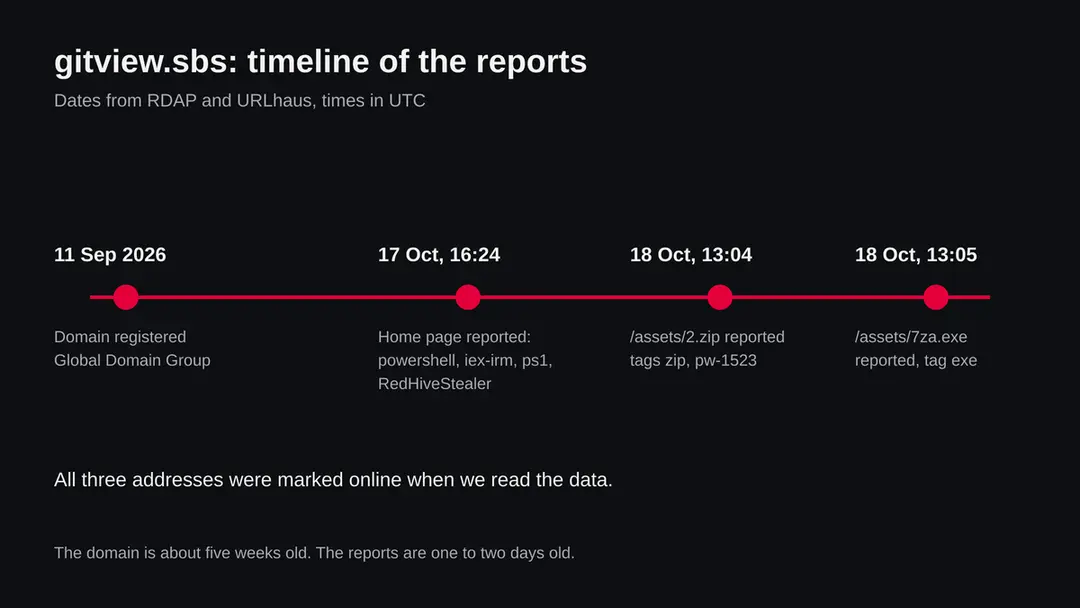
The dates for gitview.sbs from RDAP and URLhaus. The reports are one to two days old. 18 October 2026
Our plain request
The home page answers with status 200 from an nginx server on Ubuntu, with no redirect. All three URLhaus entries are still marked online.
What the pattern suggests, and what it does not: a new domain, a script on the front page and two supporting files on a folder called assets within a day looks like a freshly built distribution point. That is our reading of the dates, not something any report says. The domain name looks like a code hosting site, which may be chosen so that a copied command looks harmless; we have no source that says this is the reason.
How a one line PowerShell command can lead to a stealer
We did not see what gitview.sbs does to a PC. The chain below is how Microsoft, Arctic Wolf and SOC Prime describe campaigns that use the same pieces. Whether this address follows it step by step is not known.
- 1
A person is made to run a command
Microsoft describes the ClickFix trick: a fake verification page copies a command to the clipboard and tells the visitor to open the Windows Run box or a terminal, paste it and press Enter. Because the user runs it, many automatic defences never see an attachment. Lures reach people by phishing email, bad ads and hacked websites. We do not know that gitview.sbs is used this way; it is the best documented route for a command like iex-irm.
- 2
The command downloads a script and runs it in memory
Arctic Wolf describes a ClickFix command that builds the word irm out of pieces, downloads text and passes it to iex, so the content runs without being saved to disk first. The tag iex-irm on the gitview.sbs home page is the same pattern. In memory means a file scan of the disk may find nothing.
- 3
The script fetches tools and a payload
Arctic Wolf describes another ClickFix command that downloads the 7-Zip archive manager together with a password protected archive that holds a remote access trojan. The files on gitview.sbs look similar: 7za.exe is the name of the stand alone command line version of 7-Zip, and the tag pw-1523 suggests the zip is locked with the password 1523. That is our reading of a tag. A locked zip also stops many mail and web filters from looking inside.
- 4
A stealer starts
SOC Prime describes a ClickFix chain where PowerShell pulls shellcode that loads a downloader and injects the StealC information stealer into svchost.exe. We do not know that RedHiveStealer works like this. For any stealer in these chains, the goal is browser data, wallets and accounts, sent to the operator.
- 5
The operator uses what was taken
Microsoft lists infostealers (Lumma Stealer as the most common), remote access tools and loaders among what ClickFix delivers. The same PC may get more than one.
Microsoft says the technique works because the user performs the action, and advises, among other things, teaching people to check what they copy and paste, turning on network and web protection and SmartScreen, and checking the RunMRU registry key for odd entries.
What RedHiveStealer is, and what is not known
We searched for a report on RedHiveStealer and found none. The name comes from one URLhaus tag. Everything below separates what that tag lets us say from what we would only be guessing.
| Question | What we can say | Source |
|---|---|---|
| Is RedHiveStealer a known family? | We found no vendor, MITRE or CERT page under that name on 18 October 2026. It may be new, renamed or a reporter's own label | Our search; URLhaus tag |
| What kind of malware is it? | The word stealer means it is meant to collect data from the PC and send it away. Which data is not known | URLhaus tag |
| How does it reach a PC? | The home page is tagged as a PowerShell script run with iex-irm. How the command reaches the victim is not known | URLhaus tags |
| What do 7za.exe and 2.zip do? | 7za.exe is, by its name, the 7-Zip command line tool; the zip is tagged pw-1523. Our reading is a zip locked with a password. We did not open either | URLhaus tags; our reading |
| Does it stay on the PC? | Not known. Some stealers run once and delete themselves, some stay. A PC can be fully stolen from in a few minutes | Not available |
| Who is behind it? | Not known. Two different reporters saw the server; the registrar is Global Domain Group LLC, which tells us who sold the name, not who uses it | RDAP; URLhaus |
| Which Microsoft detection name? | None known, because we did not open the files | Not available |
What gitview.sbs (RedHiveStealer, PowerShell loader) can steal or download
What a stealer of this kind usually goes after
We do not know what RedHiveStealer takes. The list below is what Microsoft and the vendors name for the stealers and remote tools that ClickFix chains deliver, so treat it as what is possible, not what is proven for this server.
Possible, for stealers in this kind of chain
- Saved browser passwords
- Browser cookies and logged in sessions
- Cryptocurrency wallet data
- Autofill and card details saved in the browser
- Files from the desktop and documents
- Messenger and game account sessions
- Extra malware downloaded later
| Data | Why it matters |
|---|---|
| Passwords and cookies | A stolen session can let someone in without your password. Changing the password and signing out of all devices ends that |
| Crypto wallets | A seed phrase or wallet file that was on the PC should be treated as known. Transfers cannot be reversed |
| Files | Documents, scans of ID and photos that sit on the PC may be copied |
| Extra payloads | Microsoft says ClickFix chains also deliver remote access tools and loaders, so one command may bring more than one thing |
What this can cost you
Reading about the site or seeing its name costs nothing. The risks below apply to a Windows PC where a command that points to gitview.sbs was run.
- High
Passwords and logged in accounts
A stealer takes what the browser stores. Change passwords from another device, because anything typed on the PC after the infection can be seen too.
- High
Crypto and banking
Wallet data is a stated target of stealers. Funds sent out of a wallet cannot be called back.
- Medium
Your files
Documents and photos on the PC may be copied. We cannot say which, because we did not read the script.
- Medium
More malware on the same PC
The chain fetches several files. A PC that ran it may have received more than the stealer.
- Low
Nothing, if you only saw the name
A name in a block list, a log or a warning is not an infection.
What you may notice, and what you may not
Stealers are built to be quiet and to finish quickly. The signs below come from the way the chain works; none is certain, and many victims notice nothing until an account is misused.
| Sign | What it is based on |
|---|---|
| A PowerShell window that flashed open and closed after you pasted something | The chain runs a command and a script. The window may close in seconds |
| A recent entry in the Run box history | Microsoft names the RunMRU registry key as a place where a pasted ClickFix command can leave a trace |
| 7za.exe or an unknown zip in a user or temp folder | The server serves these names. Finding 7za.exe is not proof, as 7-Zip is genuine software, but one you did not install is worth a look |
| Logins from new places or password reset emails | This follows from stolen logins and sessions. It is our reading |
| A Defender detection | Microsoft Defender may block or quarantine the script or the stealer. Look in Protection history |
| Nothing at all | A script that runs in memory and ends leaves little behind |
How to check the PC for gitview.sbs (RedHiveStealer, PowerShell loader)
How a person ends up running a command from gitview.sbs
Nobody visits gitview.sbs on purpose. The request comes from a command, so the real question is how the command got in front of the person. We cannot say for this server. The routes below are the ones that Microsoft and other vendors document for the same kind of command.
- 1
A fake verification page
A page that says you must prove you are human or fix an error, then asks you to press Windows key and R, paste, and press Enter. Microsoft describes fake CAPTCHA and Cloudflare Turnstile style pages. Real checks never ask you to run a command.
- 2
A phishing email or a bad ad
Microsoft names phishing email, malicious ads and compromised websites as the ways people reach these pages. Arctic Wolf also describes a lure that pretends to be GitHub, which fits a domain called gitview, but we have no proof that this is how gitview.sbs is used.
- 3
A guide or a post that tells you to paste a command
A forum answer, a video description or a comment that says to open PowerShell and paste a line starting with irm or iwr. If you do not understand the line, do not run it.
Check your PC before you delete anything
Start with the question that matters: did you, or anyone using this PC, paste or run a command that mentions gitview.sbs, or one that started with irm or iex? If you saw the name in a firewall or DNS log from your own network, the device that asked is the one to check. If the answer is yes or you are not sure, do the checks below. None of them deletes anything.
While you check, stop using the PC for banking, email, work or crypto. Disconnect it from the network if you can.
- 1
Disconnect first
Turn off Wi-Fi or unplug the network cable. A stealer needs the connection to send what it took.
- 2
Find which device asked for the address
If you came here from a log, a router page or an alert, note the device and the time. Only that device is in question, not every device on the network.
- 3
Look at the Run box history
Microsoft names the RunMRU registry key as a place to look for suspicious pasted commands. Open Registry Editor and go to HKEY_CURRENT_USER\Software\Microsoft\Windows\CurrentVersion\Explorer\RunMRU. Entries that start with powershell, irm, iex or mshta, or that mention gitview.sbs, are a strong sign. Do not edit anything here yet; write down what you see.
- 4
Open Protection history
In Windows Security > Virus & threat protection > Protection history, look for anything blocked or quarantined around the time of the first contact, especially a script or a trojan name.
- 5
Look for files you did not make
Search File Explorer for 7za.exe and for zip files with names like 2.zip in Downloads, Temp and your user folder. A 7za.exe that you did not put there is worth noting. Do not open or run any zip you find.
- 6
Look at Startup apps and Task Scheduler
Open Settings > Apps > Startup and switch off entries you do not recognise. In Task Scheduler Library, look for tasks with random names that run a script. Many stealers run once and leave nothing, so a clean list does not clear the PC.
- 7
Check your accounts from another device
Look at the sign in activity of your email, bank and exchange accounts and at crypto balances. This is quicker than any file check, and it is the part that tells you if data was used.
- 8
A scan helps, but it does not clear the PC
A scan with Microsoft Defender or another product can find known files. Treat a clean result like a clean site test: one data point. We did not infect a PC with these files, so the order of this plan is our judgement from Microsoft's and the FTC's pages, not a tested result.
How to remove gitview.sbs (RedHiveStealer, PowerShell loader)
How to remove gitview.sbs
A loader's job is to install other malware, so treat the PC as infected with more than one program until the scans are clean.
Step 1: Delete scheduled tasks that bring it back
Open Task Scheduler from the Start menu and click Task Scheduler Library. Select each task you do not recognise and read the Actions tab:
- a task that starts a file in
%AppData%or%Temp% - runs
powershellwith a long encoded line - opens a web address belongs to gitview.sbs or a similar program
Right-click such a task and choose Delete, and check the subfolders too. Leave tasks from Microsoft, your PC's maker and programs you use. Task Scheduler is the same in Windows 11 and Windows 10.

Windows 11: Task Scheduler Library, the task selected, the Actions tab shows the file it runs. Full procedure with screenshots: Remove what malware leaves behind in Windows
- a task that starts a file in
Step 2: Remove it from startup
Whatever gitview.sbs installed usually starts with Windows. Open Task Manager with Ctrl + Shift + Esc, go to Startup apps in Windows 11 or the Startup tab in Windows 10, and disable what you do not know, starting with entries that have an empty Publisher column.
Open file location on the right-click menu shows the file, which helps you decide and tells you what to delete later. Disabling is safe: if something you need stops working, switch it back on.
Full procedure with screenshots: Stop apps from opening at startup On uGetFix
Step 3: Delete the folders left behind
What the uninstaller leaves behind is usually in the user folders. Open File Explorer, switch on View > Show > Hidden items (in Windows 10 View > Hidden items), and go through
%LocalAppData%,%AppData%, %ProgramData% and the two Program Files folders.Sort by Date modified and delete folders that appeared together with the problem and belong to no program you use. Folders with random names that hold
.exe,.dll, .js or .ps1 files are the strongest sign.Full procedure with screenshots: Remove what malware leaves behind in Windows
Step 4: Scan the PC, then run the offline scan
Open Windows Security > Virus & threat protection > Scan options, run a Full scan and remove everything it finds. Then select Microsoft Defender Antivirus (offline scan) and click Scan now: the PC restarts and scans before Windows loads, which finds files that hide while Windows runs.
Save your work first, because the offline scan takes about 15 minutes. Both scans are built into Windows 11 and Windows 10, and a second scanner from another vendor is a useful extra opinion.

Windows 11: Windows Security > Virus & threat protection > Scan options. Full procedure with screenshots: Run a Microsoft Defender Offline scan
Step 5: Change passwords from another device and sign out other sessions
Assume that the passwords saved in this PC's browsers, and the accounts that were open in them, are known to the attacker. From a phone or a clean computer, change the e-mail password first, then banking, shopping, social and gaming accounts.
Use each service's option to sign out of all other sessions, because stolen cookies keep a session open even after a password change. Turn on two-step verification on each account. Wait with the infected Windows 11 or Windows 10 PC until the scans are clean.
Full procedure with screenshots: Turn on two-step verification / secure a hacked account
If you use a Mac, an iPhone or an Android phone
The tags describe a Windows threat: a PowerShell script, an exe and a zip. We found nothing that says gitview.sbs affects anything else.
| Your device | What we know | What to do |
|---|---|---|
| Mac | PowerShell with iex-irm and a Windows exe are Windows tools. Microsoft notes one ClickFix campaign showed Windows instructions to Mac users and delivered the Atomic macOS Stealer, but that is a different case and we have no link to gitview.sbs | Nothing to remove for this threat if you did not paste a command. Do not follow the Windows steps on a Mac |
| iPhone or iPad | No source ties this address to iOS | Nothing to remove. If you typed passwords on a page, change them |
| Android | No source mentions it | Nothing to remove for this threat; change passwords if you entered any |
After removal: passwords, accounts and prevention
After a clean PC: protect what was taken
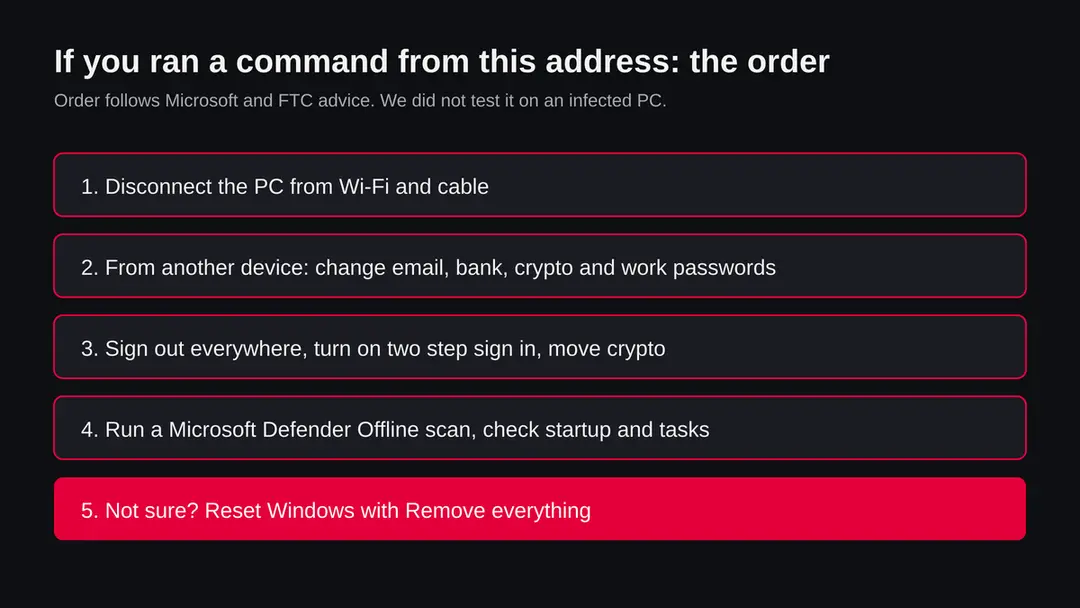
The PC is one half. The other half is everything you typed or stored on it before the stealer ran. The order matters: another device first, then the PC.
- 1
Change passwords from a clean device
Start with email, because it resets everything else, then bank, work, cloud storage and crypto exchanges. Do not use the PC you suspect. The FTC advises a unique password of about 12 to 15 characters or a passphrase.
- 2
Sign out of all devices and turn on two step sign in
The FTC says to sign out of the account on all devices, which removes a stolen session, and to turn on two factor authentication if it is offered. Check that the recovery email and phone number are yours, and look for auto forwarding rules in your email that you did not create.
- 3
Move crypto first if a wallet was on the PC
If a seed phrase or wallet file was ever on the PC, assume it is known. Create a new wallet and recovery phrase on a clean device and move the funds there.
- 4
Run a Microsoft Defender Offline scan
In Windows Security > Virus & threat protection > Scan options, choose Microsoft Defender Offline scan and select Scan now. Save your work first: Windows restarts for the scan. It runs outside the normal Windows, so malware has a harder time hiding. We did not read Microsoft's page for this step in this run, so check the wording on your own PC.
- 5
Remove what the check found, with care
If Startup apps or Task Scheduler showed an entry that you can tie to the incident, remove it. If you cannot tell, do not guess: the safe answer is the reset below.
- 6
If you are not sure, reset Windows
Go to Settings > System > Recovery > Reset this PC. Keep my files removes apps and settings but keeps personal files; Remove everything wipes the PC. For a PC where a stranger's script ran, the full wipe is the answer that does not depend on finding every piece. Back up first.
- 7
Restore only documents by hand
Copy back documents and photos, not programs, and not a full system image from after the first contact. Install apps from their makers' own sites.
- 8
Rebuild logins in a password manager
Do not let the browser save passwords again on a PC that was affected. Use a password manager and an authenticator app or security key for two step sign in.
- 9
Watch your money and your accounts
Check card statements and exchange logs for a few weeks and turn on alerts. The FTC says to report exposed personal information at IdentityTheft.gov, which gives a personal recovery plan.
If you own a site and think someone placed these files
gitview.sbs is a new domain with a name that looks like a code viewer, so it is more likely built for this than hacked. We cannot rule out either. If your own site shows up in a report like this one, the steps are different.
- 1
Do not just delete the file
Copy the logs first. Note when the file appeared and which account or plugin wrote it.
- 2
Close the way in
Change the hosting, admin, database and FTP passwords from a clean device, update the site software and plugins, and remove accounts you do not know.
- 3
Ask for a review
When the site is clean, ask the list that reported you to recheck. Search engines and URLhaus users react to the site's status, so a site that stays clean drops off over time.
Keep a PC out of this kind of chain
The chain starts with a person running a command. Most of the defence is a habit.
Do
- Treat any page that tells you to press Windows key and R, or to paste a command to prove you are human, as an attack, and close it.
- Keep Windows and Microsoft Defender updated, with cloud delivered protection on.
- Read a command before you run it; if you cannot, do not run it.
- Get programs from their makers' own sites or from the Microsoft Store.
- Use a password manager and two step sign in, so one stolen password is not enough.
- If you manage PCs, follow Microsoft's list: SmartScreen, network protection, script block logging and attack surface reduction rules.
Don't
- Do not paste anything from a web page into the Run box, a terminal or PowerShell.
- Do not open a password protected zip that came from a page or an unknown sender.
- Do not trust a name like git or view in a web address to mean it is a code hosting site.
- Do not change your passwords on the PC you suspect.
- Do not rely on a quiet scan to say that you are safe.
Questions about gitview.sbs (RedHiveStealer, PowerShell loader)
What is gitview.sbs?
It is a web address that URLhaus, the malware tracking project run by abuse.ch, lists three times on 17 and 18 October 2026. The home page is tagged as a PowerShell script with the name RedHiveStealer, and two files, 7za.exe and 2.zip, sit in a folder called assets.
It is not a program on your PC and not a website anyone is meant to visit. We did not download the files, so what they contain is not confirmed by us.
Is gitview.sbs safe to open?
No. Do not request files from it and do not run anything that does. Our plain request from our server got a normal answer with status 200, which proves nothing: servers that hand out malware often answer scripts and browsers differently.
The rating comes from the URLhaus reports and their tags, three addresses all marked online when we read the data.
Is gitview.sbs a virus or a scam?
It is a malware distribution address according to the URLhaus reports, not a virus you have on your PC. The danger is a command that runs a script from it.
We cannot say what the script does because we did not read it, and we found no vendor report on RedHiveStealer. Treat it as dangerous: if a command pointing here ran on your PC, assume your passwords and sessions are exposed.
What is RedHiveStealer?
It is the name a URLhaus reporter attached to the home page of gitview.sbs. We searched for a vendor or researcher report under that name and found none on 18 October 2026, so we cannot tell you what it takes or how it hides.
A stealer in general collects data such as browser passwords, sessions and wallets and sends it to its operator. Treat it as that until a source says more.
What do iex and irm mean in a PowerShell command?
irm is short for Invoke-RestMethod, which downloads text from a web address. iex is short for Invoke-Expression, which runs text as a command.
Joined, the pair downloads a script and runs it at once without saving a file, which Arctic Wolf describes in ClickFix commands. It is a normal tool that attackers abuse. If you do not understand a line that contains them, do not run it.
I saw gitview.sbs in my firewall or DNS log. Am I infected?
Not necessarily, and the name alone proves nothing. It does mean a device on your network asked for it, and a person does not usually do that by hand. Find which device it was, disconnect it, and run the checks on this page:
- Run box history
- Protection history
- odd files
- Startup apps
- a Microsoft Defender Offline scan
Do the account changes from another device.
How do I remove it from Windows?
Change your passwords from another device first. Then run a Microsoft Defender Offline scan under Windows Security, Virus and threat protection, Scan options, and check the Run box history, Startup apps and Task Scheduler for entries you did not make.
If you are not sure, reset Windows with Remove everything and restore only documents. We followed Microsoft and FTC pages for this and did not test the steps on an infected PC.
What can a stealer take from my PC?
Stealers in ClickFix chains go after saved browser passwords, cookies and logged in sessions, cryptocurrency wallet data and files, according to the vendors we read. We do not know what RedHiveStealer takes in particular.
Treat every password, session and wallet on the PC as known, change them from another device, and turn on two step sign in so a password alone is not enough.
Does gitview.sbs affect Mac, iPhone or Android?
We found nothing that says so. PowerShell scripts and exe files are Windows tools. On a Mac, iPhone or Android phone there is nothing to remove for this threat.
If you typed a password on a suspicious page, change it. Microsoft notes that a ClickFix page can show Windows steps to a Mac user, but that does not tie this address to Mac malware.
Will Fortect remove gitview.sbs?
Fortect scans Windows for malware and unwanted programs and repairs the system files and settings they change, and its free scan shows what it finds on your PC before you decide anything.
For gitview.sbs, follow the plan above as well: the browser steps take back permissions and settings that no scanner treats as a threat, and uninstalling the program that brought it removes the source.
Run Microsoft Defender's full scan and, if anything was found, its offline scan as a second opinion. If the symptoms are gone after the plan and both scans are clean, there is nothing more to do.
Sources
- Microsoft Security Blog: Think before you ClickFix, analyzing the ClickFix social engineering technique (21 August 2025) (read October 18, 2026)
- Arctic Wolf: ClickFix campaign exploits PowerShell loader with identifier obfuscation (read October 18, 2026)
- SOC Prime: How ClickFix Opens the Door to Stealthy StealC Information Stealer (read October 18, 2026)
- Microsoft Support: Stay protected with Windows Security (read October 18, 2026)
- FTC: Email or social media hacked? Here's what to do (read October 18, 2026)