
GoUnzip Toolbar: what it is and how to remove it
GoUnzip is another creation from famous toolbar creator. This toolbar family seems to have never-ending resources for the creation of useless toolbars.
Facts checked October 7, 2026. Removal steps tested on Windows 11 (26H2) and checked against Microsoft's and the browser makers' current documentation. Sections marked as our earlier report are the original text: they describe the threat as it was then and have not been reviewed since. The 2026 status, the removal steps and the questions are current.
Automatic
Get a free scan and check if your PC is infected.
Fortect finds malware, unwanted programs and the Windows damage they leave behind, and repairs it in one pass.
If GoUnzip Toolbar keeps coming back after uninstalling, a scan can find what reinstalls it.
Do it yourself · free Remove GoUnzip Toolbar yourself 4 steps, about 12 minutes, no software needed.
Start the steps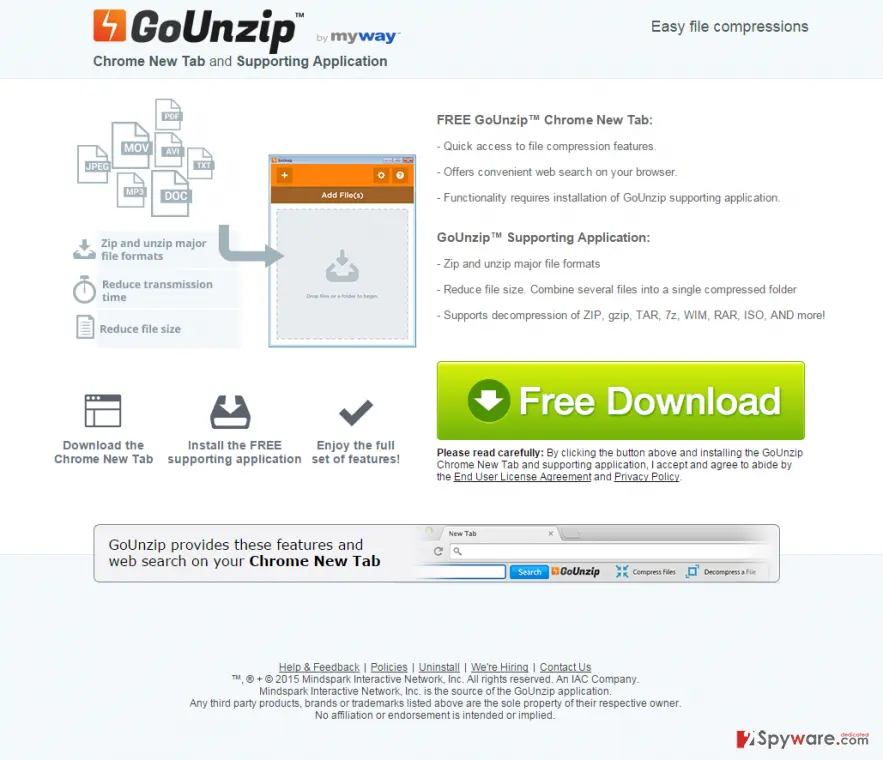
GoUnzip Toolbar: summary
| Detection names | No Microsoft detection name is known |
|---|---|
| Distribution | Not recorded in the old report |
| Damage | Not recorded in the old report |
| Name | GoUnzip Toolbar |
| Type | System optimizer |
| Symptoms | An unknown program in Installed apps |
| Removal | Scan the PC with security software to find and remove the malware and anything installed with it. Fortect scans Windows for malware and repairs the system files and settings it damaged. Remove it nowTo use the full-featured product, you have to purchase a license for Fortect. The scan is free. |
Show 4 more facts
| Evidence | One write-up by a security site; details still limited |
|---|---|
| Program | GoUnzip Toolbar |
| First seen | 8 July 2015 |
| Facts checked | 7 October 2026 |
Is GoUnzip Toolbar safe? Why it is flagged
From our report of Jul 2015 · not reviewed since
What is GoUnzip Toolbar?
GoUnzip is another creation from famous toolbar creator.
This toolbar family seems to have never-ending resources for the creation of useless toolbars. GoUnzip is another one and its principle of operation is identical to MetroHotspot Toolbar, CoolPopularGames Toolbar, and FreeLocalWeather Toolbar or probably any other toolbar this developer is about to devise.
As any other toolbar from this developer, it is also classified as a potentially unwanted program (PUP). In this instance, GoUnzip toolbar is supposedly created to help users with the extraction of files in a quick and simple way. However, it does no such thing.
Moreover, it changes your homepage to home.tb.ask.com and set the default search engine to search.tb.ask.com on the most popular browsers like Internet Explorer, Mozilla Firefox, and Google Chrome. Secondly, its main purpose is to generate income for its creators since they receive revenue any time you click on a sponsored link.
This is another problem with this toolbar. While Ask.com is a legitimate search engine, if set by any of the developers toolbars, it might display search results featuring various sponsored ads.
Clicking on these ads might result in you ending up on some bogus website with suspicious content which might jeopardize your data and system security. What is more, GoUnzip Toolbar collects your browsing-related information like search queries or data about websites you are visiting which might be shared with third parties.

From our report of Jul 2015 · not reviewed since
How can GoUnzip Toolbar affect my computer?
While you can actually find a legitimate website called gounzip.com, where you can download the application and read about its policy, we highly doubt that there are many users who got this application from the website.
A more believable scenario involves a user downloading this program with some free software and installing it unintentionally. This deceptive technique is called bundling and as most of the potentially unwanted programs like adwares and browser hijackers, GoUnzip might be installed through a pay-per-install bundle.
In order to avoid stealth installation of third party programs, you should always be attentive when installing free software. Always check 'Advanced' and 'Custom' options. This is the place where most of the unwanted programs are usually hidden.
If you find any program that seem unfamiliar or suspicious, deselect it. Also avoid installing programs through some installers and download managers which are usually used to distribute bundled software.
These mentions fully fulfill each of the requirements of FTC.
How to uninstall GoUnzip Toolbar
How to remove GoUnzip Toolbar
Uninstall it, then remove what keeps it starting with Windows.
Nothing it flagged needs fixing.
Step 1: Uninstall GoUnzip Toolbar
Open Settings > Apps > Installed apps in Windows 11, or Settings > Apps > Apps & features in Windows 10. Sort the list by install date and find GoUnzip Toolbar, then choose Uninstall from the three-dot menu next to it (in Windows 10, click the entry and then Uninstall).
Remove anything else installed on the same day that you do not recognise, because such programs usually arrive together in one installer. If the uninstaller opens a browser page with an offer or a survey, close it: the program is removed either way.
Full procedure with screenshots: Uninstall a program or app in Windows On uGetFix
Step 2: Remove it from startup
Whatever GoUnzip Toolbar installed usually starts with Windows. Open Task Manager with Ctrl + Shift + Esc, go to Startup apps in Windows 11 or the Startup tab in Windows 10, and disable what you do not know, starting with entries that have an empty Publisher column.
Open file location on the right-click menu shows the file, which helps you decide and tells you what to delete later. Disabling is safe: if something you need stops working, switch it back on.
Full procedure with screenshots: Stop apps from opening at startup On uGetFix
Step 3: Delete the folders left behind
What the uninstaller leaves behind is usually in the user folders. Open File Explorer, switch on View > Show > Hidden items (in Windows 10 View > Hidden items), and go through
%LocalAppData%,%AppData%, %ProgramData% and the two Program Files folders.Sort by Date modified and delete folders that appeared together with the problem and belong to no program you use. Folders with random names that hold
.exe,.dll, .js or .ps1 files are the strongest sign.Full procedure with screenshots: Remove what malware leaves behind in Windows
Step 4: Scan the PC, then run the offline scan
Open Windows Security > Virus & threat protection > Scan options, run a Full scan and remove everything it finds. Then select Microsoft Defender Antivirus (offline scan) and click Scan now: the PC restarts and scans before Windows loads, which finds files that hide while Windows runs.
Save your work first, because the offline scan takes about 15 minutes. Both scans are built into Windows 11 and Windows 10, and a second scanner from another vendor is a useful extra opinion.
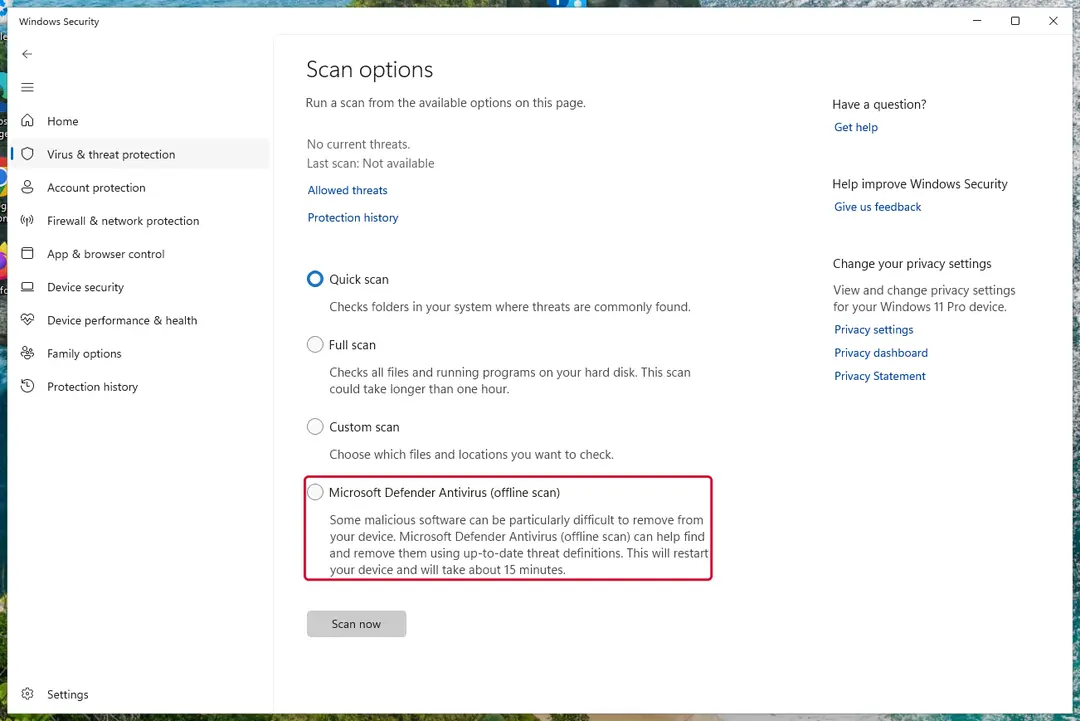
Windows 11: Windows Security > Virus & threat protection > Scan options. Full procedure with screenshots: Run a Microsoft Defender Offline scan
Access your website securely from any location
When you work on the domain, site, blog, or different project that requires constant management, content creation, or coding, you may need to connect to the server and content management service more often. The best solution for creating a tighter network could be a dedicated/fixed IP address.
If you make your IP address static and set to your device, you can connect to the CMS from any location and do not create any additional issues for the server or network manager that needs to monitor connections and activities. VPN software providers like can help you with such settings and offer the option to control the online reputation and manage projects easily from any part of the world.
Recover files after data-affecting malware attacks
While much of the data can be accidentally deleted due to various reasons, malware is one of the main culprits that can cause loss of pictures, documents, videos, and other important files.
More serious malware infections lead to significant data loss when your documents, system files, and images get encrypted. In particular, ransomware is is a type of malware that focuses on such functions, so your files become useless without an ability to access them.
Even though there is little to no possibility to recover after file-locking threats, some applications have features for data recovery in the system. In some cases, can also help to recover at least some portion of your data after data-locking virus infection or general cyber infection.
From our report of Jul 2015 · not reviewed since
How to remove GoUnzip Toolbar?
In order to restore your browser settings and return to your usual homepage and search engine, you will have to uninstall GoUnzip completely.
You should also bear in mind that all sorts of potentially unwanted programs that access your computer in bundles are rarely distributed alone. Therefore, there might be other potentially harmful applications that could have ended up on your computer.
1. Click Start → Control Panel → Uninstall a Program. 2. When in the Add/Remove Programs/Uninstall a Program, look for UnzipApp Toolbar and other programs that are unknown to you.
3. Click 'Uninstall' and then OK to save the changes.
Google Chrome: 1. Open Google Chrome, click on the menu icon (top right corner) and select 'Tools' -> 'Extensions'. 2. Here, select unfamiliar plugins (UnzipApp Toolbar, MyWay, MyWebSearch, etc.) and select trash icon to delete these entries.
3. In order to change your homepage, click on menu icon, choose 'Settings' -> 'On startup' section -> 'set pages'. 4. Here, eliminate myway.com by clicking on the "X" and enter your preferred website.
- Uninstall programs that are related to UnzipApp Toolbar from your computer:
- Reset your web browser:
Questions about GoUnzip Toolbar
Is GoUnzip Toolbar a virus?
Most programs that appear the way GoUnzip Toolbar did are not viruses in the strict sense. They are potentially unwanted programs:
- real software that arrives bundled with other downloads and then shows offers
- changes browser settings
- starts with Windows
Some are harmless, some are annoying and a few carry adware. What makes it worth removing is that you did not choose it.
Uninstall it from Installed apps and check the startup list and the browsers for anything added the same day. If it refuses to uninstall or returns after a restart, treat it as more serious and run a Microsoft Defender offline scan.
GoUnzip Toolbar came back after I uninstalled it. Why?
Something else is reinstalling it. Common causes are a second program from the same publisher, a scheduled task that downloads it again, or a browser extension that keeps prompting for it. Sort Installed apps by install date and uninstall each entry from the same day that you did not choose.
Then open Task Scheduler and look in the Task Scheduler Library for tasks with updater-style names that you do not recognise. Check Startup apps in Task Manager too. If GoUnzip Toolbar still returns, start Windows in Safe Mode, uninstall it there and run a Microsoft Defender offline scan, which looks for loaders that ordinary scans can miss.
GoUnzip Toolbar came back after I removed it. Why?
Something reinstalls it:
- another program from the same bundle
- a scheduled task that downloads it again
- a browser extension restored by sync
Look in Installed apps for anything from the same publisher or installed on the same date, and in Task Scheduler for tasks with the program's name or random names.
Remove extensions while signed in to the browser so sync deletes them on every device. Remove everything in one session and restart. If GoUnzip Toolbar still returns, a full scan and a Microsoft Defender offline scan usually find the part that brings it back.
Is it safe to remove GoUnzip Toolbar?
Yes. Removing an unwanted program does not damage Windows, because programs like this are not part of the system. Before uninstalling, make sure it is not something you rely on: if the publisher is a company you know and you use the program, keep it.
If not, uninstall it from Installed apps, restart and check that goUnzip Toolbar in the list of installed apps is gone. If something you need stops working afterwards, reinstall that program from its official website, choosing the custom installation so that the unwanted extra is not added again.
GoUnzip Toolbar has no uninstall option. What now?
Some unwanted programs leave no entry in Installed apps on purpose. Find the program's files instead:
- open Task Manager while goUnzip Toolbar in the list of installed apps is visible
- right-click the process
- choose Open file location
End the process, then look in that folder for an uninstall file. If there is none, delete the folder after checking that it holds nothing you need.
Before deleting, remove the startup entry and any scheduled task that points to it, otherwise it may be recreated. A restart and a full scan in Windows Security finish the job and catch files stored elsewhere.
Should I call GoUnzip Toolbar malware?
Most security vendors would call it a potentially unwanted program rather than malware. The difference is intent and consent:
- malware hides and harms
- while unwanted programs are installed with a click someone barely noticed
- then do more than expected
The sign reported here, goUnzip Toolbar in the list of installed apps, is typical of the second group. In practice the label matters less than the result.
Whatever it is called, a program you did not choose should go, and the place it came from should be checked for other programs. Microsoft Defender can block this class of software if you switch on Potentially unwanted app blocking in Windows Security.
Can I use GoUnzip Toolbar safely?
Yes, if you installed it on purpose and control its settings. Download it only from the publisher's own site, never through a bundle or a portal. After installing, disable automatic start, offers and telemetry, and check that it did not change your search engine or add extensions.
Watch for renewals if you bought a licence, and turn on PUA blocking in Windows Security so that anything it tries to add during updates is stopped. If GoUnzip Toolbar keeps pushing payments or offers, it is not worth the trouble.
Will removing GoUnzip Toolbar speed up Windows?
It often helps a little and sometimes a lot, depending on how many programs came in the same bundle. Every unwanted program that starts with Windows adds to boot time and uses memory. The one behind goUnzip Toolbar in the list of installed apps is no exception.
Remove it, check the Startup list for others, restart and compare. If the PC is still slow, look at disk space, Windows updates and the processes at the top of Task Manager. A clean PC should sit almost idle when no programs are open.
Why does my antivirus call GoUnzip Toolbar a PUA or PUP?
These labels mean potentially unwanted application or program. They are used for software that is legal but uses deceptive distribution, aggressive ads, misleading claims or a hard removal. Microsoft's PUA categories include advertising software, bundlers, download managers, torrent clients, marketing software and miners.
A PUA detection is a warning, not proof of infection, and you decide whether to keep GoUnzip Toolbar. Other vendors use their own labels for the same idea, such as PUP.Optional or not-a-virus. Read more in our guide to potentially unwanted programs.
Will Fortect remove GoUnzip Toolbar?
Fortect scans Windows for malware and unwanted programs and repairs the system files and settings they change, and its free scan shows what it finds on your PC before you decide anything.
For GoUnzip Toolbar, follow the plan above as well: the browser steps take back permissions and settings that no scanner treats as a threat, and uninstalling the program that brought it removes the source.
Run Microsoft Defender's full scan and, if anything was found, its offline scan as a second opinion. If the symptoms are gone after the plan and both scans are clean, there is nothing more to do.
Sources
- FTC: How to recognize, remove and avoid malware (read October 7, 2026)
- Microsoft Learn: Microsoft Defender Offline (read October 7, 2026)
- Microsoft Learn: How Microsoft names malware (read October 7, 2026)