
App Explorer: what it is and how to remove it
App Explorer is a SweetLabs application pre-installed on Lenovo laptops designed to browse and update apps, but causes excessive CPU usage and ads. Uninstallation through Control Panel is recommended for users experiencing performance issues.
Facts checked October 9, 2026. Removal steps tested on Windows 11 (26H2) and checked against Microsoft's and the browser makers' current documentation. Sections marked as our earlier report are the original text: they describe the threat as it was then and have not been reviewed since. The 2026 status, the removal steps and the questions are current.
Automatic
Get a free scan and check if your PC is infected.
Fortect finds malware, unwanted programs and the Windows damage they leave behind, and repairs it in one pass.
Unsure whether HostAppServiceUpdater.exe is safe? A free scan checks the file and what starts it.
Do it yourself · free Remove App Explorer yourself 4 steps, about 12 minutes, no software needed.
Start the steps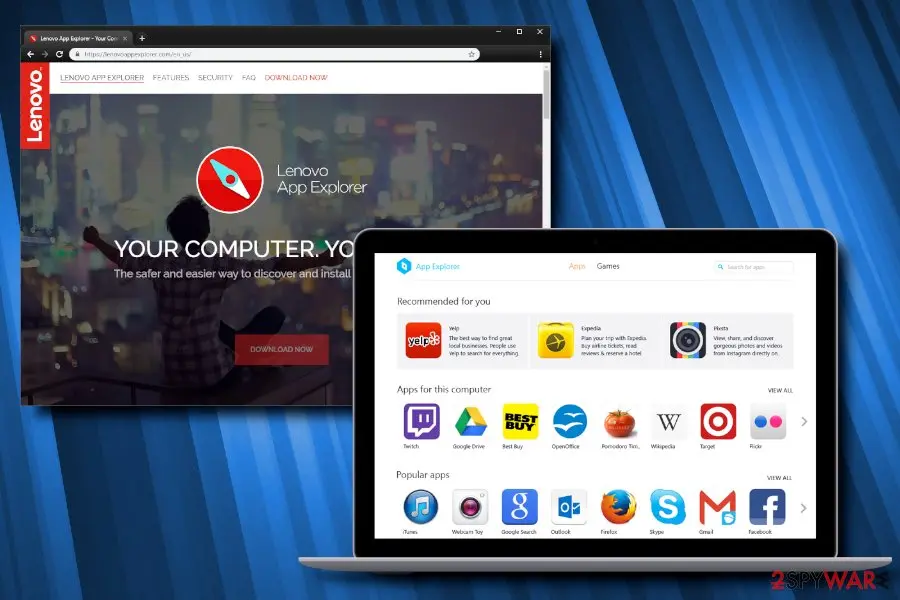
App Explorer: summary
| Name | App Explorer |
|---|---|
| Type | Potentially unwanted program |
| Developer | SweetLabs |
| Related | Pokki, OpenCandy |
| Symptoms | Increased amount of adverts, high CPU usage |
| Infiltration | Software bundling |
| Removal | Scan the PC with security software to find and remove the malware and anything installed with it. Fortect scans Windows for malware and repairs the system files and settings it damaged. Remove it nowTo use the full-featured product, you have to purchase a license for Fortect. The scan is free. |
Show 7 more facts
| Detection names | No Microsoft detection name is known |
|---|---|
| Distribution | Not recorded in the old report |
| Damage | Not recorded in the old report |
| Files and processes | HostAppServiceUpdater.exe |
| Evidence | 4 write-ups by security sites; details still limited |
| First seen | 1 March 2019 |
| Facts checked | 5 October 2026 |
Is App Explorer safe? Why it is flagged
What readers reported about App Explorer
How can I remove FBI Virus on Galaxy s4?. I've tried all suggestions to remove virus. I cannot find BaDoink app or any other suspicious looking apps under Application Manager or Device Administrators. Virus also only shows up when using Internet Explorer. Please help. I want it gone.
Removing Rvzr-a.akamaihd.net pop-up virus. When I try to uninstall the add-ons in Internet explorer there is no uninstall button in the tools and extensions screen I am using Office Home 2010 and have the latest idiot version of Windows
From the comments under our earlier guide; names and contact details removed.
App Explorer on Acer laptops and the App Explorer was recently updated notice
App Explorer on an Acer laptop is the same SweetLabs program that Lenovo laptops carry.
Wikipedia notes that SweetLabs released its App Install Platform in May 2014 and that device makers including Acer, Toshiba and Lenovo used it. So finding App Explorer on a new Acer machine usually means it came preinstalled by the maker, not that malware slipped in. You can still uninstall it if you do not use it.
The message App Explorer was recently updated most likely comes from the program's own updater, which keeps it current in the background. We found no official SweetLabs or Acer page that explains this exact notice, so this is our reading.
The notice is not a sign of infection by itself. If it keeps appearing and you never open App Explorer, uninstall the program and its update service from Installed apps in Settings.
App Explorer SweetLabs adalah is an Indonesian search that simply means what is App Explorer by SweetLabs. The answer is the same in any language: it is a preinstalled app store and app recommendation tool from SweetLabs, the company behind Pokki. It is not a virus, but it can show app offers and use processor time. Removing it does not harm Windows or your files.
From our report of Oct 2026 · outdated details corrected in October 2026
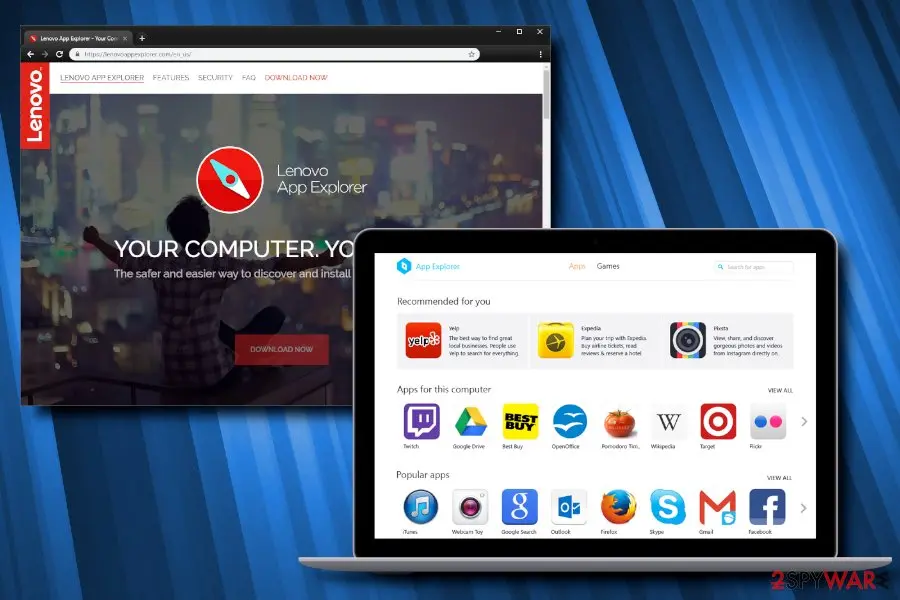
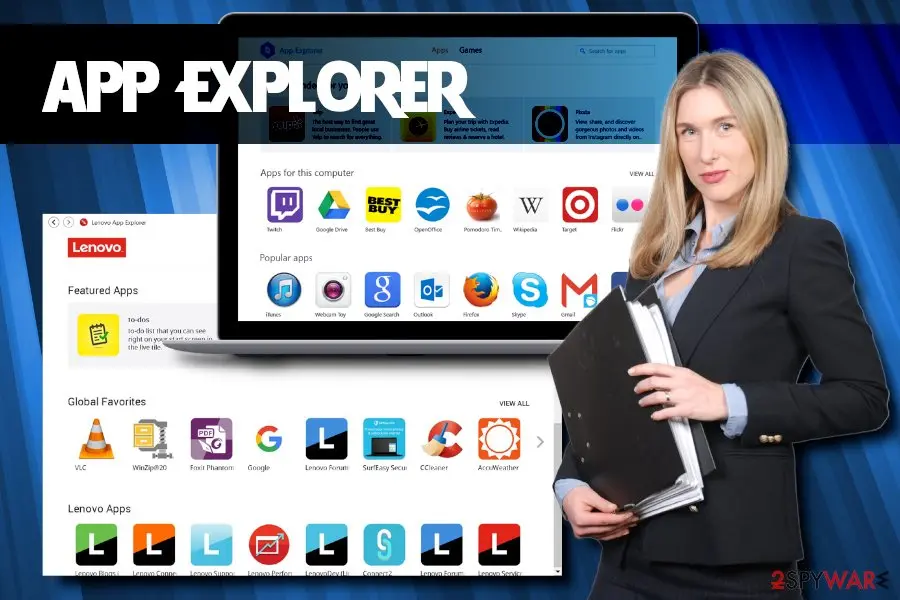
App Explorer - an application that comes as a pre-installed module on laptops from Lenovo
App Explorer is a legitimate application developed by SweetLabs and is often bundled on devices produced by major companies like Lenovo.
Allegedly, the application is designed as an alternative to Microsoft's Web store, which helps users to browse, download and update various apps. Unfortunately, the developer of the program also produced Pokki and OpenCandy - tools that are considered to be potentially unwanted or even malicious by some anti-virus vendors.
In fact, App Explorer might just fit into the same category of adware - intrusive delivery of commercial content, as well as slowdown in system performance. Some users reported that the app appeared out of nowhere on their PCs, meaning that it can be distributed with the help of deceptive marketing technique called software bundling. Fortunately, users can easily remove App Explorer in case they are having troubles with it.
Once App Explorer is installed on the PC, it launches the update service HostAppServiceUpdater.exe, along with its main executable HostAppService.exe which run in the background. The app also creates a scheduled task so that it is started with every system reboot.
While the application is approved by Lenovo, it does not mean that it is entirely safe to use and does not cause any problems to users. Multiple people complained about excessive CPU usage of the service spawned by Lenovo App Explorer. Some users said their CPU spiked to 60-80% usage, which is abnormal for typical apps running in the background.
Speaking of Lenovo, it is not the first time the company was delivering adware on users' devices. The recent scandal over Superfish adware that was pre-installed on users' laptops between 2014 and 2015 and exposed them to potential cyber attacks, compromising their safety.
Lenovo settlement reached $7.3 million. Have Lenovo learned the lesson? Maybe, considering that App Explorer did not get any negative criticism from security researchers in 2019, and no anti-virus engines flagged it as malicious at that time.
However, users complaining about advertisement content, as well as abnormally high CPU usage when the app is running should warrant App Explorer removal. Because none of the security applications recognized the file in 2019, users could only uninstall the app via the Control Panel. We explain the procedure below.
From our report of Oct 2026 · not reviewed since
Beware of bundled software - it can install potentially dangerous programs on your system
While we cannot say that Lenovo app explorer is a virus, its distribution techniques definitely resemble.
Many users complained about finding the application performing updates, even though they never initiated the download of software in the first place. This is typical for potentially unwanted programs, such as adware or browser hijackers.
This happens because users do not pay much attention to the installation procedure of new applications they acquire from the internet. Beware that all websites that distribute freeware or shareware bundle software - it is a way to monetize, and such sites would simply not exist otherwise.
Therefore, even if you accessed well-known sites like File Hippo or Download.com, pay close attention to the installation procedure. Check out the Privacy Policy and Terms of Service, not rush by clicking "Next" several times, and always opt for Advanced or Custom installation settings instead of Recommended/Quick mode.
Once you pick the former, you will be able to view all the optional components that are marked for the installation. Merely remove the tick marks and only leave the initial program you required.
Check your PC and browser
- File:
HostAppServiceUpdater.exe
How to uninstall App Explorer
How to remove App Explorer
Uninstall the bundle first, then everything it added:
- programs
- extensions
- changed browser settings
Step 1: Uninstall programs you did not mean to install
App Explorer rarely comes alone: it is usually installed by, or together with, a free program. In Windows 11 open Settings > Apps > Installed apps, in Windows 10 Settings > Apps > Apps & features, and sort by install date.
Uninstall every entry from the day the trouble began that you did not install on purpose, for example a download manager, a converter or a browser you never chose.
Keep drivers and entries from Microsoft, Intel, AMD, NVIDIA or your PC's maker unless you are sure.
Full procedure with screenshots: Uninstall a program or app in Windows On uGetFix
Step 2: Remove it from startup
Press Ctrl + Shift + Esc to open Task Manager and select Startup apps (Windows 11) or the Startup tab (Windows 10). Disable entries you do not recognise, especially ones with no publisher or with a name that copies a Windows component.
Right-click an entry and choose Open file location to see where it runs from: programs in
%AppData%or%Temp%deserve a closer look. Some entries are not listed there but in the registry Run keys, which the procedure below shows how to check.Full procedure with screenshots: Stop apps from opening at startup On uGetFix
Step 3: Delete the folders left behind
Uninstalling often leaves the program's folders, and some threats reinstall themselves from them.
Press Windows + R, type
%LocalAppData%and press Enter, then do the same for%AppData%and %ProgramData%, and look for folders named after App Explorer, its publisher or created on the day the problem started.Delete those folders, and check
C:\Program FilesandC:\Program Files (x86)too.If Windows says a file is in use, end it in Task Manager or delete the folder after a restart in Safe Mode. The folders are the same in Windows 11 and Windows 10.
Full procedure with screenshots: Remove what malware leaves behind in Windows
Step 4: Scan the PC, then run the offline scan
A scan finds the parts of App Explorer that the manual steps cannot see. In Windows Security > Virus & threat protection > Scan options, start a Full scan and quarantine what it reports.
Follow it with Microsoft Defender Antivirus (offline scan) > Scan now, which restarts the PC and checks the disk while Windows and the malware are not running.
It takes about 15 minutes and works the same in Windows 11 and Windows 10. If either scan finds something, run the full scan again after removal until it comes back clean.

Windows 11: Windows Security > Virus & threat protection > Scan options. Full procedure with screenshots: Run a Microsoft Defender Offline scan
Instructions for each browser and system
The detailed steps for every browser and system this guide covers. Open the one you use.
Uninstall from Windows
To remove App Explorer from the system, follow these step-by-step instructions:
Uninstall from Windows 10/8:
- Type Control Panel into the Windows search box and open the result.
- Under Programs, select Uninstall a program.

Uninstall from Windows 7/XP:
- Click on Windows Start > Control Panel (Windows XP users should click on Add/Remove Programs).
- In Control Panel, select Programs > Uninstall a program.

Remove the unwanted program:
- In the Programs and Features window, look for any recently installed suspicious entries, select them, and click Uninstall.
- If User Account Control appears, click Yes to confirm, then complete the removal.

Choose a proper web browser and improve your safety with a VPN tool
Online spying has got momentum in recent years and people are getting more and more interested in how to protect their privacy online.
One of the basic means to add a layer of security - choose the most private and secure web browser. Although web browsers can't grant full privacy protection and security, some of them are much better at sandboxing, HTTPS upgrading, active content blocking, tracking blocking, phishing protection, and similar privacy-oriented features.
However, if you want true anonymity, we suggest you employ a powerful VPN - it can encrypt all the traffic that comes and goes out of your computer, preventing tracking completely.
Lost your files? Use data recovery software
While some files located on any computer are replaceable or useless, others can be extremely valuable.
Family photos, work documents, school projects - these are types of files that we don't want to lose. Unfortunately, there are many ways how unexpected data loss can occur:
- power cuts
- Blue Screen of Death errors
- hardware failures
- crypto-malware attack
- even accidental deletion
To ensure that all the files remain intact, you should prepare regular data backups. You can choose cloud-based or physical copies you could restore from later in case of a disaster. If your backups were lost as well or you never bothered to prepare any, can be your only hope to retrieve your invaluable files.
From our report of Oct 2026 · outdated details corrected in October 2026
Uninstall Lenovo App Explorer from your device if it is causing you troubles
The answer to the question "Should I uninstall Lenovo App Explorer?" highly depends on whether or not your system is experiencing any difficulties, and whether or not you are using it in the first place. Our recommendation would be to opt for App Explorer removal, as we do not see any use of such a program. If anything, using default Microsoft store should be sufficient.
Nevertheless, you should not remove App Explorer if you think that it is beneficial to you. In 2019, Lenovo completely approved of the app, and no security researchers came forward with negative comments.
Questions about App Explorer
What is Lenovo App Explorer?
App Explorer is a legitimate application developed by SweetLabs and pre-installed as a module on Lenovo laptops. It's designed as an alternative to Microsoft's Web Store, helping users browse, download, and update various apps. However, SweetLabs also produced other tools like Pokki and OpenCandy, which some antivirus vendors classify as potentially unwanted or malicious programs.
App Explorer itself may fit into the adware category due to intrusive ad delivery and system performance slowdowns. The application launches HostAppServiceUpdater.exe and HostAppService.exe in the background and creates scheduled tasks for automatic startup. Users report that the app appeared without clear authorization, suggesting deceptive bundling techniques distributed with major hardware vendors' products.
Is App Explorer safe to use?
While Lenovo approves App Explorer and no security researchers have reported malware, the program causes legitimate user concerns. Multiple users complained about excessive CPU usage, with spikes reaching 60 to 80 percent—abnormal for background applications.
The app displays intrusive advertisements and consumes significant computer resources, degrading system performance. These issues warrant removal if you experience problems. The situation parallels Lenovo's Superfish scandal (2014-2015), where pre-installed adware exposed users to cyber attacks; Lenovo settled that case for $7.3 million.
Although App Explorer hasn't received negative security research attention, its performance impact and ad delivery classify it as potentially unwanted software. Removal is recommended if your system experiences slowdowns or excessive ads.
How does App Explorer get on my computer?
App Explorer comes pre-installed on Lenovo laptops from major manufacturers as a bundled application. Many users report finding the application performing updates even though they never authorized the download.
This distribution resembles potentially unwanted program tactics where software is installed by default without clear user awareness or consent. The bundling strategy is common among free software distributors who lack other revenue models.
Most users don't pay attention during installation and miss information about additional downloaded components hidden in optional settings. Even well-known distribution sites like File Hippo bundle additional software. Lenovo's default inclusion means users must actively uninstall rather than opt-in to installation, reversing typical software permission models.
Should I uninstall Lenovo App Explorer?
The answer depends on whether your system experiences problems and whether you actively use the application. If you notice high CPU usage, excessive advertisements, slowdowns, or simply don't use the app, removal is recommended.
Microsoft Store provides sufficient app browsing and updating functionality for most users, making App Explorer redundant. No anti-virus vendors currently flag the application as malicious, and Lenovo officially approves it. However, the excessive resource consumption reported by many users justifies removal for performance improvement.
If you find the application beneficial and your system runs smoothly, keeping it is acceptable. Make your decision based on personal experience—removal is simple if you encounter problems. Consider whether you've used App Explorer in the past month; disused software should be removed.
What CPU issues does App Explorer cause?
Multiple users report excessive CPU usage when App Explorer runs in background. The service HostAppService.exe consumes abnormally high processor resources, with documented spikes reaching 60 to 80 percent usage—far beyond what typical background applications should require.
This excessive consumption causes noticeable system slowdown, affecting overall computer performance. Normal background processes should consume minimal CPU resources; such high usage indicates inefficient programming or intentional aggressive activity. If your CPU spikes when App Explorer launches, the application is the likely culprit.
You can monitor resource usage through Task Manager to confirm this connection. System slowdowns, fans running constantly, or reduced battery life on laptops all indicate problematic CPU usage that warrants App Explorer removal.
How do I remove App Explorer from my Lenovo laptop?
App Explorer cannot be detected by security software as malicious, so you cannot use automated anti-malware removal. You must manually uninstall it through Control Panel. First, access Control Panel and navigate to Programs or Applications section.
Find Lenovo App Explorer in the installed programs list. Right-click the entry and select Uninstall, confirming any User Account Control prompts. Wait for the uninstallation process to complete and click OK.
The application stops running immediately and no longer launches at startup. No additional cleanup is typically necessary, though you might check for leftover HostAppService.exe processes in Task Manager. After uninstallation, you can use Microsoft Store for app management without performance degradation.
Can I trust pre-installed software from Lenovo?
Lenovo's inclusion of App Explorer shows the company bundles software with devices that may not benefit users or respect their preferences. While Lenovo currently approves App Explorer and it's not flagged as malicious, the company's history raises concerns.
The 2014-2015 Superfish adware scandal demonstrated that Lenovo installed harmful software affecting security without meaningful user consent. That incident resulted in a $7.3 million settlement and damaged consumer trust. App Explorer's default installation and resource consumption parallel concerning practices.
Users should scrutinize pre-installed software, remove items causing problems or performance issues, and maintain awareness of bundled programs. Just because a vendor approves software doesn't guarantee it serves user interests. Always monitor system performance and uninstall applications that degrade experience.
What alternatives exist to App Explorer?
Microsoft Store serves as a sufficient app browsing, downloading, and updating platform for most Windows users. It's the native Windows solution, requires no additional installation, and doesn't consume excessive resources.
Windows automatically manages Store app updates without separate software running in background. Third-party app stores and platforms like Epic Games Store (for games) provide specialized alternatives for specific software categories. The default Windows Store eliminates the need for Lenovo's App Explorer.
If you prefer alternative app management, simply uninstall App Explorer and rely on Windows native tools or choose specialized platforms matching your needs. No replacement is necessary for general app management—Windows Store and built-in Windows features suffice for most users.
Will Fortect remove App Explorer?
Fortect scans Windows for malware and unwanted programs and repairs the system files and settings they change, and its free scan shows what it finds on your PC before you decide anything.
For App Explorer, follow the plan above as well: the browser steps take back permissions and settings that no scanner treats as a threat, and uninstalling the program that brought it removes the source.
Run Microsoft Defender's full scan and, if anything was found, its offline scan as a second opinion. If the symptoms are gone after the plan and both scans are clean, there is nothing more to do.
Sources
- 2-spyware: Lenovo's settlement with FTC over Superfish adware reached $7.3M (read October 5, 2026)
- Virus Total: lenovoappexplorer.exe (read October 5, 2026)
- FTC: How to recognize, remove and avoid malware (read October 5, 2026)
- Microsoft Learn: Microsoft Defender Offline (read October 5, 2026)
- Microsoft Learn: How Microsoft names malware (read October 5, 2026)
- Wikipedia: SweetLabs (read October 9, 2026)