
H1B scam: how fake H-1B job offers and visa fee demands work, and what to do
An H1B scam is a fake job or visa offer that promises H-1B sponsorship and then asks the worker to pay a fee, send identity papers or both. A real employer pays the H-1B filing costs, so stop paying, check the employer yourself and report it.
Facts checked October 11, 2026. Removal steps tested on Windows 11 (26H2) and checked against Microsoft's and the browser makers' current documentation.
Automatic
Get a free scan and check if your PC is infected.
Fortect finds malware, unwanted programs and the Windows damage they leave behind, and repairs it in one pass.
An automatic scan checks installed programs, startup items and browser extensions for anything that came with a job offer or message that promises H-1B visa sponsorship and asks you to pay.
Do it yourself · free Remove H1B scam yourself 5 steps, about 15 minutes, no software needed.
Start the steps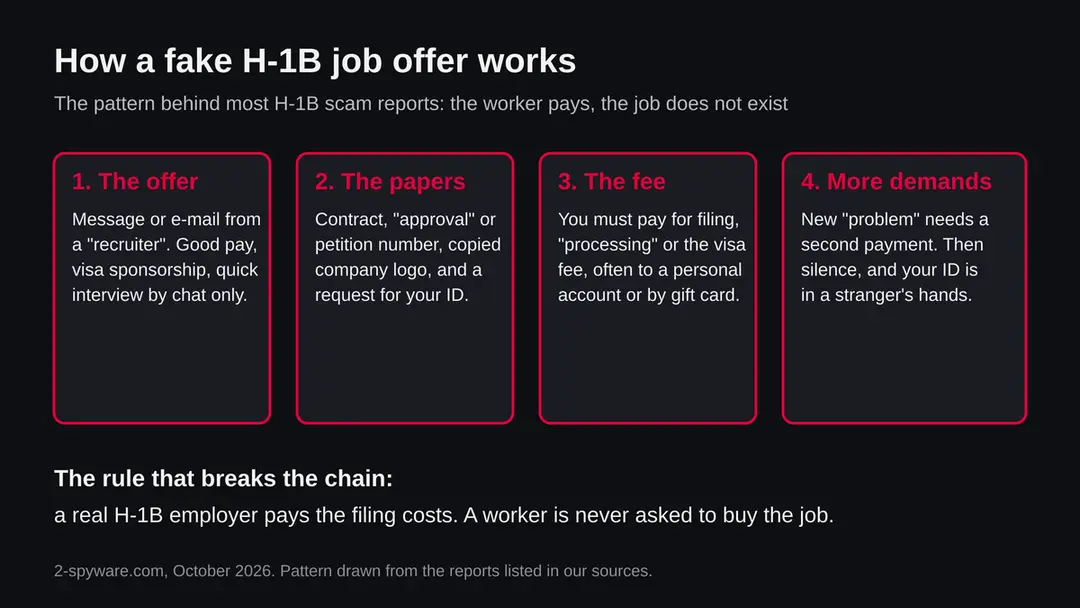
H1B scam: summary
| Name | H1B scam (also written H-1B scam, H1B visa scam, H1B sponsorship scam) |
|---|---|
| Type | Fake job, visa or fee offer that uses H-1B sponsorship as bait; not a program on your device |
| Risk | High for money and identity if you pay or send documents; no malware by itself |
| Symptoms | A recruiter you never contacted offers sponsorship, asks you to pay a fee, wants a passport scan, pushes for speed and avoids video calls |
| How to get rid of it | Stop paying, check the employer yourself, tell your bank if you paid, protect your identity and report it |
| Our check (11 October 2026) | Topic check from public sources; no address tested, no malware report found |
| Removal | Scan the PC with security software to find and remove the malware and anything installed with it. Fortect scans Windows for malware and repairs the system files and settings it damaged. Remove it nowTo use the full-featured product, you have to purchase a license for Fortect. The scan is free. |
Show 7 more facts
| Who pays H-1B costs | The employer files and pays; the worker should not be asked to buy the job |
|---|---|
| Microsoft detection | None is tied to this scam, which is a fraud pattern and not a Windows threat. If a file a recruiter sent is flagged, Microsoft Defender shows a generic name such as Trojan:Win32/Wacatac.B!ml, which says nothing about who sent the file (we did not test any such file) |
| Evidence | 0 write-ups by security sites; details still limited |
| First seen | 11 October 2026 |
| Distribution | Typically fake installers, cracked programs, e-mail attachments, fake "verify you are human" pages and ads for popular apps |
| Damage | Installs other malware, often several programs at once |
| Facts checked | 11 October 2026 |
Facts checked on 11 October 2026 against five sources: a Yale international office summary of USCIS guidance on the 100,000 US dollar H-1B payment, a Department of Labor inspector general press release of 8 July 2026, an H-1B employer red flags article, a labor-news alert about a fee-based offer and a report on FTC job scam warnings. We tested no website and contacted no recruiter.
What an H1B scam is
An H1B scam is any offer, message, website or phone call that uses the H-1B work visa to get money or identity documents from you. The H-1B is a real United States visa for specialty occupations, and that is exactly why it is used as bait: people who want it are motivated, often live far away and cannot easily check who is talking to them.
The search "h1b scam" covers several different things, and they need different answers. The first is the fake job offer, where a stranger promises sponsorship and asks you to pay. The second is the fake agent or lawyer who sells you a place in the "H-1B lottery" or a guaranteed approval.
The third is a message that pretends to come from the immigration service or an embassy and demands a payment. The fourth is the dishonest employer or consultancy that is real but files petitions for jobs that do not exist or takes money back from the worker. We cover all four below.
We did not find a single website, file or program behind this name, so there is nothing to uninstall and no address to block. This page is about recognising the offer, stopping the loss and reporting it.
Our own facts come from a topic check, not from a site test: no address was tested, and no malware report names this subject. Everything else on the page comes from the sources listed at the end, and we say where a source is a law firm, a university office or a news report and not a government page.
- What it is
- A fake or abusive job, visa or fee offer that uses H-1B sponsorship as bait
- Who meets it
- People abroad and in the United States who look for H-1B sponsorship, and also employers who get fake petition or fee messages
- What the scammer wants
- Money (fees, "processing", "training", "equipment"), copies of passports and other IDs, bank details
- Not the same as
- A virus on your device; the harm comes from what you pay, send or sign
- Biggest warning sign
- The worker is asked to pay for the job or the sponsorship
Who really pays for an H-1B, and why that matters
In the H-1B system the employer files the petition and the employer carries the filing costs. If anyone tells you that you must pay for the sponsorship, the filing or the job itself, treat it as a scam until proven otherwise.
A recent example shows why the rule is useful. A presidential proclamation introduced a payment of 100,000 US dollars that applies to new H-1B petitions filed on or after 21 September 2025 for workers who are outside the United States and do not already hold a valid H-1B visa, according to a summary on the Yale international office site that follows the immigration service's guidance of 20 October 2025.
The same summary says the petitioner, which means the employer, makes the payment through pay.gov before filing and must show proof with the petition, and that petitions without proof are denied. It also says that change of status and extension petitions for people already in the United States are generally not covered.
That money is not paid by the worker, and it is not paid to a person's bank account or by gift card. We could not open the immigration service's own page from our server (it refused our request), so we rely on the Yale summary here and tell you to check the current text on the immigration service website yourself, because such rules change.
The point for this guide is simple: big, scary fee headlines give scammers a ready script. A fake recruiter only has to say that "the new fee must be paid by the candidate" and many people believe it.
| Cost | Who normally pays | What it means if a stranger asks you for it |
|---|---|---|
| H-1B petition filing and lawyer fees | The employer (the petitioner) | Scam sign: you are asked to pay them yourself |
| The 100,000 US dollar payment on new petitions for workers abroad | The employer, through pay.gov, before filing (as summarised by Yale) | Scam sign: you are told to send it to a person, a bank account or by gift card |
| "Registration" or "lottery guarantee" fee | No one; a guaranteed place does not exist | Scam sign: a promise of selection for a price |
| "Training" or "equipment" bought through the recruiter | No one; you should never pay to get a job (FTC advice as reported) | Scam sign: an invoice for a computer or course |
| Visa interview fee at an embassy | The applicant, but only on the official government payment page | Check the address yourself; never pay a link a recruiter sends |
The four kinds of H1B scam
Almost every case falls in one of four groups: the fake job offer, the fake agent, the fake government message and the abusive real employer. The group decides what you should do first.
- High
The fake job offer
A message on a job site, a messaging app or e-mail promises a well paid job and H-1B sponsorship. The interview happens only in chat. Then comes a contract, a made-up petition or approval number, and a demand for a fee. A Latin American labor-news alert describes such an offer for a job in Birmingham, Alabama, where applicants were sent to an agency that charged 1,050 US dollars paid to a person's bank account, and where no record of an official certification for the job could be found.
- High
The fake agent or lawyer
Someone who is not a lawyer sells "guaranteed H-1B selection", "priority" processing or a "special quota". No such guarantee exists, and the immigration service does not sell places. The fee is the product, and the filing never happens.
- High
The fake government message
A call, text or e-mail claims to come from the immigration service, an embassy or the labor department, says your case has a problem and demands an urgent payment, often by gift card, cash app or cryptocurrency. Real agencies do not ask for payment this way.
- Medium
The abusive real employer
A real consultancy files petitions for a job that is not there, asks the worker to pay the "immigration costs" back, or keeps part of the wage. The Department of Labor inspector general announced an investigation on 8 July 2026 into fraud and human trafficking in the H-1B and PERM systems, including wage kickback schemes, as reported in the press release we cite.
What H1B scam does on an infected PC
Timeline of the facts we found
The dates below come from the sources at the end of the page. We found no public count of H1B scam victims and we do not invent one.
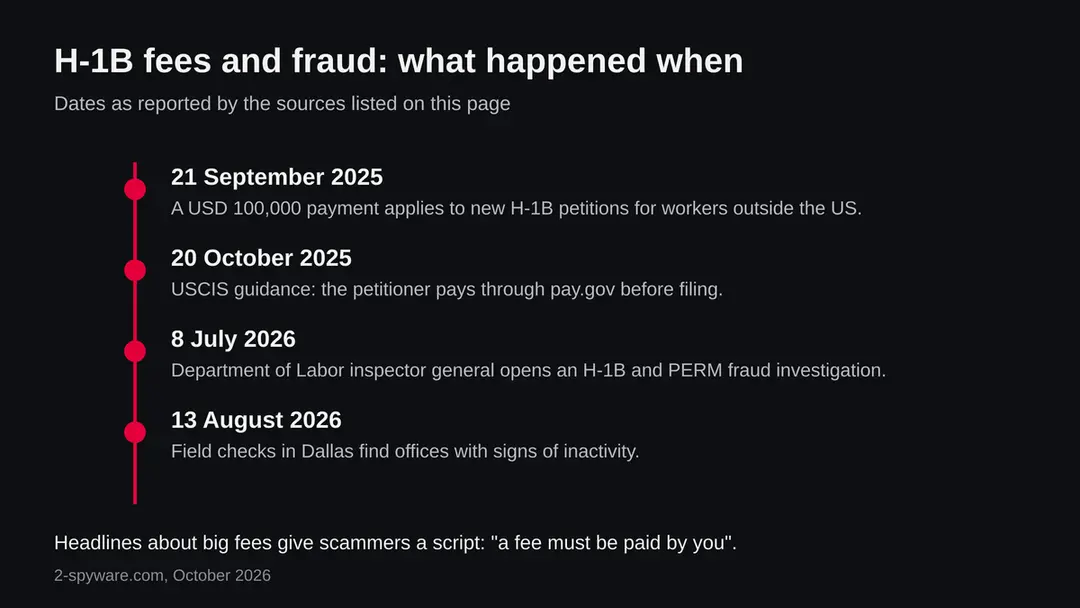
21 September 2025
The 100,000 dollar payment starts
The 100,000 US dollar payment applies from this date to new H-1B petitions for workers outside the United States who do not hold a valid H-1B visa (Yale summary of the guidance).
20 October 2025
Payment guidance is clarified
The immigration service clarifies that the petitioner pays through pay.gov before filing and files proof with the petition; petitions without proof are denied (same summary).
8 July 2026
Inspector general investigation
The Department of Labor inspector general announces an investigation into fraud and human trafficking in the H-1B and PERM systems, describing fraudulent applications and wage kickback schemes.
13 August 2026
Field checks in Dallas
A further release reports field checks in Dallas at addresses of companies with many approved petitions; many offices showed signs of inactivity. The inspector general said hotline complaints are being answered.
11 October 2026
Our check for this guide
Our check for this guide: no website, file or malware report found for this subject; the page was written from the sources listed below.
How to tell a fake H-1B sponsor from a real one
A real sponsor can be checked from outside, does not ask you for money and talks to you through channels that you can verify. A fake one fails at least two of those tests.
Seven checks you can do before you reply
- A fee is requested from youThe FTC says you should never have to pay to get a job, and that includes training or equipment. A sponsor that wants the worker to pay filing costs is a sign of a scam or of an abusive arrangement.
- Payment goes to a personA bank account in an individual's name, a gift card, a cash app or cryptocurrency is not how a company handles immigration costs.
- Contract repays the costsOne H-1B advice site lists a clause about repayment of immigration costs and a thin company online presence as warning signs. This is a commercial source, so ask a lawyer to read any such clause.
- Chat-only interviewA text interview with no video call, no named manager and no way to reach the company on a number you found yourself is a common scam trait, though some real firms also hire by chat.
- Personal e-mail domainRecruiters who write from a free mail account and not from the company's own domain deserve a second look; scammers also copy real company logos and names.
- Polished website, empty officeThe same advice site notes that even problem employers can have good websites and fine reviews, and the inspector general reported offices with signs of inactivity. Looks prove nothing.
- What a real process looks likeA named employer, a lawyer you can reach, the employer paying the filing costs and documents that you can compare with official sites. None of this guarantees a job, but it removes the scam shape.
Any request for money from the worker is the line Offers that ask you to pay for sponsorship or filing should be treated as fraud until the employer confirms the offer through contact details you found yourself.
What the scammer wants from you
The money is the visible goal, but your documents are often worth more. A passport scan, a photo, your address and bank details are enough to open accounts, to run a second scam in your name or to sell on.
What fake H-1B recruiters ask for
- Passport scan
- Photo and signature
- Date of birth and address
- Bank account details
- Social security or national ID number
- Education certificates
- Fee for filing or processing
- Fee for training or equipment
- Payment by gift card or cash app
- A second payment after the first
Once you have paid, the next step is almost always a second reason to pay: a problem with the petition, a customs fee, a lawyer's fee, a fine. Each payment is presented as the last one. The more you have paid, the harder it feels to stop, and scammers rely on that feeling.
How to remove H1B scam
A loader's job is to install other malware, so treat the PC as infected with more than one program until the scans are clean.
Step 1: Delete scheduled tasks that bring it back
Open Task Scheduler from the Start menu and click Task Scheduler Library. Select each task you do not recognise and read the Actions tab:
- a task that starts a file in
%AppData%or%Temp% - runs
powershellwith a long encoded line - opens a web address belongs to H1B scam or a similar program
Right-click such a task and choose Delete, and check the subfolders too. Leave tasks from Microsoft, your PC's maker and programs you use. Task Scheduler is the same in Windows 11 and Windows 10.
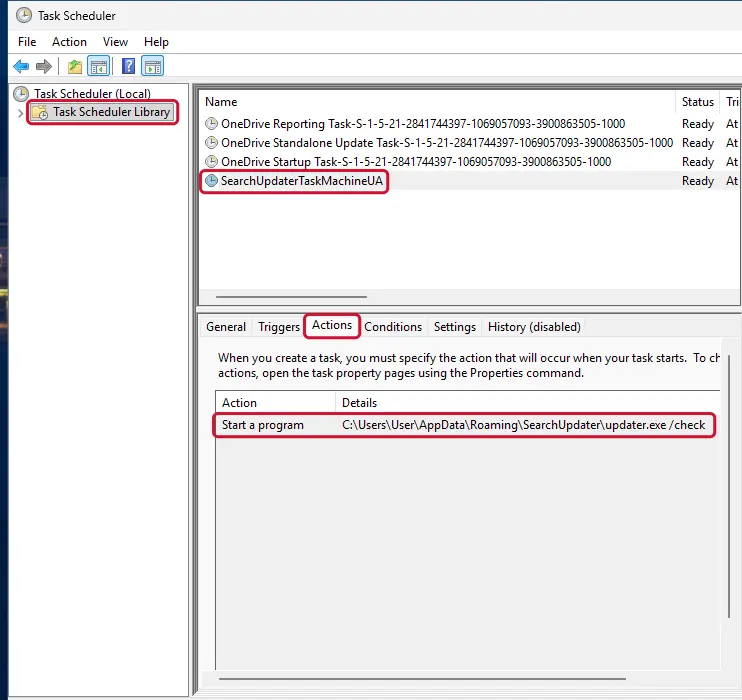
Windows 11: Task Scheduler Library, the task selected, the Actions tab shows the file it runs. Full procedure with screenshots: Remove what malware leaves behind in Windows
- a task that starts a file in
Step 2: Remove it from startup
Whatever H1B scam installed usually starts with Windows. Open Task Manager with Ctrl + Shift + Esc, go to Startup apps in Windows 11 or the Startup tab in Windows 10, and disable what you do not know, starting with entries that have an empty Publisher column.
Open file location on the right-click menu shows the file, which helps you decide and tells you what to delete later. Disabling is safe: if something you need stops working, switch it back on.
Full procedure with screenshots: Stop apps from opening at startup On uGetFix
Step 3: Delete the folders left behind
What the uninstaller leaves behind is usually in the user folders. Open File Explorer, switch on View > Show > Hidden items (in Windows 10 View > Hidden items), and go through
%LocalAppData%,%AppData%, %ProgramData% and the two Program Files folders.Sort by Date modified and delete folders that appeared together with the problem and belong to no program you use. Folders with random names that hold
.exe,.dll, .js or .ps1 files are the strongest sign.Full procedure with screenshots: Remove what malware leaves behind in Windows
Step 4: Scan the PC, then run the offline scan
Open Windows Security > Virus & threat protection > Scan options, run a Full scan and remove everything it finds. Then select Microsoft Defender Antivirus (offline scan) and click Scan now: the PC restarts and scans before Windows loads, which finds files that hide while Windows runs.
Save your work first, because the offline scan takes about 15 minutes. Both scans are built into Windows 11 and Windows 10, and a second scanner from another vendor is a useful extra opinion.
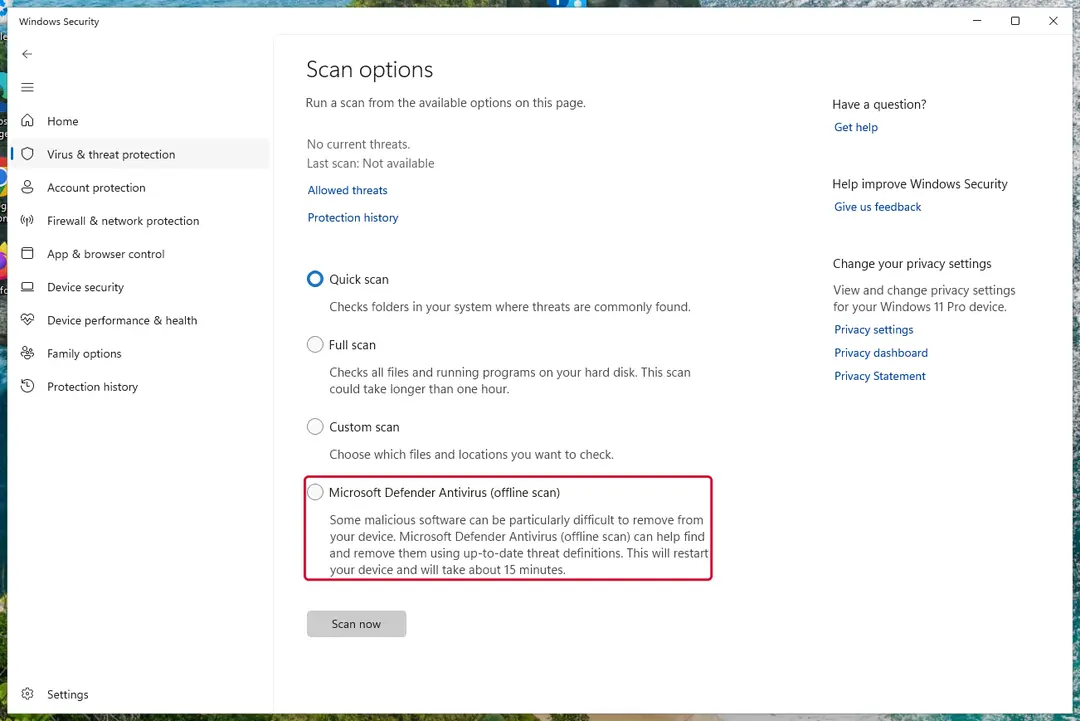
Windows 11: Windows Security > Virus & threat protection > Scan options. Full procedure with screenshots: Run a Microsoft Defender Offline scan
Step 5: Change passwords from another device and sign out other sessions
Assume that the passwords saved in this PC's browsers, and the accounts that were open in them, are known to the attacker. From a phone or a clean computer, change the e-mail password first, then banking, shopping, social and gaming accounts.
Use each service's option to sign out of all other sessions, because stolen cookies keep a session open even after a password change. Turn on two-step verification on each account. Wait with the infected Windows 11 or Windows 10 PC until the scans are clean.
Full procedure with screenshots: Turn on two-step verification / secure a hacked account
If you already paid or sent documents
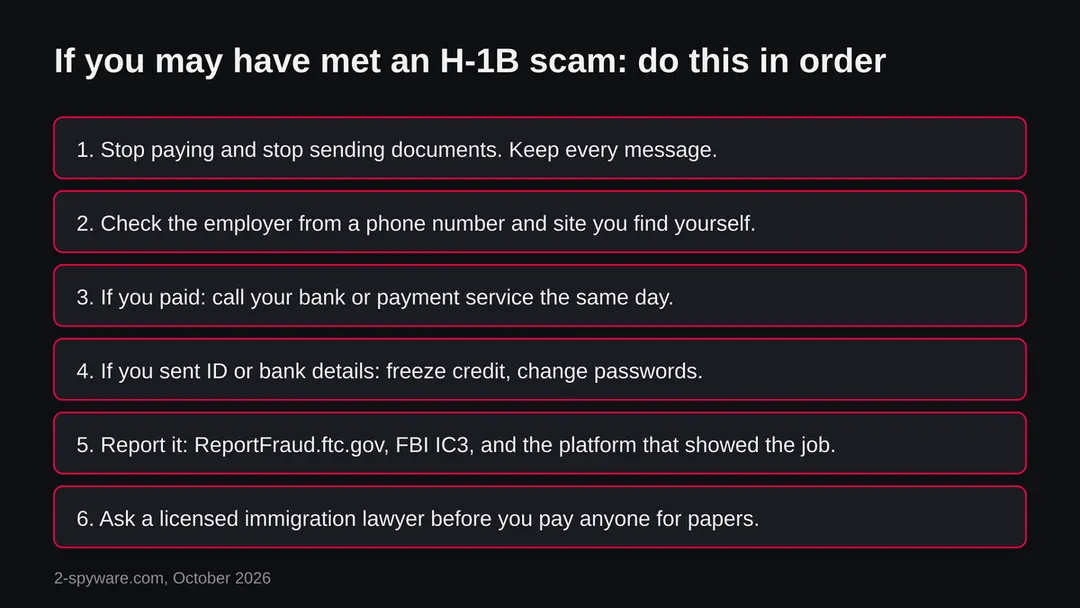
Act on the same day. The chance to stop or reverse a payment is the highest in the first hours, and a stolen identity is easier to contain early.
- 1
You paid by bank transfer or card
Call your bank or card issuer, say it is fraud and ask whether the payment can be stopped or disputed. Give the date, the amount and the account or name that received it. Banks cannot promise a refund, but a fast report gives the best chance.
- 2
You paid by gift card, cash app or cryptocurrency
Contact the card company or the payment service at once and report the fraud. These payments are the hardest to recover, so do not send a further amount to "unlock" the first one.
- 3
You sent a passport or ID
Treat the documents as exposed. Tell your bank, watch for accounts or loans in your name, and ask your country's identity authority how to report a stolen or misused document and whether to replace it.
- 4
You gave bank or account passwords
Change them from a device you trust, turn on two-step sign-in and check recent activity. If the recruiter made you install a program or share your screen, see the note below.
- 5
You installed software or opened a file the recruiter sent
Some job scams ask for a "test" program, a remote-access tool or a document with macros. If that happened, disconnect the device from the internet, run a full scan with your security software and change passwords from another device. Do not restart the conversation.
If you are an employer or a company named in a fake offer
Scammers copy real company names, logos and recruiter titles. If a worker writes to you about an offer you never made, your company is being used as a mask.
- 1
Answer the worker clearly
Tell them in writing that you did not make the offer, that your company never asks a worker to pay for sponsorship and which address your real recruiters use. Do not argue with the scammer.
- 2
Publish a notice
Put a short warning on your careers page that lists your official contact domain and says you never charge candidates. This helps the next person who searches.
- 3
Report the impersonation
Report the fake profile or domain to the platform or registrar that hosts it, to the FTC and to the FBI complaint center. Keep copies of the messages the worker forwarded.
- 4
Check your own fee process
Make sure the people who handle H-1B payments for you know that the large petition payment, where it applies, is made by the company through pay.gov and not through any link a stranger sends.
What we could not confirm
We did not test any website, we did not contact any recruiter and we did not read the immigration service's own pages from our server.
H1B scam · desk check · 11 October 2026
- A site or file behind the nameNone found. This is a topic, so there was no plain request to an address and no URLhaus entry to read.
- The immigration service's own pagesOur request to one of its pages was refused, so the fee details come from a university summary of the guidance and may change.
- How many people lose moneyWe found no reliable count for H-1B scams alone. FTC figures reported by the press cover job scams in general.
- Reporting channelsThe channels in the table above exist; check each address on its own official site before you send anything.
A pattern, not a single operation H1B scam is a pattern of fee and identity fraud, not one program. Our advice rests on the pattern in the sources, not on a test of any offer you hold.
After removal: passwords, accounts and prevention
Where to report an H1B scam
Report it even if the sum is small. Reports let agencies link cases, and the inspector general said it is responding to hotline complaints on H-1B fraud.
| Where | What to report | Note |
|---|---|---|
| ReportFraud.ftc.gov (United States) | Job scams and fake employment agencies | The FTC says job scams are on the rise; reports help it track them |
| FBI Internet Crime Complaint Center (ic3.gov) | Money lost online, fake recruiters, identity theft | Keep payment records and messages |
| Department of Labor inspector general hotline | Employer or broker fraud in H-1B and PERM, wage kickbacks | Press releases say hotline complaints are being answered |
| Immigration service tip line for suspected H-1B fraud or abuse | Fake petitions, abuse by a real employer | Open to workers and others; check the current address on the official site |
| The platform or app where you met the recruiter | The profile, the job post, the chat | Use its report button so the account is removed |
| Your local police or consumer authority (outside the US) | Payment fraud and identity theft | Ask your bank for a fraud reference number |
Tell the authorities
Police rarely recover money from one report, but reports are how operations against groups like the one behind H1B scam start, and the reference number matters to banks.
Describe A job offer or message that promises H-1B visa sponsorship and asks you to pay in the list of installed apps and attach screenshots.
US readers use IC3 and ReportFraud.ftc.gov; UK readers Report Fraud or Police Scotland on 101; Canadian readers the CAFC at 1-888-495-8501; Australian readers ReportCyber. Organisations may also have to notify a data protection authority.
For the EU list and evidence checklists, see where to report ransomware, scams and cybercrime.
How to protect yourself when you look for sponsorship
Do
- Find the employer yourself and contact it on a phone number or website you already trust, not one the recruiter gave you.
- Ask for the employer's name and the lawyer's name, and ask who pays the filing costs, in writing.
- Let a licensed immigration lawyer read any contract that mentions repayment of immigration costs.
- Keep every message, invoice and payment receipt.
- Make payments only through official government payment pages that you opened yourself.
Don't
- Pay a fee to get a job, sponsorship, a lottery place or an interview.
- Send a passport scan or bank details before the employer is confirmed.
- Pay by gift card, cash app, cryptocurrency or to a personal account.
- Install software or open files a recruiter sends for a "test".
- Believe a guaranteed selection or approval.
Questions about H1B scam
What is an H1B scam?
An H1B scam is a fake offer or message that uses H-1B visa sponsorship to take money or identity documents from you. The most common form is a fake recruiter who promises a job and sponsorship, then asks for a fee for filing, processing, training or equipment.
Others sell a guaranteed place in the H-1B lottery, or pretend to be a government office demanding payment. The H-1B itself is a real visa. The scam lies in who is asking and what they ask you to pay, since a real employer files and pays for the petition.
Is the H-1B visa itself a scam?
No. The H-1B is a real United States visa for specialty occupations, and real employers sponsor workers every year. What is a scam is the offer you receive: a stranger who promises sponsorship for a price, or a guaranteed selection.
The program has also had real abuse by employers and brokers, and the Department of Labor inspector general announced an investigation on 8 July 2026 into fraud and human trafficking in the H-1B and PERM systems. So the visa is genuine, but offers that use it need checking from outside before you pay or send any papers.
Do I have to pay to get H-1B sponsorship?
You should not be asked to pay for the sponsorship or the job. The petitioner, meaning the employer, files the petition and carries the filing costs. For the 100,000 US dollar payment on new petitions for workers outside the United States, a Yale summary of the immigration service's guidance says the petitioner pays through pay.gov before filing.
We could not open the official page ourselves, so check the current rules on the official site. Whatever the rule, a payment sent to a person, a bank account or by gift card is not how it works.
How can I tell if an H-1B job offer is fake?
Look for the shape of the scam:
- a fee asked from you
- payment to a personal account
- a chat-only interview
- a recruiter on a free e-mail address
- a copied company name
- a promise of guaranteed approval
- pressure to hurry
Then check from outside. Find the company yourself, call a number from its official site and ask whether the job and the recruiter exist.
Ask who pays the filing costs and who the immigration lawyer is. A real sponsor will answer, and a scammer will avoid it or push you to pay first.
I paid an H-1B recruiter. What should I do now?
Stop paying at once and call your bank or payment service today. Tell them it was fraud, give the date, amount and receiving account, and ask about a recall or dispute. Keep screenshots, messages and receipts.
If you sent a passport or other ID, watch for accounts opened in your name and ask your identity authority how to report it. Then report the offer to the FTC at ReportFraud.ftc.gov and the FBI complaint center. Do not pay a second time to recover the first payment, because that is the usual next step of the scam.
Can a real company ask me to repay H-1B costs?
It can happen, and it is a reason to be careful. One H-1B advice site lists a contract clause about repayment of immigration costs as a warning sign, and the inspector general has described wage kickback schemes in the H-1B system.
Rules on what an employer may recover are legal questions that depend on the facts and the contract. Do not sign such a clause without a licensed immigration or employment lawyer reading it. If you already pay money back to an employer, you can report it to the Department of Labor.
Is an H-1B lottery guarantee real?
No. A guaranteed place in the H-1B selection, a special quota or priority processing for a fee is the mark of a scam. The immigration service does not sell selection, and no agent can promise it.
A legitimate lawyer can explain the rules, and a real employer can register you according to the official process, but neither can guarantee the result. If someone offers certainty in exchange for money, stop and check the claim on the official immigration service site before you pay anything.
Who can I report an H1B scam to?
In the United States, report job and fee scams at ReportFraud.ftc.gov and online fraud at the FBI Internet Crime Complaint Center, ic3.gov.
For fraud by an employer or labor broker in the H-1B system, the Department of Labor inspector general has a hotline, and the immigration service has taken tips on suspected H-1B fraud by e-mail; check the current address on its site.
Also use the report button on the platform where you met the recruiter. Outside the United States, tell your bank and your local police or consumer authority.
Can a fake H-1B recruiter infect my computer or phone?
The offer itself is only words, but some job scams add a trap:
- a file for a "test"
- a program to install for an "interview"
- a request to share your screen
Those can give the sender access to your accounts. If you opened or installed anything the recruiter sent, disconnect the device from the internet, run a full scan with your security software, remove any remote-access tool you did not choose and change your passwords from another device.
If you only chatted and paid, your device is probably fine but your money and documents are at risk.
Will Fortect remove H1B scam?
Fortect scans Windows for malware and unwanted programs and repairs the system files and settings they change, and its free scan shows what it finds on your PC before you decide anything.
For H1B scam, follow the plan above as well: the browser steps take back permissions and settings that no scanner treats as a threat, and uninstalling the program that brought it removes the source.
Run Microsoft Defender's full scan and, if anything was found, its offline scan as a second opinion. If the symptoms are gone after the plan and both scans are clean, there is nothing more to do.
Sources
- Yale Office of International Students and Scholars: USCIS Clarifies $100,000 H-1B Fee Requirement (read October 11, 2026)
- U.S. Department of Labor Office of Inspector General: DOL OIG Launches Investigation into H-1B Visa Fraud and Human Trafficking (8 July 2026) (read October 11, 2026)
- F1 Jobs: How to Spot Fake, Exploitative, and Scam H-1B Sponsors Before You Accept an Offer in 2026 (read October 11, 2026)
- Contratados: alert about a fee-based H-1B job offer in Birmingham, Alabama (read October 11, 2026)
- WKNO: FTC warns job scams are on the rise (14 July 2026) (read October 11, 2026)