
Addedprint.com ads: what it is and how to remove it
Addedprint.com is a dangerous website that seeks to deceive people into subscribing to its notifications by showing various misleading prompts. As soon as you push the Allow button, the shady site will start showing you ads directly on your screen or desktop.
Facts checked October 6, 2026. Removal steps tested on Windows 11 (26H2) and checked against Microsoft's and the browser makers' current documentation. Sections marked as our earlier report are the original text: they describe the threat as it was then and have not been reviewed since. The 2026 status, the removal steps and the questions are current.
Automatic
Get a free scan and check if your PC is infected.
Fortect finds malware, unwanted programs and the Windows damage they leave behind, and repairs it in one pass.
A scan of the PC is a quick way to confirm that nothing installed is behind the addedprint.com redirects.
Do it yourself · free Remove Addedprint.com ads yourself 3 steps, about 9 minutes, no software needed.
Start the steps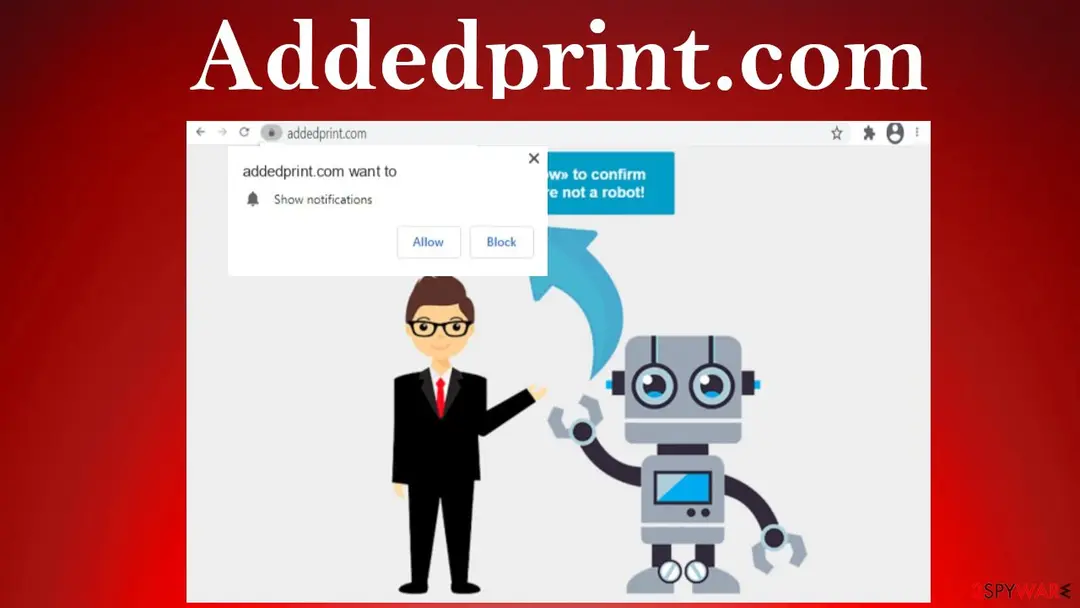
Addedprint.com ads: summary
| Distribution | Deceptive ads, software bundling, fake Flash Player updates |
|---|---|
| Damage | Installation of other PUPs, malware infections |
| name | Addedprint.com |
| type | PUP, adware, redirect virus |
| IP address | 104.21.61.125 |
| Purpose | Gain revenue from redirecting users to affiliated portals |
| Removal | Scan the PC with security software to find and remove the malware and anything installed with it. Fortect scans Windows for malware and repairs the system files and settings it damaged. Remove it nowTo use the full-featured product, you have to purchase a license for Fortect. The scan is free. |
Show 10 more facts
| Symptoms | Ads displayed as notifications, sudden redirects occur landing you on questionable pages, slower browsing speed |
|---|---|
| Detection names | No Microsoft detection name is known |
| Name | Addedprint.com |
| Type | Ad redirect domain |
| Evidence | 4 write-ups by security sites; details still limited |
| Domains | addedprint.com |
| Ads shown as | Redirects through ad pages |
| Browsers | Chrome, Edge and Firefox |
| First seen | 23 March 2021 |
| Facts checked | 6 October 2026 |
Is Addedprint.com ads dangerous?
From our report of Mar 2021 · not reviewed since
Addedprint.com – a website that users are forced to visit when a PUP is infecting their devices
Addedprint.com is a dangerous website that seeks to deceive people into subscribing to its notifications by showing various misleading prompts.
As soon as you push the Allow button, the shady site will start showing you ads directly on your screen or desktop.
In many cases, Addedprint.com ads can't be closed by simply pushing the "X" button. If you do that, you might get redirected to affiliated sites as if you clicked the ad itself. The worst part is that the affiliated sites might have various malicious intentions. Thus it would help if you never accepted push notifications from shady sites.
Adware, browser hijacker, or other potentially unwanted programs (PUPs for short) are most likely responsible for making you visit questionable sites. Please don't panic as they're not as dangerous as malware, but you should still remove any of them swiftly.
New push notification sites with ill intentions are constantly created. The latest ones, apart Addedprint.com, include Time4news.net, Captcha-sourcecenter.com, News-central.org. They might have catchy names to trick users into subscribing to their notifications, but people still don't visit such sites willingly.
That's where adware and other PUP developers step in to promote them. Although shady portals like Addedprint.com don't function very long, they're taken down as soon as they're flagged as dangerous. Still, many people can get tricked to press the Allow button and then suffer the consequences.
One of which is Addedprint.com ads, which are displayed in the form of notifications and appear directly on your desktop or screen. As we've stated before, they can be impossible to close, as the clicking of the "X" button could trigger a redirect to an affiliated site as if you've pressed the ad itself.
What's even more disturbing is that Addedprint.com redirect can land you on sponsored pages without you even pressing on any ads. Shady websites commonly advertise other questionable portals alike, so you might be forced to visit pages with dubious contents, including but not limited to:
Therefore you should remove Addedprint.com along with any PUPs or malware immediately. According to many user reviews, the best free tools for automatic threat elimination are and . All you need to do is download either of these apps, perform a full system scan, and let the security tool do what it's supposed to.
Since PUPs and questionable websites leave a lot of traces on your machines, IT experts highly advise using the time-proven tool to fix any system irregularities. If they're left unattended, your device might exhibit various strange behavior such as BSoDs, freezing, sluggish performance, etc.
- other push notification sites,
- PUPs,
- malware,
- porn,
- gambling,
- various scams.


From our report of Mar 2021 · not reviewed since
Watch out for additional apps when installing software from a bundle
Potentially unwanted apps, such as browser hijackers, unwanted toolbars, adware, and others, are distributed using various stealthy techniques, including fake Flash Player updates, deceptive ads, etc. But one of the most popular PUP spreading methods is via software bundles.
These are packs of software containing installers for more than one apps. And the trick is that all programs are preselected for installation. Thus if you rush and choose the Standard, Recommended, Quick installation mode, when prompted, all of them are automatically installed.
The key is to take your time when getting new software. Pick the Advanced or Custom installation mode and then go step-by-step, removing ticks from all apps that you're not willing to install. If you're on the fence about any of them, do a web search, or better yet, check if we didn't write about it.

From our report of Mar 2021 · not reviewed since
More from our earlier report on Addedprint.com
- If any symptoms of irregular performance are spotted, you must perform a full system scan with dependable anti-malware software
Check your browser and PC
- Address:
addedprint.com
How to remove Addedprint.com ads
How to stop the Addedprint.com redirects
Work in this order and test a few links after each step, so you know which one was the cause.
Step 1: Check the browser's extensions
Redirects to
addedprint.comon sites that normally behave mean something in the browser is sending you there. In Chrome openchrome://extensions, in Edge edge://extensions, in Firefox the menu > Extensions and themes.Remove every extension you do not remember adding, especially new tab, search, coupon, PDF or video downloader add-ons. The extension pages look the same on Windows 11 and Windows 10.
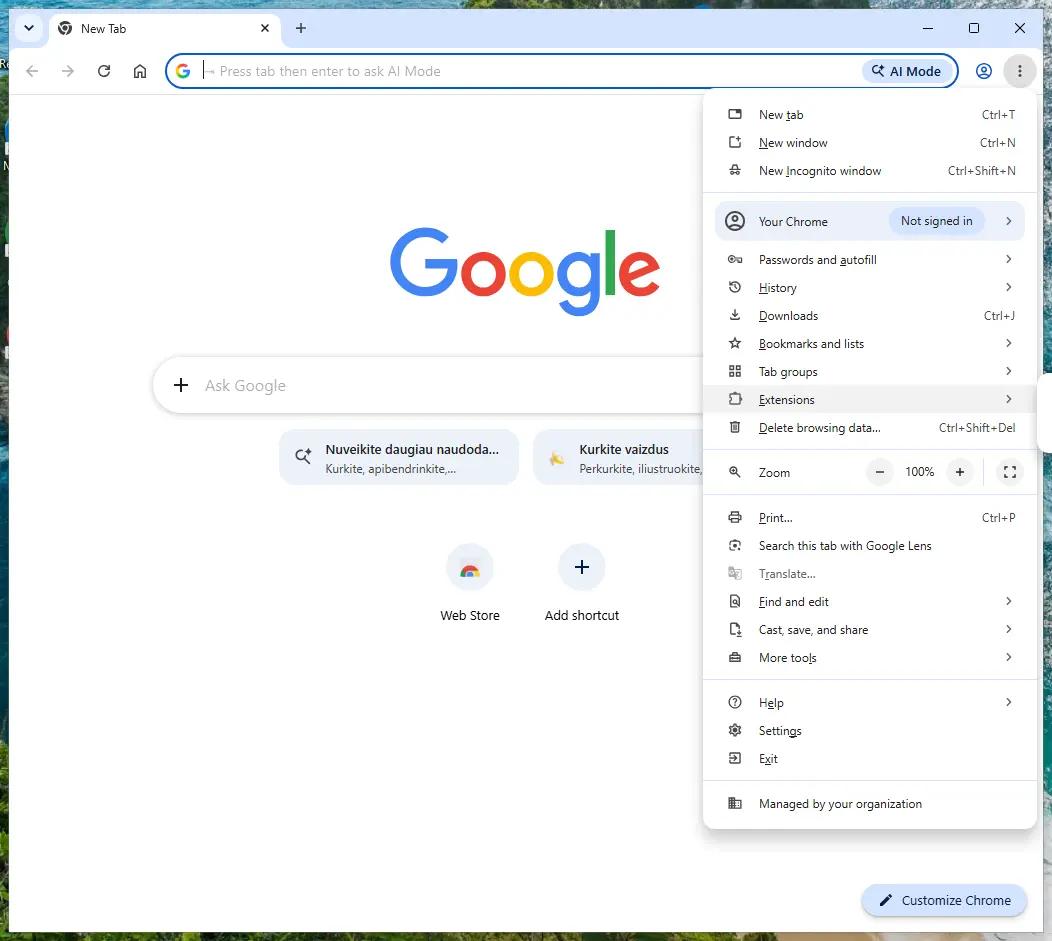
Chrome on Windows 11: More > Extensions > Manage extensions. Full procedure with screenshots: Remove a browser extension
Step 2: Reset the browser if the redirects continue
If
addedprint.comstill opens after the extensions are gone, put the browser's settings back to their defaults. In Chrome open Settings > Reset settings > Restore settings to their original defaults; in Edge Settings > Reset settings; in Firefox Help > More troubleshooting information > Refresh Firefox.Tip: Bookmarks and saved passwords stay, while site permissions, the start page and the search engine are reset.
Redirects that survive a reset in every browser point to a program installed in Windows 11 or Windows 10, so uninstall anything you do not recognise in Settings > Apps > Installed apps.
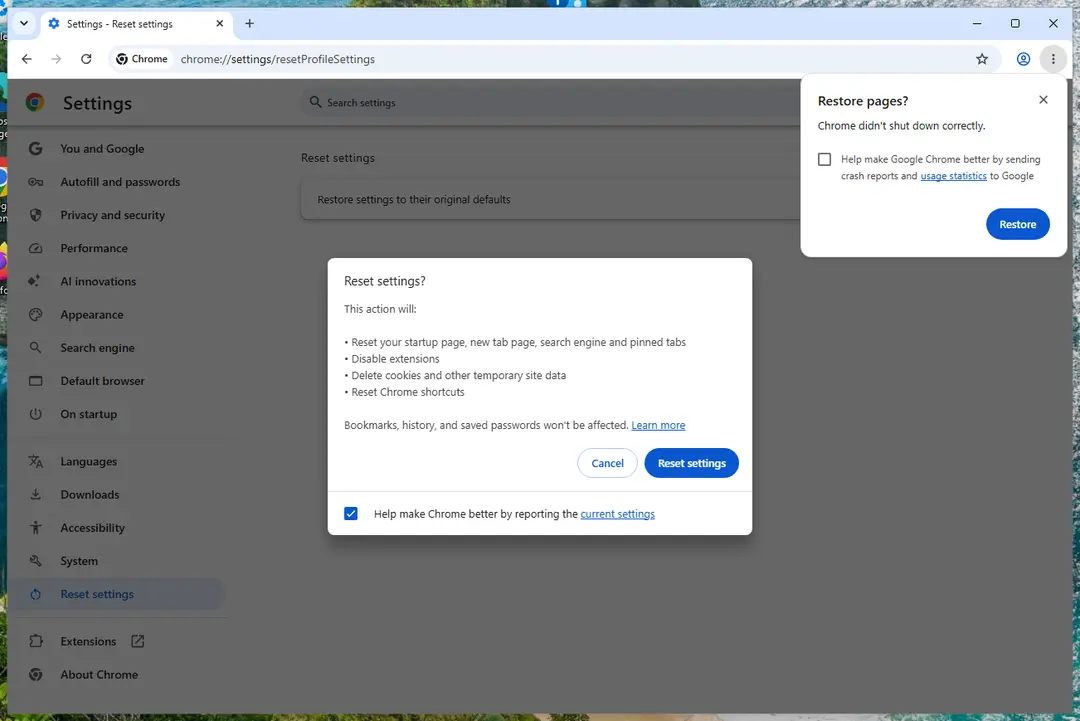
Chrome on Windows 11: Settings > Reset settings. Full procedure with screenshots: Reset a browser and fix a hijacked search engine
Step 3: Scan the PC if you downloaded anything from the ads
If you only saw the notifications and clicked nothing, you can stop before this step. If a notification led you to download or run something, delete that file, then scan Windows.
In Windows Security > Virus & threat protection > Scan options, run a Full scan, then choose Microsoft Defender Antivirus (offline scan) and Scan now. The offline scan restarts the PC and takes about 15 minutes on Windows 11 and Windows 10.
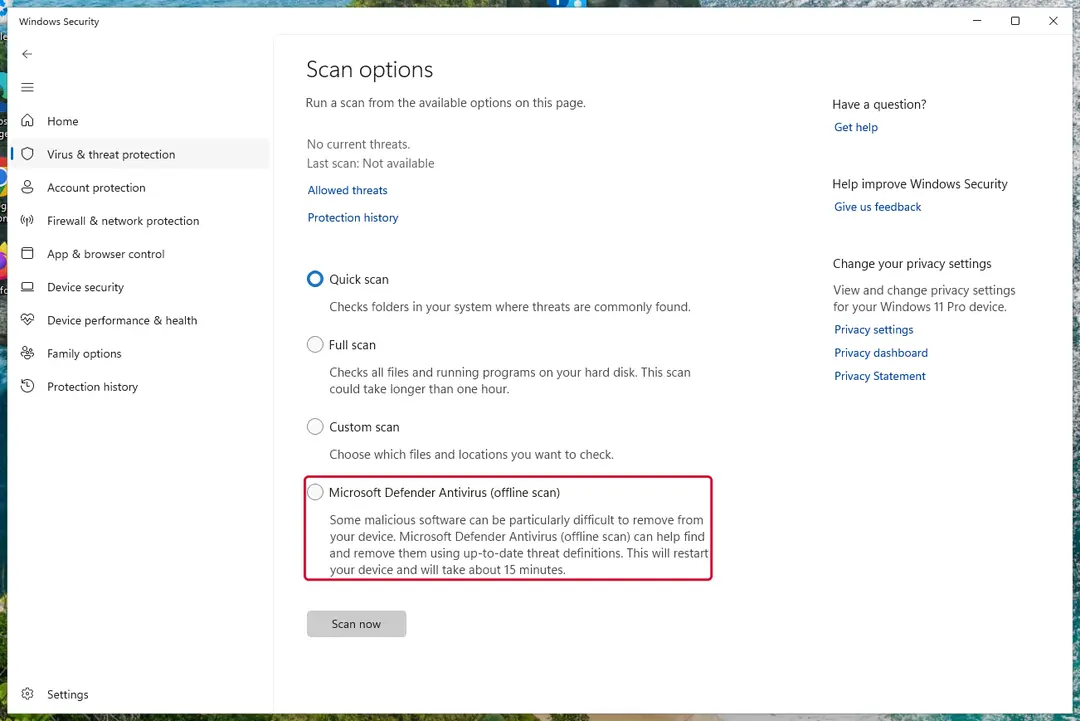
Windows 11: Windows Security > Virus & threat protection > Scan options. Full procedure with screenshots: Run a Microsoft Defender Offline scan
Instructions for each browser and system
The detailed steps for every browser and system this guide covers. Open the one you use.
Uninstall from Windows
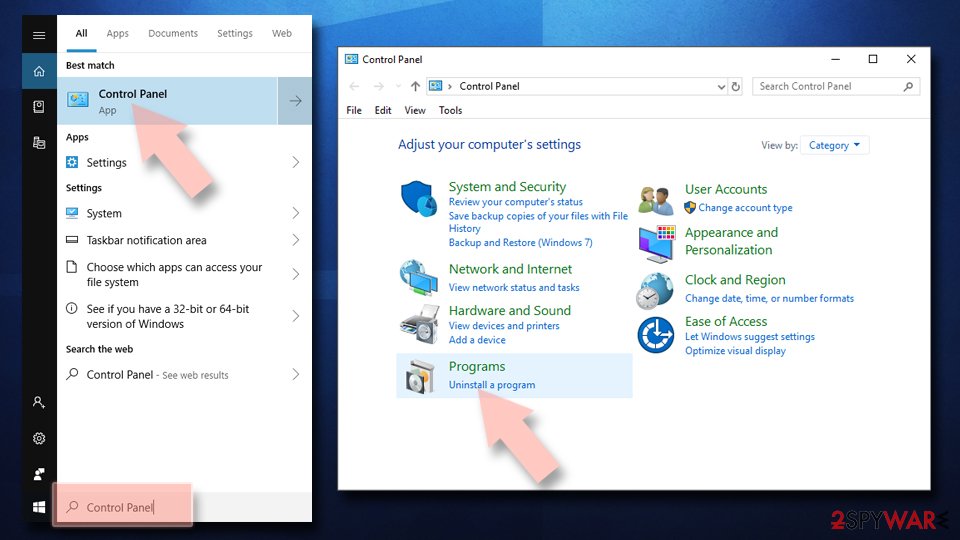
Uninstall from Windows 10/8:
- Type Control Panel into the Windows search box and open the result.
- Under Programs, select Uninstall a program.
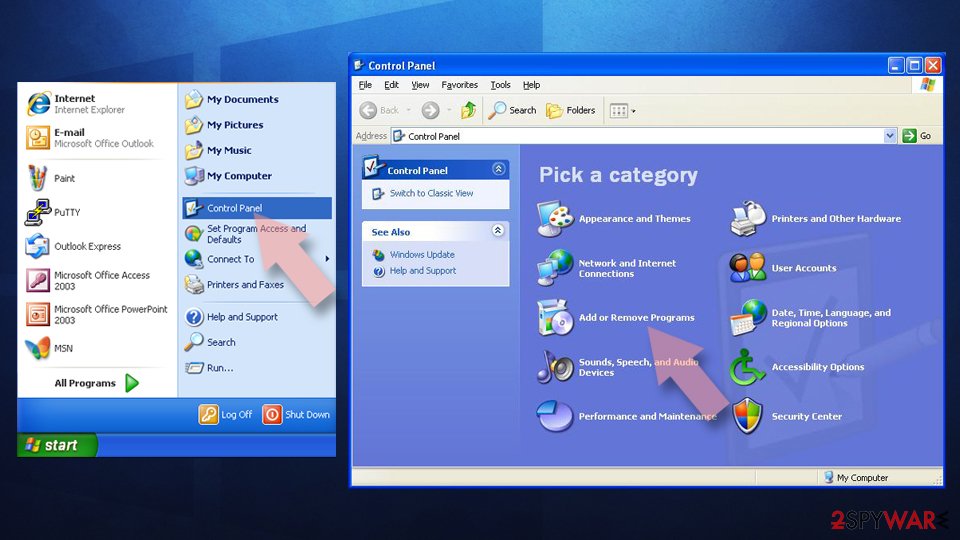
Uninstall from Windows 7/XP:
- Click on Windows Start > Control Panel (Windows XP users should click on Add/Remove Programs).
- In Control Panel, select Programs > Uninstall a program.
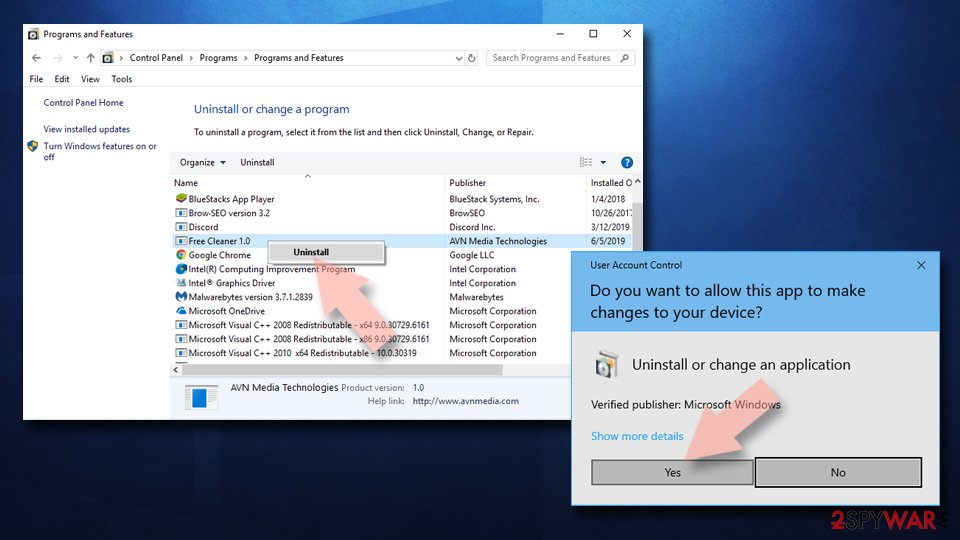
Remove the unwanted program:
- In the Programs and Features window, look for any recently installed suspicious entries, select them, and click Uninstall.
- If User Account Control appears, click Yes to confirm, then complete the removal.
Remove from Google Chrome
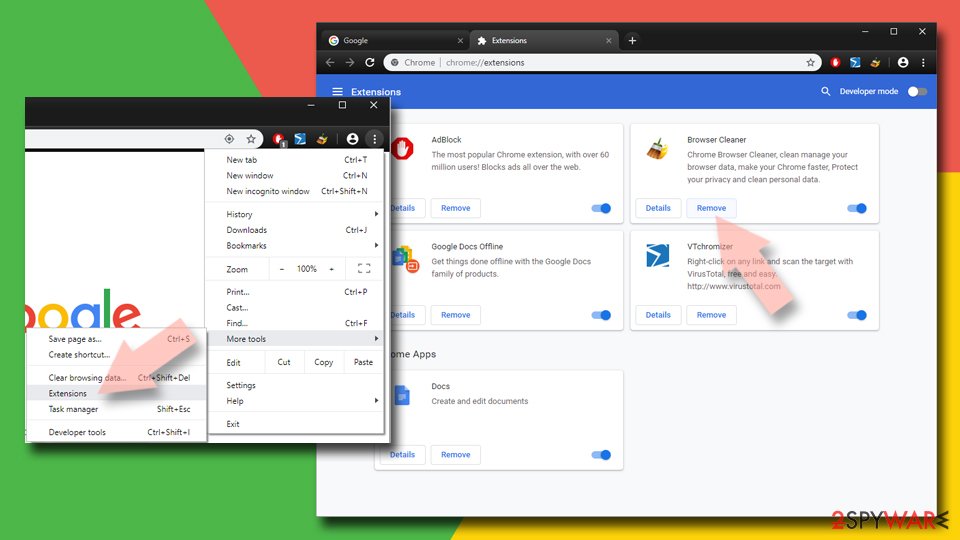
Delete malicious extensions from Google Chrome:
- Open Google Chrome, click on the Menu (three vertical dots at the top-right corner) and select More tools > Extensions.
- In the newly opened window, you will see all the installed extensions. Uninstall all suspicious extensions related to the unwanted program by clicking Remove.
Clear cache and web data from Chrome:
- Click on Menu and pick Settings.
- Under Privacy and security, select Clear browsing data.
- Select Browsing history, Cookies and other site data, as well as Cached images and files.
- Click Clear data.
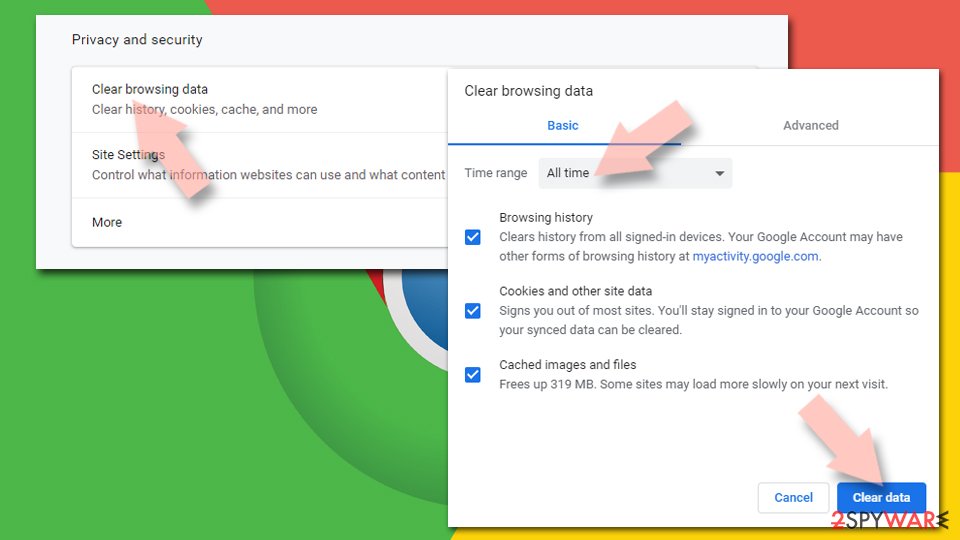
Change your homepage:
- Click menu and choose Settings.
- Look for a suspicious site in the On startup section.
- Click on Open a specific or set of pages and click on three dots to find the Remove option.
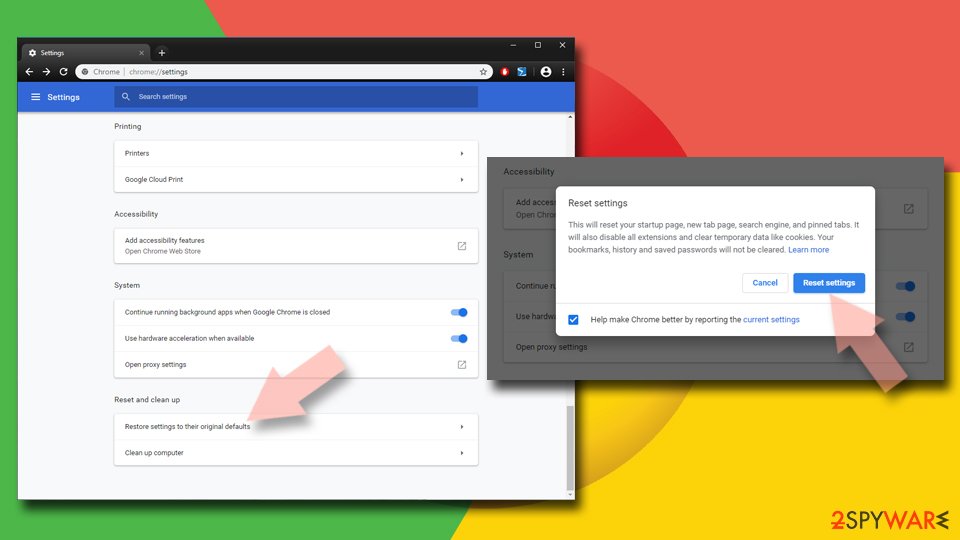
Reset Google Chrome:
If the previous methods did not help you, reset Google Chrome to eliminate all the unwanted components:
- Click on Menu and select Settings.
- In the Settings, scroll down and click Advanced.
- Scroll down and locate Reset and clean up section.
- Now click Restore settings to their original defaults.
- Confirm with Reset settings.
Remove from Microsoft Edge
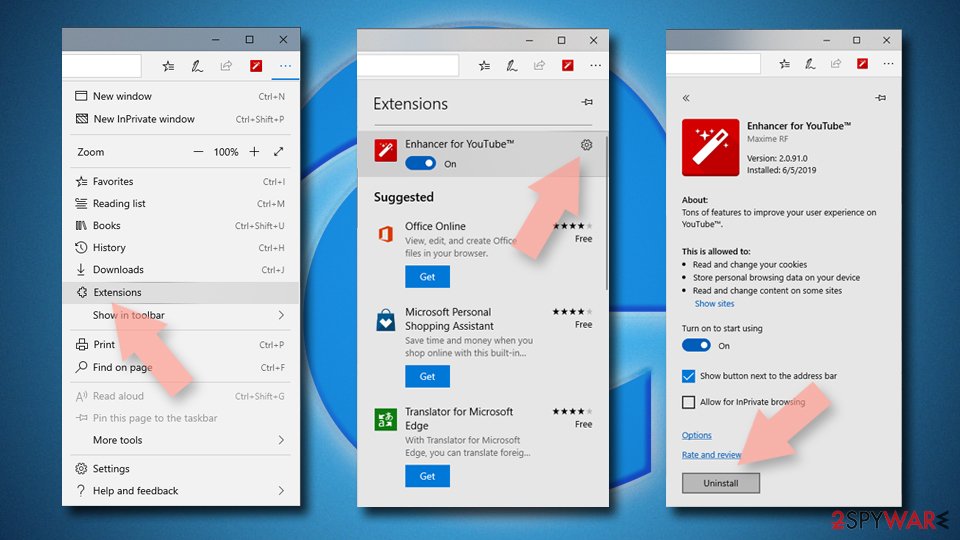
Delete unwanted extensions from MS Edge:
- Select Menu (three horizontal dots at the top-right of the browser window) and pick Extensions.
- From the list, pick the extension and click on the Gear icon.
- Click Remove.
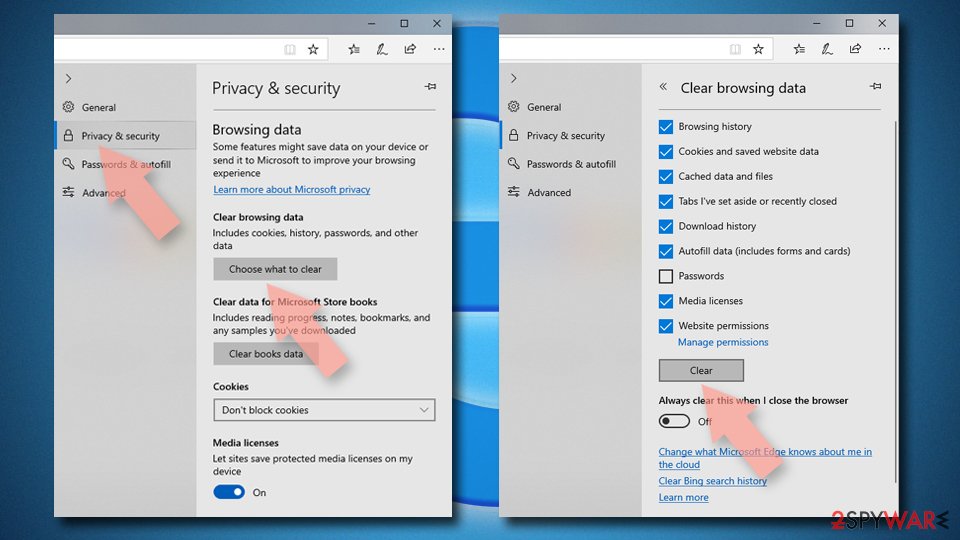
Clear cookies and other browser data:
- Click on the Menu (three horizontal dots at the top-right of the browser window) and select Settings > Privacy, search, and services..
- Under Clear browsing data, pick Choose what to clear.
- Select Cookies and other site data and Cached images and files. (apart from passwords, although you might want to include Media licenses as well, if applicable) and click on Clear.
Restore new tab and homepage settings:
- Click the menu icon and choose Settings.
- Then find On startup section.
- Click Remove next to any suspicious startup page.
Reset MS Edge if the above steps did not work:
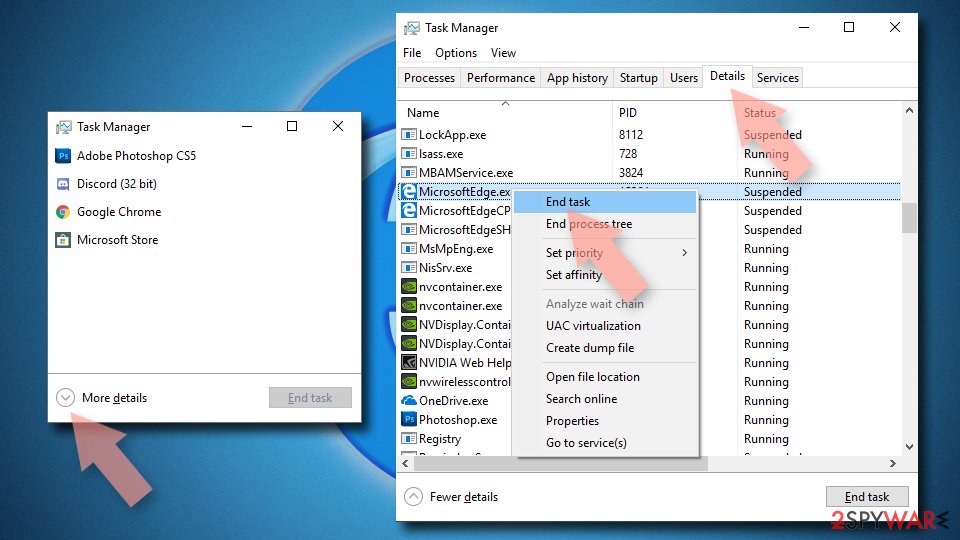
- Press on Ctrl + Shift + Esc to open Task Manager.
- Click on More details arrow at the bottom of the window.
- Select Details tab.
- Now scroll down and locate every entry with Microsoft Edge name in it. Right-click on each of them and select End Task to stop MS Edge from running.
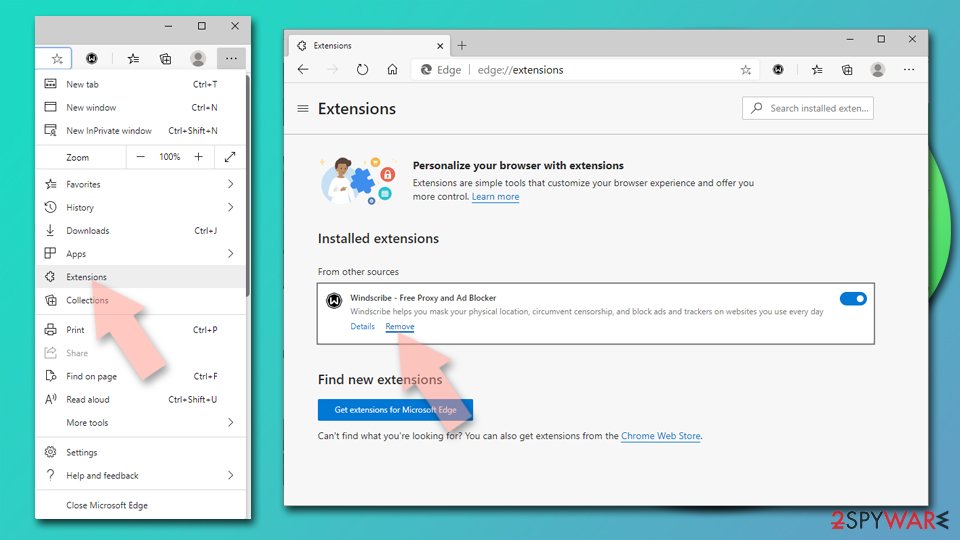
Delete extensions from MS Edge (Chromium):
- Open Edge and click select Settings > Extensions.
- Delete unwanted extensions by clicking Remove.
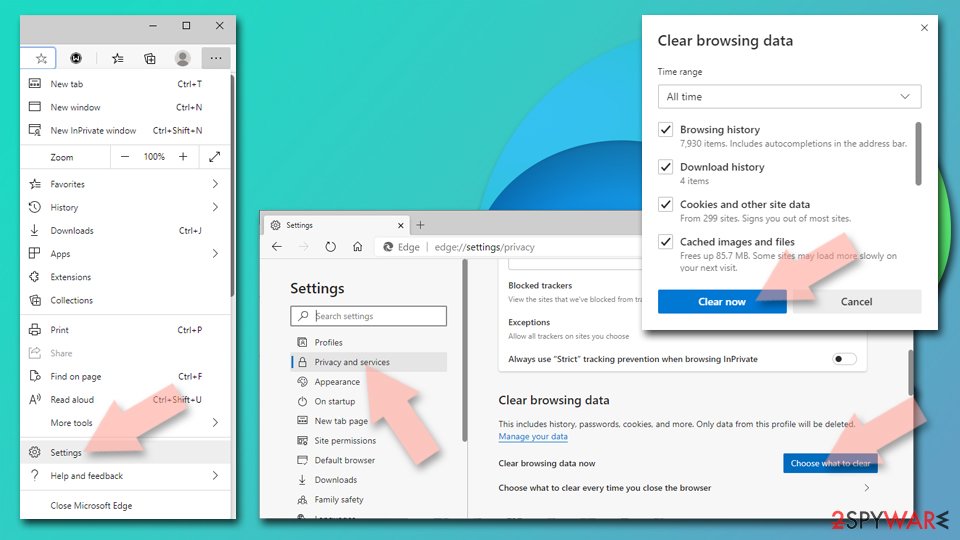
Clear cache and site data:
- Click on Menu and go to Settings.
- Select Privacy, search and services.
- Under Clear browsing data, pick Choose what to clear.
- Under Time range, pick All time.
- Select Clear now.
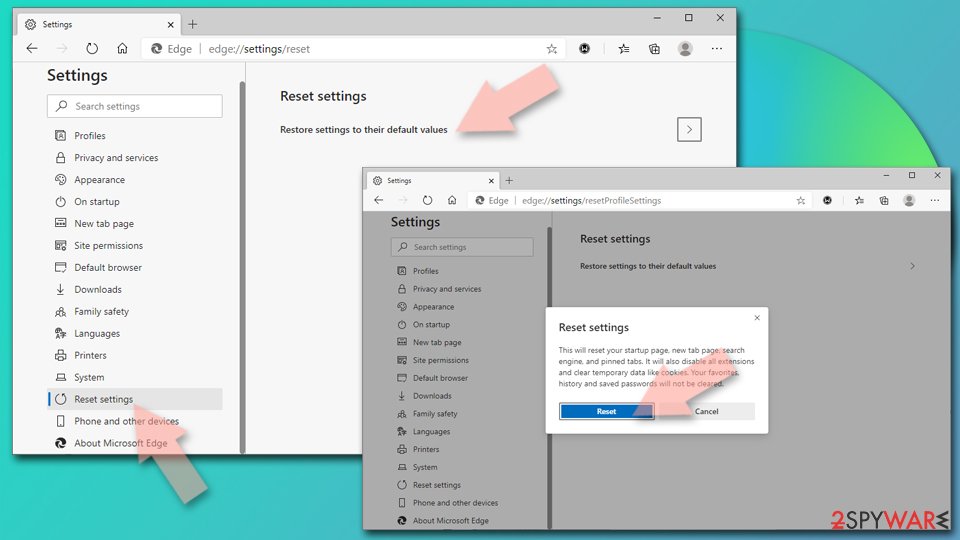
Reset Chromium-based MS Edge:
- Click on Menu and select Settings.
- On the left side, pick Reset settings.
- Select Restore settings to their default values.
- Confirm with Reset.
- This will disable extensions and reset startup pages but will not delete bookmarks, saved passwords, or browsing history.
Remove from Mozilla Firefox (FF)
Remove dangerous extensions:
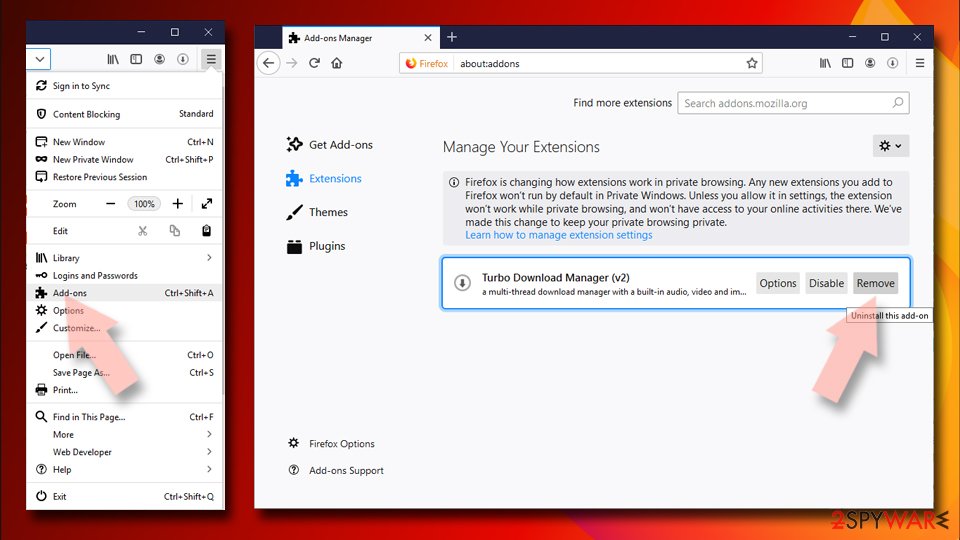
- Open Mozilla Firefox browser and click on the Menu (three horizontal lines at the top-right of the window).
- Select Add-ons.
- In here, select the unwanted extension and click Remove.
Reset the homepage:
- Click three horizontal lines at the top right corner to open the menu.
- Choose Settings.
- Under Home, set your preferred homepage and new tab settings.
Clear cookies and site data:
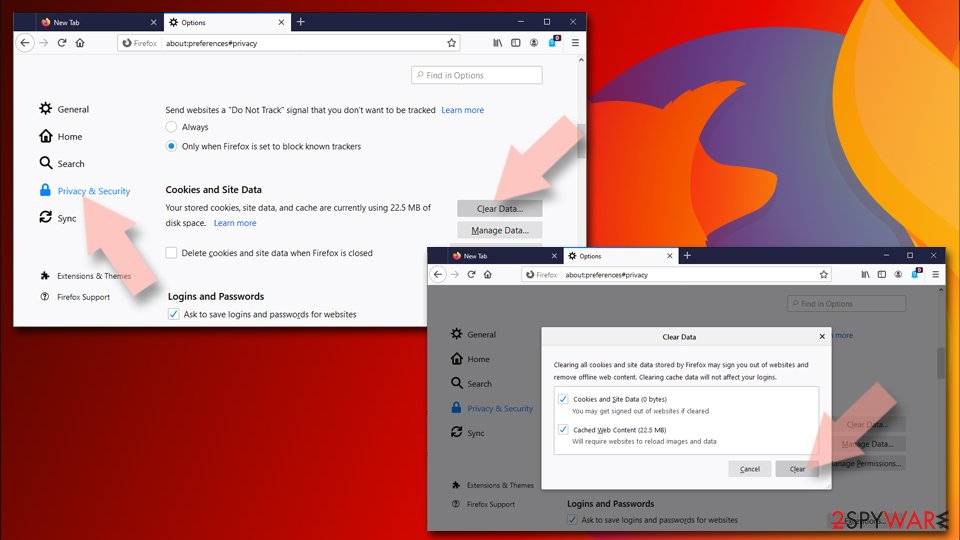
- Click Menu and pick Settings.
- Go to Privacy & Security section.
- Scroll down to locate Cookies and Site Data.
- Click on Clear Data...
- Select Cookies and Site Data and Temporary cached files and pages, then click Clear.
Reset Mozilla Firefox
If clearing the browser as explained above did not help, reset Mozilla Firefox:
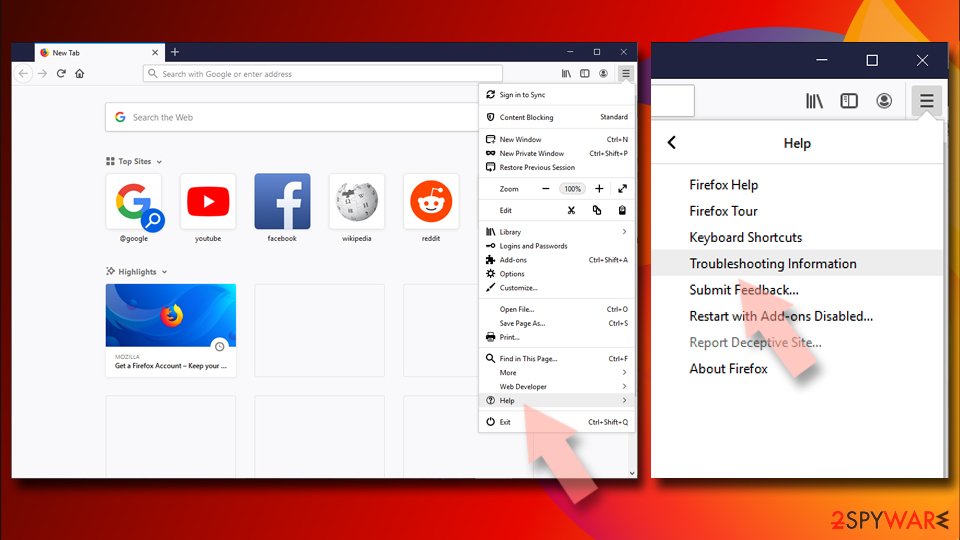
- Open Mozilla Firefox browser and click the Menu.
- Go to Help and then choose Troubleshooting Information.
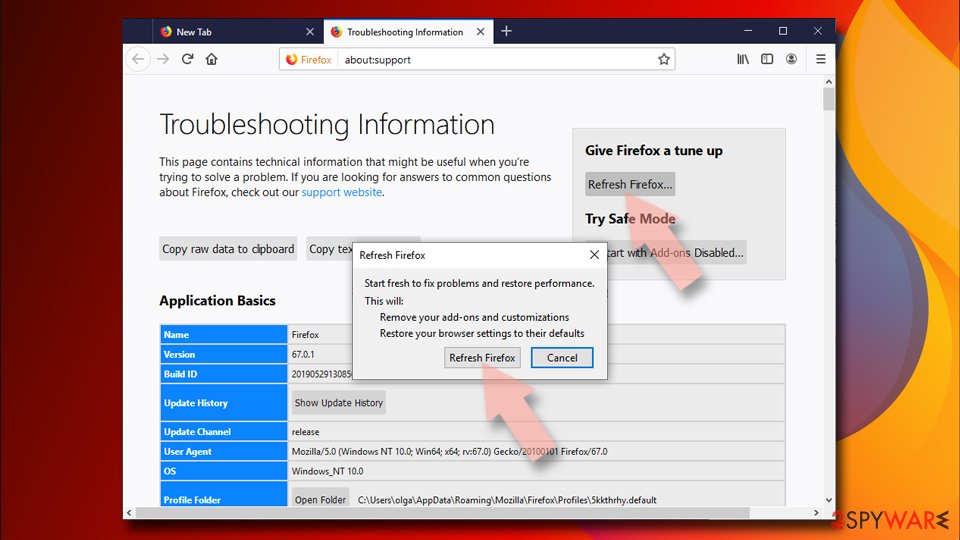
- Under Give Firefox a tune up section, click on Refresh Firefox...
- Once the pop-up shows up, confirm the action by pressing on Refresh Firefox.
Delete from Safari
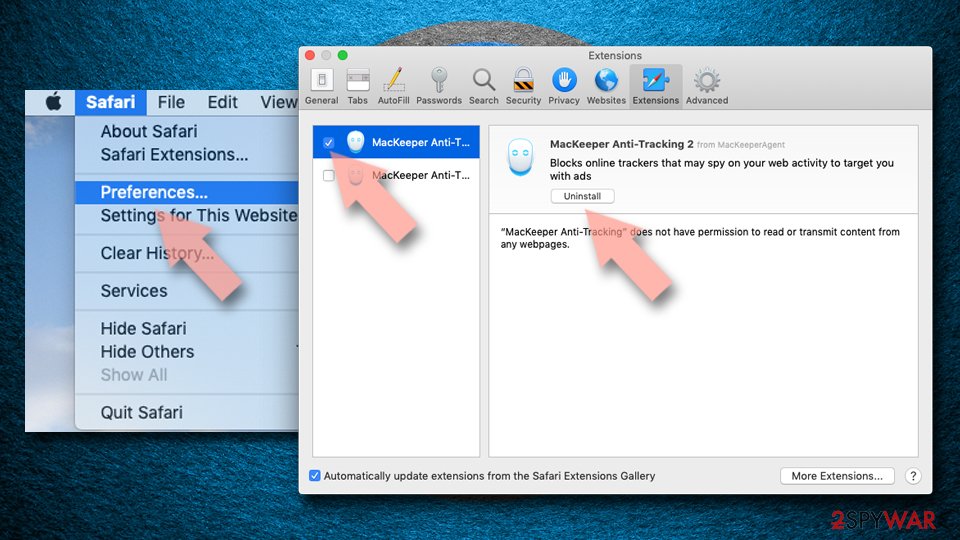
Remove dangerous extensions:
- Open Safari, click Safari in the menu at the top-left of the screen, and select Preferences.
- Go to the Extensions tab, look for any suspicious entries, and click Uninstall to remove them.
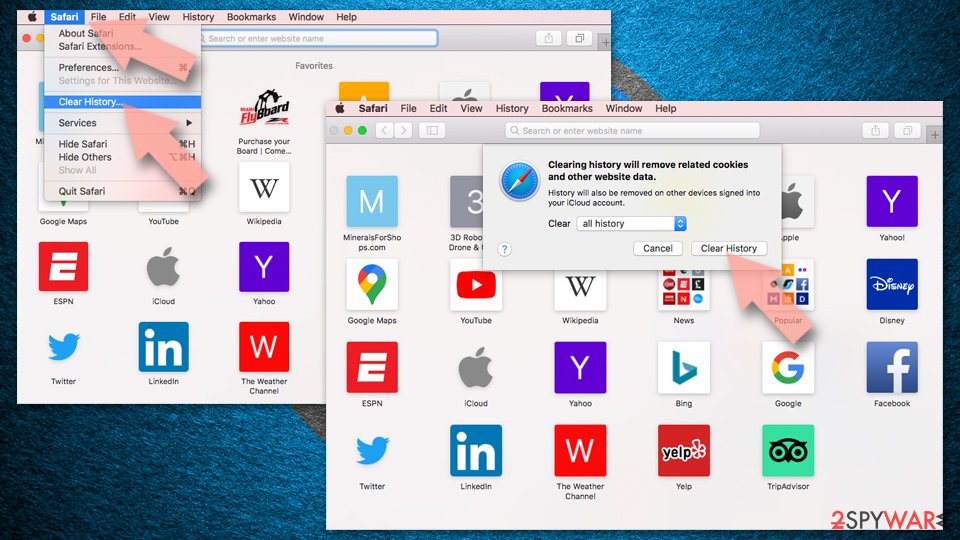
Clear history and website data:
- Click Safari in the menu and pick Clear History.
- Set Clear to all history and confirm with Clear History.
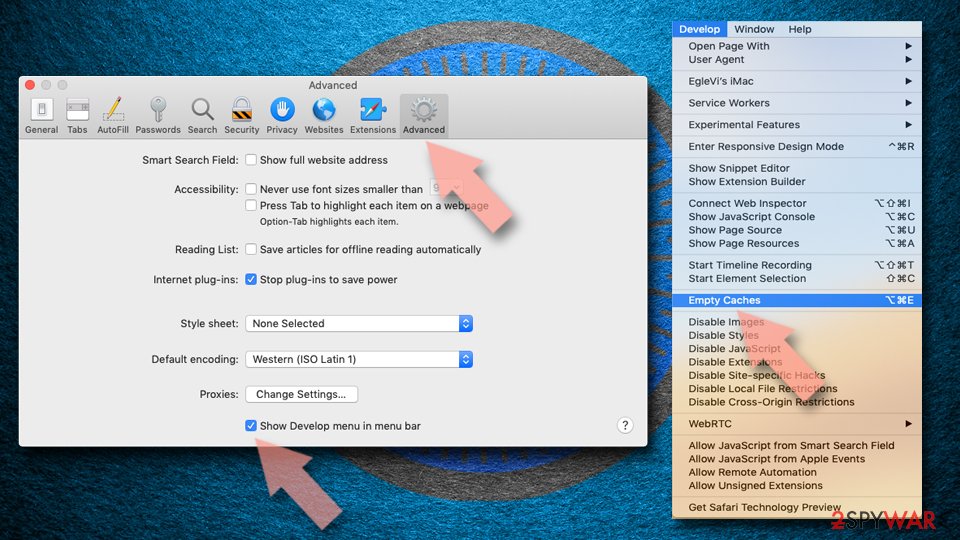
Reset Safari:
- Click Safari in the menu and select Preferences > Advanced.
- Enable Show Develop menu in menu bar.
- From the menu bar, click Develop and select Empty Caches.
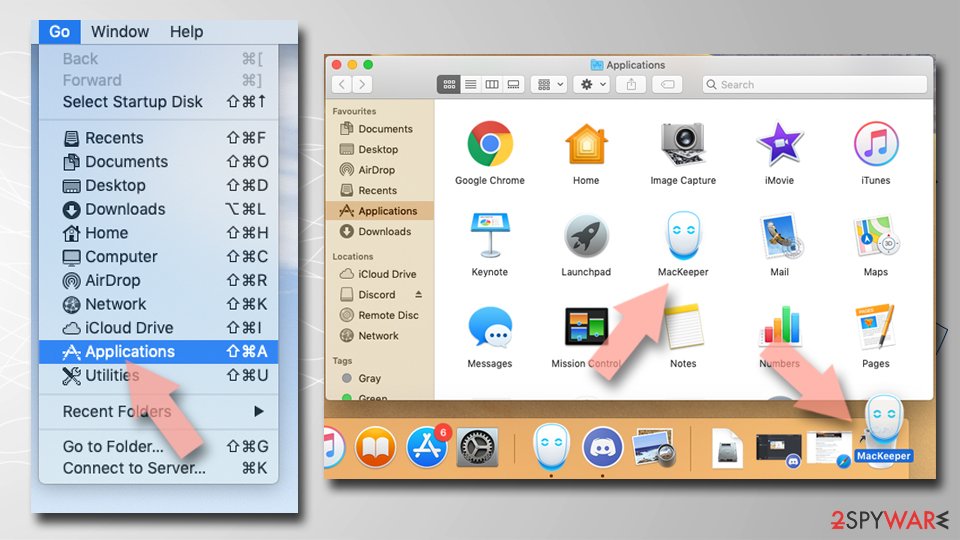
Delete from macOS
Remove the unwanted application:
- From the menu bar, select Go > Applications.
- In the Applications folder, look for any suspicious entries, then drag them to Trash (or right-click and pick Move to Trash).
Delete leftover files and folders:
- Select Go > Go to Folder.
- Enter /Library/Application Support and remove any suspicious folders related to the unwanted program.
- Repeat the same check in the /Library/LaunchAgents and /Library/LaunchDaemons folders, deleting any suspicious entries.
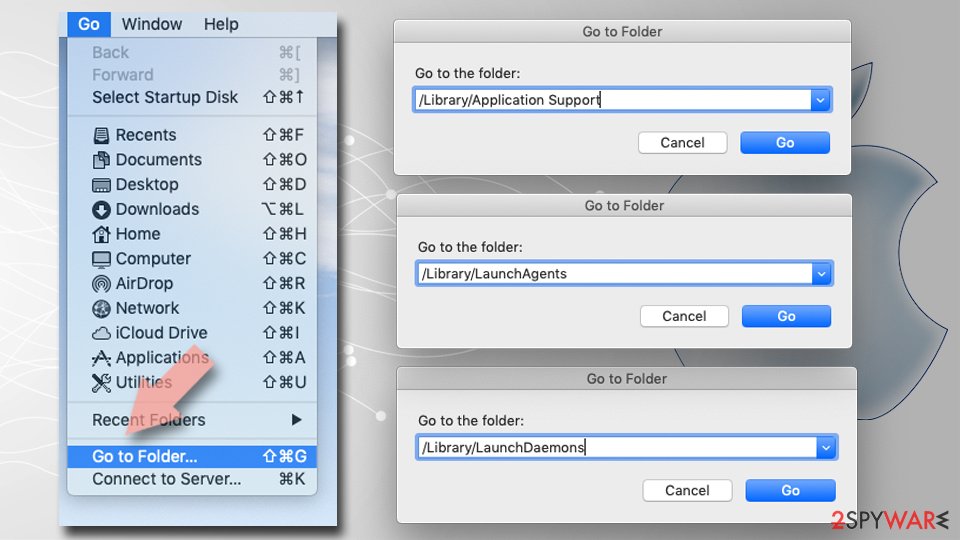
- Finally, empty the Trash to permanently remove the leftovers.
Uninstall from Android
Uninstall unwanted programs from Android device:
- Go to Settings -> Apps/Applications.
- Expand the full list of the installed apps.
- Scroll through the list and tap on a suspicious application once.
- Tap on it and select Uninstall.
- If the Uninstall option is unavailable, the app may require additional permissions to be revoked first.
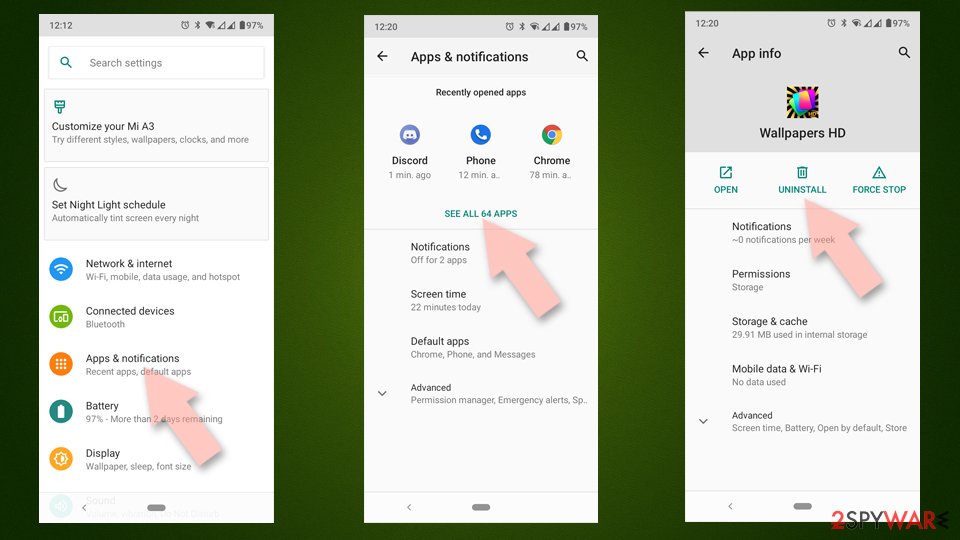
- Reboot the device.
Clear storage and cache for Google Chrome or other apps::
- Go to Settings > Apps/Applications.
- Expand the full list of the installed apps.
- Tap on Chrome and select Storage & cache.
- Clear storage and clear cache of the app.
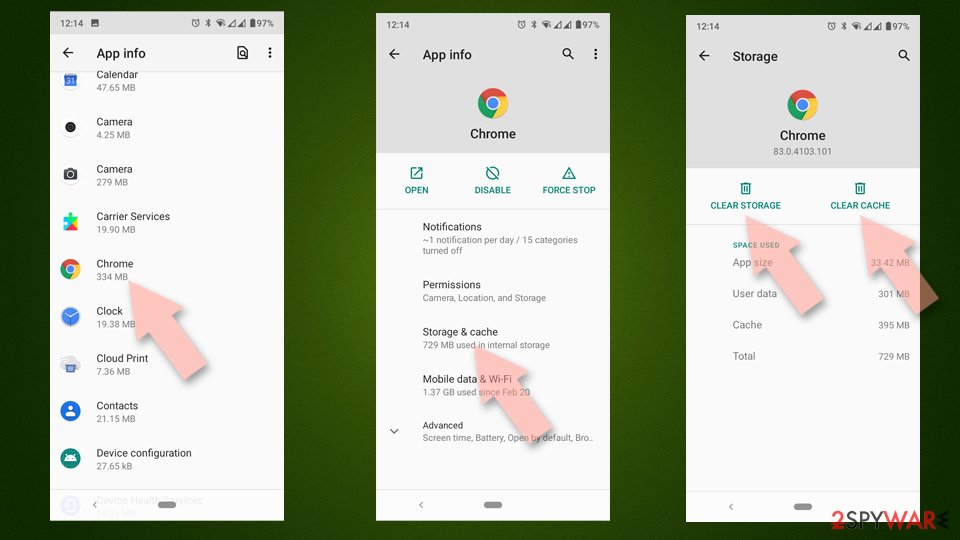
If you are seeing ads on top of other apps but are not sure what is causing it, perform the following steps:
- Go to Apps/Applications.
- Select Special App access.
- Tap on Display over other apps.
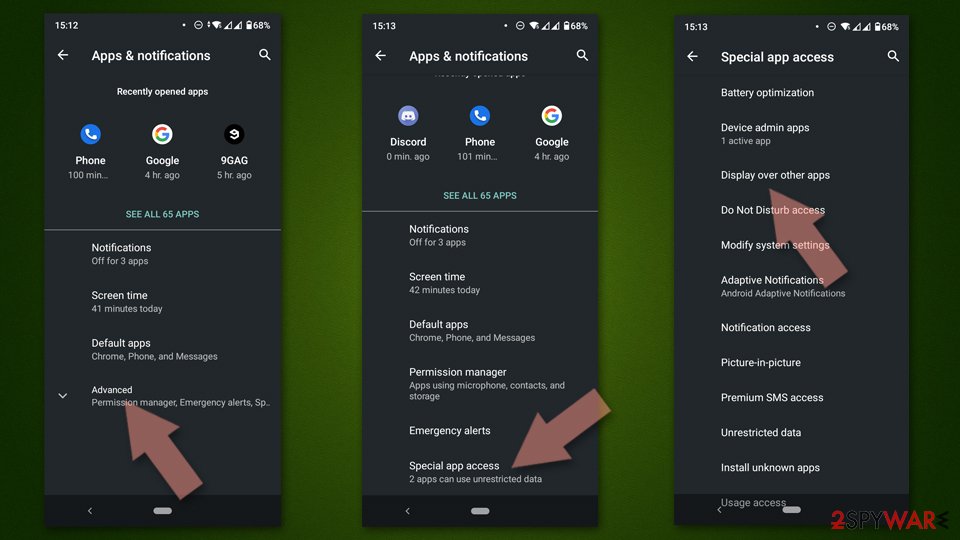
- Eliminate apps with these access rights enabled.
Stop browser notifications
Do not let government spy on you
The government has many issues in regards to tracking users' data and spying on citizens, so you should take this into consideration and learn more about shady information gathering practices.
Avoid any unwanted government tracking or spying by going totally anonymous on the internet.
You can choose a different location when you go online and access any material you want without particular content restrictions. You can easily enjoy internet connection without any risks of being hacked by using VPN.
Control the information that can be accessed by government any other unwanted party and surf online without being spied on. Even if you are not involved in illegal activities or trust your selection of services, platforms, be suspicious for your own security and take precautionary measures by using the VPN service.
Backup files for the later use, in case of the malware attack
Computer users can suffer from data losses due to cyber infections or their own faulty doings.
Ransomware can encrypt and hold files hostage, while unforeseen power cuts might cause a loss of important documents. If you have proper up-to-date backups, you can easily recover after such an incident and get back to work. It is also equally important to update backups on a regular basis so that the newest information remains intact - you can set this process to be performed automatically.
When you have the previous version of every important document or project you can avoid frustration and breakdowns. It comes in handy when malware strikes out of nowhere. Use for the data restoration process.
From our report of Mar 2021 · not reviewed since
Guidelines to safely remove Addedprint.com virus within minutes
Push notification sites such as Addedprint.com virus could bring only harm both to you and your device in-use.
Such shady websites are developed to promote various affiliated portals with ill intentions. They could try to draw out your private details, lure you into gambling, infect your machines with PUPs, or even malware.
That's why you shouldn't hesitate for a second before downloading a proper anti-malware tool and scanning your entire device system. A trustworthy security tool will detect, isolate and remove Addedprint.com automatically. Remember to keep its virus signatures updated so it could spot the latest infections.
If you accepted notifications from this dangerous site, use our Addedprint.com removal guides from browsers (Safari, Firefox, Chrome, etc.) posted below. And lastly, take care of your system's overall health by performing system diagnostics with compatible tools.
Questions about Addedprint.com ads
How do I stop addedprint.com from opening?
Find and remove whatever opens it. Start with the browser's extensions page and remove anything you do not remember adding. Next, open the notification settings and take away permission from sites you do not recognise.
Then check Settings > Apps > Installed apps for programs added around the day the redirects began, and uninstall those. Restart the browser and test a few links after each step.
If addedprint.com still appears, reset the browser, which restores the default search engine, start page and permissions without deleting bookmarks or saved passwords. Redirects that survive a reset in every browser point to a program in Windows, and a full scan is the next step.
Should I worry about redirects to addedprint.com?
Worry less about addedprint.com itself and more about what keeps sending you there. A single redirect from a free streaming or download site is normal and harmless once the tab is closed.
Repeated redirects on sites that used to work fine mean something in the browser or in Windows changed, often an extension or program installed alongside other software. It may also collect the pages you visit. Remove the cause with the steps in this guide, and do not act on anything the redirected pages ask:
- no Allow clicks
- no downloads
- no calls
If you already did one of those, the matching section of this guide explains what to do next.
Why does Addedprint.com show me ads?
Because that is its whole purpose. Addedprint.com is an ad redirect domain, and its operators are paid for every ad it displays and every click it gets. In this case the ads take the form of redirects through ad pages.
They are chosen by ad networks that accept almost any advertiser, which is why so many look like warnings or prizes. The ads are not a sign that your PC is broken or infected with something worse; they are a sign that something on it, or in the browser, has permission to advertise. Removing that permission or program stops them.
Is addedprint.com safe to visit?
No. The site addedprint.com exists to push visitors towards ads, and the pages it leads to include fake virus warnings, fake updates, prize scams and notification prompts. Visiting it once does not infect an up-to-date PC, but anything you click or download there is a gamble.
Do not enter personal details, do not allow notifications and do not call phone numbers it shows. If it opens by itself, close the tab and check the browser's extensions and notification permissions. Blocking the single domain helps little, because the operators register new names regularly.
Do I have to clean every browser?
Yes, if you use more than one. We saw Addedprint.com in Chrome, Edge and Firefox, and each browser keeps its own extensions, notification permissions and settings. Chrome and Edge share the same extension format, so one installer can add the same adware to both, while Firefox has its own add-ons.
Check every browser on the PC, including ones you rarely open. If you sync a browser with an account, clean it while signed in, so that the removal reaches your other computers rather than the adware returning from them.
How do I know the ads come from Addedprint.com?
Look for redirects to addedprint.com. That is the trace Addedprint.com leaves, and it shows up as redirects through ad pages. Ads that appear on every site, including ones that never carried ads before, point to something on your PC or in the browser rather than to the sites themselves.
A quick test is a private window, where extensions are off by default: if the ads disappear there, an extension is responsible. If they appear even with the browser closed, the source is a notification permission or a program in Windows.
Why didn't my antivirus catch Addedprint.com?
Many security products do not block adware or notification sites by default, because users often agreed to them, even through a misleading prompt. Notification spam installs nothing at all, so there is no file to detect.
In Windows 11 you can make Microsoft Defender block potentially unwanted apps: open Windows Security > App & browser control > Reputation-based protection settings and turn on Potentially unwanted app blocking. If notifications caused the pop-ups, no scanner will report them; the fix is in the browser's site settings.
Can adware slow down my PC?
Yes. Adware runs in the background, loads ad scripts, opens extra tabs and contacts its servers, all of which use processor time, memory and bandwidth. Ad-heavy extensions also slow down every page, because they inspect and change it before you see it.
The effect is strongest on older PCs and when several adware programs arrived together. After removal, restart the PC and check Task Manager for anything still using a lot of resources that you do not recognise. Speed usually returns to normal once the ads stop.
Does adware steal passwords?
Ordinary adware is built to show ads, not to steal logins, and most of it never touches saved passwords. The line is blurry, though. Extensions that can read every page could capture what you type, and adware ads sometimes lead to phishing pages that ask for passwords directly.
If you entered credentials on a page reached through an ad, change that password from a clean device and turn on two-step verification. Otherwise, removing ad redirect domain and clearing cookies is usually enough.
Will Fortect remove Addedprint.com?
Fortect scans Windows for malware and unwanted programs and repairs the system files and settings they change, and its free scan shows what it finds on your PC before you decide anything.
For Addedprint.com, follow the plan above as well: the browser steps take back permissions and settings that no scanner treats as a threat, and uninstalling the program that brought it removes the source.
Run Microsoft Defender's full scan and, if anything was found, its offline scan as a second opinion. If the symptoms are gone after the plan and both scans are clean, there is nothing more to do.
Sources
- Howtogeek: Everything You Need To Know About the Blue Screen of Death (read October 6, 2026)
- Wikipedia: Software (read October 6, 2026)
- Google Chrome Help: Use notifications to get alerts (no longer online) (read October 6, 2026)
- FTC: How to recognize, remove and avoid malware (read October 6, 2026)
- Microsoft Learn: Microsoft Defender Offline (read October 6, 2026)