
Best-Lucky-Cat.xyz ads: what they are and how to stop them
Best-Lucky-Cat.xyz is a web address that our 2022 report found showing fake prize and gift-card pages; on our October 2026 visit it showed only a for-sale page. Nothing is installed on your PC by the address itself; take back any notification permission in your browser, as shown below.
Facts checked October 6, 2026. Removal steps tested on Windows 11 (26H2) and checked against Microsoft's and the browser makers' current documentation.
Automatic
Get a free scan and check if your PC is infected.
Fortect finds malware, unwanted programs and the Windows damage they leave behind, and repairs it in one pass.
If notifications from best-lucky-cat.xyz led you to download something, a free scan can check the PC for anything that came with it.
Do it yourself · free Remove Best-Lucky-Cat.xyz yourself 2 steps, about 6 minutes, no software needed.
Best-Lucky-Cat.xyz: summary
| Type | Prize-page and ad website; not a program |
|---|---|
| Risk | Low to medium: nothing is installed, but prize pages and the ads that follow lead to scams and fake downloads |
| Symptoms | Gift-card or survey pages after a click; notifications at random times, even with no page open |
| How to get rid of it | Block the site in the browser's notification list; scan only if pop-ups continue or you ran a file |
| Our check (5 October 2026) | A for-sale page; no notification request, redirect or pop-up on this one visit |
| First seen | Our report is from 10 June 2022; the current registration was created on 6 May 2026 |
| Removal | Scan the PC with security software to find and remove the malware and anything installed with it. Fortect scans Windows for malware and repairs the system files and settings it damaged. Remove it nowTo use the full-featured product, you have to purchase a license for Fortect. The scan is free. |
Show 10 more facts
| Name | Best-Lucky-Cat.xyz |
|---|---|
| Evidence | One write-up by a security site; details still limited |
| Domains | best-lucky-cat.xyz |
| Ads shown as | Desktop notifications |
| Browsers | Chrome, Edge and Firefox |
| Installed on the PC | Nothing; a browser notification permission only |
| Distribution | Typically redirects from streaming and download sites, fake "click Allow" checks and fake video players |
| Damage | Notification ads that lead to scam pages, fake virus alerts and unwanted downloads |
| Detection names | None: nothing is installed on the PC, so Microsoft Defender and other antivirus programs have no file to detect |
| Facts checked | 6 October 2026 |
Facts checked on 5 and 6 October 2026 against our own test of best-lucky-cat.xyz in desktop Chromium from Lithuania and the registry's RDAP record for the domain.
What Best-Lucky-Cat.xyz is and why you see it
Best-Lucky-Cat.xyz is a web address, not a program. Our 2022 report described it as a page that shows prize and gift-card messages and sends visitors on to other sites. Nothing is installed on your PC by opening it; the ads and pop-ups come from the page and from the ad networks behind it, and any change to your browser comes from something you allowed or ran.
- 1
You land on the address
Our 2022 report says visitors arrive through ads and redirects on other shady sites, sometimes through free software. We did not test how.
- 2
A prize page fills the screen
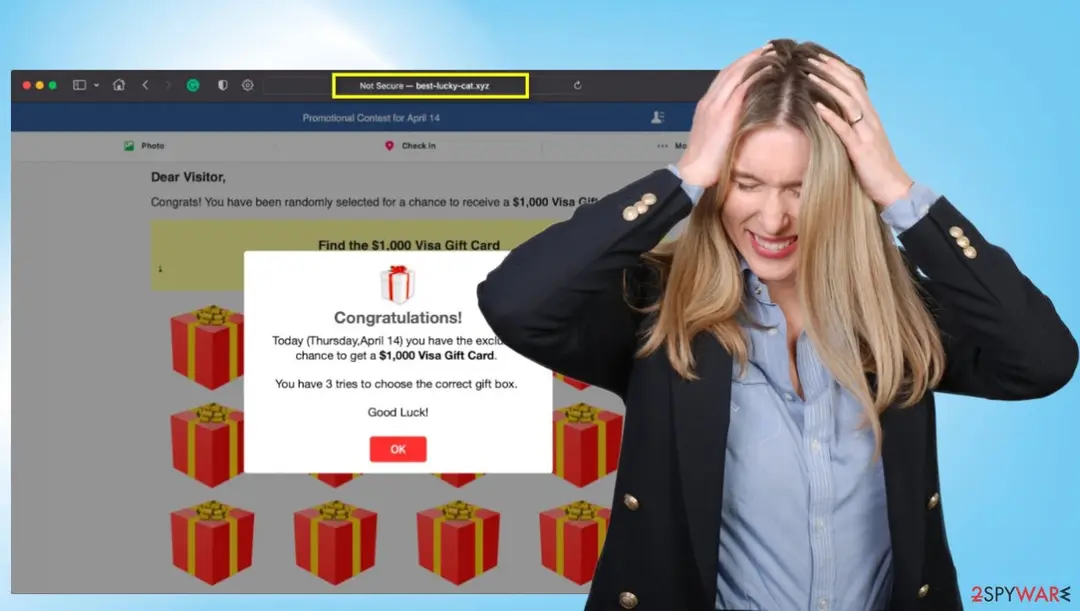
The pictures in our 2022 report show a "promotional contest" with a $1,000 Visa gift card and a page that pretends to be a Verizon survey. They are bait for clicks, answers and, on pages of this kind, notification permission.
- 3
One click on Allow is remembered
If a notification prompt appears and you click Allow, the browser keeps that permission for the site address until you remove it (Chrome Help). Closing the tab does not take it back.
- 4
Ads then arrive as notifications
The site's server sends messages through the browser's push service, and they show in the corner of the screen even when no page from the site is open. Chrome and Edge keep running in the background by default, so this works after the last window is closed; Firefox shows them only while it is open (Mozilla Support).
- Address
- best-lucky-cat.xyz, a .xyz domain
- Current registration
- Created 6 May 2026 at the registrar Dynadot, last changed 11 May 2026, paid until 6 May 2027 (registry RDAP record)
- Our report
- First published 10 June 2022, almost four years before the current registration began
- Same campaign, other names
- The 2022 pictures show best-lucky-cat.xyz and best-lucky-man.xyz, so the same pages were run under more than one address
- What it needs from you
- Clicks on the page and, if a prompt appears, one click on Allow; no download is needed for the notifications
What the Best-Lucky-Cat.xyz ads look like
Congratulations! You have been randomly selected for a chance to receive a $1,000 Visa Gift Card
Is Best-Lucky-Cat.xyz dangerous?
Our test on 5 October 2026
We opened best-lucky-cat.xyz the way a visitor does: a clean desktop Chromium browser in Lithuania, one visit. It showed a parked-domain page, not the prize pages from 2022.
Best-Lucky-Cat.xyz · desktop Chromium · Lithuania · 5 October 2026
- PageAnswered with status 200 and a short page headed best-lucky-cat.xyz with the line "This domain may be for sale" and links to Terms of Service and Privacy Policy. Nothing else was on it.
- RedirectNone on this one visit; the address stayed the same.
- Notification requestNone on this one visit.
- Pop-upsNone opened on this one visit.
- Service workerNone registered in the browser.
- Ad networksNone named in the page. It loaded files only from assets.abovedomains.com.
- Not testedOther countries, phones, other referrers, a second visit, a click on the page and visits through an ad. Adware pages change what they show by country, device, referrer or visit, so one quiet visit tells us nothing about what other visitors get.
- Old permissionA notification permission allowed in 2022 or later stays in the browser under this address, whatever the page shows today. If notifications under this name keep arriving, they come from that permission.
Low risk on this one visit The address showed only a for-sale page when we looked. That is one visit from one place and does not clear the name: the domain was registered again in May 2026, its new owner is unknown, and prize pages of this kind show different things to different visitors.
What the 2022 report showed, and what changed
November 2021
A sibling address: Verizon "survey"
The picture in our 2022 report shows a page on best-lucky-man.xyz in iPad Safari, dated Friday, 5 November 2021. It is headed "Dear Verizon customer" and promises a choice of phones and gift cards for answering nine questions. The offer is fake and the company named is not involved.
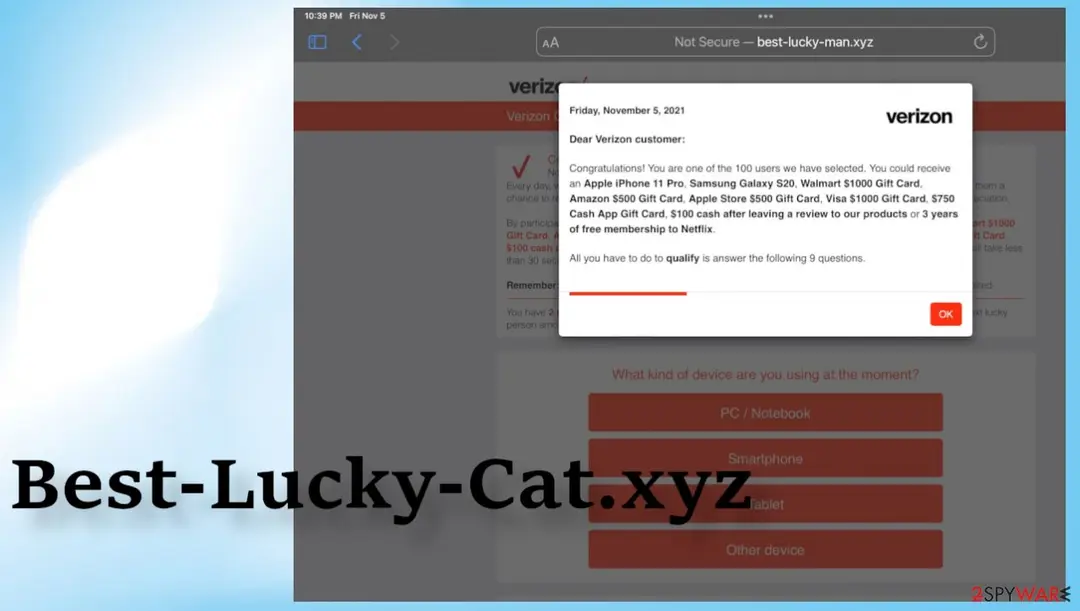
From our 2022 report: the same kind of page on the sibling address best-lucky-man.xyz (the address bar says so). It is not a capture from our 2026 test. April 2022
The gift-card page on best-lucky-cat.xyz
The second picture shows this address in the Safari bar with a "Promotional Contest for April 14" page: pick the right gift box in three tries to "win" a $1,000 Visa gift card. Nobody wins; the game keeps you clicking toward the next offer.
From our 2022 report: the gift-box game on best-lucky-cat.xyz. It is not a capture from our 2026 test. 6 May 2026
The current registration starts
The registry record shows the domain created on 6 May 2026. The name was registered again or changed hands; the record does not say which, or who runs it now.
5 October 2026
Our new check: a for-sale page
One visit showed a parked page with no prompt, redirect or pop-up.
The prize and gift-card pages, and how to read them
None of these pages is real. A web page cannot know you were "randomly selected" or scan your PC, and it has no gift cards to give.
| What the page says | What it pretends to be | What it really does |
|---|---|---|
| Congratulations! You have been randomly selected for a $1,000 Visa gift card | A prize draw | Starts a chain of clicks and survey forms; no card exists |
| You have 3 tries to choose the correct gift box | A game of chance | Keeps you on the page and clicking; the outcome is fixed in the page |
| Dear Verizon customer, answer 9 questions to qualify | A message from your phone company | Collects answers and contact details for the people who run the page; the company named is not involved |
| Click Allow to continue | A routine step | Lets the site send you notifications |
Notifications, pop-ups or redirects: which are you seeing?
Our 2022 report said that adware controls this page. A web page is run by whoever owns the address; adware is one possible reason a browser keeps opening such addresses, and not the usual one. The causes look alike and have different fixes.
| What you see | Most likely cause | What to do |
|---|---|---|
| Ads in the corner of the screen at random times, with no page from this site open | A notification permission allowed earlier | Block the site in the browser's notification list (steps above) |
| A prize page opens after you click a video, download or link on another site | The page you were on sends visitors through an ad network and this address is one link in the chain | Close the tab and do not click anything on the prize page; nothing needs removing from the PC |
| The same pages open on many unrelated sites, or new tabs open by themselves | An unwanted browser extension, or a program that came with free software (adware) | Check the extensions and the list of installed apps, then reset the browser (sections below) |
The real risks, from most to least serious
The notification permission installs nothing. These are the ways the pages and ads that follow it can hurt you.
- High
Running a file an ad or notification offers
Fake updates, "players" and "cleaners" are how adware and trojans get onto a PC.
- Medium
Giving details on a prize or survey page
Prize and survey forms ask for a name, phone number, address and sometimes a card number "for delivery". Whatever you type goes to the people who run the page.
- Low
The permission alone
It lets the site show notifications and nothing else. It is a nuisance, and it stays until you remove it.
How to remove Best-Lucky-Cat.xyz
How to stop Best-Lucky-Cat.xyz notifications
Do this in every browser you use, and in every profile inside it: each keeps its own list of sites allowed to send notifications.
Nothing has to be uninstalled for the notifications themselves.
Which browser shows the ads?
Step 1: Remove best-lucky-cat.xyz from Chrome's notification list
Chrome keeps a list of every site you once allowed to send notifications, and
best-lucky-cat.xyzis on it. Pastechrome://settings/content/notificationsinto the address bar, find best-lucky-cat.xyz under Allowed to send notifications, open the three-dot menu next to it and pick Remove.Then click Add next to Not allowed to send notifications and type best-lucky-cat.xyz, so the site cannot ask a second time. Repeat it in every Chrome profile you use on Windows 11 or Windows 10, since each profile has its own list.
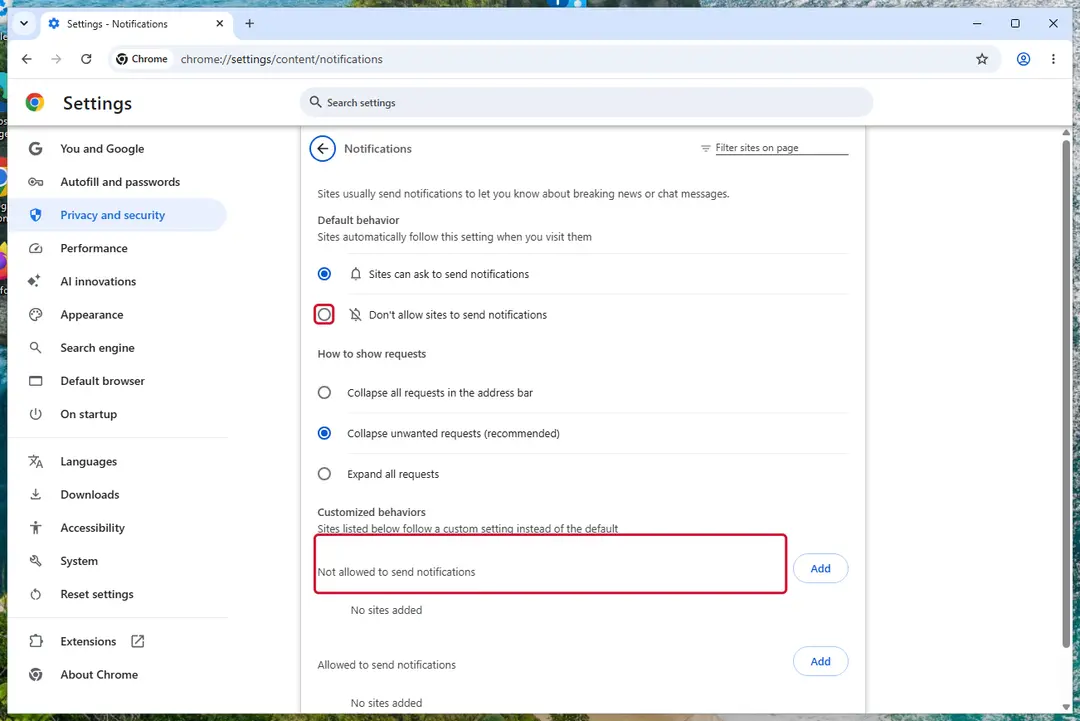
Chrome on Windows 11: Settings > Privacy and security > Site settings > Notifications. Full procedure with screenshots: Stop website notifications and pop-ups
Still there? More for Google Chrome
On an Android phone
In Chrome tap the three-dot menu > Settings > Site settings > Notifications. Tap each unknown site under Allowed and pick Reset permissions, or turn notifications off for all sites. Then look in Settings > Apps for apps you did not install.
Remove extensions you do not recognise
Type
chrome://extensionsin the address bar and press Remove on any extension you did not add, such as a video downloader or a "search" helper.Full procedure with screenshots: Remove a browser extension
Reset Chrome
Go to Settings > Reset settings > Restore settings to their original defaults > Reset settings. The start page and search engine return to default and extensions are switched off; bookmarks and passwords stay. To stop alerts after Chrome is closed, also turn off Settings > System > Continue running background apps when Google Chrome is closed.
Full procedure with screenshots: Reset a browser and fix a hijacked search engine
Step 1: Remove best-lucky-cat.xyz from Edge's notification list
Open Settings and more (the three dots) > Settings > Privacy, search, and services > Site permissions > All permissions > Notifications. Remove
best-lucky-cat.xyzfrom the Allowed list, then click Add site next to Not allowed to send notifications and enter it there.Edge is built into both Windows 11 and Windows 10, so check it even if you normally use another browser. If the notifications came with the Edge logo, this is the browser that holds the permission.
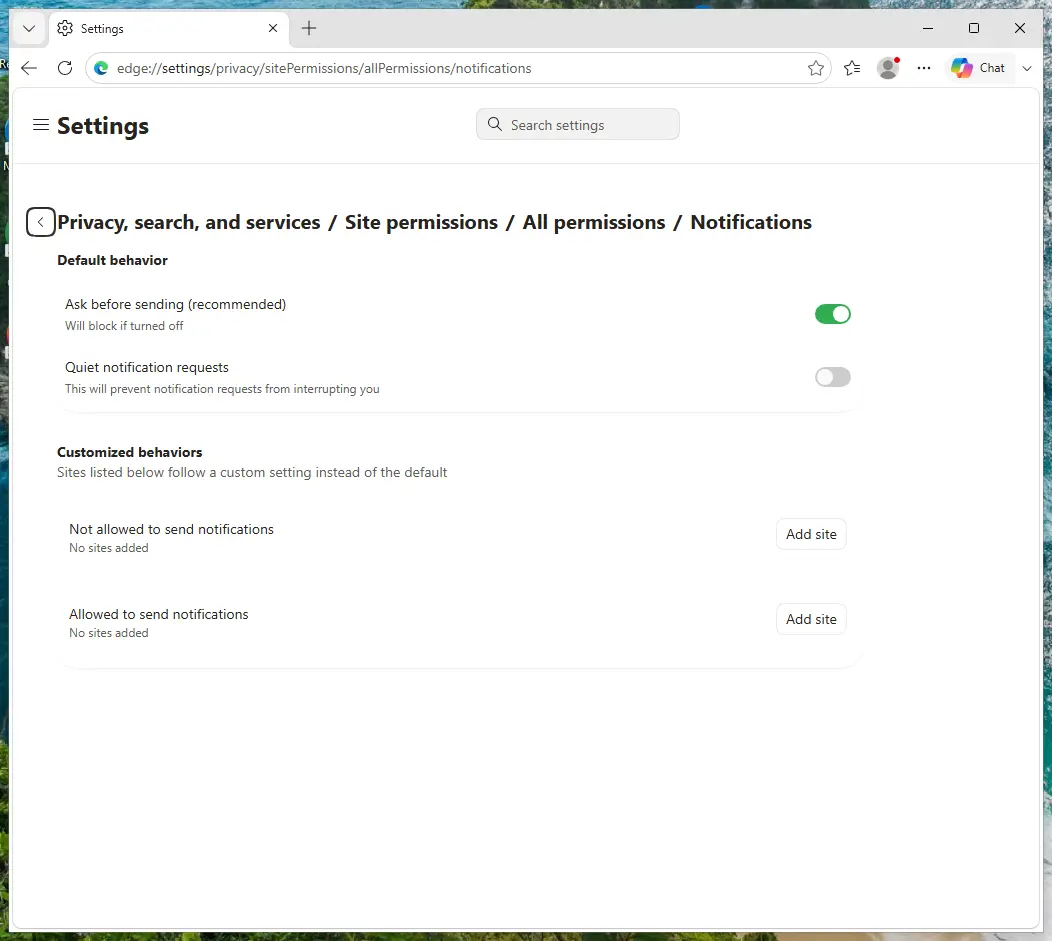
Edge on Windows 11: Site permissions > All permissions > Notifications. Full procedure with screenshots: Stop website notifications and pop-ups
Still there? More for Microsoft Edge
Remove extensions you do not recognise
Type
edge://extensionsin the address bar and press Remove under any extension you did not add.Full procedure with screenshots: Remove a browser extension
Reset Edge
Go to Settings > Reset settings > Restore settings to their default values > Reset. Extensions are switched off and the start page returns to default; favourites, history and passwords stay. To stop alerts after Edge is closed, turn off Settings > System and performance > Continue running background extensions and apps when Microsoft Edge is closed.
Full procedure with screenshots: Reset a browser and fix a hijacked search engine
Step 1: Remove best-lucky-cat.xyz from Firefox's notification permissions
Open the menu (three lines) > Settings and click Permissions and data in the left list, then Notifications. Select
best-lucky-cat.xyz, click Remove Website and confirm with Save Changes.In versions older than Firefox 152 the same list sits under Privacy & Security, behind a Settings button next to Notifications. Firefox shows these notifications only while it is running, on Windows 11 and Windows 10 alike.
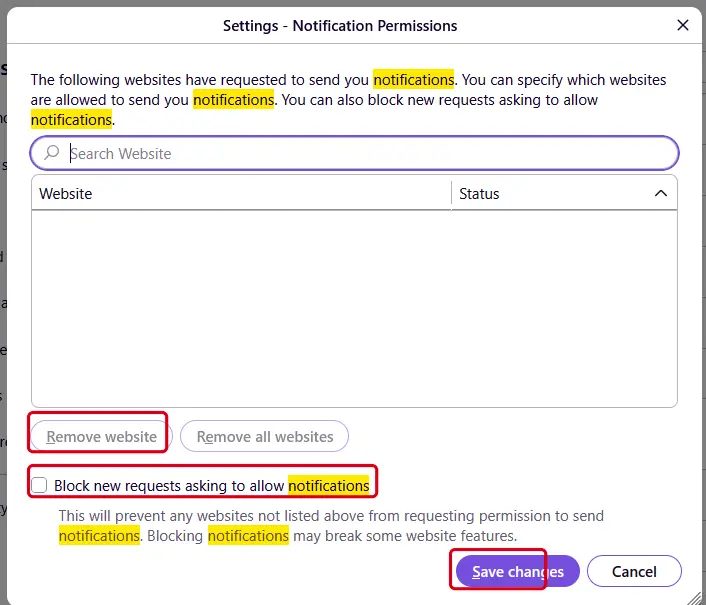
Firefox on Windows 11: the Notification Permissions window. Full procedure with screenshots: Stop website notifications and pop-ups
Still there? More for Mozilla Firefox
Remove add-ons you do not recognise
Type
about:addonsin the address bar, open Extensions and choose Remove from the three-dot menu of any add-on you did not install.Full procedure with screenshots: Remove a browser extension
Clear cookies and site data
Go to Settings > Privacy & Security > Cookies and Site Data > Clear Data, tick both boxes and press Clear.
Refresh Firefox
Open the menu > Help > More troubleshooting information > Refresh Firefox. Add-ons and custom settings go; bookmarks, history and passwords stay.
Full procedure with screenshots: Reset a browser and fix a hijacked search engine
Take back the notification permission
In Safari 18 or later on macOS open Safari > Settings > Websites > Notifications, select
best-lucky-cat.xyzor any site you do not know, and choose Deny or Remove. Untick Allow websites to ask for permission to send notifications so no site can ask again.Remove extensions you do not recognise
Open Safari > Settings > Extensions, select any you did not install and press Uninstall.
Clear the site data
Open Safari > Settings > Privacy > Manage Website Data and remove the site, or use History > Clear History > all history.
Check the Mac for apps from the ads
Pages like this push fake players and "cleaners" to Mac users. In Finder > Applications move unknown apps to the Bin, and remove unknown entries in System Settings > General > Login Items & Extensions. Then use Go > Go to Folder to look in
/Library/LaunchAgents,~/Library/LaunchAgents,/Library/LaunchDaemonsand/Library/Application Supportfor items with the same names, and empty the Bin.
Then, whichever browser you use
Step 2: Scan the PC if you downloaded anything from the ads
If you only saw the notifications and clicked nothing, you can stop before this step. If a notification led you to download or run something, delete that file, then scan Windows.
In Windows Security > Virus & threat protection > Scan options, run a Full scan, then choose Microsoft Defender Antivirus (offline scan) and Scan now. The offline scan restarts the PC and takes about 15 minutes on Windows 11 and Windows 10.

Windows 11: Windows Security > Virus & threat protection > Scan options. Full procedure with screenshots: Run a Microsoft Defender Offline scan
After removal: keep the ads from coming back
If you ran a file or the pop-ups keep coming
Browser steps cover notifications. If pop-ups or redirects continue, or you ran a file that a page offered, add these three.
- 1
Remove unknown programs
In Windows 11 open Settings > Apps > Installed apps (Apps & features in Windows 10), sort by install date and uninstall what appeared on the day of the click (Uninstall a program or app in Windows On uGetFix).
- 2
Scan twice
Run a Microsoft Defender Full scan, then the Microsoft Defender Antivirus (offline scan), which runs before Windows starts. On a Mac, look through Applications and Login Items as in the Safari steps.
- 3
Reset the browser
Changed start pages, search engines and extensions are undone by the reset for your browser above.
Typed a password or card number on a page that came from an ad? Change that password today and tell your bank about the card.
How to avoid prize pages and notification traps
Do
- Close a prize page without touching it.
- Switch notification prompts off: Chrome Settings > Privacy and security > Site settings > Notifications > Don't allow sites to send notifications.
- Install software from the maker's site or the Microsoft Store, and pick Custom setup to untick bundled extras.
- Leave Microsoft Defender SmartScreen or Chrome's Enhanced protection on.
- Keep a recent backup of your files.
Don't
- Click Allow unless you want that site's notifications.
- Give a phone number, address or card number to "claim" a gift.
- Open a file that an ad or notification calls an update, player or cleaner.
Questions about Best-Lucky-Cat.xyz
What is Best-Lucky-Cat.xyz?
Best-Lucky-Cat.xyz is a web address that our 2022 report described as a prize and redirect page. The pictures in that report show a Promotional Contest with a $1,000 Visa gift card and, on the sibling address best-lucky-man.xyz, a fake Verizon survey. It is not a program: nothing is installed when you open it.
When we visited on 5 October 2026 it showed only a page saying the domain may be for sale, and the registry record shows the domain created on 6 May 2026, so it was registered again or changed hands. One visit does not clear the name.
Is Best-Lucky-Cat.xyz a virus?
No, Best-Lucky-Cat.xyz is not a virus: it is a website, and a website cannot install a program just because you opened it. The risk is what the pages ask you to do.
The prize and survey pages of 2022 wanted clicks, answers and personal details, and pages of this kind often ask for notification permission, which lets the site send ads to your desktop later.
Running a file such a page offers is how real malware arrives. Our one visit on 5 October 2026 saw a for-sale page and no prompt, which does not clear the site, because such pages can show different things to different visitors.
How do I stop Best-Lucky-Cat.xyz notifications?
Take the permission back in your browser. In Chrome, open Settings > Privacy and security > Site settings > Notifications, find best-lucky-cat.xyz or any address you do not recognise under the allowed sites, and choose Block. In Edge the list is under Settings > Cookies and site permissions > Notifications.
In Firefox, open Settings > Privacy & Security > Permissions > Notifications > Settings, set the site to Block and save. In Safari on a Mac, open Safari > Settings > Websites > Notifications and set it to Deny. On Android, use Chrome's Site settings > Notifications list.
Why do I see Best-Lucky-Cat.xyz pop-ups when the browser is closed?
The pop-ups are browser notifications, and notifications do not need the page to be open. When you click Allow, the browser stores the permission and the site's server can send messages through the browser's push service. Chrome and Edge keep running in the background by default after you close the last window, so the messages can appear then.
Firefox shows them only while it is open. The browser's own permission is the usual cause, not adware. Remove the permission, and in Chrome or Edge also turn off background running after the browser is closed.
I got a message about a $1,000 Visa gift card or a Verizon prize. Is it real?
No, a message like that is a scam page, not a prize. The pictures in our 2022 report show a gift-box game promising a $1,000 Visa gift card and a survey with a phone company's logo, and neither was run by the companies named.
A web page cannot know you were randomly selected, and no card is handed out after three tries. Close the tab. If you gave a phone number, expect scam calls; if you typed a card number, call your bank.
I clicked Allow on Best-Lucky-Cat.xyz. What should I do now?
Remove the permission first, then check whether anything else happened. Block the site in the browser's notification list. If you only clicked Allow, nothing is installed and the browser steps are enough.
If you ran a downloaded file, uninstall programs you do not know by install date, run a Microsoft Defender full scan and an offline scan, and reset the browser.
If you typed a password or card details on a page that opened from an ad, change the password and call your bank about the card. Do this even though the page is a for-sale page today, because the permission stays.
Do I need antivirus software to remove Best-Lucky-Cat.xyz?
No, not for the notifications. The permission is a browser setting and is removed in the browser, with no extra software. A scan is worth running if pop-ups or redirects continue, if your browser settings changed, or if you ran a file from a page.
Windows 11 and 10 include Microsoft Defender, which can run a full scan and an offline scan, and a browser reset covers changed settings and unwanted extensions. We do not claim that any product removes this address: it is a website, and nothing of it sits on the PC.
How do I avoid prize pages like Best-Lucky-Cat.xyz?
Close the tab. A page that says you were randomly selected for a prize is an ad, whatever company logo it shows. Never click Allow on a page that gives a reason other than wanting its notifications, and never answer prize or survey questions with a phone number or card number.
You can turn requests off: in Chrome, Settings > Privacy and security > Site settings > Notifications > Don't allow sites to send notifications. Download programs from their makers' sites, choose Custom setup in installers and untick extras, and keep Defender SmartScreen or Chrome's Enhanced protection on.
Will Fortect remove Best-Lucky-Cat.xyz?
No program removes Best-Lucky-Cat.xyz itself, because there is nothing on the PC to remove: the notifications come through a permission saved in the browser, and only the browser's settings take it away, as the steps above show.
What Fortect can do is check the rest of Windows. Its free scan looks for malware, unwanted programs and damaged system files, which is useful if you clicked the ads, downloaded something from the pages they opened, or are not sure what else changed on the PC.
If the scan finds nothing and the notifications stopped after you removed the permission, this problem is solved. Use Microsoft Defender as a second opinion whenever you have downloaded files from pages like these.
Sources
- Registry RDAP record: best-lucky-cat.xyz (read October 5, 2026)
- Google Chrome Help: Use notifications to get alerts (no longer online) (read October 6, 2026)
- Mozilla Support: Firefox push notifications (read October 6, 2026)
- MDN: Push API (read October 6, 2026)
- Apple Support: Customize website notifications in Safari (read October 6, 2026)
- FTC: How to recognize, remove and avoid malware (read October 6, 2026)
- Microsoft: Stay protected with the Windows Security app (read October 6, 2026)
- Microsoft: Internet Explorer 11 desktop app retirement FAQ (read October 6, 2026)