
Is ClipGrab safe? The "ClipGrab virus" claims, the installer offers and how to remove them
ClipGrab is a real video downloader and converter, and our 2018 guide called it a browser hijacker because older Windows installers bundled a search toolbar. The program is not a virus; the extras in its Windows installer are what to watch, and the fix is to uninstall them and reset your search engine and home page.
Facts checked October 12, 2026. Removal steps tested on Windows 11 (26H2) and checked against Microsoft's and the browser makers' current documentation.
Automatic
Get a free scan and check if your PC is infected.
Fortect finds malware, unwanted programs and the Windows damage they leave behind, and repairs it in one pass.
A quick scan confirms nothing else was installed alongside the clipgrab.org search hijacker.
Do it yourself · free Remove ClipGrab yourself 2 steps, about 6 minutes, no software needed.
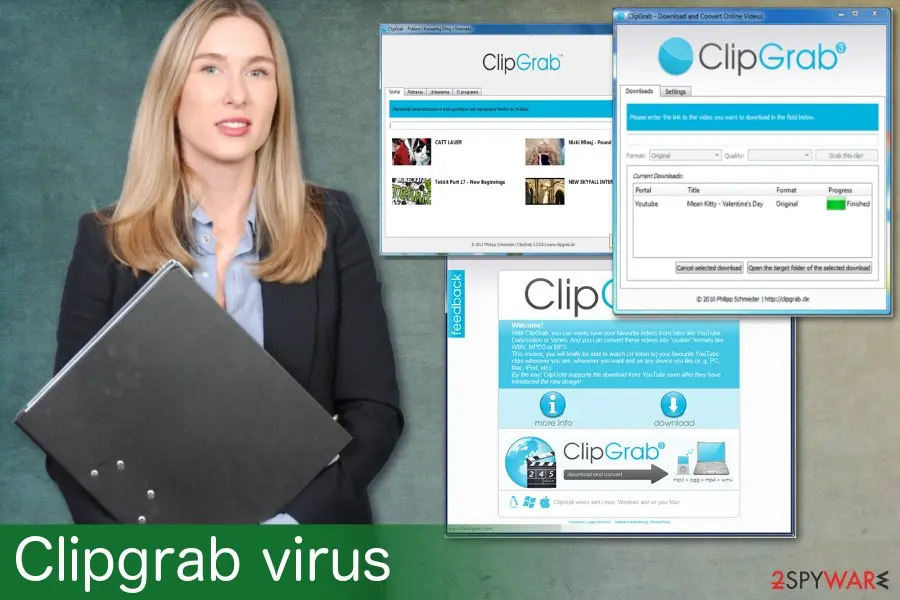
ClipGrab: summary
| Type | Genuine video downloader; its Windows installer is supported by third-party offers; older builds bundled a Conduit toolbar |
|---|---|
| Risk | Low for the downloader; medium if an installer offer was accepted |
| Symptoms | Home page or new tab changed; search engine changed to a sponsored one; sponsored links above results; a toolbar or unfamiliar program installed the same day as ClipGrab |
| How to get rid of it | Uninstall ClipGrab and any extra from Installed apps, set your own search engine and home page, remove unknown extensions, scan |
| Our check (5 October 2026) | Official page and registry record read; no installer run, no browser test, so offers seen today: none |
| Running since | clipgrab.org registered 25 May 2013; renewed until 25 May 2027 |
| Removal | Scan the PC with security software to find and remove the malware and anything installed with it. Fortect scans Windows for malware and repairs the system files and settings it damaged. Remove it nowTo use the full-featured product, you have to purchase a license for Fortect. The scan is free. |
Show 11 more facts
| First reported by us | 19 July 2018 |
|---|---|
| Installed on the PC | The downloader you choose; plus whatever the installer's offers add, which we could not see |
| Detection | Microsoft Defender: no Microsoft detection name is known for the downloader; we scanned no sample |
| Damage | No harm to files recorded; the old toolbar changed search settings and ran a scheduled task |
| Distribution | The installer's third-party offers (older builds: Conduit toolbar); copies from download portals not tested |
| Evidence | clipgrab.org, the registry record, a program database record of version 3.2.0.9, our 2018 report |
| Name | ClipGrab |
| Search page | clipgrab.org |
| Browsers | Chrome, Edge and Firefox |
| First seen | 19 July 2018 |
| Facts checked | 5 October 2026 |
Facts checked on 5 October 2026 against clipgrab.org's page text and the registry's RDAP record. We did not run an installer, so what the offers are today is not confirmed; the file list is a program database's record of version 3.2.0.9.
What ClipGrab is and why people call it a virus
ClipGrab is a real video downloader and converter, not a virus. The "ClipGrab virus" reports come from the extras that some of its Windows installers carried: in the old version a Conduit search toolbar, and today a notice that the Windows download is "supported by third-party offers".
- What it is
- A free downloader and converter for YouTube, Vimeo, Facebook and other video sites that saves a video as MPEG4, MP3 or another format, according to clipgrab.org
- Where it comes from
- The website clipgrab.org, registered on 25 May 2013 and renewed until 25 May 2027; our 2018 pictures name Philipp Schmieder as the author
- Platforms
- Windows (the page names Windows 11, 10 and 8), macOS 10.12 or newer and Linux; the Linux version is described as open source under the GPLv3
- Where the trouble was
- The Windows installer: older builds offered a Conduit toolbar, and the current Windows download says it is powered by dotSetup and supported by third-party offers
- What the extras changed
- A program database records the old Conduit toolbar as a search-advertising add-on for Internet Explorer with a scheduled task; the old guide said it also changed the home page and search engine
So there are two things with one name. The downloader is what you chose to install. The extras are what the installer offered next to it, and it is the extras that carry the behaviour people complain about: a changed search engine, a new start page, ads. Which extras you would be offered today we could not see, because the offers belong to the installer and we did not run it.
ClipGrab virus detected: what the antivirus warning means
A ClipGrab virus detected warning usually means your scanner flagged the installer or an offer bundled with it, not that the downloader itself is a virus.
Microsoft calls such software potentially unwanted applications: programs that show unexpected ads or offer to install other software. Microsoft says these are not considered a virus or malware, but they can still slow a PC or add programs you did not choose.
Read the exact name in the warning before you act. In Microsoft Defender, a detection that starts with PUA: is a potentially unwanted application, and Defender blocks it and moves it to quarantine.
A name that starts with Trojan: or another malware type is more serious and should not be allowed. Open Windows Security, then Virus and threat protection, then Protection history to see the full name and the file path.
If the flagged file came from a site other than clipgrab.org, delete it and do not restore it from quarantine. If you want ClipGrab, download it again from the official page and decline every extra offer in the installer. In Microsoft Edge you can also turn on Settings, then Privacy, search, and services, then Block potentially unwanted apps, so similar downloads are stopped early.
Is ClipGrab dangerous? What it collects
What we checked on 5 October 2026
We read the official page, clipgrab.org, and the registry record of the domain. We did not open the page as a visitor in a browser and we did not download or run any installer, so this is a reading of what the maker says, not a behaviour test.
clipgrab.org · page text and links · 5 October 2026
- Windows installerThe page says ClipGrab for Windows "is powered by dotSetup and supported by third-party offers" and links a privacy policy on
thecassinilabs.com. It does not list the offers. - Version without offersThe page links a "Download version without third-party offers" under the Windows button. We did not download it, so we cannot say how it differs.
- Mac and LinuxThe Mac (4.0.0-beta2) and Linux (3.9.14) downloads carry no offer notice on the page. We did not test either file.
- Domain
clipgrab.orgwas registered on 25 May 2013 and expires on 25 May 2027: a long-running site, not a throwaway one. - Notification request, pop-ups, redirectsNot tested. We read the page text only, so we cannot say whether the page asks for notifications or opens new tabs for some visitors.
- What the installer offers todayNot seen. Third-party offers can differ by country, by Windows version and from one download to the next.
Medium risk The program itself is not what we flagged. The Windows installer is: its own page says it carries third-party offers. Because we did not run it, nothing here proves that a particular download is clean or unclean; read each installer screen.
What changed since our 2018 report
May 2013
The domain is registered
clipgrab.org was registered on 25 May 2013 and moved to its current registrar on 19 May 2016, according to the registry record (RDAP).
2018
Our first report: a downloader said to come in two versions
Our guide described a downloader plus a toolbar "version" and called both a potentially unwanted program. The picture shows the ClipGrab window and start page of that time and, at bottom right, an ad-style green button reading "Download CLIPGRAB.EXE Error Repair Tool".
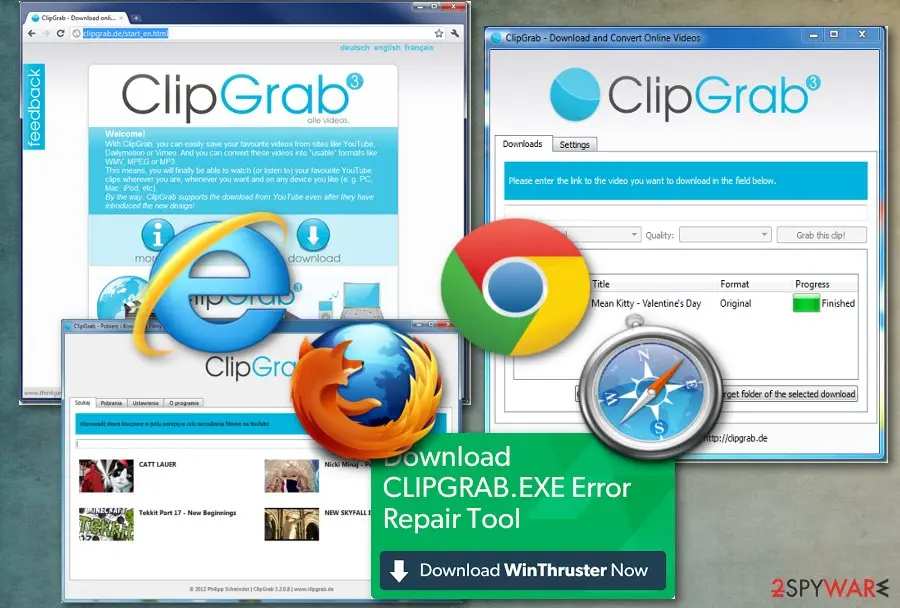
The picture from our 2018 report: the ClipGrab 3 window and start page, browser logos, and a green "Download CLIPGRAB.EXE Error Repair Tool" button. The official page we read in 2026 offers no such tool. Older builds
The toolbar was part of the installer
A program database lists version 3.2.0.9 as installing the Conduit Toolbar: the installer could download it through
ConduitInstaller.exe, and it added a scheduled task. It lists a toolbar for Internet Explorer; our 2018 guide said the toolbar reached every browser, which we could not confirm.October 2026
The offers are now stated on the download page
The Windows download is described as powered by dotSetup and supported by third-party offers, with a link to a version without them. Windows version 3.9.15, Mac 4.0.0-beta2 and Linux 3.9.14 are listed. We could not see which offers an installer shows now.
What can actually go wrong
"ClipGrab virus" is not accurate for the downloader. These are the real concerns, from most to least serious.
- Medium
An extra program you did not mean to install
An accepted offer is a program with its own behaviour and its own uninstaller. That, not ClipGrab, is the part that needs cleaning, and it may have installed more than one thing.
- Medium
A search engine or start page you did not choose
The old toolbar is recorded as delivering search-based advertising and results, and our 2018 guide listed a changed home page, a sponsored search engine and sponsored links at the top of results. Whoever is the default search engine sees what you type.
- Low
Fake repair or "updated" downloads
The 2018 picture carries an ad for a "CLIPGRAB.EXE Error Repair Tool". The official page offers none; treat any such button as an advert and get ClipGrab only from
clipgrab.org. - Low
Downloading what you may not save
YouTube's terms of service allow downloading only where the service gives you a way to do it. That is a rules and copyright question, not a malware one.
How ClipGrab got into your browser
Most "ClipGrab virus" cases follow one of these routes. Check them in this order.
| Route | What you would see | How to check |
|---|---|---|
| The Windows installer showed an offer and it was accepted | A new program or browser extension installed on the same day as ClipGrab; sometimes a changed search engine or start page | Settings > Apps > Installed apps, sorted by install date |
| An old ClipGrab 3.x installer with the Conduit toolbar | A toolbar in Internet Explorer; files such as tbClip.dll in the ClipGrab folder; a scheduled task | C:\Program Files\ClipGrab, and Task Scheduler |
| A copy of the installer from a download portal, not from clipgrab.org | Extra screens or programs we cannot describe, because we tested none of them | Compare the file with a fresh download from clipgrab.org |
Free programs often come with extra offers, and the Default or Quick setup accepts them for you. The Custom or Advanced setup lists them with ticks already placed; remove the ticks before you go on. The old guide warned that P2P downloads are riskier still; we could not source that, but taking the installer from the maker's own site is the safer habit either way.
Check your browser and PC
This list is from a program database's record of the old version 3.2.0.9, not from a recent install. Names in a newer installer can differ, and we did not install ClipGrab to compare.
| File or item | What it is | Keep it? |
|---|---|---|
ClipGrab.exe | The downloader itself, the process the old guide saw in Task Manager | Yes, if you want ClipGrab |
ffmpeg.exe and the Qt…4.dll files | The converter and the Qt framework the program is built on; the old guide credited Qt to the toolbar, but the record lists these files as part of ClipGrab | Yes, with ClipGrab |
tbClip.dll, ldrtbClip.dll | Conduit toolbar files, listed by the record as made by Conduit; a DLL is a library, not a program you start | No |
ClipGrabToolbarHelper.exe | A "ToolbarH Application" the record says is run by a scheduled task | No |
uninstall.exe in the ClipGrab folder | Listed as the Conduit Engine uninstaller, also run by a scheduled task | Only through the program's own uninstall |
| A rule in Windows Firewall for ClipGrab | The 2018 guide said the toolbar added one; the record we read does not mention it, so this is not confirmed | Check Windows Security > Firewall & network protection > Allow an app through firewall; keep a rule for ClipGrab itself, remove one for a toolbar helper |
- 1
Look at the program folder
Open
C:\Program Files\ClipGrabandC:\Program Files (x86)\ClipGrab. Files withtborToolbarin the name are the toolbar, not the downloader. - 2
Check Task Scheduler
Press Start, type Task Scheduler, open Task Scheduler Library and look for a task that runs a file from the ClipGrab folder or a name with "Toolbar". Right-click it and choose Delete only when it points to the toolbar. We did not run this on a PC with the toolbar, so the task name is not confirmed.
How to remove ClipGrab
How to remove ClipGrab and get your search engine back
Remove the extension first.
The search settings only stay fixed once nothing on the PC can change them again.
Which browser shows the ads?
Set another search engine
Open Settings > Search engine, click Change next to the search engine used in the address bar and pick the one you want. Then open Manage search engines and site search and delete any entry you did not add.
Remove extensions you do not recognise
Paste
chrome://extensionsinto the address bar and click Remove on anything you did not install yourself, especially "search" or PDF helpers added recently.Full procedure with screenshots: Remove a browser extension
Clear the site data
Press Ctrl + Shift + Delete, choose All time, tick Cookies and other site data and Cached images and files, and click Delete data.
Reset Chrome
Open Settings > Reset settings > Restore settings to their original defaults and confirm with Reset settings. This resets the start page, search engine and pinned tabs and turns off extensions; bookmarks and saved passwords stay.
Full procedure with screenshots: Reset a browser and fix a hijacked search engine
Set another search engine
Open Settings > Privacy, search, and services > Address bar and search and choose the search engine used in the address bar. Check Manage search engines for entries you did not add.
Remove extensions you do not recognise
Paste
edge://extensionsinto the address bar and click Remove under anything you did not install yourself.Full procedure with screenshots: Remove a browser extension
Clear the site data
Open Settings > Privacy, search, and services > Delete browsing data > Choose what to clear, set All time, tick Cookies and other site data and Cached images and files, and click Clear now.
Reset Edge
Open Settings > Reset settings > Restore settings to their default values and confirm with Reset. Extensions are turned off and the start page goes back to default; favourites, history and saved passwords stay.
Full procedure with screenshots: Reset a browser and fix a hijacked search engine
Set another search engine
Open Settings > Search and pick another engine under Default Search Engine. Under Search Shortcuts, remove any entry you did not add.
Remove add-ons you do not recognise
Paste
about:addonsinto the address bar, open Extensions, and choose Remove from the three-dot menu of anything you did not install yourself.Full procedure with screenshots: Remove a browser extension
Clear cookies and site data
Open Settings > Privacy & Security > Cookies and Site Data > Clear Data, tick both boxes and click Clear.
Refresh Firefox
Open the menu > Help > More troubleshooting information and click Refresh Firefox. Add-ons and custom settings are removed and the home page goes back to default; bookmarks, history and passwords stay.
Full procedure with screenshots: Reset a browser and fix a hijacked search engine
Remove ClipGrab if you no longer want it
Drag ClipGrab from Finder > Applications to the Bin and empty it. The Mac download we read is a 4.0.0-beta2 build of the same program.
Set another search engine
Open Safari > Settings > Search and choose a different Search engine. If you also see an Ecosia entry in Settings > Extensions, select it and click Uninstall.
Remove extensions you do not recognise
In Safari > Settings > Extensions, select anything you did not install yourself and click Uninstall. Ecosia's desktop browser, if you have it, is removed from Finder > Applications.
Clear the site data
In Safari > Settings > Privacy > Manage Website Data, remove the site's data, or use History > Clear History > all history. To empty the cache as well, turn on Show features for web developers in Settings > Advanced and choose Develop > Empty Caches.
Check the Mac for apps from the ads
Ads also target Mac users with fake players and "cleaners". In Finder > Applications, move anything unknown to the Bin. In System Settings > General > Login Items & Extensions, remove unknown items. Then use Go > Go to Folder to check
/Library/LaunchAgents,~/Library/LaunchAgents,/Library/LaunchDaemonsand/Library/Application Supportfor folders and files with the same unknown names, and empty the Bin.
Then, whichever browser you use
Step 1: Uninstall programs you did not mean to install
Open Settings > Apps > Installed apps in Windows 11, or Settings > Apps > Apps & features in Windows 10, and sort the list by install date. Look at what appeared around the day the problem started and uninstall every program you do not recognise or did not choose.
Free converters, PDF and video tools, "system optimizers" and unknown browsers are the usual carriers of ClipGrab. If a name is unclear, search for it before you remove it, so you do not uninstall a driver or a Windows component.
Full procedure with screenshots: Uninstall a program or app in Windows On uGetFix
Step 2: Scan the PC, then run the offline scan
Open Windows Security > Virus & threat protection > Scan options, run a Full scan and remove everything it finds. Then select Microsoft Defender Antivirus (offline scan) and click Scan now: the PC restarts and scans before Windows loads, which finds files that hide while Windows runs.
Save your work first, because the offline scan takes about 15 minutes. Both scans are built into Windows 11 and Windows 10, and a second scanner from another vendor is a useful extra opinion.
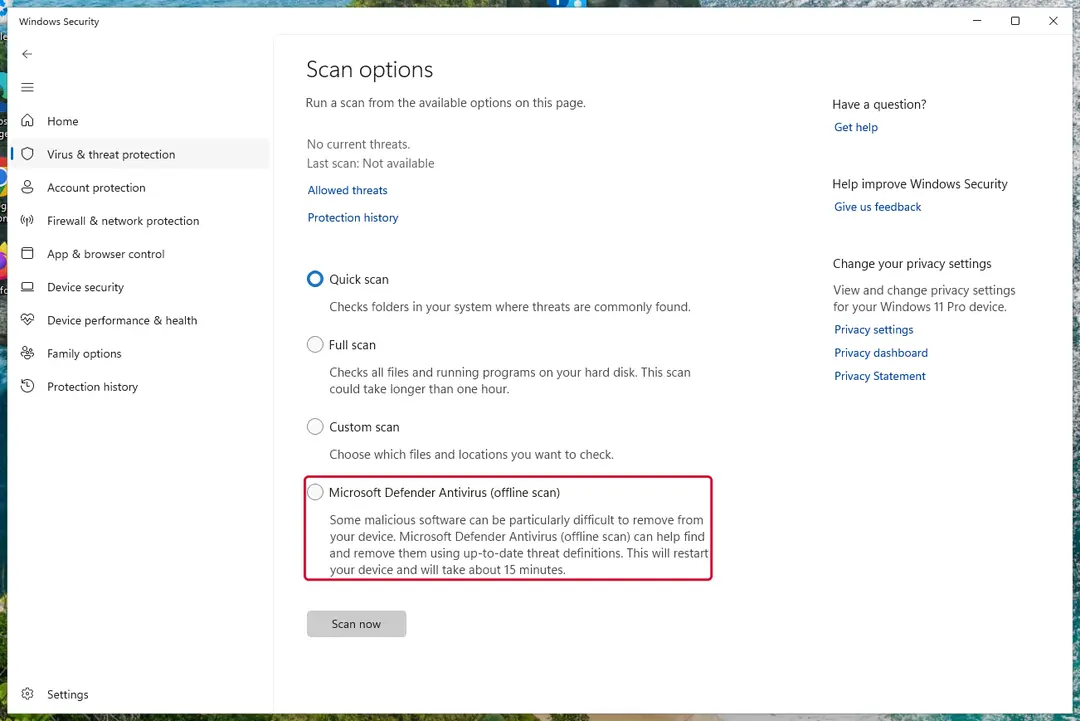
Windows 11: Windows Security > Virus & threat protection > Scan options. Full procedure with screenshots: Run a Microsoft Defender Offline scan
After removal: keep your search engine and start page
If you ran the installer and accepted something
Change the browser's search engine and home page first. If a program or toolbar came with ClipGrab, remove it as well.
- 1
Uninstall what came with it
Open Settings > Apps > Installed apps in Windows 11 (Apps & features in Windows 10), sort by install date and uninstall anything installed on the day you installed ClipGrab that you do not recognise. If you no longer want ClipGrab, uninstall it the same way (Uninstall a program or app in Windows On uGetFix). The old toolbar also has the entry Conduit or a name that includes Toolbar.
- 2
Scan, then scan offline
Run a Microsoft Defender Full scan, then the Microsoft Defender Antivirus (offline scan), which finds programs that hide while Windows runs. We could not confirm a current detection name for ClipGrab, so a clean scan does not prove that the extras are gone.
- 3
Check the browser again
Open the search engine and home page settings once more after a restart. If a setting returns, a program or extension is still putting it back.
If the offers were declined and only ClipGrab was installed, nothing from the offers is on the PC, and the only job left is deciding whether you want a downloader that is built this way.
How to keep it from happening again
Do
- Download ClipGrab only from
clipgrab.org, and choose the version without third-party offers if you use Windows. - Choose Custom or Advanced setup in any installer and remove the ticks from extra programs, toolbars and search settings.
- After installing free software, open the browser's search engine and home page settings and check them once.
- Keep Microsoft Defender SmartScreen on, or Chrome's Enhanced protection: both warn before known malicious pages and downloads.
- Keep a current backup of your files (File History or OneDrive), so an infection or a failed disk does not cost you your documents.
- On public networks, a VPN hides your IP address from the sites and ad networks you visit; it does not block ads or malware.
Don't
- Click through Default or Quick setup without reading it.
- Take the installer from a download portal when the maker has its own page.
- Click a button that offers to "repair"
ClipGrab.exeor update the program. - Accept "make this your search engine" prompts from a program you did not go to install.
Keep ClipGrab, or choose another way
You do not have to choose between the risk and doing without. Compare the options by who controls the installer.
| Option | What to know |
|---|---|
| ClipGrab for Windows, version without third-party offers | The route the maker's page itself links. We did not run it, so read every screen anyway |
| ClipGrab for Mac or Linux | The page shows no offer notice for these two; the Mac build listed is a 4.0.0-beta2, so expect beta behaviour |
| The video site's own offline feature | YouTube Help describes downloading videos to watch offline inside its app, within its rules |
| Leave it uninstalled | If ClipGrab was added for one job that is done, uninstalling it removes the question |
Many people find ClipGrab useful, as the old guide said: it saves a clip as an audio file you can carry on a phone, a tablet or a music player. That usefulness is a reason to install it carefully, not a reason to accept whatever the installer adds.
Questions about ClipGrab
Is ClipGrab safe?
ClipGrab is a genuine, long-running downloader and not a virus, but its Windows installer is supported by third-party offers, so safe depends on how you install it. Its own page says the Windows download is powered by dotSetup and supported by third-party offers, and links a version without them.
We read the page and did not run an installer, so we cannot say what an offer is today. Download from clipgrab.org, choose the version without offers, read each screen and check your browser settings afterwards. If you accepted an extra program, remove it through Installed apps.
Is ClipGrab safe to use today?
Yes for the downloader on the maker's own page, with care for the Windows installer. The page lists Windows 3.9.15, macOS 4.0.0-beta2 and Linux 3.9.14, and puts the third-party offer notice only under Windows. We did not install or test any of them, so we cannot call a given file clean.
Use the version without third-party offers, avoid copies from download portals, run Microsoft Defender once on the downloaded file, and open your search engine and home page settings after the first launch. If either changed, an offer was accepted and should be removed.
Is ClipGrab a virus or a browser hijacker?
Neither in its own right. Our 2018 guide called it a browser hijacker and potentially unwanted program because the older installer bundled a Conduit toolbar that changed search settings and ran a scheduled task. A program database records that toolbar for version 3.2.0.9, installed through ConduitInstaller.exe.
The downloader itself saves videos and converts them. If your search engine or home page changed after installing it, the cause is an extra program or extension, and the fix is to remove that, set your own search engine again and check the other browsers.
How do I remove ClipGrab from my computer?
On Windows 11 open Settings > Apps > Installed apps, find ClipGrab, open the three-dot menu and choose Uninstall; on Windows 10 use Apps & features. Then check the same list for anything installed the same day that you do not recognise, and uninstall it.
On a Mac, move ClipGrab from Finder > Applications to the Bin and check System Settings > General > Login Items & Extensions. Afterwards open each browser's search engine and home page settings, because uninstalling the downloader does not reset settings that an extra program changed.
How do I remove the ClipGrab toolbar or search engine from my browser?
Set your own search engine and home page in each browser, then remove the extensions you do not recognise. In Chrome go to Settings > Search engine; in Edge, Settings > Privacy, search, and services > Address bar and search; in Firefox, Settings > Search; in Safari, Settings > Search.
Then open the extensions page and remove anything you did not add. If the setting returns after a restart, a program in Windows is putting it back, so uninstall programs installed with ClipGrab and reset the browser. Our 2018 guide also asked users to reset every installed browser.
What are tbClip.dll and ClipGrabToolbarHelper.exe?
They are files of the old Conduit toolbar, not of the downloader. A program database lists tbClip.dll and ldrtbClip.dll as made by Conduit and ClipGrabToolbarHelper.exe as a toolbar helper started by a scheduled task, all for version 3.2.0.9. ClipGrab.exe is the downloader.
If you find the toolbar files, uninstall the toolbar from Installed apps instead of deleting files by hand, then check Task Scheduler for a leftover task. We could not confirm the file names in recent installers, so treat the list as the old version's.
Why does my antivirus warn about ClipGrab?
We could not confirm a current detection name, so we cannot say which warning you saw. A common reason for a warning on a free downloader is an offer inside the installer, and ClipGrab's Windows page says its installer is supported by third-party offers. If a scanner blocks the file, do not override it:
- delete it
- download again from clipgrab.org using the version without offers
- scan it once more
If the warning names a toolbar or adware, treat the extra program as the problem and keep the downloader decision separate.
Is it legal to download YouTube videos with ClipGrab?
That depends on the video and where you live, and this is not legal advice. YouTube's terms of service allow downloading content only where the service itself gives you a way to do it, so saving a clip with a third-party tool can break the terms even when the program is harmless.
Copyright is a separate question: videos you made, or that have a licence allowing copies, are fine to save; other people's music and films usually are not. YouTube Help describes an official offline feature inside its app for videos where the uploader allows it.
Will Fortect remove ClipGrab?
Fortect scans Windows for malware and unwanted programs and repairs the system files and settings they change, and its free scan shows what it finds on your PC before you decide anything.
For ClipGrab, follow the plan above as well: the browser steps take back permissions and settings that no scanner treats as a threat, and uninstalling the program that brought it removes the source.
Run Microsoft Defender's full scan and, if anything was found, its offline scan as a second opinion. If the symptoms are gone after the plan and both scans are clean, there is nothing more to do.
Sources
- ClipGrab: official download page (read October 5, 2026)
- Public Interest Registry RDAP: clipgrab.org registration record (read October 5, 2026)
- Should I Remove It: ClipGrab 3.2.0.9 program record (read October 5, 2026)
- Our 2018 guide to the ClipGrab virus (pictures and text) (read October 5, 2026)
- Microsoft Support: Uninstall or remove apps and programs in Windows (read October 5, 2026)
- Google Chrome Help: Change your default search engine (no longer online) (read October 5, 2026)
- Microsoft Support: Change your default search engine in Microsoft Edge (read October 5, 2026)
- Mozilla Support: Change your default search settings in Firefox (read October 5, 2026)
- Apple Support: Change your search settings in Safari on Mac (read October 5, 2026)
- YouTube Terms of Service (read October 5, 2026)
- YouTube Help: Download videos to watch offline (no longer online) (read October 5, 2026)
- Microsoft Learn: Block potentially unwanted applications with Microsoft Defender Antivirus (read October 12, 2026)