
imklaunchagent on Mac: what it is, is it a virus, and how to check it
imklaunchagent is a program built into macOS that starts your input methods, so it appears in Activity Monitor on a normal Mac. It is not a virus, but malware can use the name; here is how to check yours in two minutes and what to do if it is a fake.
Facts checked October 6, 2026. Removal steps checked against Apple's current documentation and the security vendors' reports. We have not run the malware on a Mac.
Automatic
Get a free scan and check if your Mac is infected.
Fortect for Mac scans for malware and unwanted programs, and its free scan shows what it finds before you decide anything.
Do it yourself · free Remove imklaunchagent yourself 2 steps, about 6 minutes, no software needed.
Start the stepsImklaunchagent: summary
| Type | macOS system process (InputMethodKit launch agent), not a virus; malware could copy the name |
|---|---|
| Risk | None for the genuine file; high for a copy outside /System or one not signed by Apple |
| Symptoms | imklaunchagent in Activity Monitor or in a security tool's list; "Operation not permitted" when you try to delete it |
| How to get rid of it | Nothing to remove for the genuine file; delete only a fake copy and the launch item that starts it |
| Our check (6 October 2026) | macOS 26.4.1: Apple-signed, valid on disk, root:wheel, parent launchd, 0.0% CPU, one Mac and one moment |
| Running since | Manual page dated 2019; our first guide 3 March 2020 |
| Check the PC | The genuine file needs no removal. Fortect's free scan checks the Mac for malware hiding under system file names. Remove it nowTo use the full-featured product, you have to purchase a license for Fortect. The scan is free. |
Show 7 more facts
| Linked malware | None. The technique (a malicious LaunchAgent plist) is real and listed by MITRE as T1543.001 |
|---|---|
| Detection names | None for the genuine file; we did not look up names for fake copies |
| Can it be removed | No. It is part of macOS and the system folder is protected |
| File name | imklaunchagent |
| Distribution | Part of Windows; malware sometimes copies the name in another folder |
| Damage | None from the genuine file; an impostor copy is as harmful as its malware |
| Facts checked | 6 October 2026 |
Facts checked on 6 October 2026 against our own check on macOS 26.4.1, the imklaunchagent manual page, Apple's launchd documentation, MITRE ATT&CK T1543.001 and a community thread.
What the imklaunchagent file is
What imklaunchagent does
imklaunchagent is a program that ships with macOS. It starts the input methods you pick for typing in other languages, so it appears in Activity Monitor on an ordinary Mac. It is not a virus, and the old claim that it is "part of targeted Mac malware attacks" is wrong.
- 1
You pick an input method
An input method is what lets you type Chinese, Japanese, Korean, Vietnamese and other languages, or use a different keyboard layout or emoji and dictation helpers built on Apple's InputMethodKit. You add one in System Settings > Keyboard > Text Input > Input Sources.
- 2
launchd keeps the agent ready
At login,
launchdreads/System/Library/LaunchAgents/com.apple.imklaunchagent.plistand startsimklaunchagent. The plist setsKeepAlive, solaunchdstarts it again if it ever stops, and it registers four Mach service names that begincom.apple.inputmethodkit. - 3
It launches and watches the input method
Apple's manual page says it "is automatically invoked to launch input methods that are selected via direct user interaction", and that it monitors abnormal behavior: it will not launch an input method that keeps terminating unexpectedly within a short time.
- File
/System/Library/Frameworks/InputMethodKit.framework/Versions/A/Resources/imklaunchagent, about 255 KB, a universal binary for Intel and Apple silicon- Owner
root, groupwheel, in/System, which macOS keeps read-only- Signed by
- Apple (
Software Signing, Apple Code Signing Certification Authority, Apple Root CA) - Started by
launchd(process 1) from/System/Library/LaunchAgents/com.apple.imklaunchagent.plist, never by an app you installed- Documented as
- "not intended to be invoked via other means and must not be terminated" (
man imklaunchagent) - Can you remove it
- No, and you should not try. It belongs to the operating system. You only need to remove a copy of the name found outside
/System
Many users find it only because it sits in the process list all the time. A related thread on Ask Different, from someone who found it in Activity Monitor on Mojave and asked how to delete it, ended with the asker writing that the process is not harmful. The answer explained that macOS does not let anyone alter the contents of /System, so the "Operation not permitted" message they got is the system working as intended.
What we saw on a real Mac
We checked the file on a Mac running macOS 26.4.1 on 6 October 2026. This shows what the genuine file looks like. It does not show that yours is the genuine one.
macOS 26.4.1 (build 25E253) · 6 October 2026
- Location and owner
/System/Library/Frameworks/InputMethodKit.framework/Versions/A/Resources/imklaunchagent, 261,600 bytes,root:wheel,-rwxr-xr-x. The FrameworksResourcesfolder is a link toVersions/Current/Resources, so the launch plist path and this path name the same file. - Signature
codesign -dvvreported the identifiercom.apple.imklaunchagent, authority chainSoftware Signing>Apple Code Signing Certification Authority>Apple Root CA, and a platform identifier (an Apple system binary). - Integrity
codesign --verify --verboseanswered "valid on disk" and "satisfies its Designated Requirement". System Integrity Protection was enabled. - Launch item
launchctl print gui/501/com.apple.imklaunchagentshowed typeLaunchAgent, staterunning, loaded from/System/Library/LaunchAgents/com.apple.imklaunchagent.plist(875 bytes,root:wheel). - Running processOne process, PID 827, started the evening before, parent PID 1 (
launchd), 0.0% CPU, about 7 MB of memory. It had no open network connection thatlsoflisted. - Other copiesA Spotlight search for the name found only this file, its plist, a sandbox profile and the manual page, plus manual pages inside the Command Line Tools SDK folders.
- What we did not doWe did not watch it over time, did not inspect its network traffic beyond that one listing, and did not read its code. We say nothing about other macOS versions.
Genuine file, one Mac, one moment On this Mac the file is Apple's and unmodified, and nothing was wrong with it on this one look. That says nothing about yours: malware can use the same name from another folder. Repeat the checks below on your own Mac.
Is imklaunchagent safe or a virus?
Real or fake: where the "virus" idea came from
The genuine imklaunchagent is not malware. Two true things got mixed up on the old version of this page: the name sits in a folder that malware also uses, and a malicious file can borrow the name of a system process.
| Genuine imklaunchagent | Suspicious | |
|---|---|---|
| Location | /System/Library/Frameworks/InputMethodKit.framework/.../Resources/imklaunchagent | Any other folder: ~/Library, /Library, /tmp, /Users/Shared, Downloads, a hidden folder |
| Signature | Apple system binary, identifier com.apple.imklaunchagent, valid | Not signed, signature broken, ad-hoc signed, or signed by another developer |
| Parent process | launchd (PID 1) | An app, a shell or a script |
| Launch item | /System/Library/LaunchAgents/com.apple.imklaunchagent.plist | A plist with a similar name in ~/Library/LaunchAgents or /Library/LaunchAgents |
| Load | Close to 0% CPU and a few MB of memory when idle | Steady CPU, large memory, or network traffic under that name |
| Can you delete it | No: it is in the protected system folder | A copy outside /System can be deleted, once you know it is a copy |
The danger is the name, not the file. MITRE's ATT&CK entry for Launch Agent persistence says the name of a malicious launch agent "may be disguised by using a name from the related operating system or benign software", and its list of examples includes Mac malware that used com.apple. names for its plist files. So a file called imklaunchagent in the wrong place deserves a look, and the one in /System does not.
LaunchAgents: the real malware technique behind the old claim
The old page described a "LaunchAgent virus" and treated the name imklaunchagent as that method. The two are different things: LaunchAgents are a normal macOS feature, malware does abuse them, and imklaunchagent is just one Apple program that happens to be started that way.
| Folder | Used for | Who can write there |
|---|---|---|
/System/Library/LaunchAgents | Apple's own agents, including com.apple.imklaunchagent.plist | Only Apple; the folder is part of the protected system volume |
/Library/LaunchAgents | Agents that start for every user, installed by apps and installers | An administrator, so an installer you approved |
~/Library/LaunchAgents | Agents that start only for your account | Your own user, so any program that runs as you, without a password |
/Library/LaunchDaemons | System-level background jobs that run without a login | An administrator |
2017-2018
The picture the old page used
It shows an Activity Monitor panel for Google Chrome (parent process
launchd, 0.83% CPU) and a Finder window on a user's~/Library/LaunchAgentsfolder with a few plist files. Neither window isimklaunchagent: they illustrate what a process panel and a LaunchAgents folder look like. The folder dates in the picture are 2017 and 2018.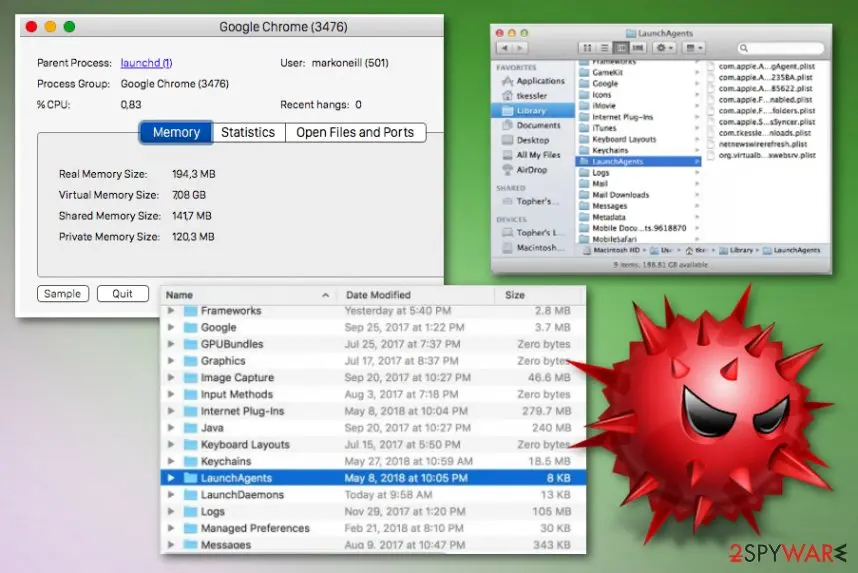
The 2020 page's picture: a Chrome process panel and a user LaunchAgents folder, with a decorative red virus. It does not show imklaunchagent. 2016-2019
Mac malware that persisted through LaunchAgents
MITRE's list of examples includes Komplex (2016), whose plist was
~/Library/LaunchAgents/com.apple.updates.plist, Dok (2017), whose plists followed the patterncom.random.name.plist, and CoinTicker (2018), with.espl.plistandcom.apple.[random string].plist. Each copied an Apple-looking name or a random one.Today
The technique is still used
The same MITRE page lists entries added much later, for instance GlassWorm, which wrote a plist under
/Library/LaunchAgents. A LaunchAgent plist is still one of the first places to look on an infected Mac.
One thing the old page got wrong: the agent folders are not mainly used for backups, and a plist is not suspicious because it starts a program. Apple's documentation says agents are the preferred way to run per-user background processes, and the same mechanism that starts a legitimate updater starts malware. What matters is whose program the plist points to.
Signs of a real infection, and what they do not prove
None of the signs below is caused by the genuine imklaunchagent. They are the signs of Mac malware or adware in general, and they are worth acting on whether or not you ever saw the name.
- Medium
Apps in the menu bar that are not in your login items
A program that starts at login without showing up in System Settings > General > Login Items & Extensions can be started by a LaunchAgent or LaunchDaemon plist instead. Compare the menu bar with that list.
- Medium
Browser redirects and changed settings
Redirects to ad-supported sites, a changed start page or search engine, and extensions you did not add point to adware or a browser hijacker, a nuisance rather than a trojan, but the same plist trick can keep it coming back.
- Medium
Unknown processes using resources in the background
A process you do not recognise with steady CPU or network use. Malware that mines cryptocurrency is one of the uses of background persistence, and MITRE lists CookieMiner as an example that installed several launch agents for mining software.
- High
Remote access, keyloggers and data theft
Several of the MITRE examples (CrossRAT, Keydnap, Proton, MacSpy) are remote access or credential-stealing programs that persist through a launch agent. We found no report that ties any of them to a file named
imklaunchagent, so the old page's statement that this name "can use keyloggers" is not confirmed. - High
Ransomware
The old page warned that such an infection may lead to ransomware that locks your files. Mac ransomware exists (ThiefQuest is in the same MITRE list and persisted through
~/Library/LaunchAgents), but we found nothing linking it to this name. Keep a backup you can restore from.
No one can say how long a hidden program runs before it shows a symptom. The old page said the same: there is no rule for it, so act on what you can check (path, signature, launch item) and not on how the Mac feels.
How to check the imklaunchagent file
Do this when a page or a security tool called imklaunchagent suspicious, or when you find the name somewhere other than /System. The checks below are the ones we ran on our own Mac, so the output you should see is the one in the section above.
- 1
Find it in Activity Monitor
Open Activity Monitor (Spotlight: Cmd + Space, type its name). In the View menu choose All Processes, then type
imklaunchagentin the search box. Note the PID. - 2
See the real path and parent
Open Terminal and run
ps -p <PID> -o pid,ppid,pcpu,rss,comm. The command column must read/System/Library/Frameworks/InputMethodKit.framework/Resources/imklaunchagentandppidmust be1, which islaunchd. - 3
Verify the signature
Run
codesign -dvv /System/Library/Frameworks/InputMethodKit.framework/Versions/A/Resources/imklaunchagentand read theAuthoritylines:Software Signing,Apple Code Signing Certification Authority,Apple Root CA. Then runcodesign --verify --verboseon the same path; it must say "valid on disk". If the path in the previous step was different, run both commands on that path: a copy that is not signed by Apple is not the system file. - 4
See what starts it
Run
launchctl print gui/$(id -u)/com.apple.imklaunchagent. Thepathline must be/System/Library/LaunchAgents/com.apple.imklaunchagent.plist. If the path is a plist in~/Libraryor/Library, a program you installed is behind the name. - 5
Look in the user folders
In Finder choose Go > Go to Folder and open
~/Library/LaunchAgents,/Library/LaunchAgentsand/Library/LaunchDaemons. Apple's ownimklaunchagentplist is not in any of them. A file there whose name containsimkorimklaunchis not the system one.
If every check passes, the file is Apple's and there is nothing to remove. If the path, the signature or the launch item does not match, go to the removal section further down.
Where imklaunchagent comes from
imklaunchagent is already on every Mac. Real Mac malware arrives in the ways below, and may then start itself through a launch item. The old page said many Mac users believe their computers are immune: that belief is false.
- High
Pirated and cracked software
Cracked apps, pirated films, music and games, and "game cheat" packages are the oldest way in, because a small script can be added to the package unnoticed. This is the route the old page named.
- High
Spam attachments and links
An email can carry the file, or a link that opens a page that starts a download. Open attachments only when you expected them, from a sender you can confirm.
- Medium
Hacked or malicious websites
A legitimate site that has been hacked, or a page that says a browser, a player or a codec needs an update. Update software from its own menu or the App Store.
- Medium
Installers that ask you to paste commands
A .dmg or a web page that asks you to drag a file into Terminal or paste a line there hands the attacker the same rights you have.
The old advice stands: use official sources for programs, stay away from torrent sites and file-sharing services, and read email carefully, especially messages with attachments or links.
What to do with imklaunchagent
How to check imklaunchagent
The genuine file is part of Windows and needs no removal.
These steps tell it apart from an impostor.
Step 1: Check the location and signature of imklaunchagent
Open Task Manager (Ctrl + Shift + Esc), right-click
imklaunchagenton Processes and choose Open file location. The genuine file is in/System/Library/Frameworks/InputMethodKit.framework/Versions/A/Resources/imklaunchagent; the same name anywhere else, especially in %AppData% or %Temp%, is an impostor to remove.Right-click the file > Properties > Digital Signatures to see who signed it. A genuine file needs nothing done, and ending it can make Windows 11 or Windows 10 unstable.
Full procedure with screenshots: Run a Microsoft Defender Offline scan
Step 2: Scan the PC, then run the offline scan
A scan finds the parts of imklaunchagent that the manual steps cannot see. In Windows Security > Virus & threat protection > Scan options, start a Full scan and quarantine what it reports.
Follow it with Microsoft Defender Antivirus (offline scan) > Scan now, which restarts the PC and checks the disk while Windows and the malware are not running.
It takes about 15 minutes and works the same in Windows 11 and Windows 10. If either scan finds something, run the full scan again after removal until it comes back clean.

Windows 11: Windows Security > Virus & threat protection > Scan options. Full procedure with screenshots: Run a Microsoft Defender Offline scan
If it is a fake: removal steps
This applies only when a check above failed: a file named like imklaunchagent outside /System, a plist you did not install, or an unsigned binary. Never delete anything in /System, /usr/libexec or /Library/Apple: those are Apple's.
- 1
Note it, then stop it
In Activity Monitor, select the process and click i, then Open Files and Ports to see what it has open. Write down the path, then click the stop button and choose Force Quit. A malicious item that is set to keep running will start again, which is why the next steps matter: the old page was right that removal does not last if the launch item stays.
- 2
Find the launch item that starts it
Open
~/Library/LaunchAgents,/Library/LaunchAgentsand/Library/LaunchDaemonswith Go > Go to Folder. Open each recent plist with a text editor, or runplutil -p <file>in Terminal, and readLabelandProgramArguments: the second names the program that is started. A plist that points to the fake path or to a program you did not install is the one that restarts it. - 3
Unload it, then delete both files
The
launchctlmanual page describesbootoutfor stopping a loaded job: runlaunchctl bootout gui/$(id -u)/<Label>for a user agent, using the label you read. We did not run it on a fake item. Then move the plist and the program it pointed to to the Bin, empty it and restart. - 4
Check the other persistence places
In System Settings > General > Login Items & Extensions, remove unknown items and switch off unknown ones under Allow in the Background. Then open General > Device Management (Profiles on older macOS) and remove any profile you did not install. Browser extensions are covered in the next section.
- 5
Restart, look again, and change passwords
Restart and run the checks again: a launch item that came back means another file is recreating it. Change the passwords saved in your browser and Keychain from another device, and turn on two-factor sign-in where you can.
We did not run these steps on a real infection, so we cannot tell you what the files of a specific fake look like, and we do not list file names for any family. Do not copy file lists from pages that do not say where they got them.
Scan, reset the browsers, and what a scan cannot do
A scan is a sensible step after a failed check or a risky install. It is one step, not a cure, and neither we nor any vendor can promise that a tool removes a named file.
- 1
Update macOS first
Open System Settings > General > Software Update. Updates carry Apple's own malware protection (XProtect), which is separate from any app you install.
- 2
Run a scan with a Mac security product you trust
Pick a product from a vendor you can check, scan the whole Mac and read what it lists before it deletes anything. The scan finds files a manual check can miss, such as an item in a folder you did not look in. A scan result that says nothing found is not proof either, so keep the path, signature and launch item checks as well.
- 3
Do not use a cleaner to "repair system files"
The old advice to run a repair or optimizer tool afterwards was written for Windows. A Mac has no registry to repair, and a tool that edits system files is more of a risk than the problem. If macOS itself misbehaves after an infection, reinstall it from Recovery.
| Browser | What to do |
|---|---|
| Chrome | Menu (three dots) > Extensions > Manage extensions, Remove anything you did not add. Settings > Privacy and security > Delete browsing data: tick history, cookies and cached files. If settings keep changing: Settings > Reset settings > Restore settings to their original defaults. Bookmarks stay. |
| Firefox | Add-ons and themes > Extensions, remove unknown ones; if the start page returns, Help > More troubleshooting information > Refresh Firefox. |
| Safari | Use the Safari tab of the removal chapter: Safari has no Reset button any more. |
After the check: keep Windows clean
Do
- Install apps from the App Store or from the developer's own site, and keep Gatekeeper and System Integrity Protection on.
- Keep macOS and your apps updated: System Settings > General > Software Update.
- Look at Login Items & Extensions now and then, and remove what you do not use.
- Keep a Time Machine backup on a drive you disconnect, so a bad install is a restore and not a loss.
- A VPN hides your address from websites. It does not remove adware or stop a launch item, so it is not a cure for this.
Don't
- Delete, rename or move anything in
/System: macOS blocks it, and recent versions will not let you. - Install cracked apps or run installers that ask you to paste commands into Terminal.
- Remove
imklaunchagentor turn off anything because a page called it a virus, without checking its path and signature first. - Run a "repair" or "cleaner" tool on system folders after a scare.
Questions about imklaunchagent
What is imklaunchagent?
imklaunchagent is a program that comes with macOS and starts the input methods you select for typing, such as Chinese, Japanese or Korean input. Apple's manual page says it is invoked automatically to launch input methods chosen by direct user interaction, must not be terminated, and monitors abnormal behavior, so it refuses to launch an input method that keeps crashing.
launchd starts it at login from /System/Library/LaunchAgents/com.apple.imklaunchagent.plist, and it then sits in the background using almost no CPU. Seeing the name in Activity Monitor is normal. Only a copy in another folder, or one without Apple's signature, is a reason to look closer.
Is imklaunchagent a virus or malware?
No. The genuine file is a signed Apple system program, not a virus. On our test Mac (macOS 26.4.1) it was owned by root, signed by Apple, reported "valid on disk", and started by launchd.
Pages call it malware because the name appears in the LaunchAgents list and because malware can copy system names, not because the Apple file does anything harmful.
A fake would sit in another folder, lack an Apple signature or be started by a plist you did not install. Run the path and codesign checks above before you decide, and repeat them if a scan flags the name.
Why can I not delete imklaunchagent?
Because it lives in /System, which macOS protects, and nobody but Apple can change it in normal use. Trying to delete it in Terminal gives "Operation not permitted", even if you give Terminal Full Disk Access.
An answer on Ask Different explains that /System is the part of the operating system and macOS blocks changes to keep it intact; a comment adds that it can only be removed by turning off System Integrity Protection or working from Recovery, which you should not do.
You do not need to delete it. A copy of the name outside /System is another matter and can be removed after you check it.
How do I know whether my imklaunchagent is the real one?
Check three things. Path: ps -p <PID> -o comm must show /System/Library/Frameworks/InputMethodKit.framework/Resources/imklaunchagent.
Parent: ppid must be 1, which is launchd. Signature:
codesign -dvvon the file must showSoftware SigningApple Code Signing Certification AuthorityandApple Root CAcodesign --verify --verbosemust say "valid on disk"
Then run launchctl print gui/$(id -u)/com.apple.imklaunchagent: its path must be the plist in /System/Library/LaunchAgents. A different folder, parent, signature or plist means the file is not Apple's.
What does a LaunchAgent have to do with malware?
A LaunchAgent is a plist file that tells macOS to start a program when a user logs in, and malware uses the same mechanism to keep itself running after a restart. Apple's documentation names the folders /System/Library/LaunchAgents, /Library/LaunchAgents and ~/Library/LaunchAgents.
MITRE lists the technique as T1543.001 and says attackers may disguise the agent's name with a name from the operating system or benign software. So a LaunchAgent is not the sign of a virus by itself. Read the plist's Label and ProgramArguments and check what program it starts.
Can imklaunchagent steal data, log keystrokes or mine cryptocurrency?
Not the genuine one, as far as we could confirm. Apple's manual page describes it only as a launcher and monitor for input methods, and ours made no network connection that we could list. Other Mac malware does use LaunchAgents for remote access, keylogging and mining; MITRE lists CrossRAT, Keydnap, MacSpy and CookieMiner among its examples.
We found no source that ties any of them to the name imklaunchagent, so the old claim that this name "can use keyloggers" stays unconfirmed. If a copy outside /System has unusual CPU or network use, treat that copy as suspicious.
Should I run an antivirus scan if I see imklaunchagent?
Only if the checks fail or you have other signs:
- unknown login items
- redirects
- a changed start page
- a process using a lot of CPU that you cannot explain
Seeing the name alone is not a reason. When you do scan, use a Mac security product you can check, read the results before it deletes anything, and keep macOS updated, because Apple's own malware protection comes with the updates.
A scan that finds nothing is not proof either. Do not use a cleaner or repair tool on system folders: the old advice to run one was written for Windows.
Will removing a program remove the imklaunchagent problem?
Only if the problem was a fake copy that the program installed. Removing an app does not always remove the plist and helper files it left behind, so a launch item can bring the process back, which the old page described as the virus "reinstalling itself".
Look in ~/Library/LaunchAgents, /Library/LaunchAgents and /Library/LaunchDaemons for a plist that points to the file, remove both the plist and the program, restart and check again. The genuine Apple file stays in /System and is not a problem to remove.
Is there an imklaunchagent on Windows, iPhone or Android?
No. It is part of macOS's InputMethodKit framework and exists only on the Mac. A file with this name on Windows would not be Apple's and is worth checking with a scan, but we did not find reports of one.
Windows has no LaunchAgent folders, so the old page's mention of registry entries did not apply to this name, and a Mac has no registry: macOS keeps its settings in plist files. On an iPhone or iPad there is nothing to open or remove.
Will Fortect remove imklaunchagent?
Fortect scans Windows for malware and unwanted programs and repairs the system files and settings they change, and its free scan shows what it finds on your PC before you decide anything.
For imklaunchagent, follow the plan above as well: the browser steps take back permissions and settings that no scanner treats as a threat, and uninstalling the program that brought it removes the source.
Run Microsoft Defender's full scan and, if anything was found, its offline scan as a second opinion. If the symptoms are gone after the plan and both scans are clean, there is nothing more to do.
Sources
- imklaunchagent(8) manual page, macOS 26.4.1 (read locally with man imklaunchagent) (read October 6, 2026)
- Apple: Creating Launch Daemons and Agents (Daemons and Services Programming Guide) (read October 6, 2026)
- MITRE ATT&CK T1543.001: Create or Modify System Process, Launch Agent (read October 6, 2026)
- Ask Different: Deleting a suspicious malware (imklaunchagent) in Mac (read October 6, 2026)