
tronzadorasnng.com: a Windows XWorm malware site that hides code in PNG pictures, and what to do if a script from it ran
tronzadorasnng.com is a website that URLhaus lists for malware downloads:
- seven file addresses added within four minutes on 9 October 2026
- all tagged xworm
- three of them PNG pictures also tagged stego
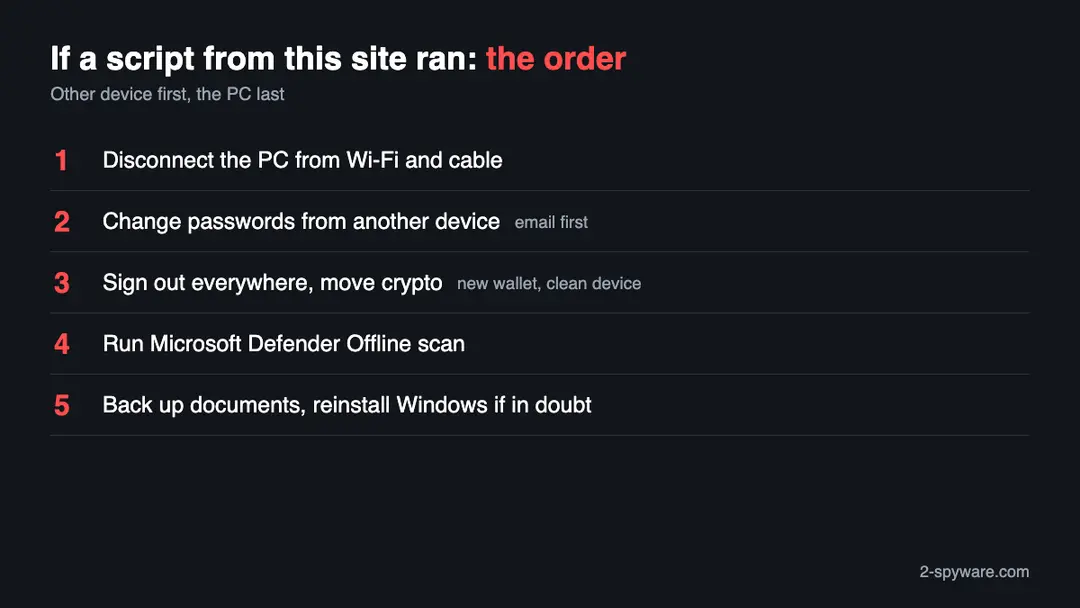
The site no longer answers when we look it up. If you ran a script or a pasted command from it on Windows, treat the PC as compromised: change your passwords from another device, then scan it offline.
Facts checked October 10, 2026. Removal steps tested on Windows 11 (26H2) and checked against Microsoft's and the browser makers' current documentation.
Automatic
Get a free scan and check if your PC is infected.
Fortect finds malware, unwanted programs and the Windows damage they leave behind, and repairs it in one pass.
An automatic scan checks installed programs, startup items and browser extensions for anything that came with a script or file from tronzadorasnng.com, or a command that fetched an image from it.
Do it yourself · free Remove tronzadorasnng.com (XWorm, stego PNG) yourself 5 steps, about 15 minutes, no software needed.
Start the steps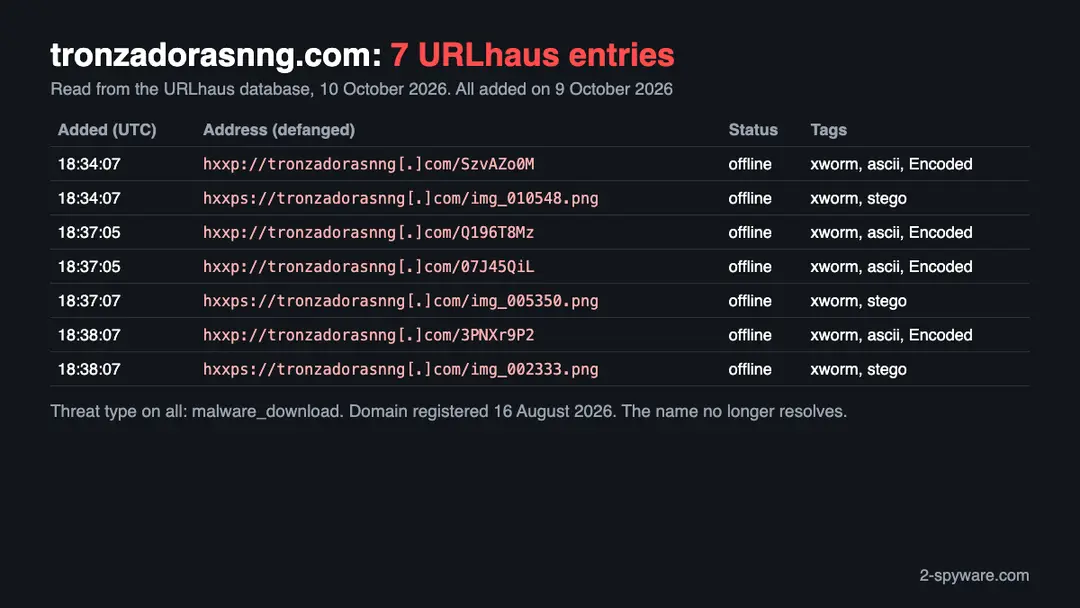
Tronzadorasnng.com (XWorm, stego PNG): summary
| Type | A malware download address for Windows: URLhaus lists four encoded text files and three stego PNGs, all tagged xworm |
|---|---|
| Risk | High if a script from it ran: passwords, sessions, crypto and PC control may have been exposed |
| Symptoms | Often none. A script you ran, pictures that will not open, or a scheduled task you did not make are the signs |
| How to get rid of it | Disconnect, change passwords from another device, move crypto, run a Microsoft Defender Offline scan, then back up documents and reinstall Windows if in doubt |
| Our check (10 October 2026) | One lookup: the name did not resolve, no page. A quiet or dead site clears nothing; the danger rating comes from URLhaus |
| Running since / first seen | Domain registered 16 August 2026; first malware URLs reported 9 October 2026 |
| Removal | Scan the PC with security software to find and remove the malware and anything installed with it. Fortect scans Windows for malware and repairs the system files and settings it damaged. Remove it nowTo use the full-featured product, you have to purchase a license for Fortect. The scan is free. |
Show 9 more facts
| Platform | Windows, by the xworm tag; no source says other systems are affected |
|---|---|
| Detection names | No Microsoft detection name is known for the files on this server, because we did not open them and found no Microsoft page that names this campaign. The URLhaus tags are xworm, stego, ascii and Encoded. Run a Microsoft Defender Offline scan and read the name in Protection history |
| Name | Tronzadorasnng.com |
| Domain registered | 16 August 2026 |
| Evidence | 7 write-ups by security sites; details still limited |
| First seen | 9 October 2026 |
| Distribution | Typically fake installers, cracked programs, e-mail attachments, fake "verify you are human" pages and ads for popular apps |
| Damage | Installs other malware, often several programs at once |
| Facts checked | 10 October 2026 |
Facts checked on 10 October 2026 against our copy of the URLhaus data for tronzadorasnng.com, RDAP, one browser test of our own, the AhnLab ASEC write-up of an XWorm campaign that uses pictures, and Microsoft Learn. We did not download the files and we infected no PC; the removal steps follow Microsoft's page and were not tried on a live infection.
What tronzadorasnng.com is, and what we know about it
tronzadorasnng.com is a web address, not a program on your PC. It is a domain that the abuse.ch project URLhaus lists as a place where malware was served, and all seven of its entries carry the tag xworm. No public write-up of this one domain exists that we could find, so this page rests on what URLhaus shows, what we saw ourselves and what AhnLab has published about XWorm delivered through pictures.
- 1
What URLhaus lists
Seven file addresses on tronzadorasnng.com, all added on 9 October 2026 by the abuse.ch reporter account between 18:34 and 18:38 UTC. Four are plain addresses with random eight-character names and the tags ascii, Encoded and xworm: SzvAZo0M, Q196T8Mz, 07J45QiL and 3PNXr9P2. Three are PNG pictures with the tags stego and xworm: img_010548.png, img_005350.png and img_002333.png. All seven carry the threat type malware_download and were offline when we read them.
- 2
What the tags mean
xworm names the malware family: XWorm is a remote access tool, a program that lets another person control a PC. stego says that the PNG picture hides data inside it. ascii says the other files are plain text, not compiled programs, and Encoded says the reporter saw that text in an encoded form. Together they describe text files and pictures that a script combines to rebuild a program.
- 3
What we could not confirm
We did not download any of the files and we never saw a page that tells visitors what to do. So we do not know how a victim reached the files, what exactly each picture holds, or how the four text files differ. The tags are the reporter's labels, not our finding.
- 4
What this means for you
If you only saw the name in a log, a link or a warning, you are not infected by that alone. The risk is for people who opened a script file that reached out to this address, pasted a command that did, or ran a file that came from it.
- Kind of threat
- A malware download address; all seven entries are tagged xworm, three of them PNG pictures tagged stego
- Malware family
- XWorm, a remote access tool for Windows (reporter's tag, not confirmed by us)
- Domain registered
- 16 August 2026, expires 16 August 2027, registrar NameSilo, LLC; record last changed 8 October 2026 (RDAP, read 10 October 2026)
- URLhaus entries
- 7 file addresses, all added on 9 October 2026 within four minutes; all 7 offline when we read them
- Platform
- Windows, by the xworm tag and the PowerShell style of the chain. No source says which other systems are hit
What tronzadorasnng.com (XWorm, stego PNG) does on an infected PC
What we checked on 10 October 2026, and what we could not
We opened https://tronzadorasnng.com/ one time from Lithuania with an automated Chromium set to English. The browser could not find the name, so there was no page to look at. A missing page says nothing good about the owner, and it proves nothing about safety either.
Our site test, 10 October 2026
- Name lookup failedChromium stopped with ERR_NAME_NOT_RESOLVED: the domain returned no address. URLhaus marks every one of its seven files offline, which matches a server that was pulled or switched off.
- A dead name is not an all clearPossible reasons: the owner deleted the DNS records, the registrar or a host stepped in, or the campaign moved to a new domain. None of these undo what a script already did on a PC that fetched from it. The same chain may now be served from somewhere else.
- Notifications, pop-ups, redirects, ad networksNone seen, because nothing loaded during this single visit.
- URLhausSeven malware addresses, each with the tag xworm, each offline when we read the feed.
- Files and page contentWe fetched no file and saw no page, so what the text files and pictures contain is unknown to us.
Dangerous: treat it as a malware site One failed lookup says nothing either way. The rating rests on the URLhaus reports. A domain that is down does not repair a PC that already ran something from it.
What happened to tronzadorasnng.com, from registration to our test
The history is short: the domain is under two months old and all seven malware addresses were reported within four minutes of each other. The dates come from RDAP and from the URLhaus database.
16 August 2026
The domain is registered
RDAP shows tronzadorasnng.com registered on 16 August 2026 through the registrar NameSilo, LLC, valid until 16 August 2027. The name reads like Spanish for a cutting machine maker with a short ending; nothing we found shows a real business behind it.
8 October 2026
The registration record changes
RDAP shows the record last changed on 8 October 2026, the day before the first malware reports. We do not know what was changed or why.
9 October 2026, 18:34 UTC
The first files are reported
URLhaus receives a text file, SzvAZo0M, and a picture, img_010548.png, both tagged xworm. This is the first time URLhaus sees the host.
The seven URLhaus entries for tronzadorasnng.com as we read them on 10 October 2026. Addresses are defanged. 9 October 2026, 18:37 to 18:38 UTC
Five more files follow
Within about four minutes the reporter adds two more text files, Q196T8Mz and 07J45QiL, then a picture, img_005350.png, then a fourth text file, 3PNXr9P2, and a third picture, img_002333.png. The pattern looks like one batch of files collected from the same server.
10 October 2026
Our test finds no address
Our browser visit to https://tronzadorasnng.com/ ends in ERR_NAME_NOT_RESOLVED, and URLhaus shows all seven files offline.
We could not read the URLhaus pages themselves, because they ask for a browser check. The entries above come from the same data in our own database, which holds the URLhaus feed.
How malware can hide in a picture, and what XWorm is
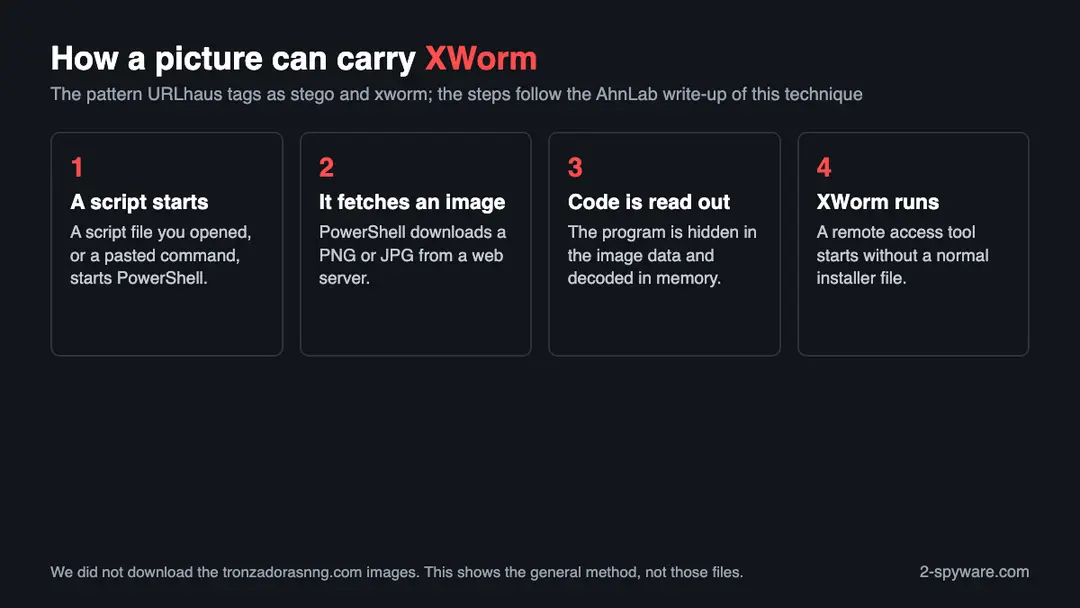
We did not see what tronzadorasnng.com's pictures hold. This is how AhnLab describes the same method in another XWorm campaign, so you can recognise the pattern.
- 1
A script file starts the chain
AhnLab's analysis says a phishing email delivers a VBScript or JavaScript file. The first script adds an embedded PowerShell script that holds Base64 text mixed with dummy characters. The PowerShell removes the dummy characters with Replace(), decodes the rest and runs it.
- 2
PowerShell fetches a picture
That PowerShell downloads a JPG image from an outside server. The image opens as a normal picture, so a person who looked at it would see nothing wrong.
- 3
The program is read out of the picture data
AhnLab describes two versions. In the older one, Base64 text sat between the markers <<BASE64_START>> and <<BASE64_END>>. In the newer one, the script finds a bitmap signature at the end of the JPG and reads the red, green and blue values of its pixels to rebuild a .NET loader.
- 4
The loader starts XWorm
The rebuilt loader runs and starts the final malware, XwormRAT. AhnLab says the files it names in that campaign were hosted on services such as archive.org, an r2.dev address and paste.ee. That shows attackers mix picture files and text files from different places, which fits the mix of text and picture files URLhaus lists here, though we cannot say that the two campaigns are linked.
The point of the trick is that no ordinary installer file ever lands on the disk, and a PNG or JPG looks harmless to a quick filter. It does not mean the picture on your screen is dangerous to view. The danger is the script that reads the picture and runs what it finds.
XWorm itself is a remote access tool. That is a program that connects out to a server run by the attacker and then takes orders, which is why this page tells you to disconnect the PC before anything else. We did not analyse a sample, and we found no first-hand analysis of the tronzadorasnng.com files, so we do not list its commands or settings here.
The seven files: what each name suggests, and what we do not know
File names are weak evidence. We list what each group could be and mark which statements are only a reading of the names and tags.
| Files on tronzadorasnng.com | What URLhaus says | What they may be (our reading) |
|---|---|---|
| /SzvAZo0M, /Q196T8Mz, /07J45QiL, /3PNXr9P2 | Offline, tagged ascii, Encoded and xworm, added 9 October 2026 between 18:34 and 18:38 UTC | Plain text with no file ending, holding encoded content. They are probably script stages or data that a first script fetches and decodes. Not confirmed |
| /img_010548.png, /img_005350.png, /img_002333.png | Offline, tagged stego and xworm, added 9 October 2026 between 18:34 and 18:38 UTC | PNG files that carry hidden data. They are probably the containers from which a program is rebuilt. Not confirmed |
Three pictures with numbered names and four text files with random names suggest a server that offers several variants, perhaps one set for each target or each day. That is a habit we can guess at, not something we saw. We did not fetch the files, so we cannot say how the seven belong together.
What tronzadorasnng.com (XWorm, stego PNG) can steal or download
What a remote access tool like XWorm can mean for you
We did not open the files and found no analysis of them, so we cannot list what this copy does. The table below is the general meaning of a remote access tool, not a claim about this site's files.
Names and tags from the reports and the research we read
- xworm (URLhaus tag on all seven files)
- stego (URLhaus tag on the three PNGs)
- ascii and Encoded (URLhaus tags on the four text files)
- A .NET loader rebuilt from picture data (AhnLab)
- Base64 text mixed with dummy characters (AhnLab)
- Files hosted on mixed public services (AhnLab)
| Kind | What it can do to you | Source |
|---|---|---|
| Remote access tool | Lets another person reach the PC from outside. What that person can then do depends on the tool and its settings; typical abuse is watching, copying and installing more software | Our reading of the xworm tag; not confirmed for this site |
| Loader | Rebuilds and starts the final program from the picture data, so the first script may not be the last thing on the PC | AhnLab on a similar chain |
| Encoded script text | Hides what the script does from a quick look, so reading the file does not tell you what it ran | AhnLab on a similar chain |
What this can cost you
Reading the site name or seeing a warning costs nothing. The risks below apply to a PC where a script from the site ran or a file from it was opened.
- High
A stranger at the controls
A running XWorm lets someone reach the PC over the internet. Pull the network cable or turn off Wi-Fi before anything else, even before you touch a password.
- High
Logins, cookies and saved data
Whatever you type or keep in the browser can be read by a remote tool. Reset passwords on a different device and use each service's sign out everywhere option, since a fresh password may not cancel a session that was already copied.
- High
Wallets and recovery phrases
Treat any crypto wallet on that PC as exposed. Transfers cannot be undone, so create a new wallet on a clean device and move the funds first.
- Medium
A copy that survives a restart
We found no source that describes how this chain keeps itself alive. Until an offline scan has run, or Windows has been reinstalled, assume the PC may call home again after it boots.
- Medium
Employer systems
A work laptop holds logins to company tools. Call your IT or security contact immediately so they can lock those accounts.
- Low
Little or nothing for a name seen in passing
Meeting the domain name in a log, a mail filter report or a blocked link does not mean anything was installed.
What you may notice, and what you may not
Many victims notice nothing. The signs below follow from how these chains are built; the first is the best evidence you have.
| Sign | What it means |
|---|---|
| A script file or a pasted command you ran that mentions a picture or an address on tronzadorasnng.com | This is the start of the chain. Note the file name or the line before you do anything else |
| A window that flashed and closed | A PowerShell or Command Prompt window that runs a one-line download and exits |
| Picture files in a folder such as Downloads, Temp or Public that will not open as pictures | A real picture opens in Photos; a data container named like a picture does not. Our reading, not a finding about these files |
| A scheduled task or a Startup entry you did not make | We found no source that says this chain makes one, but any task you did not create is a reason to look closer |
| Accounts you did not touch | Logins from new places, password-reset emails and messages sent from your accounts. This follows from stolen sessions; it is our reading, not a quote |
| Nothing at all | Remote tools are built to stay quiet |
How to check the PC for tronzadorasnng.com (XWorm, stego PNG)
How people end up running a script like this
No source tells us how people reached tronzadorasnng.com. AhnLab names one route for this picture technique in general, a mail that carries a script.
- 1
A mail with a script attached
AhnLab says the chain starts with a phishing mail carrying a VBScript or JavaScript file. ANY.RUN describes a comparable XWorm dropper named like a purchase order, PurchaseOrder_25005092.js, that writes its parts to C:\Users\PUBLIC. Windows treats a .js or .vbs file as a program, so opening it runs it.
- 2
A command a page asks you to paste
Some pages tell you to paste a line into the Run box or PowerShell to pass a check. Extensionless text files fetched by one short command would fit that start, but no source says this site did it, and we never saw its page.
- 3
A fake update or free program
Cracked programs and fake updates often carry remote tools. That is general background, not something we saw here.
- 4
A link in a message
A link in chat, mail or a comment can lead to a script download. We have no evidence of how this domain was shared.
Check your Windows PC before you delete anything
Begin with one question: did you open a script, paste a command that pulled something from tronzadorasnng.com, or start a file that came from it? If so, go straight to the numbered plan, because a tidy check does not clear a PC. If you are unsure, run the checks below first. None of them deletes a thing.
Until you know, keep the PC away from banking, email, work and crypto, and take it off Wi-Fi and cable if you can.
- 1
Identify what you actually ran
Locate the file you double clicked, or recall the line you pasted. Write down its name and folder. If it came in an email, keep that message. Do not run it a second time.
- 2
Hunt for pictures that are not pictures
In File Explorer open Downloads,
C:\Users\Publicand%TEMP%. Look for .png or .jpg files you never saved. A file that refuses to open in Photos should be noted by name and left in place for now. - 3
Scan Task Scheduler for strangers
Press the Windows key, type Task Scheduler and open it, then pick Task Scheduler Library. Read the name and the Actions tab of anything new or oddly named. Only record what you see.
- 4
Open the Startup folder
Press Windows key + R, enter
shell:startupand confirm. Anything you did not place there deserves a note. - 5
Read your Run history after a pasted command
Start Registry Editor (Windows key, regedit, Enter) and browse to
HKEY_CURRENT_USER\Software\Microsoft\Windows\CurrentVersion\Explorer\RunMRU. Each value is a line once typed in the Run box. Copy down any that mention powershell, a web address or tronzadorasnng, and never execute them. - 6
Review Windows Security
Go to Windows Security > Virus & threat protection > Protection history. On Windows 10 reach it through Settings > Update & Security > Windows Security. Look for alerts near the time the script ran.
- 7
Read a clean result with care
This kind of chain works in memory and may leave almost nothing on disk, so a tidy report only reduces the doubt.
How to remove tronzadorasnng.com (XWorm, stego PNG)
How to remove tronzadorasnng.com
A loader's job is to install other malware, so treat the PC as infected with more than one program until the scans are clean.
Step 1: Delete scheduled tasks that bring it back
Open Task Scheduler from the Start menu and click Task Scheduler Library. Select each task you do not recognise and read the Actions tab:
- a task that starts a file in
%AppData%or%Temp% - runs
powershellwith a long encoded line - opens a web address belongs to tronzadorasnng.com or a similar program
Right-click such a task and choose Delete, and check the subfolders too. Leave tasks from Microsoft, your PC's maker and programs you use. Task Scheduler is the same in Windows 11 and Windows 10.
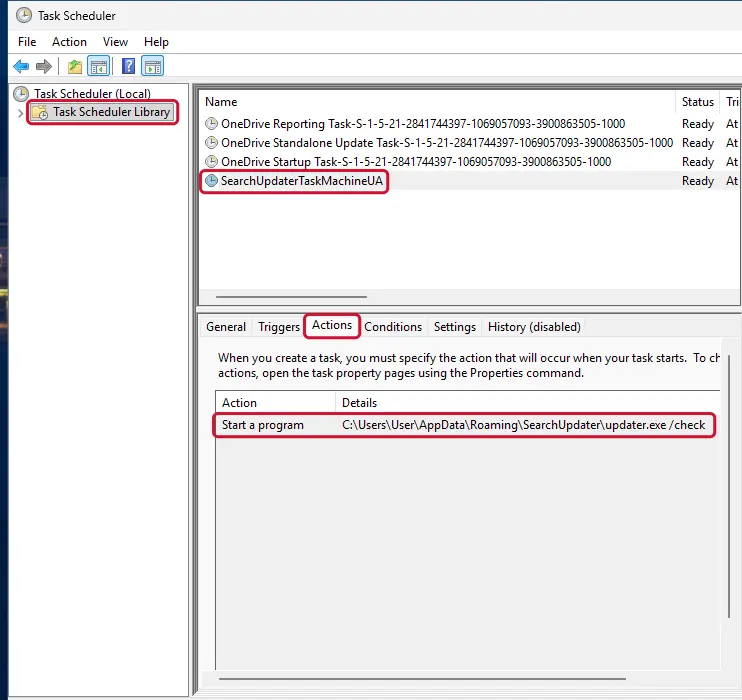
Windows 11: Task Scheduler Library, the task selected, the Actions tab shows the file it runs. Full procedure with screenshots: Remove what malware leaves behind in Windows
- a task that starts a file in
Step 2: Remove it from startup
Whatever tronzadorasnng.com installed usually starts with Windows. Open Task Manager with Ctrl + Shift + Esc, go to Startup apps in Windows 11 or the Startup tab in Windows 10, and disable what you do not know, starting with entries that have an empty Publisher column.
Open file location on the right-click menu shows the file, which helps you decide and tells you what to delete later. Disabling is safe: if something you need stops working, switch it back on.
Full procedure with screenshots: Stop apps from opening at startup On uGetFix
Step 3: Delete the folders left behind
What the uninstaller leaves behind is usually in the user folders. Open File Explorer, switch on View > Show > Hidden items (in Windows 10 View > Hidden items), and go through
%LocalAppData%,%AppData%, %ProgramData% and the two Program Files folders.Sort by Date modified and delete folders that appeared together with the problem and belong to no program you use. Folders with random names that hold
.exe,.dll, .js or .ps1 files are the strongest sign.Full procedure with screenshots: Remove what malware leaves behind in Windows
Step 4: Scan the PC, then run the offline scan
Open Windows Security > Virus & threat protection > Scan options, run a Full scan and remove everything it finds. Then select Microsoft Defender Antivirus (offline scan) and click Scan now: the PC restarts and scans before Windows loads, which finds files that hide while Windows runs.
Save your work first, because the offline scan takes about 15 minutes. Both scans are built into Windows 11 and Windows 10, and a second scanner from another vendor is a useful extra opinion.
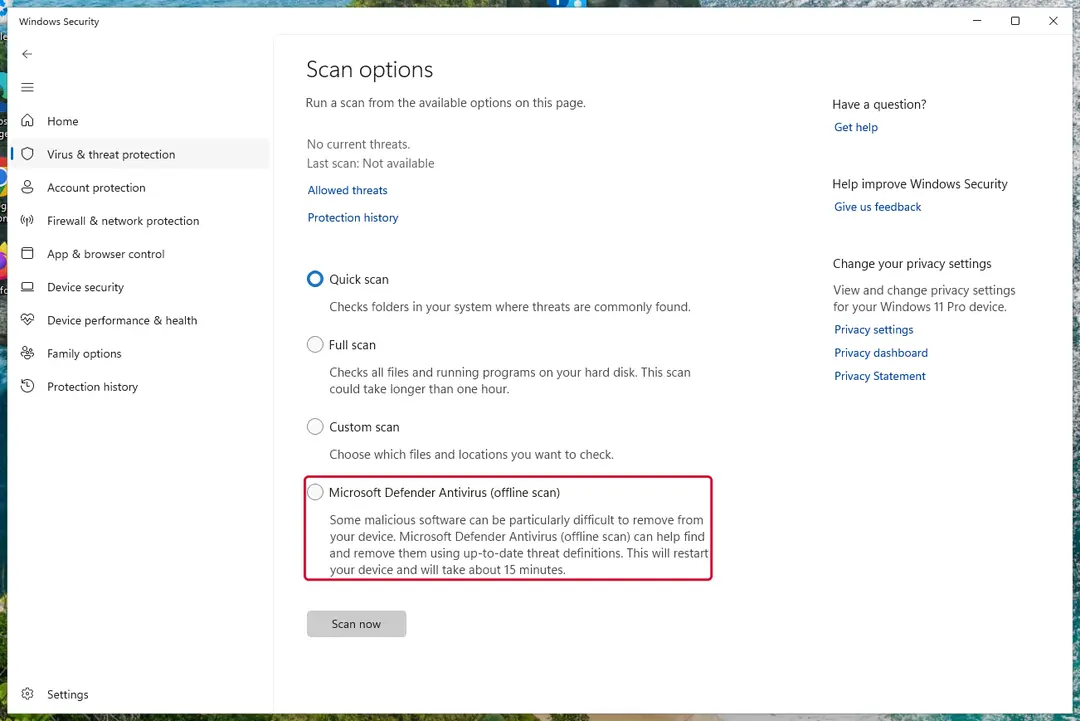
Windows 11: Windows Security > Virus & threat protection > Scan options. Full procedure with screenshots: Run a Microsoft Defender Offline scan
Step 5: Change passwords from another device and sign out other sessions
Assume that the passwords saved in this PC's browsers, and the accounts that were open in them, are known to the attacker. From a phone or a clean computer, change the e-mail password first, then banking, shopping, social and gaming accounts.
Use each service's option to sign out of all other sessions, because stolen cookies keep a session open even after a password change. Turn on two-step verification on each account. Wait with the infected Windows 11 or Windows 10 PC until the scans are clean.
Full procedure with screenshots: Turn on two-step verification / secure a hacked account
Scan from outside Windows: Microsoft Defender Offline
Microsoft Defender Offline starts a scan outside the running Windows session. Microsoft's page says it runs outside the normal Windows kernel and aims at malware that dodges the shell, such as rootkits, which makes hiding harder.
- 1
Get ready
Save open work and close programs. Microsoft puts the run at about 15 minutes plus a restart. You need local administrator rights and Windows Recovery Environment switched on. Check it in an elevated Command Prompt with
reagentc /info, and turn it on withreagentc /enableif it reads Disabled. Microsoft warns that with WinRE off the scan silently does nothing. - 2
Pause BitLocker first
If the system drive uses BitLocker, suspend protection beforehand, or the restart into the scan may ask for your recovery key.
- 3
Launch it
In Windows Security pick Virus & threat protection, then Scan options, tick Microsoft Defender Offline scan and press Scan now. Accept the prompts. Windows signs you out, reboots into the scan and returns to the desktop when done. An elevated PowerShell does the same with
Start-MpWDOScan. - 4
Find the outcome
Afterwards open Virus & threat protection > Scan options > Protection history. Microsoft notes the offline scan is not available on Windows on ARM, and that Defender Antivirus has to be your primary antivirus to get its updates.
- 5
Keep going even if it is empty
An empty report cannot prove that a remote tool never ran. If a script from this site did run, finish with a document backup and a clean Windows install.
If you use a Mac, an iPhone or an Android phone
The xworm tag and the PowerShell style of the chain suggest Windows. Nothing we read says the seven files run elsewhere.
| Your device | What we know | What to do |
|---|---|---|
| Mac | The chain is built around PowerShell for Windows and would not run unchanged on macOS. What a Mac visitor was served is unknown | If you ran something from a site on a Mac, handle it as a separate case with our Mac guides, not with these Windows steps |
| iPhone or iPad | iOS does not run Windows scripts | Nothing to clean. Change any password you typed into a page |
| Android | No source mentions Android for this domain | Nothing to clean for this chain. Change any password you entered |
After removal: passwords, accounts and prevention
After a clean PC: protect what was taken
Cleaning the PC covers only half the job. The data that sat on it may already be copied, so work from the outside in: another device, then money, then the PC.
- 1
Reset passwords on a trusted device
Use a phone or a different computer. Do the email account first, then banking, then work and social media. Anything typed on the affected PC may have been seen. For Microsoft sign in, use account.microsoft.com.
- 2
End other sessions and cancel keys
A copied cookie can outlive a password change. In every important account choose sign out of all devices. Cancel API tokens, SSH keys and cloud keys that lived on the PC.
- 3
Move funds before anything else if a wallet was there
If a recovery phrase might be exposed, send the funds to a fresh wallet with a new phrase created on a clean device.
- 4
Add a second sign in factor
Use an authenticator app or a security key where offered, so a stolen password or session alone is not enough at a new login.
- 5
Save documents and reset Windows if unsure
Copy only documents and photos to an external disk, never programs. On Windows 11 go to Settings > System > Recovery, on Windows 10 to Settings > Update & Security > Recovery, and reset the PC with everything removed.
- 6
Keep watching
For several weeks check bank, email and crypto for anything you did not do, and call your bank the moment something looks wrong.
Keep a Windows PC out of this kind of trap
One habit blocks this chain: a script that arrives by mail or from a web page is a program, and you should leave it alone.
Do
- Handle any .js, .vbs, .ps1 or .cmd file from mail or a download as a program and delete it.
- Close the tab whenever a page tells you to paste a command into Run or PowerShell.
- Install Windows and browser updates, and leave Windows Security on.
- Keep a document backup on a disk that is unplugged afterwards.
- Protect key accounts with an authenticator app.
Don't
- Never open an order, invoice or receipt that turns out to be a script, even with a purchase order name.
- Never assume a file is harmless because it opens as a picture; the harm sits in whatever reads it.
- Never run files from sites that offer paid software for free.
- Never open a file sent by link or message that calls itself an update.
- Never treat one quiet scan as proof you are safe.
Questions about tronzadorasnng.com (XWorm, stego PNG)
What is tronzadorasnng.com?
tronzadorasnng.com is a domain that URLhaus, abuse.ch's malware database, lists as a malware download source. The reporter added seven file addresses on 9 October 2026 over about four minutes, every one tagged xworm.
Three are PNG pictures also tagged stego. Four are text files tagged ascii and Encoded. RDAP shows the domain registered on 16 August 2026.
When we looked on 10 October 2026 the name no longer resolved and all seven files were offline. We found no public analysis of this domain.
Is tronzadorasnng.com a virus?
The site is not a virus, but it is a listed source of malware. All seven URLhaus entries have the threat type malware_download and the tag xworm, the name of a remote access tool. We fetched none of the files, so we cannot describe what they do.
Do not open the address, and do not run anything it offered. Reading this page cannot infect you. The danger is for people who ran a script or file that came from the domain.
What is XWorm?
XWorm is a remote access tool for Windows, the label researchers use for a program that calls out to an attacker's server and takes orders. That gives the attacker a way to reach the PC from outside.
AhnLab describes campaigns that spread it through script files and pictures, ending in a .NET loader that starts XwormRAT. We did not analyse a sample from this domain, so we make no claim about the settings or commands of the copy it served.
What does the stego tag on the PNG files mean?
Stego stands for steganography, hiding data inside another file. For the three PNGs it suggests the files are more than pictures: code or data is tucked into the image bytes, and a script pulls it out and runs it.
AhnLab shows this for XWorm with JPG files, where a script reads the red, green and blue values of a bitmap placed at the end of the image. We did not open these PNGs, so their content is unconfirmed.
I ran a script from tronzadorasnng.com. What now?
Take the PC off the network first: switch off Wi-Fi and pull the cable. From a different device, change your email, bank and work passwords, sign out of accounts everywhere and move any crypto to a new wallet.
Then run Microsoft Defender Offline on the PC. Because a remote tool may leave little behind, the safest finish is a document backup and a clean Windows install. If it is a work PC, tell your IT team straight away.
What if I only opened the site and ran nothing?
Merely visiting is unlikely to be the problem here, because the harm comes from a script or file you run. Do not open anything it handed you. If you downloaded a file and left it unopened, delete it.
If you typed a password into a page from this site, change that password from a safe device. We never saw the page, so we cannot say what visitors were shown, and the site no longer answers.
Why does the site not load any more?
On 10 October 2026 Chromium reported ERR_NAME_NOT_RESOLVED, meaning the name returned no address, and URLhaus showed all seven files offline. The owner may have deleted the DNS records, the registrar or a host may have acted, or the campaign may have moved to another domain.
A dead address does not clean a PC that already ran what it served, and the same chain may now point at a different server.
Can a picture infect me just by being viewed?
Looking at a picture is not the danger. In the chains researchers describe, a script that is already running downloads the picture and reads hidden data out of it, and that script starts the malware.
The image looks normal on screen. The risk is opening a script file or pasting a command. Even so, avoid opening files from sources you do not know.
Will Windows Security remove it?
It may catch parts of it, but a quiet scan does not show that the PC is clean. These chains work in memory and may leave little on disk.
Run Microsoft Defender Offline from Windows Security under Virus and threat protection, then Scan options, and read Protection history after. If a script from this site ran, back up documents and reinstall Windows, after changing your passwords from another device.
Will Fortect remove tronzadorasnng.com?
Fortect scans Windows for malware and unwanted programs and repairs the system files and settings they change, and its free scan shows what it finds on your PC before you decide anything.
For tronzadorasnng.com, follow the plan above as well: the browser steps take back permissions and settings that no scanner treats as a threat, and uninstalling the program that brought it removes the source.
Run Microsoft Defender's full scan and, if anything was found, its offline scan as a second opinion. If the symptoms are gone after the plan and both scans are clean, there is nothing more to do.
Sources
- URLhaus (abuse.ch): host page for tronzadorasnng.com (entries read from our copy of the feed) (read October 10, 2026)
- RDAP registration record for tronzadorasnng.com (read October 10, 2026)
- AhnLab ASEC: XwormRAT Being Distributed Using Steganography (read October 10, 2026)
- ANY.RUN: malware trends report with an XWorm JavaScript and PNG loader chain (read October 10, 2026)
- Microsoft Learn: Microsoft Defender Offline scan in Windows (read October 10, 2026)