
maxxlavalink.cyou: a server that handed out Mirai and coin miner files for Linux routers and IoT devices, and what to do
maxxlavalink.cyou is a web address that URLhaus lists 19 times, all on 4 October 2026 within about sixteen minutes, for Linux program files named after processor types (arm, mips, x86_64 and more), eleven tagged Mirai and two tagged CoinMiner.
These files are built for routers, cameras and small Linux servers, not for a Windows PC or a phone. If you only saw the name in a log, nothing is proven; if a device on your network asked for these files, treat that device as taken over, unplug it from the network, and reset it as described below.
Facts checked October 11, 2026. Removal steps tested on Windows 11 (26H2) and checked against Microsoft's and the browser makers' current documentation.
Automatic
Get a free scan and check if your PC is infected.
Fortect finds malware, unwanted programs and the Windows damage they leave behind, and repairs it in one pass.
An automatic scan checks installed programs, startup items and browser extensions for anything that came with a script or device that downloads program files from maxxlavalink.cyou.
Do it yourself · free Remove maxxlavalink.cyou (Mirai, CoinMiner, Linux binaries) yourself 5 steps, about 15 minutes, no software needed.
Start the steps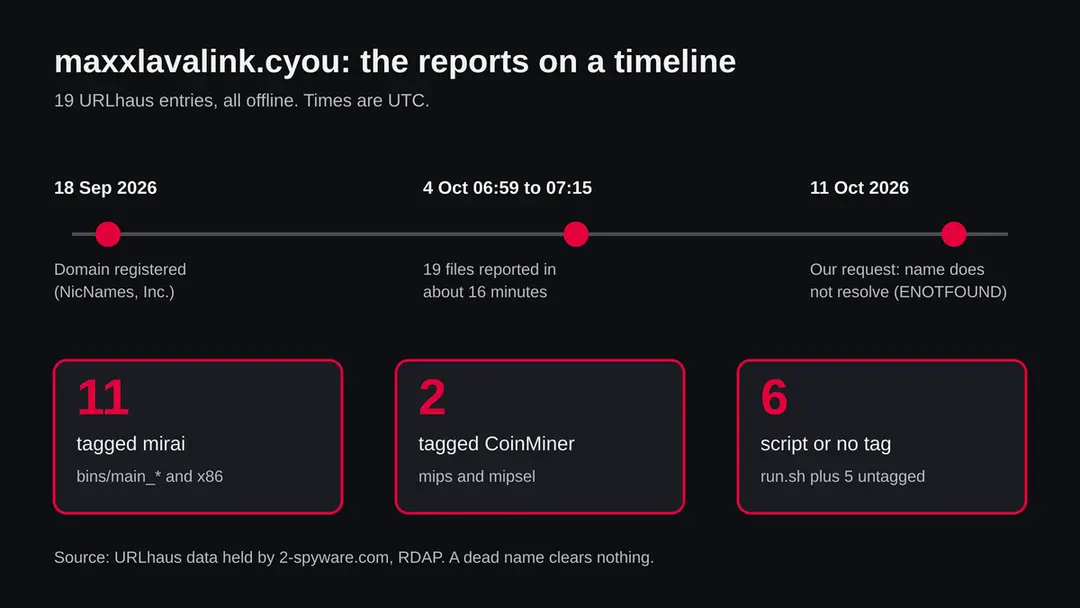
Maxxlavalink.cyou (Mirai, CoinMiner, Linux binaries): summary
| Type | A malware server: URLhaus tags 11 of its 19 files mirai and 2 CoinMiner; they are Linux programs for routers, cameras and small servers |
|---|---|
| Risk | High for a reachable device with a weak login that fetched the files: it can join a botnet or mine coins. Low if you only saw the name |
| Symptoms | Often none. A hot, slow or unstable device, high processor use at idle, changed DNS settings or a changed admin password are the signs in the reports |
| How to get rid of it | Disconnect the device, factory reset it, update the firmware, set a new password, turn off remote access; rebuild a hacked server from a clean image |
| Our check (11 October 2026) | One plain request from our server: the name did not resolve (ENOTFOUND). That clears nothing; the rating comes from URLhaus |
| Running since / first seen | Domain registered 18 September 2026; all 19 files reported on 4 October 2026 between 06:59 and 07:15 UTC |
| Removal | Scan the PC with security software to find and remove the malware and anything installed with it. Fortect scans Windows for malware and repairs the system files and settings it damaged. Remove it nowTo use the full-featured product, you have to purchase a license for Fortect. The scan is free. |
Show 9 more facts
| Platform | Linux and embedded Linux. Nothing we read says a Windows PC, a Mac or a phone runs these files |
|---|---|
| Detection names | No exact Microsoft name is confirmed for these files, because we did not open them. Microsoft's scheme for Linux malware uses prefixes such as Trojan:Linux/ and Backdoor:Linux/, so a Mirai file would appear as Trojan:Linux/Mirai.<letters> or similar (our reading, not checked on microsoft.com/wdsi). URLhaus tags: mirai, CoinMiner, script |
| Name | Maxxlavalink.cyou |
| Domain registered | 18 September 2026 |
| Evidence | 19 write-ups by security sites; details still limited |
| First seen | 4 October 2026 |
| Distribution | Typically fake installers, cracked programs, e-mail attachments, fake "verify you are human" pages and ads for popular apps |
| Damage | Installs other malware, often several programs at once |
| Facts checked | 11 October 2026 |
Facts checked on 11 October 2026 against the URLhaus data for maxxlavalink.cyou held in our database (the abuse.ch host page itself was not fetched), the RDAP record read on 7 October 2026, one plain request from our server, and published material from SANS Internet Storm Center, Krebs on Security, Akamai and press coverage of a Microsoft report.
Some pages were read as search extracts only; the CISA and Cloudflare Mirai pages could not be loaded. We did not download the files and we infected no device; the cleaning steps follow the SANS advice and were not tried on a live infection.
What maxxlavalink.cyou is, and what we know about it
maxxlavalink.cyou is not a program on your computer. It is a web address that the abuse.ch project URLhaus lists as a place where malware files were served. We found no public write-up of this one address, so what follows is what URLhaus shows, what the registration record says, what our own request returned, and what other researchers have published about the kind of malware the tags name.
- 1
What URLhaus lists
Nineteen file addresses, all plain http, added between 06:59:21 and 07:15:17 UTC on 4 October 2026 by one reporter. Eighteen are program files with names such as x86_64, aarch64, armv7l, mips, mipsel and ppc64, or names in a folder called bins such as main_arm, main_mips and main_sh4. One, run.sh, is a script. Every one carries the threat label malware_download, and every one was marked offline when we read our copy of the data.
- 2
What the tags say
Eleven addresses are tagged mirai, two (mips and mipsel) are tagged CoinMiner, one (run.sh) is tagged script, and five carry no tag at all. Mirai is the name of a botnet family that takes over devices running Linux, such as routers and cameras, and uses them to attack other servers. A CoinMiner is a program that uses a machine's processor to mine cryptocurrency for someone else. A tag is a label from the reporter, not a proof, and we did not download the files.
- 3
What we could not confirm
We did not open any file, so we cannot tell you which Mirai build is inside, which servers it calls home to, or which attacks it can run. We do not know which exploit or weak password was used to make a device ask for the files. That first step happens on the victim's side and is not visible from the server.
- 4
What this means for you
If you only saw the name in a firewall, router or DNS log, you are not infected by that alone. The risk is for a device that was already reachable and weak, and that went to fetch one of these files. People do not request files called mips or main_sh4 by hand.
- Kind of threat
- A server that handed out Linux program files for many processor types; 11 tagged Mirai, 2 tagged CoinMiner, 1 shell script
- Where the files were
- hxxp://maxxlavalink[.]cyou/ with names like x86_64, mips, aarch64 and bins/main_arm: plain http, no secure connection
- Domain registered
- 18 September 2026 through NicNames, Inc.; the statuses server hold and client hold are set (RDAP, read 7 October 2026)
- URLhaus entries
- 19 file addresses, all added on 4 October 2026 between 06:59 and 07:15 UTC; all 19 offline
- Delivery trick
- One file per processor type, so the same script works on whatever device it lands on. The entry step is not known
- Platform
- Linux and embedded Linux devices (routers, cameras, recorders, small servers). Nothing we read says these files run on a Windows PC, a Mac or a phone
What maxxlavalink.cyou (Mirai, CoinMiner, Linux binaries) does on an infected PC
What we checked on 11 October 2026, and what we could not
Our check was a plain request from our own server on 11 October 2026. It did not reach any page: the lookup failed with the error getaddrinfo ENOTFOUND, which means the name did not resolve to an address at all. That is all it shows. It does not clear the owner of the address, and it does not say what the files did while the name worked.
Our check, 11 October 2026
- The address did not resolveOur server asked for maxxlavalink.cyou and got ENOTFOUND, so no web server answered. There was no page, no download and no redirect to look at.
- Why that is not a clean resultA domain can stop working because a registrar or registry put it on hold, because the operator moved on, or because the DNS records were removed. It can also come back, or the same files can move to a new name. A dead name today says nothing about the devices that already ran the files.
- Notification request, pop-ups, ad networksNone seen. There was nothing to see: no page loaded. This address was never a website for people.
- URLhaus listingNineteen file addresses reported on 4 October 2026, eleven tagged mirai, two CoinMiner, one script; all offline in our copy of the data.
- Registration recordRegistered 18 September 2026, sixteen days before the reports. RDAP lists server hold and client hold among its statuses. Our reading: the name was switched off, but the record does not say by whom or why.
- The files themselvesWe did not download or run any file. We cannot tell you what is inside them.
Dangerous while it worked: treat it as a malware server Our request was one attempt that found nothing, so it proves nothing either way. The rating comes from the 19 URLhaus reports and their tags, not from our request. Do not request files from this address and do not run anything that does.
What happened to maxxlavalink.cyou, from registration to our check
The domain is only a few weeks old and every report sits inside one quarter of an hour. Dates come from RDAP and from the URLhaus data we hold; times are UTC.
18 September 2026
The domain is registered
RDAP shows maxxlavalink.cyou registered on 18 September 2026 at 12:59 UTC through NicNames, Inc. The ending .cyou is one of many cheap new endings; the ending alone says nothing about the owner.
4 October 2026, 06:59 UTC
The script and the first binaries are reported
The script run.sh is added at 06:59:21. Within the next 25 seconds, Mirai-tagged files such as bins/main_sh4, main_arm5, main_arm6, main_arm7 and main_mips are added, then x86, aarch64 and the Mirai-tagged x86_64 files.
4 October 2026, 06:59 to 07:00 UTC
More processor types
main_mpsl, main_arm, main_m68k, main_ppc, armv7l, ppc64 and the CoinMiner-tagged mips and mipsel files are added. A file named main_x86 with the word deleted in its name is also listed, which suggests a file that was already removed when it was reported.
4 October 2026, 07:15 UTC
The last report
The file x86_64 in the top folder is added at 07:15:17 UTC. All nineteen entries are marked offline when we read the data, and no later report is in our copy.
7 October 2026
We read the registration
RDAP, fetched on 7 October 2026, shows the statuses server hold, client hold, server transfer prohibited and client transfer prohibited.
11 October 2026
Our request finds nothing
A plain request from our server fails with ENOTFOUND: the name does not resolve.
From registration on 18 September to our failed request on 11 October 2026: the 19 reports all fall inside sixteen minutes on 4 October.
What the pattern suggests, and what it does not: the whole set was reported in one burst, with one file per processor type. That looks like a person or tool that collected a prepared set from an open folder in one go, which is our reading of the times. No report says so.
How a set of files like this is used
We did not see the script on this server, so this is the usual pattern for this kind of file set as researchers describe it, and our reading of the names. Treat it as a map, not as a description of what happened on any one device.
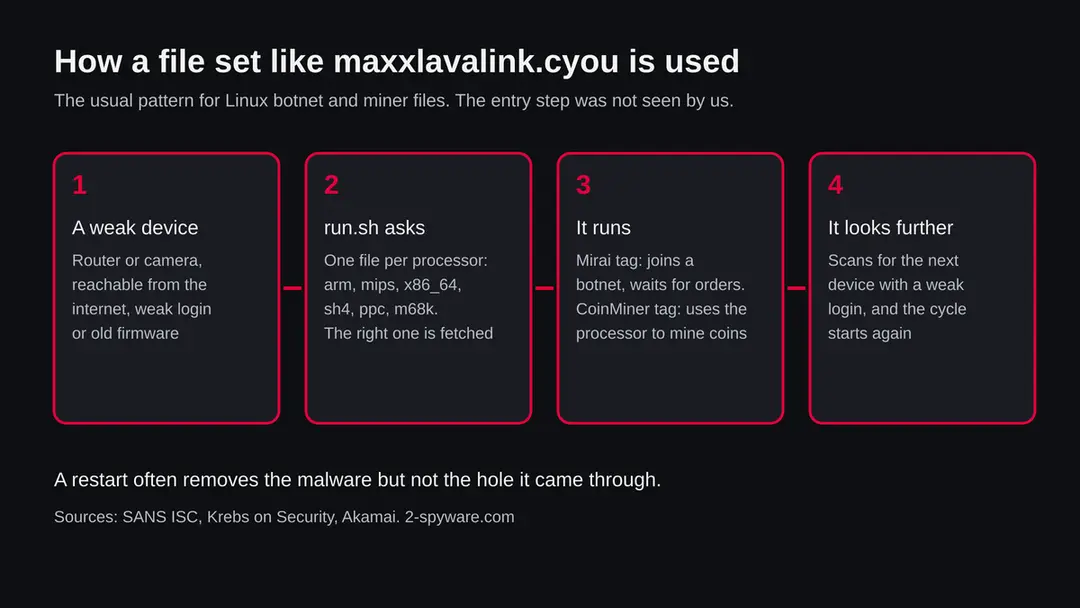
- 1
A weak device is reached first
Mirai-style malware does not arrive by a click. It is pushed onto a device that can be reached from the internet and has a weak or default login, or an old unpatched hole. SANS describes router malware, including Mirai variants, as typically entering through the same weakness that stays open afterwards.
- 2
A script picks the right file
A small shell script such as run.sh is a common way to do this. Because routers, cameras and servers use different processors, the script tries the download that fits: arm, mips, x86 and so on. That is why a server like this holds one file per type. Our reading is that run.sh did this here; we did not read it.
- 3
The file runs and the device joins a botnet or mines
A Mirai file turns the device into a bot that waits for orders. Krebs reported in November 2016 that a Mirai worm knocked about 900,000 Deutsche Telekom customers offline, because their routers were taken over and crashed. A CoinMiner file uses the processor for mining instead; Akamai described in 2019 a botnet that installed the XMRig miner on devices and added entries to crontab so the miner started again after a restart.
- 4
It looks for the next victim
Mirai family malware is known for scanning the internet for more devices with weak logins. The infected device then both attacks others and spreads the infection. A device on your network can therefore be part of attacks on strangers without showing any sign to you.
What the 19 file names tell you
The names are mostly processor types. The table is our reading of the names plus the tags from URLhaus; we did not open the files, so we do not know which processors each really targets.
| File name | Tag on URLhaus | Our reading of the name |
|---|---|---|
| bins/main_arm, main_arm5, main_arm6, main_arm7 | mirai | Versions for ARM processors, common in routers, cameras and set-top boxes |
| bins/main_mips, main_mpsl | mirai | MIPS, big and little endian, common in older routers |
| bins/main_ppc, main_m68k, main_sh4 | mirai | Rarer processors (PowerPC, Motorola 68000, SuperH) found in old or specialist embedded devices |
| bins/main_x86_64, x86 | mirai | Ordinary 64 bit and 32 bit PC and server processors |
| bins/main_x86 (deleted) | none | A file that was already removed when it was reported |
| mips, mipsel | CoinMiner | MIPS files tagged as a coin miner rather than a bot |
| x86_64, aarch64, armv7l, ppc64 | none | Files for 64 bit PCs, 64 bit ARM, 32 bit ARM and 64 bit PowerPC; no tag, so not confirmed as either |
| run.sh | script | A shell script, likely the part that starts a download (our reading) |
What this kind of malware can do, and what only other reports show
Nothing on this page comes from analysing the files on this server. The behaviours below are what published reports say about Mirai and miner botnets in general.
| Behaviour | Where it comes from | How far it can be trusted |
|---|---|---|
| Takes over a device and uses it in large attacks that flood other servers | Krebs, November 2016 (Mirai worm and Deutsche Telekom) | Reported for Mirai in 2016; not tested on these files |
| Uses the processor to mine cryptocurrency for someone else | Akamai 2019 (XMRig botnet); Microsoft campaign of 2023 as covered by TechRadar | Matches the CoinMiner tag; not tested on these files |
| Survives a restart through a scheduled entry | Akamai 2019 (crontab entries for the miner) | Seen in one miner botnet; Mirai itself is often described as not surviving a restart (SANS) |
| Is removed by a power cycle but returns | SANS ISC diary on resetting a router | The hole that let it in usually stays open, so it can come back |
| Changes the router's DNS settings | SANS ISC diary | Done by other attacks too, and may survive a factory reset |
| Hides under names like ps | Akamai 2019 | One botnet; may not apply to these files |
What maxxlavalink.cyou (Mirai, CoinMiner, Linux binaries) can steal or download
What an infected device can cost you
The cost depends on the device. A bot on a camera may be invisible; a bot on a router sits between your whole home and the internet.
- High
A taken-over router or gateway
A router sees everything that goes in and out. If its settings were changed, such as the DNS servers, other devices can be sent to wrong pages even after the malware is gone.
- High
You become part of an attack
A bot can be used to flood strangers' servers. Your internet address can then be blocked, and the provider can cut or warn you.
- Medium
Slow device, hot device, slow internet
A miner uses the processor all the time. Small devices become slow, hot or unstable, and a router may drop connections.
- Medium
More malware later
A device that was reachable once with a weak login is likely reachable by others. Several botnets can sit on the same device.
- Medium
A server owner's bill and reputation
On a small cloud server, a miner can raise the bill and the provider can suspend the account for abuse.
- Low
Nothing at all
If you only saw the name in a log of blocked requests, no harm may have happened. The danger is the case you cannot tell apart yet.
Who can meet this, and who cannot
These are Linux files for devices with certain processors. Most readers of this page found the name in a log, an alert or a router message, not on a screen.
| Where you are | Can these files affect it? | What to do |
|---|---|---|
| Home router, Wi-Fi extender, modem | Yes, if it runs Linux, is reachable from outside and has a weak login or old firmware | Run the router steps below |
| IP camera, video recorder, smart home hub, NAS | Yes, same reasons | Run the device steps below |
| Small Linux server or cloud instance | Yes, if SSH or a web service has a weak password or an unpatched hole | Run the server owner steps below |
| Windows PC | No: these are Linux programs. A Windows PC may still be where a person typed a password that was later stolen | Change passwords from a clean device if in doubt |
| Mac, iPhone, Android phone | We found nothing that says so | Nothing to remove for this; change passwords if you typed them on a suspicious page |
| You run a website and the name is in your files | Your site may have been hacked and used to host these files | Run the website owner steps below |
How to check the PC for maxxlavalink.cyou (Mirai, CoinMiner, Linux binaries)
Check your router or device before you reset it
Write down what you see before you change anything: the log line, the time and the device's address. That tells you which device asked for the name.
- 1
Find which device asked
Open the router's log or your DNS filter's log and look for maxxlavalink.cyou and the time. The entry shows the local address of the device. Match that address to a device in the router's list of connected devices (the names vary by brand).
- 2
Look at the device's sign-in
Try to sign in to the device with the password you set. If the old password no longer works, or the device asks for a new one, someone may have changed it. Note that.
- 3
Check what is open from the internet
Open the router's admin page and look for remote management, port forwarding, UPnP entries and exposed services such as Telnet or SSH. Remove forwards you did not make.
- 4
Check the DNS settings
Look at the DNS servers in the router's internet settings. If they are addresses you did not set and your provider does not use, write them down. SANS warns that DNS changes can survive a reset and can be done without any malware at all.
- 5
Look at the load
If the device offers a status page, check processor use and the list of running processes. A small device that runs flat out while idle fits a miner. A quiet page clears nothing.
- 6
Check the firmware version
Compare the firmware number with the newest on the maker's support page. A very old version is a sign that known holes are open.
Detection names, and why we give no Microsoft name
We did not open the files, so we do not know the detection names that security products use for them. A tag on URLhaus is not a detection name.
| Source | What it says | What it tells you |
|---|---|---|
| URLhaus tag mirai | 11 of the 19 addresses | The reporter links the file to the Mirai family |
| URLhaus tag CoinMiner | 2 of the 19 addresses (mips, mipsel) | The reporter links the file to a coin miner |
| Microsoft Defender | No exact name confirmed for these files; the form would be Trojan:Linux/Mirai.<letters> (our reading, not checked on microsoft.com/wdsi) | Defender on a Windows PC does not run Linux files; Microsoft puts Linux malware under prefixes such as Trojan:Linux/ and Backdoor:Linux/ |
| Router or device antivirus | Names differ by maker | A name tells you which rule matched, not what the file is |
How to remove maxxlavalink.cyou (Mirai, CoinMiner, Linux binaries)
How to remove maxxlavalink.cyou
A loader's job is to install other malware, so treat the PC as infected with more than one program until the scans are clean.
Step 1: Delete scheduled tasks that bring it back
Programs like maxxlavalink.cyou add a scheduled task so they return after an uninstall or reopen a page at every sign-in. Start Task Scheduler, open Task Scheduler Library and sort by Last Run Time to see what ran recently.
On the Actions tab, a program in a user folder, a script or a web address is a warning sign; right-click such a task and choose Delete.
Tasks with names copying Google, Edge or Windows updaters but pointing to an odd folder are typical. The tool looks the same in Windows 11 and Windows 10.

Windows 11: Task Scheduler Library, the task selected, the Actions tab shows the file it runs. Full procedure with screenshots: Remove what malware leaves behind in Windows
Step 2: Remove it from startup
Press Ctrl + Shift + Esc to open Task Manager and select Startup apps (Windows 11) or the Startup tab (Windows 10). Disable entries you do not recognise, especially ones with no publisher or with a name that copies a Windows component.
Right-click an entry and choose Open file location to see where it runs from: programs in
%AppData%or%Temp%deserve a closer look. Some entries are not listed there but in the registry Run keys, which the procedure below shows how to check.Full procedure with screenshots: Stop apps from opening at startup On uGetFix
Step 3: Delete the folders left behind
Uninstalling often leaves the program's folders, and some threats reinstall themselves from them.
Press Windows + R, type
%LocalAppData%and press Enter, then do the same for%AppData%and %ProgramData%, and look for folders named after maxxlavalink.cyou, its publisher or created on the day the problem started. Delete those folders, and check C:\Program Files and C:\Program Files (x86) too.If Windows says a file is in use, end it in Task Manager or delete the folder after a restart in Safe Mode. The folders are the same in Windows 11 and Windows 10.
Full procedure with screenshots: Remove what malware leaves behind in Windows
Step 4: Scan the PC, then run the offline scan
A scan finds the parts of maxxlavalink.cyou that the manual steps cannot see. In Windows Security > Virus & threat protection > Scan options, start a Full scan and quarantine what it reports.
Follow it with Microsoft Defender Antivirus (offline scan) > Scan now, which restarts the PC and checks the disk while Windows and the malware are not running.
It takes about 15 minutes and works the same in Windows 11 and Windows 10. If either scan finds something, run the full scan again after removal until it comes back clean.

Windows 11: Windows Security > Virus & threat protection > Scan options. Full procedure with screenshots: Run a Microsoft Defender Offline scan
Step 5: Change passwords from another device and sign out other sessions
Maxxlavalink.cyou can copy saved passwords, cookies and session tokens and send them out in seconds, so cleaning the PC does not undo the theft.
Change your passwords on a device that was never infected, starting with the e-mail account, since every other reset goes through it. On each account, end all other sessions and check the recovery e-mail, phone number and forwarding rules.
Then turn on two-step verification. Sign in on the Windows 11 or Windows 10 PC again only after the offline scan is clean.
Full procedure with screenshots: Turn on two-step verification / secure a hacked account
Clean a router or IoT device
Do the steps in order. We did not run them against an infected device; they follow SANS Internet Storm Center advice on resetting a router and the general advice in the other sources. Exact menu names differ by maker, so use your device's manual for the button names.
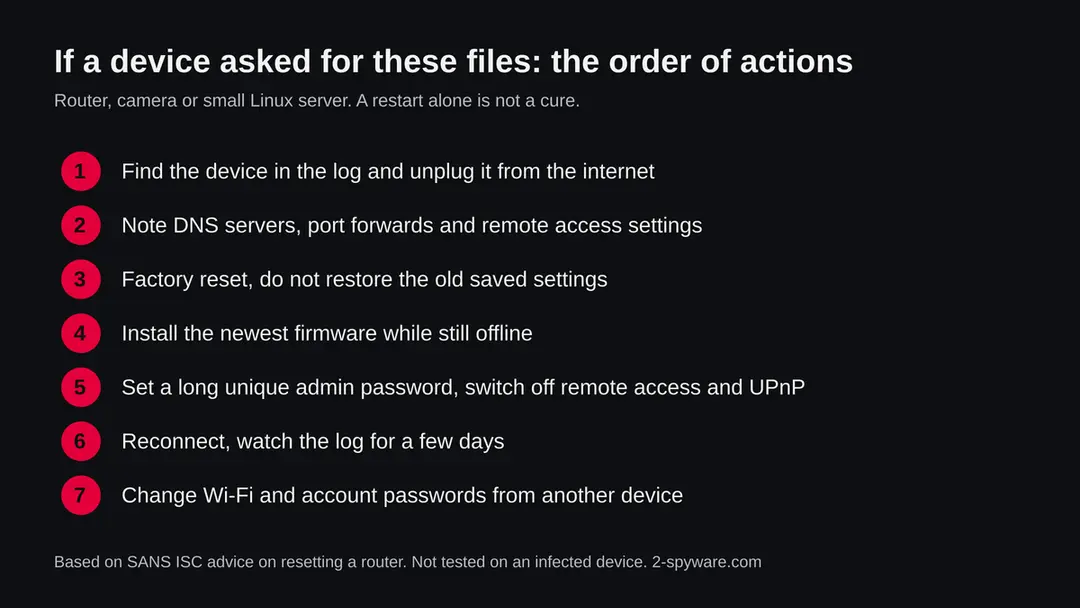
- 1
Disconnect it from the internet
Unplug the cable that goes to the internet, or take the device off the network. This stops it from attacking others and from fetching more files. Leave the power on only if you need to see settings.
- 2
Do not rely on a restart
SANS says router malware, including Mirai variants, generally does not survive a simple power cycle. That is why a restart can make it look fixed. The hole that let it in usually stays open, so it can be back within minutes of being online.
- 3
Back up only what you need
Write down your internet provider's settings (user name, VLAN, any special values). Do not restore a saved configuration file from the infected device, because settings such as DNS can be part of the problem.
- 4
Factory reset the device
Use the reset button or the factory reset item in the menu, as the maker describes. A factory reset puts the software back to the maker's default. SANS recommends going further than a button press for the paranoid case: reinstall the firmware from the maker's file.
- 5
Update the firmware before reconnecting
Download the newest firmware from the maker's support page on another device, check that the file name matches your exact model, and install it while the device is still cut off from the internet.
- 6
Set a new admin password and close the doors
Choose a long, unique password. Turn off remote management, UPnP and any Telnet or SSH access from the internet unless you need it. Turn on automatic updates if the device offers it.
- 7
Reconnect and watch
Reconnect and watch the device's log for a few days for requests to unknown names. If you cannot get a firmware update because the maker stopped supporting the model, replace the device.
- 8
Change passwords for what passed through it
Change your Wi-Fi password and the passwords of accounts used on the network, from another device, starting with email. Turn on two step sign in.
If you run a Linux server or a website
The same file names can turn up on a server that was hacked and used as a host, or on a small server that was taken over and set to mine. We cannot say which case this is. These steps are general good practice, not taken from a report on this address.
- 1
Look for what you did not install
List running processes sorted by processor use, and check crontab entries for every user, the files in the folders used for temporary files, and the start-up scripts. Files named like system tools but in odd folders deserve a closer look.
- 2
Search your web folders for these names
If you run a website, search for files called run.sh, main_arm, main_mips or x86_64 that you did not upload. If you find them, the site was probably used to host malware, which is what a reporter may have seen.
- 3
Rebuild rather than clean
The safest answer is a fresh server from a known image, with data restored from a backup made before the incident. Cleaning by hand can miss a backdoor. Akamai and the Microsoft campaign reports both describe attackers who add persistence.
- 4
Close the way in
Turn off password login for SSH and use keys, update the software that was exposed, restrict which addresses can reach admin ports, and change every password and API key that was on the server.
- 5
Ask your host
Tell your hosting provider what you found. Many providers have a process for abuse reports and will help prove that the server was cleaned.
After removal: passwords, accounts and prevention
Report it
If an attack hit you or you found the files on your server, a report helps the people who take such servers down.
- 1
Your internet provider or host
Tell them which device and which log lines. Many providers can see botnet traffic and will warn other customers.
- 2
The device maker
If you found a hole in a model, tell the maker so it can issue an update.
- 3
Your national cyber centre or consumer authority
Most countries have a body that takes reports on botnets and fraud. Search for your country's cyber security centre by name.
Keep routers and IoT devices out of botnets
The weak points are almost always the same: default logins, old firmware and services open to the internet.
Do
- Change the default admin password of every router, camera and recorder to a long, unique one on the day you install it.
- Install firmware updates, and check for them every few months or turn on automatic updates.
- Turn off remote management, UPnP and port forwarding you do not need.
- Put cameras and smart devices on a guest network, apart from computers.
- Replace devices that the maker no longer updates.
- On servers, use SSH keys, keep software patched and watch for processes that use the processor with no reason.
Don't
- Do not leave a camera or recorder reachable from the internet with the factory password.
- Do not treat a restart as a cleaning; it is not.
- Do not restore a saved configuration from a device that may have been taken over.
- Do not open ports on your router because an app asked you to, unless you know why.
- Do not request or run files from the address in this guide.
Questions about maxxlavalink.cyou (Mirai, CoinMiner, Linux binaries)
What is maxxlavalink.cyou?
It is a web address that URLhaus, the malware tracking project run by abuse.ch, lists 19 times for program files and one script. All 19 were reported on 4 October 2026 between 06:59 and 07:15 UTC. Eleven are tagged mirai, two are tagged CoinMiner and one is tagged script.
It is not a program on your computer and not a site anyone is meant to visit. We did not download the files, so what they contain is not confirmed by us. The domain was registered on 18 September 2026, only sixteen days before the reports.
Is maxxlavalink.cyou safe to open?
No. Do not request files from it, and do not run anything that does. Our own plain request on 11 October 2026 failed because the name did not resolve, which proves nothing about safety: a name can be switched off, moved or revived.
The rating comes from the 19 URLhaus reports and their tags. Opening the address in a browser would also not be a useful test, because the files were built for routers and servers, not for people to view.
What does the Mirai tag mean?
Mirai is the name of a botnet family that takes over devices running Linux, such as routers and cameras, and uses them to attack other servers. Krebs on Security reported in November 2016 that a Mirai worm knocked about 900,000 Deutsche Telekom customers offline.
The tag on URLhaus is the reporter's label and not a proof for each file. We did not open the files, so we cannot tell you which build or which attacks these ones contain.
What is a CoinMiner and why would it be on a router?
A coin miner is a program that uses a device's processor to mine cryptocurrency for whoever planted it. Akamai described in 2019 a botnet that first hit MIPS and ARM devices and then moved to PC type systems, installing the XMRig miner and adding crontab entries so it started again after a restart.
Routers and cameras are weak miners, but an attacker with thousands of them gets a little from each. Two of the 19 files here, mips and mipsel, carry the CoinMiner tag.
I saw maxxlavalink.cyou in my router or DNS log. Am I infected?
Not necessarily, and the name alone proves nothing. It does mean that a device on your network asked for it, and a person does not usually do that by hand. Find which device it was from the local address in the log, disconnect it, and run the checks on this page:
- sign-in
- remote access
- DNS settings
- firmware version
- processor load
A quiet device does not clear it. If the device is a router or camera, a factory reset and a firmware update are the safe answer.
How do I remove Mirai from a router?
Disconnect the router from the internet, factory reset it, install the newest firmware from the maker while it is still cut off, set a new long admin password and turn off remote management and UPnP.
SANS says router malware like Mirai does not survive a plain power cycle, which is why a restart looks like a cure, but the hole it used usually stays open. We followed SANS and general advice and did not test the steps on an infected router. If the maker no longer updates your model, replace it.
Does this affect my Windows PC, Mac, iPhone or Android phone?
We found nothing that says so. The file names (arm, mips, x86_64, sh4 and others) and the Mirai and CoinMiner tags describe Linux programs for routers, cameras, recorders and small servers. A Windows PC or Mac does not run them as they are.
If you typed a password on a suspicious page or into a hacked router, change it from a clean device and turn on two step sign in. If your PC shows a Defender alert, that is a different problem from this address.
The domain does not load any more. Is the danger over?
No, only the source is quiet. Our request on 11 October 2026 failed with ENOTFOUND, and the registration record lists server hold and client hold among its statuses. Our reading is that the name was switched off, but the record does not say by whom.
A device that already ran the files stays infected without the server, and the same files can be served from a new name. Check your devices as described above whether or not the address answers.
I run a website or server and found files with these names. What now?
Treat the server as taken over. Take it off the network if you can, keep a copy of the files for the investigation, and rebuild from a clean image with data restored from a backup made before the incident.
Cleaning by hand can miss a backdoor. Close the way in:
- turn off SSH password login
- update exposed software
- change every password and key that was on the server
Tell your hosting provider, who can help prove that the problem is fixed.
Will Fortect remove maxxlavalink.cyou?
Fortect scans Windows for malware and unwanted programs and repairs the system files and settings they change, and its free scan shows what it finds on your PC before you decide anything.
For maxxlavalink.cyou, follow the plan above as well: the browser steps take back permissions and settings that no scanner treats as a threat, and uninstalling the program that brought it removes the source.
Run Microsoft Defender's full scan and, if anything was found, its offline scan as a second opinion. If the symptoms are gone after the plan and both scans are clean, there is nothing more to do.
Sources
- SANS Internet Storm Center: Resetting Your Router the Paranoid (=Right) Way (read October 11, 2026)
- Krebs on Security: New Mirai Worm Knocks 900K Germans Offline (30 November 2016) (read October 11, 2026)
- Akamai: XMR cryptomining targeting x86/i686 systems (read October 11, 2026)
- TechRadar: Microsoft uncovers savage new cyberattacks hitting Linux and IoT devices (2023) (read October 11, 2026)
- F-Secure: What's a Mirai Botnet Doing With My Router? (read October 11, 2026)