
Antivirus
Webroot Review 2026: Essentials, Price, Tests, Uninstall
Webroot SecureAnywhere is a cloud-based antivirus that the vendor now sells as Webroot Essentials and that belongs to OpenText. This review covers the name change, current prices, lab results with dates, refunds, renewal and how to remove the program.
7.0/10
Light multi-device antivirus, one recent lab result
Webroot SecureAnywhere is now Webroot Essentials, a light cloud antivirus for PC, Mac and phones with a solid but not top 2026 SE Labs result.
- Our score
- 7.0 / 10
- Price from
- $34.99 for the first year
- Platforms
- Windows 8.1, 10 and 11, macOS 14 and newer, Android 11+, iOS 15+
- Type
- Antivirus
Verdict in short
- SE Labs 2026 Q2: total accuracy 91 percent, protection 81 percent, 2 percent false positives, AA rating.
- Essentials costs $34.99 to $44.99 in the first year and $49.99 to $89.99 at the regular price, with a 70-day refund window.
- Owned by OpenText since 2019; the latest AV-TEST result found is from 2019 and AV-Comparatives from 2012.
What we liked
- One plan for Windows, Mac, Android, iPhone and Chromebook
- Recent SE Labs result with low false positives
- Small disk footprint and simple main window
- Frequent PC updates in 2026
- 70-day refund window and online opt-out of renewal
What we did not
- No recent AV-TEST or AV-Comparatives result
- Protection rating of 81 percent in SE Labs 2026 Q2
- No free edition
- Year-two price not stated plainly
- Several names for one product family
Score breakdown
- Detection and protection6.8SE Labs 2026 Q2 total accuracy 91 percent; older labs show a falling protection score.
- Tools and features7.0Antivirus, web shield, firewall, password manager; scam tools on Android only.
- Ease of use and removal7.4Simple main window and a standard Windows uninstall.
- Value6.5Low first-year price, higher regular price, renewal not stated plainly.
- Platform coverage8.0Windows, Mac, Android, iOS and Chromebook on one plan.
- Support and refunds7.470-day refund policy and an online renewal opt-out.
Webroot SecureAnywhere at a glance
Webroot SecureAnywhere is the cloud-based antivirus that Webroot has sold for home users since the early 2010s. The vendor's site now sells the same family under the name Webroot Essentials, and it says so in plain words: Essentials is the new name for Webroot SecureAnywhere products [1]. This review covers the current product, so you will find Essentials prices and features below, with the old name explained.
Webroot belongs to OpenText, which bought Carbonite and Webroot in December 2019 [10]. On the vendor's site on 2026-10-10 the cheapest plan, Essentials for one device, cost $34.99 for the first year against a regular price of $49.99 [1][2]. A refund window of 70 days applies to consumer products [4].
- Best for: people who want a light, always-on antivirus for a mixed household of Windows, Mac, Android and iPhone devices, and who accept that only one major lab has a recent result for it.
- Platforms: Windows 8.1, 10 and 11, macOS 14, 15 and 26, Android 11 and newer, iOS 15 and newer [1].
- Price: Essentials $34.99 for 1 device, $41.99 for 3 devices and $44.99 for 5 devices in the first year; regular prices $49.99, $69.99 and $89.99 [1].
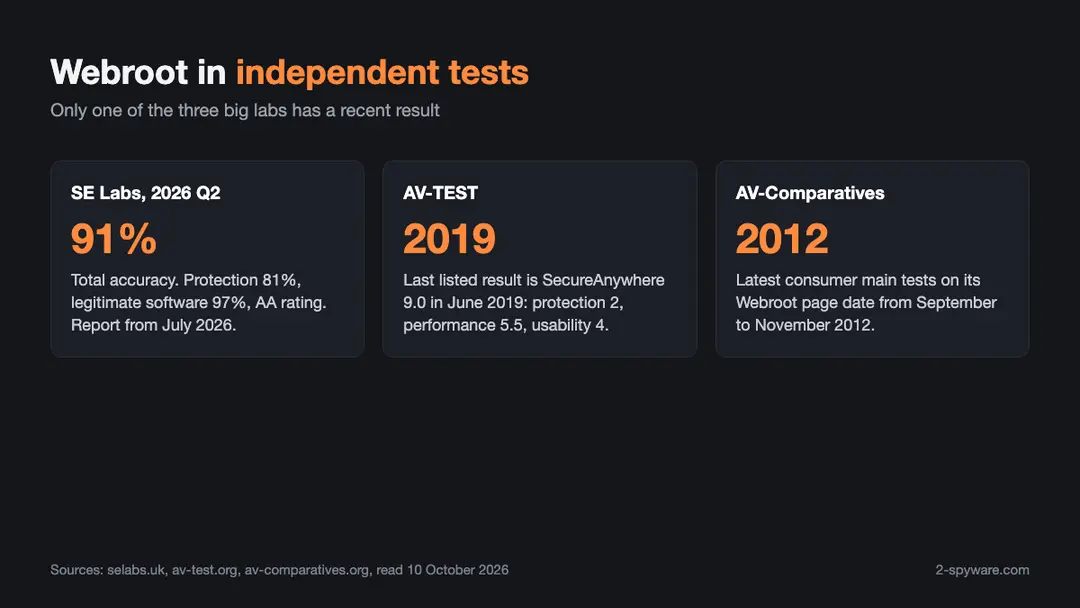
- Independent tests: SE Labs home test 2026 Q2, total accuracy 91 percent, AA rating [6][7]. The latest AV-TEST result we found is from June 2019 [8], and the latest AV-Comparatives consumer main tests listed are from 2012 [9].
- Latest PC build: version 9.0.46.75 with Core 1.16.0.8, released on 29 September 2026 [3].
- Refund: 70-day money-back policy on consumer products, according to the vendor [4].
What changed since our old review
Our first Webroot review is many years old, and most of it no longer matches the product. We installed the program on one Mac and one PC back then. The installer was a tiny file of 731 KB, the first scan found an infection that was already on one machine, and we saw no slowdown. We did not retest the 2026 build hands-on for this update, so those notes are history and not a measurement of today's version.
Here is what is different today, checked against the vendor's pages.
- The name. SecureAnywhere AntiVirus, Internet Security Plus and Complete are now Webroot Essentials for 1, 3 or 5 devices [1]. The Windows program and the vendor's release notes still carry the SecureAnywhere name [3][11].
- The price. Our old text quoted $19.19 a year for three devices. Essentials for three devices is now $41.99 for the first year and $69.99 at the regular price [1].
- The owner. Our old text did not name one. Webroot has belonged to OpenText since December 2019 [10].
- The platforms. Windows 7 no longer appears in the requirements list. The vendor lists Windows 8.1, 10 and 11, and macOS 14, 15 and 26 [1]. Mobile apps for Android and iOS are part of the plans.
- The free version. We wrote that there was no free edition, and we found none on the vendor's product pages in 2026 either [1][2].
- The tests. Our old text called the program fast and powerful and cited no lab. We now have a 2026 SE Labs result, and we also found that AV-TEST and AV-Comparatives have not listed a recent consumer result [6][8][9].
Two claims from the old text we cannot confirm today, so we drop them: the two-minute scan promise and the Social Network Protection feature for Twitter and Facebook. Neither appears on the current Essentials page [1].
How we reviewed Webroot and how we earn money
For this update we read the vendor's own pages: the Essentials product page, the pricing page, the release notes, the refund and auto-renewal pages, and the Windows uninstall article [1][2][3][4][5][11]. We then read the lab pages of SE Labs, AV-TEST and AV-Comparatives for results with dates [6][7][8][9]. The screenshot comes from the vendor's support site. The infographics are our own, drawn from those pages.
2-spyware.com earns a commission only from partner products such as the Fortect offer shown on some of our pages. We have no deal with Webroot or OpenText. This review carries no affiliate link to them, and we earn nothing if you buy Webroot after reading it.
Prices change often, especially around sales such as the Cybersecurity Awareness Month deal that the vendor's site showed on the day we read it [1]. Treat every price here as a snapshot dated 2026-10-10 and check the checkout page before you pay.
Who makes Webroot now?
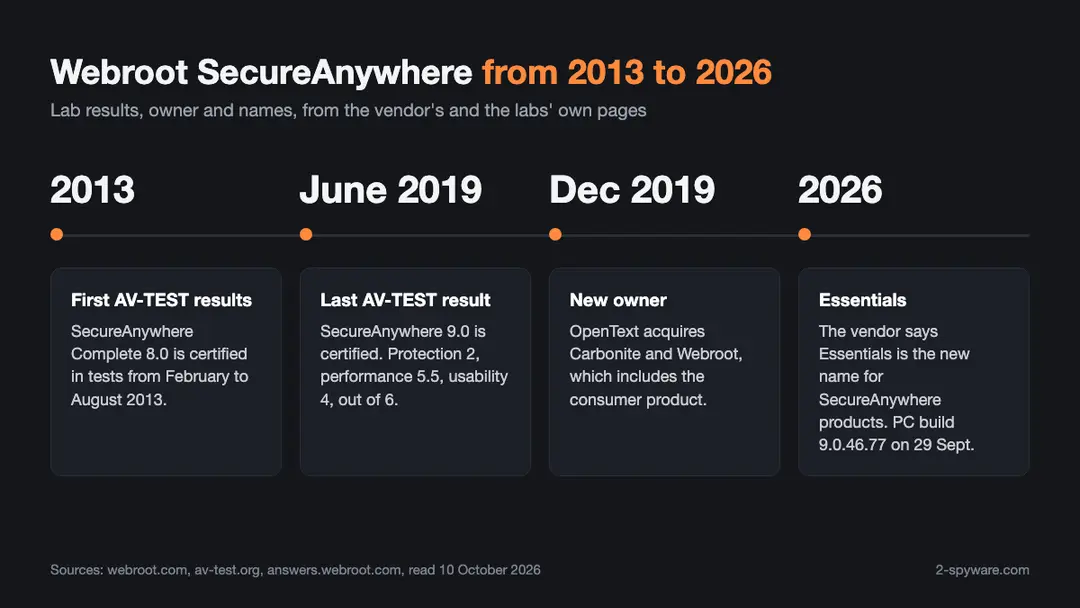
Webroot was founded in 1997 and is based in Colorado, USA, according to AV-Comparatives, which says Webroot joined its main test series in 2011 [9]. In December 2019 OpenText acquired Carbonite and Webroot, a deal the vendor's own about page describes as a way to bring cyber resilience solutions to enterprises and managed service providers [10].
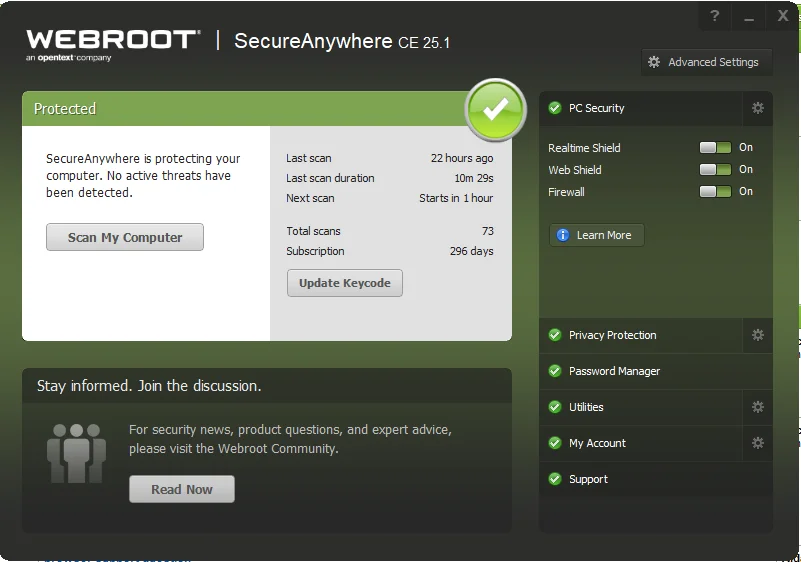
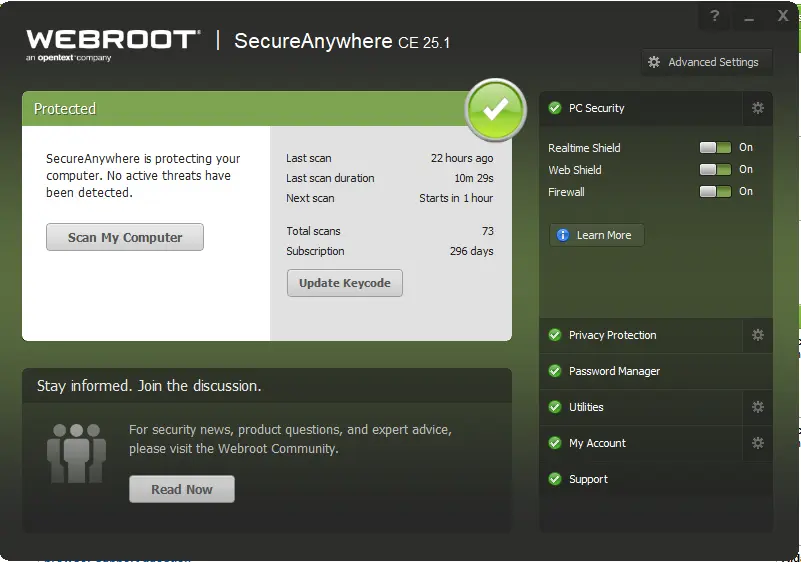
What does this mean for you as a home user? Support articles and release notes now sit under the Webroot by OpenText branding, and the interface screenshot in our hero picture carries the line an OpenText company next to the logo [3][12].
There is one practical effect to know about. If you bought Webroot through Best Buy, the Geek Squad or a Total Tech Support plan, the vendor says Best Buy manages those accounts itself. Webroot cannot cancel automatic renewal or process refunds for them, and you have to call the Best Buy assurance line instead [5].
Names and editions: SecureAnywhere, Antivirus, Essentials, Premium
Webroot names are confusing, because the same engine appears under several labels. The vendor's product page calls the home antivirus Webroot Essentials [1]. SE Labs lists its 2026 test subject as Webroot Antivirus [6]. The Windows installer and release notes still say SecureAnywhere [3]. Shops such as Amazon sell boxes and key cards under the Webroot Antivirus label.
The vendor's page explains what happened to the old names. Webroot AntiVirus Basic, Webroot Internet Security Plus and Webroot Complete were replaced by Webroot Essentials for 1, 3 or 5 devices. If you own one of the old subscriptions you can renew it or switch to Essentials, Premium or Total Protection [1].
The current home lineup, from the vendor's pricing page on 2026-10-10 [2]:
- Webroot Essentials: antivirus, anti-malware, browser protection, anti-phishing and a password manager. $49.99 for 1 device, $69.99 for 3 devices, $89.99 for 5 devices at the regular price [1][2].
- Webroot Premium: everything in Essentials plus a system optimizer and identity protection, for 5 devices and 1 identity, at $129.99. A Premium Family plan covers 10 devices and 10 identities at $249.99 [1][2].
- Webroot Total Protection: everything in Premium plus parental controls, a secure VPN and automated cloud backup with unlimited storage for one device. $179.99 for 5 devices, $299.99 for the family plan [1][2].
- AntiVirus for PC Gamers at $39.99 for 1 device, Secure VPN from $59.99 for 3 devices, PC Optimizer at $49.99 for 10 devices and Security for Chromebook at $24.99 for 1 device [2].
Premium includes up to $1 million of reimbursement for fraud expenses and stolen funds, underwritten by American Bankers Insurance Company of Florida, with terms and exclusions that apply [1]. Read those terms before you count on it. For most readers of this review, Essentials is the plan that matches the old SecureAnywhere AntiVirus.
Features checked against the vendor's pages
Below is what the vendor says Essentials does, with our notes on what each item means in daily use [1]. We could not test the 2026 build hands-on for this update, so the notes rest on the vendor's description, our earlier tests and how this type of tool works.
Antivirus protection
The vendor lists always-on protection against viruses, phishing and ransomware, scans that run without interrupting you, and coverage for PCs, Macs, smartphones, Chromebooks and tablets [1]. The company markets the product as cloud-based. It says the program scours 95 percent of the internet three times a day to find new threats [1], and a second page claims it scans six times faster than the competition [5]. These are vendor statements, not lab results.
What cloud-based means in practice is a small program on your machine that asks the vendor's servers about files it does not know. That keeps the local footprint low. The vendor's requirements list only 10 MB of hard disk space [1]. The trade-off is that the program needs internet access to do its best work.
Main window and Realtime Shield
The interface is simple. The vendor's own screenshot shows a green Protected banner, the date of the last scan, the length of the last scan, the next scheduled scan, the number of scans so far and the days left on your subscription [12]. A Scan My Computer button starts a manual scan. On the right you see switches for Realtime Shield, Web Shield and Firewall, plus entries for Privacy Protection, Password Manager and Utilities [12].
Web Threat Shield and anti-phishing
The Web Threat Shield warns you about fraudulent and risky websites before you open them, and the anti-phishing feature works in real time [1]. Release notes show that the browser extension for the shield is updated separately from the main program. Version 9.0.46.77 of Webroot Protection was released on 29 September 2026 [3]. If you use several browsers, check that the extension is enabled in each.
Firewall and network monitor
The Essentials page lists a firewall and network monitor under antivirus protection [1]. Our old review counted the firewall as a selling point on the Mac, so it is a long-standing part of the product.
Scam protection, breach monitor and AI chat privacy
Essentials adds scam protection with text scam detection and a breach monitor. The vendor marks both of those as available on Android devices only [1]. The plan also says it protects personal information in AI chats, and it includes a password manager [1]. The page gives no technical detail about how the AI chat protection works, so we cannot judge it.
Independent test results from SE Labs, AV-TEST and AV-Comparatives
Lab results are where the Webroot story gets uneven. One lab tested the current product recently. The other two big labs show nothing recent. We list each result with its date, so you can weigh it yourself.
SE Labs, 2026 Q2
SE Labs tested Webroot Antivirus in its Home Anti-Malware (Protection) evaluation for April to June 2026, with the report published in July 2026 [6]. Eleven home products took part, including Microsoft Defender Antivirus, Norton360, Kaspersky Premium and Malwarebytes Premium [6].
The Webroot factsheet shows a protection accuracy rating of 81 percent, a legitimate accuracy rating of 97 percent and a total accuracy rating of 91 percent [7]. It records 2 percent false positives. General threats scored 75 points (90 percent) and targeted attacks 15 points (90 percent) [7]. The factsheet carries an AA badge [7].
In plain words: the product blocked most of the threats in the test, and it rarely flagged harmless software by mistake. A protection rating of 81 percent is lower than its legitimate rating, which means some threats got through or were only partly handled. Compare the SE Labs reports of other products before you decide, because the same lab publishes all of them.
AV-TEST
AV-TEST lists Webroot results from February, April, June and August 2013 for SecureAnywhere Complete 8.0, and one more from June 2019 for SecureAnywhere 9.0. All were certified [8]. Each result has three scores out of 6, for protection, performance and usability.
The protection score fell across the listed tests: 5 in February 2013, 4.5 in April 2013, 3 in June 2013, 2.5 in August 2013 and 2 in June 2019. Performance stayed at 6 in 2013 and was 5.5 in 2019, and usability was between 4 and 4.5 [8]. The June 2019 result is the last one listed. We found no later AV-TEST result for a Webroot home product, so those scores say little about the 2026 build.
AV-Comparatives
AV-Comparatives says Webroot joined its main test series in 2011 [9]. The latest consumer main tests on its Webroot page are the Real-World Protection Test of November 2012, the Performance Test of October 2012 and the False Alarm Test of September 2012 [9]. Webroot's page there has no result newer than that.
A missing result is not proof that a product is weak. It does mean you have to rely on the SE Labs result and the vendor's own claims for the current build.
Prices, renewal and refunds
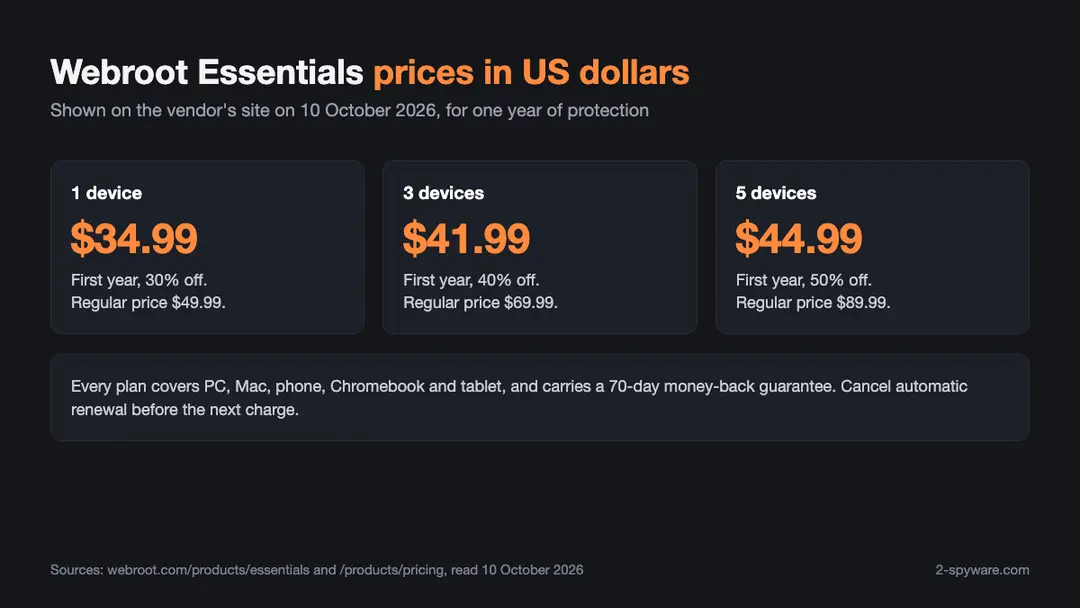
On 2026-10-10 the Essentials page showed three one-year plans, each with a first-year discount [1]. One device cost $34.99, from a regular price of $49.99. Three devices cost $41.99, from $69.99. Five devices cost $44.99, from $89.99. The pricing page lists the regular prices as $49.99, $69.99 and $89.99 [2]. All prices were in US dollars.
The first-year label matters. The pages we read do not say in plain words what year two costs, so the regular price is the nearest figure you have.
Automatic renewal
Webroot offers subscriptions that renew by themselves. Its opt-out page asks for your keycode, without dashes, and then removes automatic renewal from your subscription preferences [5]. If you were already charged for a renewal, the same page points you to the online refund request page [5]. Put the date of the renewal in your calendar the day you buy.
Refunds
The vendor says it offers a 70-day money-back policy on all consumer products, in line with the end user license agreement [4]. Its support article adds that if you ask after 70 days, automatic renewal is switched off and you can use the licence until it expires [13]. Keep the order email and your keycode, because the refund form works from them.
The free versus paid question is simple here. We found no free edition on the vendor's product pages [1][2]. Webroot is a paid subscription, and the refund window is your trial.
Installation and system requirements
The vendor's computer requirements list Windows 8.1 in 32 and 64 bit, Windows 10 in 32 and 64 bit, Windows 11 in 64 bit, and Windows 11 on ARM, except for Webroot Total Protection [1]. On Mac it lists macOS 14 Sonoma, macOS 15 Sequoia and macOS 26 Tahoe, on Apple M-series or Intel processors [1]. If you run Windows 7 or an older Mac, Essentials is not an option.
Mobile support needs Android 11 or newer with at least 200 MB of free storage, or iOS 15 or newer with at least 26.4 MB [1]. The vendor also lists a 10 MB disk space minimum for the computer program and a list of supported browsers, including Chrome, Edge in part, Firefox and Opera [1].
Updates come often. The release notes for the PC program list builds on 16 April, 14 May, 4 June, 1 July, 1 September and 29 September 2026 [3]. The newest listed is PC Version 9.0.46.75 with Core 1.16.0.8 [3]. If the build on your PC is far behind this list, update before you rely on it.
Get the installer only from the vendor's own site or from a seller you trust, and never from a download portal or an ad. If you are unsure about a file, use our link and file check before you run it. We do not link to installers in our reviews.
How to uninstall Webroot
The vendor says that on Windows, Webroot is removed using Windows itself [11]. The steps below follow the vendor's article for Windows 10 and 11, with our notes.
- Click Start, or the Windows icon, type appwiz.cpl in the search field and press Enter. This opens the Programs and Features list.
- Select the Webroot SecureAnywhere line and click Uninstall.
- If Webroot does not show up at first, click the refresh button. This can happen when you installed it a short while ago.
- Follow the prompts, then restart the computer.
- Test the problem you were chasing before you reinstall anything. The vendor itself suggests a reboot and a test if you uninstall to troubleshoot an issue [11].
If you see the message that SecureAnywhere is currently managed by the Web Console and all changes need to be applied centrally, the installation has a business licence [11]. In that case ask the person who manages your company's licences. If the vendor's article does not help, open a support ticket [11].
Removing the program is a separate job from ending the subscription. The removal steps do not mention renewal, and the opt-out page works from your keycode [5][11]. Do both if you are leaving. Our general guide to uninstalling a program on Windows shows the Settings route for Windows 11, and removing malware leftovers helps if folders or startup items stay behind.
On a Mac, the vendor has a separate article for macOS, which we did not test. Install a different antivirus only after you have removed the old one, and run one real-time antivirus at a time.
Pros and cons
What works well
- Light program with a small disk footprint, according to the vendor [1].
- One plan covers Windows, Mac, Android, iPhone and Chromebook devices [1].
- A recent independent result: SE Labs 2026 Q2, total accuracy 91 percent, AA rating, 2 percent false positives [7].
- Frequent PC updates, with six builds listed between April and September 2026 [3].
- A 70-day refund window and a simple online opt-out of automatic renewal [4][5].
What to weigh
- No recent AV-TEST or AV-Comparatives result for the home product [8][9].
- The 2026 SE Labs protection rating of 81 percent is below its legitimate software rating of 97 percent [7].
- No free edition, and the pages we read do not state the year-two price in plain words [1][2].
- Several names for one product family, which makes support articles and reviews hard to match.
- Some features, such as text scam detection and the breach monitor, work on Android only [1].
Alternatives
If you want a free option with a record in the labs, read our review of Microsoft Defender, which is built into Windows. If you want a second scanner that runs next to your main antivirus, see our reviews of Malwarebytes and SUPERAntiSpyware, or the older anti-spyware tool Spybot Search and Destroy.
For a one-off scan of a PC you suspect, the Microsoft Safety Scanner review explains a tool that does not install permanently. If your PC shows damage after an infection, such as system errors or broken settings, our own product Fortect, reviewed separately, is a partner product on which we earn a commission. You can also browse every tool in our software category. For help after a ransomware attack, see the guide on ransomware recovery.
Verdict
Webroot SecureAnywhere is now Webroot Essentials, a light cloud-based antivirus owned by OpenText. It suits people who want one simple plan for many devices and a clear main window. The 2026 SE Labs result is solid but not top, and the missing AV-TEST and AV-Comparatives results leave gaps [6][7][8][9].
We rate it 7.0 out of 10. The score rests on the SE Labs result, the clear refund policy, the wide platform coverage and the frequent updates. It loses points for the old lab history, the confusing names and the unclear renewal price.
Our advice is practical. Buy a single device or three-device plan only if you will use the refund window to test it on your own machines. Set a reminder before the renewal date, and keep Windows and your browser updated. If you want a free baseline, Microsoft Defender is already there. You can compare it with Webroot on the same SE Labs report [6].
Features
Always-on protection
Realtime protection against viruses, phishing and ransomware on PC, Mac and phones.
Web Threat Shield
Warns you about fraudulent and risky websites before you open them.
Firewall and network monitor
Listed on the Essentials page under antivirus protection.
Cloud-based scanning
A small local program backed by the vendor's cloud; 10 MB disk space listed.
Password manager
Included in every Essentials plan.
Scam protection
Text scam detection and breach monitor, marked Android only by the vendor.
AI chat privacy
The vendor says Essentials protects personal information in AI chats.
Frequent updates
Six PC builds listed between April and September 2026.
Pricing
Essentials, 1 device$34.99 for the first year
1 device · renews at Regular price $49.99; renewal price not stated plainly
- Antivirus and anti-phishing
- Password manager
- 70-day refund window
Essentials, 3 devices$41.99 for the first year
3 devices · renews at Regular price $69.99; renewal price not stated plainly
- Everything in 1 device
- PC, Mac and phones
- 70-day refund window
Essentials, 5 devices$44.99 for the first year
5 devices · renews at Regular price $89.99; renewal price not stated plainly
- Everything in 3 devices
- Five devices
- 70-day refund window
Prices as recorded in the review on October 10, 2026. Check the vendor's site for current prices.
Frequently asked questions
What is Webroot SecureAnywhere?
Webroot SecureAnywhere is a cloud-based antivirus for Windows and Mac that the vendor has sold to home users for many years. On its site the vendor now calls the home product Webroot Essentials and says that name replaces the SecureAnywhere products. The Windows program and release notes still use the SecureAnywhere name.
Is Webroot SecureAnywhere the same as Webroot Essentials?
According to the vendor, yes. Its page says Webroot Essentials is the new name for Webroot SecureAnywhere products. Webroot AntiVirus Basic, Internet Security Plus and Complete were replaced by Essentials for 1, 3 or 5 devices. SE Labs lists the 2026 test product as Webroot Antivirus.
Who owns Webroot?
Webroot belongs to OpenText. OpenText acquired Carbonite and Webroot in December 2019. Webroot was founded in 1997 and is based in Colorado, according to AV-Comparatives. The home products still carry the Webroot name.
Is there a free version of Webroot?
We found no free edition on the vendor's product or pricing pages on 2026-10-10. Webroot sells paid subscriptions, and the 70-day refund window works as a way to try it. Microsoft Defender is the free option built into Windows.
How much does Webroot cost in 2026?
On 2026-10-10 Webroot Essentials cost $34.99 for 1 device, $41.99 for 3 devices and $44.99 for 5 devices in the first year. Regular prices were $49.99, $69.99 and $89.99. Premium starts at $129.99 and Total Protection at $179.99 for 5 devices. Prices change often, so check the checkout page.
Does Webroot work on Mac, Android and iPhone?
Yes. The vendor lists macOS 14, 15 and 26, Android 11 and newer, and iOS 15 and newer, as well as Windows 8.1, 10 and 11. Some features, such as text scam detection and the breach monitor, are marked as Android only.
How did Webroot do in independent tests?
In the SE Labs Home Anti-Malware test for 2026 Q2, Webroot Antivirus scored 91 percent total accuracy with a protection rating of 81 percent, a legitimate rating of 97 percent and an AA badge. The latest AV-TEST result we found is from June 2019, and the latest AV-Comparatives consumer tests listed are from 2012.
What is the latest Webroot version?
The vendor's release notes list PC Version 9.0.46.75 with Core 1.16.0.8, released on 29 September 2026. A Webroot Protection build, version 9.0.46.77, was released the same day. Check the release notes page, because new builds appear about monthly.
How do I uninstall Webroot on Windows?
Click Start, type appwiz.cpl and press Enter. Select the Webroot SecureAnywhere line, click Uninstall and restart the PC. If the line is missing, click refresh. If you see a message about a Web Console, the installation has a business licence and your administrator manages it.
How do I cancel Webroot and get a refund?
The vendor offers a 70-day money-back policy on consumer products. Use its online refund request page with your keycode. After 70 days, it turns off automatic renewal and you can use the licence until it expires. If you bought through Best Buy or the Geek Squad, contact Best Buy instead.
Will Webroot slow down my computer?
The vendor says it offers light, fast scans and lists only 10 MB of disk space as a requirement. AV-TEST gave its older versions 6 out of 6 for performance in 2013 and 5.5 in 2019. We did not measure the 2026 build ourselves.
Can I use Webroot next to Microsoft Defender?
We did not test the two together, and the vendor pages we read do not cover it. As a rule, run one real-time antivirus at a time. If you only want a second opinion, use an on-demand scanner such as the ones in our alternatives section.
Sources
- Webroot Essentials: product page (name change, plans, first-year prices, features, system requirements)
- Webroot: official pricing for home products (regular prices, Premium, Total Protection, VPN, Optimizer)
- Webroot: release notes for SecureAnywhere on Windows (builds and dates in 2025 and 2026)
- Webroot: online refunds for your purchase (70-day money-back policy)
- Webroot: manage or opt out of auto renewal (keycode, refunds, Best Buy accounts)
- SE Labs: Security Evaluation Test Report, Home Anti-Malware (Protection), 2026 Q2
- SE Labs: Webroot Antivirus factsheet, July 2026
- AV-TEST: Webroot home antivirus results for Windows, 2013 to 2019
- AV-Comparatives: Webroot vendor page (company information and latest consumer main tests)
- Webroot: about OpenText (acquisition of Carbonite and Webroot in December 2019)
- Webroot support: uninstall Webroot SecureAnywhere on Windows
- Webroot support: SecureAnywhere main interface (source of the screenshot)
- Webroot support: request a refund (70-day policy and what happens after)
Questions and experiences
Ask about this page: members and our editors answer. Reading is open; writing needs a free account.
…