Malware Defense (Removal Guide) - scam
Malware Defense Removal Guide
What is Malware Defense?
Malware Defense – a fake security tool your should immediately uninstall
Malware Defense is a fake antivirus program from the same family as AntiMalware. Keep in mind that this program does not protect your computer in any way and can significantly diminish its productivity and performance. In the meantime, the program will create fake pop-ups and notifications that alert you about alleged virus infections, all of which are fake. Please read the removal instructions carefully and get rid of this infection from your computer as soon as possible.
| Name | Malware Defense |
| Type | Rogue anti-spyware, malware |
| Distribution | Malicious software packages, fake updates, deceptive ads, Trojans |
| Risks | Installation of other malicious programs, monetary loss, fake sense of security, information leak |
| Removal | Perform a full system scan with security tool after uninstalling the app as per instructions below |
| System fix | You can restore your Windows into its pre-infection stage and repair system files automatically with FortectIntego |
Once installed, the program will generate fake alerts or notifications and report false detections to convince you to purchase this bogus anti-virus software. Please don't purchase it. Otherwise, you will simply lose your money.
When running, Malware Defense will simulate a system scan and display a list of infections that can't be removed with a trial version of this program. In order to remove found infections, you have to buy a full version of it. However, this is nothing more but a scam. Let's see why.
First of all, MalwareDefense reports non-existing or legitimate Windows files as infections. Do not remove those files manually because you can seriously damage your computer. Some of the infections will be shown with the following names:
- Backdoor.Win32.Agent.ich
- Rootkit.Win32.Agent.pp
- Virus.Win32.Gpcode.ak
- Trojan.Dropper
- Email-Worm.Win32.NetSky.q
- Net-Worm.Win32.Mytob.t etc.
Usually, the malicious program detects those infections in main Windows OS directories. Of course, this malicious software detects the same infections on every infected computer.
While running, Malware Defense will also display fake security alerts, notifications, and error messages. This is a part of the MalwareDefense scam. This virus will block particular software and display a fake warning that states:
There is unauthorized antivirus software detected on your computer. It is recommend you to remove it, otherwise it could conflict with Malware Defense. Press 'OK' to terminate [Program name]
Other fake security alerts will state that your computer is not protected and that Internet Explorer, Windows Messenger, or other programs are infected. While browsing the web, you will likely see fake warnings claiming that particular websites are dangerous and may harm your PC.

Do not click on fake alerts and update prompts online
This rogue anti-spyware is typically promoted through the use of Trojans, mostly Trojan.FakeAlert. Most of the time, Trojans come from fake online scanners, misleading websites, or masquerading as a fake video codec. Please note that Trojans can come bundled with other illegitimate software downloaded from suspicious third-party websites.
Therefore, act very carefully when you are browsing the web or installing new applications, especially when they come from high-risk websites, e.g., torrents. When opening emails, avoid extracting attachments that ask you to enable the macro feature. Finally, pirated programs and cracks are often riddled with malware, so stay away from those. Equipping your system with powerful anti-malware along with complementary software such as FortectIntego will keep your system more secure and ensure that it is problem-free in the long run.
Uninstall Malware Defense and check your system with a legit security tool
As it should be clear by now, Malware Defense virus removal is necessary. By keeping this malicious software on your computer, not only will you not be able to operate the device properly (intrusive pop-ups and other notifications will show up constantly), but it would also leave your PC vulnerable to other cyber infections.
Therefore, terminate this useless app – you can find all the step-by-step instructions below. We also provide a guide to clean your web browsers accordingly, as rogue anti-spyware programs are known to manipulate various settings in order to prevent users from accessing certain websites and redirect them to malicious sites. Once done, perform a full system scan with a legitimate security tool. If you have already purchased this misleading program, contact your credit card company and dispute the charges.
You may remove virus damage with a help of FortectIntego. SpyHunter 5Combo Cleaner and Malwarebytes are recommended to detect potentially unwanted programs and viruses with all their files and registry entries that are related to them.
Getting rid of Malware Defense. Follow these steps
Uninstall from Windows
-
Click Start → Control Panel → Programs and Features (if you are Windows XP user, click on Add/Remove Programs).

-
If you are Windows 10 / Windows 8 user, then right-click in the lower left corner of the screen. Once Quick Access Menu shows up, select Control Panel and Uninstall a Program.

-
Uninstall Malware Defense and related programs
Here, look for Malware Defense or any other recently installed suspicious programs. -
Uninstall them and click OK to save these changes.


Remove from Microsoft Edge
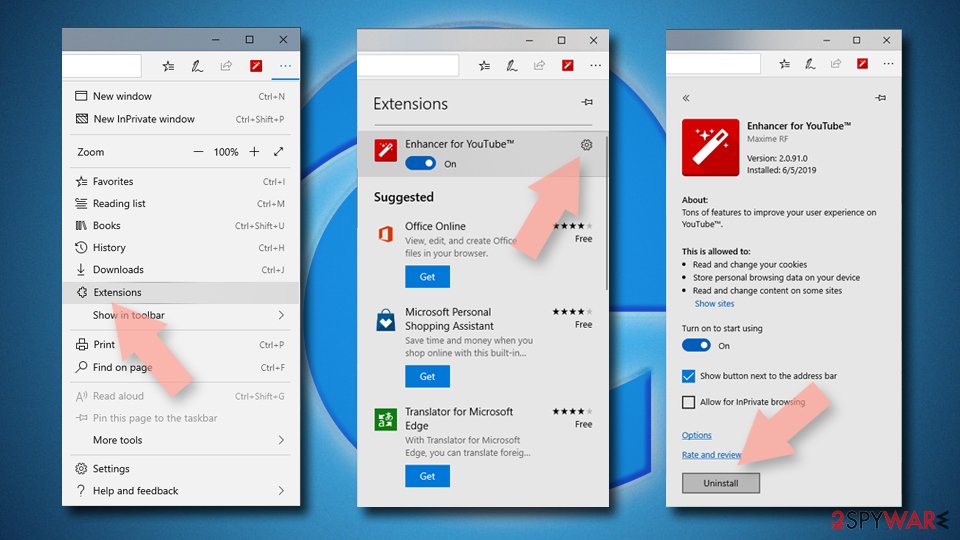
Delete unwanted extensions from MS Edge:
- Select Menu (three horizontal dots at the top-right of the browser window) and pick Extensions.
- From the list, pick the extension and click on the Gear icon.
- Click Remove.

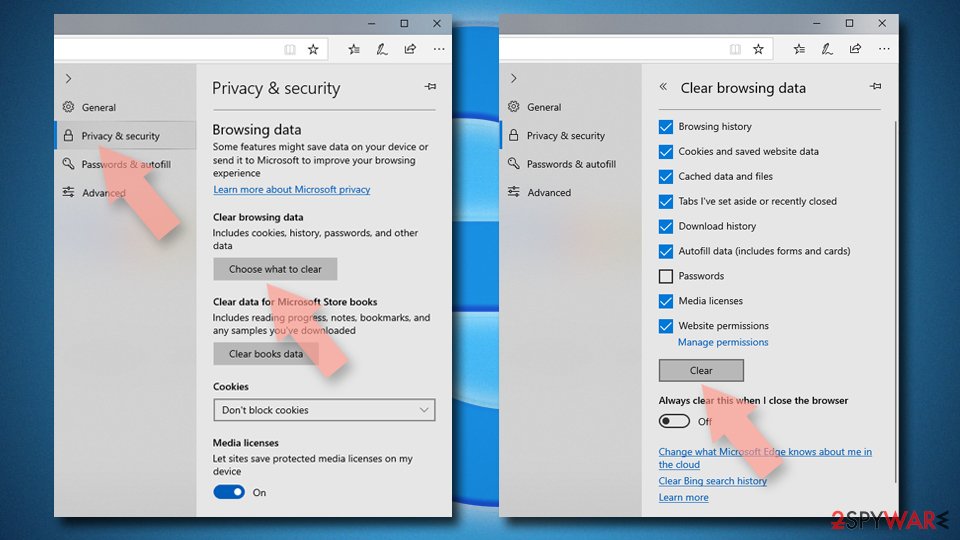
Clear cookies and other browser data:
- Click on the Menu (three horizontal dots at the top-right of the browser window) and select Settings > Privacy, search, and services..
- Under Clear browsing data, pick Choose what to clear.
- Select Cookies and other site data and Cached images and files. (apart from passwords, although you might want to include Media licenses as well, if applicable) and click on Clear.

Restore new tab and homepage settings:
- Click the menu icon and choose Settings.
- Then find On startup section.
- Click Remove next to any suspicious startup page.
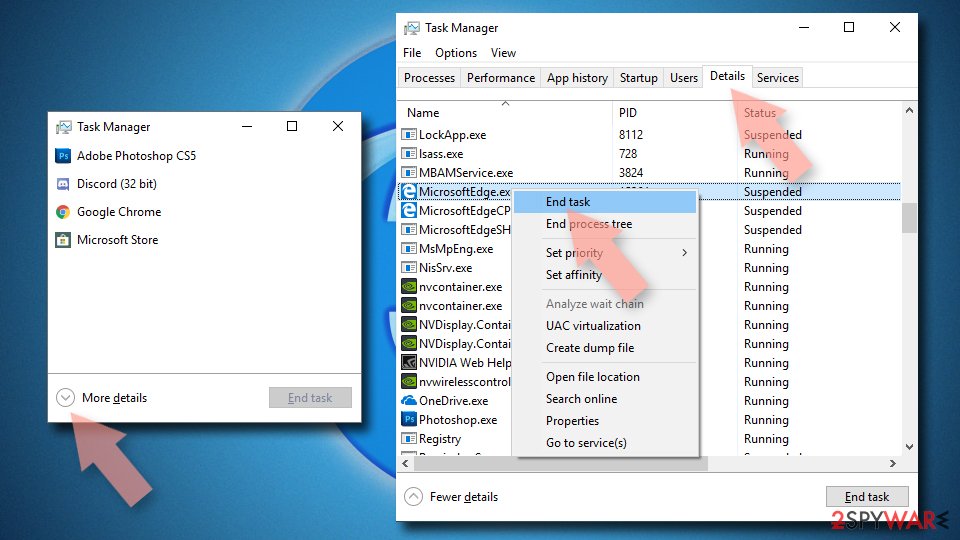
Reset MS Edge if the above steps did not work:
- Press on Ctrl + Shift + Esc to open Task Manager.
- Click on More details arrow at the bottom of the window.
- Select Details tab.
- Now scroll down and locate every entry with Microsoft Edge name in it. Right-click on each of them and select End Task to stop MS Edge from running.

Instructions for Chromium-based Edge
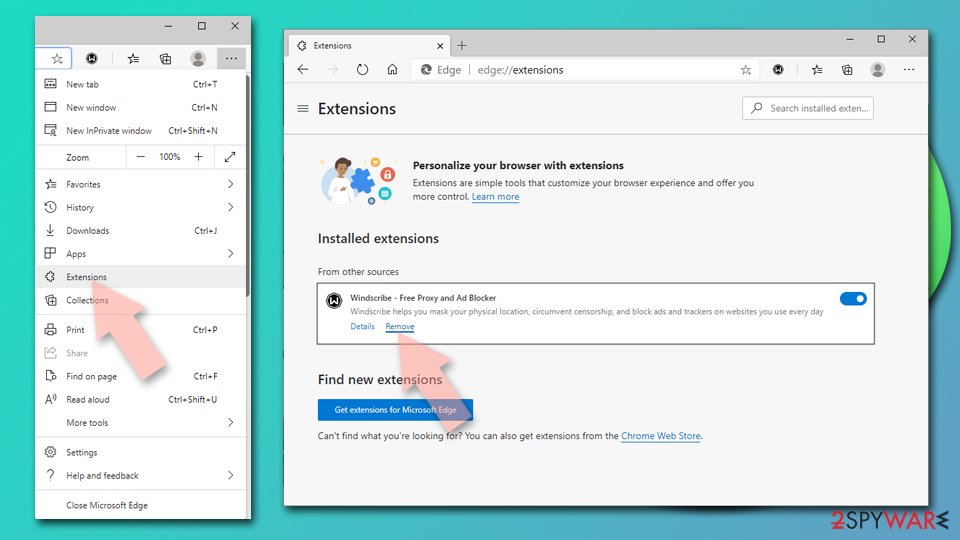
Delete extensions from MS Edge (Chromium):
- Open Edge and click select Settings > Extensions.
- Delete unwanted extensions by clicking Remove.

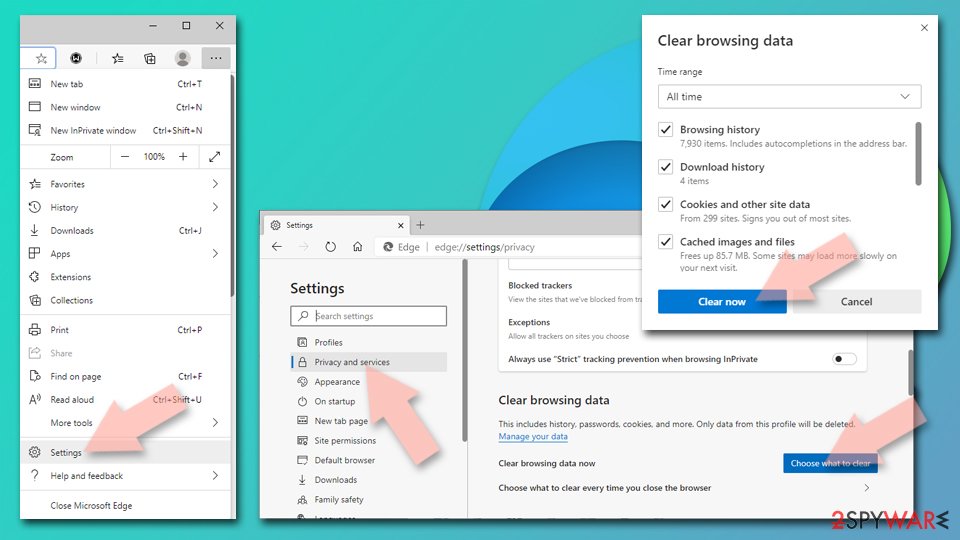
Clear cache and site data:
- Click on Menu and go to Settings.
- Select Privacy, search and services.
- Under Clear browsing data, pick Choose what to clear.
- Under Time range, pick All time.
- Select Clear now.

Reset Chromium-based MS Edge:
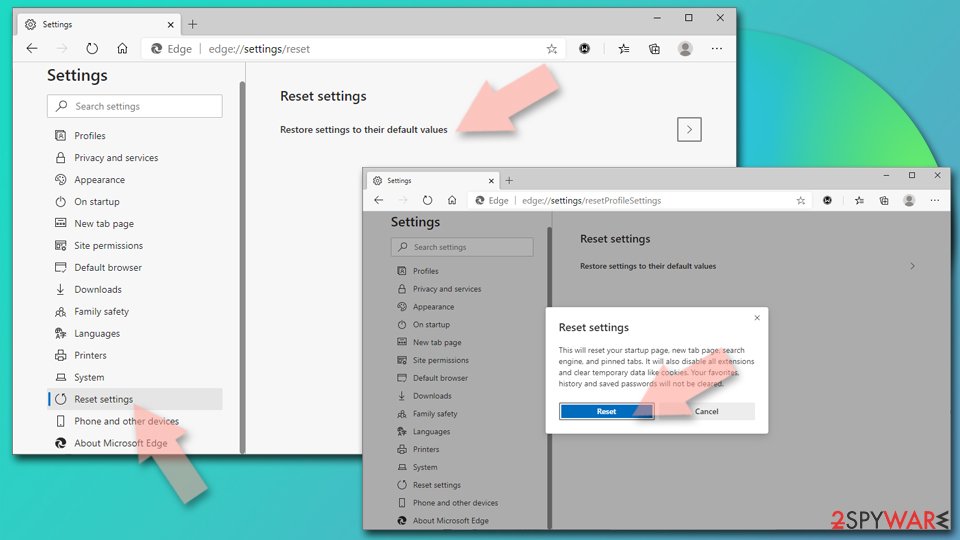
- Click on Menu and select Settings.
- On the left side, pick Reset settings.
- Select Restore settings to their default values.
- Confirm with Reset.
- This will disable extensions and reset startup pages but will not delete bookmarks, saved passwords, or browsing history.

Remove from Mozilla Firefox (FF)
Remove dangerous extensions:
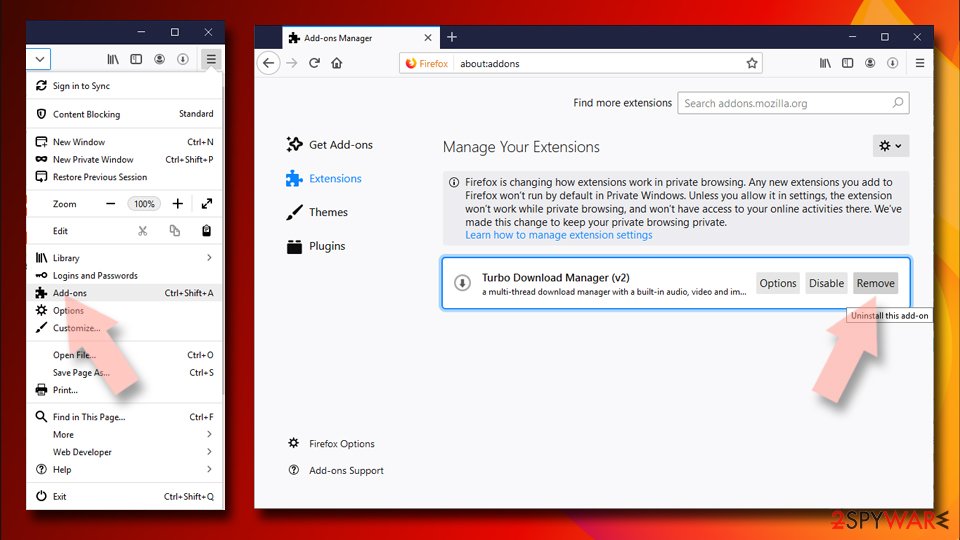
- Open Mozilla Firefox browser and click on the Menu (three horizontal lines at the top-right of the window).
- Select Add-ons.
- In here, select the unwanted extension and click Remove.

Reset the homepage:
- Click three horizontal lines at the top right corner to open the menu.
- Choose Settings.
- Under Home, set your preferred homepage and new tab settings.
Clear cookies and site data:
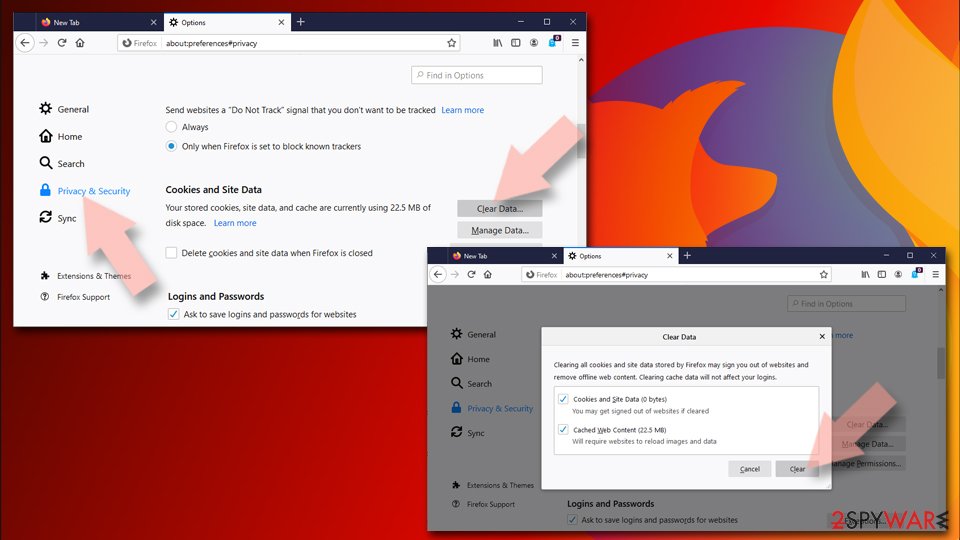
- Click Menu and pick Settings.
- Go to Privacy & Security section.
- Scroll down to locate Cookies and Site Data.
- Click on Clear Data…
- Select Cookies and Site Data and Temporary cached files and pages, then click Clear.

Reset Mozilla Firefox
If clearing the browser as explained above did not help, reset Mozilla Firefox:
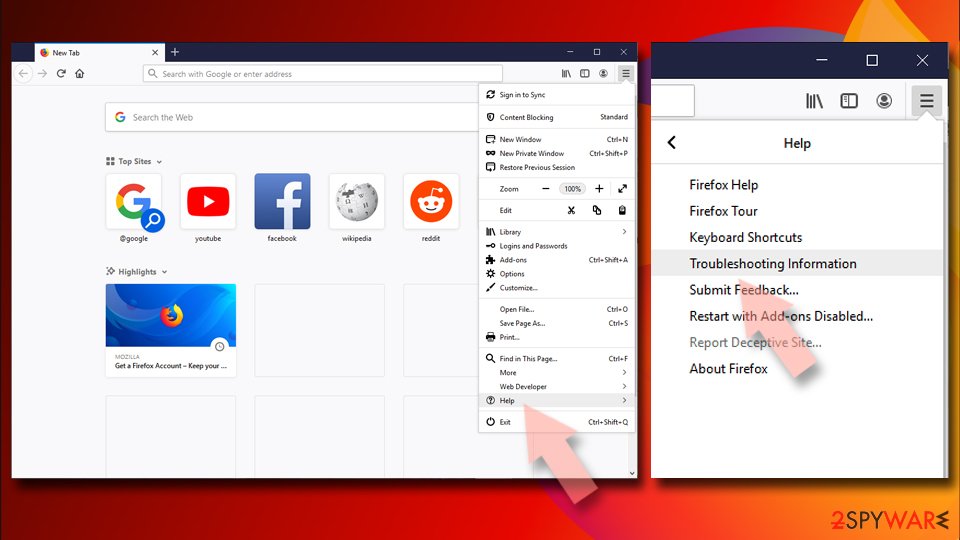
- Open Mozilla Firefox browser and click the Menu.
- Go to Help and then choose Troubleshooting Information.
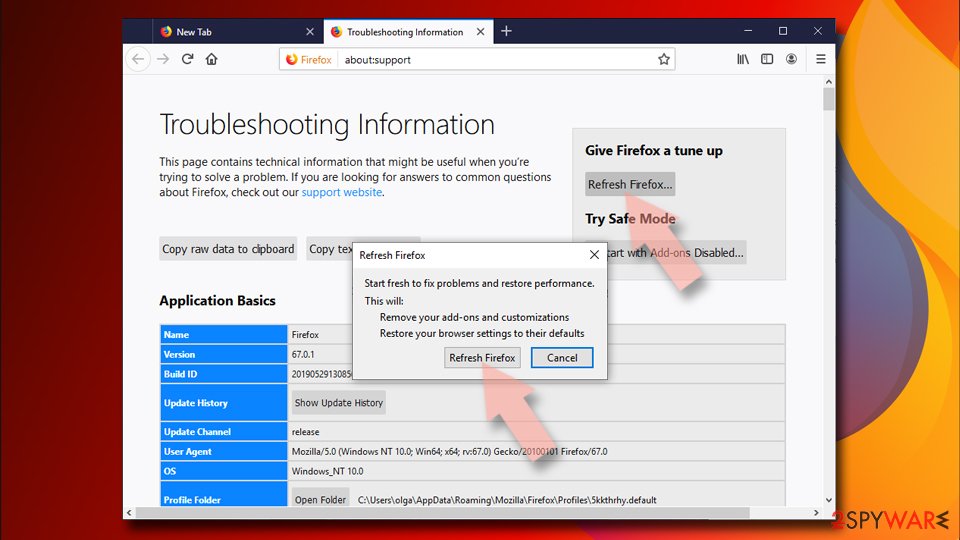
- Under Give Firefox a tune up section, click on Refresh Firefox…
- Once the pop-up shows up, confirm the action by pressing on Refresh Firefox.


Remove from Google Chrome
Delete malicious extensions from Google Chrome:
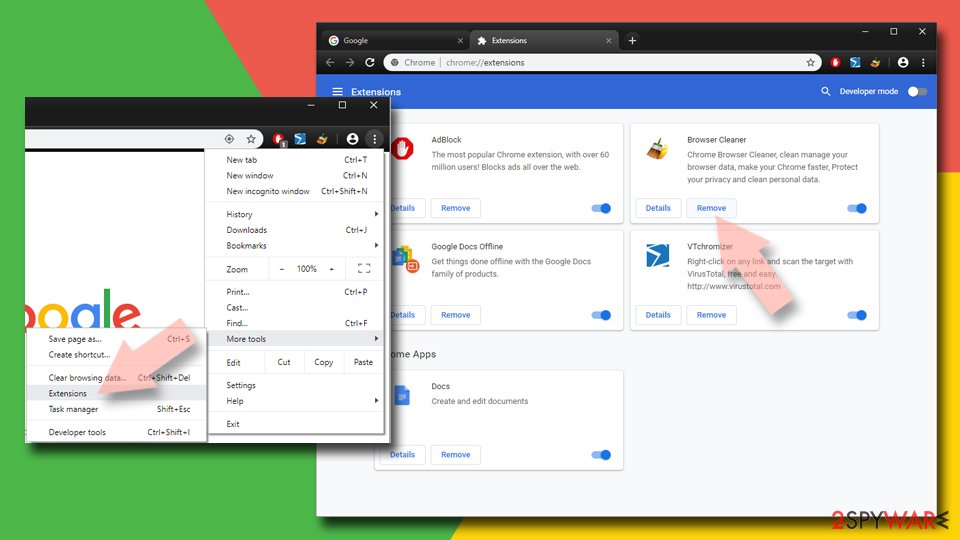
- Open Google Chrome, click on the Menu (three vertical dots at the top-right corner) and select More tools > Extensions.
- In the newly opened window, you will see all the installed extensions. Uninstall all suspicious extensions related to the unwanted program by clicking Remove.

Clear cache and web data from Chrome:
- Click on Menu and pick Settings.
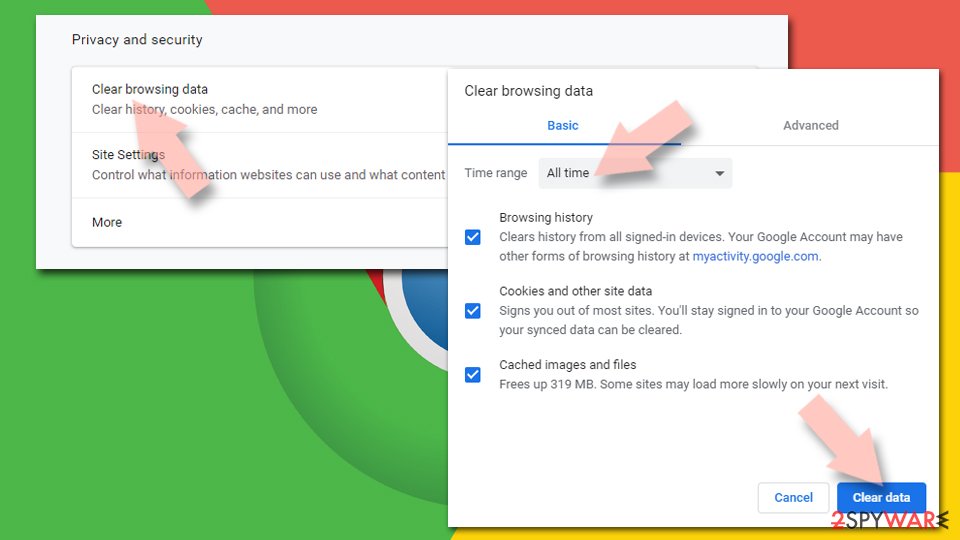
- Under Privacy and security, select Clear browsing data.
- Select Browsing history, Cookies and other site data, as well as Cached images and files.
- Click Clear data.

Change your homepage:
- Click menu and choose Settings.
- Look for a suspicious site in the On startup section.
- Click on Open a specific or set of pages and click on three dots to find the Remove option.
Reset Google Chrome:
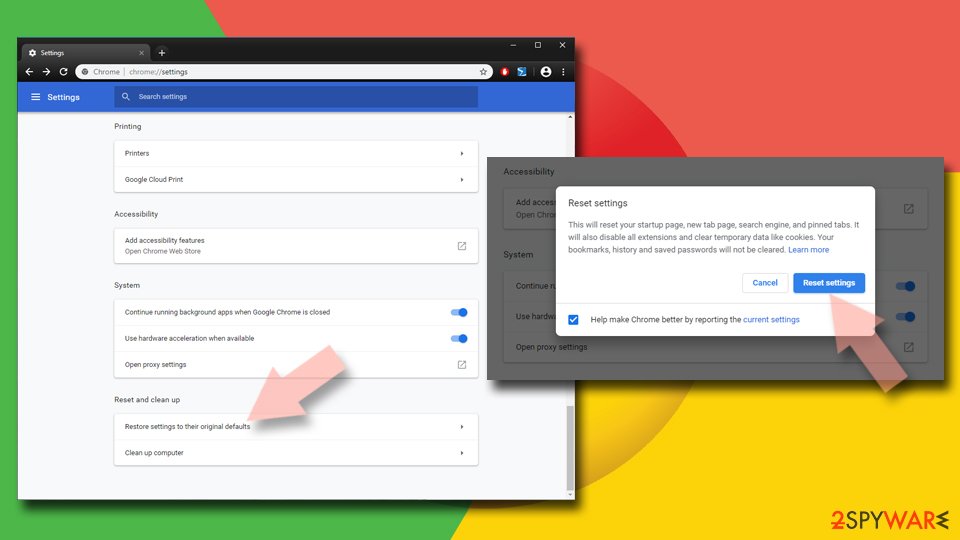
If the previous methods did not help you, reset Google Chrome to eliminate all the unwanted components:
- Click on Menu and select Settings.
- In the Settings, scroll down and click Advanced.
- Scroll down and locate Reset and clean up section.
- Now click Restore settings to their original defaults.
- Confirm with Reset settings.

Delete from Safari
-
Remove dangerous extensions
Open Safari web browser and click on Safari in menu at the top left of the screen. Once you do this, select Preferences.
-
Here, select Extensions and look for Malware Defense or other suspicious entries. Click on the Uninstall button to get rid each of them.

-
Reset Safari
Open Safari browser and click on Safari in menu section at the top left of the screen. Here, select Reset Safari....
-
Now you will see a detailed dialog window filled with reset options. All of those options are usually checked, but you can specify which of them you want to reset. Click the Reset button to complete Malware Defense removal process.


After uninstalling this potentially unwanted program (PUP) and fixing each of your web browsers, we recommend you to scan your PC system with a reputable anti-spyware. This will help you to get rid of Malware Defense registry traces and will also identify related parasites or possible malware infections on your computer. For that you can use our top-rated malware remover: FortectIntego, SpyHunter 5Combo Cleaner or Malwarebytes.
How to prevent from getting rogue antispyware
Do not let government spy on you
The government has many issues in regards to tracking users' data and spying on citizens, so you should take this into consideration and learn more about shady information gathering practices. Avoid any unwanted government tracking or spying by going totally anonymous on the internet.
You can choose a different location when you go online and access any material you want without particular content restrictions. You can easily enjoy internet connection without any risks of being hacked by using Private Internet Access VPN.
Control the information that can be accessed by government any other unwanted party and surf online without being spied on. Even if you are not involved in illegal activities or trust your selection of services, platforms, be suspicious for your own security and take precautionary measures by using the VPN service.
Backup files for the later use, in case of the malware attack
Computer users can suffer from data losses due to cyber infections or their own faulty doings. Ransomware can encrypt and hold files hostage, while unforeseen power cuts might cause a loss of important documents. If you have proper up-to-date backups, you can easily recover after such an incident and get back to work. It is also equally important to update backups on a regular basis so that the newest information remains intact – you can set this process to be performed automatically.
When you have the previous version of every important document or project you can avoid frustration and breakdowns. It comes in handy when malware strikes out of nowhere. Use Data Recovery Pro for the data restoration process.

If this free guide helped you and you are satisfied with our service, please consider making a donation to keep this service alive. Even a smallest amount will be appreciated.