
AccuWeather Location Data Scandal: What It Means in 2026
- The AccuWeather scandal in 2026: the short answer
- Timeline: AccuWeather and weather app location data
- What changed since 2017
- Privacy risks of weather apps (our analysis)
- How to limit what a weather app shares
- What is still unknown
- Our original 2017 report
- Location data was sent when the tracking was turned off
- AccuWeather continues sharing user's data
- Related guides on 2-Spyware
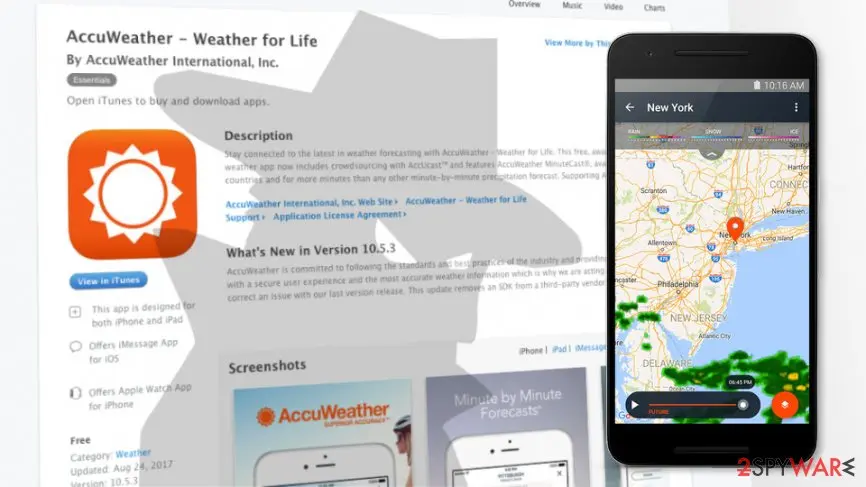
The AccuWeather scandal in 2026: the short answer
In August 2017, security researcher Will Strafach found that the AccuWeather iPhone app sent location related data to the monetization firm Reveal Mobile, even when users had turned location sharing off.[1] AccuWeather and Reveal Mobile then issued a joint statement. They said that, once the feature was reinstated, zero data should go to Reveal Mobile when someone opts out of location sharing.[2]
Later tests reported that the app still shared precise location with advertisers when users allowed location access.[5] The case became a reference point for weather app privacy. In 2020, a separate case against The Weather Channel app ended with a settlement in Los Angeles over how location data use was disclosed.[6] We found no new AccuWeather location data case in the sources we read as of 2026.
| Question | Answer |
|---|---|
| Who found it | Security researcher Will Strafach[1] |
| What was sent | Location related data, including Wi-Fi router name and BSSID when GPS access was off[1] |
| Who received it | Reveal Mobile, a data monetization firm[1][4] |
| Company response | Joint statement promising zero data to Reveal Mobile after opt-out[2] |
| Later finding | Precise location still shared with advertisers when users allowed access[5] |
| Status in 2026 | We found no new AccuWeather location data case in our sources |
Timeline: AccuWeather and weather app location data
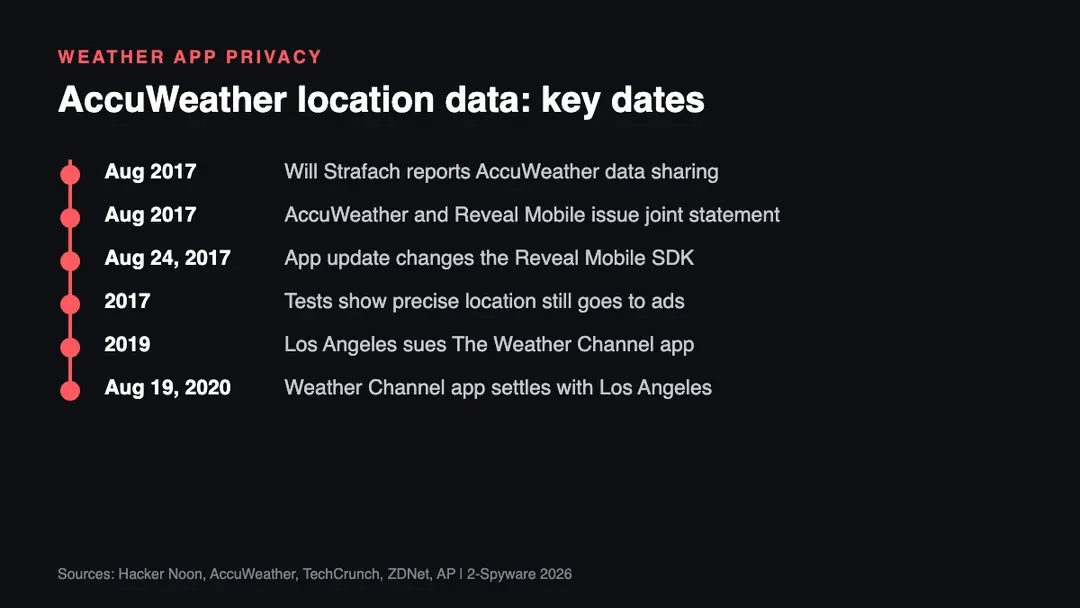
| Date | Event |
|---|---|
| August 2017 | Will Strafach publishes his advisory on the AccuWeather iOS app[1] |
| August 2017 | AccuWeather and Reveal Mobile publish a joint statement[2] |
| August 24, 2017 | TechCrunch reports the app update that changes the Reveal Mobile code[4] |
| 2017 | ZDNet tests show precise location still shared with advertisers when allowed[5] |
| 2019 | The Los Angeles city attorney sues the operator of The Weather Channel app[6] |
| August 19, 2020 | The Weather Channel app operator settles and agrees to clearer disclosures[6] |
What changed since 2017
The AccuWeather case showed a gap that many weather apps share. A forecast needs your location, but the same permission can also feed advertising and data firms. Strafach's test found that even without GPS access, the app sent the Wi-Fi router name and BSSID, which can reveal a less precise location.[1]
Regulators later took up the same issue in another app. In a 2019 lawsuit, the Los Angeles city attorney alleged that users of The Weather Channel app were misled when they shared location for forecasts and alerts, while the data was sold to third parties.[6] The suit alleged a fraudulent, deceptive and unfair practice under California law.[7]
The settlement was announced on August 19, 2020. The app operator agreed to change how it tells users about location tracking and data sales. The city attorney had said that 80% of users agreed to share location because the details were buried in a 10,000-word privacy policy.[6] The company said the claims were baseless.[6]
Privacy risks of weather apps (our analysis)
These points are our analysis of what the AccuWeather and Weather Channel cases teach, not new findings about either app today.
- Always-on location. An app with background location access can build a detailed map of where you live and work.
- Indirect location signals. Wi-Fi names and router IDs can reveal location even when GPS access is off.[1]
- Third-party SDKs. Advertising code inside an app may send data the app maker does not fully control.
- Long privacy policies. Key facts can sit deep in a long text that few people read.[6]
- Fake weather apps. Copycat apps with weather names can carry adware or ask for far more permissions than a forecast needs.
How to limit what a weather app shares
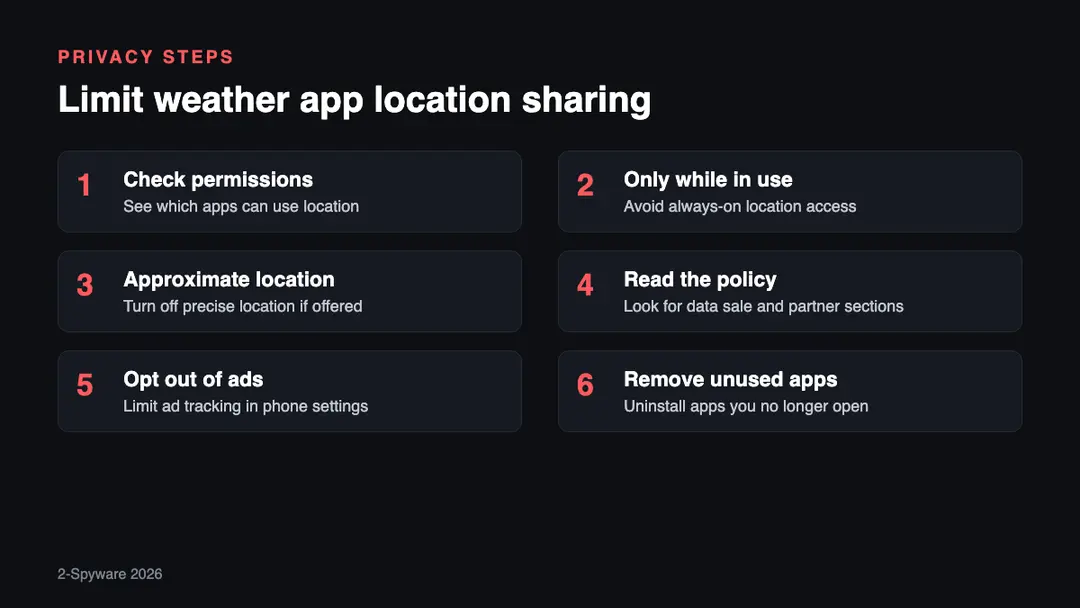
1. Check permissions. Open your phone's privacy or location settings and see which apps can read your location.
2. Only while in use. Give a weather app location access only while you use it. Background access is what allows a full movement history.
3. Approximate location. If your phone offers an approximate location option, use it. A city level forecast does not need your exact address.
4. Read the policy. Look at the sections about partners, advertising and data sales in the app's privacy policy before you agree.[6]
5. Opt out of ads. Limit ad tracking in your phone settings, and inside the app if it offers a choice.
6. Remove unused apps. Uninstall weather apps you no longer open, and check for unwanted programs with our malware removal guides.
What is still unknown
- How AccuWeather's current apps share location with partners. We did not test the app for this update.
- Whether the Reveal Mobile code was removed from all versions, since later tests looked at the iOS app.[5]
- How many users were affected in 2017. We found no official count.
Our original 2017 report
The text below is our report as first published in 2017. We keep it unchanged for the record; the sections above bring it up to date.
Security researcher Will Strafach[1] delivered shocking news for AccuWeather iOS users last week. Their location data was tracked even if their disabled this feature. What is worse, aggregated details are shared with third-party advertising and monetization firm RevealMobile without user's knowledge and permission.
RevealMobile is a company that helps to boost mobile revenue for app developers. Therefore, aggregated location information allows displaying targeted ads based on user's location. It means that you might be offered to visit a shop or restaurant that is in your neighborhood.
However, this issue raised the concerns that one of the most popular mobile weather apps might be violating Apple guidelines. Due to these data tracking and sharing activities, the app might be removed from iTunes.
However, the company published an apology a few days after the scandal.[2] According to the company, they care about users privacy. Thus, they promise never share similar information without asking direct permission. However, it seems it was just beautiful words.
The latest information claims that AccuWeather continues sharing data with advertisers behind users' back.[3] Indeed, this behavior is unexpected from one of the most popular weather apps.
Location data was sent when the tracking was turned off
After the installation of AccuWeather on iPhone, users are asked to give permission to track their location in order to provide better and more accurate weather forecast. The app asks to access these details even if a person does not use the app:
- precise GPS coordinates,
- Wi-Fi information,
- Bluetooth connection info.
Strafach's tested the app for 36 hours and discovered that aggregated information was sent 16 times to RevealMobile. Although users can disable location tracking, it might not be a solution. According to the analysis, it might track information even if a user does not allow it:
"If you do not grant AccuWeather access to your GPS information, it will still send your Wi-Fi router name and BSSID, providing RevealMobile access to less precise location information regarding your device's whereabouts."
However, once the incident occurred, AccuWeather releases an update for the app that was supposed to improve the behavior of SDK. Long story short, they indeed made a slight change. Now location information is shared with third-parties only if a user allows it.
AccuWeather continues sharing user's data
Nevertheless, the company made a public statement and released an update for the app;[4] it seems that situation changed only a little. Despite these promises, researchers continued testing and monitoring app's behavior.
According to the newest data, AccuWeather continues sharing precise location data with third-party advertisers. The company sends aggregated information to Nexage servers that are owned by Oath. However, this time data is shared only if a user enables location sharing feature.[5]
Nevertheless, this privacy violation has been discovered only in the iOS version of the app; Android users reacted to this issue too. Users decide to uninstall the app and left bad reviews in Google Play store.
Users are not only concerned about their privacy; they do not want to support the company that sells other users' data to third-parties. These activities simply are immoral and not tolerated.
This recent incident definitely had a negative impact on AccuWeather's reputation. Though, they haven't released an official statement about the recent issue yet.
Related guides on 2-Spyware
Frequently asked questions
What was the AccuWeather scandal?
In August 2017, researcher Will Strafach found that the AccuWeather iPhone app sent location related data to the monetization firm Reveal Mobile even when location sharing was off.{1} It sent the Wi-Fi router name and BSSID, which can reveal where a device is. AccuWeather then promised that opted-out users would send zero data to Reveal Mobile.{2}
Who is Will Strafach?
Will Strafach is the security researcher who tested the AccuWeather iOS app in 2017 and published the advisory on its data sharing.{1} His test showed that the app sent data to Reveal Mobile even when users had not granted GPS access, which started the public scandal.
Does AccuWeather still share location data in 2026?
We could not confirm the 2026 state. After the 2017 update, tests reported that precise location was still shared with advertisers when users allowed location access.{5} We did not test the current app. Check its privacy policy and give it location only while in use.
What does the AccuWeather privacy policy say about location?
We did not review the current AccuWeather privacy policy for this update, so we cannot quote it. In general, read the parts about partners, advertising and sale of data. The Weather Channel case showed that key location facts can sit deep inside a 10,000-word policy.{6}
How do I stop AccuWeather from using my location?
Open your phone's location settings, find AccuWeather and set access to never or only while using the app. If your phone offers approximate location, use it. Then enter your city by hand in the app, so you still get forecasts without sharing your exact position.
Should I uninstall AccuWeather?
That depends on how much location sharing you accept. If you keep it, limit location to while in use and turn off ad tracking. If you prefer not to share any location, uninstall it and use a forecast website where you type your city by hand.
Sources
- Hacker noon. The blog about hackers, cyber security and industry news
- AccuWeather. The official website
- Softpedia. Recent cyber security news
- TechCrunch. The latest technology news and information on startups
- ZDNet. Technology News, Analysis, Comments and Product Reviews
- NBC Los Angeles (Associated Press)
- Temple 10-Q
Log in to comment
No comments yet. Be the first.