
Elon Musk Crypto Scam Sites: BitVex and Clones in 2026
- Elon Musk crypto scam sites in 2026: the short answer
- Timeline: from BitVex to casino-style clones
- What changed since 2022
- Common scam formats in 2026 (our analysis)
- Six steps to stay safe from fake Musk platforms
- What is still unknown
- Our original 2022 report
- Real interviews with fake promotions
- Instead of returns – complete loss of investments
- Related guides on 2-Spyware
Elon Musk crypto scam sites in 2026: the short answer
Elon Musk does not own BitVex or any of the many look-alike crypto sites that use his face. BitVex was a 2022 scam that used deepfake videos of Musk and other crypto figures to sell a fake trading platform.[3] The same trick is still in use in 2026, under new names and with better AI voices.
The names keep changing. People search for sites such as Kepovex, Nevodex, Venowex, Bilepex, Yoxwex, Vagowex, Zewonex and Bimodex together with Musk's name. We did not test each of these domains, but they follow the pattern that users report for Nebofex and Ponegex: a fake "Musk crypto casino" where you can deposit but cannot withdraw.[10] Treat every one of them as a scam.
| Question | Answer |
|---|---|
| Does Musk own BitVex or similar sites | No, they are fake platforms[3] |
| How the videos are made | Real footage dubbed with an AI voice[6] |
| Most used fake brand | Quantum AI, according to a 2024 Sensity report[7] |
| Promised return in the BitVex case | About 30% on deposits[3] |
| US crypto scam losses in 2025 | 11.37 billion dollars, citing FBI data[8] |
| Can you get the money back | Rarely; crypto transfers are hard to reverse |
Timeline: from BitVex to casino-style clones
| Date | Event |
|---|---|
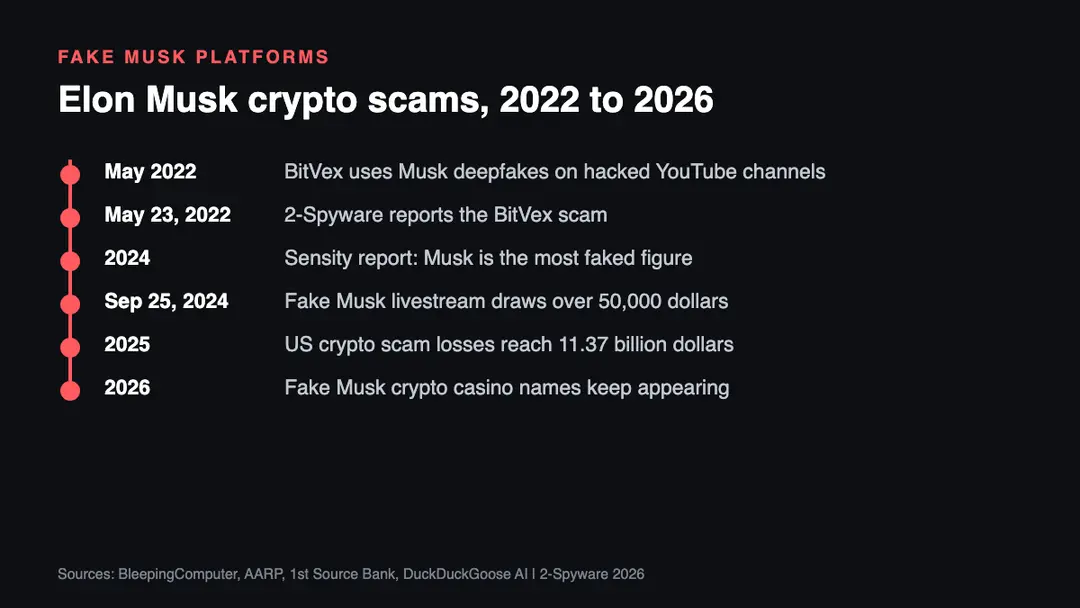
| May 2022 | BitVex scam spreads through deepfake videos on new and hacked YouTube channels[3] |
| May 23, 2022 | 2-Spyware publishes its report |
| 2024 | Sensity reports Musk is the most impersonated figure and Quantum AI the common fake brand[7][8] |
| September 25, 2024 | A Musk deepfake livestream pulls in over 50,000 dollars in under two hours, reported by DFRLab[9] |
| 2025 | Americans lose 11.37 billion dollars to crypto scams, per FBI data[8] |
What changed since 2022
In 2022 the BitVex deepfakes were weak. Our original report noted the lip-sync glitches and the odd script, and the scam wallet received only about 1,700 dollars. Since then the fakes have become harder to spot. Fact-checkers at RMIT FactLab describe videos that dub real Musk footage with an AI voice and send viewers to a fake news page about a platform called Quantum AI.[6]
The scale has grown too. AARP reports that Musk is the second most impersonated celebrity in scams, after MrBeast, and that his image is also used to sell fake products.[7] A summary of FBI figures puts US crypto scam losses in 2025 at 11.37 billion dollars, up 22% from the year before.[8] In one 2024 case, a fake Musk livestream collected more than 50,000 dollars in under two hours.[9]
The format has also spread beyond trading sites. Users now report fake "Elon Musk crypto casinos" with short invented names, promoted through direct messages and hacked accounts.[10] The hook is the same: Musk's name, a bonus code, and a balance you can never withdraw.
Common scam formats in 2026 (our analysis)
This list is our own analysis of the formats described in the reports above and in our 2022 investigation.
- Deepfake video ads. Real interviews dubbed with an AI voice that names a platform and a minimum deposit.[6]
- Fake livestreams. A recorded deepfake labelled as live, promising to double any crypto sent to a wallet.[8]
- Fake news pages. Sites that copy the look of a known outlet and quote a deepfake interview.[6][8]
- Fake crypto casinos. Short invented brand names, a bonus code from "Elon", and withdrawals that never arrive.[10]
- Recovery scams. After a loss, someone offers to get your crypto back for an upfront fee.
Six steps to stay safe from fake Musk platforms
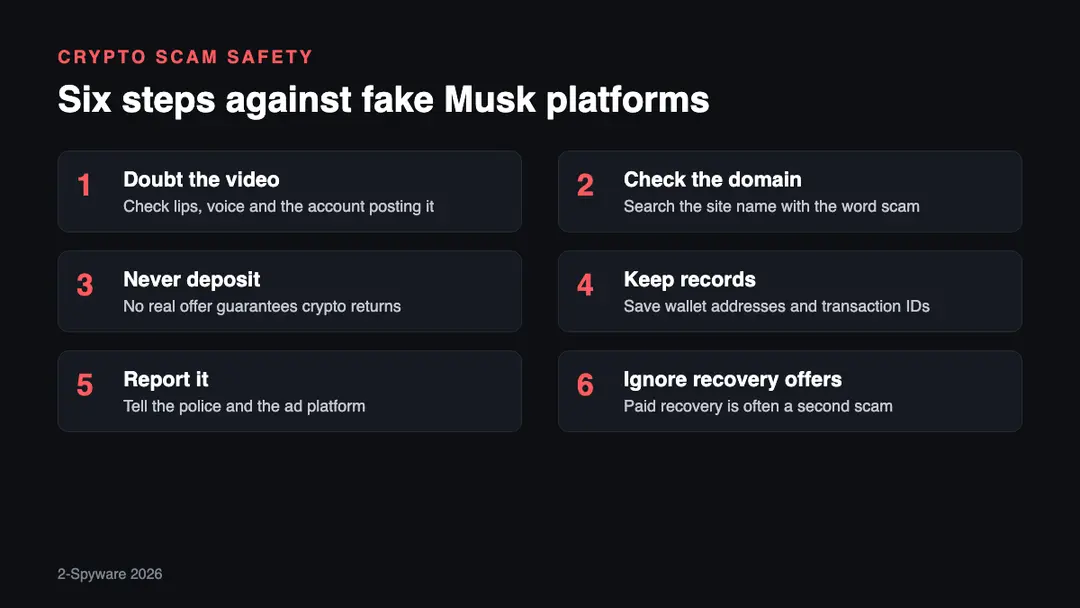
1. Doubt the video. Watch the lips and listen to the voice. Blurred lips and audio out of sync are signs of a deepfake.[6] Check who posted it: a new or hijacked channel is a red flag.
2. Check the domain. Search the site name together with the word scam. A brand-new domain with an invented name and Musk's face is enough to walk away.
3. Never deposit. No real platform guarantees fixed returns such as 30% on crypto deposits. A promise like that is the scam itself.
4. Keep records. If you already paid, save the site address, screenshots, wallet addresses and transaction IDs. Police and exchanges need these details.
5. Report it. Report the ad or video to the platform that showed it, and file a police report. Our guide on how to report phishing lists where to send scam reports.
6. Ignore recovery offers. People who promise to recover lost crypto for an upfront fee are usually scammers too. Do not pay them and do not share wallet keys.
What is still unknown
- Who runs the new casino-style domains. We found no public attribution for names like Kepovex or Nevodex.
- How much the 2022 BitVex operators earned in total. The wallets could be rotated, so the 1,700 dollar figure is likely incomplete.
- Whether ad platforms will stop paid deepfake ads before they reach users. We found no 2026 data showing a clear drop.
Our original 2022 report
The text below is our report as first published in 2022. We keep it unchanged for the record; the sections above bring it up to date.
Cryptocurrency scammers used deep fakes of Elon Musk in videos promoting the scam pages. Other prominent cryptocurrency advocates also used to promote the BitVex trading platform scam that is stealing deposited currency.[1] The fake trading platform is promoted to be owned by Elon Musk.[2] The entrepreneur allegedly created the site to allow everyone to earn around 30% returns on their deposits of cryptocurrency.[3]
These campaigns started this month and have been related to creating and hacking other YouTube accounts. These are used to display deep fake videos with Elon Musk, Brad Garlinghouse, Michael Saylor, Charles Hoskinson, and Cathie Wood. These videos are real interviews modified with these deep fakes[4] of the known people. The technology also allows using the person's voice in the script provided by the criminals.
These versions of videos surfaced online and in many of them, Elon Musk claims to have been investing up to $50 million into the platform and swears on its accuracy and legitimacy of the platform. However, these deep fakes were not good enough and synchronization glitches indicate the scam and fake factors. Also, the script that is used by threat actors is stupid and funny.
Real interviews with fake promotions
These videos show scripted interviews with a completely new and different message but take video material from interviews and evens like TED talks. It is obvious that interviews are altered to simulate the voice of Elon to promote the BitVex trading platform. There are other clues indicating that the material is fake and manipulated.
Such scam videos are displayed using many YouTube channels that are newly created or hacked. These videos promote the trading site and list all these fake videos. YouTube channels previously showing gaming videos or other content in Arabic suddenly started to display Shorts with promotional material to BitVex.org. Including those faces and names that many people link with cryptocurrency.
Researchers found dozens of those hacked accounts on the platform that are used just to promote this scam online. The visit to the main site shows facts that are even more obvious to indicate the scam nature of the campaign. The site lists Elon as the CEO and other companies as endorsers and investors.
Instead of returns – complete loss of investments
The site claims to have endorsements from Ark Invest's Cathie Wood and Binance CEO Chapeng Zhao, without Elon Musk being listed as the CEO. This platform requires the registration of the account either on .org or .net version of the BitVex page. The investment platform should provide access to the site and fund transfers.
Once the user is created and logged in, the site shows the dashboard where the deposits can be made in various cryptocurrencies. The investment plans are there for the selection, and the dashboard shows the option of a withdrawal. The dashboard looks typical and other cryptocurrency scams also show such recent withdrawals of various cryptocurrencies, so the page looks legitimate and more attractive.
However, these withdrawals expose the fake process because the JavaScript-based process is randomly selecting the cryptocurrency from the possibilities and enters the amount randomly too. This scam is not successful. Only $1700 worth of deposits were made to the address. Those can be rotated, so there is a possibility that scammers might have already stolen more since the beginning. There have been more successful scams involving Elon Musk that have tricked people into transferring funds, so criminals earn hundreds of thousands.[5]
Related guides on 2-Spyware
Frequently asked questions
Is BitVex owned by Elon Musk?
No. BitVex was a fake trading platform that used deepfake videos of Elon Musk and other crypto figures to look legitimate.{3} It promised returns of around 30% and took deposits that people could not get back. Musk had no role in it. Any site that claims he owns it or guarantees its profits should be treated as a scam.
Are Kepovex, Nevodex, Venowex and similar sites real Elon Musk projects?
We found no evidence that Elon Musk runs any of them, and we treat them as part of the same scam family. Similar names such as Nebofex and Ponegex have been reported by users as fake "Elon Musk crypto casinos" where deposits cannot be withdrawn.{10} New names appear often because scammers swap domains when old ones get flagged.
How does the Elon Musk investment scam work?
Scammers take real footage of Musk and dub it with an AI voice so he appears to recommend a platform.{6} The video runs as an ad or a fake livestream, and it links to a site that asks for a deposit. The site shows fake profits, then blocks or delays withdrawals. Some versions ask for a minimum deposit, such as 400 dollars in one Quantum AI case.{6}
How can I tell if an Elon Musk video is a deepfake?
Look at the lips and the sound first. In analysed Quantum AI videos, Musk's lips were blurred and out of sync with a robotic voice.{6} Other signs are a promise of guaranteed returns, a link to an unknown site, and pressure to act fast. A real executive does not ask the public to deposit crypto into a new platform.
How much money do people lose to these scams?
The amounts are large. One summary of FBI data says Americans lost 11.37 billion dollars to crypto scams in 2025, and 893 million dollars to AI-powered scams, including deepfake endorsements.{8} Individual losses reported include 690,000 dollars for one US retiree.{8} The 2022 BitVex wallet we wrote about received only about 1,700 dollars.
What should I do if I sent crypto to a fake Musk platform?
Stop sending money at once, even if the site asks for a fee to release your profits. Save the site address, wallet addresses and transaction IDs, then report it to the police and to the platform where you saw the ad. Be careful with anyone who offers to recover your crypto for a fee, because that is often a second scam.
Log in to comment
No comments yet. Be the first.