
Japanese Computer Virus Plan in 2026: What Happened

- Japan's "good virus" in 2026: the short answer
- Timeline: from a virus plan to a cyber defense law
- What changed since 2019
- A 2026 reminder: real malware hit Japan's military
- Risks around the topic (our analysis)
- Six steps for a reader in 2026
- What is still unknown
- Our original 2019 report
- Experts find the word "virus" doubtful in this case
- Specialists believe that the "good" malware might also carry bugs
- Related guides on 2-Spyware
Japan's "good virus" in 2026: the short answer
We found no public report that Japan ever released the defensive virus announced in 2019. Kyodo said then that the Defense Ministry would develop its first defense virus by the following March.[6] Since then the story moved away from a single program. In May 2025 Japan enacted an active cyber defense law that lets state agencies disable the servers behind attacks.[8]
So the "good virus" headline turned into something larger and more official. The 2019 concerns raised by Bitdefender, mainly bugs and unwanted side effects, still apply to any tool that touches other people's systems.[5] This page covers what happened since, what the new law does, and what it means for an ordinary computer user.
| Question | Answer |
|---|---|
| What was announced in 2019 | A defense virus to be developed by March 2020[6] |
| Was it publicly released | We found no report that it was |
| What replaced it | The Active Cyber Defense Law, enacted May 16, 2025[8] |
| What it allows | Police and Self-Defense Forces can access and disable foreign servers used for attacks[8] |
| Oversight | A new independent commission must approve or review actions[8] |
| When it works fully | Operational in 2027, with parts phased in earlier[7][8] |
Timeline: from a virus plan to a cyber defense law
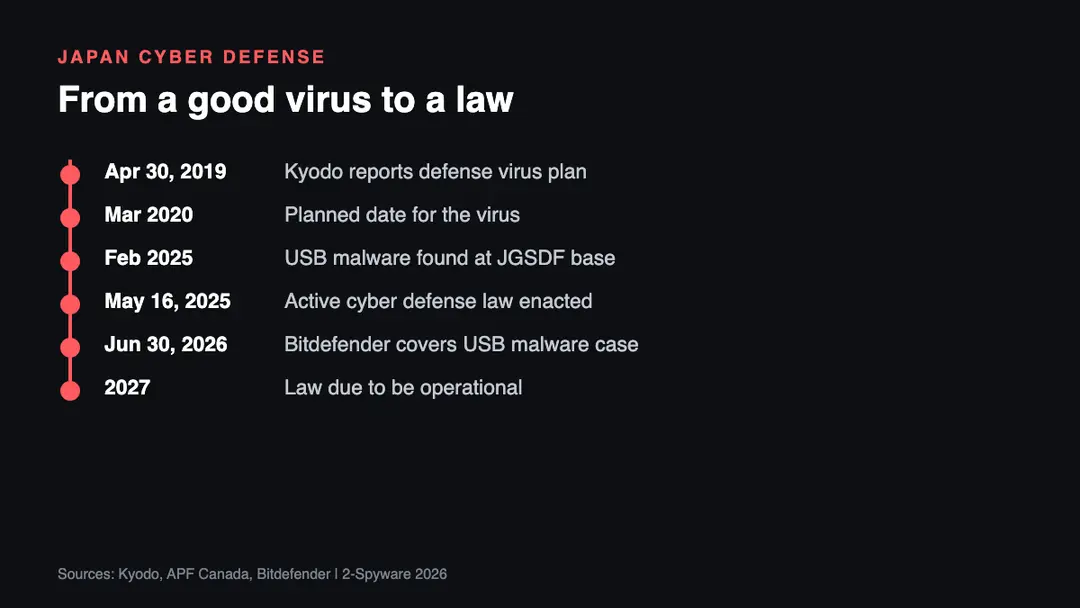
| Date | Event |
|---|---|
| April 30, 2019 | Kyodo reports Japan will develop its first defense virus by next March[6] |
| May 16, 2025 | Japan enacts a law allowing pre-emptive action against digital threats[8] |
| February 2025 | Malware found on a JGSDF computer after staff noticed it ran slowly[9] |
| June 30, 2026 | Bitdefender reports on the USB case based on Nikkei Asia[9] |
| 2027 | The law is due to become operational[8] |
What changed since 2019
In 2019 the plan was described as a virus used only to prevent cyber attacks. The 2025 law is broader. It rests on three pillars: a Cyber Council for government and industry, use of communications data to spot threats, and remote access to neutralize attacker infrastructure such as malicious servers.[7]
The law uses metadata such as IP addresses and traffic patterns from cross-border internet activity, not the content of domestic communications.[8] Critics say it could conflict with Article 21 of the Japanese constitution, which guarantees privacy of communications, and question how independent the oversight commission will be.[8]
The staffing problem from the original report is still part of the picture. The Canadian brief says a chronic shortage of cyber talent could slow the law's goals.[8] We did not find updated staff numbers, so we do not repeat the 2019 figures as current.
A 2026 reminder: real malware hit Japan's military
Bitdefender reported on June 30, 2026 that counterfeit USB drives carrying malware had been used on Japan's Ground Self-Defense Force computers for nearly a year.[9] Staff noticed a slow computer in February 2025, and six of eight drives tested held the same malicious code.[9]
The drives had been attached to over 50 computers, nearly half of them handling classified data.[9] The Defense Ministry said the malware was a legacy type limited to self-replication, without data theft or outside communication.[9] The case shows why defense depends on basic hygiene as much as on clever tools.
Risks around the topic (our analysis)
- Fake "Japanese government antivirus" downloads. No government agency distributes a defense virus to the public, so treat any such offer as a scam.
- Cheap USB drives and memory cards from unknown sellers, which Nikkei Asia linked to malware in Japan.[9]
- Friendly-sounding names for risky tools. A program that spreads by itself is malware, whatever the stated intent.[5]
- Headlines that say a country "released a virus". We found no confirmation of that, so check the source before you share.
Six steps for a reader in 2026
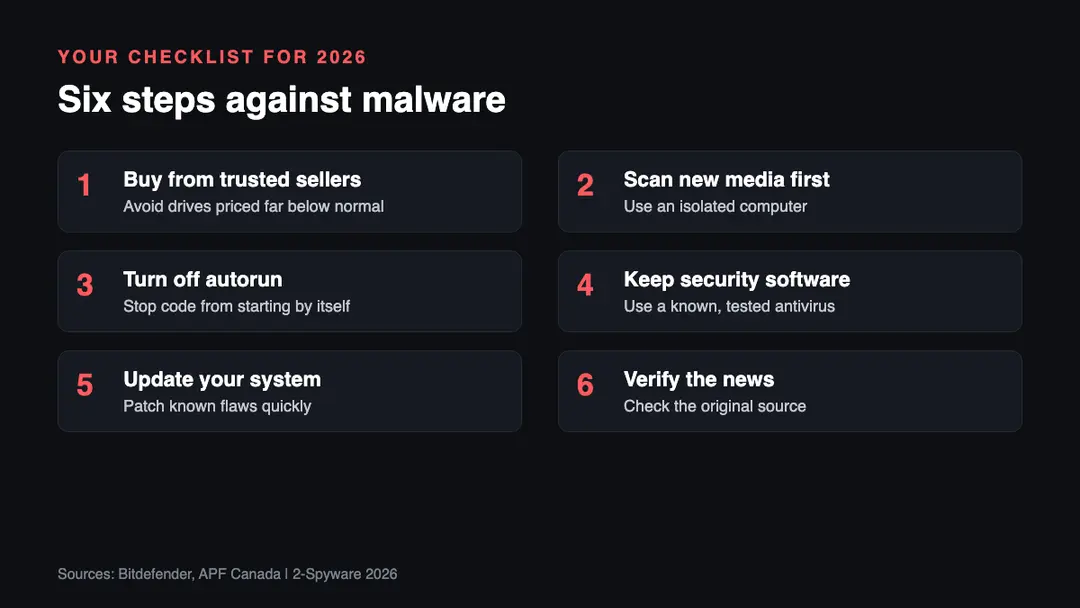
1. Buy from trusted sellers. Suspiciously cheap storage is a warning sign.[9]
2. Scan new media first. Check removable drives on an isolated system before you plug them into your main computer.[9]
3. Turn off autorun. Disabling autoplay stops malicious code from starting when a drive is attached.[9]
4. Keep security software running. As Bitdefender argued in 2019, strong antivirus is the safer path than any "good" malware.[5]
5. Update your system. Install updates for your operating system and apps soon after they appear.
6. Verify the news. Open the original report before you trust or repeat a claim about state-run malware.
What is still unknown
- Whether the 2019 defense virus was ever built or used. We found no public statement either way.
- How the oversight commission will work in practice, since the Canadian brief calls its independence unclear.[8]
- How often the new powers will be used against servers abroad, and how other countries will react.[8]
- Where the counterfeit USB drives were bought. Neither the military nor the Ishikawa prefectural government could produce a paper trail.[9]
Our original 2019 report
The text below is our report as first published in 2019. We keep it unchanged for the record; the sections above bring it up to date.
The news that Japan is seeking to develop a "good" computer virus for cybersecurity purposes has flown widely around the world. The Defense Ministry in Japan has stated that they are looking forward to releasing such a virus in March 2020. Also, they have ensured that such cyber threat will be used ONLY as a prevention measure of cyber attacks and will not have any malicious purposes.[1]
Japan has made such a decision due to the fact that the country falls behind other countries in the cybersecurity field. Another plan of the Defense Ministry is to level up the number of staff that is responsible for the security on the Internet. Japan is looking forward to increasing the employee number from 150 to 220. It is quite low, having in mind that the amount of security staff in the USA has already reached 6,200, in China – 130,000, and in North Korea – 7,000.[2]
Experts find the word "virus" doubtful in this case
As security experts claim, the aim of this virus is to:
break into a computer system, hoping such as computer virus could work as a deterrent against cyberattacks.
However, according to Bitdefender, there are so few details provided about this "good" virus and everything might not be as positive as it looks from the first view. Cybersecurity experts are concerned about the word "virus" which definitely doesn't mean something defensive, but the opposite, makes you become doubtful and worried.
According to tech experts, a virus is a malicious program which executes various damaging actions without the user's participation. The best example of a computer virus is a Trojan horse[3] which executes its code secretly when a victim opens a malicious attachment or accesses an infectious hyperlink and remains in various harmful features such as data theft, injection of other malware, software crashes and disabling programs, etc.
Specialists believe that the "good" malware might also carry bugs
Computer experts from Bitdefender[4] found another reason why creating defense malware might not be a good idea at all. Specialists have doubts about the program's safety as the malware itself can definitely include some flaws or bugs.[5] The biggest concern is that the "good" virus might cause harm to the targeted system as regular malware does.
Bitdefender finds the defense virus idea very doubtful: if a bug from the malware appears on the system, updates for the big fix might not be released that fast so no harm would be done. Releasing a defense computer virus is a big risk which is supposedly not worth taking as the consequences might be even worse than expected.
Rather than releasing such program, experts believe that creating strong anti-malware and antivirus software would be enough. However, every user needs to put his own effort in performing safety measures. It does not mind what kind of defense programs the person will run if he still will keep on acting carelessly.
Related guides on 2-Spyware
Frequently asked questions
Did Japan ever release its defensive computer virus?
We found no public report that it did. Kyodo reported in April 2019 that Japan planned to develop its first defense virus by the following March.{6} The plan was never followed by a launch announcement in the sources we read. What Japan did pass is a 2025 law that lets the police and Self-Defense Forces disable attacker servers.{8}
What is the first computer virus in Japan?
We found no source that names a first Japanese computer virus, so we do not give one. The nearest item we can verify is the 2019 Defense Ministry plan, which Kyodo called Japan's first-ever virus built for defense.{6} That was a government project, not malware found in the wild.
Is there a Japanese antivirus I can use?
Yes, Japan has its own security vendors, and the government is funding them. A Canadian policy brief says METI has launched funding and procurement reforms to grow the domestic cybersecurity sector from 900 billion yen to over 3 trillion yen within a decade.{8} We did not test any Japanese product, so pick one using independent lab results.
Is Bitdefender available in Japan?
We found no Bitdefender page that says it is blocked or unavailable in Japan, and we did not test a Japanese purchase. Bitdefender wrote about the Japanese virus plan in 2019 and about infected USB drives in Japan in June 2026.{5}{9} Check the Bitdefender site for your country before you buy.
Is a good virus a real thing?
Not in the way the headline suggested. Bitdefender warned in 2019 that a defensive virus could carry bugs and harm the systems it touches.{5} Japan's 2025 law takes a different route: authorized agencies neutralize attacker servers under oversight rather than spreading self-copying code.{7}{8}
How can I protect myself from malware spread by USB drives?
Buy storage only from trusted sellers and scan new drives on an isolated machine first. Bitdefender advises treating suspiciously cheap drives with caution and disabling autorun.{9} Nikkei Asia found counterfeit drives priced 30 to 50 percent below real brands carrying malware in Japan.{9}
Log in to comment
No comments yet. Be the first.