
app-artifacts-1305923417.cos.ap-guangzhou.myqcloud.com: a Tencent Cloud bucket listed for ActiveMQ exploit files, and what to check on your server
app-artifacts-1305923417.cos.ap-guangzhou.myqcloud.com is a storage bucket on Tencent Cloud that URLhaus lists for four XML files, poc.xml, poc_win.xml, t_a.xml and t_e.xml, all tagged ActiveMQ and added on 17 October 2026. Files like these are not opened by people. They are fetched by an Apache ActiveMQ server that is being attacked through the flaw CVE-2023-46604, and they tell that server to run a command.
If you only saw the name in a check or a log on a home PC, you are very likely not the target. If you run ActiveMQ, upgrade it, close port 61616 to the internet and check whether the broker asked for these files.
Facts checked October 17, 2026. Removal steps tested on Windows 11 (26H2) and checked against Microsoft's and the browser makers' current documentation.
Automatic
Get a free scan and check if your PC is infected.
Fortect finds malware, unwanted programs and the Windows damage they leave behind, and repairs it in one pass.
If an Apache ActiveMQ server or a scanner log that shows requests for XML files on app-artifacts-1305923417.cos.ap-guangzhou.myqcloud[.]com keeps coming back after uninstalling, a scan can find what reinstalls it.
Do it yourself · free Remove app-artifacts-1305923417.cos.ap-guangzhou.myqcloud.com (ActiveMQ exploit XML files) yourself 5 steps, about 15 minutes, no software needed.
Start the steps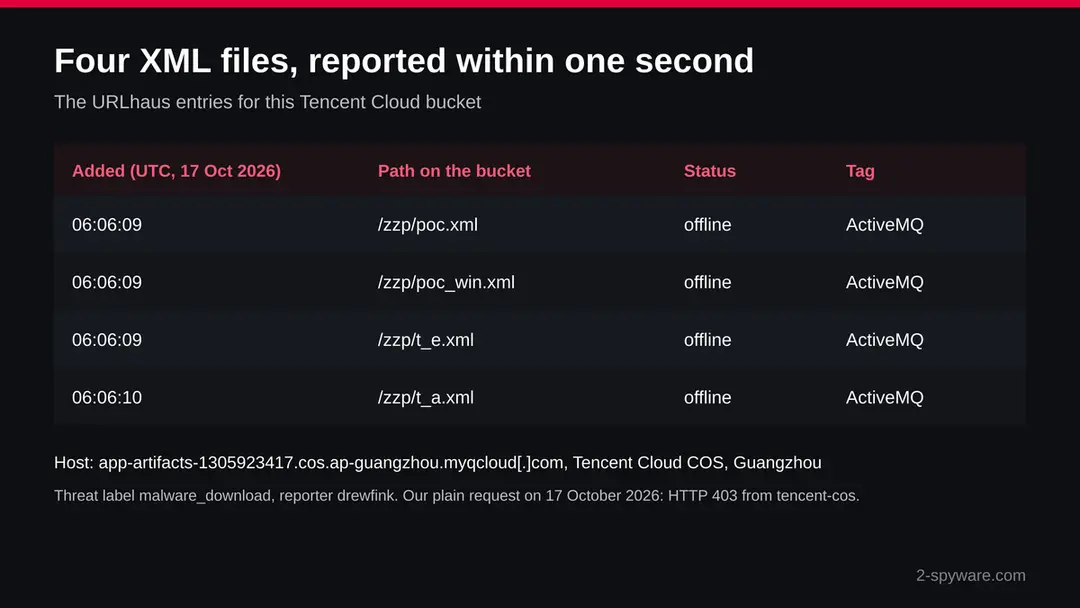
App-artifacts-1305923417.cos.ap-guangzhou.myqcloud.com (ActiveMQ exploit XML files): summary
| Type | A cloud storage bucket used to hand out XML files for attacks on Apache ActiveMQ servers (URLhaus tag ActiveMQ, threat malware_download) |
|---|---|
| Risk | High for an unpatched ActiveMQ broker reachable on port 61616: the flaw allows commands to run on it. Low for a home PC that only shows the name in a check |
| Symptoms | On a server: java.exe or java starting cmd.exe, PowerShell, msiexec, bash, curl or wget; odd OpenWire warnings in activemq.log; outbound http requests for .xml files |
| How to get rid of it | Upgrade ActiveMQ brokers and clients to 5.15.16, 5.16.7, 5.17.6, 5.18.3 or later, block port 61616 from the internet, then check and rebuild a broker that ran the XML |
| Our check (17 October 2026) | One plain request from our server: HTTP 403 from the server tencent-cos. URLhaus marks all four files offline. A quiet answer clears nothing |
| Running since / first seen | All four files reported on 17 October 2026 between 06:06:09 and 06:06:10 UTC; the bucket's age is not public |
| Removal | Scan the PC with security software to find and remove the malware and anything installed with it. Fortect scans Windows for malware and repairs the system files and settings it damaged. Remove it nowTo use the full-featured product, you have to purchase a license for Fortect. The scan is free. |
Show 8 more facts
| Platform | Servers that run Apache ActiveMQ on Windows or Linux. poc_win.xml suggests a Windows variant; nothing we read points to Mac or phones |
|---|---|
| Detection names | No Microsoft name is known for the XML files on this bucket, because we did not open them. For HelloKitty ransomware, one payload seen with this flaw, Microsoft uses Ransom:Win32/HelloKitty!rfn |
| Name | App-artifacts-1305923417.cos.ap-guangzhou.myqcloud.com |
| Evidence | 4 write-ups by security sites; details still limited |
| First seen | 17 October 2026 |
| Distribution | Typically fake installers, cracked programs, e-mail attachments, fake "verify you are human" pages and ads for popular apps |
| Damage | Installs other malware, often several programs at once |
| Facts checked | 17 October 2026 |
Facts checked on 17 October 2026 against the URLhaus rows for this host in our data, the RDAP record of myqcloud.com, one plain request from our server (no browser), the Apache ActiveMQ advisory, Tencent Cloud's bucket documentation and reports by Rapid7, SonicWall and The Hacker News. We did not download the XML files, so what they contain is not confirmed.
What app-artifacts-1305923417.cos.ap-guangzhou.myqcloud.com is, and what we know about it
app-artifacts-1305923417.cos.ap-guangzhou.myqcloud.com is not a program on your PC and not a website made for people. It is a storage bucket on Tencent Cloud Object Storage (COS) where someone placed four XML files that URLhaus lists as malware downloads. All four carry the tag ActiveMQ. We found no public write-up of this bucket, so what follows is what URLhaus shows, what our plain request saw, and what Apache and security vendors have published about the attack the files are made for.
- 1
What URLhaus lists
Four file addresses in a folder called zzp: poc.xml, poc_win.xml, t_a.xml and t_e.xml. They were added on 17 October 2026 at 06:06:09 and 06:06:10 UTC by a reporter named drewfink. All four have the threat label malware_download and the tag ActiveMQ. All four were already marked offline in our copy of the data.
- 2
What the address itself says
Tencent Cloud's documentation says a bucket name is made of a name and an APPID joined by a hyphen, and that the APPID is assigned by the system and unique. So app-artifacts is the chosen name, 1305923417 is the account's APPID, and ap-guangzhou is the Guangzhou region. myqcloud.com is Tencent's own domain, registered in 2013 through MarkMonitor, not the attacker's.
- 3
What the file names suggest
poc stands for proof of concept, the usual name in public exploits for this flaw. Public tools for CVE-2023-46604 point a broker at a hosted poc.xml. poc_win.xml looks like a Windows version. What t_a.xml and t_e.xml do is not known. This is our reading of the names, not a fact from a report.
- 4
What we could not confirm
We did not download the files, so we cannot tell you which commands they hold or which payload they fetch next. We do not know whether the bucket was set up by the attacker or belongs to an account that was misused. A harmless sounding name like app-artifacts says nothing about its owner.
- Kind of threat
- XML files that tell a vulnerable ActiveMQ broker to run commands (exploit stage for CVE-2023-46604, by the tag and the file names)
- Where the files were
- hxxp://app-artifacts-1305923417.cos.ap-guangzhou.myqcloud[.]com/zzp/ : poc.xml, poc_win.xml, t_a.xml, t_e.xml, plain http
- Hosting
- Tencent Cloud Object Storage, Guangzhou region; myqcloud.com registered 24 April 2013 through MarkMonitor (Shanghai), RDAP read 17 October 2026
- URLhaus entries
- 4 file addresses, all added 17 October 2026 at 06:06 UTC, all offline in our data
- Who is at risk
- Owners of Apache ActiveMQ brokers and clients older than 5.15.16, 5.16.7, 5.17.6 or 5.18.3, with OpenWire reachable
- Platform
- Servers on Windows or Linux running ActiveMQ; not home PCs that never ran a broker
What app-artifacts-1305923417.cos.ap-guangzhou.myqcloud.com (ActiveMQ exploit XML files) does on an infected PC
What we checked on 17 October 2026, and what we could not
Our check was one plain request from our server to the bucket's address, with no browser and no clicks. The bucket answered HTTP 403 and named its server tencent-cos. That clears nothing: a storage bucket often refuses a request for its root while single files stay reachable, and these files were already offline.
Our check, 17 October 2026
- Plain request to the bucketHTTP 403, server tencent-cos, no page title. A 403 means the storage service refused that request. It does not show what the bucket held earlier.
- URLhaus listingFour XML files tagged ActiveMQ, threat label malware_download, all added on 17 October 2026.
- Online statusAll four files were marked offline in our copy of the URLhaus data. The same path can be filled again at any time, or the files can move to a new bucket.
- The files themselvesNot downloaded. We cannot tell you their commands, their next payload or the address they report to.
- Notification request, pop-ups, redirectsNone. There is no web page here for a visitor to see.
Dangerous for ActiveMQ servers The rating comes from the four URLhaus reports and their tag, not from our request. Block the host on servers and do not fetch the files.
What happened to this bucket, from the reports to our check
Everything we know happened on one day. The times are UTC and come from the URLhaus rows we hold.
Unknown
The bucket is created
Tencent Cloud does not publish when a bucket was made, and RDAP covers only myqcloud.com, which is Tencent's domain from 2013. We do not know how long app-artifacts-1305923417 existed before the reports.
17 October 2026, 06:06
Four XML files are reported
poc.xml, poc_win.xml and t_e.xml are added at 06:06:09 and t_a.xml at 06:06:10, all by drewfink, all tagged ActiveMQ. Four entries within one second look like one batch report of a folder, not four separate finds.
The four URLhaus entries for this bucket, all added on 17 October 2026 at 06:06 UTC and all marked offline. Our own plain request to the bucket answered HTTP 403. 17 October 2026
Offline, and our request
In our copy of the data all four files are offline. Our plain request to the bucket the same day gets HTTP 403 from tencent-cos.
What the pattern suggests, and what it does not: the files were reported and taken offline quickly, which fits a short-lived staging place for one campaign. The same attacker can copy them to another bucket in minutes. That is our reading of the dates, not something any report says.
How an XML file can take over an ActiveMQ server
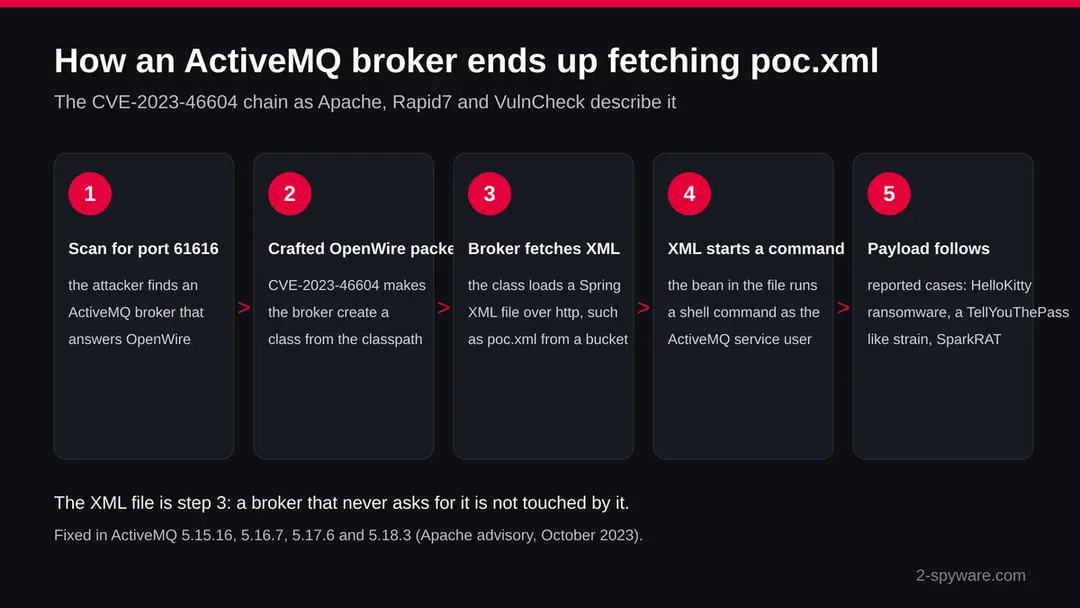
An XML file like poc.xml cannot hurt anyone who opens it in a browser. It is dangerous only to an Apache ActiveMQ broker or client that is tricked into loading it. This is how Apache and the vendors describe the flaw; we did not see these particular files run.
- 1
The flaw
Apache's advisory says the Java OpenWire protocol marshaller in ActiveMQ is open to remote code execution. An attacker with network access to a broker or client can make it create any class on its classpath and so run shell commands. The flaw is CVE-2023-46604, tracked as AMQ-9370, with a CVSS score of 10.0.
- 2
The packet
SonicWall writes that the attacker connects to the OpenWire TCP port 61616 and sends a manipulated command. No password is needed. SonicWall counted over 6,000 exposed vulnerable servers on Shodan in November 2023.
- 3
The XML file
The Hacker News, citing VulnCheck, says attackers used the Spring class ClassPathXmlApplicationContext to load a malicious XML bean configuration file over HTTP. The broker downloads that file from a server such as this bucket and builds what it describes. A bean in the file can start a process with a command.
- 4
The command
The command runs with the rights of the ActiveMQ service. In the cases Rapid7 handled in October 2023, java.exe from the ActiveMQ folder started cmd.exe, which ran msiexec to load files named M2.png and M4.png from a remote server. They were really MSI installers.
- 5
The payload
Rapid7 tied those cases to HelloKitty ransomware, which appended .locked to encrypted files. The Hacker News also names a strain similar to TellYouThePass and the remote access trojan SparkRAT. What the four files on this bucket deliver is not known.
Why two XML files may exist for one target: a Windows broker needs cmd.exe or PowerShell commands, a Linux broker needs bash commands. A file named poc_win.xml beside poc.xml fits that split. It is our reading, and t_a.xml and t_e.xml may be further variants.
Which ActiveMQ versions are affected
| Branch | Affected | Fixed in |
|---|---|---|
| 5.18 | 5.18.0 to 5.18.2 | 5.18.3 |
| 5.17 | 5.17.0 to 5.17.5 | 5.17.6 |
| 5.16 | 5.16.0 to 5.16.6 | 5.16.7 |
| 5.15 and older | before 5.15.16 | 5.15.16 |
| Legacy OpenWire module | 5.8.0 to 5.15.15, 5.16.0 to 5.16.6, 5.17.0 to 5.17.5, 5.18.0 to 5.18.2 | the same fixed versions |
What app-artifacts-1305923417.cos.ap-guangzhou.myqcloud.com (ActiveMQ exploit XML files) can steal or download
The risk is all on the server side. A broker that loaded one of these files ran the attacker's command, so think of it as handed over until you have checked it.
- High
Ransomware on the broker and beyond
Rapid7 saw more than half a dozen encryption attempts in one incident and tied it to HelloKitty ransomware. A broker sits in the middle of business systems, so it is a good step into the rest of the network.
- High
Remote control
The Hacker News names SparkRAT among the payloads. A remote access trojan on a server gives the attacker a lasting way back in, even after ActiveMQ is upgraded.
- Medium
Messages and credentials
The ActiveMQ service can read its configuration, which often holds passwords for databases and other services, and the messages passing through the broker. Treat both as seen.
- Medium
Hidden traces
The Hacker News reports that VulnCheck built a quieter method that stays in memory and that the exploit leaves an exception in activemq.log, which attackers then need to clean. A clean log after an attack is therefore not proof.
- Low
A home PC that shows the name
If a home PC never ran ActiveMQ, it had nothing to load these files with. A security check that names the host is a warning about the address, not a sign that the PC ran it.
How to check the PC for app-artifacts-1305923417.cos.ap-guangzhou.myqcloud.com (ActiveMQ exploit XML files)
Who meets this address, and how
- 1
A server owner with an exposed broker
Attackers scan the internet for port 61616. A broker that answers and is not patched receives the crafted packet and fetches the XML file from the bucket. This is the case that matters.
- 2
A company with ActiveMQ inside another product
ActiveMQ is built into many business products. If a vendor's product bundles an old ActiveMQ, the product may be exposed even if nobody installed ActiveMQ by name. Ask the vendor which version it ships.
- 3
A person who saw the name in a check or a log
Security tools, DNS filters and lookups such as our /check show the host because it is on a block list. Seeing it there does not mean anything was fetched by your PC.
- 4
A researcher
Public lists like URLhaus are read by defenders who block the host. Fetching the files from a work PC is not needed to protect a server and can set off alarms.
Check your ActiveMQ server before you change anything
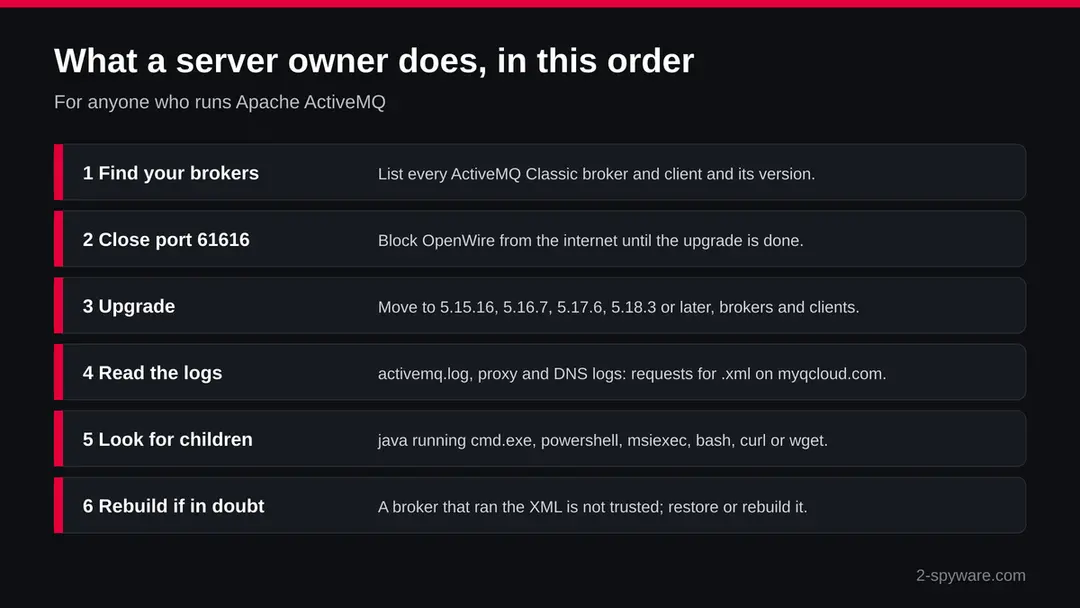
Save what you find before you clean up: logs and process lists are the only record of what the XML did.
- 1
Find the version
Look at the folder name or the startup line in activemq.log, for example apache-activemq-5.15.3. Compare it with the table above. Check clients too, because Apache says clients are affected as well.
- 2
Check who can reach port 61616
From outside your network, test whether TCP 61616 answers. If it does and the version is affected, block it at the firewall now, before the upgrade.
- 3
Read activemq.log
Rapid7's test produced a single WARN line, Transport Connection to: tcp://<address> failed, on the 61616 port. The Hacker News says the newer method leaves an exception message. Look for unusual OpenWire errors around the time of any attack.
- 4
Look for child processes of java
On Windows, look in your endpoint tool or event logs for java.exe from the ActiveMQ folder starting cmd.exe, powershell.exe or msiexec.exe. On Linux, look for java starting sh, bash, curl or wget. Rapid7 lists ActiveMQ launching CMD and MSIExec loading over HTTP as the signs.
- 5
Search proxy and DNS logs
Search for app-artifacts-1305923417.cos.ap-guangzhou.myqcloud[.]com and for any request for an .xml file on a myqcloud.com address from the broker. A broker has no reason to fetch XML from a cloud bucket.
- 6
Look for ransomware signs
Rapid7 also names the deletion of volume shadow copies. Files ending in .locked or a ransom note mean the attack went further than one command.
How to remove app-artifacts-1305923417.cos.ap-guangzhou.myqcloud.com (ActiveMQ exploit XML files)
How to remove app-artifacts-1305923417.cos.ap-guangzhou.myqcloud.com
A loader's job is to install other malware, so treat the PC as infected with more than one program until the scans are clean.
Step 1: Delete scheduled tasks that bring it back
Programs like app-artifacts-1305923417.cos.ap-guangzhou.myqcloud.com add a scheduled task so they return after an uninstall or reopen a page at every sign-in. Start Task Scheduler, open Task Scheduler Library and sort by Last Run Time to see what ran recently.
On the Actions tab, a program in a user folder, a script or a web address is a warning sign; right-click such a task and choose Delete.
Tasks with names copying Google, Edge or Windows updaters but pointing to an odd folder are typical. The tool looks the same in Windows 11 and Windows 10.
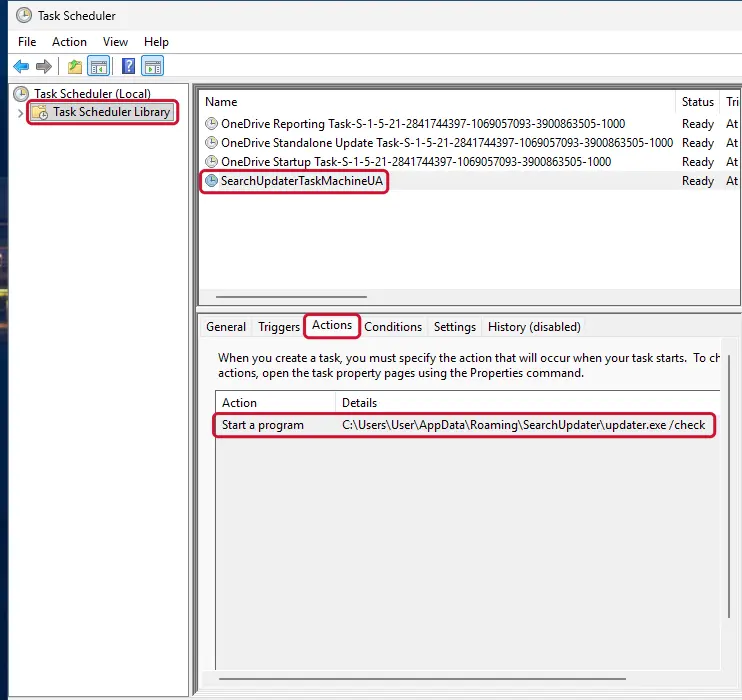
Windows 11: Task Scheduler Library, the task selected, the Actions tab shows the file it runs. Full procedure with screenshots: Remove what malware leaves behind in Windows
Step 2: Remove it from startup
Press Ctrl + Shift + Esc to open Task Manager and select Startup apps (Windows 11) or the Startup tab (Windows 10). Disable entries you do not recognise, especially ones with no publisher or with a name that copies a Windows component.
Right-click an entry and choose Open file location to see where it runs from: programs in
%AppData%or%Temp%deserve a closer look. Some entries are not listed there but in the registry Run keys, which the procedure below shows how to check.Full procedure with screenshots: Stop apps from opening at startup On uGetFix
Step 3: Delete the folders left behind
Uninstalling often leaves the program's folders, and some threats reinstall themselves from them.
Press Windows + R, type
%LocalAppData%and press Enter, then do the same for%AppData%and %ProgramData%, and look for folders named after app-artifacts-1305923417.cos.ap-guangzhou.myqcloud.com, its publisher or created on the day the problem started. Delete those folders, and check C:\Program Files and C:\Program Files (x86) too.If Windows says a file is in use, end it in Task Manager or delete the folder after a restart in Safe Mode. The folders are the same in Windows 11 and Windows 10.
Full procedure with screenshots: Remove what malware leaves behind in Windows
Step 4: Scan the PC, then run the offline scan
A scan finds the parts of app-artifacts-1305923417.cos.ap-guangzhou.myqcloud.com that the manual steps cannot see. In Windows Security > Virus & threat protection > Scan options, start a Full scan and quarantine what it reports.
Follow it with Microsoft Defender Antivirus (offline scan) > Scan now, which restarts the PC and checks the disk while Windows and the malware are not running.
It takes about 15 minutes and works the same in Windows 11 and Windows 10. If either scan finds something, run the full scan again after removal until it comes back clean.
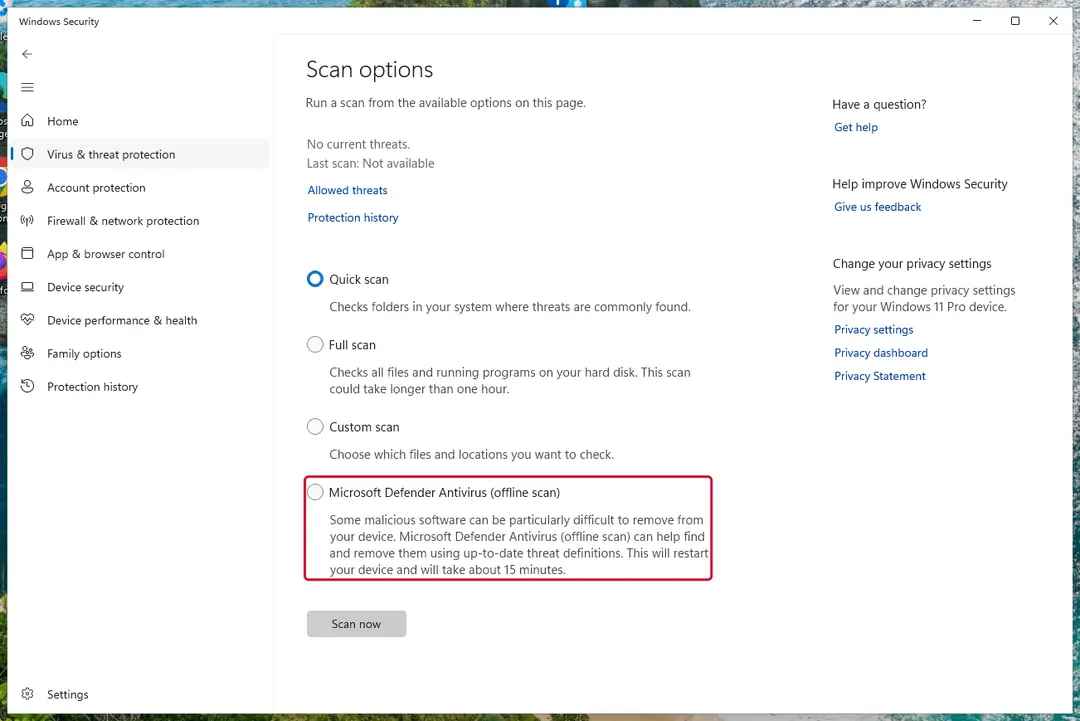
Windows 11: Windows Security > Virus & threat protection > Scan options. Full procedure with screenshots: Run a Microsoft Defender Offline scan
Step 5: Change passwords from another device and sign out other sessions
App-artifacts-1305923417.cos.ap-guangzhou.myqcloud.com can copy saved passwords, cookies and session tokens and send them out in seconds, so cleaning the PC does not undo the theft.
Change your passwords on a device that was never infected, starting with the e-mail account, since every other reset goes through it. On each account, end all other sessions and check the recovery e-mail, phone number and forwarding rules.
Then turn on two-step verification. Sign in on the Windows 11 or Windows 10 PC again only after the offline scan is clean.
Full procedure with screenshots: Turn on two-step verification / secure a hacked account
If you use a home PC, a Mac or a phone
| Device | What it means |
|---|---|
| Home Windows PC | No ActiveMQ, no risk from these files. If a block list or a check showed the name, keep your security program up to date and move on. |
| Windows or Linux server with ActiveMQ | Follow the checks above, upgrade and rebuild if the XML was fetched. |
| Mac | Nothing we read points to Mac users. Only a Mac that runs an ActiveMQ broker for development would be in the same position as a server. |
| iPhone and Android | Not affected. Phones do not run ActiveMQ brokers. |
After removal: passwords, accounts and prevention
After the upgrade: close the way back in
- 1
Upgrade brokers and clients
Install 5.15.16, 5.16.7, 5.17.6, 5.18.3 or a later supported release, as Apache's advisory says. An upgrade closes the flaw. It does not remove anything the attacker already installed.
- 2
Rebuild a broker that fetched the XML
If logs show the broker loaded an XML file from this or any outside address, restore the server from a backup made before the attack or rebuild it. A remote access trojan can survive a simple cleanup.
- 3
Change the passwords it held
Change the passwords in the ActiveMQ configuration, the service account and anything else stored on that server, from a clean computer.
- 4
Keep OpenWire off the internet
Allow port 61616 only from the systems that need it. Block outbound http from the broker to the internet unless it truly needs it, so a future exploit cannot fetch its next file.
- 5
Block the host
Add app-artifacts-1305923417.cos.ap-guangzhou.myqcloud[.]com to your proxy or DNS block list. URLhaus data can feed such a list for the next bucket too.
Keep an ActiveMQ server out of this kind of chain
Do
- Keep an inventory of every ActiveMQ broker and client and its version
- Patch message brokers as quickly as web servers
- Allow port 61616 only from known systems
- Alert when java starts a shell, PowerShell, msiexec, curl or wget
- Keep offline backups of broker servers
Don't
- Do not leave OpenWire open to the internet
- Do not assume a product is safe because ActiveMQ is hidden inside it
- Do not trust a clean activemq.log after an attack
- Do not download the XML files from a work PC to look at them
Questions about app-artifacts-1305923417.cos.ap-guangzhou.myqcloud.com (ActiveMQ exploit XML files)
What is app-artifacts-1305923417.cos.ap-guangzhou.myqcloud.com?
It is a storage bucket on Tencent Cloud Object Storage in the Guangzhou region. URLhaus lists four XML files on it, poc.xml, poc_win.xml, t_a.xml and t_e.xml, as malware downloads tagged ActiveMQ.
They were reported on 17 October 2026 and were offline in our data. The files are made to be fetched by an attacked Apache ActiveMQ server, not opened by people.
Is myqcloud.com itself malicious?
No. myqcloud.com is Tencent Cloud's own domain, registered in 2013, and it hosts storage buckets for many customers. Only the single bucket app-artifacts-1305923417 is listed here.
Blocking all of myqcloud.com would also block legitimate files, so block the exact host instead. A bucket is a folder rented by one customer, so the problem is that customer's account or whoever took it over.
What is poc.xml?
poc stands for proof of concept. In public exploits for the ActiveMQ flaw CVE-2023-46604 the attacker hosts a Spring XML file, often named poc.xml, and makes the broker load it.
The file describes an object that starts a command when it is built. We did not download the files on this bucket, so their exact commands are not known.
I saw this address in a check or a log on my home PC. Am I infected?
Very likely not. These files only do something on a computer that runs an Apache ActiveMQ broker or client and is tricked into loading them. A home PC without ActiveMQ has nothing that would run them.
A block list or a check that names the host warns you about the address. Keep your security program updated and do not fetch the files yourself.
Which ActiveMQ versions are vulnerable?
Apache lists 5.18.0 to 5.18.2, 5.17.0 to 5.17.5, 5.16.0 to 5.16.6 and versions before 5.15.16, plus the matching Legacy OpenWire module. The fixed versions are 5.15.16, 5.16.7, 5.17.6 and 5.18.3.
Apache says to upgrade both brokers and clients, because both can be attacked through the OpenWire protocol. Until you can upgrade, block port 61616 from the internet.
How do I know if my ActiveMQ server was attacked?
Look for java, started from the ActiveMQ folder, launching cmd.exe, PowerShell, msiexec, bash, curl or wget. Search proxy and DNS logs for requests for .xml files on outside addresses such as this bucket.
Check activemq.log for odd OpenWire warnings or exceptions. Shadow copy deletion or files ending in .locked mean ransomware ran.
What malware has been spread through this ActiveMQ flaw?
Rapid7 tied attacks in October 2023 to HelloKitty ransomware, delivered as MSI files named M2.png and M4.png. The Hacker News also names a ransomware strain similar to TellYouThePass and the remote access trojan SparkRAT.
What the files on this bucket deliver is unknown, because we did not open them. Microsoft detects HelloKitty as Ransom:Win32/HelloKitty!rfn.
Will upgrading ActiveMQ remove the infection?
No. The upgrade closes the flaw so the next attempt fails, but anything the XML already installed stays. If logs show that the broker loaded an outside XML file, restore the server from a backup made before the attack or rebuild it, then change every password stored on it from a clean computer.
Does this affect Mac, iPhone or Android?
Not as a normal user. Nothing we read points to Mac or phones.
Only a Mac that runs an ActiveMQ broker for development would be exposed in the same way as a server. iPhone and Android phones do not run ActiveMQ, so these files cannot do anything on them. A block list entry on a phone only stops the address.
Will Fortect remove app-artifacts-1305923417.cos.ap-guangzhou.myqcloud.com?
Fortect scans Windows for malware and unwanted programs and repairs the system files and settings they change, and its free scan shows what it finds on your PC before you decide anything.
For app-artifacts-1305923417.cos.ap-guangzhou.myqcloud.com, follow the plan above as well: the browser steps take back permissions and settings that no scanner treats as a threat, and uninstalling the program that brought it removes the source.
Run Microsoft Defender's full scan and, if anything was found, its offline scan as a second opinion. If the symptoms are gone after the plan and both scans are clean, there is nothing more to do.
Sources
- Apache ActiveMQ: CVE-2023-46604 security advisory (AMQ-9370) (read October 17, 2026)
- Rapid7: Suspected exploitation of Apache ActiveMQ CVE-2023-46604 (1 November 2023) (read October 17, 2026)
- The Hacker News: New PoC exploit for Apache ActiveMQ flaw could let attackers fly under the radar (15 November 2023) (read October 17, 2026)
- SonicWall: Apache ActiveMQ remote code execution CVE-2023-46604 (10 November 2023) (read October 17, 2026)
- Tencent Cloud: Cloud Object Storage, Bucket Overview (read October 17, 2026)