
Does Chaturbate cause viruses? Redirects and how to remove them
Chaturbate.com is an adult live-cam website, registered in 2011; opening it installs nothing, but adware, ads and look-alike addresses can lead to it, and to scam pages. If your browser keeps landing there or on pages you did not choose, the steps below remove the cause.
Facts checked October 7, 2026. Removal steps tested on Windows 11 (26H2) and checked against Microsoft's and the browser makers' current documentation.
Automatic
Get a free scan and check if your PC is infected.
Fortect finds malware, unwanted programs and the Windows damage they leave behind, and repairs it in one pass.
If redirects to chaturbate.com keep coming back, a free scan can check extensions, programs and browser settings in one pass.
Do it yourself · free Remove Chaturbate.com yourself 1 step, about 5 minutes, no software needed.
Chaturbate.com: summary
| Type | Adult live-cam website that shows third-party ads; not malware. The redirects, ads and look-alike addresses are what people call the virus |
|---|---|
| Risk | Medium: the real site installs nothing; the redirecting adware, the pages it opens and look-alike addresses are the risk |
| Symptoms | Tabs that open on chaturbate.com or other sites you did not choose, adult ads on every site, changed start page or search engine, notifications from unknown sites |
| How to get rid of it | Uninstall programs you did not choose, remove unknown extensions and notification permissions, run a Microsoft Defender full and offline scan, reset the browser |
| Our check (6 October 2026) | One visit to the home page: an 18+ notice, no notification request, pop-up or redirect; Google Ad Manager the only ad network identified |
| Running since | 26 February 2011 (domain registered; paid until November 2027, registrar Cloudflare, Inc.) |
| Removal | Scan the PC with security software to find and remove the malware and anything installed with it. Fortect scans Windows for malware and repairs the system files and settings it damaged. Remove it nowTo use the full-featured product, you have to purchase a license for Fortect. The scan is free. |
Show 12 more facts
| Installed on the PC | Nothing: visiting a website installs no program; files from the ads, fake alerts or bundled installers that sent you there are what to remove |
|---|---|
| Microsoft detection | None: Microsoft Defender has no detection name for the website, because nothing is installed by visiting it |
| First reported by us | 5 July 2021 |
| Name | Chaturbate.com |
| Evidence | One report; details still limited |
| Domains | chaturbate.com |
| Ads shown as | Redirects through ad pages |
| Browsers | Chrome, Edge and Firefox |
| First seen | 5 July 2021 |
| Distribution | Typically ad scripts on free streaming, file-hosting and adult sites, typo domains and hacked websites |
| Damage | Redirects to scam pages, fake updates and tech support scams |
| Facts checked | 6 October 2026 |
Facts checked on 6 October 2026 against our own test of the home page in desktop Chromium from Europe, the registry's RDAP record, the site's privacy policy, and the browser, Windows and FTC help pages. The test covers one visit to the home page; other addresses were not tested.
Chaturbate.com in short
You saw chaturbate.com open through redirects through ad pages, its name flashing in the address bar for a moment.
It is a redirect domain: its only job is to pass you on to whatever page pays most for a visitor from your country and browser.
The page at the end may be a fake virus scan, a fake update or a notification prompt. Close it, do not download anything from it, and find out whether a site or your PC sent you there. More about this kind of advertising: our adware explainer.
What Chaturbate.com is and why people call it a virus
Chaturbate.com is a website, not a program: it is an adult live-cam site for people aged 18 and over, and opening it does not install anything on a device. The "Chaturbate virus" people search for is the redirects, ads and look-alike addresses that lead to the name, not the real site itself.
- What it is
- An adult live video-chat website with a chat feature, registered in 2011, served over HTTPS
- What people call the virus
- Redirects that land on it, explicit ads on other sites and look-alike addresses
- What it asks first
- An 18+ notice with terms to accept before the content opens, as the page text in our test showed
- What HTTPS means here
- The connection to the site is encrypted; it says nothing about the ads on it or about copies on other addresses
- 1
Something sends you there
Adware on the device, a pop-up on a high-risk site or a link in an ad opens
chaturbate.comin a new tab or in the current one, without you typing it. - 2
You see content you did not ask for
The page is real and adults-only. People who did not mean to visit call it a "virus" because it arrives unasked, and it is a problem on a shared or family computer.
- 3
The same cause sends you elsewhere
The cause is not limited to one site: it can as easily open scam pages, fake alerts or download offers, and that is where the harm starts.
Is chaterbate safe, and was there a Chaturbate data leak?
Chaterbate is a misspelling of Chaturbate, and the real chaturbate.com installs nothing when you open it.
In our check on 6 October 2026 one visit showed an 18+ notice and no notification request, pop up or redirect. A misspelled address typed in the browser can open a different site, so look at the address bar. If such a page asks for notifications, a download or card details, close it.
The only Chaturbate data leak we could confirm from a source we read is small. The breach tracker HEROIC logged a leak dated 11 October 2015 with 2,662 records, limited to email addresses and with no passwords. HEROIC gives no statement from Chaturbate, and we found no company confirmation. Claims of larger leaks circulate online, but we found no reliable source that confirms them.
If you had an account, check your email address on a breach checking service such as Have I Been Pwned. Change the Chaturbate password and any other account where you used the same one, and turn on two step sign in where it is offered. Treat an email that says it holds your viewing history as the blackmail scam described below, and never pay.
Is Chaturbate.com dangerous?
Our test on 6 October 2026
We loaded https://chaturbate.com/ in a clean desktop Chromium browser from Lithuania, with no extension and no account, and did not click anything.
Chaturbate.com home page · desktop Chromium · Europe · 6 October 2026
- Page answeredYes, status 200, and the address stayed on
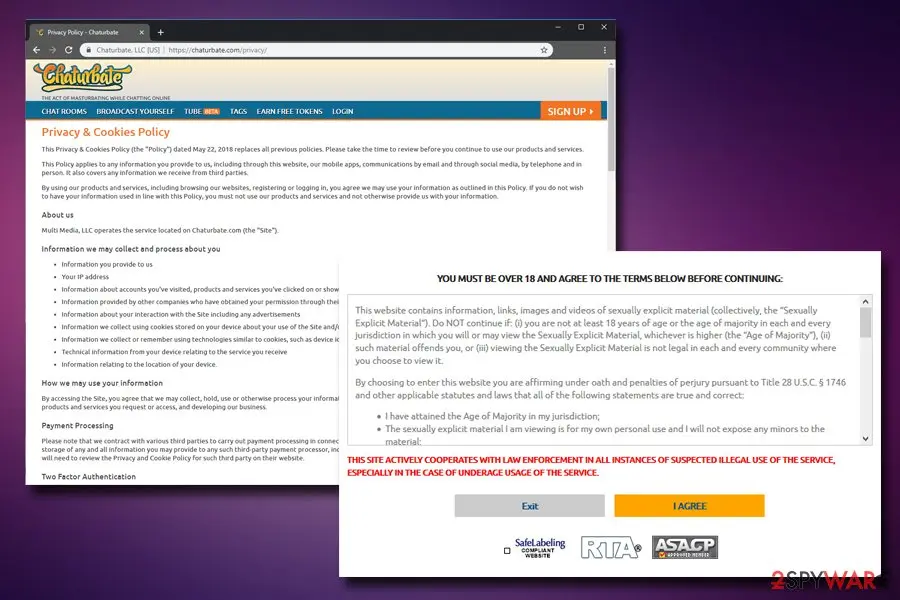
chaturbate.com. - Age noticeThe first thing on the page was a notice headed "You must be over 18 and agree to the terms below before continuing", the same kind of gate our 2021 picture shows.
- Notification requestNone on this one visit; the site registered no service worker, the part a page needs to deliver notifications later.
- Pop-ups and redirectsNone on this one visit; no second window or tab opened and the address did not change.
- Ad networkGoogle Ad Manager, a platform that sells and serves ad space.
- Outside hostsFifteen hosts in all: the site's own image and script hosts (
mmcdn.comandhighwebmedia.comaddresses, which we did not investigate further), plus Google's analytics, tag, fonts and statistics hosts. - Not testedChat rooms, sign-up, a click on any ad, a phone, other countries, a second visit, a visit from an ad or a search result.
Quiet on one visit The home page asked for nothing and opened nothing on this one visit. That does not clear the site or the ads around it: ad networks decide what to show by country, device, referrer, a delay, a second visit or a click, and they can recognise automated browsers, so a visitor elsewhere, on a phone or after a click can see things we did not.
What changed since our 2021 guide
February 2011
The domain is registered
chaturbate.comwas registered on 26 February 2011 and is paid until 19 November 2027; the registrar is Cloudflare, Inc. and the registry record was last changed on 20 November 2017.July 2021
Our first guide: redirects and the age notice
We described the name as something people meet through adware redirects, quoted the site's age notice, which says it cooperates with law enforcement, and listed what its privacy policy says it collects. Our old guide treated that notice as a claim made by a virus; it is the real site's own wording, shown in the picture above. The guide had two more pictures, the home page with blurred thumbnails and a sign-up page, left out here to keep the page free of adult material.
November 2023
The privacy policy is replaced
The policy our 2021 picture shows is dated 22 May 2018. The one now on the site is dated 8 November 2023 and adds items, for example content you share through your account, billing and support messages, and age-verification material (see the privacy section below).
October 2026
Our new check: nothing on one visit
The home page loaded behind the age notice, without a notification request, a pop-up or a redirect. The only ad network we could identify is Google Ad Manager. We did not test copies.
Look-alike addresses and where redirects go
Our 2021 guide said adware sends people to chaturbate.com.es and other "affiliated" domains. We did not open any other address for this rewrite, so we cannot say what any of them is now; what follows is how to tell the real address from a look-alike.
| Address you see | What we know |
|---|---|
chaturbate.com | The address we tested. Registered 26 February 2011; on 6 October 2026 it loaded behind an age notice without a pop-up, redirect or notification request. |
chaturbate.com.es | The address our 2021 guide named as a redirect target. We did not open it in 2026 and do not know who runs it. The ending after .com is a different domain. |
| Another name that merely contains "chaturbate" | Not the same site. Anyone can register an address that looks close, and nothing in the name proves who runs it. |
| A page that arrives through an ad, pop-up or email | Treat it as unknown even if it looks identical: a page can be copied, the address bar cannot. |
The FTC describes how fake pages work: they copy a real brand and ask for passwords, card numbers or other personal details, or push a download. Read the address bar before you type anything, and close any page that asks for card details to "verify your age".
The real risks, from most to least serious
The website is not a virus. We use the phrase "Chaturbate virus" for what can happen to a device when something keeps sending it to the site or when a look-alike address is opened.
- High
Running a file that came from an ad or an alert
Redirecting adware is usually part of a program installed with something else. The pages it opens can be hacked or misleading sites with fake update prompts and an "anti-virus" to download; running one brings more unwanted programs and sometimes a Trojan, spyware or ransomware.
- High
Giving card or personal details to a fake page
A look-alike address or a scam page opened by a redirect can ask for a card number, a name or a phone number, often with a catchy offer about your looks or finding a partner. Money paid there is hard to get back.
- Medium
Explicit ads on a shared computer
Adware can fill ordinary sites with adult ads or open the site on its own. If children use the computer, remove the cause rather than only closing the tab, because the ads will return.
- Medium
Adware already on the device
A program or extension that adds ads and redirects can also change the start page, the new-tab page or the search engine, and can send details about your browsing to its operator.
- Medium
Blackmail emails
Visits to adult sites are used as bait: emails claim the sender recorded you through your webcam and demand cryptocurrency. The FTC calls such claims empty threats, and the emails have nothing to do with the site.
- Low
Cookies and out-of-date software
Tracking cookies are not an infection; the browser clears them. Rarely, a malicious page uses a known flaw in an old browser or system to install a program, which updates close.
We saw one ad network on our visit and no malicious ad. Adult sites are a common place for harmful ads, which is the general warning of our 2021 guide, but we have no test showing that for this site, so we say only that ads on any such page can lead off the site and that you should not click them.
What the site says it collects
Our 2021 guide called the data collection suspicious. It is the site's own privacy policy, dated 8 November 2023 at the time of our reading on 6 October 2026, and its list is typical of a site with accounts, payments and ads. We did not test what is actually sent.
Listed in the policy as information it may collect
- Username, email address and date of birth
- Images and content you share, including age-verification material
- Your IP address
- Accounts visited, products and services clicked
- Information from other companies you allowed to share it
- Your interaction with the site and its ads
- Cookies and similar device identifiers
- Technical information from your device
- Messages to billing and support
- Location of your device
Two parts matter for a visitor who only browsed: the IP address and the cookies. The rest applies when you register or buy. The policy also says payments are handled by third parties that follow their own policies, and that a phone number given for two-step sign-in goes to a separate provider. If you never signed up, the practical protection is the same as on any site: block third-party cookies and keep the browser updated.
How adware reaches a device
Adware rarely arrives alone: it rides inside installers, fake update prompts and "free" downloads, and usually the user's own click lets it in.
- 1
A free tool is downloaded
A video converter, a downloader, a driver finder or a cracked program from a site that is not the maker's.
- 2
The setup screen hides a choice
The quick path (named Recommended, Express or just Next) accepts bundled add-ons, toolbars or a second program that were ticked for you.
- 3
The extra program starts working
It shows ads, opens tabs and changes settings. Where the tabs go is decided by whoever buys the traffic that day: one person lands on
chaturbate.com, another on a prize page or a fake alert.
Bundling itself is legal as long as the installer discloses it, which many do only in small print. A web page that says your browser or Windows needs an update is the same trick, since a page cannot update either of them.
How to remove Chaturbate.com
How to stop the Chaturbate.com redirects
Work in this order and test a few links after each step, so you know which one was the cause.
Which browser shows the ads?
Try the same link in a private window (Ctrl+Shift+N in Chrome and Edge, Ctrl+Shift+P in Firefox).
Extensions are usually off there. If chaturbate.com does not appear in the private window, an extension is the likely cause.
If it still appears, check another browser. Redirects in only one browser point to that browser's settings; redirects in all browsers point to a program installed in Windows.
Withdraw notification permissions
Go to Settings > Privacy and security > Site settings > Notifications and set every site you do not recognise to Not allowed, or Remove it.
Delete extensions you did not add
Type
chrome://extensionsin the address bar and press Remove under anything you did not install yourself, especially tools for search or PDFs that appeared lately.Full procedure with screenshots: Remove a browser extension
Wipe the site data
Press Ctrl + Shift + Delete, set the range to All time, tick Cookies and other site data and Cached images and files, then press Delete data.
Reset Chrome
Open Settings > Reset settings > Restore settings to their original defaults and press Reset settings. The start page, search engine and pinned tabs go back to default and extensions are switched off; bookmarks and saved passwords stay. Also switch off Settings > System > Continue running background apps when Google Chrome is closed, so nothing keeps running after you close the window.
Full procedure with screenshots: Reset a browser and fix a hijacked search engine
Withdraw notification permissions
Go to Settings > Cookies and site permissions > Notifications and remove each site you do not know.
Delete extensions you did not add
Type
edge://extensionsin the address bar and press Remove under anything you did not install yourself.Full procedure with screenshots: Remove a browser extension
Wipe the site data
Go to Settings > Privacy, search, and services > Delete browsing data > Choose what to clear, pick All time, tick Cookies and other site data and Cached images and files, then press Clear now.
Reset Edge
Open Settings > Reset settings > Restore settings to their default values and press Reset. Extensions are disabled and the start page returns to default; favourites, history and saved passwords stay. Also switch off Settings > System and performance > Continue running background extensions and apps when Microsoft Edge is closed.
Full procedure with screenshots: Reset a browser and fix a hijacked search engine
Withdraw notification permissions
Go to Settings > Privacy & Security > Permissions > Notifications > Settings and remove each site you do not know.
Delete add-ons you did not add
Type
about:addonsin the address bar, open Extensions, and use the three-dot menu to choose Remove for anything you did not install yourself.Full procedure with screenshots: Remove a browser extension
Wipe cookies and site data
Go to Settings > Privacy & Security > Cookies and Site Data > Clear Data, tick both boxes and press Clear.
Refresh Firefox
Open the menu > Help > More troubleshooting information and press Refresh Firefox. Add-ons and custom settings are removed and the home page returns to default; bookmarks, history and passwords stay.
Full procedure with screenshots: Reset a browser and fix a hijacked search engine
Withdraw the notification permission
In Safari 18 or later on macOS open Safari > Settings > Websites > Notifications, pick
chaturbate.comor any site you do not recognise and choose Deny, or press Remove. Untick Allow websites to ask for permission to send notifications at the bottom so none can ask again.Uninstall extensions you did not add
Open Safari > Settings > Extensions, select anything you did not install yourself and press Uninstall.
Wipe the site data
Open Safari > Settings > Privacy > Manage Website Data and remove the site's data, or choose History > Clear History > all history. To empty caches too, tick Show features for web developers in Settings > Advanced, then pick Develop > Empty Caches.
Look for apps that came with the ads
Ads aimed at Mac users push fake players and "cleaners". In Finder > Applications drag anything unknown to the Bin, and in System Settings > General > Login Items & Extensions remove unknown items. Then use Go > Go to Folder to check
/Library/LaunchAgents,~/Library/LaunchAgents,/Library/LaunchDaemonsand/Library/Application Supportfor entries with those same unknown names, and empty the Bin.
Then, whichever browser you use
Step 1: Scan the PC if you downloaded anything from the ads
If you only saw the notifications and clicked nothing, you can stop before this step. If a notification led you to download or run something, delete that file, then scan Windows.
In Windows Security > Virus & threat protection > Scan options, run a Full scan, then choose Microsoft Defender Antivirus (offline scan) and Scan now. The offline scan restarts the PC and takes about 15 minutes on Windows 11 and Windows 10.
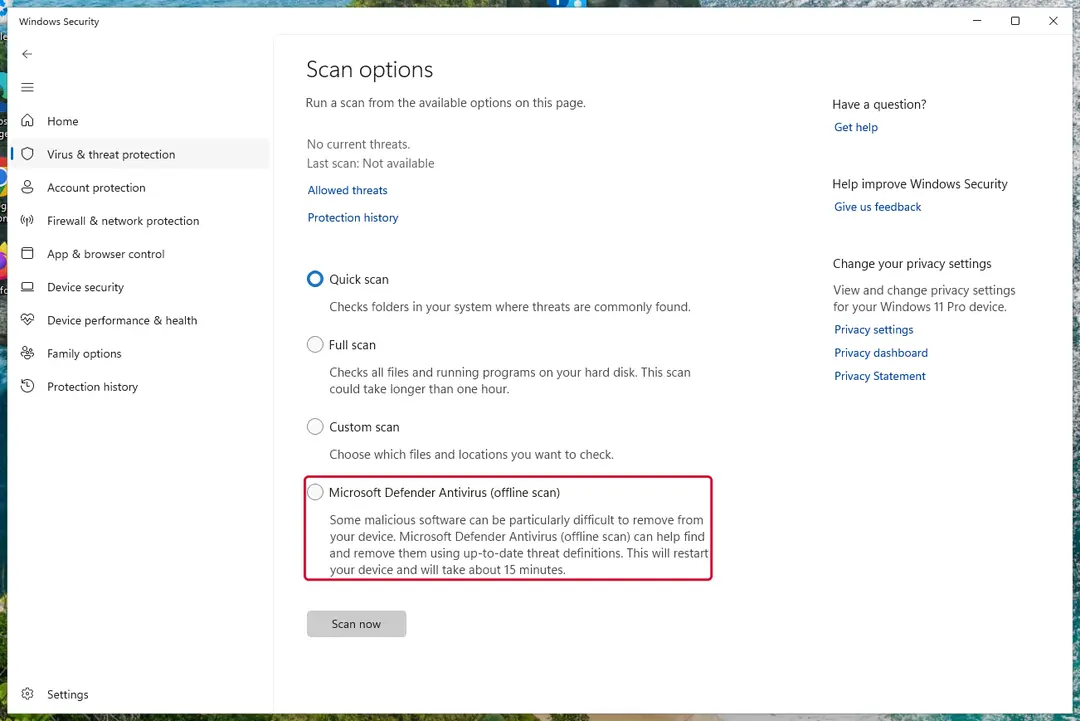
Windows 11: Windows Security > Virus & threat protection > Scan options. Full procedure with screenshots: Run a Microsoft Defender Offline scan
The plan in short
- Close tabs from
chaturbate.comwithout clicking anything on them. - Remove extensions you did not add: Remove a browser extension.
- Remove notification permissions from unknown sites: Stop website notifications and pop-ups.
- Uninstall programs installed shortly before the redirects began: Uninstall a program or app in Windows On uGetFix.
- If redirects continue on every site, reset the browser: Reset a browser and fix a hijacked search engine.
- Run a Microsoft Defender offline scan: Run a Microsoft Defender Offline scan.
How to tell site ads from adware on the PC: how ad redirects work.
Stop the redirects to chaturbate.com
Remove extensions you did not add on purpose: Remove a browser extension.
Take away notification permissions from sites you do not recognise: Stop website notifications and pop-ups.
If chaturbate.com still opens after a browser restart, uninstall programs added on the day the redirects started (Uninstall a program or app in Windows On uGetFix) and, as a last step, reset the browser: Reset a browser and fix a hijacked search engine.
Test with the same links that redirected before. If they now open the right pages, the source is gone and nothing else needs to change.
After removal: keep the ads from coming back
Ads back after a few days?
That usually means the visible part was removed but the installer or updater was not.
Check whether you see redirects to chaturbate.com in all browsers or only in one: all browsers points to a program in Windows, one browser points to an extension or sync.
Then look at Task Manager > Startup apps and Task Scheduler for entries added on the day the ads began, and at chrome://policy or edge://policy for policies you did not set. Remove what you find and restart. More on these tricks: our adware explainer.
If you clicked an ad or ran a file
If all you saw were tabs, ads or notifications, the browser steps are enough. Add the steps below when you downloaded or opened something a page gave you, or typed personal details into it.
- 1
Remove the programs that arrived with it
No program carries the site's name, so look at dates. In Windows 11 open Settings > Apps > Installed apps (Windows 10: Apps & features), sort by Install date, and uninstall what you do not remember choosing, starting with the day the tabs began to appear (Uninstall a program or app in Windows On uGetFix).
- 2
Scan twice with the tools Windows has
Start a Microsoft Defender Full scan, and afterwards the Microsoft Defender Antivirus (offline scan), which reboots the PC and checks it before Windows starts, where stubborn malware has fewer places to hide. A scan cannot revoke a notification permission or undo a changed start page, so the browser steps still apply.
- 3
Reset the browser
Programs that come from ads usually leave a changed start page, search engine or extension behind. Use the reset in your browser's tab above.
- 4
Secure the accounts you touched
A password typed on a page an ad or a look-alike address opened is a password to replace, on every account that shares it. A card number typed there is a reason to call the bank today.
How to keep it from happening again
Do
- Look up a program before installing it: the maker's own site and independent reviews tell more than the page offering the file.
- Pick Custom or Advanced in an installer and clear every extra program, add-on and ready-ticked offer.
- Read the small print on setup screens, because optional installs are disclosed there.
- Keep the browser and Windows up to date and take programs only from their makers or the Microsoft Store.
- Stop sites from asking to notify you: in Chrome open Settings > Privacy and security > Site settings > Notifications and choose Don't allow sites to send notifications.
- Back your files up regularly with File History or OneDrive, so a bad install never costs you them.
- On a public network a VPN keeps your IP address from the sites you visit; it does not filter ads or stop malware.
Don't
- Click an ad, however well it fits the page: close the tab.
- Press Allow on a page that wants notifications to "continue" or to prove your age.
- Install a player, update, cleaner or extension because a page insists.
- Answer or pay an email that says it has a recording of you.
- Assume a site that was quiet once will be quiet again: ads change with country, device and time.
Questions about Chaturbate.com
Does Chaturbate cause viruses?
No: opening the real site does not install a virus, and our test met no download prompt. On one visit on 6 October 2026 the home page showed an 18+ notice, asked for no notifications, opened no pop-up and did not redirect.
That was one visit from Lithuania, and ad networks change what they show by country, device, referrer and time, so we cannot call the site risk-free. Trouble comes from the surroundings:
- ads that lead off the site
- a look-alike address
- a page offering a player or an update
Keep the browser updated, click no ads and run nothing a page hands you.
Is the Chaturbate virus real?
There is no program with that name. People use the phrase when the site opens in their browser without being asked, which usually means adware, an extension, or a link in an ad or pop-up on some other site. Visiting the website installs nothing.
The real things are the adware doing the redirecting, the scam pages it opens besides, and look-alike addresses. If tabs open on many different sites, assume adware on your own device and work through the removal steps on this page, starting with extensions and notification permissions.
Why does my browser keep opening Chaturbate.com?
Something is sending it there. Most often that is adware: an extension or program whose tabs go wherever its operator is paid to send them. Other causes are a notification permission you once gave a site, which now opens pages through its alerts, and repeated clicks on ads on risky sites.
Look through your extensions, your notification permissions and Settings > Apps > Installed apps for anything you did not choose, then reset the browser and run a Microsoft Defender full scan.
Is Chaturbate.com safe to visit?
It is a real adult website that asks you to confirm you are over 18 and accept its terms, and on our single visit it acted like an ordinary site:
- no pop-up
- no redirect
- no notification request
That is all we can say, because we did not sign in, click an ad or try other countries or a phone. Google Ad Manager served ads there, and ads are the part nobody controls. Use an updated browser, block notifications and pop-ups, type the address yourself rather than following links, and give card details only on the exact address.
What information does Chaturbate collect?
Its privacy policy, dated 8 November 2023, lists what it may collect: what you give it (username, email address, date of birth, shared content and age-verification material), your IP address, the accounts and services you click, how you use the site and its ads, cookies and similar identifiers, device details and the device's location.
Payments go to third parties that follow their own policies. We read the policy but did not measure what the site sends, so this is the site's own description of itself.
How do I stop Chaturbate redirects and pop-ups?
Remove the cause, not the tab. In the browser, delete extensions you do not know, take unfamiliar sites off the notification list and block pop-ups and redirects in site settings. In Windows, open Settings > Apps > Installed apps, sort by install date and uninstall programs you did not pick.
Then run Microsoft Defender's full scan and its offline scan, and reset the browser if the start page or search engine changed. Whichever step makes the tabs stop shows you what the cause was.
I clicked an ad or a link to Chaturbate. What should I do now?
Close the page and do not press Allow or download anything it offers. If you only reached the real site, nothing needs removing.
If a page asked you to update, install a player or verify your age and you ran a file, uninstall what was installed that day, run the Defender full scan and the offline scan, and reset the browser.
A password or card number typed into such a page must be changed or reported to your bank. Ignore emails claiming a recording of you.
Will an antivirus remove the Chaturbate redirects?
Only when a program on the device causes them. A scan finds adware, hijackers and trojans that an installer dropped, but it cannot withdraw a notification permission, which is a browser setting, and it cannot stop you opening a link.
First remove unknown extensions and permissions, uninstall unknown programs, then run Microsoft Defender's full scan and offline scan, which restarts the PC and checks before Windows loads. Avoiding the problem is easier: use Custom setup and install from the maker's site.
An email says it recorded me visiting adult sites. Is it real?
No: this is a known scam and no recording exists. The FTC describes such mails: the sender claims to have hacked your computer or webcam, says you were filmed on adult sites and demands payment in cryptocurrency.
The same text goes to many people, sometimes with an old password from an unrelated breach as proof. Do not reply, pay or open attachments. Change any password the mail quotes, switch on two-step sign-in and report the message to your national consumer authority.
Will Fortect remove Chaturbate.com?
Fortect scans Windows for malware and unwanted programs and repairs the system files and settings they change, and its free scan shows what it finds on your PC before you decide anything.
For Chaturbate.com, follow the plan above as well: the browser steps take back permissions and settings that no scanner treats as a threat, and uninstalling the program that brought it removes the source.
Run Microsoft Defender's full scan and, if anything was found, its offline scan as a second opinion. If the symptoms are gone after the plan and both scans are clean, there is nothing more to do.
Sources
- Verisign RDAP: chaturbate.com registration record (read October 6, 2026)
- Chaturbate: Privacy & Cookies Policy (dated 8 November 2023) (read October 6, 2026)
- Google Chrome Help: Use notifications to get alerts (computer) (no longer online) (read October 6, 2026)
- Microsoft Support: Virus and threat protection in the Windows Security app (offline scan) (read October 6, 2026)
- FTC Consumer Advice: Scam emails demand Bitcoin, threaten blackmail (read October 6, 2026)
- FTC: How to recognize, remove and avoid malware (read October 4, 2026)
- FTC: How to recognize and avoid phishing scams (read October 6, 2026)
- HEROIC: Breach Intelligence Report, Chaturbate (2,662 emails, leak date 11 October 2015) (read October 7, 2026)