

Under-Cover.info is a browser hijacker that modifies web browser settings in order to show users fake search results
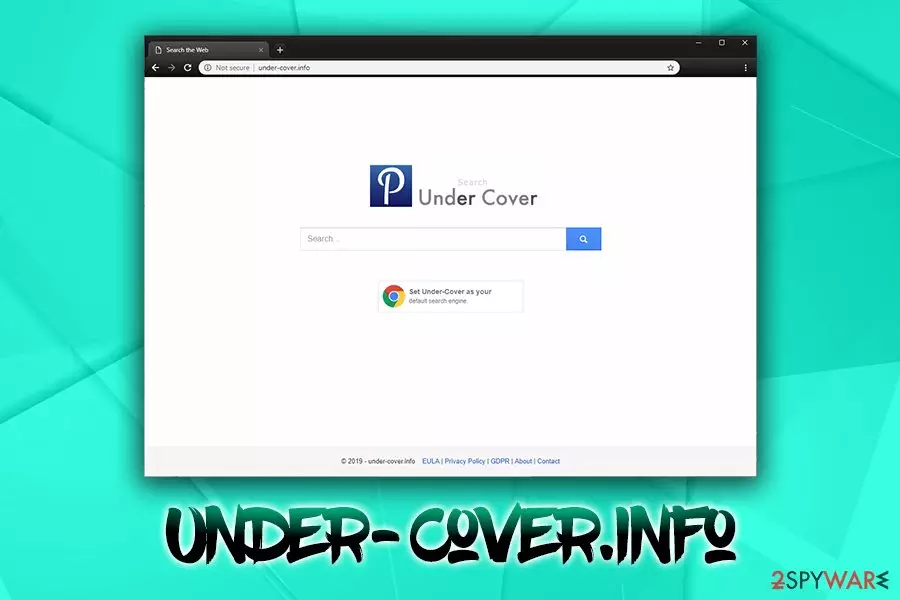
Under-Cover.info is a browser-hijacking application developed by Kinner Lake Limited – a Gibraltar-based company. The unwanted programs usually enter machines without users noticing, as software bundles typically try to hide optional installs under Advanced settings, and most people simply skip this step by choosing the Recommended mode. Once inside the machine, Under-Cover.info virus starts performing a variety of changes, including the ones that modify users' homepage and a new tab, along with the search engine. From that point, users are forced to browse via the hijacked engine,[1] which typically shows them fake search results that include a colossal amount of sponsored links, deal with redirects to questionable websites, and suffer from the slow operation of the browser.
| SUMMARY | |
| Name | Under-Cover.info |
| Type | Browser hijacker, Potentially unwanted program |
| Related apps | Under Cover Search, Flowsurf |
| Developer | Kinner Lake Limited |
| Distribution | Software bundling, third-party websites |
| Symptoms | Homepage set to hxxp://under-cover.info/?home=1&a=notset&u=notset&t=8, excessive amount of sponsored links in search results, pop-up ads on various sites, redirects to affiliated or dangerous websites |
| Risk factors | Money loss, malware infection, data leak |
| Removal | Delete the browser hijacker with security software or use our guide for manual termination |
| Optimization | To recover from the infection, scan your device with FortectIntego |
While browser hijackers are not considered to be severe computer infections, their presence might compromise computer security and users' online safety. In this article, we will explain peculiarities of this type of threat, and will also describe how to remove Under-Cover.info from Google Chrome, Mozilla Firefox, Safari, Opera, or another browser.
The primary goal of Under Cover Search developers is to generate traffic to sponsored websites, which would consequently increase the profits for both parties. For that, PUP authors need to make sure that Under-Cover.info hijacker reaches as many users as possible – hence the shady distribution technique.
Once the changes to the installed browsers are made, Under-Cover.info starts its shady activities by displaying sponsored content, placing a layer of ads on most sites, exposing to altered search results, and also tracking users' web browsing activities. This is done with the help of tracking technologies, such as Beacons[2] or Cookies. This information-gathering allows Under-Cover.info developers to gather the following information:[3]
- technical information transmitted by your device such as type of operating system, device type, default browser;
- your aggregated use of the Software, basically we know if you installed the software;
- usage statistics;
- language and the time stamp;
- approximate geographical location.
This data is collected in order to generate personalized ads, but these are always coming from the affiliates. Therefore, Under-Cover.info hijack can manipulate what sites users visit, influence their interests and make them buy products or services that they otherwise would not.
Therefore, while the browser hijacking changes might seem relatively minor, it might result in the installation of potentially dangerous apps, exposure to online scams, and even malware infection. Thus, if you noticed that your homepage has changed, check your system with security software or perform manual Under-Cover.info removal as explained below. After you kill the PUP, make sure you use FortectIntego or similar repair software to bring your device to a pristine condition.

Make use of Advanced installation settings to avoid PUPs
If you do not want to let potentially unwanted programs hijack your computer, you should pay more attention to the software installation process. Contrary to many people’s beliefs, Default or Recommended installation settings are not the ones that should be trusted during the procedure.
In fact, Custom or Advanced settings will allow you to determine which applications are secretly offered to you. Therefore, opt for these settings because they enable you to reject unwanted items added to the desired software. Be aware that most of the free apps will include some sort of “offer” or “deal,” and it might be hidden in various ways, including grayed out buttons, pre-ticked boxes, misleading placement of the toggle, etc.
There are two ways to terminate Under-Cover.info from your computer
As we already mentioned, the presence of a browser hijacker will not bring you any benefit but instead will manipulate the search results and expose you to potentially dangerous content. For that reason, it is best to take care of Under-Cover.info removal before you compromise your computer safety.
You can remove Under-Cover.info virus manually or automatically. The latter option is best for those who are less tech-savvy, however. It will allow you to terminate the unwanted application in just a few minutes. Simply download and install a security program that focuses on potentially unwanted program removal and then perform a full system scan. Alternatively, you can also use our instructions below to delete the PUP manually.
Uninstall from Windows
Uninstall from Windows 10/8:
- Type Control Panel into the Windows search box and open the result.
- Under Programs, select Uninstall a program.


Uninstall from Windows 7/XP:
- Click on Windows Start > Control Panel (Windows XP users should click on Add/Remove Programs).
- In Control Panel, select Programs > Uninstall a program.


Remove the unwanted program:
- In the Programs and Features window, look for any recently installed suspicious entries, select them, and click Uninstall.
- If User Account Control appears, click Yes to confirm, then complete the removal.


Delete from macOS
Remove the unwanted application:
- From the menu bar, select Go > Applications.
- In the Applications folder, look for any suspicious entries, then drag them to Trash (or right-click and pick Move to Trash).


Delete leftover files and folders:
- Select Go > Go to Folder.
- Enter /Library/Application Support and remove any suspicious folders related to the unwanted program.
- Repeat the same check in the /Library/LaunchAgents and /Library/LaunchDaemons folders, deleting any suspicious entries.

- Finally, empty the Trash to permanently remove the leftovers.

Reset Internet Explorer
Remove dangerous add-ons:
- Open Internet Explorer, click on the Gear icon (IE menu) on the top-right corner of the browser
- Pick Manage Add-ons.
- You will see a Manage Add-ons window. Here, look for suspicious plugins. Click on these entries and select Disable.


Change your homepage if it was altered:
- Open IE and click on the Gear icon.
- Select Internet Options.
- In the General tab, delete the Home page address and replace it by your preferred one (for example, Google.com).
- Click Apply and then select OK.


Delete temporary files:
- Press on the Gear icon and select Internet Options.
- Under Browsing history, click Delete...
- Select relevant fields and press Delete.


Reset Internet Explorer:
- Click on Gear icon > Internet options and select Advanced tab.
- Select Reset.
- In the new window, check Delete personal settings and select Reset.


Remove from Microsoft Edge
Delete unwanted extensions from MS Edge:
- Select Menu (three horizontal dots at the top-right of the browser window) and pick Extensions.
- From the list, pick the extension and click on the Gear icon.
- Click Remove.


Clear cookies and other browser data:
- Click on the Menu (three horizontal dots at the top-right of the browser window) and select Settings > Privacy, search, and services..
- Under Clear browsing data, pick Choose what to clear.
- Select Cookies and other site data and Cached images and files. (apart from passwords, although you might want to include Media licenses as well, if applicable) and click on Clear.


Restore new tab and homepage settings:
- Click the menu icon and choose Settings.
- Then find On startup section.
- Click Remove next to any suspicious startup page.
Reset MS Edge if the above steps did not work:
- Press on Ctrl + Shift + Esc to open Task Manager.
- Click on More details arrow at the bottom of the window.
- Select Details tab.
- Now scroll down and locate every entry with Microsoft Edge name in it. Right-click on each of them and select End Task to stop MS Edge from running.


Instructions for Chromium-based Edge
Delete extensions from MS Edge (Chromium):
- Open Edge and click select Settings > Extensions.
- Delete unwanted extensions by clicking Remove.


Clear cache and site data:
- Click on Menu and go to Settings.
- Select Privacy, search and services.
- Under Clear browsing data, pick Choose what to clear.
- Under Time range, pick All time.
- Select Clear now.


Reset Chromium-based MS Edge:
- Click on Menu and select Settings.
- On the left side, pick Reset settings.
- Select Restore settings to their default values.
- Confirm with Reset.
- This will disable extensions and reset startup pages but will not delete bookmarks, saved passwords, or browsing history.


Remove from Mozilla Firefox (FF)
Remove dangerous extensions:
- Open Mozilla Firefox browser and click on the Menu (three horizontal lines at the top-right of the window).
- Select Add-ons.
- In here, select the unwanted extension and click Remove.


Reset the homepage:
- Click three horizontal lines at the top right corner to open the menu.
- Choose Settings.
- Under Home, set your preferred homepage and new tab settings.
Clear cookies and site data:
- Click Menu and pick Settings.
- Go to Privacy & Security section.
- Scroll down to locate Cookies and Site Data.
- Click on Clear Data...
- Select Cookies and Site Data and Temporary cached files and pages, then click Clear.


Reset Mozilla Firefox
If clearing the browser as explained above did not help, reset Mozilla Firefox:
- Open Mozilla Firefox browser and click the Menu.
- Go to Help and then choose Troubleshooting Information.

- Under Give Firefox a tune up section, click on Refresh Firefox...
- Once the pop-up shows up, confirm the action by pressing on Refresh Firefox.



Remove from Google Chrome
Delete malicious extensions from Google Chrome:
- Open Google Chrome, click on the Menu (three vertical dots at the top-right corner) and select More tools > Extensions.
- In the newly opened window, you will see all the installed extensions. Uninstall all suspicious extensions related to the unwanted program by clicking Remove.


Clear cache and web data from Chrome:
- Click on Menu and pick Settings.
- Under Privacy and security, select Clear browsing data.
- Select Browsing history, Cookies and other site data, as well as Cached images and files.
- Click Clear data.


Change your homepage:
- Click menu and choose Settings.
- Look for a suspicious site in the On startup section.
- Click on Open a specific or set of pages and click on three dots to find the Remove option.
Reset Google Chrome:
If the previous methods did not help you, reset Google Chrome to eliminate all the unwanted components:
- Click on Menu and select Settings.
- In the Settings, scroll down and click Advanced.
- Scroll down and locate Reset and clean up section.
- Now click Restore settings to their original defaults.
- Confirm with Reset settings.


Delete from Safari
Remove dangerous extensions:
- Open Safari, click Safari in the menu at the top-left of the screen, and select Preferences.
- Go to the Extensions tab, look for any suspicious entries, and click Uninstall to remove them.


Clear history and website data:
- Click Safari in the menu and pick Clear History.
- Set Clear to all history and confirm with Clear History.


Reset Safari:
- Click Safari in the menu and select Preferences > Advanced.
- Enable Show Develop menu in menu bar.
- From the menu bar, click Develop and select Empty Caches.


Did this guide help?
4 comments
Robert
Under Cover is insanely useless dont try to use it... .Im telling ya
Godzilla
Under-cover.info infected chrome, mozilla, and IE.... now i gotta clean them all, and its so disturbing. i have to waste my time because some nasty browser hijacker wnats me to use this stupid search engine! Thats not fair!
u_n_o
Why did I click on that "Install UnderCover" button....
CoMi222
Finally fixed the PC!!!! Nailed it