
Segurazo antivirus: what it is and how to remove it
Segurazo is a Windows program sold as an antivirus that security vendors class as a potentially unwanted application, not a virus. It often arrives bundled with free software and can be stubborn to uninstall, so below are our check, the files to look for and the removal steps for Windows 11 and 10.
Facts checked October 5, 2026. Removal steps tested on Windows 11 (26H2) and checked against Microsoft's and the browser makers' current documentation.
Automatic
Get a free scan and check if your PC is infected.
Fortect finds malware, unwanted programs and the Windows damage they leave behind, and repairs it in one pass.
If Segurazo keeps coming back after uninstalling, a scan can find what reinstalls it.
Do it yourself · free Remove Segurazo yourself 4 steps, about 12 minutes, no software needed.
Start the steps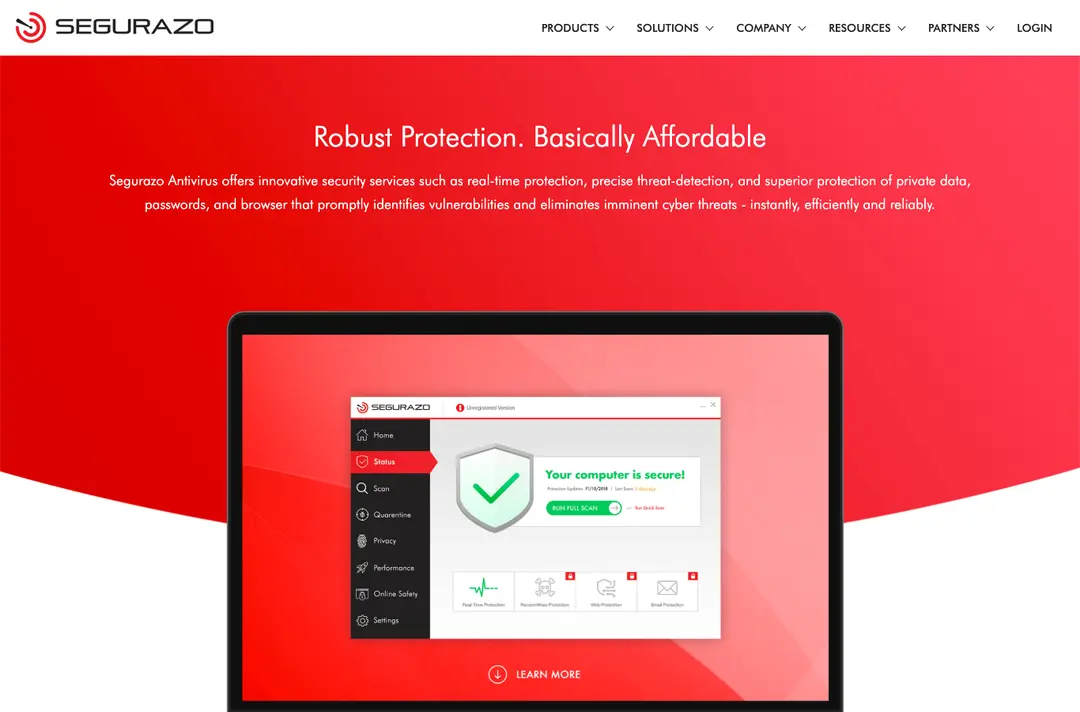
Segurazo: summary
| Type | Potentially unwanted application sold as an antivirus and optimizer; Windows only; not ransomware, not confirmed as a virus |
|---|---|
| Risk | Medium: unwanted and hard to uninstall, may come with other bundled programs, and may push a paid upgrade |
| Symptoms | An antivirus you did not choose, SegurazoClient.exe in Task Manager, a tray icon, scan results and upgrade prompts, a slow PC |
| How to get rid of it | Quit it, uninstall Segurazo and SAntivirus, use Safe Mode if it will not go, remove leftovers and scan (steps below) |
| Our check (5 October 2026) | No notification request, pop-up or ad network on one visit to www.segurazo.com; the bare domain redirected once to an unrelated games site; the program itself was not run |
| Running since | Reported by readers since 2019; domain segurazo.com registered 11 January 2007 |
| Removal | Scan the PC with security software to find and remove the malware and anything installed with it. Fortect scans Windows for malware and repairs the system files and settings it damaged. Remove it nowTo use the full-featured product, you have to purchase a license for Fortect. The scan is free. |
Show 13 more facts
| Microsoft detection | No Microsoft detection name is known: we found none in the sources we read, and we did not run the installer through Defender |
|---|---|
| Install folder | C:\Program Files (x86)\SAntivirus (Trend Micro) |
| First reported by us | 8 March 2021 |
| Name | Segurazo |
| Domain registered | 11 January 2007 |
| Evidence | 2 reports from affected users and security sites; details still limited |
| Program | Segurazo |
| Publisher | Segurazo (segurazo.com) |
| Category | Optimizer |
| First seen | 8 March 2021 |
| Distribution | Typically bundled installers and ads |
| Damage | Money paid for exaggerated results, needless registry changes |
| Facts checked | 5 October 2026 |
Facts checked on 5 October 2026:
- one browser visit and two plain fetches of segurazo.com
- its RDAP record
- three vendor and forum write-ups
We did not install Segurazo, so what it does on a PC comes from those write-ups.
What Segurazo is and how it behaves
Segurazo is a Windows program sold as an antivirus. It appears on PCs under three names, Segurazo, SAntivirus and SAproduct, and many readers find it without remembering that they installed it. Security vendors classify it as a potentially unwanted program, not as a virus.
- 1
It arrives with something else
Most reports say it came in a free-software installer or a download from a third-party site, ticked by default on a "recommended" or "quick" setup screen.
- 2
It installs a protection suite
A program called Segurazo (also listed as SAntivirus) is placed in
C:\Program Files (x86)\SAntiviruswith a background process,SegurazoClient.exe, and background services. - 3
It scans and reports
Its window shows a scan, a list of findings and a prompt to upgrade. Its own site offers a free Basic version with a 7-day trial of real-time protection and a paid Pro version.
- 4
It is hard to get rid of
People report that the normal uninstall leaves a process, a folder or an icon behind, so the program seems to come back.
- Also called
- SAntivirus, SAproduct, Segurazo Antivirus, Segurazo Service
- Type
- Potentially unwanted application, sold as an antivirus and system optimizer (Trend Micro calls it a PUA; our 2021 review called it a PUP)
- Main process
SegurazoClient.exerunning in the background- Install folder
C:\Program Files (x86)\SAntivirus(Trend Micro's removal article)- Its own site
segurazo.com, which offers Basic (7-day trial) and Pro and lists Windows 10 and 8/8.1 as supported
It is not ransomware, and nothing in the sources we read says it steals files. It is also not something Windows needs: Windows 11 and Windows 10 already include Microsoft Defender.
Is Segurazo safe? Why it is flagged
Our check on 5 October 2026
We opened segurazo.com and www.segurazo.com in a desktop Chromium browser from Lithuania and fetched the page with a plain HTTP client. We did not install Segurazo on a test PC, so what the program does on a PC comes from the sources below, not from our own run.
www.segurazo.com · desktop Chromium · Lithuania (EU) · 5 October 2026
- Notification requestNone on this one visit (permission stayed at the default after 6 seconds).
- Pop-ups and new tabsNone opened on this one visit.
- Service workerNone registered.
- Other domainsOn the visit to
www.segurazo.comevery request went to that same host, so no ad network was loaded. - RedirectThe first visit to the bare address
segurazo.comended onwildtangent.com, a games site, with no explanation. A later visit towww.segurazo.comstayed on the page. We saw the redirect once and cannot say why or when it happens. - Unstable responseFetches of the bare address with a plain client returned the full page once and an empty page twice, and a second browser visit to it timed out.
- DomainRegistered on 11 January 2007 (RDAP); the page we received says it was last modified in June 2019.
- What we could not testThe installer, the scan results, the upgrade prompts and the uninstaller. We neither confirm nor deny that its scans are exaggerated.
Not cleared The site looked like an ordinary product page on this visit, but it redirected once to an unrelated domain and answered inconsistently. Adware and bundled installers often behave differently by country, device, referrer or second visit, so one quiet visit proves little. For the program itself we rely on the vendor write-ups listed under Sources.
What changed since our 2021 review
2019 to 2020
Readers ask how to get rid of it
Readers wrote to us in September 2019 and July 2020 that they could not remove it, and one said the icon stayed in the Start menu after a scan. Microsoft's Q&A forum has a thread from March 2020 with more than 400 people marking "same question".
September 2020
Many engines flag SegurazoClient.exe
A VirusTotal result from our 2021 review, dated 25 September 2020, had 33 of 68 engines flagging
SegurazoClient.exe, mostly with PUP or PUA names. The screenshot tags the file both "signed" and "invalid-signature".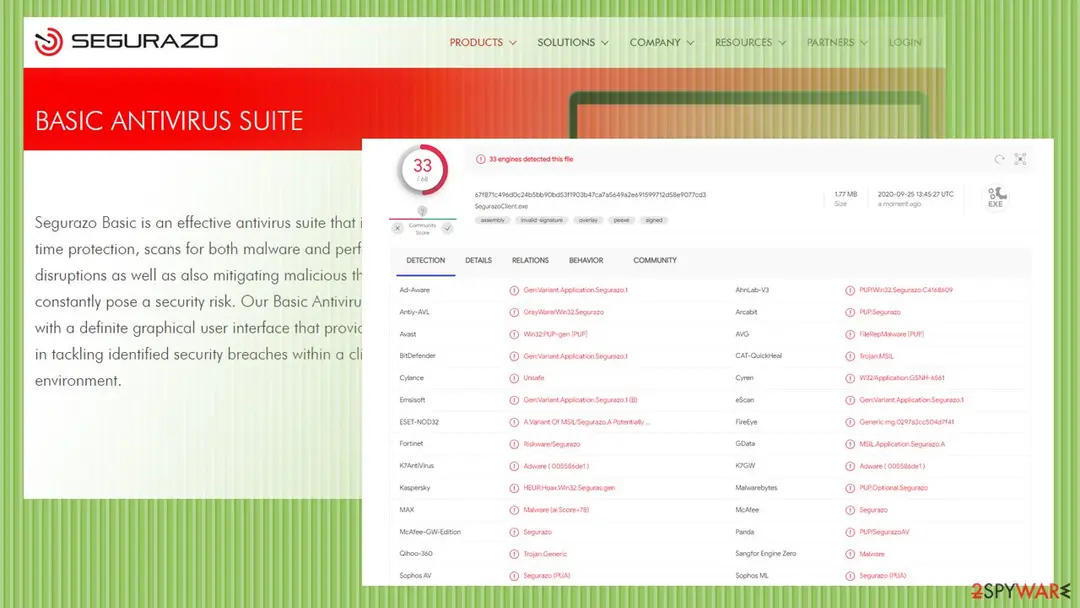
A VirusTotal result from September 2020 for SegurazoClient.exe: 33 of 68 engines flagged it, with names such as PUP.Optional.Segurazo and Segurazo (PUA). Detection counts change over time; this one is from 2020. 2020 to 2021
Services and a PUP alert
Our review also showed a Malwarebytes alert for
SegurazoSetup.exein a Downloads folder, labelled PUP.Optional.Segurazo, and a Windows Services list in which three entries starting with "Segurazo" describe themselves as protecting the PC from viruses and spyware, all set to start automatically.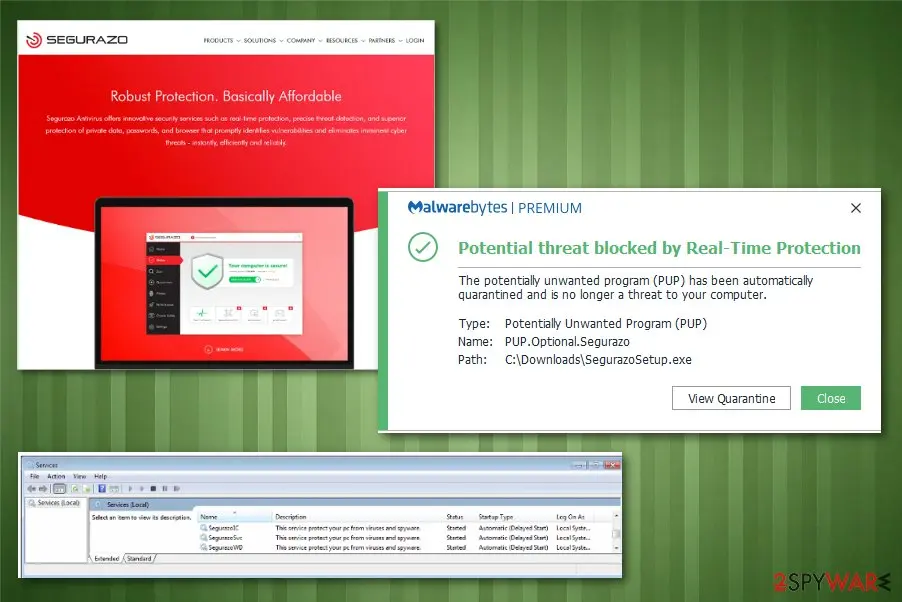
The Malwarebytes alert and Services list from our 2021 review. They show the detection name and that Segurazo installs services; the services screenshot is from an older Windows version. September 2026
Still in circulation
Trend Micro updated "How to remove Segurazo Antivirus" on 15 September 2026 and All About Cookies updated its guide in February 2025, so the program is still being removed from PCs. The old review's advice to buy a paid scanner is gone from this page; the removal steps are kept and rewritten for Windows 11 and 10.
What security programs call it
When your security software names a file, the name tells you whether it is treated as a nuisance or as malware. For Segurazo the names are almost all in the PUP and PUA family.
| Where the name comes from | Name shown | What it means |
|---|---|---|
| Malwarebytes (our 2021 review) | PUP.Optional.Segurazo | A potentially unwanted program of the optional kind |
| Avast (VirusTotal, 2020) | Win32:PUP-gen [PUP] | A generic PUP signature |
| Sophos (VirusTotal, 2020) | Segurazo (PUA) | A potentially unwanted application |
| Kaspersky (VirusTotal, 2020) | HEUR:Hoax.Win32.Seguras.gen | A "hoax" heuristic, used for programs that mislead about what they do |
| ESET (our 2021 review) | A Variant Of Win32/Segurazo.C Potentially Unwanted | A potentially unwanted variant |
| Other engines in our 2021 text | Hoax.Win32.DeceptPCClean.kaw, Misleading:Win32/Lodi, PUA.Superfluss, PotentialRisk.PUA/Segurazo.aqu | Misleading-program and PUA labels |
Names to look for in Installed apps and Task Manager
- Segurazo
- SAntivirus
- SAproduct
- SegurazoClient.exe
- Segurazo Uninstaller
- SegurazoSvc
Search for every name: removing only one often leaves the others.
SegurazoClient.exe and the other files
SegurazoClient.exe is the program's background process. If you see it in Task Manager, Segurazo is installed on that PC.
- What it is
- The background client of the Segurazo suite, started when Windows starts
- Where it lives
- In the install folder,
C:\Program Files (x86)\SAntivirusaccording to Trend Micro; our older text names a Program Files (x86) location too - How to see it
- Press Ctrl + Shift + Esc, open Details, and look for
SegurazoClient.exe; Startup apps shows whether it starts with Windows - Other parts
- Services whose names start with Segurazo, a Segurazo Uninstaller in the install folder, and a tray icon next to the clock
- What we could not confirm
- That it reads keyboard and mouse input, runs with elevated rights or creates scheduled tasks, as our 2021 text said. We found no source that shows it, so treat these as unproven; the response is the same either way. If you typed passwords while it ran and feel uneasy, change them from another device after the removal
The real risks, from most to least serious
Segurazo is unwanted rather than destructive, but two things on this list can cost you money or time.
- Medium
Paying for a scan result
The old review and All About Cookies say Segurazo shows scan findings that push you to buy the full version. We could not run the program to check, so judge by the rule that applies to any security program: do not pay because a scan you did not choose told you to, and run a Windows Security scan as a second opinion first.
- Medium
More bundled programs
Trend Micro says Segurazo is known to be bundled with other unwanted programs, and some are worse than itself. A PC where Segurazo appeared by surprise may have other installs from the same installer.
- Medium
Windows protection left switched off
Windows turns Microsoft Defender off when it sees another antivirus registered. After removing Segurazo, check in Windows Security that protection is back on.
- Low
Slow PC and constant prompts
Always-on scanning and upgrade prompts use disk and CPU and interrupt work. This is the most common complaint in the Microsoft Q&A thread.
- Low
Redirects to other sites
The old review said Segurazo sends people to other sites that promote optimizers. We did not see it do that on its own site, only one unexplained redirect of the bare address to a games site.
How Segurazo got installed
Nobody searches for a PUP and picks it on purpose. It arrives inside something else, and the installer's screens are built so that agreeing to everything installs everything.
- 1
You download a free program
The first reports said Segurazo came with free software from third-party download sites, or after clicking an ad that promoted a free "antivirus" or optimizer.
- 2
You choose Quick or Recommended
A quick installation accepts the bundled extras without showing them. A Custom or Advanced installation lists them with tick boxes.
- 3
The bundle installs
Segurazo, and sometimes other bundled programs next to it, are installed and start with Windows.
- 4
You notice it later
A tray icon, a scan window, an upgrade offer, or a program that will not go away is how most people find out. Even an installer from an official page can carry extras, so read each screen.
How to uninstall Segurazo
Uninstall it, then remove what keeps it starting with Windows.
Nothing it flagged needs fixing.
Step 1: Uninstall Segurazo
Open Settings > Apps > Installed apps in Windows 11, or Settings > Apps > Apps & features in Windows 10. Sort the list by install date and find Segurazo, then choose Uninstall from the three-dot menu next to it (in Windows 10, click the entry and then Uninstall).
Remove anything else installed on the same day that you do not recognise, because such programs usually arrive together in one installer. If the uninstaller opens a browser page with an offer or a survey, close it: the program is removed either way.
Full procedure with screenshots: Uninstall a program or app in Windows On uGetFix
Step 2: Remove it from startup
Whatever Segurazo installed usually starts with Windows. Open Task Manager with Ctrl + Shift + Esc, go to Startup apps in Windows 11 or the Startup tab in Windows 10, and disable what you do not know, starting with entries that have an empty Publisher column.
Open file location on the right-click menu shows the file, which helps you decide and tells you what to delete later. Disabling is safe: if something you need stops working, switch it back on.
Full procedure with screenshots: Stop apps from opening at startup On uGetFix
Step 3: Delete the folders left behind
What the uninstaller leaves behind is usually in the user folders. Open File Explorer, switch on View > Show > Hidden items (in Windows 10 View > Hidden items), and go through
%LocalAppData%,%AppData%, %ProgramData% and the two Program Files folders.Sort by Date modified and delete folders that appeared together with the problem and belong to no program you use. Folders with random names that hold
.exe,.dll, .js or .ps1 files are the strongest sign.Full procedure with screenshots: Remove what malware leaves behind in Windows
Step 4: Scan the PC, then run the offline scan
Open Windows Security > Virus & threat protection > Scan options, run a Full scan and remove everything it finds. Then select Microsoft Defender Antivirus (offline scan) and click Scan now: the PC restarts and scans before Windows loads, which finds files that hide while Windows runs.
Save your work first, because the offline scan takes about 15 minutes. Both scans are built into Windows 11 and Windows 10, and a second scanner from another vendor is a useful extra opinion.

Windows 11: Windows Security > Virus & threat protection > Scan options. Full procedure with screenshots: Run a Microsoft Defender Offline scan
After removal and prevention
If it will not uninstall: use Safe Mode
When the normal uninstall fails, the files are usually locked by the running Segurazo process. Safe Mode starts Windows without most third-party programs, so the process cannot hold them.
- 1
Open the recovery menu
On the sign-in screen hold Shift, select the Power button and click Restart. If you are signed in, hold Shift while you choose Restart from the Start menu.
- 2
Choose Startup Settings
On the blue "Choose an option" screen select Troubleshoot > Advanced options > Startup Settings > Restart.
- 3
Pick Safe Mode
After the restart press 4 or F4 for Safe Mode. Press 5 or F5 for Safe Mode with Networking if you need the internet, for example to download a scanner.
- 4
Run the Segurazo uninstaller
Open
C:\Program Files (x86)\SAntivirus, right-click Segurazo Uninstaller, choose Run as administrator, answer Yes, tick both boxes and click Uninstall. Restart Windows normally when it finishes (Trend Micro's article). - 5
Delete what is left
Still in Safe Mode, delete a leftover
SAntivirusorSegurazofolder under Program Files (x86). A reader in the Microsoft Q&A thread searched drive C: for the name and deleted what appeared; the search can take a few minutes. - 6
Restart and check
Restart into normal Windows, open Task Manager and confirm that
SegurazoClient.exeis gone, and look again in Installed apps for Segurazo and SAntivirus.
Some removal guides also tell you to edit the registry by hand. We did not test those steps and cannot confirm the exact keys, so we do not give them here. Use the uninstaller, the folder cleanup and a scan.
Remove Segurazo, its leftovers and the other installs
Order matters: quit the program, uninstall it, then deal with what it leaves. This is the order the old review used, with Windows' own tools first.
- 1
Quit it first
Right-click the Segurazo icon next to the clock and choose Quit, or end
SegurazoClient.exein Task Manager under Details. A Malwarebytes forum answer gives the same first step. - 2
Uninstall it from Windows
Open Settings > Apps > Installed apps (Windows 11) or Apps & features (Windows 10), search for Segurazo, then for SAntivirus, and uninstall each (Uninstall a program or app in Windows On uGetFix). If the entry is missing or the button fails, use the uninstaller in the install folder or Safe Mode as above.
- 3
Look at what came the same day
Sort the list by install date and uninstall every program from the day Segurazo arrived that you did not choose.
- 4
Stop what still starts
In Task Manager open Startup apps (Windows 11) or Startup (Windows 10) and disable any Segurazo entry that is still there (Stop apps from opening at startup On uGetFix).
- 5
Scan the PC
Open Windows Security > Virus & threat protection, run a Full scan, then the Microsoft Defender Antivirus (offline scan) (Run a Microsoft Defender Offline scan). Both are built into Windows 11 and 10.
- 6
Make sure Windows protection is on
Open Windows Security and confirm that Virus & threat protection shows no warnings. If Microsoft Defender was switched off while Segurazo ran, turn Real-time protection back on.
A genuine program does not reinstall itself after you remove it. If Segurazo returns, another bundled program is probably installing it again: look for an installer or updater from the same day in Installed apps and Startup apps, and remove that too.
How to keep unwanted programs off your PC
Do
- Pick Custom or Advanced installation and untick any extra program, toolbar or "offer" you did not come for.
- Read the licence and privacy text on the screen that mentions extra software; that is where bundled programs are disclosed.
- Download programs from the maker's own site or from the Microsoft Store, and avoid download portals that wrap installers.
- Keep Microsoft Defender on and its protection updates current: Windows Security > Virus & threat protection.
- Back up your documents before a big cleanup, with File History or OneDrive, so a failed removal does not take them with it.
- A VPN hides your IP address from the sites you visit; it does not stop a bundled installer and does not replace a scan.
Don't
- Install a security program because a pop-up, an ad or a free-download page told you your PC is at risk.
- Press Next through every screen of an installer without reading it, especially one called Recommended or Quick.
- Pay for the full version of a program that appeared on your PC without your choosing it.
- Run two antivirus programs at once; they conflict and slow the PC.
- Edit the registry from a forum post if you cannot say what each key does.
Questions about Segurazo
What is Segurazo?
Segurazo is a Windows program sold as an antivirus with real-time protection and a PC optimizer, also known as SAntivirus. Its own site offers a free Basic version with a 7-day trial and a paid Pro version, and says it runs on Windows 10 and 8.
Security vendors classify it as a potentially unwanted application, and Trend Micro describes it as being bundled with other unwanted programs. Many people meet it without having chosen it, because it comes with free software. Windows 11 and Windows 10 already have Microsoft Defender, so you do not need it.
Is Segurazo a virus?
No, Segurazo is not a virus in the usual sense, but it is classed as a potentially unwanted program.
That means it is not designed to destroy files or lock your PC, yet it behaves in ways many people do not want: it can arrive bundled with other software, it is reported to be hard to uninstall, and many antivirus engines flag it.
In 2020 a VirusTotal check of its client file showed 33 of 68 engines flagging it, mostly with PUP or PUA names. The practical advice is the same as for a virus: remove it and scan the PC.
Is Segurazo antivirus safe to use?
We would not rely on it, mainly because it is unwanted software with a poor reputation among security vendors. Our own check on 5 October 2026 was limited: its web page loaded normally on one visit, but the bare address redirected once to an unrelated games site and later answered inconsistently, so one quiet look proves little.
We did not run the program ourselves. All About Cookies and our 2021 review say it can show false scan results to sell an upgrade. Microsoft Defender in Windows 11 and 10 gives real protection without an extra purchase.
How do I uninstall Segurazo on Windows 11 or Windows 10?
Quit it from the tray, then open Settings, then Apps, then Installed apps (Apps and features on Windows 10), search for Segurazo and SAntivirus and uninstall each. If the entry fails, open C:\Program Files (x86)\SAntivirus, right-click Segurazo Uninstaller, choose Run as administrator, tick both boxes and click Uninstall, then restart.
If files remain, repeat the uninstall in Safe Mode and delete the leftover folder. Finish with a full Windows Security scan and the Microsoft Defender offline scan. The steps above show each screen in order.
What is SegurazoClient.exe and can I end it?
SegurazoClient.exe is the background process of the Segurazo program, so if you see it in Task Manager, Segurazo is installed on that PC. You can end it:
- open Task Manager with Ctrl
- Shift and Esc
- find it under Details and choose End task
- choose Quit from the tray icon
Ending it only stops it for now, because it starts again with Windows until you uninstall the program. Our 2021 review said it can read keyboard and mouse input; we could not confirm that from any source, so we mark it as unproven.
Why can't I uninstall Segurazo, or why does it come back?
The program holds its own files open while its background process runs, so the normal uninstall can fail or leave a folder behind. People in Microsoft's Q&A forum reported that Settings removed the entry but the process and folder stayed.
Quit the process first, then use the uninstaller in the install folder, or do the same in Safe Mode where the process does not start. If it returns after a restart, another bundled program is probably installing it again, so look for other programs installed the same day and remove them too.
Is SAntivirus the same as Segurazo?
Yes, SAntivirus is the name the Segurazo program uses in Installed apps and in its install folder, so the two entries refer to one product. Trend Micro's removal article puts it in C:\Program Files (x86)\SAntivirus, and All About Cookies advises searching for both names because one removal can leave the other.
The old review also lists SAproduct as another name. Search Installed apps, Task Manager and the Program Files (x86) folder for Segurazo, SAntivirus and SAproduct, and remove every match.
Do I need Segurazo if I already have Windows Security?
No, Windows Security (Microsoft Defender Antivirus) is already built into Windows 11 and Windows 10, scans files in real time and updates through Windows Update. A second antivirus adds little and can cause conflicts: Windows may turn Defender off while another product is registered, and two scanners slow the PC.
If you removed Segurazo, open Windows Security and check that Virus and threat protection shows no warnings and that Real-time protection is on, so the PC is not left unprotected.
The Segurazo icon is still in the Start menu after removal. What now?
A leftover icon is normally only a shortcut, not the program. Restart the PC, then check Installed apps to confirm Segurazo and SAntivirus are gone and Task Manager to confirm SegurazoClient.exe is not running.
If a tile remains on the Start menu, right-click it and choose Unpin from Start; if a shortcut remains in the program list, right-click it and delete it. You do not need to buy a repair tool for this, which one of our readers asked about in 2020.
Will Fortect remove Segurazo?
Fortect scans Windows for malware and unwanted programs and repairs the system files and settings they change, and its free scan shows what it finds on your PC before you decide anything.
For Segurazo, follow the plan above as well: the browser steps take back permissions and settings that no scanner treats as a threat, and uninstalling the program that brought it removes the source.
Run Microsoft Defender's full scan and, if anything was found, its offline scan as a second opinion. If the symptoms are gone after the plan and both scans are clean, there is nothing more to do.
Sources
- segurazo.com home page (our test, desktop Chromium) (read October 5, 2026)
- RDAP record for segurazo.com (read October 5, 2026)
- Trend Micro Help Center: How to remove Segurazo Antivirus (updated 15 September 2026) (no longer online) (read October 5, 2026)
- All About Cookies: How To Uninstall Segurazo Antivirus (updated 18 February 2025) (read October 5, 2026)
- Microsoft Q&A: I cant uninstall SAntivirus/segurazo (2020 thread) (read October 5, 2026)
- Our 2021 review of Segurazo (2-spyware.com) (read October 5, 2026)