
Congratulations, you won ads: what it is and how to remove it
Congratulations You Won is a fake prize scam using professional-looking pop-ups to steal your personal and financial information. It arrives through bundled adware and uses urgency tactics to prevent careful thinking.
Facts checked October 7, 2026. Removal steps tested on Windows 11 (26H2) and checked against Microsoft's and the browser makers' current documentation. Sections marked as our earlier report are the original text: they describe the threat as it was then and have not been reviewed since. The 2026 status, the removal steps and the questions are current.
Automatic
Get a free scan and check if your PC is infected.
Fortect finds malware, unwanted programs and the Windows damage they leave behind, and repairs it in one pass.
If Congratulations, you won keeps coming back after uninstalling, a scan can find what reinstalls it.
Do it yourself · free Remove Congratulations, you won ads yourself 4 steps, about 12 minutes, no software needed.
Start the steps
Congratulations, you won ads: summary
| Name | Congratulations, you won |
|---|---|
| Also known as | Congratulations, You have been selected; Congratulations, Google user! You are our winner today! Congratulations, Samsung user |
| Caused by | Potentially unwanted program; adware |
| Main Aims | To swindle users' personal information; generate income from sponsored content |
| Main risks | Identity theft, money loss |
| Symptoms | The continuous reappearance of misleading ads on the web browser offering fake prizes |
| Removal | Scan the PC with security software to find and remove the malware and anything installed with it. Fortect scans Windows for malware and repairs the system files and settings it damaged. Remove it nowTo use the full-featured product, you have to purchase a license for Fortect. The scan is free. |
Show 8 more facts
| Detection names | No Microsoft detection name is known |
|---|---|
| Distribution | Not recorded in the old report |
| Damage | Not recorded in the old report |
| Type | Adware extension |
| Evidence | 5 write-ups by security sites; details still limited |
| Program | Congratulations, you won |
| First seen | 2 January 2021 |
| Facts checked | 7 October 2026 |
Is Congratulations, you won ads dangerous?
From our report of Jan 2021 · not reviewed since
Congratulations, you won! is the scam that shows false messages about prizes to Chrome browser users
"Congratulations, you won" is a widespread internet scam that has been popular for several years now.
These alerts are typically triggered on Android (mostly Samsung), iOS, Windows, and MacOS. No matter how harmless such scams seem, keep in mind that their one and only aim is to swindle users' personal information.
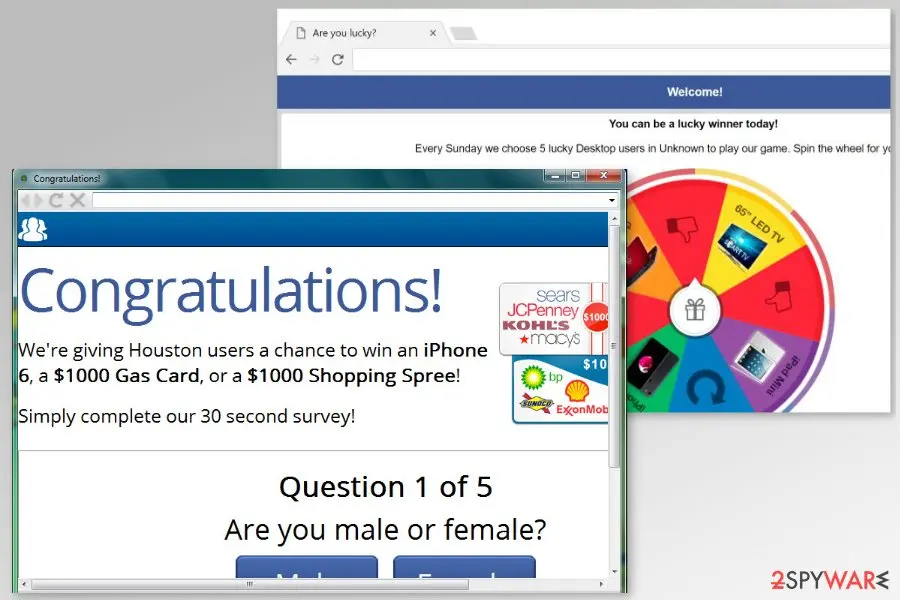
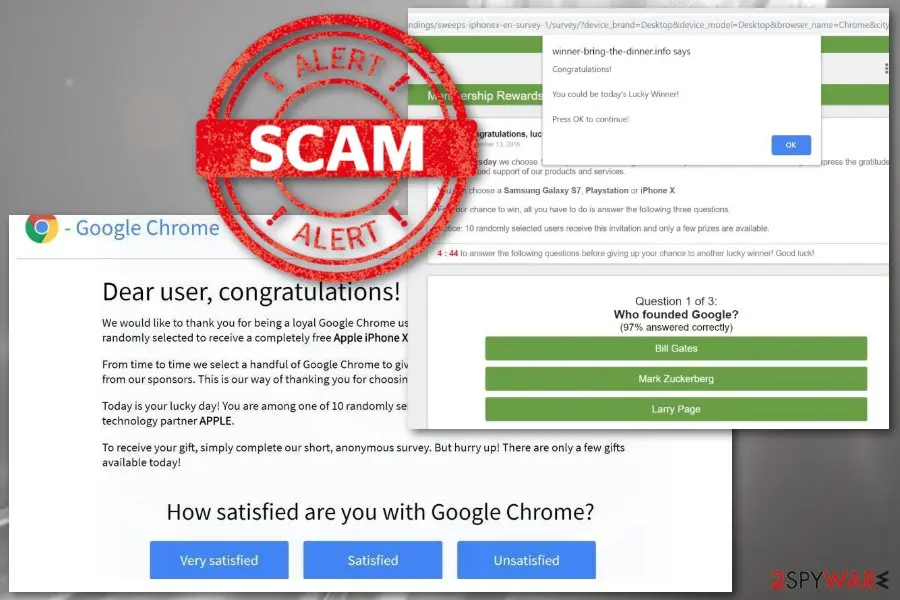
The virus poses as a lottery promising tempting prizes (iPhone, Samsung phones, Walmart, or Amazon gift cards or other prizes) in exchange for answering a few simple questions. Unfortunately, in the final stage, such surveys lead users to a form suggesting them to enter their email address, full name, or even credit card information. This information might be used for further crimes, including credential stuffing, identity theft, etc.
Congratulations, you won message might look believable (especially for inexperienced users) because of the theme used. At first glance, it looks just like any pop-up window from Microsoft Corporation. Please be aware that scammers put a lot of resources and effort to make these types of scams seem convincing. Thus, the pop-up has nothing to do with Microsoft and is designed to deceive unsuspecting users.
The scammy website might be altered based on the users' location, device, and other browser preferences because the adware can track, monitor, and collect information regarding your browsing history, most viewed sites, and searched items. Fake reward messages may state:
The cyber threat which is hiding behind this scam is stating that you have won an expensive prize that you can claim once you complete a short survey that consists of three questions. However, the Gift Card or an iPhone can be requested after you enter your full name, email address, or even log in to your online banking account.
Remember that these specific survey questions given in the Congratulations, you won gif are extremely straightforward and are designed to convince users that it is particularly easy to obtain a valuable gift in just three steps. The following text is displayed in the pop-up:
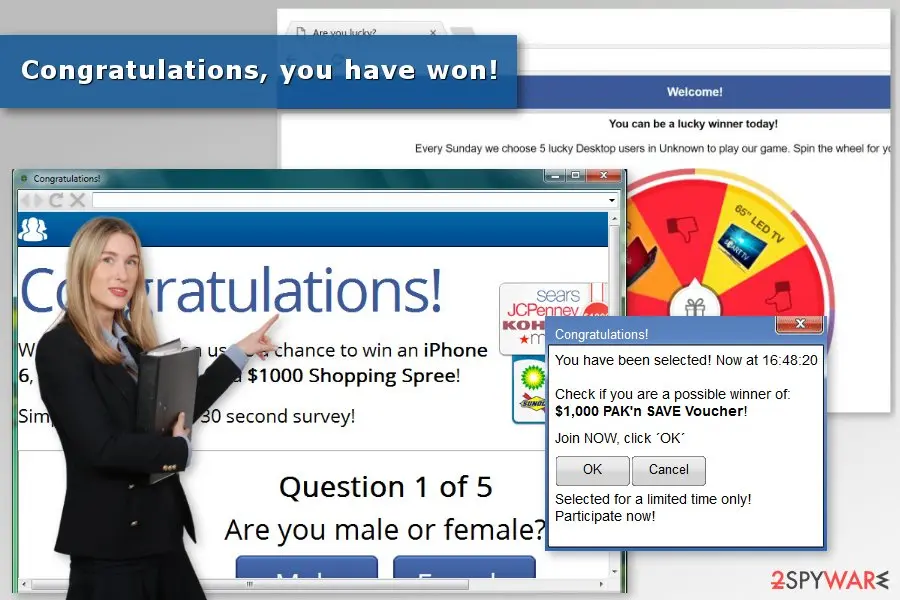
The time limit can also be given, so you are rushed to complete the survey within two minutes or so. Otherwise, the gift is said to be given to somebody else. This is a common trick used by scammers to catch users at the right moment and lead them to fear losing the promised free prize.
- Congratulations, you won a Google gift;
- Congratulations Samsung user;
- Congratulations, you won $1000 Walmart Gift Card;
- Congratulations, you won an iPhone;
- Congratulations you have been selected;
- etc.
From our report of Jan 2021 · not reviewed since
What happens after falling for the scam
If you happen to fall for this scam and proceed with the offer, you will be prompted to enter your telephone number and then has to register for a service (which costs $5 a week) that you certainly do not need.
As mentioned many times, decline all offers coming from Congratulations, you won meme. However, note that it doesn't eliminate the roots of the issue. For that, you will have to run a full system scan on your computer.
The adware that causes the scam message might also:
Keep in mind that ads generated by potentially unwanted programs might lead to malicious websites that could download and install various malware. Therefore, you should speed up with Congratulations, you won removal. Also, do not forget that scam messages may appear on various devices with different operating systems.
When trying to figure out how to get rid of the virus on an iPad, iPad, or another device, use a reputable anti-malware tool for the OS your machine is based on. Also, recent scam campaigns targeted Android users, you can find removal instructions down below.
Security experts provide two methods to remove Congratulations, you won the virus from the system. You can defeat it bare hands by following the guide below. Afterward, scan the system with , to wipe out the leftovers of this virus.
- deliver intrusive ads;
- redirect to malicious websites;
- gather non-personally identifiable information (URLs visited, IP addresses, search queries, etc.);
- sell or share aggregated information with third parties;
From our report of Jan 2021 · not reviewed since
More from our earlier report on Congratulations, you won
- Uninstall adware from the system and reset the affected web browsers.
- Next, scan the system with to fix virus damage, e.g.
- system files and other components
- You have been selected today to receive a FREE iPhone X, PlayStation 4 or Samsung Galaxy S6!
How Congratulations, you won ads got into your browser
From our report of Jan 2021 · not reviewed since
The most common way of a PUP getting into your system is with bundling.
Typically, users tend to install free software from the internet while using Recommended settings and skipping steps. However, if Advanced/Custom modes are not used, PUPs might sneak into the computer. Therefore it is highly recommended to always use Advanced settings and opt-out of any unwanted programs (browser toolbars, optimization utilities, etc.).
To protect yourself, you should also follow these security tips provided by Utanvirus.se specialists:
- Download software from official sources and never use third-party or Torrent websites;
- If you need to update your software, always visit official websites instead of clicking on pop-ups generated from dubious sites;
- While installing software, carefully read through terms and conditions and untick any unwanted programs while in Advanced mode;
- Obtain anti-malware/anti-adware software that offers real-time protection.
How to remove Congratulations, you won ads
How to remove the Congratulations, you won extension
Do the browser steps in every browser and profile on the PC, then check Windows for the program that installed the extension.
Step 1: Remove extensions you did not add
Congratulations, you won often works through an extension, so go through the extension list of each browser:
chrome://extensionsedge://extensions- Extensions and themes in Firefox
Switch suspicious extensions off one at a time and reload the page where the problem shows, then remove the one that stops it, and any other you did not add.
Remember the other browsers and profiles on the PC. If Remove is missing or greyed out, a policy forces the extension, which the policy step deals with. Windows 11 and Windows 10 show the same pages.
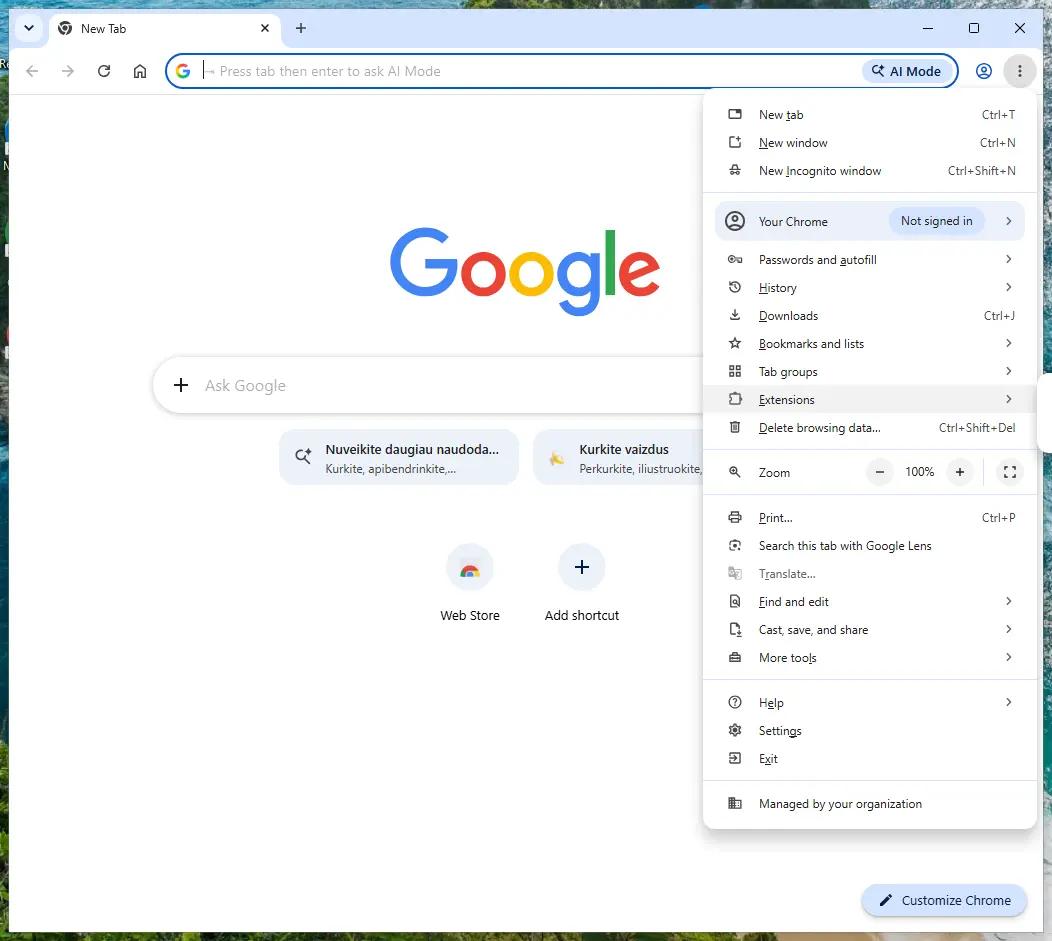
Chrome on Windows 11: More > Extensions > Manage extensions. Full procedure with screenshots: Remove a browser extension
Step 2: Uninstall Congratulations, you won
Open Settings > Apps > Installed apps in Windows 11, or Settings > Apps > Apps & features in Windows 10.
Sort the list by install date and find Congratulations, you won, then choose Uninstall from the three-dot menu next to it (in Windows 10, click the entry and then Uninstall).
Remove anything else installed on the same day that you do not recognise, because such programs usually arrive together in one installer. If the uninstaller opens a browser page with an offer or a survey, close it: the program is removed either way.
Full procedure with screenshots: Uninstall a program or app in Windows On uGetFix
Step 3: Reset the browser
Finish the browser part with a reset, which puts the search engine, start page, new tab page and site permissions back to their defaults and switches extensions off. Chrome: Settings > Reset settings > Restore settings to their original defaults.
Edge: Settings > Reset settings. Firefox: Help > More troubleshooting information > Refresh Firefox, which also removes its extensions. Your bookmarks and saved passwords are kept, and the menus are the same on Windows 11 and Windows 10.
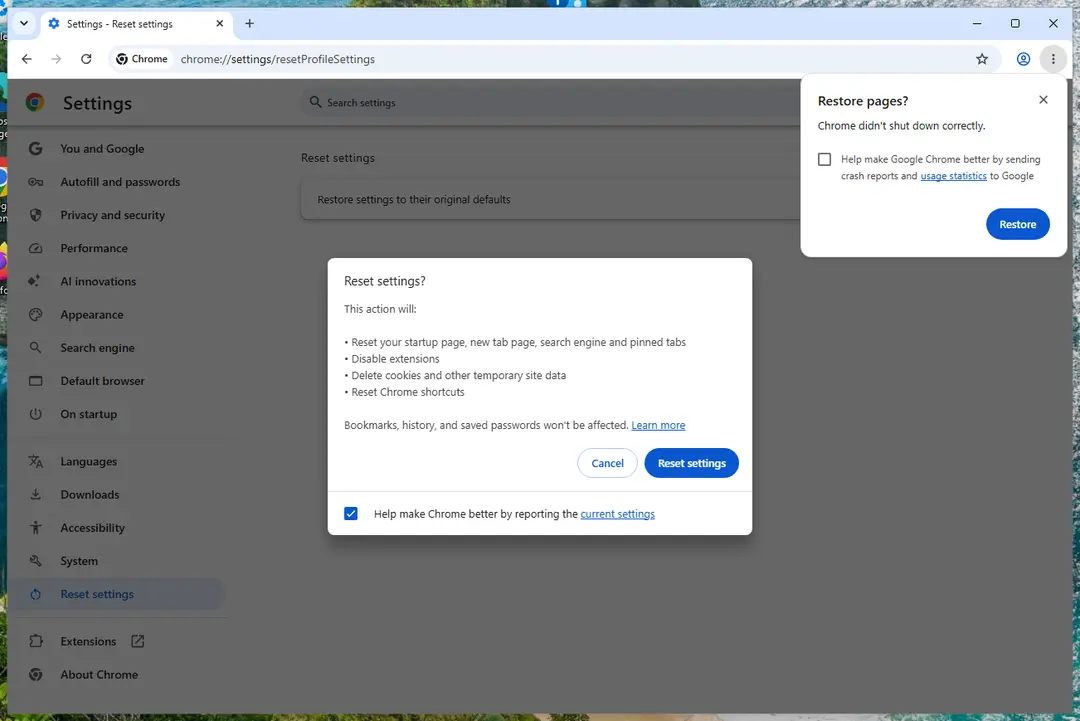
Chrome on Windows 11: Settings > Reset settings. Full procedure with screenshots: Reset a browser and fix a hijacked search engine
Step 4: Scan the PC, then run the offline scan
Open Windows Security > Virus & threat protection > Scan options, run a Full scan and remove everything it finds. Then select Microsoft Defender Antivirus (offline scan) and click Scan now: the PC restarts and scans before Windows loads, which finds files that hide while Windows runs.
Save your work first, because the offline scan takes about 15 minutes. Both scans are built into Windows 11 and Windows 10, and a second scanner from another vendor is a useful extra opinion.
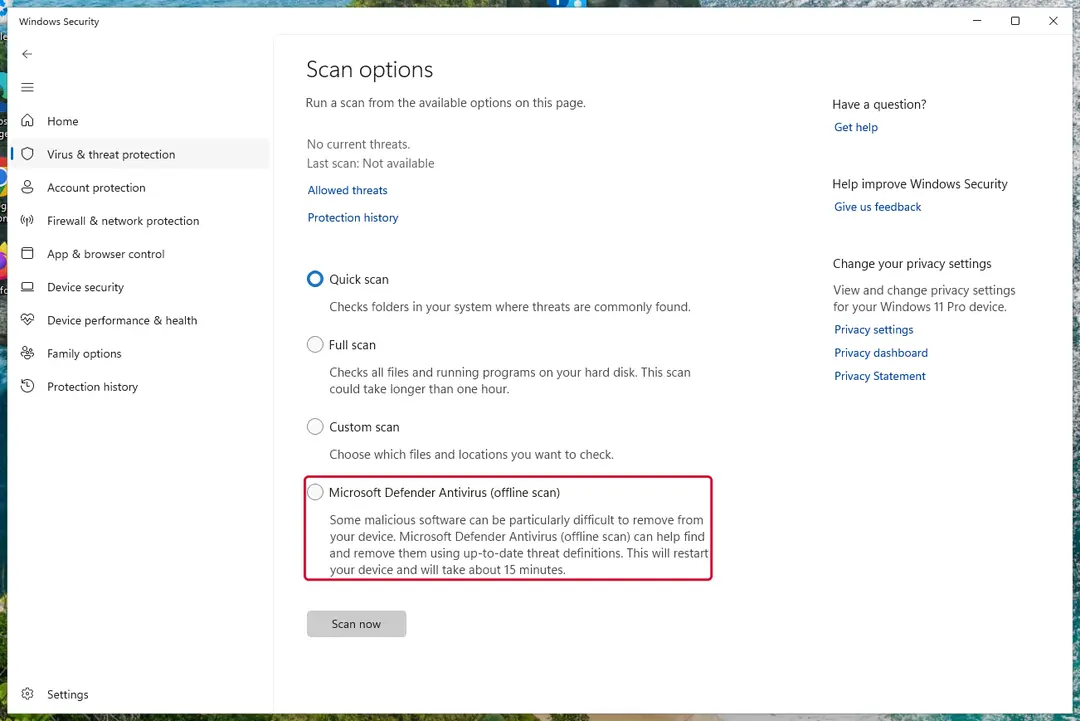
Windows 11: Windows Security > Virus & threat protection > Scan options. Full procedure with screenshots: Run a Microsoft Defender Offline scan
Instructions for each browser and system
The detailed steps for every browser and system this guide covers. Open the one you use.
Uninstall from Windows
Uninstall from Windows 10/8:
- Type Control Panel into the Windows search box and open the result.
- Under Programs, select Uninstall a program.
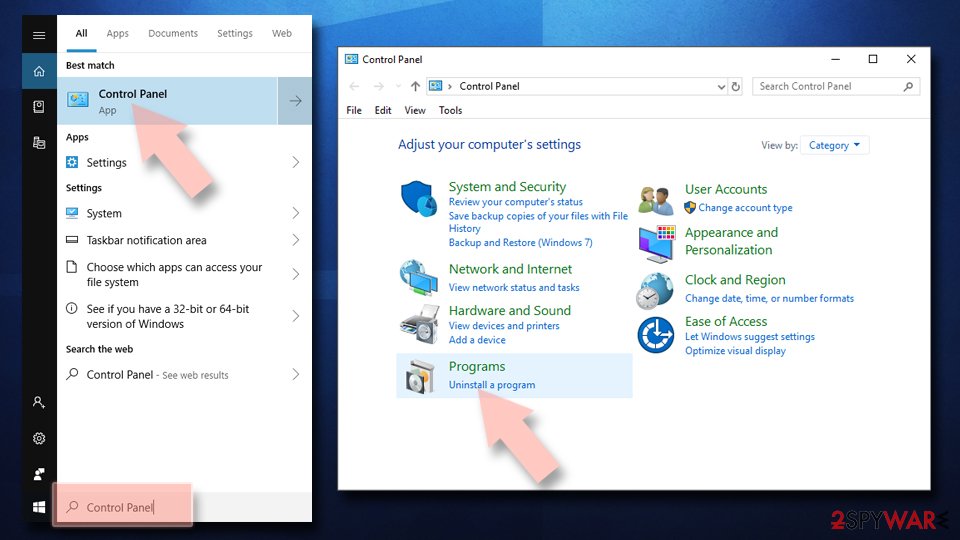
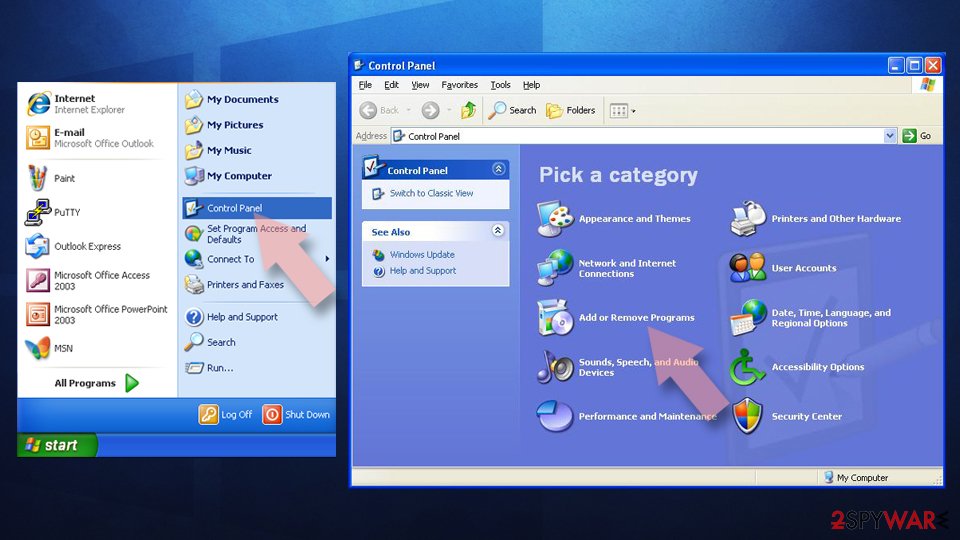
Uninstall from Windows 7/XP:
- Click on Windows Start > Control Panel (Windows XP users should click on Add/Remove Programs).
- In Control Panel, select Programs > Uninstall a program.
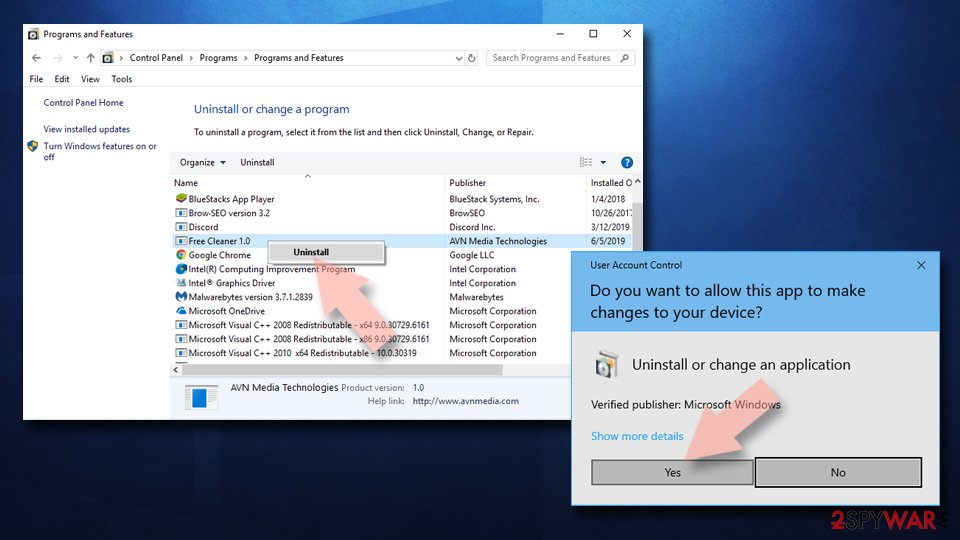
Remove the unwanted program:
- In the Programs and Features window, look for any recently installed suspicious entries, select them, and click Uninstall.
- If User Account Control appears, click Yes to confirm, then complete the removal.
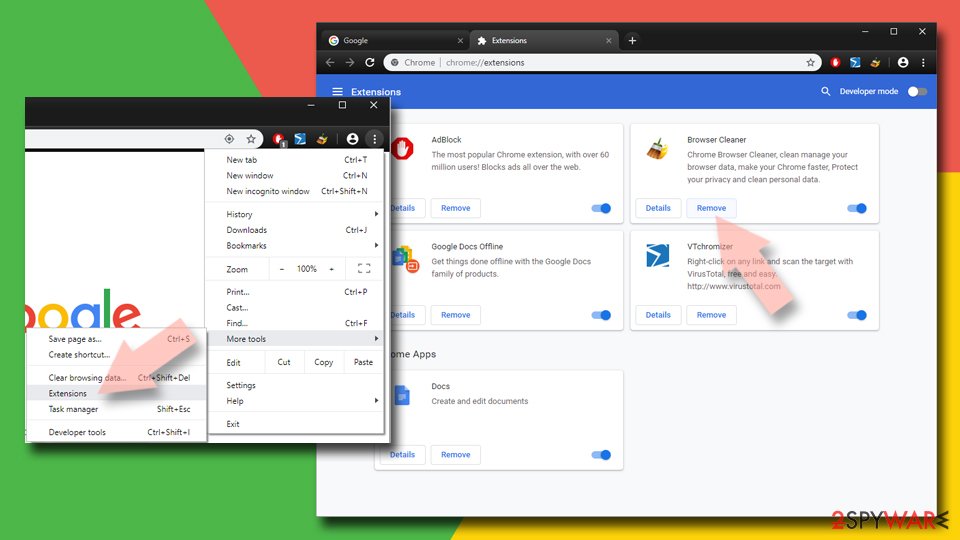
Remove from Google Chrome
Delete malicious extensions from Google Chrome:
- Open Google Chrome, click on the Menu (three vertical dots at the top-right corner) and select More tools > Extensions.
- In the newly opened window, you will see all the installed extensions. Uninstall all suspicious extensions related to the unwanted program by clicking Remove.
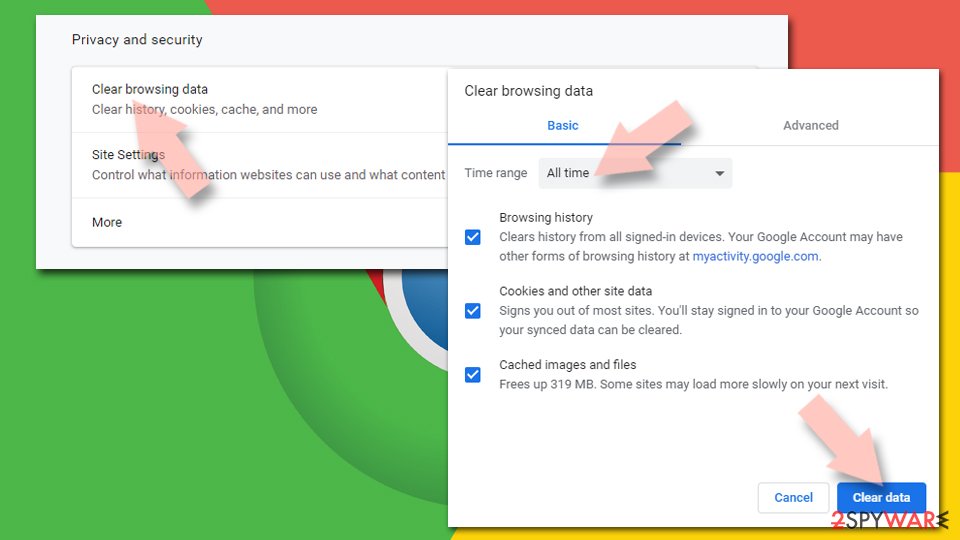
Clear cache and web data from Chrome:
- Click on Menu and pick Settings.
- Under Privacy and security, select Clear browsing data.
- Select Browsing history, Cookies and other site data, as well as Cached images and files.
- Click Clear data.
Change your homepage:
- Click menu and choose Settings.
- Look for a suspicious site in the On startup section.
- Click on Open a specific or set of pages and click on three dots to find the Remove option.
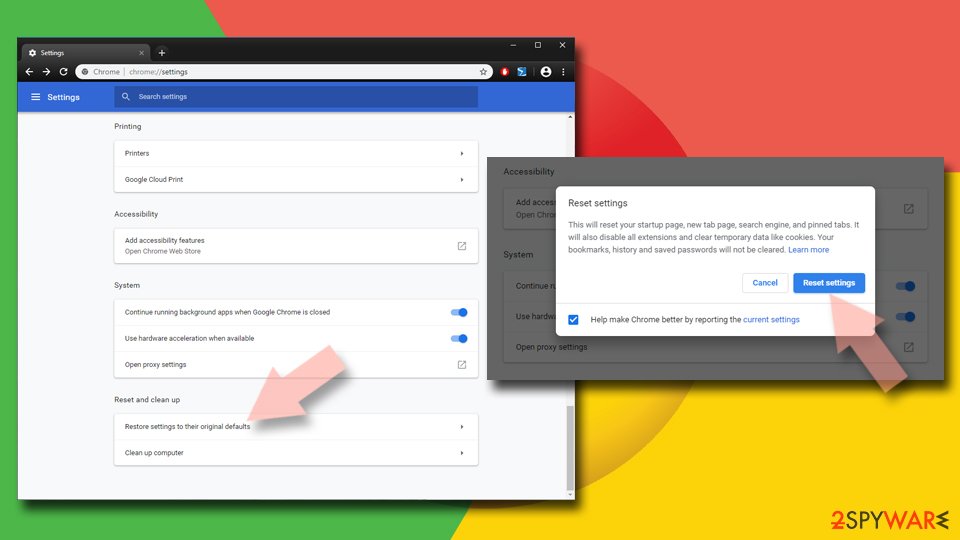
Reset Google Chrome:
If the previous methods did not help you, reset Google Chrome to eliminate all the unwanted components:
- Click on Menu and select Settings.
- In the Settings, scroll down and click Advanced.
- Scroll down and locate Reset and clean up section.
- Now click Restore settings to their original defaults.
- Confirm with Reset settings.
Remove from Microsoft Edge
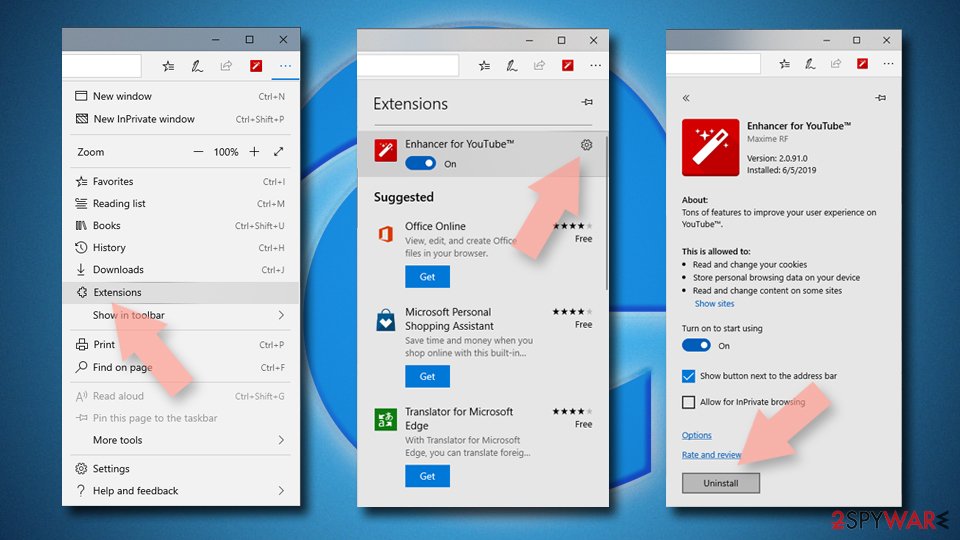
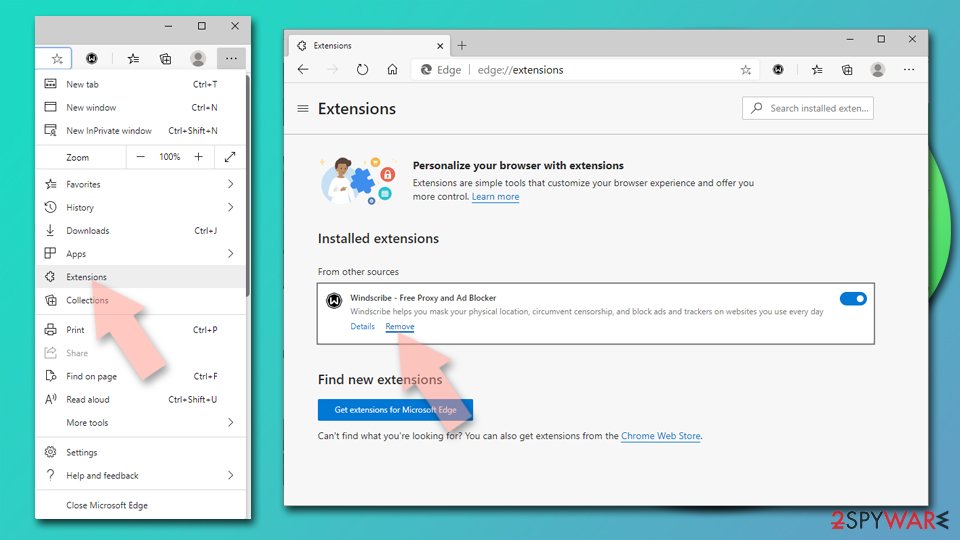
Delete unwanted extensions from MS Edge:
- Select Menu (three horizontal dots at the top-right of the browser window) and pick Extensions.
- From the list, pick the extension and click on the Gear icon.
- Click Remove.
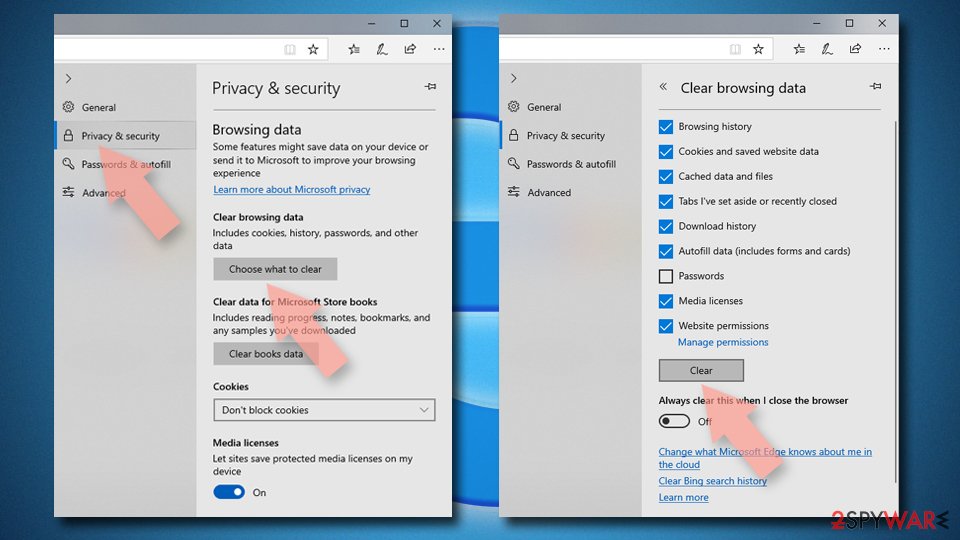
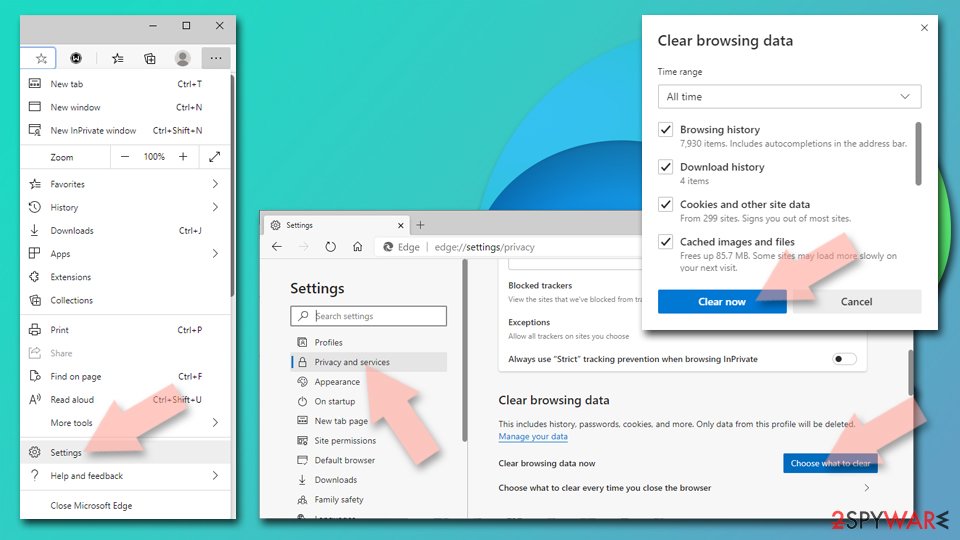
Clear cookies and other browser data:
- Click on the Menu (three horizontal dots at the top-right of the browser window) and select Settings > Privacy, search, and services..
- Under Clear browsing data, pick Choose what to clear.
- Select Cookies and other site data and Cached images and files. (apart from passwords, although you might want to include Media licenses as well, if applicable) and click on Clear.
Restore new tab and homepage settings:
- Click the menu icon and choose Settings.
- Then find On startup section.
- Click Remove next to any suspicious startup page.
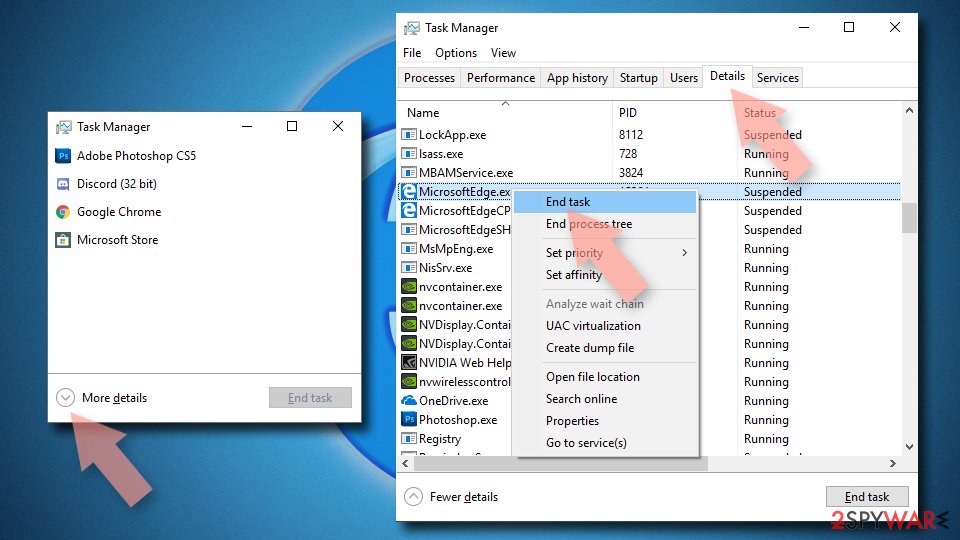
Reset MS Edge if the above steps did not work:
- Press on Ctrl + Shift + Esc to open Task Manager.
- Click on More details arrow at the bottom of the window.
- Select Details tab.
- Now scroll down and locate every entry with Microsoft Edge name in it. Right-click on each of them and select End Task to stop MS Edge from running.
Delete extensions from MS Edge (Chromium):
- Open Edge and click select Settings > Extensions.
- Delete unwanted extensions by clicking Remove.
Clear cache and site data:
- Click on Menu and go to Settings.
- Select Privacy, search and services.
- Under Clear browsing data, pick Choose what to clear.
- Under Time range, pick All time.
- Select Clear now.
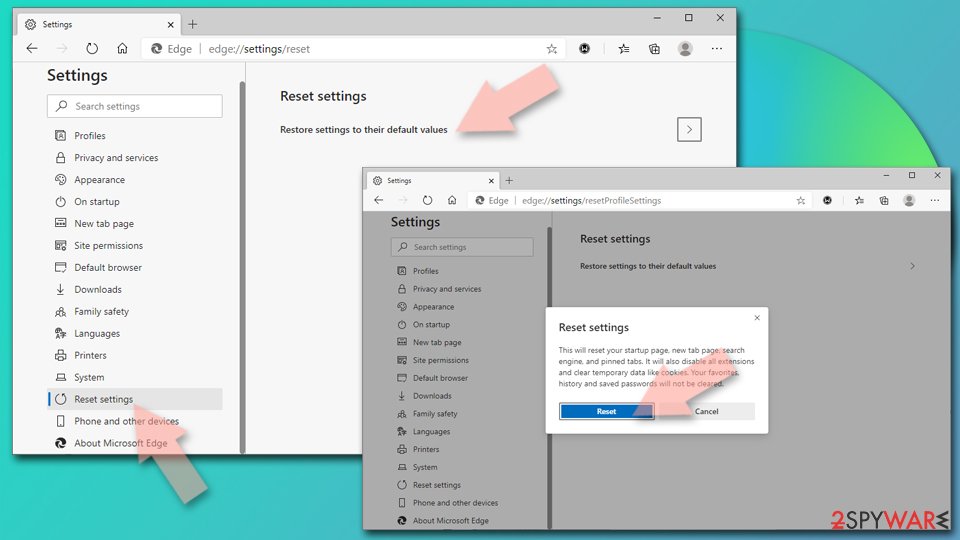
Reset Chromium-based MS Edge:
- Click on Menu and select Settings.
- On the left side, pick Reset settings.
- Select Restore settings to their default values.
- Confirm with Reset.
- This will disable extensions and reset startup pages but will not delete bookmarks, saved passwords, or browsing history.
Remove from Mozilla Firefox (FF)
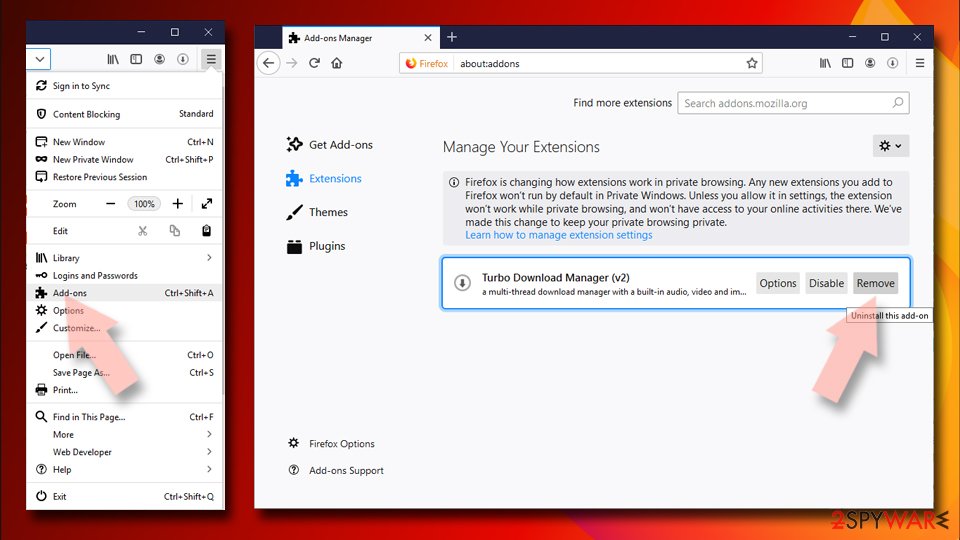
Remove dangerous extensions:
- Open Mozilla Firefox browser and click on the Menu (three horizontal lines at the top-right of the window).
- Select Add-ons.
- In here, select the unwanted extension and click Remove.
Reset the homepage:
- Click three horizontal lines at the top right corner to open the menu.
- Choose Settings.
- Under Home, set your preferred homepage and new tab settings.
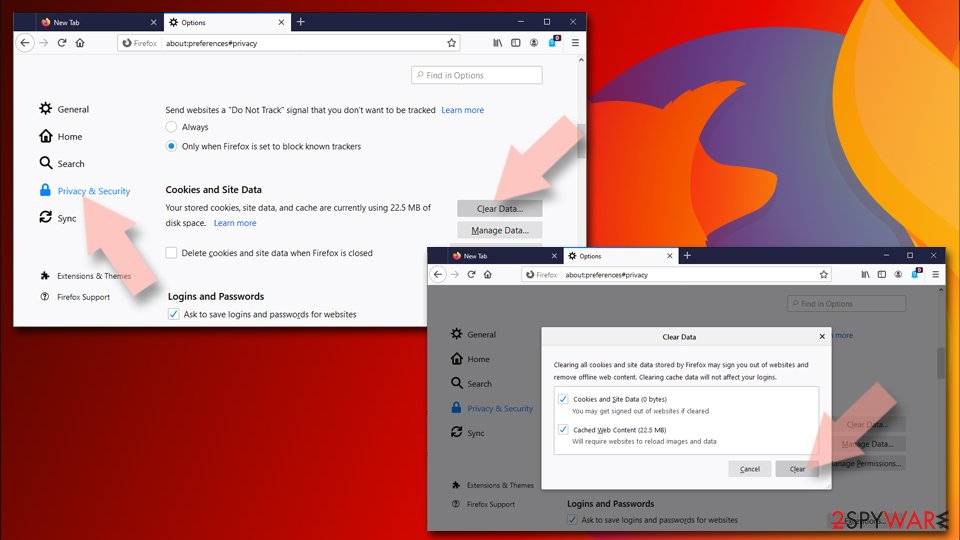
Clear cookies and site data:
- Click Menu and pick Settings.
- Go to Privacy & Security section.
- Scroll down to locate Cookies and Site Data.
- Click on Clear Data...
- Select Cookies and Site Data and Temporary cached files and pages, then click Clear.
Reset Mozilla Firefox
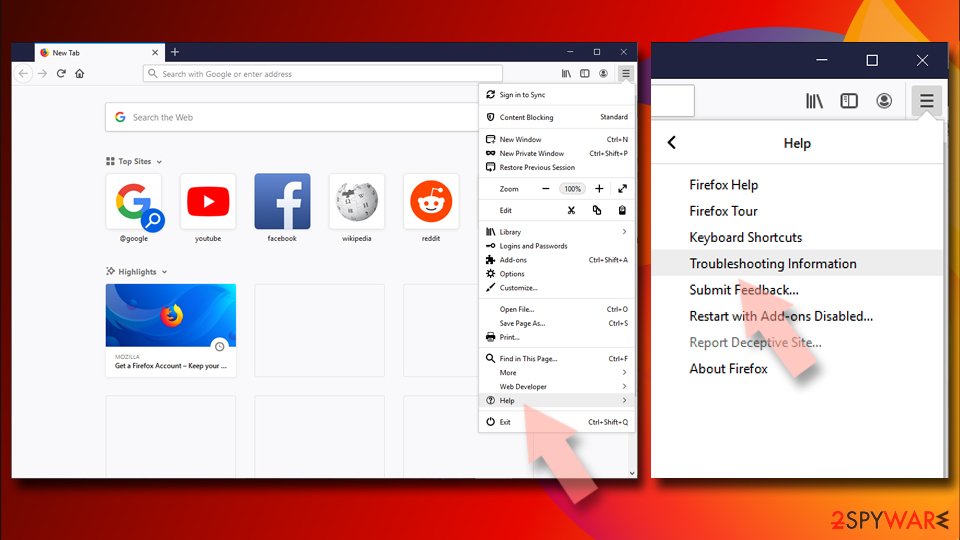
If clearing the browser as explained above did not help, reset Mozilla Firefox:
- Open Mozilla Firefox browser and click the Menu.
- Go to Help and then choose Troubleshooting Information.
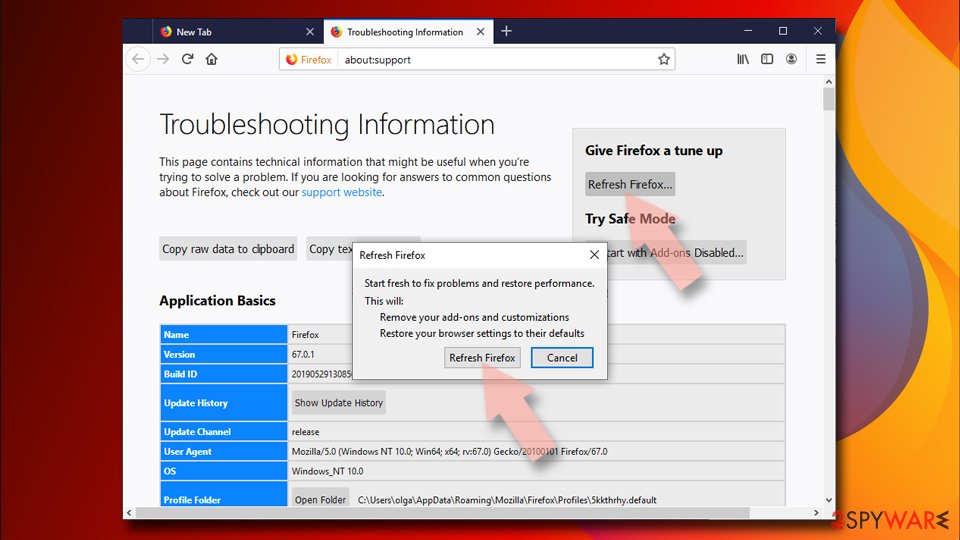
- Under Give Firefox a tune up section, click on Refresh Firefox...
- Once the pop-up shows up, confirm the action by pressing on Refresh Firefox.
Delete from Safari
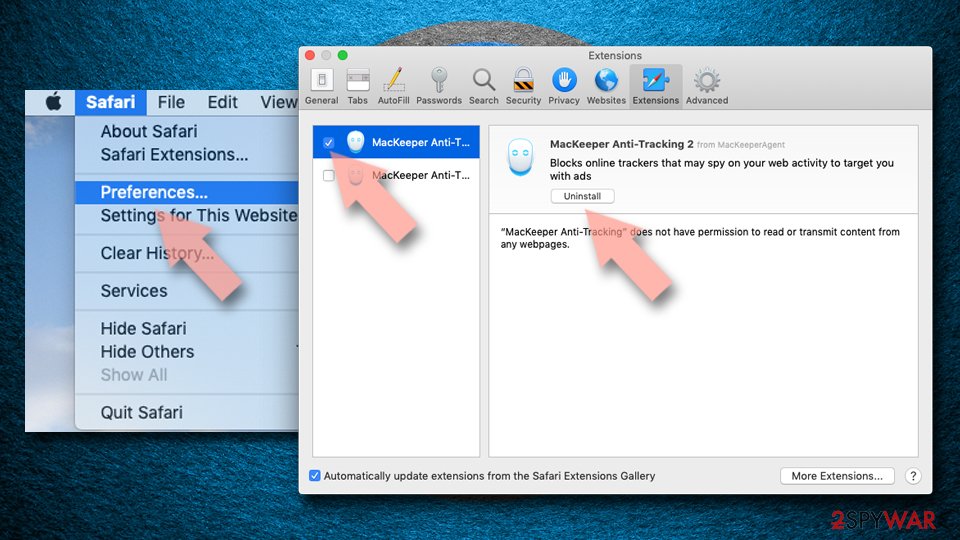
Remove dangerous extensions:
- Open Safari, click Safari in the menu at the top-left of the screen, and select Preferences.
- Go to the Extensions tab, look for any suspicious entries, and click Uninstall to remove them.
Clear history and website data:
- Click Safari in the menu and pick Clear History.
- Set Clear to all history and confirm with Clear History.
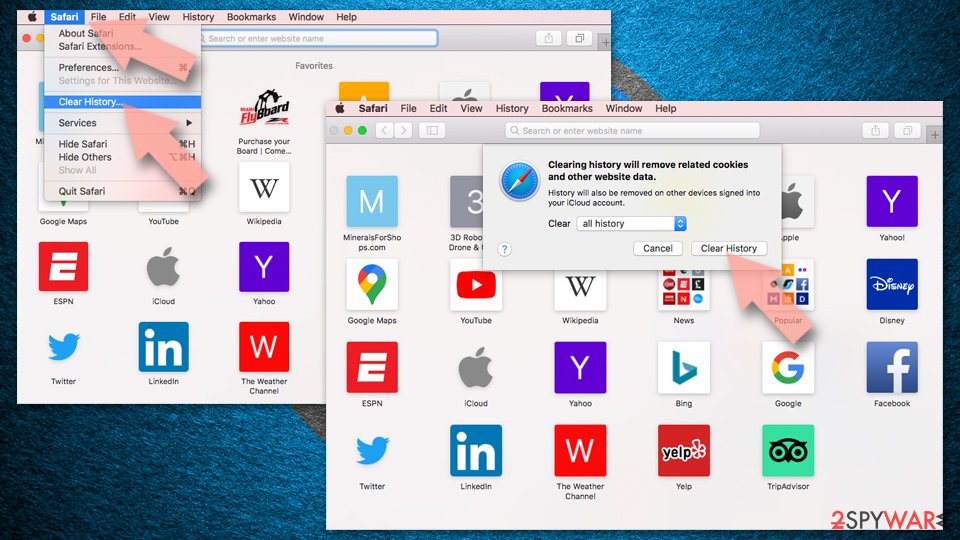
Reset Safari:
- Click Safari in the menu and select Preferences > Advanced.
- Enable Show Develop menu in menu bar.
- From the menu bar, click Develop and select Empty Caches.
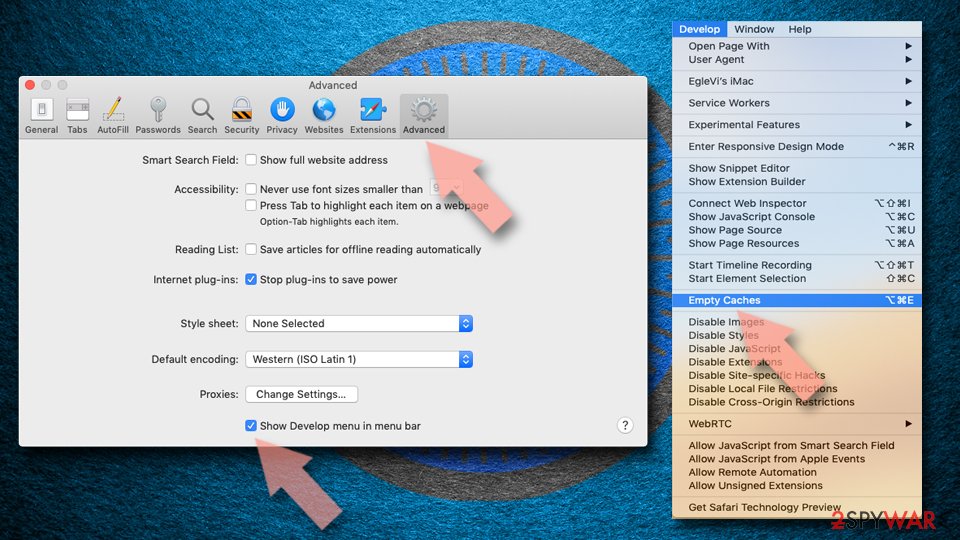
Delete from macOS
Remove the unwanted application:
- From the menu bar, select Go > Applications.
- In the Applications folder, look for any suspicious entries, then drag them to Trash (or right-click and pick Move to Trash).
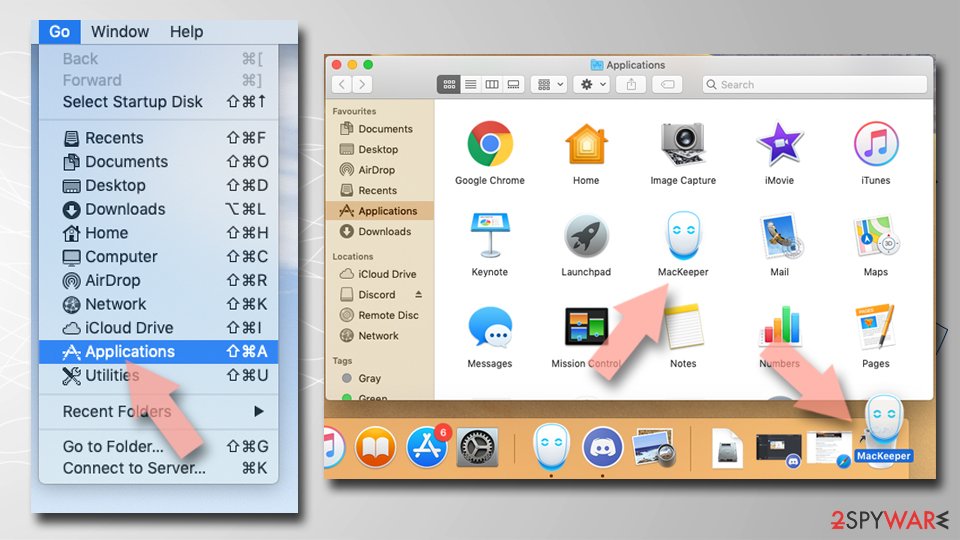
Delete leftover files and folders:
- Select Go > Go to Folder.
- Enter /Library/Application Support and remove any suspicious folders related to the unwanted program.
- Repeat the same check in the /Library/LaunchAgents and /Library/LaunchDaemons folders, deleting any suspicious entries.
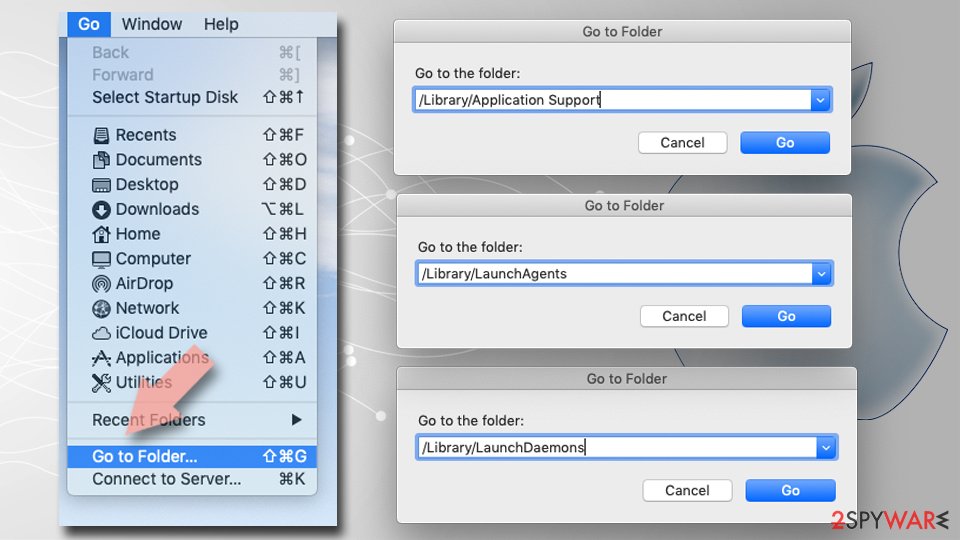
- Finally, empty the Trash to permanently remove the leftovers.
Choose a proper web browser and improve your safety with a VPN tool
Online spying has got momentum in recent years and people are getting more and more interested in how to protect their privacy online.
One of the basic means to add a layer of security - choose the most private and secure web browser. Although web browsers can't grant full privacy protection and security, some of them are much better at sandboxing, HTTPS upgrading, active content blocking, tracking blocking, phishing protection, and similar privacy-oriented features.
However, if you want true anonymity, we suggest you employ a powerful VPN - it can encrypt all the traffic that comes and goes out of your computer, preventing tracking completely.
Lost your files? Use data recovery software
While some files located on any computer are replaceable or useless, others can be extremely valuable.
Family photos, work documents, school projects - these are types of files that we don't want to lose. Unfortunately, there are many ways how unexpected data loss can occur:
- power cuts
- Blue Screen of Death errors
- hardware failures
- crypto-malware attack
- even accidental deletion
To ensure that all the files remain intact, you should prepare regular data backups. You can choose cloud-based or physical copies you could restore from later in case of a disaster. If your backups were lost as well or you never bothered to prepare any, can be your only hope to retrieve your invaluable files.
From our report of Jan 2021 · not reviewed since
Remove Congratulations, you've won virus from Android or iPhone
The adware-type virus has been actively spreading on Android and iOS devices.
If your iPhone, iPad or other dives has been interrupting you with ads offering the reward or valuable prize, there is a great chance that your system is infected with the Fakeyouwon malware or similar virus.
To uninstall Congratulations, you won from Android, follow these steps:
To get rid of the app from iPhone, use the guide given below:
Additionally, follow these steps:
- Scan the device with a reputable anti-malware tool for Android.
- Reboot the device in Safe Mode: When in Safe mode go to Settings and click on Apps or Application manager. Look for suspicious apps and uninstall them.
- If the problem persists, perform a factory reset: Go to Settings. Select Privacy and Factory reset. Back up your data before the reset. Reset device to remove the virus.
- Go to Settings;
- Tap on Safari icon;
- Select Clear History and Website Data;
- Close the window.
- Go to Settings -> General;
- Tap on Erase All Contents option.
From our report of Jan 2021 · not reviewed since
Get rid of Congratulations, you won virus for good with proper tools
Fortunately, it is relatively easy to remove Congratulations, you've won virus from Windows or MacOS.
If you are a proficient user, please follow the step-by-step guide below, presented to you by our experts.
Please be aware that you need to follow every step carefully and in the correct order, otherwise the PUP might be re-installed after a restart of your browser/computer.
If you are having issues with manual virus removal, you can use an anti-malware software as it can detect the unwanted program, delete all its registries and related files with ease.
Questions about Congratulations, you won ads
What is the Congratulations You Won scam?
Congratulations, You Won is a widespread internet scam displaying false messages about winning valuable prizes to Chrome browser users. The scam has remained popular for several years across Android, iOS, Windows, and macOS platforms. It poses as a lottery awarding tempting prizes like iPhones, Samsung phones, Walmart, or Amazon gift cards.
The scam's only aim is to swindle users' personal information for credential stuffing, identity theft, and financial fraud. The pop-up appears designed to look legitimate like official messages from Microsoft Corporation, but scammers invest significant resources making these deceptions convincing to trick unsuspecting users.
How does the scam work?
The scam displays a pop-up claiming you've been selected to receive a free premium prize before offering to another person. A time limit pressures you to complete a short survey within minutes, creating urgency and reducing careful consideration. The seemingly simple three-question survey requests your full name, email address, and phone number.
After answering, you're told you must register for a service costing five dollars weekly to claim the prize. You're then asked to enter credit card information to process the payment. In reality, recurring charges begin immediately and continue indefinitely unless you contact your bank.
Is the Congratulations message from Microsoft or Google?
No. The pop-up has absolutely nothing to do with Microsoft or Google. Scammers deliberately mimic the style and appearance of official Microsoft messages to deceive inexperienced users.
The professional design creates false legitimacy. Legitimate companies never distribute rewards through random pop-ups requiring email or payment information. Microsoft and Google never use pop-ups to notify users of winnings.
Any message claiming Microsoft or Google selected you for a prize through a pop-up is automatically a scam. You should never provide personal information to any such message.
What happens if I complete the survey?
Completing the survey leads to multiple severe consequences. You'll be prompted to enter your telephone number and then forced to register for unnecessary paid services costing five dollars weekly. Scammers might redirect you to fake websites mimicking legitimate companies where you install malware stealing your personal data and financial information.
Your credit card will be charged repeatedly every week or few weeks for services you don't need. Without contacting your bank, these bills continue indefinitely. Scammers may sell your personal information on the dark web to the highest bidder, enabling identity fraud and additional financial crimes.
Can I get my money back?
Contact your bank or credit card company immediately upon discovering unauthorized charges. Report the fraudulent activity and request that charges be reversed and your card canceled.
File a dispute claim against the recurring charges to recover your money. Contact the company making the charges and demand refunds, though scammers typically ignore such requests.
If malware was installed, your financial accounts may be compromised further. Change all banking passwords immediately and monitor your accounts closely for additional unauthorized activity. File a complaint with the Federal Trade Commission documenting the scam.
How does the scam customize to my location?
The scammy website alters its appearance based on your location, device type, and browser preferences because the underlying adware tracks and monitors your information. The scam can customize which prizes it claims you've won based on your detected location. Samsung users might see Samsung Galaxy prizes, iPhone users see iPhone rewards.
Users in different countries see locally relevant retailers like Costco, Walmart, or Amazon. The customization makes the scam more convincing because it appears tailored specifically to you. This tracking proves that adware has compromised your system beyond just the pop-up itself.
How did this scam appear on my device?
The scam reaches your device through bundled software distributions. You likely installed adware unknowingly when downloading free software using Recommended installation settings without checking Advanced mode. Adware spreads through software bundling, with PUPs sneaking into computers while users skip steps or use Quick installation.
Torrent websites and pirated software sources frequently bundle such adware. Clicking suspicious ads or fake update notifications can also trigger downloads of malicious software. Once installed, the adware displays various scam messages including Congratulations winning campaigns.
How do I remove this adware from my device?
Uninstall any applications you don't recognize or recently installed through your system's Add/Remove Programs or Applications folder. Perform a full system scan with reputable anti-malware software to find and eliminate all adware components.
Run the anti-malware scan in Safe Mode if possible to prevent the adware from interfering. Use Microsoft Defender's full scan and offline scan capabilities.
Clear all browser cache, cookies, and browsing history to eliminate adware tracking cookies. Reset your browser to default settings to remove any hijacked homepage or search engine settings. Install updated anti-malware software with real-time protection.
How can I protect myself from this scam?
Never download software from third-party or torrent websites; use only official sources. Always update software through official websites, never through pop-up notifications claiming updates are available.
During software installation, use Advanced mode and carefully read terms, unticking unwanted programs. Never click on suspicious advertisements offering unrealistic prizes or deals. Decline any offers suggesting you've won something or been specially selected.
Be skeptical of messages requiring personal information or urgent action. Obtain anti-malware software offering real-time protection to prevent infections before they reach your system.
Will Fortect remove Congratulations, you won?
Fortect scans Windows for malware and unwanted programs and repairs the system files and settings they change, and its free scan shows what it finds on your PC before you decide anything.
For Congratulations, you won, follow the plan above as well: the browser steps take back permissions and settings that no scanner treats as a threat, and uninstalling the program that brought it removes the source.
Run Microsoft Defender's full scan and, if anything was found, its offline scan as a second opinion. If the symptoms are gone after the plan and both scans are clean, there is nothing more to do.
Sources
- The Heimdal Security blog: Top Online Scams Used by Cyber Criminals to Trick You (read October 7, 2026)
- The Register: Some credential-stuffing botnets don't care about being noticed any more (read October 7, 2026)
- ScamBusters: Online Surveys: Are They All Scams? Plus 2 Real Alternatives… (read October 7, 2026)
- Google Chrome Help: Use notifications to get alerts (no longer online) (read October 7, 2026)
- FTC: How to recognize, remove and avoid malware (read October 7, 2026)