
Omerstroke: what it is and how to remove it
Omerstroke is an AOL parasite. It is capable of monitoring user's activities in AIM messenger and recording account passwords to predetermined websites.
Facts checked October 7, 2026. Removal steps tested on Windows 11 (26H2) and checked against Microsoft's and the browser makers' current documentation. Sections marked as our earlier report are the original text: they describe the threat as it was then and have not been reviewed since. The 2026 status, the removal steps and the questions are current.
Automatic
Get a free scan and check if your PC is infected.
Fortect finds malware, unwanted programs and the Windows damage they leave behind, and repairs it in one pass.
If Omerstroke keeps coming back after uninstalling, a scan can find what reinstalls it.
Do it yourself · free Remove Omerstroke yourself 4 steps, about 12 minutes, no software needed.
Start the stepsOmerstroke: summary
| Detection names | No Microsoft detection name is known |
|---|---|
| Distribution | Not recorded in the old report |
| Damage | Not recorded in the old report |
| Name | Omerstroke |
| Type | Ad-supported download manager |
| Symptoms | An unknown program in Installed apps |
| Removal | Scan the PC with security software to find and remove the malware and anything installed with it. Fortect scans Windows for malware and repairs the system files and settings it damaged. Remove it nowTo use the full-featured product, you have to purchase a license for Fortect. The scan is free. |
Show 4 more facts
| Evidence | One write-up by a security site; details still limited |
|---|---|
| Program | Omerstroke |
| First seen | 27 October 2015 |
| Facts checked | 7 October 2026 |
Is Omerstroke safe? Why it is flagged
From our report of Oct 2015 · not reviewed since
About Omerstroke
Omerstroke is an AOL parasite.
It is capable of monitoring user's activities in AIM messenger and recording account passwords to predetermined websites. It can also capture any message that the user types and sends via IM to predetermined AOL chatrooms. Once the required information is gathered, the attacker received it by e-mail.
From our report of Oct 2015 · not reviewed since
What is the purpose of Omerstroke virus?
Omerstroke is an AOL parasite that aims at monitoring AOL interface and records any changes that the user initiated in regards with AOL password.
Once the user changes the password, the Trojan reacts immediately and sends an email that contains a new password to its host. The email address is always predetermined, i.e. elitemail.org.
From our report of Oct 2015 · not reviewed since
How does this AOL parasite work?
Omerstroke virus infection is clear sign that your computer is under the control of a hacker.
There is no doubt that it's bad sign because there is high-risk of another computer attack. This AOL parasite is very similar to the Internet worm.
Once installed, Infostealer.Omerstroke file is executed, and the fake error message is being generated by a scheduled task. Omerstroke virus also creates a Windows starup key, which is HKEY_LOCAL_MACHINE\SOFTWARE\Microsoft\Windows\CurrentVersion\Run. It means that it starts working one the system is booted.
How Omerstroke got installed
From our report of Oct 2015 · not reviewed since
There are lots of ways for Omerstroke AOL parasite to infect computers.
It can be spread in a bundle with freewares/sharewares. However, that's a relatively fair manner, which is not the most frequently used. More often it is spread via fake pop-up alerts that from the first glimpse look like regular Windows notifications that contain 'Yes' and 'No' buttons. In this particular case, there is no difference in which button you will click because Omerstroke infection is executed.
Also, this parasite can also be injected on computers with the help of a Trojan horse. This method is by far the most frequently applied. This way, there is no chance of knowing how and when the system has been infected because Trojans work silently and easily exploit security vulnerabilities.
How to uninstall Omerstroke
How to remove Omerstroke
Uninstall it and remove the extras it installed, then scan for the files you downloaded with it.
Step 1: Uninstall Omerstroke
Omerstroke is removed like any other program, from the list of installed apps. In Windows 11 that is Settings > Apps > Installed apps, in Windows 10 Settings > Apps > Apps & features, and in both you can also use Control Panel > Programs and Features.
Select Omerstroke, click Uninstall and follow the uninstaller to the end. Then look at the entries just above and below it when the list is sorted by date: bundled programs install at the same minute.
Full procedure with screenshots: Uninstall a program or app in Windows On uGetFix
Step 2: Remove it from startup
Press Ctrl + Shift + Esc to open Task Manager and select Startup apps (Windows 11) or the Startup tab (Windows 10). Disable entries you do not recognise, especially ones with no publisher or with a name that copies a Windows component.
Right-click an entry and choose Open file location to see where it runs from: programs in
%AppData%or%Temp%deserve a closer look. Some entries are not listed there but in the registry Run keys, which the procedure below shows how to check.Full procedure with screenshots: Stop apps from opening at startup On uGetFix
Step 3: Delete the folders left behind
Uninstalling often leaves the program's folders, and some threats reinstall themselves from them.
Press Windows + R, type
%LocalAppData%and press Enter, then do the same for%AppData%and %ProgramData%, and look for folders named after Omerstroke, its publisher or created on the day the problem started. Delete those folders, and check C:\Program Files and C:\Program Files (x86) too.If Windows says a file is in use, end it in Task Manager or delete the folder after a restart in Safe Mode. The folders are the same in Windows 11 and Windows 10.
Full procedure with screenshots: Remove what malware leaves behind in Windows
Step 4: Scan the PC, then run the offline scan
A scan finds the parts of Omerstroke that the manual steps cannot see. In Windows Security > Virus & threat protection > Scan options, start a Full scan and quarantine what it reports.
Follow it with Microsoft Defender Antivirus (offline scan) > Scan now, which restarts the PC and checks the disk while Windows and the malware are not running.
It takes about 15 minutes and works the same in Windows 11 and Windows 10. If either scan finds something, run the full scan again after removal until it comes back clean.
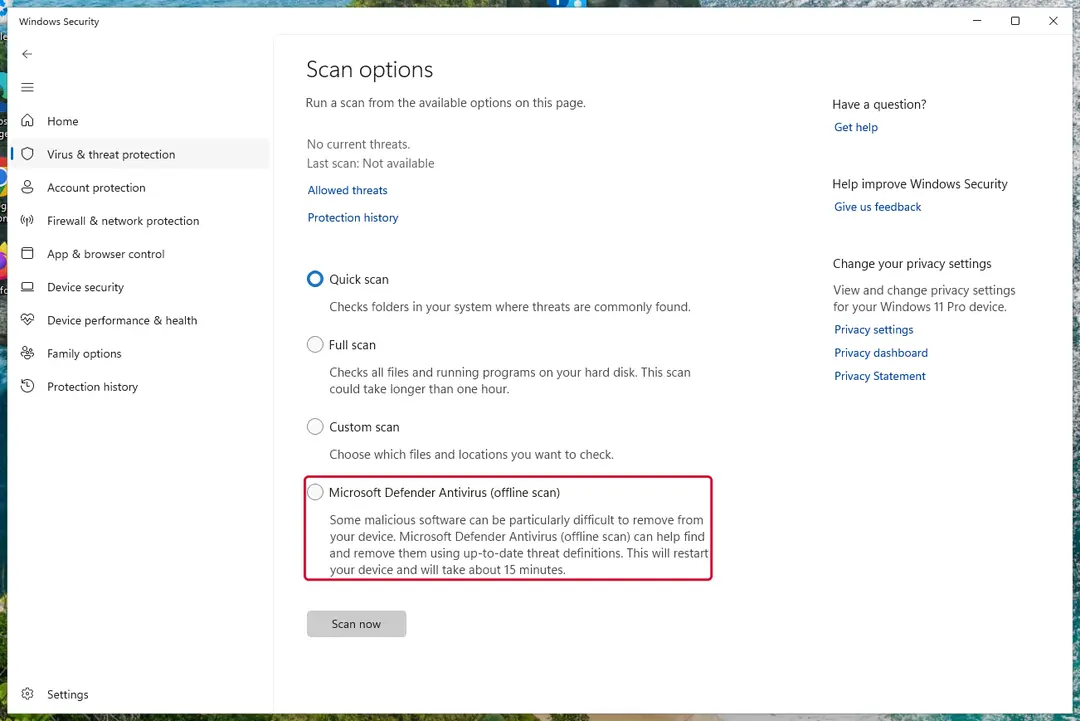
Windows 11: Windows Security > Virus & threat protection > Scan options. Full procedure with screenshots: Run a Microsoft Defender Offline scan
Do not let government spy on you
The government has many issues in regards to tracking users' data and spying on citizens, so you should take this into consideration and learn more about shady information gathering practices.
Avoid any unwanted government tracking or spying by going totally anonymous on the internet.
You can choose a different location when you go online and access any material you want without particular content restrictions. You can easily enjoy internet connection without any risks of being hacked by using VPN.
Control the information that can be accessed by government any other unwanted party and surf online without being spied on. Even if you are not involved in illegal activities or trust your selection of services, platforms, be suspicious for your own security and take precautionary measures by using the VPN service.
Backup files for the later use, in case of the malware attack
Computer users can suffer from data losses due to cyber infections or their own faulty doings.
Ransomware can encrypt and hold files hostage, while unforeseen power cuts might cause a loss of important documents. If you have proper up-to-date backups, you can easily recover after such an incident and get back to work. It is also equally important to update backups on a regular basis so that the newest information remains intact - you can set this process to be performed automatically.
When you have the previous version of every important document or project you can avoid frustration and breakdowns. It comes in handy when malware strikes out of nowhere. Use for the data restoration process.
From our report of Oct 2015 · not reviewed since
Omerstroke removal and prevention
The system that has been affected by Omerstroke AOL or another similar parasite cannot be fixed without the help of relevant software.
Security experts notify that Spyware like this is getting more and more removal resistant. In other words, they tend to create extra files, substitute location folders and initiate other tasks to avoid detection. That's why the only reliable method to remove Omerstroke parasite and prevent such infections in the future is a full system check with or another powerful anti-malware. Besides, it's a must to update anti-spyware regularly.
Questions about Omerstroke
Is Omerstroke a virus?
Most programs that appear the way Omerstroke did are not viruses in the strict sense. They are potentially unwanted programs:
- real software that arrives bundled with other downloads and then shows offers
- changes browser settings
- starts with Windows
Some are harmless, some are annoying and a few carry adware. What makes it worth removing is that you did not choose it.
Uninstall it from Installed apps and check the startup list and the browsers for anything added the same day. If it refuses to uninstall or returns after a restart, treat it as more serious and run a Microsoft Defender offline scan.
How do I stop programs like Omerstroke from being installed again?
Most unwanted programs arrive through installers, so the fix is in how you install software. Download programs from their official sites or the Microsoft Store, not from download portals or ads above search results. During setup, choose Custom or Advanced installation and untick every extra offer, including browsers, toolbars and optimizers.
Decline update prompts that appear inside other programs unless you know them. In Windows Security, turn on reputation-based protection and potentially unwanted app blocking. These steps would most likely have stopped Omerstroke before it reached the app list.
Why does Omerstroke reinstall itself?
Programs like Omerstroke are often installed with an updater or a companion app whose job is to keep them present. When you uninstall the main program, the helper downloads it again at the next scheduled run or restart.
Find the helper by sorting Installed apps by date and by checking Task Scheduler and Services for entries with the same name or publisher. Remove them all, then delete leftover folders. Turning on Potentially unwanted app blocking in Windows Security also stops many reinstall attempts.
Omerstroke will not uninstall. What can I do?
Close it first: in Task Manager, select every process with its name and click End task, and exit its tray icon. Then uninstall it from Settings > Apps > Installed apps. If the uninstaller fails, shows an error or just reopens offers, restart Windows in Safe Mode, where third-party programs do not start, and uninstall from there.
Afterwards, delete its folders in C:\Program Files and %AppData%, remove its scheduled tasks and run a full scan in Windows Security. As a last step, System Restore to a date before the install can help.
Is Omerstroke why my PC is slow?
It can be one reason. Programs of this kind often start with Windows, run updaters in the background and keep a process open all the time.
The sign reported, omerstroke in the list of installed apps, means at least one such program is active. Open Task Manager, sort by CPU, memory and network, and see whether Omerstroke or a related process is near the top.
If it is, removing it will help. If not, the slowdown has another cause, but removing a program you never chose is still worth doing. A restart after removal shows the difference best.
Is my privacy at risk because of Omerstroke?
A little, not dramatically. Unwanted programs tend to report what you install, which sites you visit or how you use the program back to their publisher. That data is sold or used for ads.
The sign people noticed, omerstroke in the list of installed apps, is consistent with such a program, and nothing reported suggests access to your files, camera or passwords.
Remove it, delete its leftovers and clear the browser data if it touched the browser. From then on, keep Potentially unwanted app blocking switched on in Windows Security, which stops many of these programs before they install.
Is Omerstroke a virus?
Not in the strict sense. Nothing reported so far shows Omerstroke copying itself, encrypting files or stealing passwords, which is what security companies mean by a virus.
What people see is omerstroke in the list of installed apps, which fits an unwanted program: software that arrives bundled with something else and keeps running without being asked for. Many antivirus programs label such software PUP or PUA rather than malware.
That label does not make it harmless. It still uses your PC and connection, may collect data and is often bundled with other programs, so removing it is the right call. Uninstall it from Installed apps, then check startup items and browser settings for its companions.
How do I stop programs like Omerstroke from installing?
Turn on Potentially unwanted app blocking in Windows Security > App & browser control > Reputation-based protection settings, with both Block apps and Block downloads checked. Download programs from the developer's own site or the Microsoft Store, choose Custom in installers and untick extra offers, and treat large download buttons on file sites as ads.
Apps from the Microsoft Store are checked by Microsoft and uninstall cleanly. Keep real-time protection on, so that bundled offers flagged as unwanted are stopped before they install.
Can Windows Security remove Omerstroke?
Often yes, if Potentially unwanted app blocking is on. Microsoft Defender detects many bundled and unwanted programs as PUA, but by default it only blocks them during download in some cases. For a program already installed, uninstall it yourself from Installed apps first, then run a full scan in Windows Security to catch leftovers.
If omerstroke in the list of installed apps returns after that, run the Microsoft Defender offline scan, which works before Windows starts. Switching on the PUA setting afterwards helps keep similar programs out.
Will Fortect remove Omerstroke?
Fortect scans Windows for malware and unwanted programs and repairs the system files and settings they change, and its free scan shows what it finds on your PC before you decide anything.
For Omerstroke, follow the plan above as well: the browser steps take back permissions and settings that no scanner treats as a threat, and uninstalling the program that brought it removes the source.
Run Microsoft Defender's full scan and, if anything was found, its offline scan as a second opinion. If the symptoms are gone after the plan and both scans are clean, there is nothing more to do.
Sources
- FTC: How to recognize, remove and avoid malware (read October 7, 2026)
- Microsoft Learn: Microsoft Defender Offline (read October 7, 2026)
- Microsoft Learn: How Microsoft names malware (read October 7, 2026)