
Protectalldevices.space: what it is and how to remove it
Protectalldevices.space is a fraudulent website implicated in a deceptive scheme that mimics virus infection warnings, ostensibly from well-known cybersecurity firms. This website falsely presents these threats to coerce users into buying what it claims to be antivirus software.
Facts checked October 7, 2026. Removal steps tested on Windows 11 (26H2) and checked against Microsoft's and the browser makers' current documentation. Sections marked as our earlier report are the original text: they describe the threat as it was then and have not been reviewed since. The 2026 status, the removal steps and the questions are current.
Automatic
Get a free scan and check if your PC is infected.
Fortect finds malware, unwanted programs and the Windows damage they leave behind, and repairs it in one pass.
Not sure what keeps opening the "Your PC is infected with 5 viruses!" page? A free scan looks at the usual sources for you.
Do it yourself · free Remove Protectalldevices.space yourself 3 steps, about 9 minutes, no software needed.
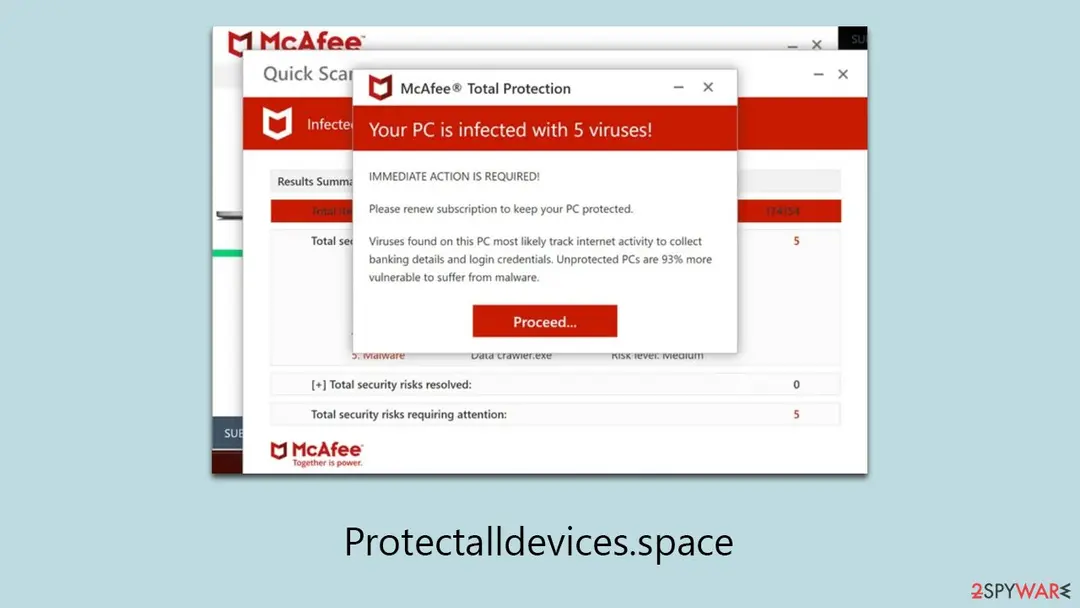
Protectalldevices.space: summary
| Distribution | Redirects from other malicious websites, adware |
|---|---|
| Damage | Loss of finances due to fake subscriptions; redirects to other malware-laden, scam websites; installation of potentially unwanted or malicious software |
| Name | Protectalldevices.space |
| Type | Scam, phishing, redirect |
| Scam content | Shows a pop-up that claims that trojans and other malware have been detected, then prompts users to purchase software to remove the allegedly found threats |
| Detection names | No Microsoft detection name is known |
| Removal | Scan the PC with security software to find and remove the malware and anything installed with it. Fortect scans Windows for malware and repairs the system files and settings it damaged. Remove it nowTo use the full-featured product, you have to purchase a license for Fortect. The scan is free. |
Show 5 more facts
| Symptoms | A fake virus warning in a browser tab |
|---|---|
| Evidence | One write-up by a security site; details still limited |
| Domains | protectalldevices[.]space |
| First seen | 8 January 2024 |
| Facts checked | 7 October 2026 |
What the Protectalldevices.space pop-up looks like
Your PC is infected with 5 viruses!
IMMEDIATE ACTION REQUIRED!
Your McAfee subscription has expired!
Renew now to keep your PC protected.
Viruses found on this PC most likely track internet activity to collect banking details and login credentials. Unprotected PCs are 93% more vulnerable to suffer from malware.
Is the Protectalldevices.space warning real?
- Address:
protectalldevices[.]space
From our report of Jan 2024 · not reviewed since
More from our earlier report on Protectalldevices.space
- You should not interact with any links or ads shown on the scam page and shut it down immediately.
- Then, perform a full scan with security software as a precautionary measure
- The website then prompts visitors to use McAfee Antivirus to remove these alleged threats.
- It's crucial to note that Protectalldevices.space is not associated with McAfee.
- Instead, it is operated by affiliates aiming to earn commissions by promoting and selling McAfee antivirus subscriptions through their links.
What the Protectalldevices.space scammers want
From our report of Jan 2024 · not reviewed since
Protectalldevices.space claims that your system is infected: do not fall for this scam
Protectalldevices.space is a fraudulent website implicated in a deceptive scheme that mimics virus infection warnings, ostensibly from well-known cybersecurity firms.
This website falsely presents these threats to coerce users into buying what it claims to be antivirus software. It is crucial to understand that these virus infection warnings are entirely bogus and are designed to replicate the look of a genuine security scan.
Despite the lack of authenticity in the virus scans presented by Protectalldevices.space, the potential presence of adware on your device should not be ignored. Adware is frequently the source of such false alerts and can expose your system to various cybersecurity threats if not addressed in a timely manner.
In the later parts of this article, we will delve into the details of the Protectalldevices.space scam and provide detailed guidance on how to identify and remove potential adware from your device. It is vital to be well-informed and vigilant to protect your digital environment from such deceptive tactics.
From our report of Jan 2024 · not reviewed since
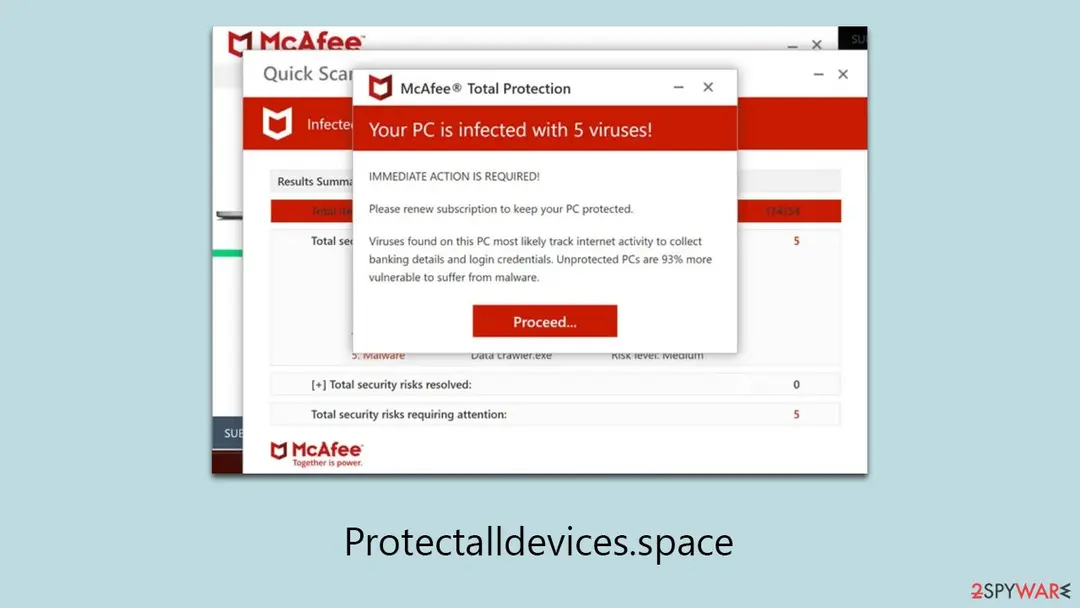
Fake messages imitating McAfee security scans
Upon accessing Protectalldevices.space, users are met with a false system scan followed by a deceiving alert claiming their computer is heavily infected with viruses.
This deliberate misinformation is designed to create urgency and fear, suggesting that these nonexistent viruses could jeopardize the user's system security and expose sensitive information like personal credentials or financial data.
This type of scam, often referred to as a "fake virus alert scam," skillfully manipulates human psychology, exploiting fears about cybersecurity to trap victims. The scammers use tactics ranging from fear-mongering to creating a sense of urgency, compelling victims to act hastily.
For example, the site might display alarming messages like:
This tactic of creating a false sense of urgency is a critical component of the scam's strategy. By convincing users that immediate action is necessary, scammers effectively prevent them from pausing to question the legitimacy of the alert. This urgency is carefully engineered to make the threat seem imminent, suggesting that any delay could result in further damage or data compromise.
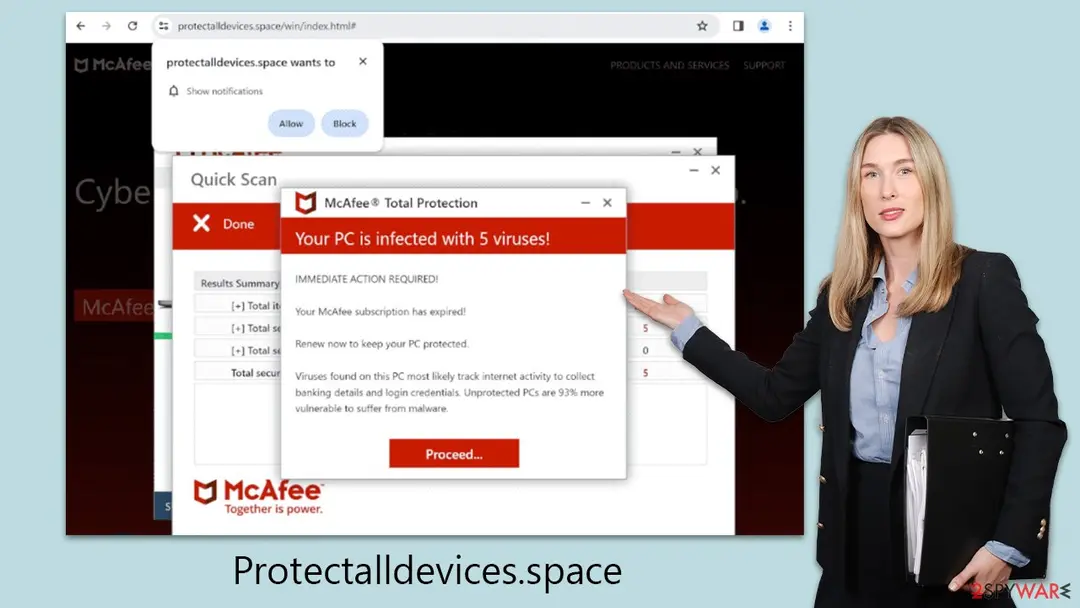
From our report of Jan 2024 · not reviewed since
Dangerous websites can be reached in numerous ways
Users typically come across scam websites like Protectalldevices.space through two main channels: accidental encounters on compromised websites or as a result of adware and other malware infections.
The first scenario occurs when users, unknowingly, visit legitimate but compromised websites. These sites might have been exploited due to security vulnerabilities or outdated software, allowing hackers to insert harmful codes. These codes, once interacted with, redirect the user to harmful websites. The deceptive nature of these embedded links makes them hard to distinguish from legitimate ones, often leading to users realizing the scam only after experiencing harm.
Alternatively, users might have their devices infected with adware or similar malware. Adware, characterized by the automatic display of unwanted advertisements, often sneaks into systems bundled with other downloads from the internet. This leads to unexpected redirections to scam websites or annoying pop-ups that direct users to these sites.
Regardless of how one encounters these fraudulent websites, the consequences can be severe, including financial loss or identity theft. This highlights the need for vigilant online behavior and robust security measures to protect against such threats.
How to get rid of the Protectalldevices.space pop-up
The warning is a web page and your PC is not infected by it.
Close it, then remove what keeps bringing it back.
Which browser shows the ads?
Step 1: Remove protectalldevices[.]space from Chrome's notification list
Chrome keeps a list of every site you once allowed to send notifications, and
protectalldevices[.]spaceis on it. Pastechrome://settings/content/notificationsinto the address bar, find protectalldevices[.]space under Allowed to send notifications, open the three-dot menu next to it and pick Remove.Then click Add next to Not allowed to send notifications and type protectalldevices[.]space, so the site cannot ask a second time. Repeat it in every Chrome profile you use on Windows 11 or Windows 10, since each profile has its own list.
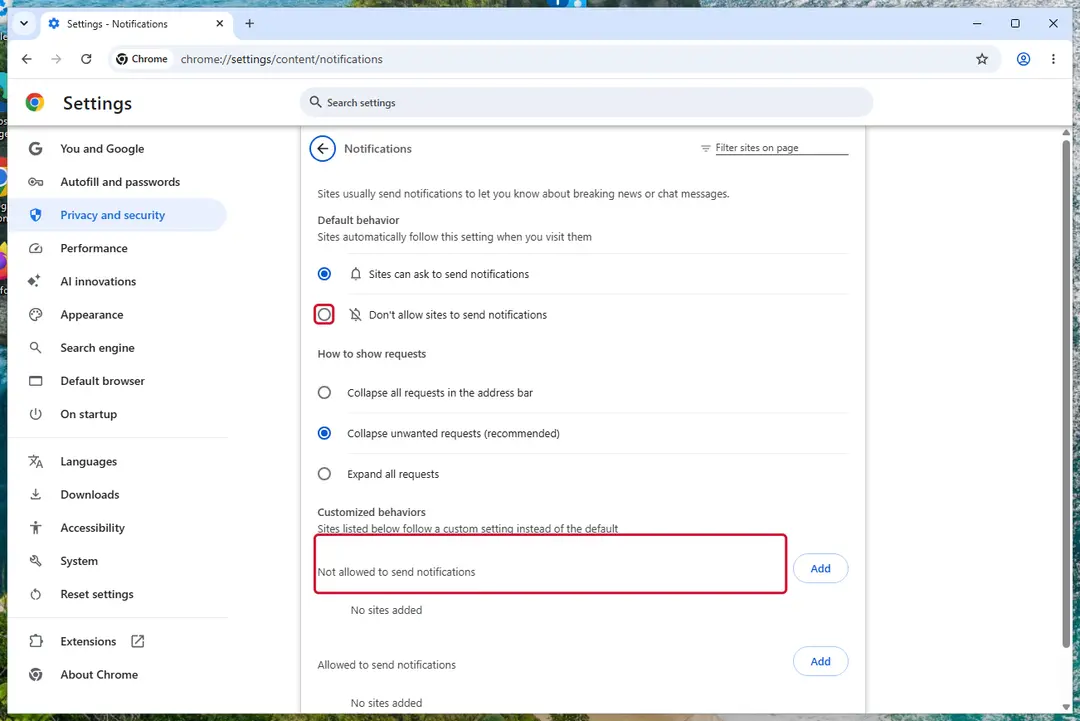
Chrome on Windows 11: Settings > Privacy and security > Site settings > Notifications. Full procedure with screenshots: Stop website notifications and pop-ups
Step 1: Remove protectalldevices[.]space from Edge's notification list
Open Settings and more (the three dots) > Settings > Privacy, search, and services > Site permissions > All permissions > Notifications. Remove
protectalldevices[.]spacefrom the Allowed list, then click Add site next to Not allowed to send notifications and enter it there.Edge is built into both Windows 11 and Windows 10, so check it even if you normally use another browser. If the notifications came with the Edge logo, this is the browser that holds the permission.
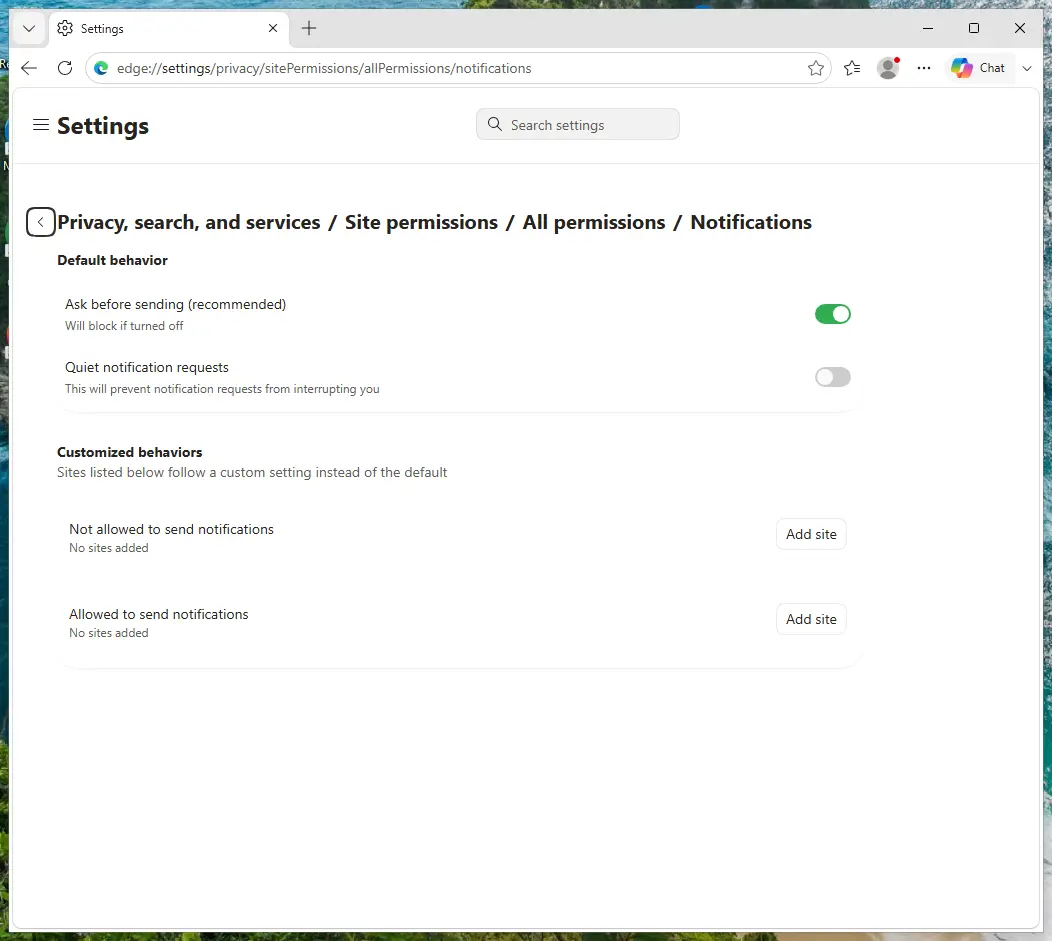
Edge on Windows 11: Site permissions > All permissions > Notifications. Full procedure with screenshots: Stop website notifications and pop-ups
Step 1: Remove protectalldevices[.]space from Firefox's notification permissions
Open the menu (three lines) > Settings and click Permissions and data in the left list, then Notifications. Select
protectalldevices[.]space, click Remove Website and confirm with Save Changes.In versions older than Firefox 152 the same list sits under Privacy & Security, behind a Settings button next to Notifications. Firefox shows these notifications only while it is running, on Windows 11 and Windows 10 alike.
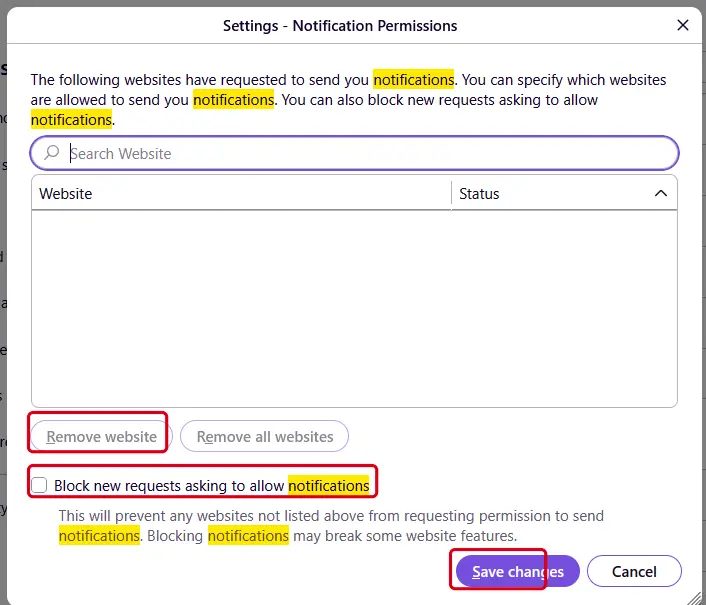
Firefox on Windows 11: the Notification Permissions window. Full procedure with screenshots: Stop website notifications and pop-ups
Then, whichever browser you use
Step 2: Close the page without touching its buttons
Press Ctrl + Shift + Esc to open Task Manager, select the browser on Processes and click End task: buttons on the page, including Close and Cancel, can trigger downloads or more pop-ups. When you reopen the browser, do not restore the previous tabs.
Warning: Never call a number shown in a browser warning; Microsoft and antivirus companies do not put phone numbers in warnings.
If the page opens again by itself, notifications or an extension are bringing it back. Task Manager works the same in Windows 11 and Windows 10.
Full procedure with screenshots: Close a frozen app (Task Manager, Force Quit) On uGetFix
Step 3: Scan the PC, then run the offline scan
A scan finds the parts of Protectalldevices.space that the manual steps cannot see. In Windows Security > Virus & threat protection > Scan options, start a Full scan and quarantine what it reports.
Follow it with Microsoft Defender Antivirus (offline scan) > Scan now, which restarts the PC and checks the disk while Windows and the malware are not running.
It takes about 15 minutes and works the same in Windows 11 and Windows 10. If either scan finds something, run the full scan again after removal until it comes back clean.
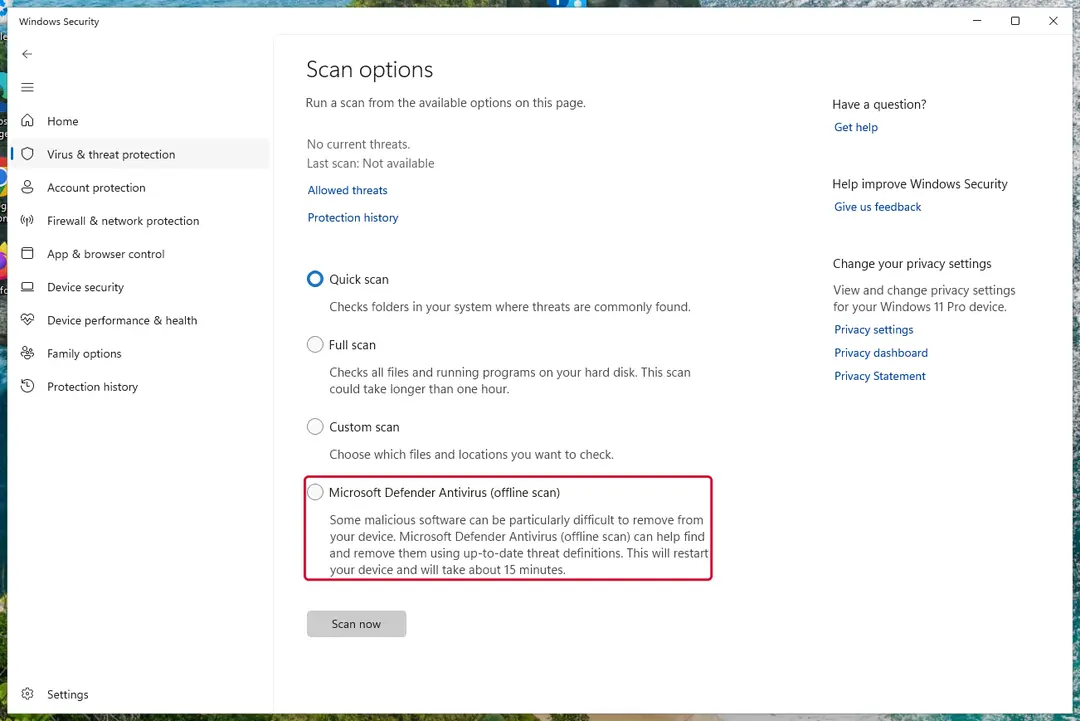
Windows 11: Windows Security > Virus & threat protection > Scan options. Full procedure with screenshots: Run a Microsoft Defender Offline scan
More removal instructions
For programs installed on the PC and older browsers. Open the one you need.
Remove adware and other unwanted apps
To effectively handle an encounter with a scam site like Protectalldevices.space, initiating an adware scan is crucial.
Employing trusted security software, such as or , allows for a thorough system check. These programs specialize in quickly identifying and removing any unwelcome software, helping restore your system to a secure state.
Manual removal of unwanted applications can be complex and risky, with the potential of mistakenly deleting useful programs. Automated removal, on the other hand, offers a faster and more straightforward approach. Once you're certain your device is clear of malware and adware, it's vital to clean your browser's cookies and other tracking elements promptly.
This can be achieved either through specialized software or by following detailed instructions we'll provide later. This dual approach of cleansing both your device and browser not only protects your system but also enhances your online browsing experience, keeping it free from intrusive tracking.
MS Edge (Chromium)
- Click on Menu and pick Settings.
- Under Privacy and security, select Clear browsing data.
- Select Browsing history, Cookies and other site data, as well as Cached images and files.
- Click Clear data.
- Click Menu and pick Options.
- Go to Privacy & Security section.
- Click on Clear Data...
- Select Cookies and Site Data, as well as Cached Web Content and press Clear.
- Click on Menu and go to Settings.
- Select Privacy and services.
- Under Clear browsing data, pick Choose what to clear.
- Under Time range, pick All time.
- Select Clear now.
- Click Safari > Clear History...
- From the drop-down menu under Clear, pick all history.
- Confirm with Clear History.
Disable unwanted push notifications
A significant tactic of Protectalldevices.space is to prompt users to enable push notifications.
This is a crucial point where users need to be wary, as consenting to these notifications can lead to more deceptive practices. These notifications may show further false alerts, amplify a sense of urgency, and flood users with unwanted ads, possibly leading to other malicious sites.
If you've enabled notifications from this site, it's important to block them to prevent these risks. The upcoming sections will guide you on how to do this effectively, ensuring your online safety.
Stop browser notifications
Protect your privacy - employ a VPN
There are several ways how to make your online time more private - you can access an incognito tab.
However, there is no secret that even in this mode, you are tracked for advertising purposes. There is a way to add an extra layer of protection and create a completely anonymous web browsing practice with the help of VPN. This software reroutes traffic through different servers, thus leaving your IP address and geolocation in disguise.
Besides, it is based on a strict no-log policy, meaning that no data will be recorded, leaked, and available for both first and third parties. The combination of a secure web browser and VPN will let you browse the Internet without a feeling of being spied or targeted by criminals.
No backups? No problem. Use a data recovery tool
If you wonder how data loss can occur, you should not look any further for answers - human errors, malware attacks, hardware failures, power cuts, natural disasters, or even simple negligence.
In some cases, lost files are extremely important, and many straight out panic when such an unfortunate course of events happen. Due to this, you should always ensure that you prepare proper data backups on a regular basis.
If you were caught by surprise and did not have any backups to restore your files from, not everything is lost. is one of the leading file recovery solutions you can find on the market - it is likely to restore even lost emails or data located on an external device.
Questions about Protectalldevices.space
Is the "Your PC is infected with 5 viruses!" warning from Microsoft?
No. Microsoft and Windows Security never show warnings inside a browser tab, never ask you to call a phone number and never charge for a scan through a web page. The message "Your PC is infected with 5 viruses!" comes from a website that copies the look of a system alert.
It runs a script that shows the same alarm to every visitor, whatever computer they use. Close the tab, and if it refuses to close, end the browser in Task Manager.
Then check the browser's notification permissions and extensions, because those are the usual reason such a page reopens. If you want to know whether the PC is really clean, open the Windows Security app from the Start menu and run a scan there.
The "Your PC is infected with 5 viruses!" page made me install something. What now?
Uninstall it first. Open Settings > Apps > Installed apps, sort the list by install date and remove whatever appeared when the page showing "Your PC is infected with 5 viruses!" told you to install it. Check the browser's extensions as well, since some pages push an extension instead of a program.
Then run a full scan with Microsoft Defender, and an offline scan if anything is found. If the program was a remote-access tool, or if you typed passwords while it was installed, change those passwords from another device and turn on two-step verification. Keep the file name and the page address; they are useful if you report the scam.
Why does my browser keep opening protectalldevices[.]space?
Because something sends you there. The usual causes are a notification permission you gave to some site, an adware extension, or a site you visit often that shows redirect ads. The site itself cannot open on its own.
Remove unknown sites from the notification settings, check the extensions list, and do not restore the previous session when the browser starts. If the page appears even with the browser closed, look in Installed apps for programs you did not install. Running a scan with Windows Security afterwards confirms that nothing else is involved.
Which browser settings protect against fake alerts?
Three matter most. First, notifications: set your browser to ask before allowing them, and block sites you do not trust. Second, reputation checks: SmartScreen in Edge and Safe Browsing in Chrome warn you before known scam pages load, and Firefox has its own deceptive-content protection under Privacy & Security.
Third, pop-ups and redirects: keep the default blocking on. Add a reputable ad blocker if fake alerts keep reaching you through ads on sites you use. Review the notification list every few months.
Can Protectalldevices.space harm my PC just by being open?
No. A web page runs inside the browser's sandbox and cannot install programs, read your files or change Windows settings on its own. Protectalldevices.space can only make noise, fill the screen and try to persuade you. The risk begins when you follow it:
- calling the number
- paying
- downloading a file
- pasting a command
Close the page, and if it frightened you into doing one of those, follow the matching steps in this guide. Otherwise, nothing on the PC needs cleaning or repairing.
The page will not close. What can I do?
Press Esc to leave full-screen mode, then close the tab. If the browser is frozen, open Task Manager with Ctrl + Shift + Esc, select the browser and click End task. When you restart the browser, do not restore tabs.
If the page loads again on start, open a new window and close the old one, then remove the page from the browser's startup settings. Restarting the PC also works. Nothing was installed by the page, so closing it by force is safe and loses nothing.
Is my phone affected by Protectalldevices.space?
Not through the PC. A scam page in a Windows browser cannot reach a phone, even if both use the same account. The sign reported, A browser warning that reads "Your PC is infected with 5 viruses!", happened in a browser on the PC.
Phones can meet similar pages on their own, usually through ads or notifications, and the fix there is the same idea: remove notification permissions and unknown apps. If you used the phone to call a number shown on the page, follow the steps for callers in this guide.
The agent knew details about my PC. Were they real?
They looked real but proved nothing. Callers from pages like Protectalldevices.space open the Windows Event Viewer, which shows harmless warnings on every PC, or run a command that lists normal system details, and present them as signs of infection. Some type alarming text into a command window themselves.
Nothing they showed you came from a real scan. If they had remote access, follow the clean-up steps anyway, because they may have installed tools while you watched. Change any password they could have seen.
I closed it, but it appeared again the next day. Why?
A page that returns on its own has a trigger. Look at how it appeared: from a pop-up in the corner of the screen means a notification permission; on start-up means a session restore or a changed start page; while browsing any site means an extension; on one particular site means that site's ads.
Each has a quick fix in the browser settings. If none of them explains it, reset the browser, which clears permissions, extensions and start pages together.
Will Fortect remove Protectalldevices.space?
Fortect scans Windows for malware and unwanted programs and repairs the system files and settings they change, and its free scan shows what it finds on your PC before you decide anything.
For Protectalldevices.space, follow the plan above as well: the browser steps take back permissions and settings that no scanner treats as a threat, and uninstalling the program that brought it removes the source.
Run Microsoft Defender's full scan and, if anything was found, its offline scan as a second opinion. If the symptoms are gone after the plan and both scans are clean, there is nothing more to do.
Sources
- FTC: How to spot, avoid and report tech support scams (read October 7, 2026)
- FTC: How to recognize, remove and avoid malware (read October 7, 2026)
- Microsoft Learn: Microsoft Defender Offline (read October 7, 2026)
- Microsoft Learn: How Microsoft names malware (read October 7, 2026)