
Free iPhone Scams in 2026: Fake Giveaways on Facebook
- Free iPhone scams in 2026: the short answer
- Timeline of social media giveaway scams
- What changed since 2017
- How free iPhone scams work today (our analysis)
- What to do if you clicked a free iPhone link
- What is still unknown
- Our original 2017 report
- Free iPhone scam used to build audience for fake Facebook or Instagram pages
- Scammers seek to collect victims' personal information
- Related guides on 2-Spyware
Free iPhone scams in 2026: the short answer
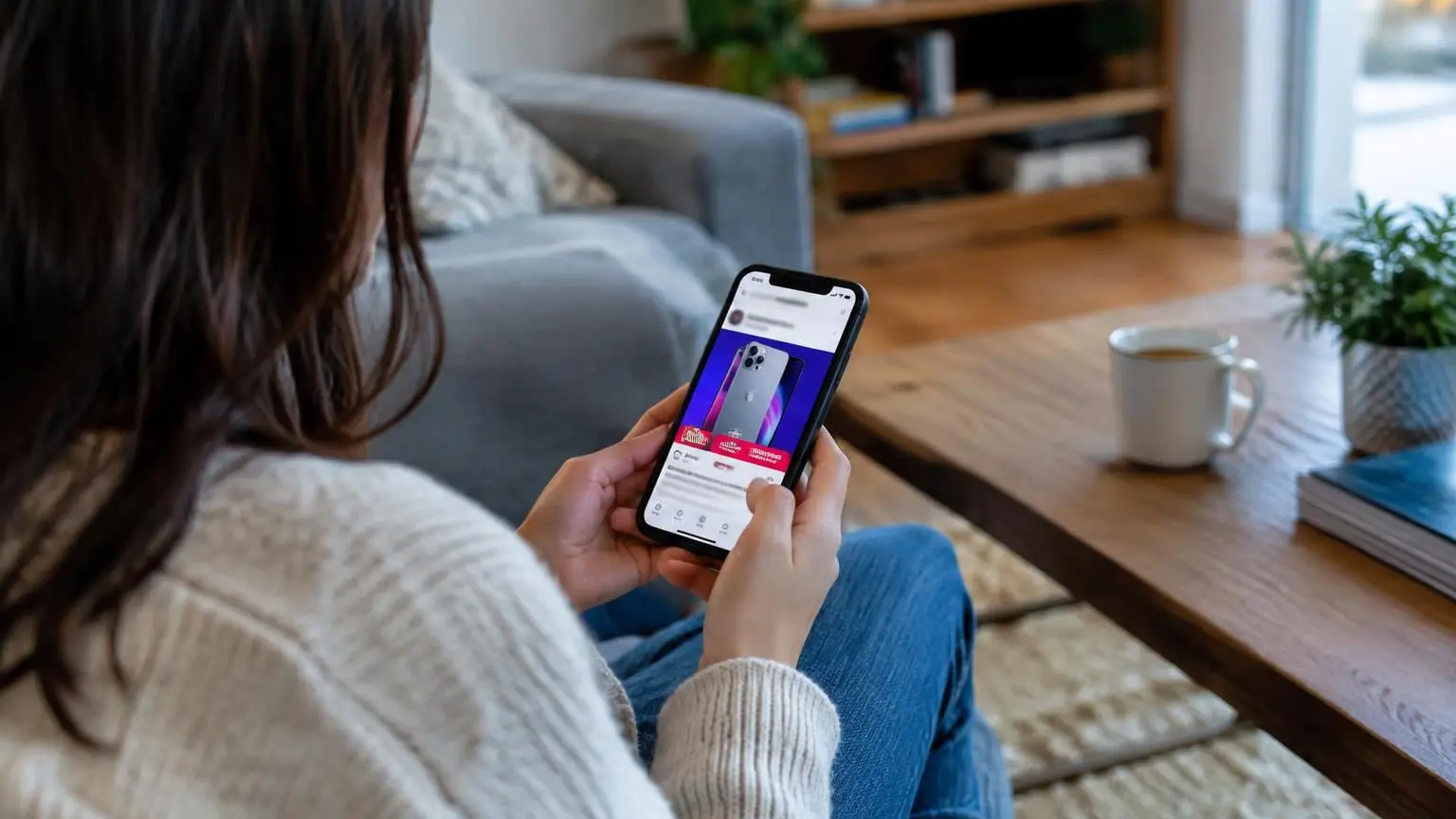
A post that promises a free iPhone for a like, a share, a survey or a small shipping fee is almost always a scam. The trick has not changed since our original report below: the prize does not exist, and the goal is your personal data, your card number or a bigger audience for a fake page.[1]
What has grown is the scale. The FTC says that in 2025 nearly 30% of people who reported losing money to a scam said it started on social media, with reported losses of $2.1 billion, about eight times the 2020 figure.[6] More money was lost to scams that started on Facebook than on any other platform.[6]
| Question | Answer in 2026 |
|---|---|
| Are free iPhone giveaways real? | Almost never when they ask for a fee, card details or a survey |
| Where do they appear? | Facebook most of all, with WhatsApp and Instagram a distant second and third[6] |
| What do scammers want? | Card numbers, personal data, page likes or app subscriptions[1][7] |
| How big is the problem? | $2.1 billion lost to scams that started on social media in 2025[6] |
| Prize scam losses | $145 million reported to the FTC in 2024[8] |
| Red flag | Any request to pay to claim a prize[7] |
Timeline of social media giveaway scams
| Date | Event |
|---|---|
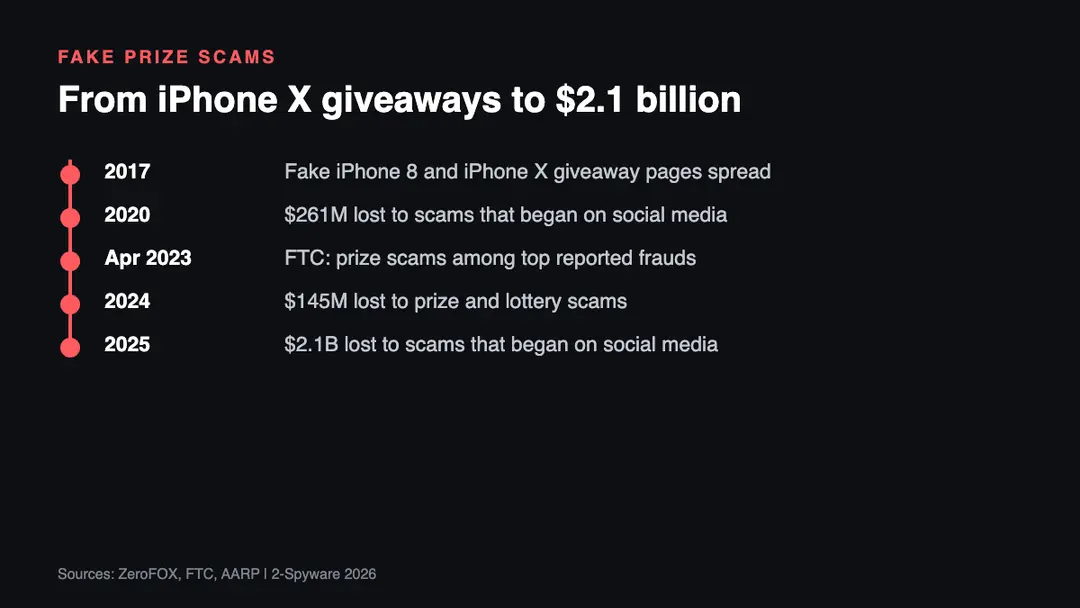
| 2017 | Fake iPhone 8 and iPhone X giveaway accounts spread on social media[1] |
| 2020 | $261 million reported lost to scams that started on social media[6] |
| April 2023 | FTC says prize, sweepstakes and lottery frauds are among the top reported scams[7] |
| 2024 | $145 million reported lost to prize, sweepstakes and lottery scams[8] |
| 2025 | $2.1 billion reported lost to scams that started on social media[6] |
What changed since 2017
The model names changed, the scheme did not. The same posts that promised an iPhone X now promise the newest model, and the same steps follow: like, share, comment, click a short link, fill in a survey, then pay a small fee or enter card details.[1][7] The FTC puts it simply: real prizes do not cost money to claim.[7]
The money involved grew. In April 2023 the FTC said people reported losing $301 million to prize, sweepstakes and lottery fraud, an average of $907 per person.[7] AARP, citing FTC data, reports $145 million lost to these scams in 2024, up more than $18 million from the year before.[8]
Social media became the main door. In 2025, social media scams caused more reported losses than any other way of contact, and shopping scams were the most reported type.[6] Free phone offers often blend both: a fake giveaway that ends in a paid order that never arrives.
How free iPhone scams work today (our analysis)
- "Chosen one" posts. A fake brand or celebrity account says you were picked and asks you to DM, like and share to claim the phone.
- Pay only shipping. A page asks for a small fee and your card number. Some sign you up for a recurring charge hidden in the terms.
- Survey funnels. You answer questions, then land on a form that asks for your name, address, email and phone number.[1]
- Short links and fake landing pages that copy Apple's design and push you to install an app or allow notifications.[2]
- Page farming. The page collects likes, then gets renamed and reused for other scams or sold to other criminals.[3]
What to do if you clicked a free iPhone link
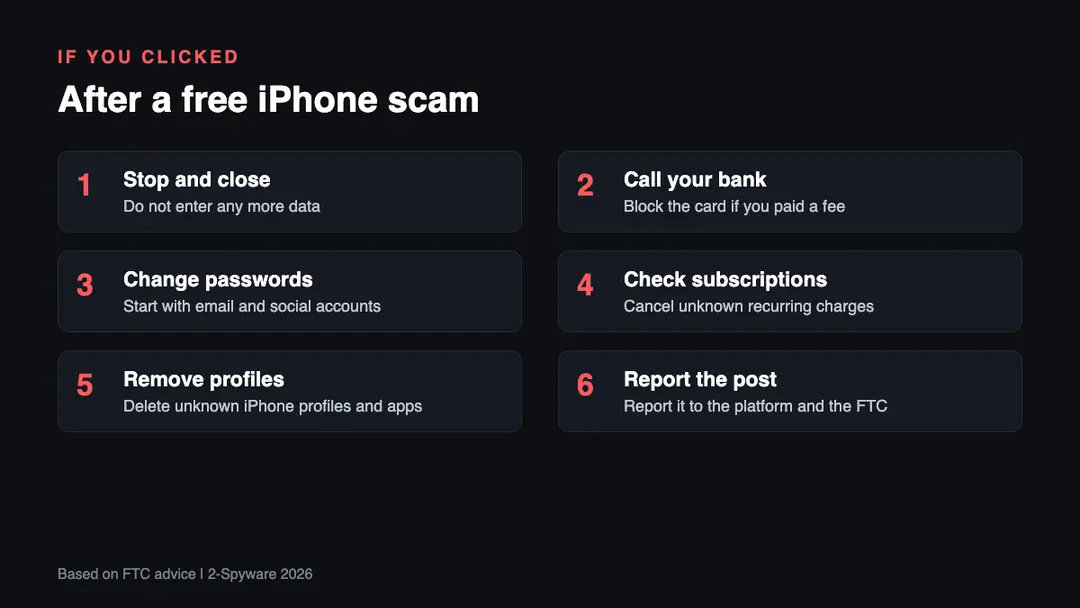
1. Stop and close. Do not finish the survey or the form. Clicking a link on an iPhone does not usually infect it, but the data you type is what the scammers want.
2. Call your bank. If you paid a fee, block the card and ask for a chargeback. The FTC also explains how to try to get money back after paying a scammer.[7]
3. Change passwords. If you signed in anywhere through the giveaway page, change that password and turn on two-step sign-in. Our leak check shows whether your email appeared in known breaches.
4. Check subscriptions. Look at your card statement for small recurring charges you do not recognise and cancel them.
5. Remove profiles. On an iPhone, check Settings for configuration profiles and apps you did not mean to install, and remove them.
6. Report the post. Report the account to the platform and, in the US, at ReportFraud.ftc.gov.[7] Our guide on how to report phishing lists other places to report.
What is still unknown
- How much of the $2.1 billion lost on social media came from fake phone giveaways. The FTC does not break the figure down that way.[6]
- How many fake giveaway pages the platforms remove each year. We found no public figure for this scam type in the sources we read.
- Full 2025 losses to prize scams. The most recent figure we found covers 2024.[8]
Our original 2017 report
The text below is our report as first published in 2017. We keep it unchanged for the record; the sections above bring it up to date.
Are you excited for the iPhone X's release? Or maybe your dream phone is iPhone 8? If so, you might fall for one of "free iPhone" or "iPhone X giveaway" scams on social media websites like Facebook, Instagram or Twitter.
Scammers follow the traditional pattern and create numerous fake accounts on social media websites, entitling them with catchy phrases such as "free iPhone giveaway," "iPhone 8 Official," "free iPhone 8" "iPhone X giveaway" "win the new iPhone X" and similar.
Later, they share and, if they succeed, boost posts promising free mobile phones to "lucky" users who will decide to participate in the giveaway[1]. Eye-catching promises to win the freshly released and quite pricey phone lure unsuspecting victims to click on a malicious link (which is usually a shortened one) which can lead to a website pushing malicious software to victims.
For example, some of the links noticed below fake YouTube videos announcing iPhone giveaways contained several shortened[2] Adf.ly links which are known to show suspicious ads to the user before landing the victim on the final website.
Free iPhone scam used to build audience for fake Facebook or Instagram pages
Another trick used by scammers is to invite people to comment, like and share (or repost) the giveaway post on Facebook or Instagram in order to enter the "giveaway" and get a chance to win the free iPhone. Such scams do not require any special efforts, and potential victims unknowingly promote the scam while expecting to become the "lucky" ones one day.
In the majority of cases, these fake giveaway posts urge victims to like the scam page on Facebook or follow it on Instagram to increase the chances of becoming the chosen one. This guarantees a quick growth of likes on the scam page.
Later on, scammers can rename the page and use it for another social engineering attack[3]. In a different scenario, such page can appear on dark web forums for sale so that other criminals could use it for evil purposes. There is no surprise why Facebook virus[4] or Instagram virus is a thing nowadays – these social media platforms are perfect places to search for potential victims.[5]
Scammers seek to collect victims' personal information
Speaking of dark web forums, personal information is also a marketable commodity. Therefore, scammers might promote links that lead to scam survey pages asking to "validate that you are not a robot" and providing a bunch of suspicious surveys to complete. Once the victim "completes the offer," another pop-up appears on the screen and asks to fill in required information so that the "prize" could be sent to him/her.
Usually, such fake forms ask to enter personally identifiable information such as full name, email and home address. Collected data can be sold on the dark web or used in a future social engineering attack.
Providing full name and email address as well as your address for criminals is enough to allow fraudsters compose convincing malware-laden emails and trick you into opening them. This way, you can be tricked into opening a phishing email that ostensibly comes from a nearby shop or your work and launching malicious attachment that comes with it.
It is an easy way for cybercriminals to push ransomware or similar malware to you. We suggest staying vigilant and bypass free iPhone scams as following scammers' commands can pose a threat to your security and privacy.
Related guides on 2-Spyware
Frequently asked questions
Are free iPhone giveaways on Facebook legit?
Almost never. A real giveaway from a known brand does not ask you to pay a fee, enter card details or complete a chain of surveys. The FTC says that if you have to pay to get a prize, you did not win.{7} Check the page's age, history and verification before you trust it.
Is the free iPhone giveaway a scam?
Yes, in nearly every case we see. These posts use the iPhone as bait to collect personal data, card numbers or likes for a fake page.{1} Prize, sweepstakes and lottery frauds are among the top scams reported to the FTC.{7}
Can clicking a free iPhone giveaway link compromise my iOS device?
Usually not by the click alone. The danger is what comes next: forms that take your data, pages that ask for card details, fake app installs or configuration profiles. If you entered data, act on that. If you installed something, remove it and check Settings for unknown profiles.
What does "you are the chosen one" mean in a giveaway message?
It is a common scam line. Fake accounts tell people they were picked as a winner to get them to send a message, click a link or pay a fee. Real contests do not pick you for a contest you never entered. Do not reply, and report the account.
Why do scammers ask you to like and share giveaway posts?
To grow the fake page fast. Every share spreads the scam to your friends, and the page gains followers it can later rename and reuse for other scams or sell.{3} That is why fake giveaways often require a like, a share and a comment before anything else.
Where can I report a fake iPhone giveaway?
Report the post or account to the platform first, using its report button. In the US you can also report it to the FTC at ReportFraud.ftc.gov.{7} If you paid, call your bank right away and ask about a chargeback.
Sources
- ZeroFOX. Social Media Security Blog
- TrendMicro Blogs. Simply Security News, Views and Opinions
- UGetFix. Computer Fixing Guides
- SC Magazine. Breaking News on Cybersecurity, Cybercrime, Industry Insight and Security Product Reviews
- ZDNet. Technology News, Analysis, Comments and Product Reviews
- Federal Trade Commission
- FTC Consumer Advice
- AARP
Log in to comment
No comments yet. Be the first.