

Bonanza is a website that collects a certain amount of personal information
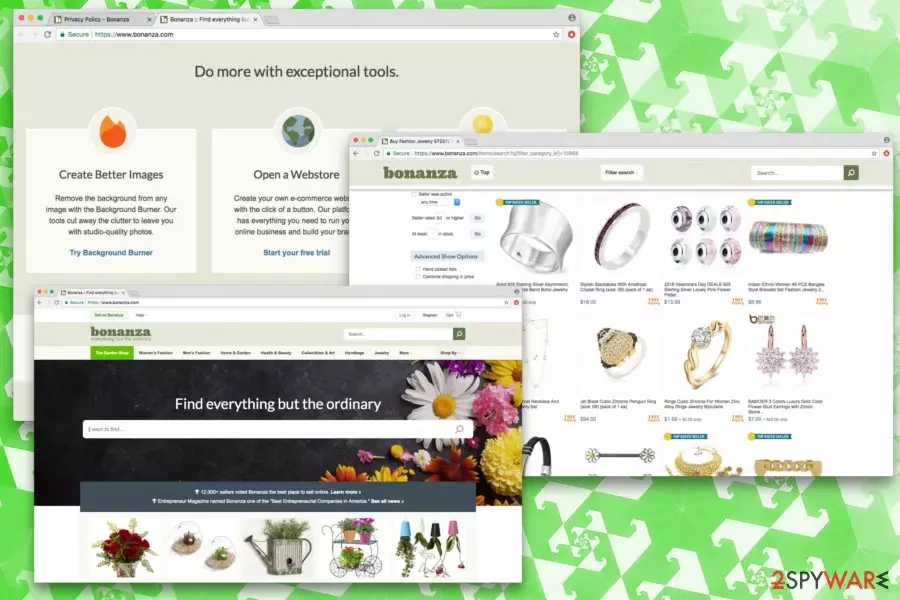
Bonanza is a legitimate service, operating similarly to eBay. Users have to register and create an account. Then, they can proceed with selling their items on the website. However, if you noticed that your browser is constantly spammed with advertisements from this retailer, it is highly likely that your computer is affected by adware[1] (ad-supported software).
| SUMMARY | |
| Name | Bonanza |
|---|---|
| Type | Adware/Potentially Unwanted Program |
| Danger Level | Low |
| Browsers affected | Internet Explorer, MS Edge, Google Chrome, Mozilla Firefox, Safari, Opera, etc. |
| Symptoms | Excessive advertisements and redirects, altered search results, slowdown of browser, etc. |
| Distribution | Bundling, suspicious sites |
| Elimination | Download and install FortectIntego. Alternatively, you can also delete it manually (instructions below) |
As soon as Bonanza virus enters the computer, it starts required modifications. In most of the cases, it drops its browser add-on on Google Chrome, Internet Explorer, Mozilla Firefox, Safari or other browser and then starts displaying ads that typically report about discounts, coupons, deals and other offers.
Even if Bonanza ads may look very convincing and legitimate, they can also cause havoc on your PC. Adware is known to display intrusive advertisements that disturb users' browsing sessions regularly. Sometimes, ads and pop-ups might cover the content of legitimate websites that typically do not advertise anything on their sites. Additionally, some words might be turned into hyperlinks.
The adverts are created to boost traffic to affiliated websites. This way, pay-per-click or pay-per-purchase revenue is generated. However, users do not get anything in return and have to deal with ads bombarding their browsers. To get rid of unwanted ads, you have to remove Bonanza from your system permanently. To do that quickly, we suggest downloading FortectIntego.

Sometimes, Bonanza might cause redirects to sponsored sites. However, developers are not responsible for the content that victims might be exposed to due to rerouting. Thus, users might end up on phishing, fake software or even malware-ridden websites. If you got redirected, never click on the content shown and close down your browser immediately.
Offers might tempt some users, and they may try to register on the official website. However, by creating the account and accepting terms of service, expose your details. Its Privacy Policy states:
Bonanza collects information from you when you register and conduct certain activities on the Site. We collect your full name, valid telephone number, contact/billing information, email address, and shipping address.
All this data is collected and shared with third-party partners who handle all the billing information. Please reconsider providing your banking details to unknown sources, as this data might end up in crooks' hands. Such information might be used for illegal purposes, such as identity theft or stolen money from your bank account.
As it is typical to adware, Bonanza collects a variety of non-personally identifiable information as well. The received data includes, but is not limited to:
- IP address;
- ISP
- Browser used
- Search queries
- Sites visited
- Cookie information[2]
- Etc
If you want to keep your search entries private, you should restrain yourself from registering to this service. If adware is affecting your PC, however, this information is already monitored, and your browsing habits are highly controlled, based on the sites you visit and links you click. Thus, if you value your virtual safety, proceed with Bonanza removal. You can find full instructions in the third section of this article.

You can avoid adware infiltration if you install freeware correctly
Adware is mostly spread in a bundle with freeware and shareware. That is why it is always recommended installing such programs as PDF creators, media players and similar software with an extreme carefulness. Whatever you do – do not rush and do not click “Next” button without looking.
In most of the cases, you need to choose “Custom” or “Advanced” installation method, and you will get the opportunity to see which components are hiding inside. Also, you should get rid of all optional applications that may be offered to you in a bundle (add-ons, toolbars, system optimizers, search engines and similar useless software). Despite developers advising to use “Default/Recommended” settings, you should never opt for these, because you will not be able to untick additional components.

Bonanza ads can be eliminated in just a few minutes
Adware can be incredibly frustrating to deal with because, over the time, the number of ads, pop-ups, and redirects increases. Security experts[3] warn that keeping Bonanza virus on the system might lead to additional PUP installation and other issues. Additionally, users might get tricked into installing fake updates or bogus programs they do not need (note that these applications are not free; hence, you risk losing your money too).
Therefore, do not delay Bonanza removal. You can either do it manually or automatically – we have both methods covered. If you are a computer-savvy individual, you can try following our illustrated instructions below this post. However, we must warn you that incorrect execution might lead to system file damage or reinfection of adware. Therefore, make sure you remove Bonanza by performing every step in exact order.
If you cannot think about yourself as an experienced user, we highly suggest installing reputable security software and running a full system scan. The process is fast and will only require you to follow on-screen instructions to uninstall Bonanza. Soon after that, you can enjoy adware-free and PUP-free browser again!
Uninstall from Windows
Uninstall from Windows 10/8:
- Type Control Panel into the Windows search box and open the result.
- Under Programs, select Uninstall a program.


Uninstall from Windows 7/XP:
- Click on Windows Start > Control Panel (Windows XP users should click on Add/Remove Programs).
- In Control Panel, select Programs > Uninstall a program.


Remove the unwanted program:
- In the Programs and Features window, look for any recently installed suspicious entries, select them, and click Uninstall.
- If User Account Control appears, click Yes to confirm, then complete the removal.


Delete from macOS
Remove the unwanted application:
- From the menu bar, select Go > Applications.
- In the Applications folder, look for any suspicious entries, then drag them to Trash (or right-click and pick Move to Trash).


Delete leftover files and folders:
- Select Go > Go to Folder.
- Enter /Library/Application Support and remove any suspicious folders related to the unwanted program.
- Repeat the same check in the /Library/LaunchAgents and /Library/LaunchDaemons folders, deleting any suspicious entries.

- Finally, empty the Trash to permanently remove the leftovers.

Reset Internet Explorer
Remove dangerous add-ons:
- Open Internet Explorer, click on the Gear icon (IE menu) on the top-right corner of the browser
- Pick Manage Add-ons.
- You will see a Manage Add-ons window. Here, look for suspicious plugins. Click on these entries and select Disable.


Change your homepage if it was altered:
- Open IE and click on the Gear icon.
- Select Internet Options.
- In the General tab, delete the Home page address and replace it by your preferred one (for example, Google.com).
- Click Apply and then select OK.


Delete temporary files:
- Press on the Gear icon and select Internet Options.
- Under Browsing history, click Delete...
- Select relevant fields and press Delete.


Reset Internet Explorer:
- Click on Gear icon > Internet options and select Advanced tab.
- Select Reset.
- In the new window, check Delete personal settings and select Reset.


Remove from Microsoft Edge
Delete unwanted extensions from MS Edge:
- Select Menu (three horizontal dots at the top-right of the browser window) and pick Extensions.
- From the list, pick the extension and click on the Gear icon.
- Click Remove.


Clear cookies and other browser data:
- Click on the Menu (three horizontal dots at the top-right of the browser window) and select Settings > Privacy, search, and services..
- Under Clear browsing data, pick Choose what to clear.
- Select Cookies and other site data and Cached images and files. (apart from passwords, although you might want to include Media licenses as well, if applicable) and click on Clear.


Restore new tab and homepage settings:
- Click the menu icon and choose Settings.
- Then find On startup section.
- Click Remove next to any suspicious startup page.
Reset MS Edge if the above steps did not work:
- Press on Ctrl + Shift + Esc to open Task Manager.
- Click on More details arrow at the bottom of the window.
- Select Details tab.
- Now scroll down and locate every entry with Microsoft Edge name in it. Right-click on each of them and select End Task to stop MS Edge from running.


Instructions for Chromium-based Edge
Delete extensions from MS Edge (Chromium):
- Open Edge and click select Settings > Extensions.
- Delete unwanted extensions by clicking Remove.


Clear cache and site data:
- Click on Menu and go to Settings.
- Select Privacy, search and services.
- Under Clear browsing data, pick Choose what to clear.
- Under Time range, pick All time.
- Select Clear now.


Reset Chromium-based MS Edge:
- Click on Menu and select Settings.
- On the left side, pick Reset settings.
- Select Restore settings to their default values.
- Confirm with Reset.
- This will disable extensions and reset startup pages but will not delete bookmarks, saved passwords, or browsing history.


Remove from Mozilla Firefox (FF)
Remove dangerous extensions:
- Open Mozilla Firefox browser and click on the Menu (three horizontal lines at the top-right of the window).
- Select Add-ons.
- In here, select the unwanted extension and click Remove.


Reset the homepage:
- Click three horizontal lines at the top right corner to open the menu.
- Choose Settings.
- Under Home, set your preferred homepage and new tab settings.
Clear cookies and site data:
- Click Menu and pick Settings.
- Go to Privacy & Security section.
- Scroll down to locate Cookies and Site Data.
- Click on Clear Data...
- Select Cookies and Site Data and Temporary cached files and pages, then click Clear.


Reset Mozilla Firefox
If clearing the browser as explained above did not help, reset Mozilla Firefox:
- Open Mozilla Firefox browser and click the Menu.
- Go to Help and then choose Troubleshooting Information.

- Under Give Firefox a tune up section, click on Refresh Firefox...
- Once the pop-up shows up, confirm the action by pressing on Refresh Firefox.



Remove from Google Chrome
Delete malicious extensions from Google Chrome:
- Open Google Chrome, click on the Menu (three vertical dots at the top-right corner) and select More tools > Extensions.
- In the newly opened window, you will see all the installed extensions. Uninstall all suspicious extensions related to the unwanted program by clicking Remove.


Clear cache and web data from Chrome:
- Click on Menu and pick Settings.
- Under Privacy and security, select Clear browsing data.
- Select Browsing history, Cookies and other site data, as well as Cached images and files.
- Click Clear data.


Change your homepage:
- Click menu and choose Settings.
- Look for a suspicious site in the On startup section.
- Click on Open a specific or set of pages and click on three dots to find the Remove option.
Reset Google Chrome:
If the previous methods did not help you, reset Google Chrome to eliminate all the unwanted components:
- Click on Menu and select Settings.
- In the Settings, scroll down and click Advanced.
- Scroll down and locate Reset and clean up section.
- Now click Restore settings to their original defaults.
- Confirm with Reset settings.


Delete from Safari
Remove dangerous extensions:
- Open Safari, click Safari in the menu at the top-left of the screen, and select Preferences.
- Go to the Extensions tab, look for any suspicious entries, and click Uninstall to remove them.


Clear history and website data:
- Click Safari in the menu and pick Clear History.
- Set Clear to all history and confirm with Clear History.


Reset Safari:
- Click Safari in the menu and select Preferences > Advanced.
- Enable Show Develop menu in menu bar.
- From the menu bar, click Develop and select Empty Caches.


Did this guide help?
2 comments
Sergey Marchuk
If you are so advanced in the spyware / malware removal why wont you actualy duplicate the issue from my site bonanzadeals.com and show snapshot of the actual malware? Well, you cant because we do not offer any downloads and our site has been inspected and protected by godaddy.
I would ask you to remove the snapshot from this post. And better do your research first before doing so. Try bonanzadeals.net they are offering such service and their ads are leading to cheapest places on ebay and online which often leads to our pages.
Nilton
Hitman pro resolve este problema.