
Cerberus virus: what it is and how to remove it
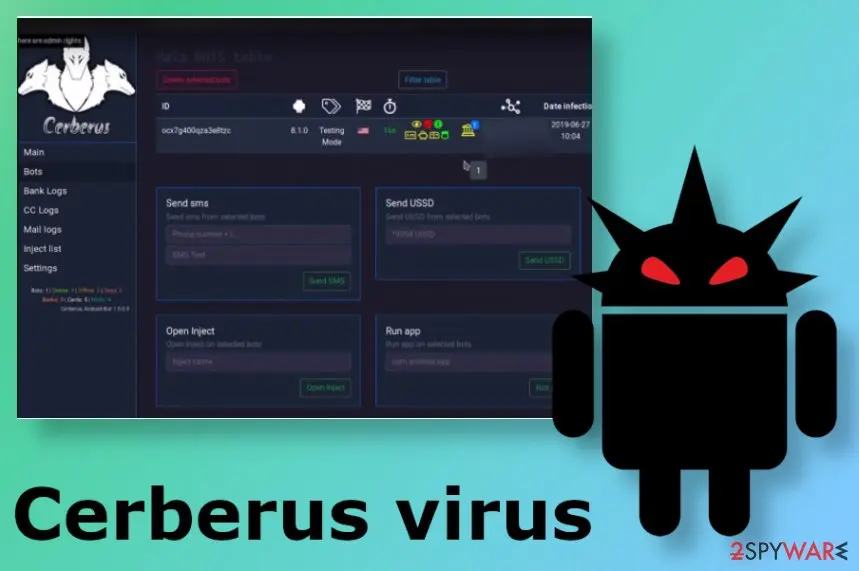
Cerberus virus – a threat that criminals use for accessing mobile phones and taking actions remotely without any indication for the user. This banking trojan relies on the accelerometer sensor to delay the launch on the system, so security researchers' analysis can be evaded.
Facts checked October 7, 2026. Removal steps tested on Windows 11 (26H2) and checked against Microsoft's and the browser makers' current documentation. Sections marked as our earlier report are the original text: they describe the threat as it was then and have not been reviewed since. The 2026 status, the removal steps and the questions are current.
Automatic
Get a free scan and check if your PC is infected.
Fortect finds malware, unwanted programs and the Windows damage they leave behind, and repairs it in one pass.
An automatic scan checks installed programs, startup items and browser extensions for anything that came with Cerberus virus.
Do it yourself · free Remove Cerberus virus yourself 4 steps, about 12 minutes, no software needed.
Start the steps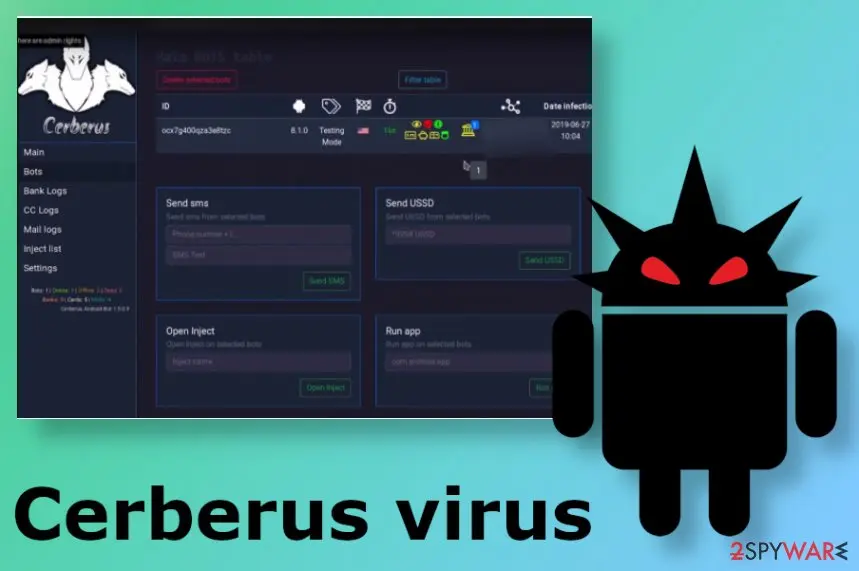
Cerberus virus: summary
| Distribution | Malware like this can spread via malicious or hacked sites, email attachments with direct malicious script injected or scam websites, deceptive pop-ups and applications |
|---|---|
| Name | Cerberus virus |
| Type | Android malware/ banking trojan |
| Danger | The threat can access valuable information, steal it, and use that data in later scams, targeted attacks, or even sell details to other criminals. Once the RAT is on the device it can control various processes and trigger actions[2] |
| Symptoms | A trojan is not causing many issues on its own, but the system gets slow and can crash due to background processes. Applications and functions cannot run normally when malware controls the behavior and modifies various parts of the device without permission |
| Possible actions | Controlling messages and calls, stealing information, making screenshots, changing functions and program behavior can all be features of the malware, depending on the aims of the particular criminals who use the tool |
| Removal | Scan the PC with security software to find and remove the malware and anything installed with it. Fortect scans Windows for malware and repairs the system files and settings it damaged. Remove it nowTo use the full-featured product, you have to purchase a license for Fortect. The scan is free. |
Show 5 more facts
| Detection names | No Microsoft detection name is known |
|---|---|
| Damage | Not recorded in the old report |
| Evidence | 5 write-ups by security sites; details still limited |
| First seen | 5 May 2020 |
| Facts checked | 7 October 2026 |
What Cerberus virus does on an infected PC
From our report of May 2020 · not reviewed since
Criminals recreate the download and installation of primary applications to infect the machine
Crooks include the malicious scripts in the code of applications and re-uploads the application along with the uploads from third-party sites or malicious pages posing as official versions of download sites and software providers or update pages. These pages can replicate and produce many domains delivering the same harmful apps and redirecting to additional downloads of similar applications.
Social media spam messages can also promote these links and apps. Once the malicious app lands on the device, it may connect to other servers and act as a downloader, so devices get infected with a trojan or different malware. These threats can also get downloaded as malicious documents via spam email campaigns when notifications resemble emails from legitimate companies or services.
Standart Android security policies shouldn't allow installations of applications from untrusted sites, so users may opt-out of such settings and allow various third-party downloads. This is how malware can enter the system though, so experts do not recommend doing so. Be careful when verifying any requirements and do not give shady apps inadequate permissions.
From our report of May 2020 · not reviewed since
The guide to clearing machine from Cerberus banking trojan
Cerberus virus is the Android OS-based malware that affects mobile devices, so you should take that into consideration and make sure to take some additional actions before starting actual procedures of malware elimination. Firstly, turn off the device until you know how bad the infection has gotten. You can win some time this way.
You can also start the Cerberus virus removal process with entering the Safe Mode on Android OS:
Of course, there are many other things that you need to delete if you want to remove Cerberus virus completely from the machine. There might be some hidden files and threats loaded on the system, so rely on tools compatible with your operating system or security software like or . Running AV detection-based programs can indicate various threats, so you need to clear them all off of the machine.
- Turn the device and hold the power button until you see the menu with choices.
- Tap on Safe Mode and enter the system. You will be on airplane mode, so the virus is no longer connecting to remote control servers and hackers in general.
- If you know which application is triggering the malware, you can possibly remove the program via settings and the control center. More solutions for system resetting, in the article about general Android virus infections.
From our report of May 2020 · not reviewed since
More from our earlier report on Cerberus virus
- To remove Cerberus virus, you should run the proper anti-malware tool, so all the issues are no longer bothering you when the malware is terminated alongside all the associated files and programs.
- You can find AV tools designed for various operating systems, so the virus can be removed easily from any device
- Trojans can affect many functions of the device to get their goals achieved, so there are many issues with the device left, even when the virus is cleared.
- You should run the PC repair or optimization tool like to find affected or even damaged files and system functions
What Cerberus virus can steal or download
From our report of May 2020 · not reviewed since
Cerberus virus – a threat that criminals use for accessing mobile phones and taking actions remotely without any indication for the user.
This banking trojan relies on the accelerometer sensor to delay the launch on the system, so security researchers' analysis can be evaded. This malware recently started to act as a malware-as-a-service business. According to creators, it is used privately for the past few years since they created the malware from scratch.
This trojan can be rented or bought on hacker forums as a tool for stealing credentials and sensitive information. The threat can easily be used to send commands to the victims' devices and perform needed actions.
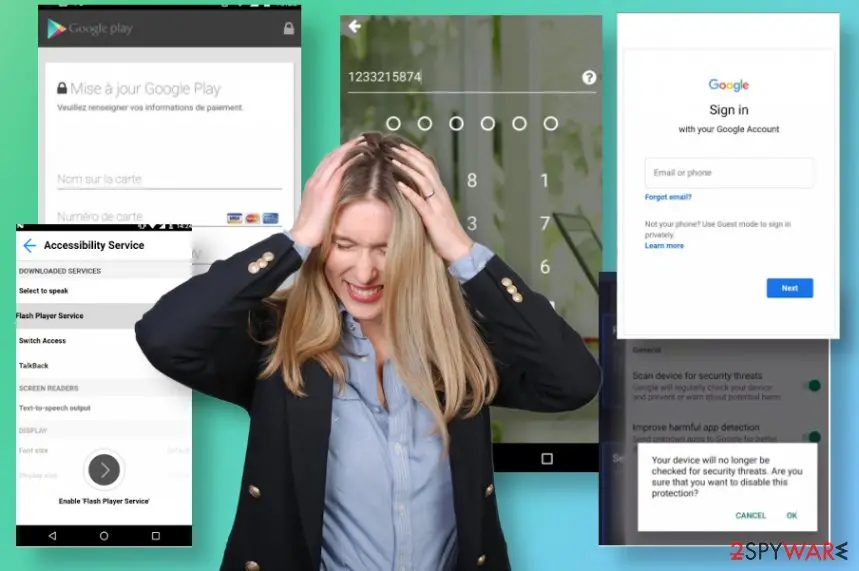
This sneaky Cerberus malware can be disguised as common applications, installs of FlashPlayer, or some service. Such methods are used to deceive users into providing privileges through the Accessibility Service because once these privileges are granted, the malware can connect to a botnet and receive commands from the C&C server.
Once that is done Cerberus becomes a tool for controlling the phone calls, SMS messages, processes, and accessing other valuable information. It is known that trojan can bypass the Google Authenticator and use advanced mechanisms to enter devices, so it can steal banking credentials and passwords or payment information on any Android device.
It acts as a Remote Acess Trojan, so there are many commands that criminals who use it can launch on targeted devices, so it may lead to serious hacker attacks and even crucial damage or data loss.
Cerberus virus can unlock the phone remotely and get into the camera, microphone, and track your behavior for a long time until anything suspicious can be noticed. Trojan uses the mechanism that determines if the device is moving or not. It is achieved by reading the information from the accelerometer sensor that is on all Android devices and measures the force on all the physical axes.
By launching the pedometer, Cerberus virus tracks if the victim is moving, and when the person moves around the motion data is generated and triggers the step counter.
Once the trojan is active it starts communicating with the C&C server when the particular number of steps is reached. Such a function is designed to avoid running on test devices or in sandbox environments and other machines used for malware analysis.
Cerberus virus is acting mainly as a typical banking trojan, so it gets executed on the system and hides the malware as the icon of a shady application like Flash Player. It asks for increased privileges through the Accessibility Service to avoid getting detected and removed from the machine.
It is not much advanced and all the features are pretty standard, so malware can send messages, open injected programs or run existing applications, send other commands and record calls, audio messages, take screenshots or directly steal data from conversations and the system itself.
Since the Cerberus virus is available online it can be used to target anyone and run commands that lead to serious issues and even damage or identity theft, financial losses.
Possible actions that Cerberus virus can take once the authorization is granted:
Cerberus trojan functions as a malware that can also reboot the device if needed and access characteristics that the original client can launch. It takes complete control of the device, and the victim may not even notice anything suspicious. Criminals who take this tool in their hands can also choose to add various information on the machine or steal anything from the databases.
Cerberus virus is dangerous firstly because of the information that it can obtain. Confidential data and sensitive credentials, banking information gets stolen when victims enter those details on various sites, and stealer collects all the keystrokes. Overlays and other data grabber methods get used to stealing these credentials and later on attacks can be launched.
There are some reports that the Cerberus virus is aiming to perform overlay attacks using banking applications and other programs launching on Android devices in France, U.S, and Japan. This malware came out with some of the campaigns involving malicious and deceptive websites that focus on the pandemic situation during the spring of 2020.
If you visit coronavirus-information.online or canada-alert-covid19.com, at least once you may need to remove Cerberus virus because some pop-ups and other additional windows trigger the drop of the malicious script that launches the trojan. Other sites with fake alerts about downloads or updates also trigger payload installation instead of browser or software updates.
Various cryptovirus sites and pages that pose as legitimate Bitcoin wallet services can spread and promote Cerberus virus or any other threat that causes serious issues ranging from data-stealing to direct damage. As we mentioned, the drop of the payload may happen significantly earlier than you notice any symptoms or suspicious behavior. Unfortunately, there is a long list of applications that banking trojan targets:
This list expands each week, so pretty much anyone that uses Android devices can become a victim of the trojan that uses overlays and gathers information from private conversations and the device in general. You need to react to these risks and run anti-malware tools that can detect the trojan and possibly perform the Cerberus virus removal.
If you get indicated that Cerberus trojan is on the machine do not wait and clean all the threats that the AV engine shows you on the list after a full system scan. Once you remove the malicious applications, you may additionally download or a similar repair/ optimization tool so damaged files or corrupted functions gat be fixed automatically.
- total control over messages and phone calls;
- data checks on the device;
- recording of any phone call;
- sending data from the machine to crook's server;
- password and username gathering;
- taking screenshots;
- stealing audio data;
- locking and unlocking the phone;
- shutting the device off and turning on.
- Bank of America Mobile Banking
- Capital One® Mobile
- Chase Mobile
- Connect for Hotmail
- Gmail
- ING
- Mail (Android)
- Microsoft Outlook
- Snapchat
- Telegram
- U.S. Bank - Inspired by customers
- Uber
- Viber
- Yahoo Mail – Organized Email
How to remove Cerberus virus
Call the bank first, because money can move faster than you can clean the PC.
Step 1: Call your bank
Money moves fast, so call the bank before anything else on this list is finished.
Use the number on the back of your card or in the bank's app, report possible fraud, and ask for the card to be blocked and new online banking credentials to be issued.
Ask whether payments made in the last days can be stopped or disputed. Do not sign in to the bank from the Windows 11 or Windows 10 PC until the scans are clean.
Full procedure with screenshots: What to do after paying a scammer
Step 2: Remove it from startup
Press Ctrl + Shift + Esc to open Task Manager and select Startup apps (Windows 11) or the Startup tab (Windows 10). Disable entries you do not recognise, especially ones with no publisher or with a name that copies a Windows component.
Right-click an entry and choose Open file location to see where it runs from: programs in
%AppData%or%Temp%deserve a closer look. Some entries are not listed there but in the registry Run keys, which the procedure below shows how to check.Full procedure with screenshots: Stop apps from opening at startup On uGetFix
Step 3: Scan the PC, then run the offline scan
A scan finds the parts of Cerberus virus that the manual steps cannot see. In Windows Security > Virus & threat protection > Scan options, start a Full scan and quarantine what it reports.
Follow it with Microsoft Defender Antivirus (offline scan) > Scan now, which restarts the PC and checks the disk while Windows and the malware are not running.
It takes about 15 minutes and works the same in Windows 11 and Windows 10. If either scan finds something, run the full scan again after removal until it comes back clean.

Windows 11: Windows Security > Virus & threat protection > Scan options. Full procedure with screenshots: Run a Microsoft Defender Offline scan
Step 4: Change passwords from another device and sign out other sessions
Cerberus virus can copy saved passwords, cookies and session tokens and send them out in seconds, so cleaning the PC does not undo the theft.
Change your passwords on a device that was never infected, starting with the e-mail account, since every other reset goes through it. On each account, end all other sessions and check the recovery e-mail, phone number and forwarding rules.
Then turn on two-step verification. Sign in on the Windows 11 or Windows 10 PC again only after the offline scan is clean.
Full procedure with screenshots: Turn on two-step verification / secure a hacked account
After removal: passwords, accounts and prevention
Secure your accounts after the clean-up
Assume that whatever was saved in the browsers on this PC while the PC showed cerberus virus in the list of installed apps has been copied:
- passwords
- cookies
- autofill data
Work from a clean device, or from this PC once the offline scan finds nothing.
Start with your main e-mail account, because it can reset everything else, then banking and payment, then social and gaming accounts. Change each password, sign out of all sessions and turn on two-step verification: Turn on two-step verification / secure a hacked account.
The full order, including crypto wallets and card replacement, is in securing your accounts after malware.
Protect your privacy - employ a VPN
There are several ways how to make your online time more private - you can access an incognito tab.
However, there is no secret that even in this mode, you are tracked for advertising purposes. There is a way to add an extra layer of protection and create a completely anonymous web browsing practice with the help of VPN. This software reroutes traffic through different servers, thus leaving your IP address and geolocation in disguise.
Besides, it is based on a strict no-log policy, meaning that no data will be recorded, leaked, and available for both first and third parties. The combination of a secure web browser and VPN will let you browse the Internet without a feeling of being spied or targeted by criminals.
No backups? No problem. Use a data recovery tool
If you wonder how data loss can occur, you should not look any further for answers - human errors, malware attacks, hardware failures, power cuts, natural disasters, or even simple negligence.
In some cases, lost files are extremely important, and many straight out panic when such an unfortunate course of events happen. Due to this, you should always ensure that you prepare proper data backups on a regular basis.
If you were caught by surprise and did not have any backups to restore your files from, not everything is lost. is one of the leading file recovery solutions you can find on the market - it is likely to restore even lost emails or data located on an external device.
Questions about Cerberus virus
What is Cerberus virus and why is it on my PC?
Cerberus virus is a program that was installed on the PC, most likely together with something else you downloaded. Free software sites and many installers add extra programs on setup pages with pre-ticked boxes, so the extra install looks like your choice even though nobody read the page.
Check the install date in Settings, Apps, Installed apps: the program you installed that day is the probable carrier. If you do not need Cerberus virus, uninstall it. If it belongs to your hardware or to a program you use, search its exact name and publisher first, because drivers and their tools can have unfamiliar names.
Cerberus virus will not uninstall. What can I do?
First restart the PC and try again, because the program may have been running and locked its own files. If the uninstaller is missing or fails, start Windows in Safe Mode, where most third-party programs do not start, and remove Cerberus virus from Installed apps there.
If it still refuses, delete its startup entry and its scheduled task, restart, and try once more. A program that actively prevents removal is behaving like malware, so finish with a Microsoft Defender offline scan. Avoid third-party uninstallers offered on search ads; several of them are unwanted programs themselves.
Do I need to reinstall Windows to get rid of Cerberus virus?
Usually not. A thorough clean-up is enough when the offline scan finds nothing afterwards and you do not see cerberus virus in the list of installed apps again. A reset is the safer choice if an attacker had remote control, if security tools were switched off, or if detections come back after every clean-up.
Windows 11 can reset itself without a USB stick under Settings > System > Recovery > Reset this PC. Copy documents and photos out first and scan the copies. A reset does not change passwords or undo stolen data, so the account steps still apply.
How do I know if my PC has Cerberus virus?
Often you do not, which is the point of a trojan. Possible signs are an antivirus alert naming Cerberus virus or a generic trojan detection, unknown programs or scheduled tasks, processes with random names in Task Manager, browser extensions you did not add, security settings turned off, slower performance, or account alerts about logins from unknown places.
The reliable check is a full scan followed by Microsoft Defender's offline scan. If you recently ran a crack, a fake installer or a command a website told you to paste, scan even without symptoms.
Is it safe to do online banking after seeing cerberus virus in the list of installed apps?
Not on that PC until it is clean. A program that produces cerberus virus in the list of installed apps runs with your rights and could read what you type or what the browser shows. Use a phone or another computer for banking and for changing passwords.
When the offline scan of the affected PC is clean and nothing suspicious starts with Windows any more, you can go back to using it. Check your bank statements for the past weeks either way, and call the bank if anything looks unfamiliar; banks can block cards and reset access quickly.
Why can't I find Cerberus virus in antivirus databases?
Because it is new or because it is listed under a different name. Antivirus companies name threats after the family they belong to, and a program that appears as Cerberus virus on your PC may carry a generic or unrelated label in their databases.
Many new samples are first detected only by behaviour, without a family name. What you saw, cerberus virus in the list of installed apps, is enough to act on:
- end the program
- remove its startup entry
- run a Microsoft Defender offline scan
- secure your accounts
A detection name from a scan is worth noting for later.
Should I check my other computers too?
Yes, it takes little time and removes doubt. Cerberus virus itself usually stays on one PC, but the download that carried it may have been copied to other computers, shared drives may hold the same installer, and an attacker who had access could have tried saved passwords on other devices.
Run a full scan on every Windows PC in the home or office, check shared folders for the original download, and change Wi-Fi and router passwords if they were stored on the infected machine.
I found AnyDesk or ScreenConnect that I did not install. Is that Cerberus virus?
Not necessarily Cerberus virus, but it is a warning sign. These are legitimate remote support tools, and criminals use them as ready-made backdoors, especially after tech support scams or fake invoice calls.
If you did not install it and no one you trust set it up, uninstall it, change passwords from a clean device and check your bank account. If someone connected to your PC through it, follow the steps for remote access trojans and consider a Windows reset. Installed apps sorted by date shows when it appeared.
My antivirus was on. How did a trojan get past it?
Antivirus programs see a file only when it is written or run, and criminals test each new build against popular scanners before release. Detection catches up within hours or days, which is often after the first victims ran it.
Archives with passwords, installers that fetch the malware later, and scripts run through PowerShell make the job harder. That is why behaviour such as downloading cracks or pasting commands matters more than any setting. Keep Windows and Defender updated, and turn on Reputation-based protection in App & browser control.
Will Fortect remove Cerberus virus?
Fortect scans Windows for malware and unwanted programs and repairs the system files and settings they change, and its free scan shows what it finds on your PC before you decide anything.
For Cerberus virus, follow the plan above as well: the browser steps take back permissions and settings that no scanner treats as a threat, and uninstalling the program that brought it removes the source.
Run Microsoft Defender's full scan and, if anything was found, its offline scan as a second opinion. If the symptoms are gone after the plan and both scans are clean, there is nothing more to do.
Sources
- VirusTotal: Virus detection rate (read October 7, 2026)
- FTC: How to recognize, remove and avoid malware (read October 7, 2026)
- Microsoft Learn: Microsoft Defender Offline (read October 7, 2026)
- Microsoft Learn: How Microsoft names malware (read October 7, 2026)