
Chrome.7z: what the file is, is it a virus, and can you delete it
Chrome.7z is the compressed installer archive of Google Chrome and of browsers built on it, so the copy in the browser's Installer folder is not a virus. A chrome.7z found anywhere else, or one that arrived by e-mail or a fake update, should be checked and scanned before you open it.
Facts checked October 6, 2026. Removal steps tested on Windows 11 (26H2) and checked against Microsoft's and the browser makers' current documentation.
Automatic
Get a free scan and check if your PC is infected.
Fortect finds malware, unwanted programs and the Windows damage they leave behind, and repairs it in one pass.
Do it yourself · free Remove Chrome.7z yourself 2 steps, about 6 minutes, no software needed.
Start the stepsChrome.7z: summary
| Type | Chrome's installer archive (a data file), not a virus; a file of that name elsewhere should be checked |
|---|---|
| Risk | None for the genuine file. A chrome.7z that arrived by e-mail or a fake update can hide a trojan |
| Symptoms | A 300 MB to 500 MB file in Application\<version>\Installer; no process, no pop-ups, no slowdown of its own |
| How to get rid of it | Not needed for the genuine file. A fake: Microsoft Defender full and offline scan, Safe Mode with Networking if the scan will not start |
| Our check (6 October 2026) | No sample run. Chromium and Brave documents and a Chromium code review read; they describe the genuine file. We found no malware of this name |
| First reported by us | 5 February 2021, as a trojan; this rewrite replaces that report |
| Check the PC | The genuine file needs no removal. Fortect's free scan checks Windows for malware hiding under system file names and for damaged system files. Remove it nowTo use the full-featured product, you have to purchase a license for Fortect. The scan is free. |
Show 6 more facts
| Where it sits | C:\Program Files\Google\Chrome\Application\<version>\Installer, or under %LocalAppData% for a per-user install |
|---|---|
| Detection names | None for the genuine file; none found for a malware called Chrome.7z |
| File name | chrome.7z |
| Distribution | Part of Windows; malware sometimes copies the name in another folder |
| Damage | None from the genuine file; an impostor copy is as harmful as its malware |
| Facts checked | 6 October 2026 |
Facts checked on 6 October 2026 against the Chromium project's installer notes, a Chromium code review, a Brave GitHub issue and security-vendor listings. We had no sample of a file called Chrome.7z and ran no test, so this is not a lab result.
What the Chrome.7z file is
What chrome.7z is: Chrome's installer archive
chrome.7z is a file the Google Chrome installer creates and uses. It is the browser's program files packed into one 7-Zip archive. Our 2021 guide described a trojan of this name; the sources we could find describe only the genuine file, and none documents a malware family called Chrome.7z.
- 1
You download the installer
The small file you download from Google carries a setup program and the 7-Zip archive of the browser, as Chromium's installer notes describe it.
- 2
Setup unpacks the archive
setup.exelooks forchrome.7z(orchrome.packed.7z) next to itself, unpacks it into the browser's folder and registers the browser with Windows. - 3
A copy stays behind
After the install, and after many updates,
chrome.7zstays in theInstallerfolder of that version. Chromium-based browsers such as Brave behave the same.
- File
chrome.7z, a 7-Zip archive. A data file: it does not run by itself- Usual place
C:\Program Files\Google\Chrome\Application\<version>\Installer(system-wide install) or the same path under%LocalAppData%- Size
- Hundreds of megabytes: about 300 MB was reported for a Chrome 110 folder, 482 MB for a Brave 1.88 folder in 2026
- Made by
- Google's installer, or the maker of a Chromium-based browser
- Part of Windows
- No. It belongs to the browser, and only to its installer and updater
- Do you need it
- To run the browser, no. For delta updates, yes (Brave's developer, December 2025)
- Detection names
- None for the genuine file. We found no antivirus name for a malware called Chrome.7z
The old guide mixed up two things: a file, and a threat that might borrow its name. Malware does copy the names of real browser and Windows files, so a chrome.7z somewhere it does not belong is worth a check. But the file that most readers find is the real one, sitting in Chrome's own folder, and removing it as a virus helps nobody.
What the public record shows, and what we did not test
We did not run a sample. We read the browser's installer notes, a code review from the Chromium project, a GitHub issue of the Brave browser and security-vendor listings, and we say what each one covers.
Sources read on 6 October 2026
- Chromium's installer notesState that
mini_installer.execarriessetup.exeand the Chrome 7zip archive as resources and knows how to extract them. - Chromium installer sourceA code comment says
setup.exeuseschrome.packed.7zorchrome.7zin the same directory as itself. - Chromium code review (2011)A change committed to Chromium deletes the
chrome.7zarchives of the old version folder when Chrome upgrades, to save disk space. - Brave's GitHub issue 25873A user reports a 300 MB
chrome.7zin Brave'sInstallerfolder (October 2022); a Brave developer says it is needed for delta updates (December 2025); a user measures 482 MB in April 2026. - A malware family named Chrome.7zNot found. Our 2021 guide named no detection name, hash or sample, and we found none in the sources above or in the search results we read.
- Our own scan of a chrome.7zNot done. We ran no sample and have no result of our own for any file of this name.
- A chrome.7z outside a browser folderNot covered. A copy of the name can sit anywhere, and one record cannot clear a file that this page has not seen. Check yours with the steps below.
Genuine where it belongs A chrome.7z in the Installer folder of a browser you installed is that browser's own file. The record says nothing about a file of that name somewhere else, and we saw none.
Is Chrome.7z safe or a virus?
Chrome.7z through the years
The file is as old as Chrome's installer. These dated entries show how people have met it.
2011
Chromium deletes old archives on upgrade
A Chromium change (committed in revision 77935) removes the
chrome.7zof the old version folder when Chrome upgrades, to save disk space. The newest version keeps its copy.5 February 2021
Our first guide
We published a short trojan description. It named no detection, path or hash, and it said to remove the file with security software. This rewrite replaces it.
8 October 2022
A Brave user asks why it is 300 MB
The user found it in Brave's
Installerfolder on Windows 11, deleted the folder and reported that the browser kept working.11 December 2025
Brave explains the file
A Brave developer wrote that delta updates patch the previous release's archive, so it must exist, and that Chrome had recently changed its delta logic so that Chrome no longer needs it. Brave planned to follow.
5 April 2026
482 MB in Brave 1.88
A user measured 506,107,921 bytes for the file in the newest version folder; the developer answered that nothing was scheduled.
Real or fake: how a chrome.7z can be told apart
A genuine chrome.7z has one job and one home. A fake is anything with the name that sits in the wrong place or arrives the wrong way.
| Genuine chrome.7z | Suspicious | |
|---|---|---|
| Place | ...\Application\<version>\Installer of an installed browser, or a temporary folder inside the browser's folder during an update | Downloads, the desktop, %Temp%, %AppData%, a USB drive or any unrelated folder |
| Arrived | With the browser's installer or update | In an e-mail, after a pop-up update warning, from a cracked-software or file-sharing site |
| Neighbours | setup.exe in the same folder; the browser's .exe two folders up, signed by its maker | Alone, or next to a script or an unknown .exe |
| Size | Hundreds of megabytes, in step with the browser | Tiny, or an odd size with a password-protected archive |
| Behaviour | Sits still, a data file | Something starts right after you extract it |
- Low
A genuine chrome.7z
No risk. It is a large file that occupies disk space and nothing else. Leave it; see below for the space trade-off.
- Medium
A copy in a browser you do not remember installing
The file is the genuine archive of a Chromium-based browser, but the browser may be an unwanted program. Check Settings > Apps > Installed apps and remove it if it is not yours.
- High
An archive that arrived by e-mail or a fake update prompt
Do not extract or start anything in it. If you already did, treat the PC as infected: such a program can steal data you type, including names, addresses and bank logins, and can bring other malware, ransomware among it. Follow the removal steps.
The old guide listed the signs of a trojan: higher CPU or GPU use, crashes and freezes, "stop errors", programs you did not install, more ads. They describe infections in general. They are slow and easy to miss, because trojans are made to stay quiet, and you may notice none of them. They are not signs of chrome.7z, so the useful check is the location and the arrival, not the symptoms.
How to check the Chrome.7z file
Do this when you find a chrome.7z and are not sure it is the browser's. It works the same in Windows 11 and Windows 10.
- 1
Open its folder
Right-click the file or the search result > Open file location. Note the path. A genuine one ends in
\Application\<version number>\Installer. - 2
Look at what is around it
The same folder normally holds
setup.exe. Go up two folders:chrome.exe(orbrave.exe,msedge.exe) sits inApplication. - 3
Check the signature of the program
Right-click that
chrome.exe> Properties > Digital Signatures. The signer should be Google LLC (Brave Software for Brave, Microsoft for Edge). The archive itself is not signed, so the program next to it is what you check. - 4
Scan the file
Right-click
chrome.7z> Scan with Microsoft Defender. For a second opinion, upload it to VirusTotal if it is under the size limit.
No Task Manager entry exists for a data file: chrome.7z is not a process, so a Task Manager hunt for it finds nothing. If the browser's own process is busy (for example the updater), that is a separate question.
Where Chrome.7z comes from
The genuine file comes with the browser. A fake one has to be put there, and the old guide's point stands: trojans need you to do something.
- High
Spam attachments and links
Phishing e-mails go out by the thousand with an attachment that holds the payload, or with a link made to look harmless. Attachments come in many wrappers, archives among them, and you cannot judge one by its extension.
- High
Cracked software and file-sharing sites
Installers of pirated programs, key generators and downloads from file-sharing sites are the usual carriers of trojans.
- High
Fake updates
A page or pop-up that says your browser must be updated. Update Chrome only from its own menu (Help > About Google Chrome).
- Medium
Malicious sites
A page that starts a download you did not ask for. Close it and delete the file without opening it.
What to do with Chrome.7z
How to check Chrome.7z
The genuine file is part of Windows and needs no removal.
These steps tell it apart from an impostor.
Step 1: Check the location and signature of chrome.7z
The name alone proves nothing: malware copies the names of real files. Use Open file location in Task Manager to see where
chrome.7zruns from, and compare it withC:\Program Files\Google\Chrome\Application\<version>\Installer.Check Properties > Digital Signatures as well, and run a Defender scan of that single file from the right-click menu. Only a copy in a wrong folder or without a valid signature needs removal on Windows 11 or Windows 10.
Full procedure with screenshots: Run a Microsoft Defender Offline scan
Step 2: Scan the PC, then run the offline scan
Open Windows Security > Virus & threat protection > Scan options, run a Full scan and remove everything it finds. Then select Microsoft Defender Antivirus (offline scan) and click Scan now: the PC restarts and scans before Windows loads, which finds files that hide while Windows runs.
Save your work first, because the offline scan takes about 15 minutes. Both scans are built into Windows 11 and Windows 10, and a second scanner from another vendor is a useful extra opinion.
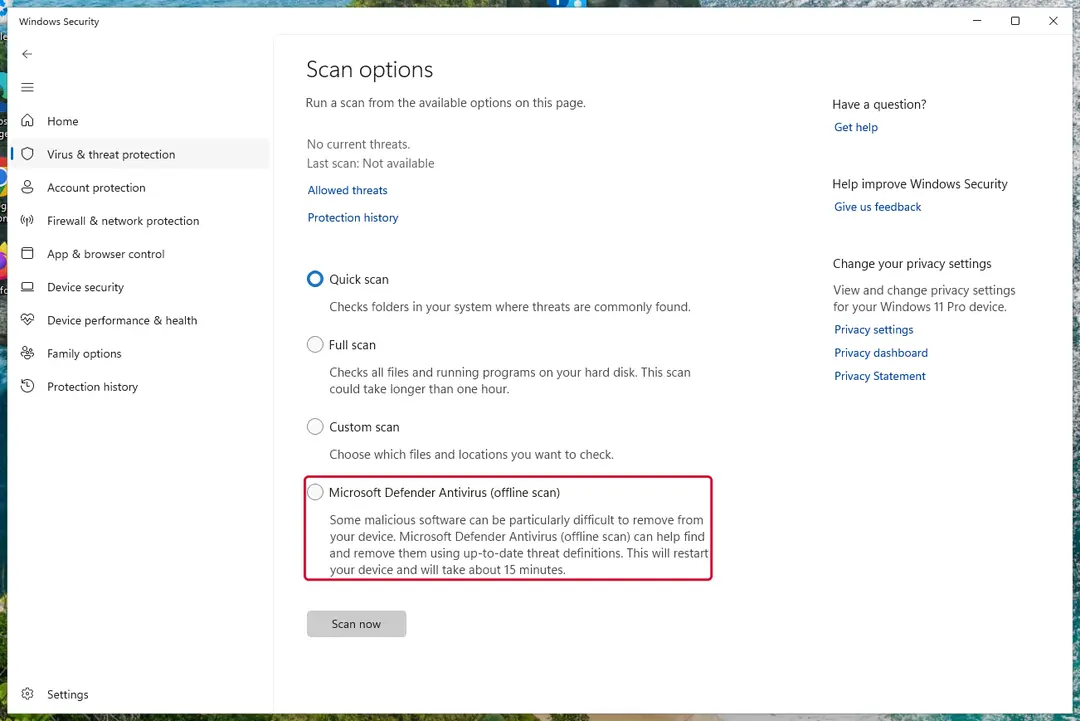
Windows 11: Windows Security > Virus & threat protection > Scan options. Full procedure with screenshots: Run a Microsoft Defender Offline scan
Can you delete chrome.7z to free disk space?
You can, but it is not needed, and it has a cost. Look at what the file does before you remove it: removing a genuine file because an old guide called it a virus can disturb the browser's updates.
| Option | What happens | Our advice |
|---|---|---|
| Leave it | Costs 300 to 500 MB; delta updates keep working (Brave's developer) | Best for most PCs |
| Delete the file in an old version folder | Chrome removes these itself on upgrade; a leftover is from a failed or interrupted update | Safe to delete once the browser runs the newer version |
| Delete it in the newest version folder | The browser keeps running (a Brave user's report); the next update may need a larger download | Only if the disk is nearly full |
| Delete a chrome.7z that is not in a browser folder | Nothing breaks | Scan it first, then delete it |
If you do delete the file in the newest folder, close the browser first, and keep chrome.exe and chrome.dll: they are what actually runs. If the browser misbehaves afterwards, reinstall it from the maker's site.
If the chrome.7z is not the browser's: remove it step by step
Do this when the file failed the checks above, when you extracted something from it, or when a scan flags it. A genuine chrome.7z needs none of this.
- 1
Scan with Microsoft Defender
Open Windows Security > Virus & threat protection > Scan options > Full scan > Scan now. Quarantine whatever it finds.
- 2
Run the offline scan
Same page: Scan options > Microsoft Defender Antivirus (offline scan) > Scan now. The PC restarts and scans before Windows loads, which finds what hides while it runs.
- 3
If the scan will not start: Safe Mode with Networking
Settings > System > Recovery > Advanced startup > Restart now > Troubleshoot > Advanced options > Startup Settings > Restart, then press 5 for Safe Mode with Networking, and scan again there.
- 4
Remove what you extracted
Delete the extracted folder and the archive, then check Startup apps in Task Manager, Task Scheduler and Installed apps for anything you did not install.
- 5
Repair damaged system files
Open Terminal (Admin) and run
sfc /scannow, thenDISM /Online /Cleanup-Image /RestoreHealth. This is what the old advice about repairing the registry and files meant; Windows does it with these two commands. - 6
System Restore, if you have a restore point
Type Create a restore point in Start > System Restore > choose a point from before the problem. It rolls back system files and settings, not your documents, and it may not remove a program you ran.
Then change the passwords you typed on this PC, starting with e-mail and bank, from another device. If you had no up-to-date backup, make one now: ransomware is the reason the old guide gave for acting fast, and a backup, not a scan, is what saves files.
After the check: keep Windows clean
Malware does not simply arrive; it needs a click. These habits cover most of the ways in.
Do
- Treat every unexpected e-mail as a possible threat, and open attachments only from people you expect.
- Keep Windows Security on, and install Windows and browser updates when they come out.
- Download programs only from their makers' sites or the Microsoft Store.
- Keep a current backup of your files (File History or OneDrive), so ransomware cannot hold them hostage.
- Update Chrome from its own menu: Help > About Google Chrome.
Don't
- Delete a chrome.7z inside your browser's own folder because a page called it a virus.
- Extract or run an archive that came from an e-mail, a pop-up or a file-sharing site.
- Install cracked programs or key generators.
- Click advertisements or links you did not ask for.
Questions about Chrome.7z
What is chrome.7z?
Chrome.7z is the compressed installer archive of Google Chrome, and of browsers built on Chromium. Chrome's installer package carries a setup program and this 7-Zip archive; setup unpacks the archive into the browser's folder and registers the browser with Windows.
After an install or update, a copy usually stays in the version folder, in a path like C:\Program Files\Google\Chrome\Application\<version>\Installer. It is a data file, not a program that runs, and it often takes 300 MB or more. Our 2021 guide called it a trojan, but we found no malware family with this name in any source we read.
Is chrome.7z a virus?
The chrome.7z inside Chrome's Installer folder is not a virus. It is the archive Chrome's installer unpacks, and Chrome's own installer code looks for it by that name. A virus could still copy the name, as malware copies many Windows and browser file names, so judge the file by where it is.
A chrome.7z in Application\<version>\Installer under Chrome's folder is the browser's own. One in Downloads, %Temp%, an e-mail attachment or a folder you do not recognise is not covered by this, and should be scanned before you open it.
Where is chrome.7z located on my PC?
On Windows, the usual place is the version folder of the browser: C:\Program Files\Google\Chrome\Application\<version number>\Installer\chrome.7z for a system-wide install, or the same path under %LocalAppData%\Google\Chrome\Application for a per-user install. It also appears briefly in a temporary folder inside Chrome's folder while an update is being unpacked.
Browsers built on Chromium keep their own copy in their own folders: Brave users have reported one in C:\Program Files\BraveSoftware\Brave-Browser\Application\<version>\Installer, and a security vendor lists one in the folder of the OneBrowser program. If yours is in none of these places, treat it as unknown and run the checks on this page before you open it.
Why is chrome.7z so big?
Because it holds the whole browser. The archive contains the program files that setup copies into the browser's folder, so its size follows the size of the browser. One user found a file of about 300 MB in a Chrome 110 folder, and a Brave user measured 482 MB (506,107,921 bytes) in 2026.
That is large next to the few kilobytes of most malware, but size alone proves nothing, and an unusually small chrome.7z is a reason to look closer, not a reason to relax. If the space matters to you, the section on deleting it explains the trade-off.
Can I delete chrome.7z?
You can, but we advise against it, and you should never delete it because an old page called it a virus. A Brave developer explained in 2025 that the file is used for delta updates: the updater patches the previous release's archive to build the new one, so it needs the file to exist.
We did not test what an update does without it, so expect a larger download at best. Chrome has deleted the archive of an older version when it upgrades since 2011, so old copies disappear by themselves. If a disk is nearly full, free space elsewhere first, and delete only when the file is not in the newest version folder.
Will deleting chrome.7z break Chrome?
Usually not. The archive is needed to install and update the browser, not to run it: one Brave user deleted the whole Installer folder and said the browser kept working. The cost may show up later: Brave's developer says updates patch this file, so the next update can need a larger download.
We did not test it. If anything goes wrong, reinstalling Chrome from google.com/chrome puts everything back, and your bookmarks and passwords stay in your Google account if sync is on. Do not touch chrome.exe or chrome.dll; they are what actually runs.
Why does Brave, Edge or another browser have a chrome.7z?
Because those browsers are built on Chromium, the open-source project behind Chrome, and they inherit its installer. Brave's own developer confirmed this on GitHub: the chrome.7z behaviour comes with Chromium, and Brave keeps the file for delta updates.
A Chromium-based browser from an unknown maker shows the same file, which is why a chrome.7z found in a folder that is not Google's is not automatically a problem. It does mean you should check who made that browser: a browser you did not choose to install can itself be the unwanted program, and the file only reveals it.
How do I know if a chrome.7z is fake?
Check the place, the size and the program around it. The genuine file sits in an Installer folder inside a version folder of an installed browser; its folder also holds setup.exe, and chrome.exe in the folder above is signed by Google LLC (Properties > Digital Signatures).
A chrome.7z in Downloads, on the desktop, in %Temp% or in an unrelated folder, or one that arrived in an e-mail or after a pop-up told you to update Chrome, deserves suspicion. Do not extract it or run what is inside. Scan it with Microsoft Defender first, and check it on VirusTotal if you want a second opinion.
Can I open chrome.7z, and is it safe?
Opening a genuine chrome.7z in 7-Zip is safe: it only lists and extracts the browser's own files, which are the same as the ones already installed next to it. You gain nothing from doing it, and the files you extract will not run as a second browser unless you know what you are doing.
Opening an unknown chrome.7z is different. An archive from an e-mail or a download page can contain an installer or script that runs when you start it. Look at the file list without running anything, and remember that the archive format does not make its contents safe.
Will Fortect remove Chrome.7z?
Fortect scans Windows for malware and unwanted programs and repairs the system files and settings they change, and its free scan shows what it finds on your PC before you decide anything.
For Chrome.7z, follow the plan above as well: the browser steps take back permissions and settings that no scanner treats as a threat, and uninstalling the program that brought it removes the source.
Run Microsoft Defender's full scan and, if anything was found, its offline scan as a second opinion. If the symptoms are gone after the plan and both scans are clean, there is nothing more to do.
Sources
- Chromium: Chrome's Installer for Windows (setup README) (read October 6, 2026)
- Chromium installer source (mirror): util_constants.cc (read October 6, 2026)
- Chromium code review 6683005: Delete chrome.7z archives in the current installation when doing an upgrade (read October 6, 2026)
- Brave GitHub issue 25873: chrome.7z left by the installer (read October 6, 2026)
- Reddit r/chrome: Safe to remove chrome.7z (read October 6, 2026)
- GridinSoft: OneBrowser removal (files list) (read October 6, 2026)
- Microsoft Learn: Microsoft Defender Offline (read October 6, 2026)
- Microsoft Support: Start your PC in safe mode in Windows (read October 6, 2026)
- Microsoft Support: System Restore (read October 6, 2026)