
Cleaner Update scam: what it is and how to remove it
Cleaner Update is a fake pop-up scam on Android claiming you need to download an app to watch videos safely. Don't click anything—the scam aims to steal your personal information or install malware.
Facts checked October 6, 2026. Steps checked against Apple's and Google's current documentation and the reports we cite. We have not run the app or the link on a phone ourselves. Sections marked as our earlier report are the original text: they describe the threat as it was then and have not been reviewed since. The 2026 status, the removal steps and the questions are current.
Do it yourself · free Remove Cleaner Update scam yourself 4 steps, about 12 minutes, no software needed.
Start the steps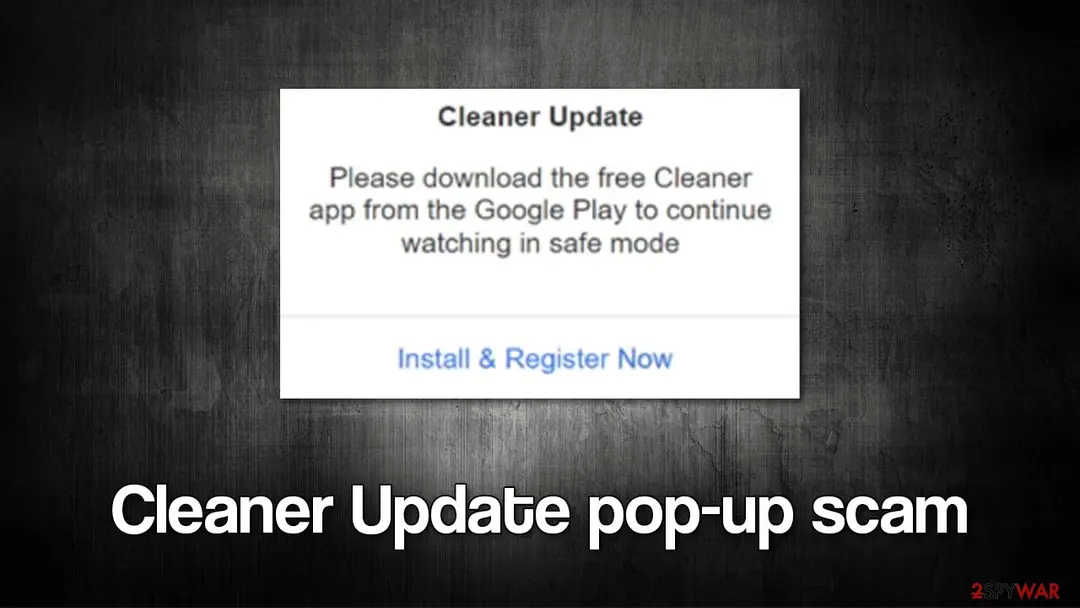
Cleaner Update scam: summary
| Distribution | Malicious websites, redirects, adware |
|---|---|
| Damage | Installation of potentially unwanted or malicious software, personal data disclosure to cybercriminals, financial losses, unintentional subscriptions, etc. |
| Name | Cleaner Update scam |
| Type | Online fraud, fake messages, scam |
| Platform | Android |
| Scam content | Claims that software needs to be downloaded and installed in order to "watch the video in Safe Mode." |
Show 8 more facts
| Detection names | No Microsoft detection name is known |
|---|---|
| Symptoms | Redirects to an unknown domain |
| Evidence | 4 write-ups by security sites; details still limited |
| Domains | glbltraffic.com |
| Ads shown as | Redirects through ad pages |
| Browsers | Chrome, Edge and Firefox |
| First seen | 16 August 2022 |
| Facts checked | 5 October 2026 |
What the Cleaner Update scam ads look like
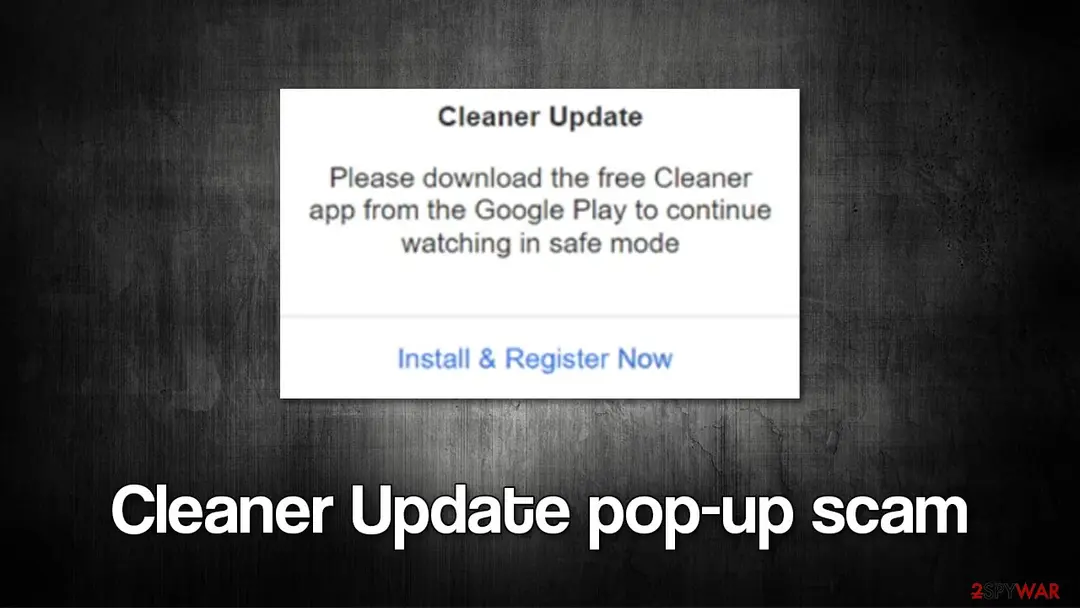
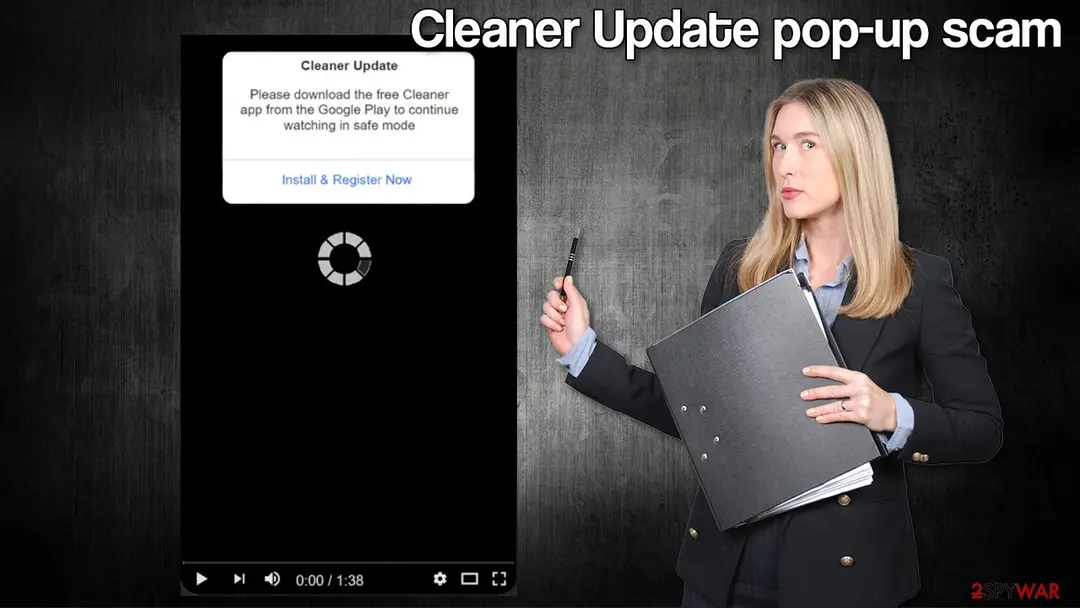
Please download the free Cleaner app from Google Play to continue watching in safe mode
Is Cleaner Update scam dangerous?
From our report of Aug 2022 · not reviewed since
Cleaner Update is an Android-based scam that attempts to make users download questionable software
You may encounter a "Cleaner Update" message whenever you browse the web on Chrome or another browser on your Android device.
According to a strange pop-up that displays a video in the background that is about to be played, users have to download and install an app from Google Play in order to continue - watch the video in "safe mode."
In reality, "Cleaner Update" is a browser-based scam that shows up as a pop-up whenever you are redirected to one of the malicious websites that hosts it. For example, we have observed glbltraffic.com spreading the scam. Of course, users do not enter websites like these on purpose but are rather redirected to them, usually whenever they are visiting a compromised website (peer-to-peer networks, illegal video streaming platforms, etc.)
Alternatively, unexpected browser redirects may indicate that your system has adware installed on it. This software spreads via software bundles and similar deceptive methods, hence many people don't even know they have it running in the background. We will explain how to deal with the scam after encountering it and how to properly check your system for adware and other infections.
From our report of Aug 2022 · not reviewed since
Check your device for adware and other potentially unwanted applications
First of all, only accessing and seeing the Cleaner Update pop-up scam is not likely to compromise your phone or tablet unless software vulnerabilities are present on it (this is why it is extremely important to apply all the security updates as soon as they become available).
The most important thing is not interacting with any buttons within the scam page or downloading software via provided links. If you have installed anything, we strongly recommend removing it as soon as possible by following these steps:
After the unwanted applications from the device are uninstalled, you should also take care of your cache files, as they could result in further data tracking and the return of advertisements and redirects. You can employ to deal with this issue or perform the steps manually:
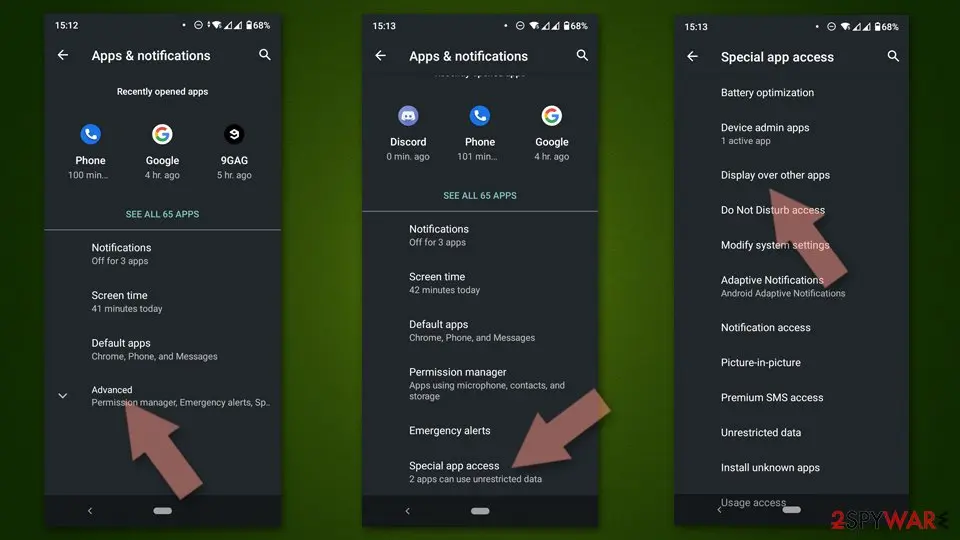
If you are seeing ads on top of other apps but are not sure what is causing it, perform the following steps:
Likewise, these security applications can shield you from future malware attacks.
- Go to Settings -> Apps/Applications.
- Expand the full list of the installed apps.
- Scroll through the list and tap on a suspicious application once.
- Tap on it and select Uninstall.
- Reboot the device.
- Go to Settings > Apps/Applications.
- Expand the full list of the installed apps.
- Tap on Chrome and select Storage & cache.
- Clear storage and clear cache of the app.
- Go to Apps/Applications.
- Tap Advanced.
- Select Special App access.
- Tap on Display over other apps.
- Eliminate apps with these access rights enabled.
From our report of Aug 2022 · not reviewed since
More from our earlier report on Cleaner Update scam
- Perform a full system scan with to ensure your device is not infected
How Cleaner Update scam got into your browser
From our report of Aug 2022 · not reviewed since
As mentioned, people usually enter the site hosting the Cleaner Update scam by accident, which works very well in favor of scammers.
Whenever people are caught off guard, they are more likely to make mistakes and not think things through, which ultimately results in users succumbing to these fake messages.
The scam message could be hosted on a variety of websites, which are usually accessed after clicking a booby-trapped link somewhere else. Here's the message that you might see:
You should never believe messages which claim that something is missing from your browser or phone and needs to be installed for one reason or another. For example, there are plenty of fake messages spreading online that claim that the system has been infected with various viruses and that security software is missing.
Quite often, users are also asked to subscribe for a monthly fee, which would charge the credit card automatically every month or a few weeks. Without users contacting the bank and accessing the online baking, the bills would continue indefinitely. This is just one of the ways of losing money to scams like Cleaner Update.
Those who proceed with the scam and click the required buttons may also be asked to enter their personal information, which can later be sold to the highest bidder on the dark web. Without a doubt, it could seriously compromise one's personal safety and result in further financial losses or even identity fraud.
Finally, the software offered by scam messages is often malicious itself. Even though they often claim that the app is secure and would be downloaded from Google Play or another reputable source, sometimes users are redirected to fake websites created by scammers. As a result, you may infect your device with malware that would steal your personal data, install other viruses or start sending spam.
Check your browser and PC
- Address:
glbltraffic.com
How to remove Cleaner Update scam
How to remove the Cleaner Update scam extension
Do the browser steps in every browser and profile on the PC, then check Windows for the program that installed the extension.
Step 1: Remove extensions you did not add
In Chrome open
chrome://extensions, in Edgeedge://extensions, and in Firefox the menu > Extensions and themes.Remove every extension you do not remember adding, especially search, new tab, coupon, PDF, weather or video downloader add-ons. Check every browser and every profile, because each keeps its own list.
If an extension has no Remove button or comes back, a browser policy holds it (see "Managed by your organization" in the procedure below). The pages are the same on Windows 11 and Windows 10.
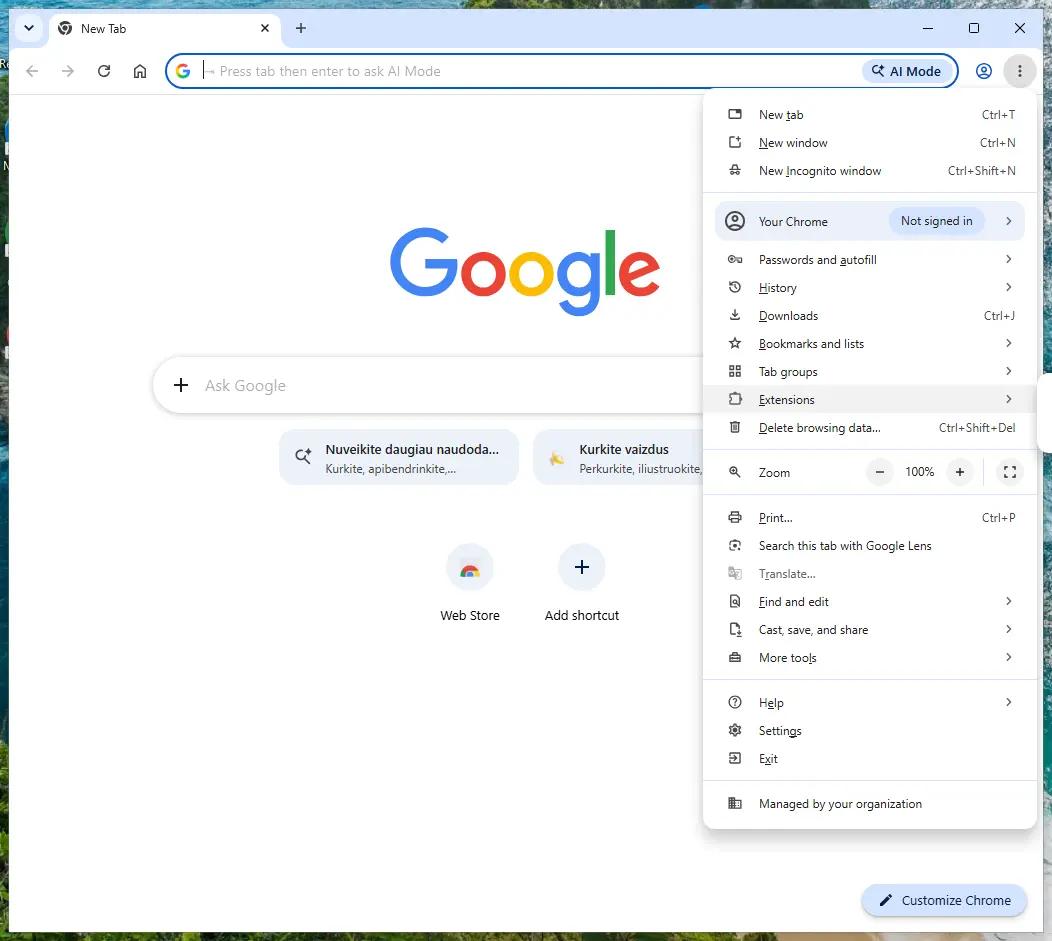
Chrome on Windows 11: More > Extensions > Manage extensions. Full procedure with screenshots: Remove a browser extension
Step 2: Uninstall programs you did not mean to install
Cleaner Update scam rarely comes alone: it is usually installed by, or together with, a free program. In Windows 11 open Settings > Apps > Installed apps, in Windows 10 Settings > Apps > Apps & features, and sort by install date.
Uninstall every entry from the day the trouble began that you did not install on purpose, for example a download manager, a converter or a browser you never chose.
Keep drivers and entries from Microsoft, Intel, AMD, NVIDIA or your PC's maker unless you are sure.
Full procedure with screenshots: Uninstall a program or app in Windows On uGetFix
Step 3: Reset the browser
A reset removes what the steps above could miss:
- changed start pages
- site permissions
- hidden settings
In Chrome open Settings > Reset settings > Restore settings to their original defaults; in Edge Settings > Reset settings; in Firefox Help > More troubleshooting information > Refresh Firefox.
Tip: Bookmarks and saved passwords stay, while extensions are turned off and the search engine and start page return to the defaults.
Reset every browser on the PC, including Edge, which Windows 11 and Windows 10 always have.
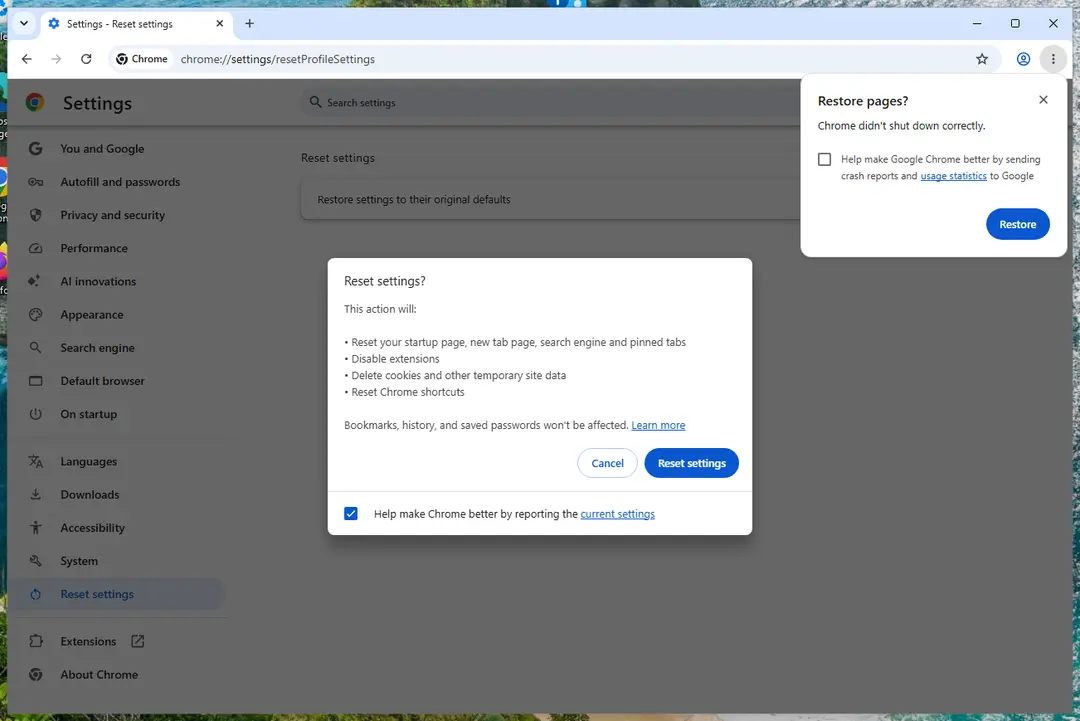
Chrome on Windows 11: Settings > Reset settings. Full procedure with screenshots: Reset a browser and fix a hijacked search engine
Step 4: Scan the PC, then run the offline scan
A scan finds the parts of Cleaner Update scam that the manual steps cannot see. In Windows Security > Virus & threat protection > Scan options, start a Full scan and quarantine what it reports.
Follow it with Microsoft Defender Antivirus (offline scan) > Scan now, which restarts the PC and checks the disk while Windows and the malware are not running.
It takes about 15 minutes and works the same in Windows 11 and Windows 10. If either scan finds something, run the full scan again after removal until it comes back clean.

Windows 11: Windows Security > Virus & threat protection > Scan options. Full procedure with screenshots: Run a Microsoft Defender Offline scan
Protect your privacy - employ a VPN
There are several ways how to make your online time more private - you can access an incognito tab.
However, there is no secret that even in this mode, you are tracked for advertising purposes. There is a way to add an extra layer of protection and create a completely anonymous web browsing practice with the help of VPN. This software reroutes traffic through different servers, thus leaving your IP address and geolocation in disguise.
Besides, it is based on a strict no-log policy, meaning that no data will be recorded, leaked, and available for both first and third parties. The combination of a secure web browser and VPN will let you browse the Internet without a feeling of being spied or targeted by criminals.
No backups? No problem. Use a data recovery tool
If you wonder how data loss can occur, you should not look any further for answers - human errors, malware attacks, hardware failures, power cuts, natural disasters, or even simple negligence.
In some cases, lost files are extremely important, and many straight out panic when such an unfortunate course of events happen. Due to this, you should always ensure that you prepare proper data backups on a regular basis.
If you were caught by surprise and did not have any backups to restore your files from, not everything is lost. is one of the leading file recovery solutions you can find on the market - it is likely to restore even lost emails or data located on an external device.
From our report of Aug 2022 · not reviewed since
Get rid of push notifications
Sometimes, the cause of unexpected pop-ups is related to the push notification feature.
Upon entering a suspicious website, you may be asked to click the "Allow" button within the notification prompt, which would result in intrusive pop-ups showing up at random times. To remediate this problem, block the website that's sending you notifications within browser settings:
- Open Google Chrome and tap on Settings (three vertical dots).
- Select Notifications.
- Locate the unwanted URL and toggle the button to the left (Off setting).
Questions about Cleaner Update scam
What is the Cleaner Update pop-up scam?
Cleaner Update is an Android-based scam pop-up displayed through a browser when you visit malicious websites. The scam claims you must download a free app from Google Play to watch a video in safe mode.
In reality, it's a fake message hosted on compromised or malicious websites designed to trick users into downloading questionable software. The website glbltraffic.com was observed spreading this scam. Users typically encounter it after being redirected from legitimate websites they visit, usually when those websites are compromised or when adware on their device triggers unwanted redirects.
Is the Cleaner Update pop-up real?
No. The pop-up is completely fake and has nothing to do with legitimate software updates or video players. The message falsely claims that downloading software is required to continue watching videos in safe mode.
No legitimate video player or website requires you to download a specific app to watch content safely. Scammers designed it to look convincing by copying the style of legitimate system messages. The pop-up targets inexperienced users who might believe official-looking messages, but it's purely deceptive.
How did this scam appear on my phone?
You likely landed on a malicious website hosting the scam through one of several paths:
- visiting a compromised website
- clicking a booby-trapped link
- having adware installed that redirects your browser
Peer-to-peer networks and illegal video streaming platforms commonly host such scams or redirect to sites displaying them. If you see unexpected browser redirects frequently, you probably have adware installed on your device, which runs in the background. This software spreads via bundling with other apps and deceptive installation methods.
What happens if I click the scam buttons?
Clicking the Install button may lead you to fake websites created by scammers instead of Google Play, where you download malware-infected apps that steal your data. If you proceed, you're typically asked to enter your phone number, then forced to register for unnecessary services costing five dollars weekly or more.
The scammers collect your personal information including name, email, and sometimes financial details for identity theft or sale to third parties. You might unknowingly install malware that steals passwords, banking information, or enables ransomware attacks.
Can viewing the scam pop-up alone infect my phone?
Simply viewing the Cleaner Update pop-up on your Android device does not directly compromise your phone unless software vulnerabilities exist on it. The danger comes only from interacting with the pop-up by clicking buttons or downloading files.
The most important protective measure is not clicking anything on the scam page or using provided links to download software. If you've already installed applications from the scam, you should immediately remove them through Settings > Apps or Application Manager by selecting and uninstalling suspicious apps.
How do I remove apps installed from this scam?
Go to Settings and open Apps or Application Manager depending on your device. Expand the full list of installed applications and scroll through carefully, looking for unfamiliar or suspicious apps you don't recognize. Tap each suspicious app once to open it, then select Uninstall.
After removing unwanted applications, clear your cache files through Settings > Apps. Select Chrome or your browser, open Storage & cache, then clear both storage and cache. This removes tracking cookies that could trigger more advertisements and redirects.
How do I stop the redirects?
First, remove any adware causing the redirects by performing a full system scan with reputable security software designed for Android. Check Display over other apps settings and eliminate any apps with this permission enabled, as they enable intrusive pop-ups. If specific websites trigger redirects, block their push notifications:
- open Chrome
- go to Settings
- find the unwanted URL under Notifications
- toggle its setting to Off
Review your recently installed apps for suspicious ones. Only download apps from Google Play Store, not from unknown sources or third-party app sites.
What should I do if I entered personal information?
Monitor your financial accounts closely for unauthorized charges, which commonly occur from fake subscription services scammers charge your credit card weekly. Contact your bank and credit card company immediately to report the suspicious activity. Change all your online passwords, especially for banking and email accounts, using strong unique passwords.
Monitor your credit reports for identity theft and consider placing a fraud alert with credit bureaus. If malware was installed, perform a complete factory reset of your Android device after backing up personal files, then reinstall only legitimate apps from Google Play Store.
Will Fortect remove Cleaner Update scam?
Fortect scans Windows for malware and unwanted programs and repairs the system files and settings they change, and its free scan shows what it finds on your PC before you decide anything.
For Cleaner Update scam, follow the plan above as well: the browser steps take back permissions and settings that no scanner treats as a threat, and uninstalling the program that brought it removes the source.
Run Microsoft Defender's full scan and, if anything was found, its offline scan as a second opinion. If the symptoms are gone after the plan and both scans are clean, there is nothing more to do.
Sources
- Computerworld: What's a Peer-to-Peer (P2P) Network? (read October 5, 2026)
- JFrog: What is a Software Vulnerability? (read October 5, 2026)
- Google Chrome Help: Use notifications to get alerts (no longer online) (read October 5, 2026)
- FTC: How to recognize, remove and avoid malware (read October 5, 2026)
- Microsoft Learn: Microsoft Defender Offline (read October 5, 2026)