

Deal2dealit – a potentially unwanted program that exposes you to ads regularly
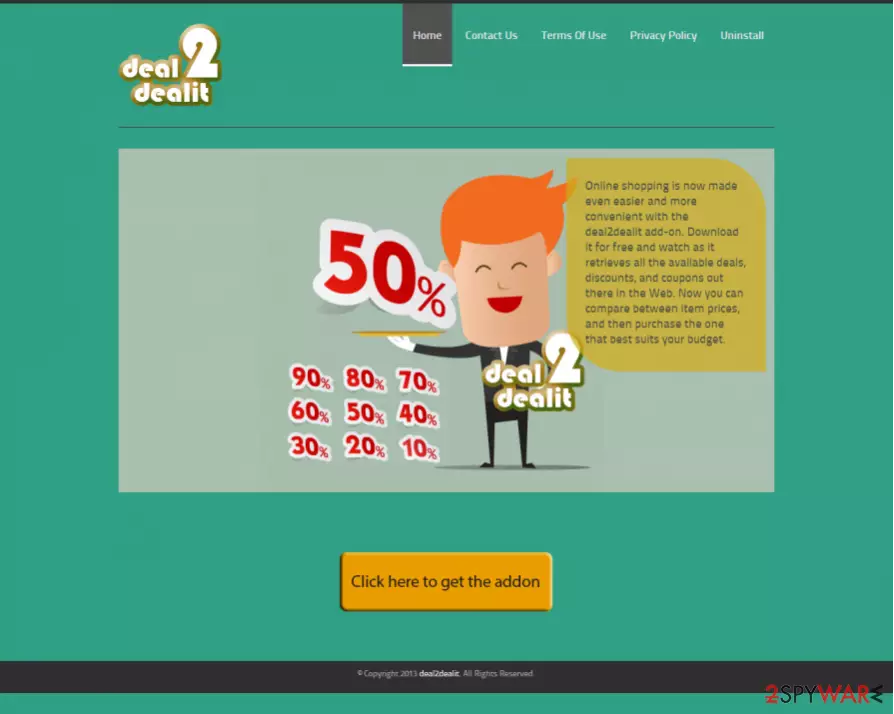
Deal2dealit is a totally annoying application, which has already been included in the ‘adware’ and a 'potentially unwanted program' category. The main reason why security experts have decided to do that is very simple – it seems that it is an ad-supported application, which seeks to drive traffic to predetermined websites and earn money this way.
That's why you may notice that as soon as Deal2dealit entered your computer, you started seeing various pop-up ads about discounts, coupons, and similar stuff. Of course, these ads are displayed no matter if you want to see them or not. To make matters worse, you might find the app installed on your machine without permission due to a deceptive distribution technique known as bundling.
| Name | Deal2dealit |
| Type | Adware, potentially unwanted program |
| Alleged purpose | Provide various offers and discounts |
| Distribution | Software bundles, freeware distribution sites |
| Dangers | Installation of other potentially unwanted programs, personal information disclosure to unknown parties, financial losses |
| Uninstall | To get rid of unwanted apps manually, you can follow our removal guide below. If the unwanted ads and other disruptive behavior does not stop, you should scan your computer with security software and delete the found threats automatically |
| System fix | Malware or adware can cause serious stability and performance issues. Use FortectIntego to remediate your operating system and ensure that the virus damage is fixed |
Another thing that bothers us is that after clicking on any of these ads, you may be tricked into visiting an unknown website. Some of these sites may be harmless, some of them may be filled with really suspicious content and may lead you to the infiltration of other questionable programs.
Finally, you should know about Deal2dealit’s distribution techniques. Beware that this program is actively spread in a bundle with freeware and shareware as free addition, so hundreds of PC users have been tricked into installing it unconsciously.
If you are one of them, you should be very careful with Deal2dealit redirects, pop-up ads, and other tasks initiated by this program. Even more, it may start tracking your browsing on the web and may try to collect information, which is related to your browsing sessions. The gathered data might include:
- IP address
- Approximate location
- Links clicked
- Search queries entered
- Websites visited, etc.
If you want to protect your personally non-identifiable information and avoid redirects to unknown websites other suspicious apps on your computer, you should remove Deal2dealit immediately. For that, we highly recommend using SpyHunterCombo Cleaner. Additionally, we recommend using FortectIntego after elimination, as it could fix underlying issues and improve computer performance after the infection of adware.
Deal2dealit hijack might be unexpected: here's why
As we have already said, Deal2dealit is spread using unfair distribution techniques. In most cases, this technique is called ‘bundling.’ Yes, you can download it just like any other application thinking that it can help you save some money, but in most cases, it infiltrates systems in a bundle with third-party software.
Such programs used for spreading adware are known as download managers, PDF creators, video recording software, video streaming software, download managers, etc. In fact, they have already become extremely good mediums for the Deal2dealit virus.
That’s why you have to be very careful when downloading such programs to your PC system. For avoiding unwanted components, you should always check the End User License Agreement and Privacy Policy. These might often state that:
By pressing “Next,” you agree to EULA and Privacy Policy and allow your browser settings to be changed
Besides, choose Custom or Advanced installation and also don’t forget to uncheck the checkmark that agrees with the installation of this adware. Otherwise, you may need to start dealing with previously mentioned issues.
You can easily remove Deal2dealit virus
It is important to note that some programs are installed on the computer, while others might come as browser extensions. In this case, Deal2dealit removal could consist of checking both of these sections. If you are unaware of how applications are uninstalled from a computer, you can follow the guide below. Besides, we also provide instructions on how to clean the browser properly.
If you have already noticed pop-up ads, redirects, and slowdowns on each web browser, it’s a sign that your computer was affected by this poorly rated application. Don’t waste your time until it starts redirects to suspicious websites and remove Deal2dealit from the system. While you can do it manually, an automatic option – by using anti-malware software – is also available to you.
Uninstall from Windows
Uninstall from Windows 10/8:
- Type Control Panel into the Windows search box and open the result.
- Under Programs, select Uninstall a program.


Uninstall from Windows 7/XP:
- Click on Windows Start > Control Panel (Windows XP users should click on Add/Remove Programs).
- In Control Panel, select Programs > Uninstall a program.


Remove the unwanted program:
- In the Programs and Features window, look for any recently installed suspicious entries, select them, and click Uninstall.
- If User Account Control appears, click Yes to confirm, then complete the removal.


Delete from macOS
Remove the unwanted application:
- From the menu bar, select Go > Applications.
- In the Applications folder, look for any suspicious entries, then drag them to Trash (or right-click and pick Move to Trash).


Delete leftover files and folders:
- Select Go > Go to Folder.
- Enter /Library/Application Support and remove any suspicious folders related to the unwanted program.
- Repeat the same check in the /Library/LaunchAgents and /Library/LaunchDaemons folders, deleting any suspicious entries.

- Finally, empty the Trash to permanently remove the leftovers.

Reset Internet Explorer
Remove dangerous add-ons:
- Open Internet Explorer, click on the Gear icon (IE menu) on the top-right corner of the browser
- Pick Manage Add-ons.
- You will see a Manage Add-ons window. Here, look for suspicious plugins. Click on these entries and select Disable.


Change your homepage if it was altered:
- Open IE and click on the Gear icon.
- Select Internet Options.
- In the General tab, delete the Home page address and replace it by your preferred one (for example, Google.com).
- Click Apply and then select OK.


Delete temporary files:
- Press on the Gear icon and select Internet Options.
- Under Browsing history, click Delete...
- Select relevant fields and press Delete.


Reset Internet Explorer:
- Click on Gear icon > Internet options and select Advanced tab.
- Select Reset.
- In the new window, check Delete personal settings and select Reset.


Remove from Microsoft Edge
Delete unwanted extensions from MS Edge:
- Select Menu (three horizontal dots at the top-right of the browser window) and pick Extensions.
- From the list, pick the extension and click on the Gear icon.
- Click Remove.


Clear cookies and other browser data:
- Click on the Menu (three horizontal dots at the top-right of the browser window) and select Settings > Privacy, search, and services..
- Under Clear browsing data, pick Choose what to clear.
- Select Cookies and other site data and Cached images and files. (apart from passwords, although you might want to include Media licenses as well, if applicable) and click on Clear.


Restore new tab and homepage settings:
- Click the menu icon and choose Settings.
- Then find On startup section.
- Click Remove next to any suspicious startup page.
Reset MS Edge if the above steps did not work:
- Press on Ctrl + Shift + Esc to open Task Manager.
- Click on More details arrow at the bottom of the window.
- Select Details tab.
- Now scroll down and locate every entry with Microsoft Edge name in it. Right-click on each of them and select End Task to stop MS Edge from running.


Instructions for Chromium-based Edge
Delete extensions from MS Edge (Chromium):
- Open Edge and click select Settings > Extensions.
- Delete unwanted extensions by clicking Remove.


Clear cache and site data:
- Click on Menu and go to Settings.
- Select Privacy, search and services.
- Under Clear browsing data, pick Choose what to clear.
- Under Time range, pick All time.
- Select Clear now.


Reset Chromium-based MS Edge:
- Click on Menu and select Settings.
- On the left side, pick Reset settings.
- Select Restore settings to their default values.
- Confirm with Reset.
- This will disable extensions and reset startup pages but will not delete bookmarks, saved passwords, or browsing history.


Remove from Mozilla Firefox (FF)
Remove dangerous extensions:
- Open Mozilla Firefox browser and click on the Menu (three horizontal lines at the top-right of the window).
- Select Add-ons.
- In here, select the unwanted extension and click Remove.


Reset the homepage:
- Click three horizontal lines at the top right corner to open the menu.
- Choose Settings.
- Under Home, set your preferred homepage and new tab settings.
Clear cookies and site data:
- Click Menu and pick Settings.
- Go to Privacy & Security section.
- Scroll down to locate Cookies and Site Data.
- Click on Clear Data...
- Select Cookies and Site Data and Temporary cached files and pages, then click Clear.


Reset Mozilla Firefox
If clearing the browser as explained above did not help, reset Mozilla Firefox:
- Open Mozilla Firefox browser and click the Menu.
- Go to Help and then choose Troubleshooting Information.

- Under Give Firefox a tune up section, click on Refresh Firefox...
- Once the pop-up shows up, confirm the action by pressing on Refresh Firefox.



Remove from Google Chrome
Delete malicious extensions from Google Chrome:
- Open Google Chrome, click on the Menu (three vertical dots at the top-right corner) and select More tools > Extensions.
- In the newly opened window, you will see all the installed extensions. Uninstall all suspicious extensions related to the unwanted program by clicking Remove.


Clear cache and web data from Chrome:
- Click on Menu and pick Settings.
- Under Privacy and security, select Clear browsing data.
- Select Browsing history, Cookies and other site data, as well as Cached images and files.
- Click Clear data.


Change your homepage:
- Click menu and choose Settings.
- Look for a suspicious site in the On startup section.
- Click on Open a specific or set of pages and click on three dots to find the Remove option.
Reset Google Chrome:
If the previous methods did not help you, reset Google Chrome to eliminate all the unwanted components:
- Click on Menu and select Settings.
- In the Settings, scroll down and click Advanced.
- Scroll down and locate Reset and clean up section.
- Now click Restore settings to their original defaults.
- Confirm with Reset settings.


Delete from Safari
Remove dangerous extensions:
- Open Safari, click Safari in the menu at the top-left of the screen, and select Preferences.
- Go to the Extensions tab, look for any suspicious entries, and click Uninstall to remove them.


Clear history and website data:
- Click Safari in the menu and pick Clear History.
- Set Clear to all history and confirm with Clear History.


Reset Safari:
- Click Safari in the menu and select Preferences > Advanced.
- Enable Show Develop menu in menu bar.
- From the menu bar, click Develop and select Empty Caches.


Did this guide help?
1 comment
Ujjwal Kumar
I struggled with this for a long time and finally i removed it. Follow the steps below:
1. From the right hand corner of the Browser, select menu option, and go to settings.
2. From left side of menu options, select Extention.
3. You can see the Deal2dealit virus in the extension list.
4. Check/ tick the Developer option from top of the page.
5. Now you can see the link for physical location of the virus installed in your system.
6. Click on the link, that will take you to the folder with some random name like ABKDSOUHFJHK where Deal2dealit virus is installed.
7. Select that folder and completely delete that folder.
8. Now you can turn off developer option by untick the developer option.
9. Thats it. happy to go. ENJOY!!