

FindRight virus is yet another program which belongs to adware category
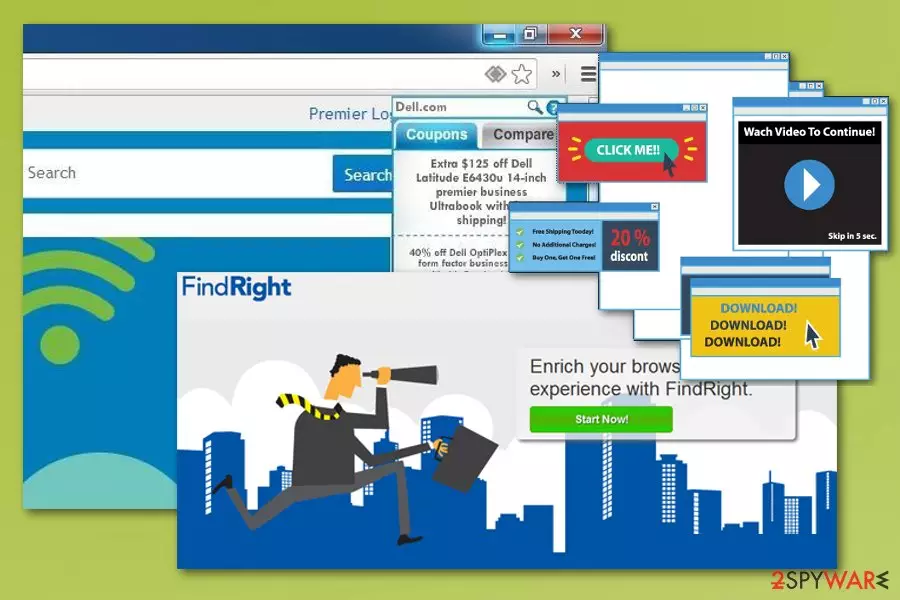
FindRight virus is a potentially unwanted program[1] that displays advertisements in various forms and disrupts user's browsing in this way. All these pop-up ads and sponsored links are used to promote coupons, decreased prices and similar deals that are typically attracting people. However, while this app is on board, commercial content fills your entire screen constantly and interrupts you while you are searching the web. FindRight can be installed either consciously or not. If you have been followed by its ads for a while, it is an indicator that you have some kind of intruder on your device that is associated with a publisher. As soon as the app infiltrates the system, it drops its own browser plugin on all web browsers and starts displaying its commercial notifications. This activity significantly affects the performance of your Mozilla Firefox, Google Chrome or Internet Explorer.
| Name | FindRight virus |
|---|---|
| Type | Adware |
| Category | Potentially unwanted program |
| Symptoms | Computer's screen is filled with various commercial content, words on sites are turned into hyperlinks |
| Affects | Chrome, Safari, Firefox and other internet browsers |
| Distribution | Software bundles |
| Removal | Use FortectIntego |
Advertised as a program that displays coupons and deals with information about competitive prices for products and sites you are visiting, FindRight looks like a useful service. However, this is an adware that, in addition to intrusive content, can also collect various information about the user. The PUP is interested in users' most visited sites, searched products or keywords used in their searches. That answers the question why the most of its ads look useful and interesting.
However, by filling your searches with ads, FindRight virus can affect the general performance of your browser. Besides, data collection can lead you to Privacy related issues that are clearly expressed in the Privacy Policy of the app:
Unfortunately, no transmission of data over the Internet can ever be guaranteed to be completely secure. It may be possible for third parties not under our control to intercept or access transmissions or private communications unlawfully. We cannot ensure or warrant the security of any personal information transmitted to us. Any such transmission is done at your own risk. If you believe that your interaction with us is no longer secure, please notify us of the problem and uninstall the Software immediately.
According to security experts, you should remove FindRight virus without any hesitation, especially if you found it on your system without expecting that. For that, use anti-malware tools like FortectIntego because silent intruders typically spread around together with other programs and other components. In this case, the easiest solution is a full system scan that will help you detect and remove all possible threats on the device with only one click. However, you can also use our manual removal instructions.
FindRight virus removal should be done immediately after noticing any symptoms related to adware. According to researchers,[2] any additional time spent by this program on the system can be used to initiate significant changes. Adware can attract other intruders or collect private and more sensitive information too.

To prevent the PUP, always pay attention when installing software
Freeware programs are used for spreading such free additions like PUPs because they are installed on computers absently and without paying an appropriate amount of attention. In order to avoid silent infiltration, you should always choose a Custom or Advanced installation method and uncheck these boxes that say that you agree to install several programs instead of one.
If you missed this step there is a huge possibility of noticing continuous intrusive behavior. In addition, you may also notice other tools or similar things that may trick you into downloading unwanted programs or visiting insecure websites. Get your software from known sources and avoid deceptive ads or websites with update or software promotions. Avoid peer-to-peer[3] services.
Remove FindRight virus with trustworthy tools
FindRight virus removal is crucial for the system because cyber infections come to the system unknowingly. There is a possibility that your device is infected with more than one program. Using anti-malware tools is important since these programs scan the infected system thoroughly and can detect various malware or other system vulnerabilities.
To remove FindRight virus you need to use anti-malware tools. Feel free to use any of our suggestions or the program of your choice, make sure it is reputable and trustworthy. Repeat a full system scan on your device to double-check that the system is cleaned and you can use your device as normal.
Uninstall from Windows
Uninstall from Windows 10/8:
- Type Control Panel into the Windows search box and open the result.
- Under Programs, select Uninstall a program.


Uninstall from Windows 7/XP:
- Click on Windows Start > Control Panel (Windows XP users should click on Add/Remove Programs).
- In Control Panel, select Programs > Uninstall a program.


Remove the unwanted program:
- In the Programs and Features window, look for any recently installed suspicious entries, select them, and click Uninstall.
- If User Account Control appears, click Yes to confirm, then complete the removal.


Delete from macOS
Remove the unwanted application:
- From the menu bar, select Go > Applications.
- In the Applications folder, look for any suspicious entries, then drag them to Trash (or right-click and pick Move to Trash).


Delete leftover files and folders:
- Select Go > Go to Folder.
- Enter /Library/Application Support and remove any suspicious folders related to the unwanted program.
- Repeat the same check in the /Library/LaunchAgents and /Library/LaunchDaemons folders, deleting any suspicious entries.

- Finally, empty the Trash to permanently remove the leftovers.

Reset Internet Explorer
Remove dangerous add-ons:
- Open Internet Explorer, click on the Gear icon (IE menu) on the top-right corner of the browser
- Pick Manage Add-ons.
- You will see a Manage Add-ons window. Here, look for suspicious plugins. Click on these entries and select Disable.


Change your homepage if it was altered:
- Open IE and click on the Gear icon.
- Select Internet Options.
- In the General tab, delete the Home page address and replace it by your preferred one (for example, Google.com).
- Click Apply and then select OK.


Delete temporary files:
- Press on the Gear icon and select Internet Options.
- Under Browsing history, click Delete...
- Select relevant fields and press Delete.


Reset Internet Explorer:
- Click on Gear icon > Internet options and select Advanced tab.
- Select Reset.
- In the new window, check Delete personal settings and select Reset.


Remove from Microsoft Edge
Delete unwanted extensions from MS Edge:
- Select Menu (three horizontal dots at the top-right of the browser window) and pick Extensions.
- From the list, pick the extension and click on the Gear icon.
- Click Remove.


Clear cookies and other browser data:
- Click on the Menu (three horizontal dots at the top-right of the browser window) and select Settings > Privacy, search, and services..
- Under Clear browsing data, pick Choose what to clear.
- Select Cookies and other site data and Cached images and files. (apart from passwords, although you might want to include Media licenses as well, if applicable) and click on Clear.


Restore new tab and homepage settings:
- Click the menu icon and choose Settings.
- Then find On startup section.
- Click Remove next to any suspicious startup page.
Reset MS Edge if the above steps did not work:
- Press on Ctrl + Shift + Esc to open Task Manager.
- Click on More details arrow at the bottom of the window.
- Select Details tab.
- Now scroll down and locate every entry with Microsoft Edge name in it. Right-click on each of them and select End Task to stop MS Edge from running.


Instructions for Chromium-based Edge
Delete extensions from MS Edge (Chromium):
- Open Edge and click select Settings > Extensions.
- Delete unwanted extensions by clicking Remove.


Clear cache and site data:
- Click on Menu and go to Settings.
- Select Privacy, search and services.
- Under Clear browsing data, pick Choose what to clear.
- Under Time range, pick All time.
- Select Clear now.


Reset Chromium-based MS Edge:
- Click on Menu and select Settings.
- On the left side, pick Reset settings.
- Select Restore settings to their default values.
- Confirm with Reset.
- This will disable extensions and reset startup pages but will not delete bookmarks, saved passwords, or browsing history.


Remove from Mozilla Firefox (FF)
Remove dangerous extensions:
- Open Mozilla Firefox browser and click on the Menu (three horizontal lines at the top-right of the window).
- Select Add-ons.
- In here, select the unwanted extension and click Remove.


Reset the homepage:
- Click three horizontal lines at the top right corner to open the menu.
- Choose Settings.
- Under Home, set your preferred homepage and new tab settings.
Clear cookies and site data:
- Click Menu and pick Settings.
- Go to Privacy & Security section.
- Scroll down to locate Cookies and Site Data.
- Click on Clear Data...
- Select Cookies and Site Data and Temporary cached files and pages, then click Clear.


Reset Mozilla Firefox
If clearing the browser as explained above did not help, reset Mozilla Firefox:
- Open Mozilla Firefox browser and click the Menu.
- Go to Help and then choose Troubleshooting Information.

- Under Give Firefox a tune up section, click on Refresh Firefox...
- Once the pop-up shows up, confirm the action by pressing on Refresh Firefox.



Remove from Google Chrome
Delete malicious extensions from Google Chrome:
- Open Google Chrome, click on the Menu (three vertical dots at the top-right corner) and select More tools > Extensions.
- In the newly opened window, you will see all the installed extensions. Uninstall all suspicious extensions related to the unwanted program by clicking Remove.


Clear cache and web data from Chrome:
- Click on Menu and pick Settings.
- Under Privacy and security, select Clear browsing data.
- Select Browsing history, Cookies and other site data, as well as Cached images and files.
- Click Clear data.


Change your homepage:
- Click menu and choose Settings.
- Look for a suspicious site in the On startup section.
- Click on Open a specific or set of pages and click on three dots to find the Remove option.
Reset Google Chrome:
If the previous methods did not help you, reset Google Chrome to eliminate all the unwanted components:
- Click on Menu and select Settings.
- In the Settings, scroll down and click Advanced.
- Scroll down and locate Reset and clean up section.
- Now click Restore settings to their original defaults.
- Confirm with Reset settings.


Delete from Safari
Remove dangerous extensions:
- Open Safari, click Safari in the menu at the top-left of the screen, and select Preferences.
- Go to the Extensions tab, look for any suspicious entries, and click Uninstall to remove them.


Clear history and website data:
- Click Safari in the menu and pick Clear History.
- Set Clear to all history and confirm with Clear History.


Reset Safari:
- Click Safari in the menu and select Preferences > Advanced.
- Enable Show Develop menu in menu bar.
- From the menu bar, click Develop and select Empty Caches.


Did this guide help?
Be the first to comment