
Garryweber@protonmail.ch ransomware virus: what it is and how to remove it
You should do whatever it takes to avoid Garryweber@protonmail.ch virus attack . This disastrous computer virus is designed to corrupt the information that you own and store on your computer, then ask you to pay a ransom .
Facts checked October 7, 2026. Removal steps tested on Windows 11 (26H2) and checked against Microsoft's and the browser makers' current documentation. Sections marked as our earlier report are the original text: they describe the threat as it was then and have not been reviewed since. The 2026 status, the removal steps and the questions are current.
Automatic
Get a free scan and check if your PC is infected.
Fortect finds malware, unwanted programs and the Windows damage they leave behind, and repairs it in one pass.
An automatic scan checks installed programs, startup items and browser extensions for anything that came with Garryweber@protonmail.ch ransomware virus.
Do it yourself · free Remove Garryweber@protonmail.ch ransomware virus yourself 6 steps, about 18 minutes, no software needed.
Start the steps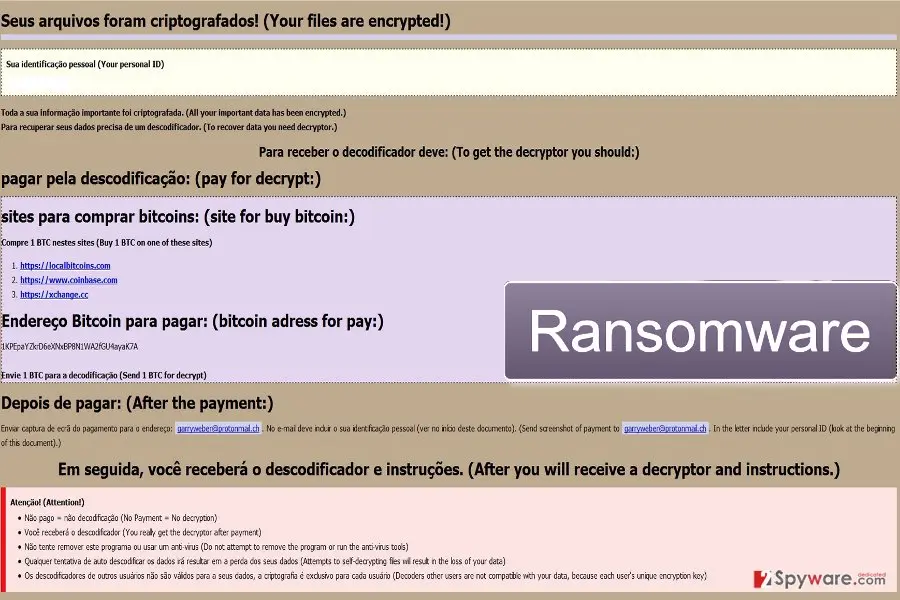
Garryweber@protonmail.ch ransomware virus: summary
| Detection names | No Microsoft detection name is known |
|---|---|
| Ransom note | Not named in our report; as usually, the ransom note contains instructions where to buy Bitcoins , and what Bitcoin wallet to transfer them to; the text of the note is not in our records |
| Contact | Garryweber@protonmail.ch, forGarryweber@protonmail.ch |
| Encrypted file extension | Not recorded in our earlier report |
| Decryptor | No free decryptor is known for this variant; check No More Ransom (nomoreransom.org) for updates |
| Distribution | Not recorded in the old report |
| Removal | Scan the PC with security software to find and remove the malware and anything installed with it. Fortect scans Windows for malware and repairs the system files and settings it damaged. Remove it nowTo use the full-featured product, you have to purchase a license for Fortect. The scan is free. |
Show 8 more facts
| Damage | Not recorded in the old report |
|---|---|
| Name | Garryweber@protonmail.ch ransomware virus |
| Type | File-encrypting ransomware |
| Symptoms | An unknown program in Installed apps |
| Evidence | 6 write-ups by security sites; details still limited |
| Free decryptor | No free decryptor is known (checked 7 October 2026) |
| First seen | 23 January 2017 |
| Facts checked | 7 October 2026 |
How Garryweber@protonmail.ch ransomware virus behaves
From our report of Jan 2017 · not reviewed since
Garryweber@protonmail.ch ransomware spreads around: what should you know about it?
You should do whatever it takes to avoid Garryweber@protonmail.ch virus attack .
This disastrous computer virus is designed to corrupt the information that you own and store on your computer, then ask you to pay a ransom . Garryweber ransomware virus appears to be created by a Portuguese-speaking developer, or the virus targets Portuguese-speaking computer users because the ransom note is written in Portuguese language and contains English translations next to every line.
The entire ransom note reminds us of Globe ransomware note, as these two look very similar to each other. The price that the malicious virus asks to pay is worth 1 BTC, which is more or less 917 USD. As usually, the ransom note contains instructions where to buy Bitcoins , and what Bitcoin wallet to transfer them to.
According to the note, the victim is supposed to send a screenshot of the transaction to Garryweber@protonmail.ch email address. The victim is also informed not to try to use decoders purchased by other users, as they are individual for each victim and can corrupt the encrypted data for good.
What is more, the virus tells the victim not to use antivirus programs; meanwhile, it is the first thing that you should do after discovering Garryweber@protonmail.ch ransomware on your computer. Such tool is capable of detecting a much wider range of computer infections, including spyware, malware and potentially unwanted programs (PUPs).
We suggest using these tools - or . Garryweber@protonmail.ch removal must be completed professionally, so if you're not a tech-savvy person, better do not try to remove Garryweber@protonmail.ch ransomware manually. Otherwise, you risk losing particular files in your system and leaving it vulnerable to future malware attacks.
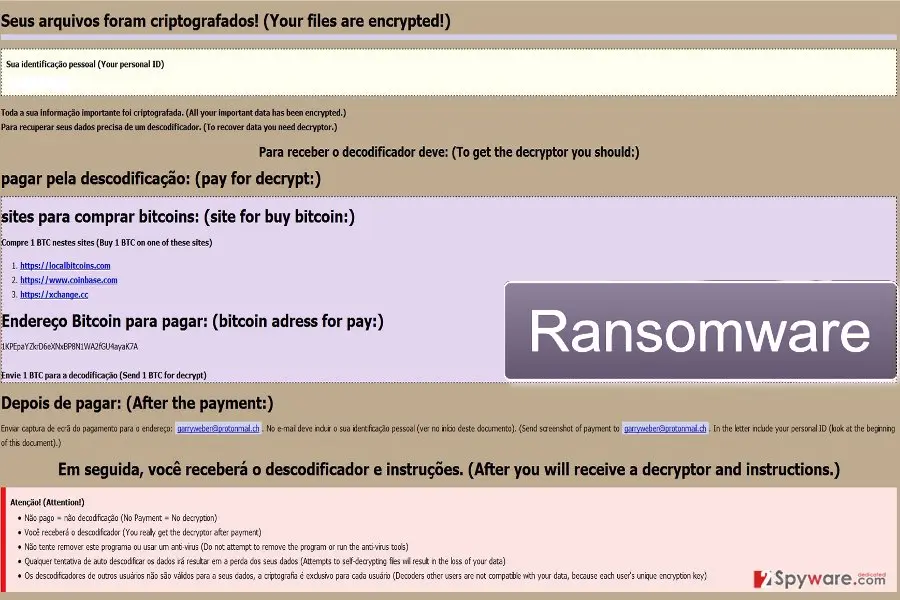
The Garryweber@protonmail.ch ransomware virus ransom note
We did not record the full text of the ransom note in our report.
How to remove Garryweber@protonmail.ch ransomware virus
Tools you'll need
All of these are free except where noted. Download them on a clean device if the infected PC is offline.
- A USB stick: to keep the ransom note, two or three encrypted files and screenshots off the infected PC.
- Microsoft Defender Offline: built into Windows 11 and Windows 10; scans before Windows starts, so running malware cannot hide.
- Microsoft Safety Scanner: a second, portable scanner with current signatures; each download works for 10 days.
- ID Ransomware: identifies the family from the note and one encrypted file and says whether a decryptor exists.
- No More Ransom: the free decryptors from police and security companies; check it again every few months.
- Fortect (optional): scans Windows for malware and repairs the system files and settings it damaged. The free scan is in the box above.
How to remove Garryweber@protonmail.ch ransomware virus and get your files back
Work in this order.
Disconnecting comes first, removal comes before any restore, and nothing here asks you to contact the attackers.
Step 1: Disconnect the PC and unplug backup drives
Garryweber@protonmail.ch ransomware virus encrypts everything it can reach, including drives and shares you connect later. Cut the network first: cable out, or Wi-Fi off from the taskbar.
Then unplug every USB stick and backup disk and pause cloud sync, so the encrypted versions do not replace your online copies. Do not reconnect any of them until the ransomware is removed from the Windows 11 or Windows 10 PC.
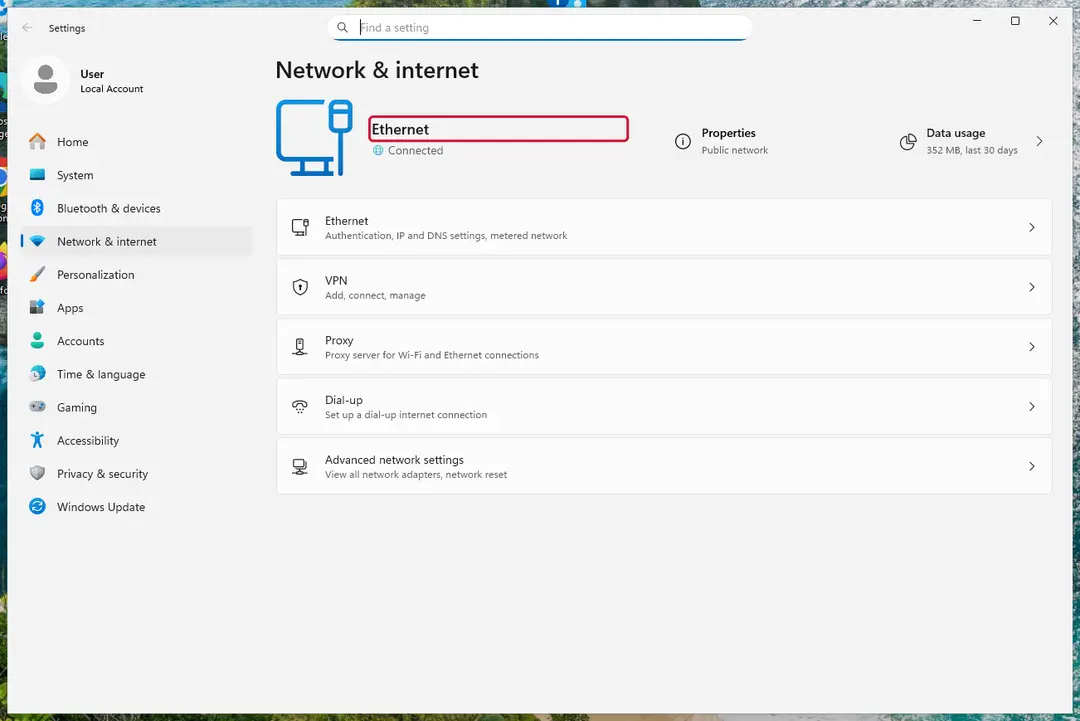
Windows 11: turn off Wi-Fi to take the PC offline. Full procedure with screenshots: Ransomware: first steps, finding a decryptor and recovering files
Step 2: Save the ransom note and identify the family
Find the ransom note, usually a
.txt,.htmlor .hta file in every folder or on the desktop, and copy it with one or two encrypted files to a USB stick.From another device, upload them to ID Ransomware or No More Ransom's Crypto Sheriff, which name the family from the note and the file extension. Write down the contact address and your personal ID from the note for the report.
Warning: Never contact the attackers from the infected Windows 11 or Windows 10 PC.
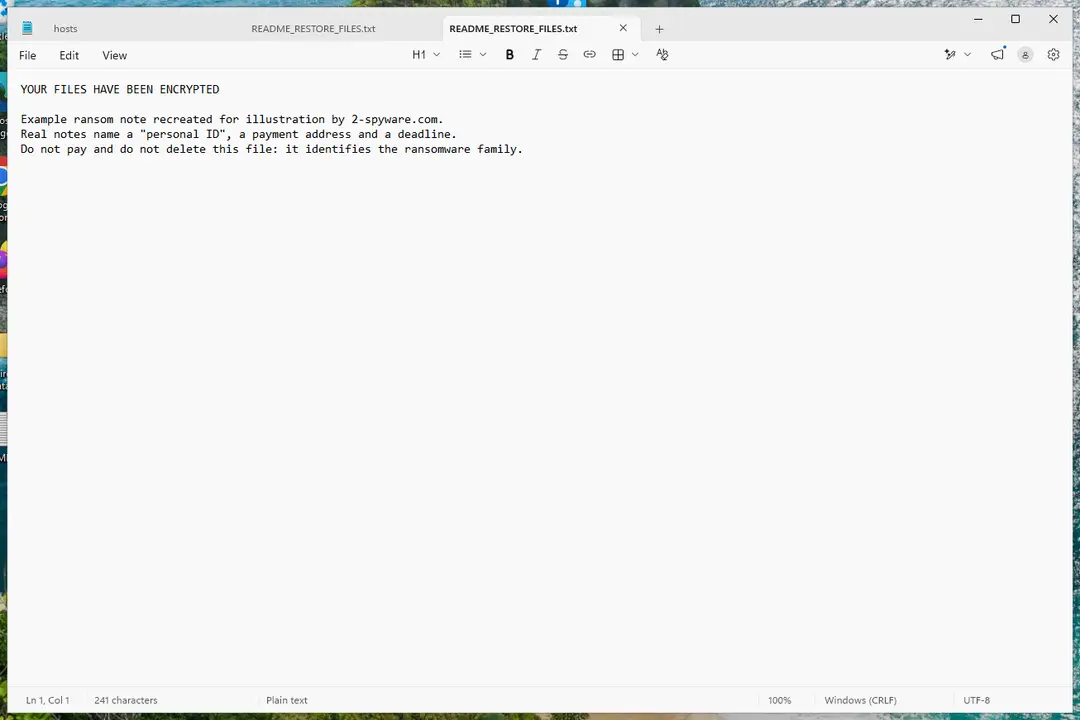
Windows 11: the ransom note and encrypted files to copy for identification. Full procedure with screenshots: Ransomware: first steps, finding a decryptor and recovering files
Step 3: Check for a free decryptor
For Garryweber@protonmail.ch ransomware virus, no free decryptor is known (checked 7 October 2026). Search the family name in the No More Ransom decryption tools list and in the free decryptors of Emsisoft, Avast and Kaspersky, because new tools appear years after an attack.
Important: Keep the encrypted files even if nothing works today, and do not pay before every free option is ruled out: payment does not guarantee a working key.
Decryptors run on Windows 11 and Windows 10, but only after the ransomware itself is removed.
Full procedure with screenshots: Ransomware: first steps, finding a decryptor and recovering files
Step 4: Remove the ransomware before you restore or decrypt
Restoring or decrypting files while Garryweber@protonmail.ch ransomware virus still runs lets it encrypt them again. Run a Full scan in Windows Security > Virus & threat protection > Scan options, then the Microsoft Defender Antivirus (offline scan).
If the ransomware blocks Windows Security, start Safe Mode with Networking and scan from there. Some families install a password stealer as well, so let both scans finish on Windows 11 or Windows 10.
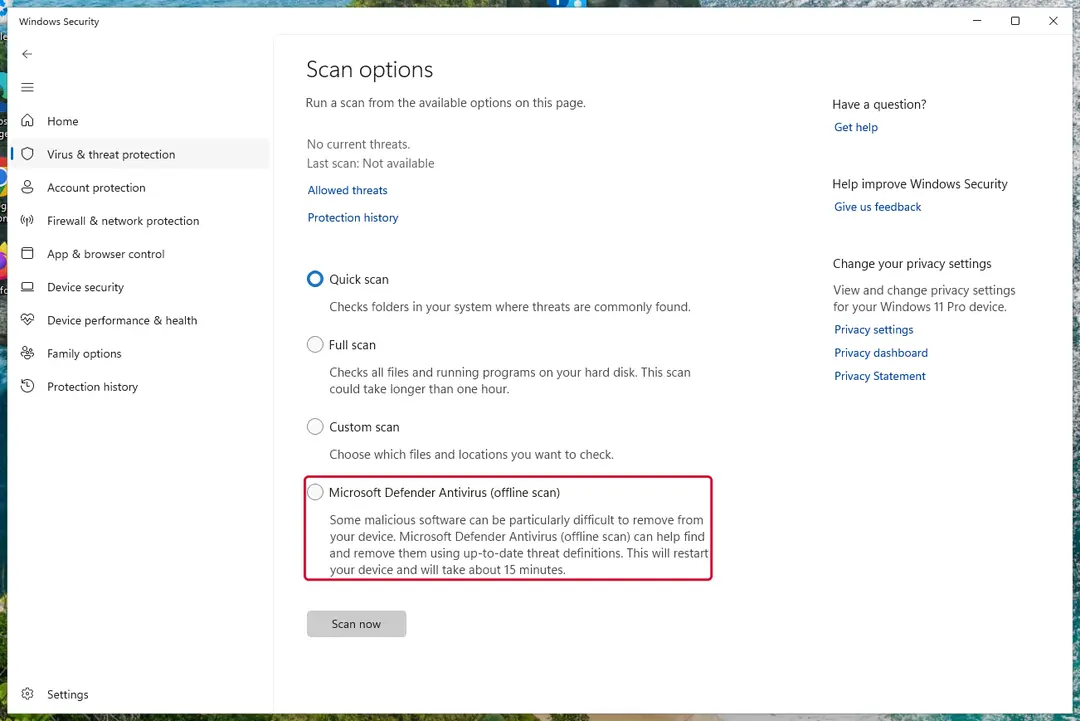
Windows 11: Windows Security > Virus & threat protection > Scan options. Full procedure with screenshots: Run a Microsoft Defender Offline scan
Step 5: Look for shadow copies of the files
Open Command Prompt as administrator and run
vssadmin list shadows. If it lists copies dated before the attack, right-click a folder with encrypted files in File Explorer, choose Properties > Previous Versions, and open or restore a version from before that date.ShadowExplorer, a free tool, shows the same copies when the tab is empty or hidden. Most current families delete shadow copies, so an empty list is normal, but the check takes two minutes on Windows 11 or Windows 10.
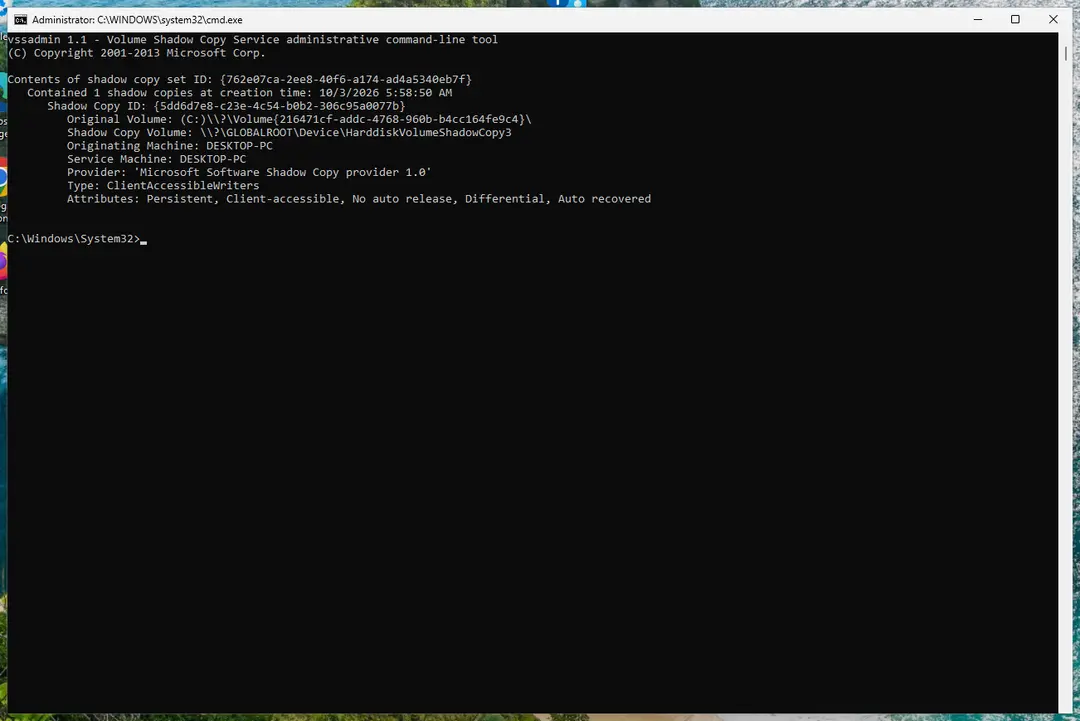
Windows 11: vssadmin list shadows shows whether shadow copies exist. Full procedure with screenshots: Ransomware: first steps, finding a decryptor and recovering files
Step 6: Restore the files from a backup or recover deleted originals
Restore from an external backup, File History or OneDrive's version history, choosing a date before the attack. Connect the backup drive only after the scans are clean, or the ransomware encrypts it too.
If there is no backup, file recovery software can sometimes find the deleted originals, because some ransomware writes an encrypted copy and deletes the original file.
Stop writing to the drive and try recovery on Windows 11 or Windows 10 before new files overwrite the space.
Full procedure with screenshots: Recover deleted files (Recycle Bin, backups, OneDrive) On uGetFix
Instructions for each browser and system
The detailed steps for every browser and system this guide covers. Open the one you use.
Manual removal using Safe Mode
Important! →
Manual removal guide might be too complicated for regular computer users. It requires advanced IT knowledge to be performed correctly (if vital system files are removed or damaged, it might result in full Windows compromise), and it also might take hours to complete. Therefore, we highly advise using the automatic method provided above instead.
Step 1. Access Safe Mode with Networking
Manual malware removal should be best performed in the Safe Mode environment.
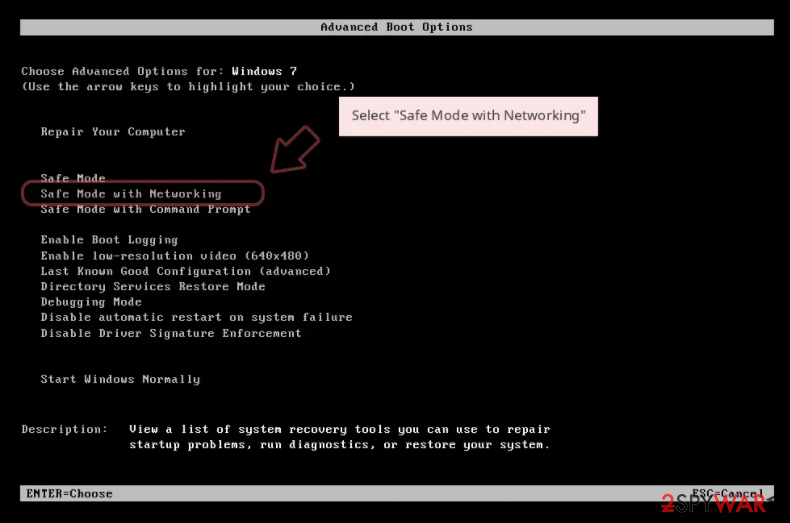
Windows 7 / Vista / XP
- Click Start > Shutdown > Restart > OK.
- When your computer becomes active, start pressing F8 button (if that does not work, try F2, F12, Del, etc. - it all depends on your motherboard model) multiple times until you see the Advanced Boot Options window.
- Select Safe Mode with Networking from the list.
Windows 10 / Windows 8
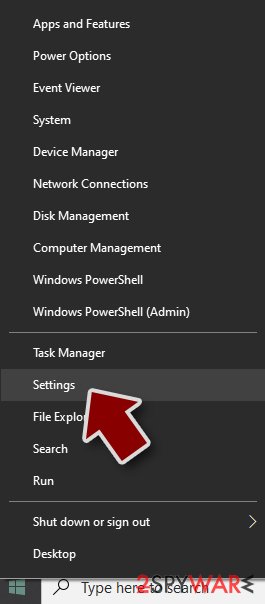
- Right-click on Start button and select Settings.
- Scroll down to pick Update & Security.
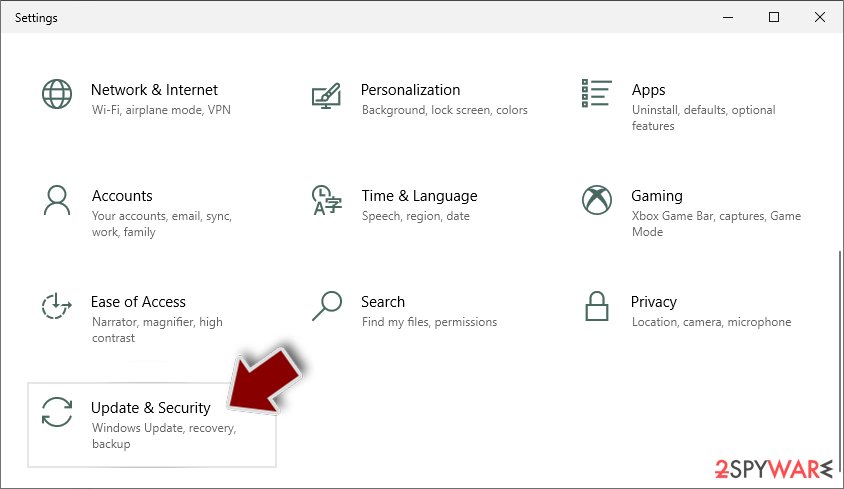
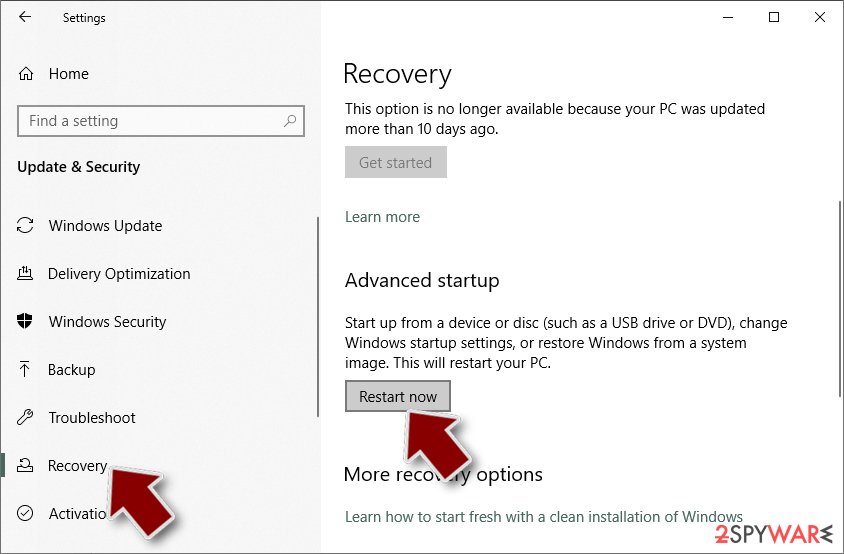
- On the left side of the window, pick Recovery.
- Now scroll down to find Advanced Startup section.
- Click Restart now.
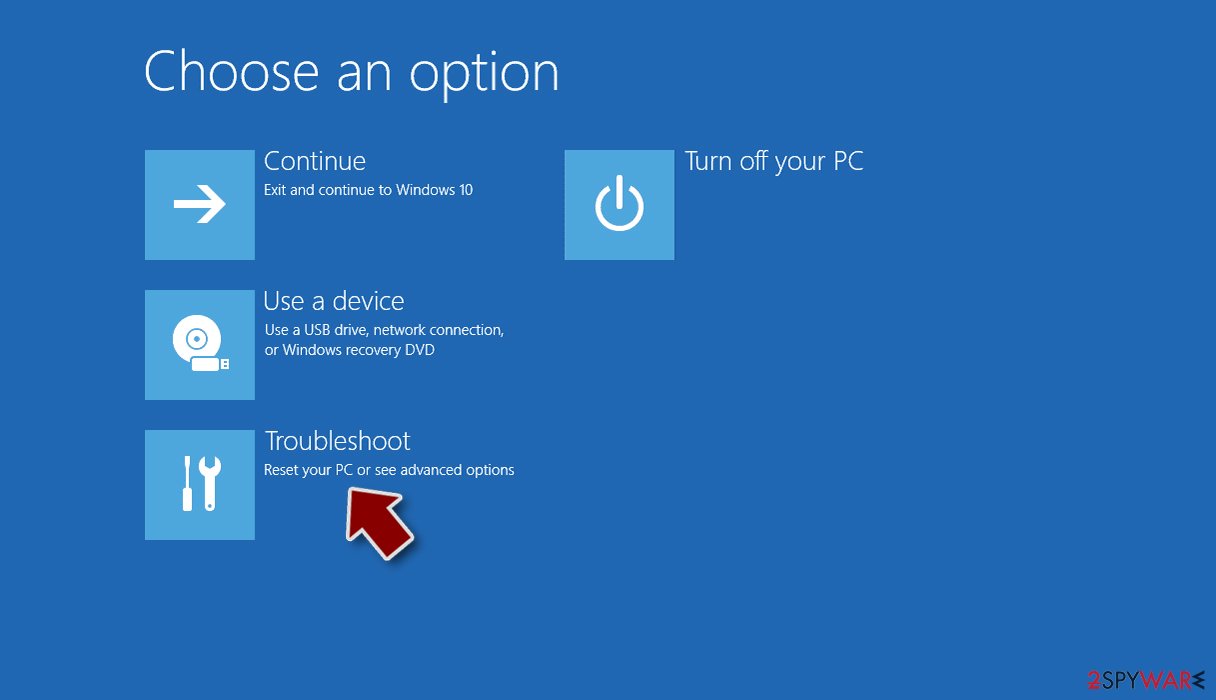
- Select Troubleshoot.
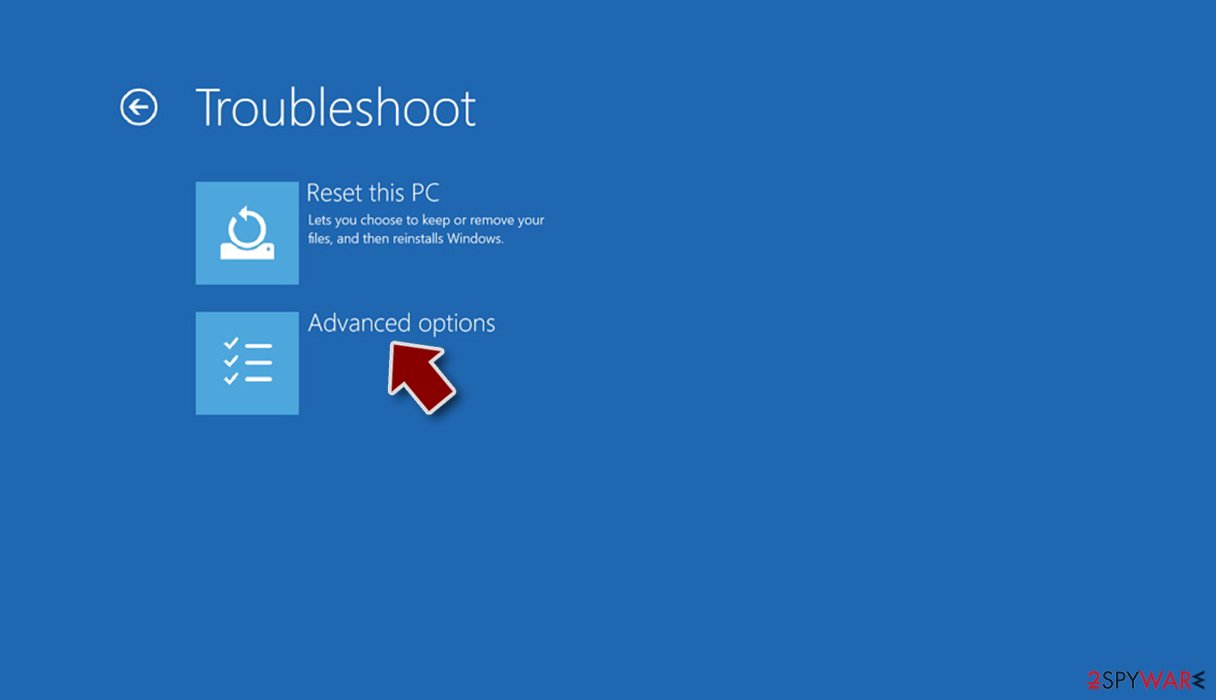
- Go to Advanced options.
- Select Startup Settings.
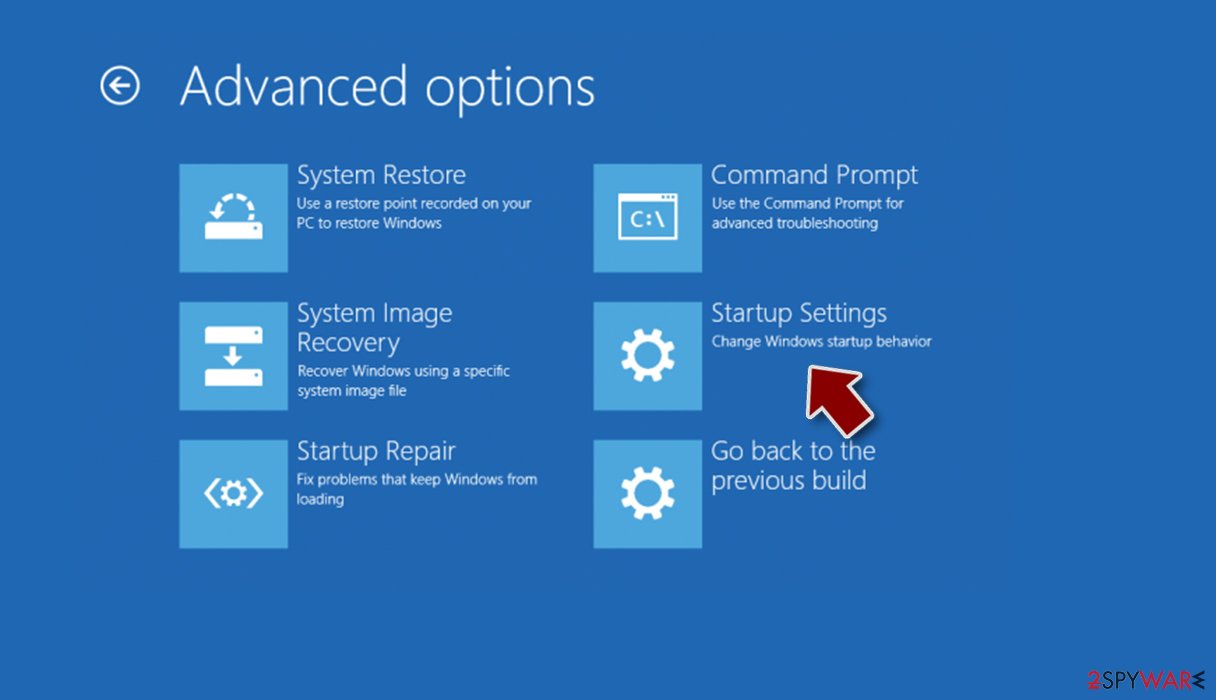
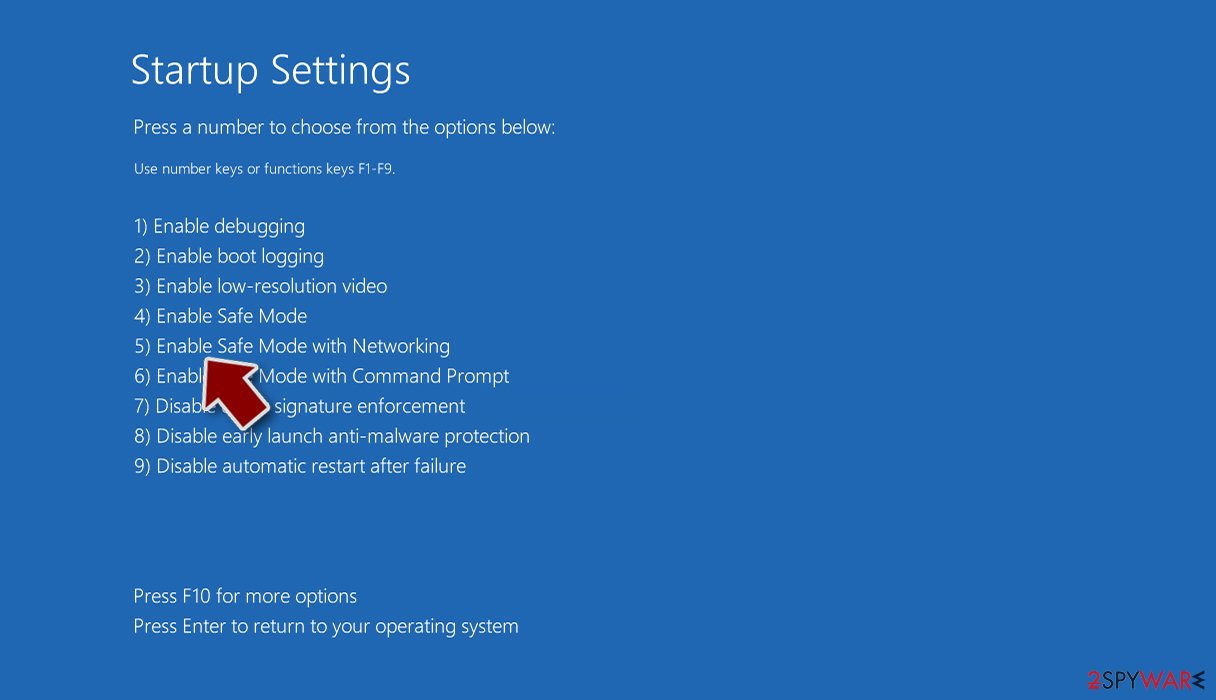
- Press Restart.
- Now press 5 or click 5) Enable Safe Mode with Networking.
Step 2. Shut down suspicious processes
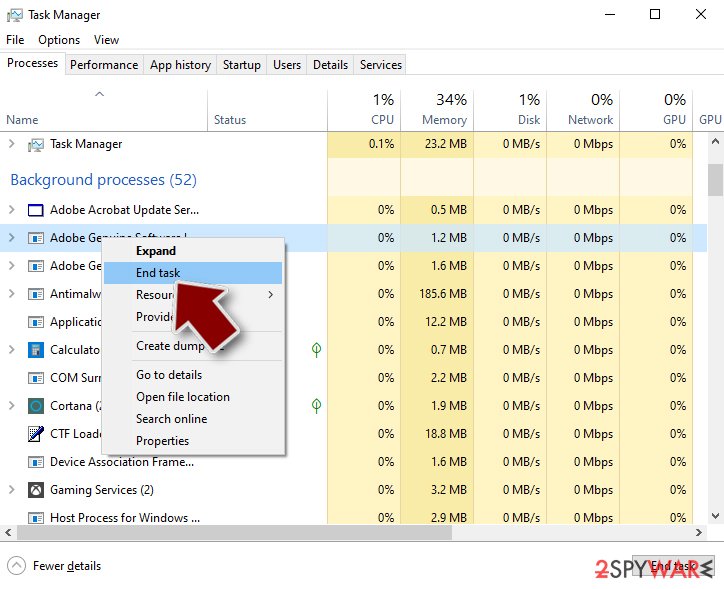
Windows Task Manager is a useful tool that shows all the processes running in the background. If malware is running a process, you need to shut it down:
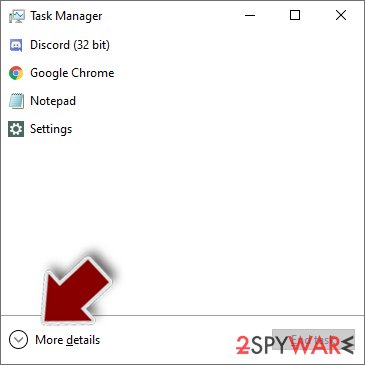
- Press Ctrl + Shift + Esc on your keyboard to open Windows Task Manager.
- Click on More details.
- Scroll down to Background processes section, and look for anything suspicious.
- Right-click and select Open file location.
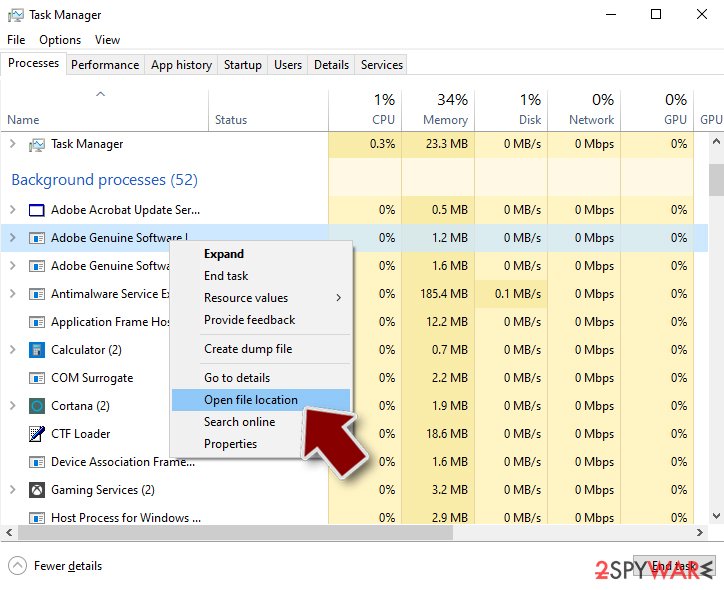
- Go back to the process, right-click and pick End Task.
- Delete the contents of the malicious folder.
Step 3. Check program Startup
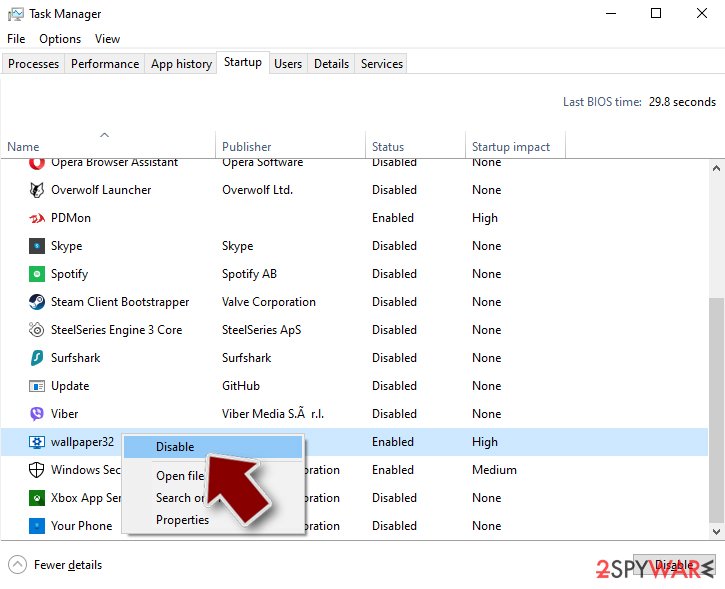
- Press Ctrl + Shift + Esc on your keyboard to open Windows Task Manager.
- Go to Startup tab.
- Right-click on the suspicious program and pick Disable.
Step 4. Delete virus files
Malware-related files can be found in various places within your computer. Here are instructions that could help you find them:
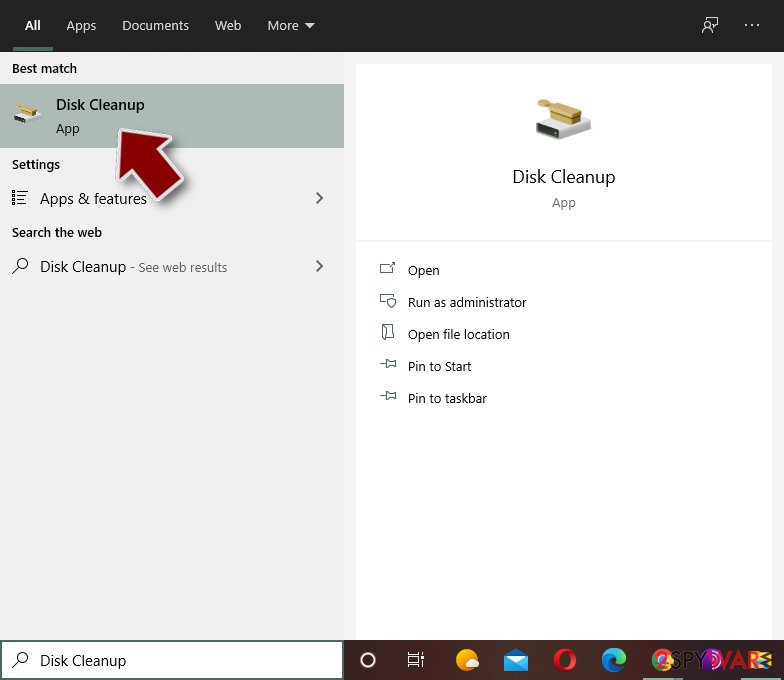
- Type in Disk Cleanup in Windows search and press Enter.
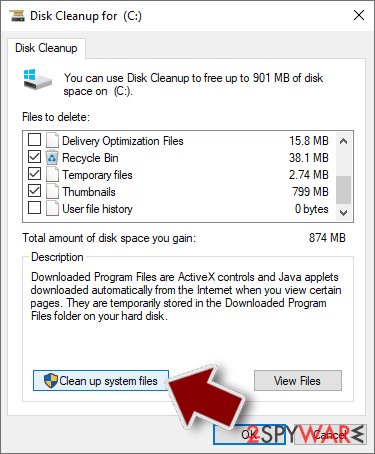
- Select the drive you want to clean (C: is your main drive by default and is likely to be the one that has malicious files in).
- Scroll through the Files to delete list and select the following:
Temporary Internet Files
Downloads
Recycle Bin
Temporary files - Pick Clean up system files.
- You can also look for other malicious files hidden in the following folders (type these entries in Windows Search and press Enter):
%AppData%
%LocalAppData%
%ProgramData%
%WinDir%
After you are finished, reboot the PC in normal mode.
From our report of Jan 2017 · not reviewed since
What are the best ransomware prevention tips?
Ransomware viruses are nasty - they travel in an obfuscated form, typically in the form of infected documents, archives, or .js files.
It is hard to understand when you are dealing with a phishing email because scammers tend to compose them precisely to make them look professional. Unsuspecting victims can easily be lured into opening such email attachments, and if they do - bad things happen.
It is highly advisable to stay away from any content that comes from unknown sources , also you should think twice before opening a legitimate-looking email attachment sent by PayPal or Amazon and double-check the sender's email address because obviously, crooks often pretend to be someone they're not. Finally, you should go a step further and backup your files.
You can never know when and what kind of malware will encroach to enter your computer, so having copies of your data can help to restore encrypted files at all times without having to pay an enormously large ransom that criminals typically demand paying. You may also want to install one or two security programs to create a shield on your computer to block away malware and spyware threats.
From our report of Jan 2017 · not reviewed since
How can I remove Garryweber@protonmail.ch virus?
Ransomware viruses are considered one of the most dangerous computer viruses available today - and you should act carefully around them.
If one managed to infect your computer, remove it properly. To remove Garryweber@protonmail.ch virus, you should follow steps provided under this article. Carry out these Garryweber@protonmail.ch removal instructions in the right order to ensure a successful virus removal.
[GI=method-1]If your antivirus/anti-malware software is blocked by the virus and you cannot remove the infection, you should follow these instructions and prepare the PC forGarryweber@protonmail.ch ransomware virus removal.
The most effective way to restore lost files is to use copies stored in a backup drive. If you have never created a backup, the situation is really bad. It might take years to recover your files; however, do not forget that paying the ransom isn't an option either, especially because offenders frequently receive the ransom and make off. Below, we list possible data recovery solutions.
Use a data recovery tool
We highly suggest you use it as described below.
Use those Windows Previous Versions
It might be possible to restore encrypted data using Windows Previous Versions, but this technique works only in case System Restore function is toggled on.
Report it and recover your files
Report it
Report the attack even if you do not expect the files back: insurers and banks ask for the report number, and police use the contacts in the note to link cases.
- United States
- FBI IC3 · FTC ReportFraud
- United Kingdom
- Report Fraud (formerly Action Fraud) · NCSC
- Australia
- ReportCyber (ASD)
- EU countries
- Europol: national reporting sites
Give the victim ID, the note and the date the files were encrypted. A business that holds personal data may also have to notify its data protection authority, in the EU within 72 hours.
Backups: the 3-2-1 rule
Keep three copies of files that matter, on two kinds of storage, with one copy offline or off-site.
A disk that stays plugged in is reached by malware like Garryweber@protonmail.ch ransomware virus together with the PC; one you connect only for the backup is not.
On Windows 11, File History keeps versions on an external drive, and OneDrive keeps earlier versions of synced files. Before restoring anything, make sure the PC no longer shows garryweber@protonmail.ch ransomware virus in the list of installed apps.
Setting it up step by step: 3-2-1 backups on Windows 11 and 10.
Choose a proper web browser and improve your safety with a VPN tool
Online spying has got momentum in recent years and people are getting more and more interested in how to protect their privacy online.
One of the basic means to add a layer of security - choose the most private and secure web browser. Although web browsers can't grant full privacy protection and security, some of them are much better at sandboxing, HTTPS upgrading, active content blocking, tracking blocking, phishing protection, and similar privacy-oriented features.
However, if you want true anonymity, we suggest you employ a powerful VPN - it can encrypt all the traffic that comes and goes out of your computer, preventing tracking completely.
Lost your files? Use data recovery software
While some files located on any computer are replaceable or useless, others can be extremely valuable.
Family photos, work documents, school projects - these are types of files that we don't want to lose. Unfortunately, there are many ways how unexpected data loss can occur:
- power cuts
- Blue Screen of Death errors
- hardware failures
- crypto-malware attack
- even accidental deletion
To ensure that all the files remain intact, you should prepare regular data backups. You can choose cloud-based or physical copies you could restore from later in case of a disaster. If your backups were lost as well or you never bothered to prepare any, can be your only hope to retrieve your invaluable files.
Questions about Garryweber@protonmail.ch ransomware virus
When will a decryptor for Garryweber@protonmail.ch ransomware virus be released?
Nobody can promise a date. When we last checked, on 7 October 2026, no free decryptor is known. Decryptors usually appear after one of three events:
- police seize the attackers' servers and keys
- the authors leak or publish the master keys
- researchers find a mistake in how the ransomware generates keys
Some families got a tool within weeks, others never. Keep the encrypted files and the note on an external drive, check No More Ransom every few months, and follow news about the Garryweber@protonmail.ch ransomware virus family. A decryptor may need an original file, so keep any unencrypted copies too.
Should I pay the ransom?
We advise against it, and so do the FBI, Europol and national cyber agencies. Payment does not guarantee a working tool: some attackers never reply, some tools damage files, and some variants have no decryptor at all. Paying also funds further attacks and can make you a target again.
Before considering payment, try every recovery option in this guide and report the attack. Companies must involve their legal adviser and insurer, because payments to sanctioned groups can be illegal. If files are truly irreplaceable, store the encrypted copies and wait; decryptors sometimes appear later.
Did Garryweber@protonmail.ch ransomware virus steal my files or passwords?
We do not know yet. Nothing published so far shows data theft by Garryweber@protonmail.ch ransomware virus, but the only confirmed sign is garryweber@protonmail.ch ransomware virus in the list of installed apps, which says nothing about what happened before. Many current ransomware attacks copy files or run a password stealer first, so it is wise to act as if they did.
From a clean device, change the passwords that were saved in the browsers on this PC, starting with e-mail and banking, sign out of all sessions and turn on two-step verification. Watch bank statements and account activity for the next few weeks.
How did Garryweber@protonmail.ch ransomware virus get on my computer?
The way Garryweber@protonmail.ch ransomware virus spreads has not been documented yet, so look at your own recent activity. On home PCs, ransomware most often comes with cracked programs, game cheats, key generators and fake updates, or with an e-mail attachment that was opened. On business networks, attackers usually log in through Remote Desktop with a stolen or guessed password.
Think back to what was downloaded or installed in the days before garryweber@protonmail.ch ransomware virus in the list of installed apps, and check the Downloads folder and Installed apps sorted by date. Keep anything suspicious for your report, but do not run it again.
Can a data-recovery company decrypt my files for a fee?
Only if a decryptor already exists or the company pays the attackers for you. Some "ransomware recovery" services advertise that they can decrypt families with no known flaw; in practice they negotiate with the attackers and add their own fee. Others use the same free tools listed on No More Ransom.
Before you hire anyone, ask in writing how they will recover the files, whether they will contact the attackers and what happens if they fail. A legitimate service answers clearly. If a free decryptor exists for your family, you can run it yourself.
Is Garryweber@protonmail.ch ransomware virus the same as other ransomware with a similar name?
Not necessarily. Ransomware names come from the file extension, the note or a word in the code, so unrelated families often end up with similar names, and one family can appear under several names. The difference matters: a decryptor or advice for one family does not fit another and can damage files.
Compare the ending added to your files and the exact name of the note with the summary table at the top of this guide, then upload the note and one encrypted file to ID Ransomware from a clean device. If the result names another family, follow the guide for that family instead.
How do I open my .docx, .jpg and other files locked by Garryweber@protonmail.ch?
You cannot open locked files normally while they stay encrypted, and renaming them will not help. Our earlier report did not record the extension that Garryweber@protonmail.ch adds, so check one locked file name and the ransom note for it.
No free decryptor is known for this variant; check No More Ransom (nomoreransom.org) for updates. Do not rename the files, change the extension or edit them, because that can make recovery harder. Copy the locked files to an external drive before you clean the system, so a decryptor released later still has them.
How can I protect my files from Garryweber@protonmail.ch and similar ransomware?
Keep tested backups, update the system and treat unexpected attachments as unsafe. Keep at least one backup copy offline, because ransomware also encrypts drives that stay connected. Install system and browser updates soon after they appear, and turn off remote desktop if you do not use it.
Do not open attachments or links from senders you did not expect, even when the message looks urgent. Use a standard user account for daily work instead of an administrator account. Restore a few files from your backup now and then to prove that it works.
Will Fortect remove Garryweber@protonmail.ch ransomware virus?
Fortect scans Windows for malware and unwanted programs and repairs the system files and settings they change, and its free scan shows what it finds on your PC before you decide anything.
For Garryweber@protonmail.ch ransomware virus, follow the plan above as well: the browser steps take back permissions and settings that no scanner treats as a threat, and uninstalling the program that brought it removes the source.
Run Microsoft Defender's full scan and, if anything was found, its offline scan as a second opinion. If the symptoms are gone after the plan and both scans are clean, there is nothing more to do.
Sources
- Microsoft: Ransomware (read October 7, 2026)
- CISA: StopRansomware (read October 7, 2026)
- No More Ransom (read October 7, 2026)
- FTC: How to recognize, remove and avoid malware (read October 7, 2026)
- Microsoft Learn: Microsoft Defender Offline (read October 7, 2026)