

A full description of MyStart Toolbar
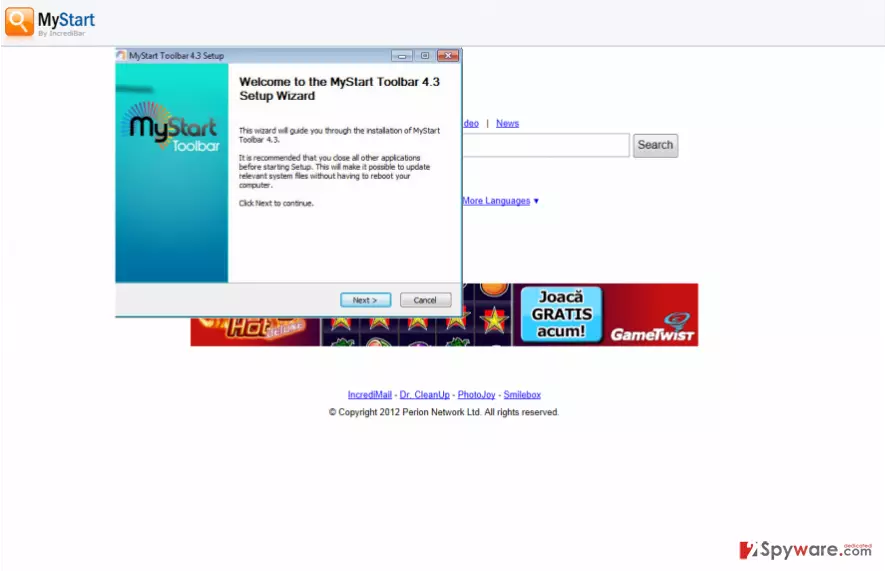
MyStart Toolbar is a suspicious browser extension[1] that may sneak into the system via other free downloads, corrupt your default web browser's settings and may try to redirect you to predetermined websites. The extension changes user's homepage to hxxp://mystart.com/ and suggests using a vague search engine provided on it.
The developer of this app, Visicom Media Inc., describes it as a “browser extension that brings the functionality of your favorite social network sites such as Facebook, Twitter, Flickr, Youtube, MySpace, and LinkedIn to your fingertips. It allows any social media user to quickly access social sites with handy shortcuts, perform searches, read social news, and take advantage of the built-in social apps to interact with their friends on Facebook or Twitter.”
Sounds attractive, we must agree. However, in reality, this program has several serious downsides due to which it has been already categorized as a browser hijacker and a potentially unwanted program (PUP). According to security researchers, there is no need to keep this toolbar on the system. The reasons to remove it are listed and explained below. For MyStart removal, we recommend using the automatic method and installing FortectIntego or similar anti-spyware.
- First of all, MyStart spreads alongside other free programs and can be offered as an opt-in addition to you. Sadly, many users do not know how to opt out it, so it gets into computer systems without user's consent (in the majority of cases);
- The browser hijacker automatically changes browser's settings without CLEARLY informing the user first. Users find such feature annoying;
- The suspicious search tool suggested by www.mystart.com site delivers altered Yahoo results that are full of ads. Clicking these can trigger redirects to highly dangerous external sites.
- The browser hijacker doesn't let the user change browser's preferences until it gets removed from the system.
If this toolbar gets inside your computer, it changes the homepage to mystart.com, whereas Yahoo! may appear as a default search engine[2]. It may seem useful at first, but we do not think that this search provider and homepage can be fully trusted, and that is why we recommend that you carefully think about keeping it.
MyStart virus may deliver altered search results that try to promote third party websites and raise their ranking. Once you receive the search results, you should look at the tab name. It says “Visicom Yahoo Search results.” We can assure you that these are not identical to the real Yahoo search results.
This search provider may fill results with various sponsored links and advertisements that can redirect you to unsafe websites. In addition to MyStart redirect problem, in the extract above you may see the lines that notify about phishing sites and stealing of personal info. At this point, we want to clarify that the browser hijacker isn't related to VisiCom Systems, Inc. – it is an entirely different company that has nothing in common with the development of potentially unwanted programs.
Be aware that this PUP itself tracks user's browsing activities and may even collect some of the personally-identifiable data, which may further be used for various proposes. For example, your email might be used to send you annoying commercial offers that you might identify as spam.
Besides, personal details collected about you can be accessed by MyStart employees. If you do not like this idea, we advise you to delete this plug-in and rely on a more reputable extension if you need one.
The hijacker reportedly actively attacks Chinese computer users. If you are from China, we kindly invite you to take a look at information about this hijacker in Wubingdu.cn site[3].

It is easy to avoid potentially unwanted programs
It is quite easy to avoid installing PUPs – you only need to know their main distribution methods. To say broadly, My Start Toolbar appears on your web browser when you accept to install it. You may do so willingly if you download this extension from its official site. However, much more frequently people accept to install it inadvertently when installing another free program, such as download manager or video streaming software.
Various well-known download websites, such as CNET, Brothersoft, or Softonic distribute bundled programs. Therefore, it is all in your hands if you want to avoid installation of bundled programs. The only way to avoid downloading the vague Toolbar and similar PUPs is to do a small research about the program and install it with extreme carefulness.
Always read End-User License Agreement, Privacy Policy, comments and reviews of other users because this way you may find out what additional components this program carries and what downsides does it have.
Besides, select Advanced or Custom installation option and deselect suggestions to install unfamiliar programs or to modify your web browser in any way. If you have already installed the browser hijacker, do not wait longer and remove it right now.
Remove MyStart.com redirect virus
To prevent your browser from redirecting you to suspicious sites, remove MyStart virus straight away. Since this program may cause infiltration of various suspicious programs on your PC and initiate annoying modifications on your web browser, you should consider which method you are going to use for MyStart removal.
You can either use a guide which is given below or install a reliable anti-spyware program. The most effective ones are given right below. Once you install one of these programs, you should update it and run a full system scan.
Uninstall from Windows
Uninstall from Windows 10/8:
- Type Control Panel into the Windows search box and open the result.
- Under Programs, select Uninstall a program.


Uninstall from Windows 7/XP:
- Click on Windows Start > Control Panel (Windows XP users should click on Add/Remove Programs).
- In Control Panel, select Programs > Uninstall a program.


Remove the unwanted program:
- In the Programs and Features window, look for any recently installed suspicious entries, select them, and click Uninstall.
- If User Account Control appears, click Yes to confirm, then complete the removal.


Delete from macOS
Remove the unwanted application:
- From the menu bar, select Go > Applications.
- In the Applications folder, look for any suspicious entries, then drag them to Trash (or right-click and pick Move to Trash).


Delete leftover files and folders:
- Select Go > Go to Folder.
- Enter /Library/Application Support and remove any suspicious folders related to the unwanted program.
- Repeat the same check in the /Library/LaunchAgents and /Library/LaunchDaemons folders, deleting any suspicious entries.

- Finally, empty the Trash to permanently remove the leftovers.

Reset Internet Explorer
Remove dangerous add-ons:
- Open Internet Explorer, click on the Gear icon (IE menu) on the top-right corner of the browser
- Pick Manage Add-ons.
- You will see a Manage Add-ons window. Here, look for suspicious plugins. Click on these entries and select Disable.


Change your homepage if it was altered:
- Open IE and click on the Gear icon.
- Select Internet Options.
- In the General tab, delete the Home page address and replace it by your preferred one (for example, Google.com).
- Click Apply and then select OK.


Delete temporary files:
- Press on the Gear icon and select Internet Options.
- Under Browsing history, click Delete...
- Select relevant fields and press Delete.


Reset Internet Explorer:
- Click on Gear icon > Internet options and select Advanced tab.
- Select Reset.
- In the new window, check Delete personal settings and select Reset.


Remove from Mozilla Firefox (FF)
Remove dangerous extensions:
- Open Mozilla Firefox browser and click on the Menu (three horizontal lines at the top-right of the window).
- Select Add-ons.
- In here, select the unwanted extension and click Remove.


Reset the homepage:
- Click three horizontal lines at the top right corner to open the menu.
- Choose Settings.
- Under Home, set your preferred homepage and new tab settings.
Clear cookies and site data:
- Click Menu and pick Settings.
- Go to Privacy & Security section.
- Scroll down to locate Cookies and Site Data.
- Click on Clear Data...
- Select Cookies and Site Data and Temporary cached files and pages, then click Clear.


Reset Mozilla Firefox
If clearing the browser as explained above did not help, reset Mozilla Firefox:
- Open Mozilla Firefox browser and click the Menu.
- Go to Help and then choose Troubleshooting Information.

- Under Give Firefox a tune up section, click on Refresh Firefox...
- Once the pop-up shows up, confirm the action by pressing on Refresh Firefox.



Remove from Google Chrome
Delete malicious extensions from Google Chrome:
- Open Google Chrome, click on the Menu (three vertical dots at the top-right corner) and select More tools > Extensions.
- In the newly opened window, you will see all the installed extensions. Uninstall all suspicious extensions related to the unwanted program by clicking Remove.


Clear cache and web data from Chrome:
- Click on Menu and pick Settings.
- Under Privacy and security, select Clear browsing data.
- Select Browsing history, Cookies and other site data, as well as Cached images and files.
- Click Clear data.


Change your homepage:
- Click menu and choose Settings.
- Look for a suspicious site in the On startup section.
- Click on Open a specific or set of pages and click on three dots to find the Remove option.
Reset Google Chrome:
If the previous methods did not help you, reset Google Chrome to eliminate all the unwanted components:
- Click on Menu and select Settings.
- In the Settings, scroll down and click Advanced.
- Scroll down and locate Reset and clean up section.
- Now click Restore settings to their original defaults.
- Confirm with Reset settings.


Delete from Safari
Remove dangerous extensions:
- Open Safari, click Safari in the menu at the top-left of the screen, and select Preferences.
- Go to the Extensions tab, look for any suspicious entries, and click Uninstall to remove them.


Clear history and website data:
- Click Safari in the menu and pick Clear History.
- Set Clear to all history and confirm with Clear History.


Reset Safari:
- Click Safari in the menu and select Preferences > Advanced.
- Enable Show Develop menu in menu bar.
- From the menu bar, click Develop and select Empty Caches.


Was this guide helpful?
Be the first to comment