

PDF Converter Hub is a browser hijacker which hijacks the Google Chrome as a useful extension
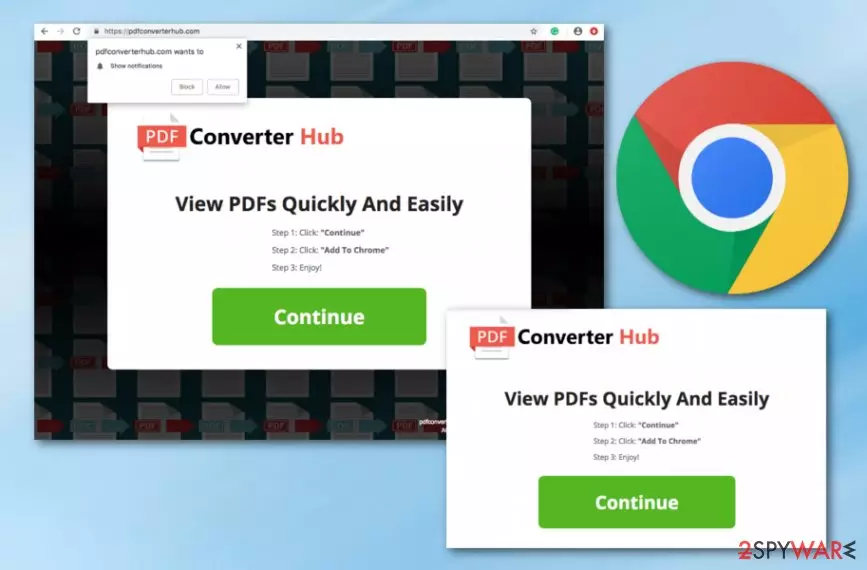
PDF Converter Hub is a browser hijacker which has mostly been targeting Google Chrome web browser. This extension is trying to convince gullible users into installing it by offering fast and easy PDF file viewing. All the user has to do is just install the PDF Converter Hub browser extension on Chrome. However, we do not recommend doing that as your web browser will be hijacked, e.g. you will let the virus change the default search engine to search.hpdfconverterhub.com and perform your searches via the new engine. Additionally, the PUP can modify the browser's homepage, new tab URL, cause dubious redirects, and even promote suspicious content by placing notifications all over the computer screen during browsing sessions.
| Name | PDF Converter Hub |
|---|---|
| Type | Browser hijacker |
| Sub-type | Potentially unwanted program |
| Danger level | Low. Affects only web browsers |
| Browsers hijacked | In this case, Chrome is the main target |
| OS infected | Usually, Windows |
| Main symptom | The default search engine is set to search.hpdfconverterhub.com |
| Distribution sources | Other free programs, main page Pdfconverterhub.com, unprotected websites, infected hyperlinks and ads |
| Detection software | For browser hijacker detection purposes, use FortectIntego |
This tool is also known as PDF Converter Hub virus due to its ability to sneak into the system unnoticed and perform rogue processes. Once this potentially unwanted program modifies your web browser's search engine, you will need to use this suspicious engine until you get rid of the browser hijacker permanently. This means you will be receiving search results that are gathered from legitimate search engines such as Yahoo or Bing.[1]
Additionally, PDF Converter Hub might start placing suspicious-looking notifications on your computer screen too. Advertising is just another possibility to make income for the developers and program creators. However, note that the biggest income source comes from your browsing activity details such as most visited pages, saved bookmarks, and other similar content. The developers share this information with third-parties after collecting it.
This browser hijacker also has the capability of redirecting users to developer-sponsored pages. In some cases, you might be accidentally taken to a malware-laden website and catch a dangerous trojan or ransomware virus infection. In order to avoid this type of possibility, we recommend performing the PDF Converter Hub removal from your computer system and web browsers. For all suspicious software detection purposes, try installing and using FortectIntego.
Additionally, you can remove PDF Converter Hub virus from your Google Chrome web browser and Windows computer by using our step-by-step guide which is presented below this article. It is very important to eliminate the browser extension which is responsible for all suspicious activities. After successful elimination, you will see that your browser's search engine will be brought to normal and all changes that were performed by the browser hijacker are reversed.
Pdfconverterhub.com hijacks web browsers after the user opts for installing the rogue extension PDF Converter Hub. This dubious component can come unexpectedly together with other software or the user might accidentally install it by herself/himself while accessing suspicious hyperlinks on the Internet. Remember, that the key to computer safety is in your own hands. If you want to know how to use it properly, continue reading our below-written browser hijacker[2] avoiding measures.

Browser-hijacking apps can be met almost anywhere on the Internet
According to computer security specialists from Virusai.lt news page,[3] browser hijackers are one of the most common potentially unwanted programs that bother numerous users (adware also, of course). Sadly, users' carelessness is the main cause of secret PUP installation. In order to avoid this unwanted installation possibility, you should:
- always use only original downloaders and installers. If you choose secondary installing sources, rogue content might be able to sneak into the system easily. Avoid this by opting for the Custom or Advanced option that allows the user himself/herself to track all incoming objects.
- keep a distance from rogue websites. Various third-party pages, especially, P2P networks[4] distribute suspicious-looking programs and their components. Dubious content comes injected into hyperlinks or advertising posts and installs into the system when the user clicks on them.
- never skip downloading/installing steps. However, if you have chosen to perform the downloading or installing process of a particular program on your own, make sure that you do it very carefully to not let any suspicious content invade the system.
- purchase strong antivirus protection. If you do not have an antivirus program on your computer already, you should browse the Internet and search for a recommended tool. Do not be afraid to invest in a truly reliable one as it will provide you with a wide range of features such as system scans, malware detection, computer optimization, etc.
PDF Converter Hub removal can be performed in three easy steps
If you have been experiencing browser hijacker-related symptoms such as browser search engine changes, redirecting, and other similar activities, you should take some actions to remove PDF Converter Hub virus from your Windows computer and Google Chrome web browser. Most important it is to find all rogue content such as PUP injected browser extensions in your web browser and any other content that might have been left somewhere on your machine.
The PDF Converter Hub removal can be completed in two ways. Which way you are going to choose should depend on your skills and virus elimination capabilities. If you are self-confident enough you can try cleaning your computer system and infected web browser by using our step-by-step guide which is provided below this text. However, if you think that you lack skills in the technology sphere, try removing the cyber threat with reputable anti-malware software.
Uninstall from Windows
Uninstall from Windows 10/8:
- Type Control Panel into the Windows search box and open the result.
- Under Programs, select Uninstall a program.


Uninstall from Windows 7/XP:
- Click on Windows Start > Control Panel (Windows XP users should click on Add/Remove Programs).
- In Control Panel, select Programs > Uninstall a program.


Remove the unwanted program:
- In the Programs and Features window, look for any recently installed suspicious entries, select them, and click Uninstall.
- If User Account Control appears, click Yes to confirm, then complete the removal.


Remove from Microsoft Edge
Delete unwanted extensions from MS Edge:
- Select Menu (three horizontal dots at the top-right of the browser window) and pick Extensions.
- From the list, pick the extension and click on the Gear icon.
- Click Remove.


Clear cookies and other browser data:
- Click on the Menu (three horizontal dots at the top-right of the browser window) and select Settings > Privacy, search, and services..
- Under Clear browsing data, pick Choose what to clear.
- Select Cookies and other site data and Cached images and files. (apart from passwords, although you might want to include Media licenses as well, if applicable) and click on Clear.


Restore new tab and homepage settings:
- Click the menu icon and choose Settings.
- Then find On startup section.
- Click Remove next to any suspicious startup page.
Reset MS Edge if the above steps did not work:
- Press on Ctrl + Shift + Esc to open Task Manager.
- Click on More details arrow at the bottom of the window.
- Select Details tab.
- Now scroll down and locate every entry with Microsoft Edge name in it. Right-click on each of them and select End Task to stop MS Edge from running.


Instructions for Chromium-based Edge
Delete extensions from MS Edge (Chromium):
- Open Edge and click select Settings > Extensions.
- Delete unwanted extensions by clicking Remove.


Clear cache and site data:
- Click on Menu and go to Settings.
- Select Privacy, search and services.
- Under Clear browsing data, pick Choose what to clear.
- Under Time range, pick All time.
- Select Clear now.


Reset Chromium-based MS Edge:
- Click on Menu and select Settings.
- On the left side, pick Reset settings.
- Select Restore settings to their default values.
- Confirm with Reset.
- This will disable extensions and reset startup pages but will not delete bookmarks, saved passwords, or browsing history.


Remove from Mozilla Firefox (FF)
Remove dangerous extensions:
- Open Mozilla Firefox browser and click on the Menu (three horizontal lines at the top-right of the window).
- Select Add-ons.
- In here, select the unwanted extension and click Remove.


Reset the homepage:
- Click three horizontal lines at the top right corner to open the menu.
- Choose Settings.
- Under Home, set your preferred homepage and new tab settings.
Clear cookies and site data:
- Click Menu and pick Settings.
- Go to Privacy & Security section.
- Scroll down to locate Cookies and Site Data.
- Click on Clear Data...
- Select Cookies and Site Data and Temporary cached files and pages, then click Clear.


Reset Mozilla Firefox
If clearing the browser as explained above did not help, reset Mozilla Firefox:
- Open Mozilla Firefox browser and click the Menu.
- Go to Help and then choose Troubleshooting Information.

- Under Give Firefox a tune up section, click on Refresh Firefox...
- Once the pop-up shows up, confirm the action by pressing on Refresh Firefox.



Remove from Google Chrome
Delete malicious extensions from Google Chrome:
- Open Google Chrome, click on the Menu (three vertical dots at the top-right corner) and select More tools > Extensions.
- In the newly opened window, you will see all the installed extensions. Uninstall all suspicious extensions related to the unwanted program by clicking Remove.


Clear cache and web data from Chrome:
- Click on Menu and pick Settings.
- Under Privacy and security, select Clear browsing data.
- Select Browsing history, Cookies and other site data, as well as Cached images and files.
- Click Clear data.


Change your homepage:
- Click menu and choose Settings.
- Look for a suspicious site in the On startup section.
- Click on Open a specific or set of pages and click on three dots to find the Remove option.
Reset Google Chrome:
If the previous methods did not help you, reset Google Chrome to eliminate all the unwanted components:
- Click on Menu and select Settings.
- In the Settings, scroll down and click Advanced.
- Scroll down and locate Reset and clean up section.
- Now click Restore settings to their original defaults.
- Confirm with Reset settings.


Delete from Safari
Remove dangerous extensions:
- Open Safari, click Safari in the menu at the top-left of the screen, and select Preferences.
- Go to the Extensions tab, look for any suspicious entries, and click Uninstall to remove them.


Clear history and website data:
- Click Safari in the menu and pick Clear History.
- Set Clear to all history and confirm with Clear History.


Reset Safari:
- Click Safari in the menu and select Preferences > Advanced.
- Enable Show Develop menu in menu bar.
- From the menu bar, click Develop and select Empty Caches.


Did this guide help?
Be the first to comment