

Pics4NewTab virus deteriorates your browsing experience
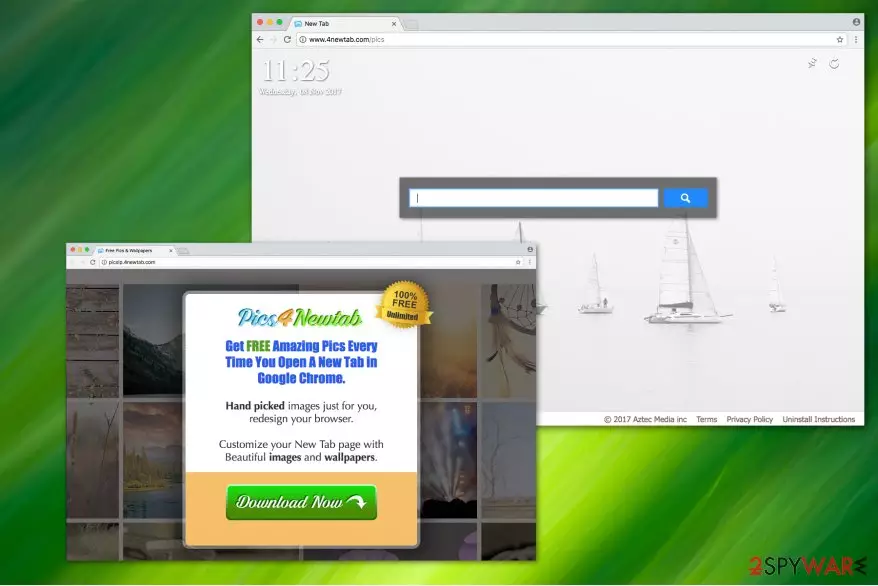
Pics4NewTab is categorized as an unreliable search engine developed by an infamous Aztec Media, Inc. It can also be called a new version of 4newtab.com hijacker mentioned on our site several weeks ago. Typically to such type of PUPs, this virus hijacks your Google Chrome browser and modifies its settings. Of course, it can be improved and be prepared to affect other web browsers in the nearest future.
You can get tricked into installing Pics4NewTab virus as a way to decorate your new tab and a homepage with free wallpapers and backgrounds. Unfortunately, researchers have discovered that this browser extension[1] can cause additional problems on your computer, so you are highly recommended to avoid it.
Delusional offers to customize your browser can end up with a desire to remove Pics4NewTab from the system because it sets www.4newtab.com/pics as browser’s default search engine, new tab and homepage without your consent, and resets settings mentioned above once you attempt to change them to the primary state. Therefore, you can get trapped and continue to use its services daily.
Moreover, cybersecurity experts from UtanVirus.se[2] warn about the possible redirects to suspicious websites by Pics4NewTab. This fake search engine floods computer users with provoking ads that are filled with shady coupons and quick prizes. If you click on those advertisements, you might get switched to pages used to distribute malware and other threats posing a serious danger to your system[3].
Some users even link Pics4NewTab virus with New Tab ads since both of them deliver excessive amounts of dangerous advertisements. These popups might come up as:
- Commercial offers;
- Discounts;
- Deals;
- Similar content related to e-shops.

Finally, we need to warn you that Pics4NewTab gathers information about its users. It might include your computer's IP address, its location, clicked ads or entered information. While many of users might not be concerned, the real problem arises when users unconsciously provide these credentials to the developers of a browser hijacker.
For example, if they submit their e-mail address in the search bar, they might receive spam later. It has become a common practice for cyber criminals and hackers to distribute high-risk computer infections via malicious attachments. Thus, to avoid getting infected with malware, we highly recommend you to get rid of this ad-supported program.
You can remove Pics4NewTab by following the instructions at the end of this article or by getting help from FortectIntego or any other reliable security software.
Techniques employed to distribute the browser hijacker
Even though Pics4NewTab is not a malicious virus, it is still classified as a potentially unwanted program (PUP). Typically, developers bundle PUPs with regular software to take advantage of people who rush to finish the installation process and skip many steps.
If you do not want to get infected with the hijacker, carefully follow the download/installation procedure — search for optional downloads that have already been selected before and de-select them immediately.
Besides, analysts say that Pics4NewTab behavior is similar to New Tab Search. Thus, there is a possibility that developers tried to confuse computer users by releasing a new version. Be aware that both of these shady browser extensions are offered on the Chrome Web Store. You shouldn’t be deceived by the attractive descriptions and stay away from the potentially unwanted programs (PUPs).
The easiest way to uninstall Pics4NewTab
If you are searching for the quickest and easiest way to remove Pics4NewTab virus, choose a professional anti-spyware software and get rid of the hijacker within seconds. You should download a security program and run a full system scan.
Our IT experts have prepared a detailed elimination guide for those who are up for a manual Pics4NewTab removal challenge. You can find it at the end of this article.
Uninstall from Windows
Uninstall from Windows 10/8:
- Type Control Panel into the Windows search box and open the result.
- Under Programs, select Uninstall a program.


Uninstall from Windows 7/XP:
- Click on Windows Start > Control Panel (Windows XP users should click on Add/Remove Programs).
- In Control Panel, select Programs > Uninstall a program.


Remove the unwanted program:
- In the Programs and Features window, look for any recently installed suspicious entries, select them, and click Uninstall.
- If User Account Control appears, click Yes to confirm, then complete the removal.


Delete from macOS
Remove the unwanted application:
- From the menu bar, select Go > Applications.
- In the Applications folder, look for any suspicious entries, then drag them to Trash (or right-click and pick Move to Trash).


Delete leftover files and folders:
- Select Go > Go to Folder.
- Enter /Library/Application Support and remove any suspicious folders related to the unwanted program.
- Repeat the same check in the /Library/LaunchAgents and /Library/LaunchDaemons folders, deleting any suspicious entries.

- Finally, empty the Trash to permanently remove the leftovers.

Reset Internet Explorer
Remove dangerous add-ons:
- Open Internet Explorer, click on the Gear icon (IE menu) on the top-right corner of the browser
- Pick Manage Add-ons.
- You will see a Manage Add-ons window. Here, look for suspicious plugins. Click on these entries and select Disable.


Change your homepage if it was altered:
- Open IE and click on the Gear icon.
- Select Internet Options.
- In the General tab, delete the Home page address and replace it by your preferred one (for example, Google.com).
- Click Apply and then select OK.


Delete temporary files:
- Press on the Gear icon and select Internet Options.
- Under Browsing history, click Delete...
- Select relevant fields and press Delete.


Reset Internet Explorer:
- Click on Gear icon > Internet options and select Advanced tab.
- Select Reset.
- In the new window, check Delete personal settings and select Reset.


Remove from Microsoft Edge
Delete unwanted extensions from MS Edge:
- Select Menu (three horizontal dots at the top-right of the browser window) and pick Extensions.
- From the list, pick the extension and click on the Gear icon.
- Click Remove.


Clear cookies and other browser data:
- Click on the Menu (three horizontal dots at the top-right of the browser window) and select Settings > Privacy, search, and services..
- Under Clear browsing data, pick Choose what to clear.
- Select Cookies and other site data and Cached images and files. (apart from passwords, although you might want to include Media licenses as well, if applicable) and click on Clear.


Restore new tab and homepage settings:
- Click the menu icon and choose Settings.
- Then find On startup section.
- Click Remove next to any suspicious startup page.
Reset MS Edge if the above steps did not work:
- Press on Ctrl + Shift + Esc to open Task Manager.
- Click on More details arrow at the bottom of the window.
- Select Details tab.
- Now scroll down and locate every entry with Microsoft Edge name in it. Right-click on each of them and select End Task to stop MS Edge from running.


Instructions for Chromium-based Edge
Delete extensions from MS Edge (Chromium):
- Open Edge and click select Settings > Extensions.
- Delete unwanted extensions by clicking Remove.


Clear cache and site data:
- Click on Menu and go to Settings.
- Select Privacy, search and services.
- Under Clear browsing data, pick Choose what to clear.
- Under Time range, pick All time.
- Select Clear now.


Reset Chromium-based MS Edge:
- Click on Menu and select Settings.
- On the left side, pick Reset settings.
- Select Restore settings to their default values.
- Confirm with Reset.
- This will disable extensions and reset startup pages but will not delete bookmarks, saved passwords, or browsing history.


Remove from Mozilla Firefox (FF)
Remove dangerous extensions:
- Open Mozilla Firefox browser and click on the Menu (three horizontal lines at the top-right of the window).
- Select Add-ons.
- In here, select the unwanted extension and click Remove.


Reset the homepage:
- Click three horizontal lines at the top right corner to open the menu.
- Choose Settings.
- Under Home, set your preferred homepage and new tab settings.
Clear cookies and site data:
- Click Menu and pick Settings.
- Go to Privacy & Security section.
- Scroll down to locate Cookies and Site Data.
- Click on Clear Data...
- Select Cookies and Site Data and Temporary cached files and pages, then click Clear.


Reset Mozilla Firefox
If clearing the browser as explained above did not help, reset Mozilla Firefox:
- Open Mozilla Firefox browser and click the Menu.
- Go to Help and then choose Troubleshooting Information.

- Under Give Firefox a tune up section, click on Refresh Firefox...
- Once the pop-up shows up, confirm the action by pressing on Refresh Firefox.



Remove from Google Chrome
Delete malicious extensions from Google Chrome:
- Open Google Chrome, click on the Menu (three vertical dots at the top-right corner) and select More tools > Extensions.
- In the newly opened window, you will see all the installed extensions. Uninstall all suspicious extensions related to the unwanted program by clicking Remove.


Clear cache and web data from Chrome:
- Click on Menu and pick Settings.
- Under Privacy and security, select Clear browsing data.
- Select Browsing history, Cookies and other site data, as well as Cached images and files.
- Click Clear data.


Change your homepage:
- Click menu and choose Settings.
- Look for a suspicious site in the On startup section.
- Click on Open a specific or set of pages and click on three dots to find the Remove option.
Reset Google Chrome:
If the previous methods did not help you, reset Google Chrome to eliminate all the unwanted components:
- Click on Menu and select Settings.
- In the Settings, scroll down and click Advanced.
- Scroll down and locate Reset and clean up section.
- Now click Restore settings to their original defaults.
- Confirm with Reset settings.


Delete from Safari
Remove dangerous extensions:
- Open Safari, click Safari in the menu at the top-left of the screen, and select Preferences.
- Go to the Extensions tab, look for any suspicious entries, and click Uninstall to remove them.


Clear history and website data:
- Click Safari in the menu and pick Clear History.
- Set Clear to all history and confirm with Clear History.


Reset Safari:
- Click Safari in the menu and select Preferences > Advanced.
- Enable Show Develop menu in menu bar.
- From the menu bar, click Develop and select Empty Caches.


Did this guide help?
Be the first to comment