

Search-smart.work – a suspicious search provider that displays tons of ads
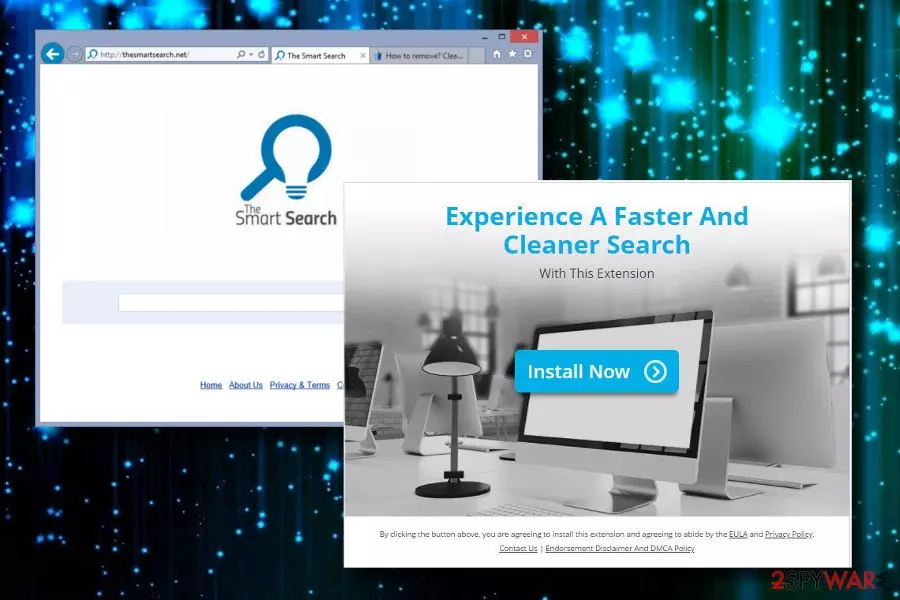
Search-smart.work is a highly suspicious search engine created by FirstGate Mobile Limited. It is classified as a browser hijacker[1] and might hijack Google Chrome, Mozilla Firefox, Internet Explorer, and other web browsers. As a result, users are forced to use an unknown search provider and cannot replace it until they get rid of the potentially unwanted program (PUP) and all its components.
| Name | Search-smart.work |
| Type | PUP, Browser Hijacker |
| Danger level | Medium |
| Associated browser extension | Smart Search |
| Symptoms | Corrupted web browser's settings (new tab URL, start page, search engine), common redirects to suspicious websites, intrusive ads |
| Distribution | Software bundling, phishing sites |
| Removal | Use reliable security software to remove the threat |
| System health | Repair virus damage by running system diagnostics with the FortectIntego tool |
Search-smart.work spreads as a browser extension called Smart Search and promises faster and cleaner search. The program has an official website where users are suggested to download it directly to the browser. The extension asks for these permissions:
- Read and change all your data on the websites you visit
- Change your search settings to: search-smart.work

However, the browser extension is also widely distributed with freeware and shareware. Hence, it might enter the system unnoticed and make these (and many other changes) without asking the user's direct permission. Finding one of the following changes on the browser often leads people to think that their machines were infected with Search-smart.work virus:
- changed default search engine, homepage, and new tab URL address;
- built-in search engine replaced by Smart Search;
- installation of unknown browser extensions and add-ons;
- redirects to suspicious third-party websites;
- an increased amount of ads, banners, pop-ups, or in-text ads.
Unfortunately, it's not easy to get rid of these changes easily unless you remove Search-smart.work and related components. However, it might not be as simple as you may think. The extension may be restored after setting another start page and search provider or even resetting the web browser’s settings to default.
You might consider using anti-malware software like MalwarebytesMalwarebytes and SpyHunterCombo Cleaner for complete and quick Search-smart.work removal. Security software can quickly eliminate suspicious components from the system. Though, you should not delay this task and continue using this bogus tool.
One of the reasons why we urge you to get rid of this tool is that it might pose a risk to your privacy and security. This search engine might include links to third-party sites which are not always relevant and safe. Therefore, the redirect issues might lead to the infiltration of malware or phishing attack.

The problem is that Search Smart virus is deeply involved in affiliate marketing. Thus, do not fall for believing that the Yahoo-based search results that it provides are genuine. You may receive multiple third-party links and intrusive ads, which may be used for generating pay-per-click[2] revenue. Some of the ads or websites promoted via the browser hijacker can promote fake software updates or other potentially dangerous content.
The presence or appearance of third-party logos, names, and/or hyperlinks should not be construed as endorsements of FirstGate Mobile Limited (“FML”) by any third-party whose logo, name, and/or hyperlinks appear on this site. All third-party endorsements will be clearly and conspicuously marked as endorsements.
[Source: Endorsement Disclaimer And DMCA Policy]
This PUP is also capable of monitoring users’ web browsing activities. The bulk of accumulated information is not treated as personal, but email address, IP address, name, and similar content that allow identifying you can also be gathered and shared with third parties.

Therefore, we highly recommend you remove Search-smart.work from the system without delay. The rejection of a third-party search provider will help you to clean the browser from potentially dangerous ads and identity-related issues. As we already mentioned, the best way to get rid of the browser hijacker is to use anti-malware software.
However, those who prefer manual PUP removal can also find help here. Our research team has submitted a step-by-step Search-smart.work uninstall guide, which can be found at the end of this post. Once you get rid of the PUP clean the entire system and repair corrupted settings and files by running system diagnostics with the FortectIntego tool.

The questionable browser extension is widely spread in software bundles
Nevertheless, the program has an official website and currently is available on Chrome Store; direct downloads are not the main distribution method of Search Smart extension. They rely on a questionable software marketing technique called “bundling.”

Software bundling is a term used to describe a legitimate distribution strategy for free applications. However, the question of whether it should be considered legit is still debatable. NoVirus.uk[3] team disapproves of bundling and claims that this method is a catch tricking thousands of PC users into installing unwanted programs every day.
This method allows the distribution of software packages, which include the free app that the user opts for installing and one or several “optional components,” such as extensions, add-ons, or toolbars. They are not disclosed on Quick or Recommended setup. Therefore, the selection of these options gives permission for additional components to be installed by default.
To prevent this from happening, the least you can do is to select Advanced or Custom installation and monitor freeware installation carefully. The most important part is to spot the window promoting additional components and reject their installation.
Remove Search-smart.work virus from your device
If you have already tried to perform Search-smart.work removal, but it keeps reassigning itself as the default search provider and startup page, we would strongly recommend you run a scan with a professional anti-malware to eliminate PUP and all of its related components. Additionally, you should reset the hijacked web browser.
However, you can also try to remove the browser hijacker manually. We want to warn that this method requires being patient and attentive. The elimination of suspicious apps and related components may be a tiresome process. Nevertheless, the guide provided below can help you to orientate.
Uninstall from Windows
Uninstall from Windows 10/8:
- Type Control Panel into the Windows search box and open the result.
- Under Programs, select Uninstall a program.


Uninstall from Windows 7/XP:
- Click on Windows Start > Control Panel (Windows XP users should click on Add/Remove Programs).
- In Control Panel, select Programs > Uninstall a program.


Remove the unwanted program:
- In the Programs and Features window, look for any recently installed suspicious entries, select them, and click Uninstall.
- If User Account Control appears, click Yes to confirm, then complete the removal.


Delete from macOS
Remove the unwanted application:
- From the menu bar, select Go > Applications.
- In the Applications folder, look for any suspicious entries, then drag them to Trash (or right-click and pick Move to Trash).


Delete leftover files and folders:
- Select Go > Go to Folder.
- Enter /Library/Application Support and remove any suspicious folders related to the unwanted program.
- Repeat the same check in the /Library/LaunchAgents and /Library/LaunchDaemons folders, deleting any suspicious entries.

- Finally, empty the Trash to permanently remove the leftovers.

Remove from Microsoft Edge
Delete unwanted extensions from MS Edge:
- Select Menu (three horizontal dots at the top-right of the browser window) and pick Extensions.
- From the list, pick the extension and click on the Gear icon.
- Click Remove.


Clear cookies and other browser data:
- Click on the Menu (three horizontal dots at the top-right of the browser window) and select Settings > Privacy, search, and services..
- Under Clear browsing data, pick Choose what to clear.
- Select Cookies and other site data and Cached images and files. (apart from passwords, although you might want to include Media licenses as well, if applicable) and click on Clear.


Restore new tab and homepage settings:
- Click the menu icon and choose Settings.
- Then find On startup section.
- Click Remove next to any suspicious startup page.
Reset MS Edge if the above steps did not work:
- Press on Ctrl + Shift + Esc to open Task Manager.
- Click on More details arrow at the bottom of the window.
- Select Details tab.
- Now scroll down and locate every entry with Microsoft Edge name in it. Right-click on each of them and select End Task to stop MS Edge from running.


Instructions for Chromium-based Edge
Delete extensions from MS Edge (Chromium):
- Open Edge and click select Settings > Extensions.
- Delete unwanted extensions by clicking Remove.


Clear cache and site data:
- Click on Menu and go to Settings.
- Select Privacy, search and services.
- Under Clear browsing data, pick Choose what to clear.
- Under Time range, pick All time.
- Select Clear now.


Reset Chromium-based MS Edge:
- Click on Menu and select Settings.
- On the left side, pick Reset settings.
- Select Restore settings to their default values.
- Confirm with Reset.
- This will disable extensions and reset startup pages but will not delete bookmarks, saved passwords, or browsing history.


Remove from Mozilla Firefox (FF)
Remove dangerous extensions:
- Open Mozilla Firefox browser and click on the Menu (three horizontal lines at the top-right of the window).
- Select Add-ons.
- In here, select the unwanted extension and click Remove.


Reset the homepage:
- Click three horizontal lines at the top right corner to open the menu.
- Choose Settings.
- Under Home, set your preferred homepage and new tab settings.
Clear cookies and site data:
- Click Menu and pick Settings.
- Go to Privacy & Security section.
- Scroll down to locate Cookies and Site Data.
- Click on Clear Data...
- Select Cookies and Site Data and Temporary cached files and pages, then click Clear.


Reset Mozilla Firefox
If clearing the browser as explained above did not help, reset Mozilla Firefox:
- Open Mozilla Firefox browser and click the Menu.
- Go to Help and then choose Troubleshooting Information.

- Under Give Firefox a tune up section, click on Refresh Firefox...
- Once the pop-up shows up, confirm the action by pressing on Refresh Firefox.



Remove from Google Chrome
Delete malicious extensions from Google Chrome:
- Open Google Chrome, click on the Menu (three vertical dots at the top-right corner) and select More tools > Extensions.
- In the newly opened window, you will see all the installed extensions. Uninstall all suspicious extensions related to the unwanted program by clicking Remove.


Clear cache and web data from Chrome:
- Click on Menu and pick Settings.
- Under Privacy and security, select Clear browsing data.
- Select Browsing history, Cookies and other site data, as well as Cached images and files.
- Click Clear data.


Change your homepage:
- Click menu and choose Settings.
- Look for a suspicious site in the On startup section.
- Click on Open a specific or set of pages and click on three dots to find the Remove option.
Reset Google Chrome:
If the previous methods did not help you, reset Google Chrome to eliminate all the unwanted components:
- Click on Menu and select Settings.
- In the Settings, scroll down and click Advanced.
- Scroll down and locate Reset and clean up section.
- Now click Restore settings to their original defaults.
- Confirm with Reset settings.


Delete from Safari
Remove dangerous extensions:
- Open Safari, click Safari in the menu at the top-left of the screen, and select Preferences.
- Go to the Extensions tab, look for any suspicious entries, and click Uninstall to remove them.


Clear history and website data:
- Click Safari in the menu and pick Clear History.
- Set Clear to all history and confirm with Clear History.


Reset Safari:
- Click Safari in the menu and select Preferences > Advanced.
- Enable Show Develop menu in menu bar.
- From the menu bar, click Develop and select Empty Caches.


Did this guide help?
Be the first to comment