

Auto Refresh Malware is a deceptive Google Chrome addon that is underrated for causing redirects and displaying pornographic ads
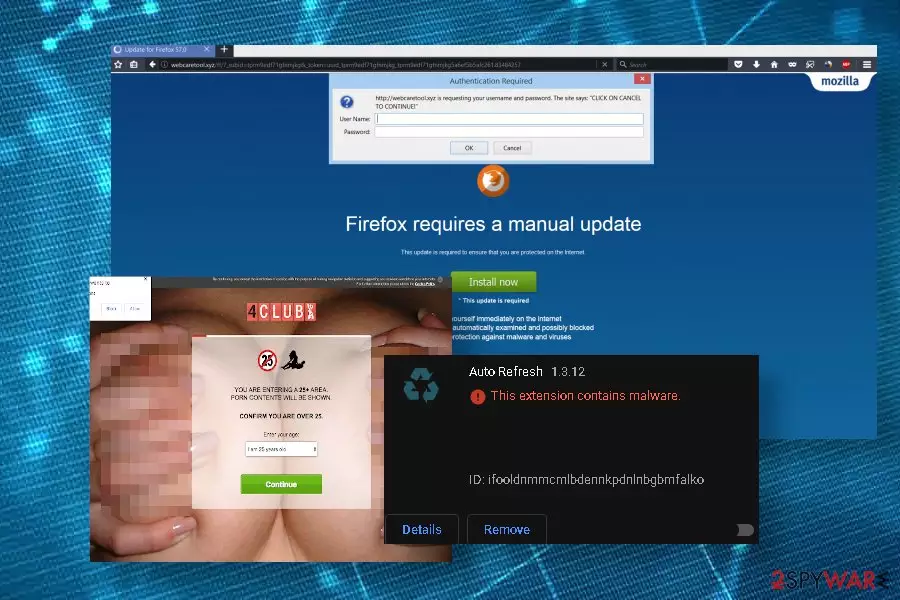
Auto Refresh Malware (a.k.a. Auto Refresh Premium or Auto Refresh Plus) is a web browser's extension that has been launched in 2016 by a team of young and ambitious developers with an intention to ensure an on-time refresh and reload of visited websites. According to the community reports[1], this browser-based plug-in was quite popular up until now. However, experts included it in the malware and potentially unwanted programs (PUP) databases after its update in 2019 October when the 1.3.14 version has been released.
According to experts, the Auto Refresh extension has received the crucial Privacy Policy changes, as well as some advertising policies. It seems to be injecting potentially dangerous scripts from static.trckingbyte.com, static/js/background.js, cwpx.armeriaalbenganese.it, static.privacytrck.com, Eaes.2track.info, and similar third-party domains. As a consequence, the affected web browser starts redirecting to affiliate third-party websites and generating new tab windows without permission. Based on people's reports, some of the Auto Refresh ads may contain pornographic content or redirect people to infamous dating websites.
| Name | Auto Refresh or Auto Refresh Premium |
| Classification | Malware, potentially unwanted program (PUP), adware |
| Distribution | The extension is usually installed purposely for increasing the website's load time and ensure a regular reload/refresh functions. However, it can also sometimes be promoted via freeware bundles and infiltrate machines without being noticed |
| The problematic version | Upon the release of the updated Auto Refresh version (1.3.14) users started reporting the extension for displaying intrusive ads and redirecting people to x-rated adult websites |
| Symptoms | The most prominent symptom – the presence of a new extension on the default web browser. However, the extension can start causing redirects to irrelevant websites, generate intrusive ads among search results, deliver altered search results, etc. |
| Related | The extension can regularly initiate redirects via the following: -static.trckingbyte.com -static/js/background.js -cwpx.armeriaalbenganese.it -static.privacytrck.com |
| Elimination | Since this extension is accused of installing malicious scripts and trojan JS/Chromex.Agent.AP, it's advisable to remove Auto Refresh malware using a professional AV engine |
| Fix & Repair | Every time when malware affects the machine, it's recommended to repair Windows registry entries. For this purpose, you can try using FortectIntego tool |
Auto Refresh Malware has been a quite popular extension of web browsers until its developers decided to fill it with potentially dangerous, highly obfuscated scripts. Although it's not dangerous, experts and users agree that the extension became a crapware and malware, the affiliated of which may be redirecting web browser's pages to porno sites.
The first Auto Refresh Premium was created in 2016 with limited functionalities and since then we have added some useful features that have been requested from you – e.g. several auto refresh timers for the different websites.
Unfortunately, the features that its developers claim[2] to be useful are not useful at all. The scrips are not the only problem that provoked the negative reaction of the users. It seems that the Auto Refresh virus may be closely related to the js/background.js file, which may try to download a malicious payload of the JS/Chromex.Agent.AP trojan.
The latter trojan-related Auto Refresh Malware may not reroute web browser to misleading third-party sites that contain porno or dating offers. Based on the latest reports, the app most frequently redirects to the Eaes.2track.info, dirtyflirt9.com, and similar domains. However, it can also track some pieces of personal information and perform other highly questionable browser-based performances:
- extract search engine queries;
- redirect the web browser to sponsored Yahoo-based search results instead of Google;
- record information stored on the browser's cookies;
- read page URLs and replace referrer codes if needed;
- identify interaction with the e-commerce domains (register what products the user was interested in, the location of the service, the amount paid, etc.). However, there are no traces that the Auto Refresh Chrome extension would be capable of gathering PII (Personally Identifiable Information), such as banking information or names.
To generalize, the Auto Refresh Plus and Premium Chrome extension is non-malicious on its own. However, it has been reported by many users on Reddit and other forums for potentially dangerous advertising schemes that may be used by third parties not only to promote dubious content but can also expose people to malware download sites.

In some rare cases, this extension may directly affect web browsers by changing default settings, including start page, search engine, new tab, etc. by altered Yahoo search or other browser hijackers. The whole tandem of malware on the system may be difficult to remove. Therefore, we recommend you remove Auto Refresh virus from the extensions and programs list with the help of a professional anti-malware tool.
If Auto Refresh Malware removal is disrupted some malicious processes, you should restart your machine into Safe Mode with Networking to disable all malicious malware-run processes. After that, launch a thorough system scan with a robust antivirus.
Finally, the users of the AutoRefresh extension should not forget to reset the web browser's settings to default and repair the system's performance. Windows registries and core OS components can be repaired with the help of FortectIntego tool.
Shady third-party websites and misleading links can make people download malware
Most of the cyber threats are distributed in a misleading manner. Even though most of the potentially unwanted programs, malware, adware, browser hijackers, etc. have their official websites. However, that stand-alone fact does not make them reliable. The official website may be treated as a camouflage allowing to disguise stealthy distribution methods.
According to LosVirus.es[3], malware and potentially unwanted programs are usually distributed by bundling (attached to freeware apps as optional downloads). Nevertheless, this method, despite being misleading, is legitimate as it allows potential victims to deselect additional components. However, it's a must to select the Advanced or Custom installation technique to see all setup windows.
In addition to that, people can download malware-laced files via spam emails, dangerous third-party ads displayed on hacked websites, hyperlinks injected into random texts, pirated software, software cracks, keygens, etc. In general, all content that is accessible online should be inspected with carefulness.
You should immediately leave the pages that you are forced to visit. Browser's redirects are usually triggered by third-party extensions that seek to promote affiliate parties, their services, products, or simply boost traffic. However, in practice, the browser's redirects can cause redirects to malware download sites, offensive or adult content where less experienced users can be tricked into giving away personal information or even money.

Auto Refresh Malware elimination guide
You may think that Auto Refresh extension is useful for your browsing activities until you start seeing intrusive redirects to websites full of pornographic scenes or ads promoting some dubious services. The extension must have been popular some time ago, however, its latest update seems to contain some potentially dangerous script that are programmed to reroute websites to pre-selected domains, as well as harvest some browser-based data.
The app is under investigation right now, though there are some references for the Auto Refresh Premium Chrome extension to the js/background.js or JS/Chromex.Agent.AP trojan. Therefore, it's advisable to scan the machine as soon as Auto Refresh ads emerge on the web browser.
If you are using a professional anti-malware tool already, Auto Refresh Malware removal should not be a difficult task for you to perform. All you have to do is launch the AV scanner or, at best, restart the machine into Safe Mode before launching the scanner.
If, however, you are not using an anti-malware tool, try installing MalwarebytesMalwarebytes or SpyHunterCombo Cleaner tools to remove Auto Refresh Malware once and for all. As a final point, perform Windows repair with the help of FortectIntego utility, which may address Windows Registry entries, system files, and cache.
Uninstall from Windows
Uninstall from Windows 10/8:
- Type Control Panel into the Windows search box and open the result.
- Under Programs, select Uninstall a program.


Uninstall from Windows 7/XP:
- Click on Windows Start > Control Panel (Windows XP users should click on Add/Remove Programs).
- In Control Panel, select Programs > Uninstall a program.


Remove the unwanted program:
- In the Programs and Features window, look for any recently installed suspicious entries, select them, and click Uninstall.
- If User Account Control appears, click Yes to confirm, then complete the removal.


Delete from macOS
Remove the unwanted application:
- From the menu bar, select Go > Applications.
- In the Applications folder, look for any suspicious entries, then drag them to Trash (or right-click and pick Move to Trash).


Delete leftover files and folders:
- Select Go > Go to Folder.
- Enter /Library/Application Support and remove any suspicious folders related to the unwanted program.
- Repeat the same check in the /Library/LaunchAgents and /Library/LaunchDaemons folders, deleting any suspicious entries.

- Finally, empty the Trash to permanently remove the leftovers.

Reset Internet Explorer
Remove dangerous add-ons:
- Open Internet Explorer, click on the Gear icon (IE menu) on the top-right corner of the browser
- Pick Manage Add-ons.
- You will see a Manage Add-ons window. Here, look for suspicious plugins. Click on these entries and select Disable.


Change your homepage if it was altered:
- Open IE and click on the Gear icon.
- Select Internet Options.
- In the General tab, delete the Home page address and replace it by your preferred one (for example, Google.com).
- Click Apply and then select OK.


Delete temporary files:
- Press on the Gear icon and select Internet Options.
- Under Browsing history, click Delete...
- Select relevant fields and press Delete.


Reset Internet Explorer:
- Click on Gear icon > Internet options and select Advanced tab.
- Select Reset.
- In the new window, check Delete personal settings and select Reset.


Remove from Microsoft Edge
Delete unwanted extensions from MS Edge:
- Select Menu (three horizontal dots at the top-right of the browser window) and pick Extensions.
- From the list, pick the extension and click on the Gear icon.
- Click Remove.


Clear cookies and other browser data:
- Click on the Menu (three horizontal dots at the top-right of the browser window) and select Settings > Privacy, search, and services..
- Under Clear browsing data, pick Choose what to clear.
- Select Cookies and other site data and Cached images and files. (apart from passwords, although you might want to include Media licenses as well, if applicable) and click on Clear.


Restore new tab and homepage settings:
- Click the menu icon and choose Settings.
- Then find On startup section.
- Click Remove next to any suspicious startup page.
Reset MS Edge if the above steps did not work:
- Press on Ctrl + Shift + Esc to open Task Manager.
- Click on More details arrow at the bottom of the window.
- Select Details tab.
- Now scroll down and locate every entry with Microsoft Edge name in it. Right-click on each of them and select End Task to stop MS Edge from running.


Instructions for Chromium-based Edge
Delete extensions from MS Edge (Chromium):
- Open Edge and click select Settings > Extensions.
- Delete unwanted extensions by clicking Remove.


Clear cache and site data:
- Click on Menu and go to Settings.
- Select Privacy, search and services.
- Under Clear browsing data, pick Choose what to clear.
- Under Time range, pick All time.
- Select Clear now.


Reset Chromium-based MS Edge:
- Click on Menu and select Settings.
- On the left side, pick Reset settings.
- Select Restore settings to their default values.
- Confirm with Reset.
- This will disable extensions and reset startup pages but will not delete bookmarks, saved passwords, or browsing history.


Remove from Mozilla Firefox (FF)
Remove dangerous extensions:
- Open Mozilla Firefox browser and click on the Menu (three horizontal lines at the top-right of the window).
- Select Add-ons.
- In here, select the unwanted extension and click Remove.


Reset the homepage:
- Click three horizontal lines at the top right corner to open the menu.
- Choose Settings.
- Under Home, set your preferred homepage and new tab settings.
Clear cookies and site data:
- Click Menu and pick Settings.
- Go to Privacy & Security section.
- Scroll down to locate Cookies and Site Data.
- Click on Clear Data...
- Select Cookies and Site Data and Temporary cached files and pages, then click Clear.


Reset Mozilla Firefox
If clearing the browser as explained above did not help, reset Mozilla Firefox:
- Open Mozilla Firefox browser and click the Menu.
- Go to Help and then choose Troubleshooting Information.

- Under Give Firefox a tune up section, click on Refresh Firefox...
- Once the pop-up shows up, confirm the action by pressing on Refresh Firefox.



Remove from Google Chrome
Delete malicious extensions from Google Chrome:
- Open Google Chrome, click on the Menu (three vertical dots at the top-right corner) and select More tools > Extensions.
- In the newly opened window, you will see all the installed extensions. Uninstall all suspicious extensions related to the unwanted program by clicking Remove.


Clear cache and web data from Chrome:
- Click on Menu and pick Settings.
- Under Privacy and security, select Clear browsing data.
- Select Browsing history, Cookies and other site data, as well as Cached images and files.
- Click Clear data.


Change your homepage:
- Click menu and choose Settings.
- Look for a suspicious site in the On startup section.
- Click on Open a specific or set of pages and click on three dots to find the Remove option.
Reset Google Chrome:
If the previous methods did not help you, reset Google Chrome to eliminate all the unwanted components:
- Click on Menu and select Settings.
- In the Settings, scroll down and click Advanced.
- Scroll down and locate Reset and clean up section.
- Now click Restore settings to their original defaults.
- Confirm with Reset settings.


Delete from Safari
Remove dangerous extensions:
- Open Safari, click Safari in the menu at the top-left of the screen, and select Preferences.
- Go to the Extensions tab, look for any suspicious entries, and click Uninstall to remove them.


Clear history and website data:
- Click Safari in the menu and pick Clear History.
- Set Clear to all history and confirm with Clear History.


Reset Safari:
- Click Safari in the menu and select Preferences > Advanced.
- Enable Show Develop menu in menu bar.
- From the menu bar, click Develop and select Empty Caches.


Did this guide help?
Be the first to comment