
Is DriverFix a virus? What it is, why it is flagged and how to remove it
DriverFix is a Windows driver updater that is not a virus, but Malwarebytes flags it as a potentially unwanted program and the maker stopped selling it in 2024. If you do not want it, uninstall it in Settings and check your card for any charge.
Facts checked October 14, 2026. Removal steps tested on Windows 11 (26H2) and checked against Microsoft's and the browser makers' current documentation.
Automatic
Get a free scan and check if your PC is infected.
Fortect finds malware, unwanted programs and the Windows damage they leave behind, and repairs it in one pass.
If DriverFix keeps coming back after uninstalling, a scan can find what reinstalls it.
Do it yourself · free Remove DriverFix yourself 4 steps, about 12 minutes, no software needed.
Start the steps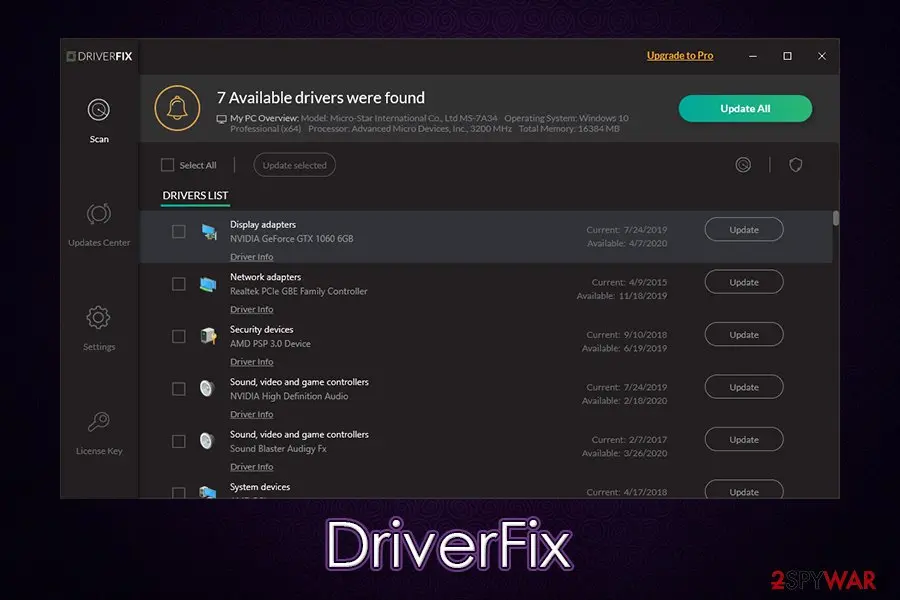
DriverFix: summary
| Type | Paid Windows driver updater, now discontinued; listed by Malwarebytes as a potentially unwanted program |
|---|---|
| Risk | Medium: not malware; the risks are a dead licence, a charge you cannot explain, and copies from other sites |
| Symptoms | A scan that lists outdated drivers, a licence-key box, reminder pop-ups, a scan that starts with Windows |
| How to get rid of it | Quit it, uninstall it in Settings, check for a payment and leftover folders, scan offline if the copy came from another site |
| Detection names | PUP.Optional.DriverFix (Malwarebytes). No Microsoft detection name is known for the genuine program (we found none in the sources we read on 6 October 2026) |
| Our check (6 October 2026) | Archived vendor pages, detection and review pages read, one visit to driverfix.com; the program was not installed or tested |
| Removal | Scan the PC with security software to find and remove the malware and anything installed with it. Fortect scans Windows for malware and repairs the system files and settings it damaged. Remove it nowTo use the full-featured product, you have to purchase a license for Fortect. The scan is free. |
Show 14 more facts
| Running since | driverfix.com registered 10 September 2004; the vendor stopped selling by May 2024 |
|---|---|
| First reported by us | 30 September 2020 |
| Price | $19.95, $29.95 or $39.95 a year for 1, 3 or 10 PCs on the vendor's page (archived May 2024); no longer sold |
| Name | DriverFix |
| Domain registered | 10 September 2004 |
| Evidence | One write-up by a security site; details still limited |
| Program | DriverFix |
| Publisher | DriverFix.com, Inc. |
| Category | Optimizer |
| Price asked | $19.95 for 1 PC for a year (archived May 2024); no longer sold |
| First seen | 30 September 2020 |
| Distribution | Typically bundled installers and ads |
| Damage | Money paid for exaggerated results, needless registry changes |
| Facts checked | 6 October 2026 |
Facts checked on 6 October 2026 against Internet Archive copies of the vendor's own pages, Malwarebytes' detection page, review pages, the registry's RDAP record and Microsoft documentation, all listed in the sources. We did not install or test the program. Our automated site test returned no result; our own single visit to driverfix.com on that day showed a domain-parking page.
What DriverFix is, and what has happened to it
DriverFix is a Windows driver updater that was sold by DriverFix.com, Inc. It is not a virus, but Malwarebytes lists it as a potentially unwanted program, and by May 2024 the maker had stopped taking new orders and renewals. If it is on your computer, you are running a paid-for product that is no longer sold, and you can safely remove it.
- Maker
- DriverFix.com, Inc., the licensor named in the end user licence agreement on the vendor's site (archived copy of 25 June 2024). We found no street address or registration number there, so we cannot say more about who stood behind it
- What it does
- Scans a Windows PC for outdated, missing or corrupted drivers, lists them, and downloads them from the vendor's own database, which the vendor's page put at "over 18 million driver files". The scan is free; installing everything in one go needs a paid key
- Platform
- Windows only. TechJury, which reviewed it, says there is no Mac or other version. It installs through a small web installer that fetches the current program from the vendor's servers
- Where it lives
- Malwarebytes' 2019 log shows
C:\ProgramData\DriverFixfor the program,C:\Users\<you>\AppData\Roaming\DriverFixfor its settings and scan history, and aDriverFixentry that starts it with Windows. A newer build may differ - Status in 2026
- Not sold. The vendor's own notice, archived on 24 May 2024, says it had stopped accepting new subscriptions and discontinued every renewal, automatic or manual. On 6 October 2026
driverfix.comshowed a domain-parking page on our one visit - Domain
driverfix.comwas registered on 10 September 2004 (RDAP record read 6 October 2026). That is the date of the name, not of the program, and we do not know when the program first appeared
- 1
You install and it scans
After the web installer runs, the program scans the computer and lists the drivers it considers out of date or missing. The scan appears within a minute, according to TechJury's 2024 test. In our 2020 screenshot it reported seven available drivers on a Windows 10 desktop.
- 2
You pay to fix them
The free edition only lets you download drivers one by one, at a limited speed, and install them yourself through Windows. The Update All button asks for a licence key, which is what the paid plans sold. The vendor's page said it made backups of your drivers before changing them.
- 3
You can do the same without it
Windows Update installs recommended drivers by itself, and the maker of your laptop or graphics card publishes the same drivers for free. The program saves a few clicks. It never unlocked a driver you could not get elsewhere.
The vendor's own front page described the product in a single line that is worth keeping in view when you judge it: "Update all your drivers with one click to enjoy better PC performance." That is a promise about speed, and neither we nor the vendor's archived pages show a test that proves it. An older version of the same page, quoted in our 2020 guide, talked of boosting gaming performance. By 2024 the wording had become "better PC performance".
DriveFix or DriverFix: what the search for drivefix usually means
Most people who search for drivefix mean DriverFix, the discontinued Windows driver updater this guide covers.
We found no reliable source for a separate security program called DriveFix, so treating it as a spelling of DriverFix is our reading. Everything on this page applies: it is not a virus, Malwarebytes lists it as PUP.Optional.DriverFix, and you can uninstall it in Settings.
To be sure which program you have, look at its name in Windows 11 or 10 under Settings > Apps > Installed apps and note the publisher. If the name or publisher differs from DriverFix, search for that exact name before you pay or enter a licence key. A copy downloaded from a site other than the maker is the riskier case, so scan it with Microsoft Defender Offline.
Is DriverFix safe? Why it is flagged
What we checked on 6 October 2026
DriverFix and its maker · vendor pages (archived), detection records, review pages and one visit to driverfix.com on 6 October 2026 · the program was not installed
- Flagged by a security vendorMalwarebytes calls it PUP.Optional.DriverFix, a "driver updater" in its system-optimizer class, and says such programs exaggerate scan results and try to sell the software that fixes the "problems". That page was last changed on 4 October 2023. The old guide said DriverFix was not a potentially unwanted program; that is not how Malwarebytes classes it.
- The AppEsteem claimThe old guide called DriverFix certified by AppEsteem. We searched AppEsteem's certified-apps list on 6 October 2026 and found other driver updaters, but no DriverFix entry in the part we read, and none of the vendor's archived pages mention AppEsteem. We could not confirm the claim, so we do not repeat it. A certificate, even if it was held, would not make an upgrade prompt less pushy.
- The product has endedThe vendor's archived notice says new sales and all renewals stopped, that support would last until the end of each paid billing cycle, and that after that the technical support and services cease. A one-year licence bought in 2023 has therefore already run out.
- Our visit to driverfix.comOn 6 October 2026 the address returned a short page that sent the browser on to
/lander, a domain-parking page served by the registrar's parking system, with no product, download or notice on it. That is one visit from one location. It does not tell us what the domain did in other countries, on other days, or for other visitors. - Billing and licence complaintsTrustpilot shows 545 reviews and a 2.6 score for
driverfix.com. Reviews we read describe failed driver installs, a licence key that did not activate, charges of several different amounts for one purchase, and, in December 2025, a payment taken for something the reviewer cancelled in 2023. We could not check any of them, and company replies on the page ask people to contact support. - Reviewers who liked itTechJury's September 2024 review found it fast and easy and says it is not a virus. Trustpilot also has five-star reviews, one of them from a user whose licence problem support solved. We list these because a fair picture has both.
- Not tested by usWe did not install the program or scan a computer with it, so we claim nothing about the accuracy of its scans, its current installer, or any pop-up it shows today. A quiet visit to a parked page is not evidence that nothing else exists under the name.
A real program, a pushy sales model, and a finished product The program is not a virus and the removal is plain. The risks are what is left behind: a licence that no longer works, a charge you cannot explain, and "DriverFix" downloads from other sites, because the vendor's own address no longer offers one. This is one day of reading and one site visit, so nothing here clears it.
Why a security program may flag it
The label is "potentially unwanted", not "trojan". It describes how the program sells, and it does not say the files are malicious.
| Source | What it says | What it means for you |
|---|---|---|
| Malwarebytes | PUP.Optional.DriverFix. The page describes a driver updater from driverfix.com, installed "by the users themselves under false pretences", and says that when you click Update All you are asked for a licence key | A potentially unwanted program, "optional" class: not a threat to your files, but not something it wants on the machine |
| Malwarebytes install warning | The page shows a warning that some people saw during installation | The installer itself raised a warning, so check your own security program's log if you want to know what it said on your computer |
| Microsoft | We did not find a Microsoft detection name for the genuine program in the sources we read on 6 October 2026 | Windows Security may say nothing: on a home PC its protection against unwanted apps is not in block mode by default (off, or audit-only on current updates) |
| Old guide | Called the program certified and not a PUP | Corrected: see "What we checked" |
Driver updaters as a group have a poor reputation, and the reason is a pattern, not a single product. Some show a long list of "problems" to make you worry, some run a free scan and then ask for money to fix what it found, and some install the wrong driver or one that does not help. The old guide put it this way: some of these tools are notorious for false positives and fake warnings. It then turned to "security experts" without naming anyone. We name the source we can show, which is Malwarebytes' own page on this program, and we describe what the program did in our 2020 screenshots rather than what "many experts" think.
DriverFix is a more ordinary case than the worst of the genre. Its scan did not frighten with a red alert, and TechJury's reviewer found its list of outdated drivers plausible. The complaint is a different one: the free scan ends at a key box, the key cost money, and the cheap price was an annual one.
What DriverFix looked like in 2020, and how it ended
10 September 2004
The domain is registered
driverfix.comappears in the .com registry on this date. When the program first used the name we could not find out.January 2019
Malwarebytes writes up the program
The detection page shows a scan log of 17 January 2019 for DriverFix 4.2018.12.18 and the entries it left: a folder in
ProgramData, a start-up value, a shortcut on the public desktop, and the downloaded installer on the desktop.30 September 2020
Our first report
Our guide called the program a reliable utility. Its screenshots show the main window with seven drivers found, a download page and a pop-up urging the user to update a network adapter driver.
The DriverFix window in our 2020 report: seven available drivers found, and Upgrade to Pro at the top. 2020 report
The licence-key box
A second screenshot shows the scan at 36 per cent beside the results window, with a box that says "Please enter your license key" opened from the License Key button in the side menu. This is the step where a free scan turns into a paid fix.
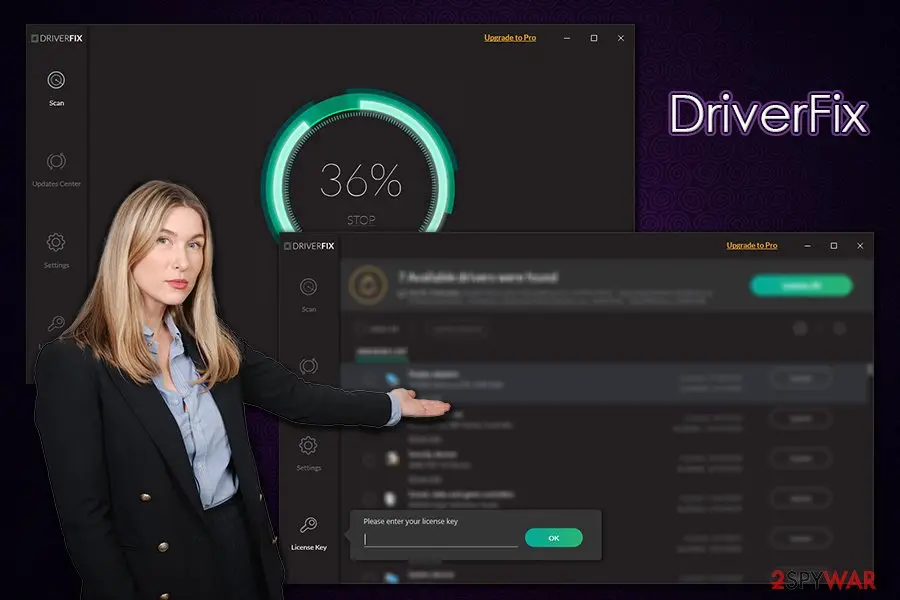
The scan and the licence-key box in our 2020 report. The person in the picture is an illustration, not a DriverFix customer. 2020 report
The download page, the price list and a pop-up
The third screenshot shows a driver download with the line "Speed up your download by upgrading to DriverFix Pro and get up to 10x faster speed", the vendor's price page, and a pop-up titled "Network adapter driver" telling the user that a more recent version was found and to click OK to update now.
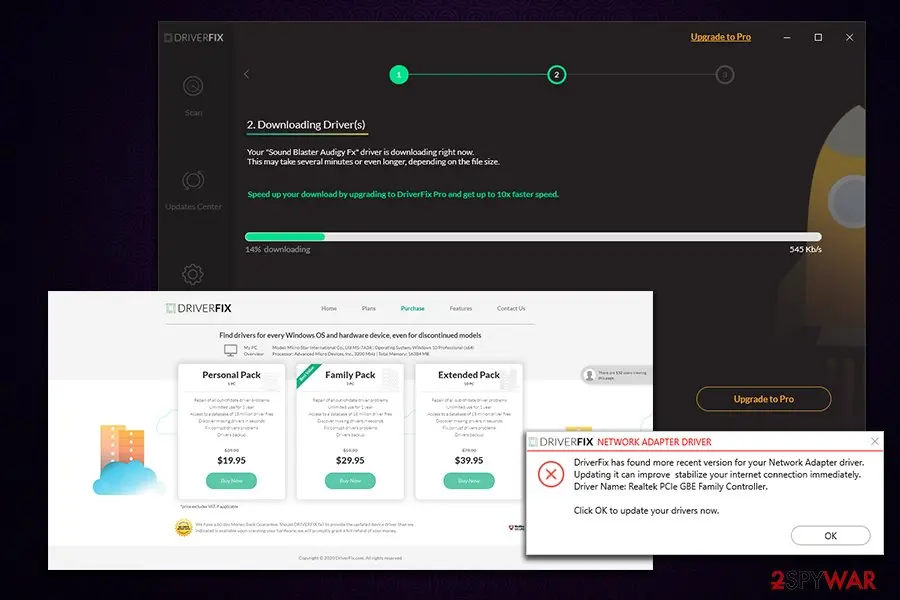
The DriverFix download screen, price page and pop-up in our 2020 report: $19.95, $29.95 and $39.95 plans. May 2021
A Trustpilot profile
The company profile for
driverfix.comon Trustpilot was claimed in May 2021. By October 2026 it showed 545 reviews and a score of 2.6, with one review in the previous twelve months.March 2024
The vendor stops selling
TechJury's review, updated on 10 September 2024, says that as of March 2024 DriverFix had ceased operations and discontinued automatic renewals. We could not confirm the month from the vendor itself.
24 May 2024
The vendor's notice
The Internet Archive's copy of the vendor's front page of that day carries a link called "Important Update About DriverFix". Its FAQ says new subscriptions are no longer accepted, all renewals are discontinued, and refunds within 60 days of a renewal made before the announcement would still be honoured.
December 2025
A reviewer reports a charge
A one-star Trustpilot review dated 21 December 2025 says a payment was taken for something cancelled in 2023 and that the website no longer works. We could not verify it, and it is one review.
6 October 2026
The address today
On one visit
driverfix.comshowed a domain-parking page and no download.
What can go wrong, from most to least serious
- High
A cracked or look-alike installer
A file named DriverFix from a torrent, a "free key" page or an unknown portal can carry a loader, an information stealer or ransomware. If the installer did not come from the vendor before 2024 and the PC behaves oddly, scan it offline before you do anything else, and change passwords from another device if you entered any.
- Medium
A wrong or failed driver
Trustpilot reviewers describe updates that errored out, froze or changed nothing, and one who compared the result with the laptop maker's own tool and found far fewer drivers needing updates. Some driver updaters install a wrong driver or one that does not help, and some PUPs cannot be trusted with the integrity of what they download. We did not test DriverFix's installs, so we do not say that it does.
- Medium
A charge you cannot explain
A licence bought before 2024 was for a year, and the vendor says renewals ended. Charges that continue after that are the kind to dispute through your card issuer.
- Medium
Software with no support
The vendor said technical support and product services end when your paid cycle ends. A program that nobody updates, sitting in your start-up list and running scans, is something you do not need.
- Low
Start-up scans and reminder pop-ups
One Trustpilot reviewer in 2023 wrote that DriverFix kept starting a scan by itself and that they had to switch the PC off to use the screen again. TechJury's reviewer reported several reminders in a day. Uninstalling removes this.
- Low
Pop-ups that say a driver is out of date
Our 2020 screenshot shows a message that a newer network adapter driver was found, with only an OK button. A message like that is a sales prompt. If you are unsure that a driver is out of date, look in Device Manager or at the hardware maker's page.
Updating drivers without a driver updater
A driver is the small piece of software that lets Windows talk to a device such as a graphics card, a network adapter or a printer. Most computers run well on the drivers they came with, and the ones to update are few.
- 1
Why drivers matter
Windows needs a driver for each part of the hardware, because different manufacturers build video cards, network cards, motherboards, keyboards and printers in different ways. A driver is the agreed language between the part and the system.
- 2
Where they come from
When you buy a desktop or a laptop, the drivers come pre-installed with the operating system, so the device works at once. Drivers do sometimes break, and when they do the device can stop working. The newest driver is usually not needed for a part to work.
- 3
Let Windows Update do it
Windows 11 installs recommended drivers by itself and lets you add optional driver updates yourself. In Windows 11, look under Settings > Windows Update > Advanced options > Optional updates; in Windows 10, choose View optional updates in Windows Update. The wording differs between builds.
- 4
If Windows finds nothing
Microsoft's advice is to check the hardware maker's website for a driver that fits your version of Windows. Laptop makers publish a driver page for each model, so search for the exact model number on the label.
- 5
For games
High-end graphics cards (GPUs) can run noticeably better on the latest driver, and that is the one case where updating is worth the effort. The graphics-card makers publish their own driver packages with their own update tools; take those from the maker's page.
- 6
The trade-off
Doing it by hand takes more care. You might miss an update, or pick the wrong driver for your model. If you update by hand, create a restore point first, and install one driver at a time, so that you know which change caused a problem.
If you still want a tool that updates drivers automatically, treat it as a purchase: read what the free version does, what the paid version adds, how it renews and how to cancel, before you scan. The old guide was right that automatic driver updaters that work can take care of a variety of driver problems, and wrong to suggest that such a tool is needed by everyone.
How DriverFix got installed
What it cost, and what to do about a charge
The scan was free and the fixing was paid, and the price shown per month was billed once a year. If a charge from DriverFix appears on your statement now, it is one the vendor's own notice says should not renew.
| Our 2020 screenshot | Vendor page, archived 24 May 2024 | |
|---|---|---|
| Free edition | Scans, lists drivers, and lets you download one at a time at a limited speed | One PC, manual installation only (TechJury, September 2024) |
| Personal pack, 1 PC | $19.95 | $19.95 billed annually, shown as $1.66 a month with a struck-through $4.75 |
| Family pack, 3 PCs | $29.95 | $29.95 billed annually |
| Extended pack, 10 PCs | $39.95 | $39.95 billed annually |
| Refund | A 60-day money-back line on the price page | 100 per cent within 60 days of purchase if you are not satisfied, requested through the support page; the licence key expires one year after purchase |
| Renewal | Not shown in our screenshot | The notice says all renewals, automatic or manual, are discontinued |
- 1
Find the order e-mail
The vendor sent a licence key and an order confirmation. Search your inbox for "DriverFix" and note the date, the amount and the company that issued the receipt.
- 2
Compare with your card statement
Look for charges at the same date or exactly a year later. The name on a card statement is often the payment company's, not the product's, so match the amount and the date rather than the word DriverFix.
- 3
Ask the vendor in writing
The vendor's pages gave
support@driverfix.comand a chat link. On Trustpilot, the company's replies ask people to write to that address. The site no longer answers on our visit, so expect that e-mail may go unanswered. - 4
Then your card issuer or PayPal
If the charge is one you did not agree to, or came after the vendor said renewals had stopped, tell your card issuer or PayPal and give them the order e-mail. Do this soon, because there is a time limit for disputing a charge.
How it ends up on computers
You may have chosen it, or it may have come with something else. Today the main danger is that the vendor's own site no longer offers a download, so a file named DriverFix is a copy from somewhere else.
| Source | What we know | Risk |
|---|---|---|
| The vendor's site (until 2024) | A small web installer, which then fetched the current program. Malwarebytes says driver updaters are "usually installed by the users themselves" | Lowest then: you got the product with its upgrade prompts |
| Download portals and review pages | Several review and download pages still list DriverFix, including CNET Download, UpdateStar and FileHorse | Medium to high now: a portal may wrap the file in its own installer, and the file is an old build |
| Bundled with other free programs | The old guide said driver updaters can arrive "seemingly out of nowhere" through third-party sites, which earn money from bundling. We did not see DriverFix in a bundle, so we treat this as possible, not as shown | Medium: an installer can add programs you did not ask for |
| Torrents and "free licence key" pages | We tested none | High: a cracked key is a common way to carry other malicious programs |
If you did not install it yourself, the question to ask is which program you did install, and where it came from. Open the installed-programs list (see the removal plan) and sort by date, then look at what else appeared on the same day.
The old guide explained that some websites make money from software bundling and that users are often led into installing programs they never planned to. That is still true, and it is why the advice in the prevention section keeps coming back to the same few habits.
How to uninstall DriverFix
How to remove DriverFix
Uninstall it, then remove what keeps it starting with Windows.
Nothing it flagged needs fixing.
Step 1: Uninstall DriverFix
Open Settings > Apps > Installed apps in Windows 11, or Settings > Apps > Apps & features in Windows 10. Sort the list by install date and find DriverFix, then choose Uninstall from the three-dot menu next to it (in Windows 10, click the entry and then Uninstall).
Remove anything else installed on the same day that you do not recognise, because such programs usually arrive together in one installer. If the uninstaller opens a browser page with an offer or a survey, close it: the program is removed either way.
Full procedure with screenshots: Uninstall a program or app in Windows On uGetFix
Step 2: Remove it from startup
Whatever DriverFix installed usually starts with Windows. Open Task Manager with Ctrl + Shift + Esc, go to Startup apps in Windows 11 or the Startup tab in Windows 10, and disable what you do not know, starting with entries that have an empty Publisher column.
Open file location on the right-click menu shows the file, which helps you decide and tells you what to delete later. Disabling is safe: if something you need stops working, switch it back on.
Full procedure with screenshots: Stop apps from opening at startup On uGetFix
Step 3: Delete the folders left behind
What the uninstaller leaves behind is usually in the user folders. Open File Explorer, switch on View > Show > Hidden items (in Windows 10 View > Hidden items), and go through
%LocalAppData%,%AppData%, %ProgramData% and the two Program Files folders.Sort by Date modified and delete folders that appeared together with the problem and belong to no program you use. Folders with random names that hold
.exe,.dll, .js or .ps1 files are the strongest sign.Full procedure with screenshots: Remove what malware leaves behind in Windows
Step 4: Scan the PC, then run the offline scan
Open Windows Security > Virus & threat protection > Scan options, run a Full scan and remove everything it finds. Then select Microsoft Defender Antivirus (offline scan) and click Scan now: the PC restarts and scans before Windows loads, which finds files that hide while Windows runs.
Save your work first, because the offline scan takes about 15 minutes. Both scans are built into Windows 11 and Windows 10, and a second scanner from another vendor is a useful extra opinion.

Windows 11: Windows Security > Virus & threat protection > Scan options. Full procedure with screenshots: Run a Microsoft Defender Offline scan
Uninstalling DriverFix in detail
DriverFix appears in the normal list of installed programs, so removal is the same as for any other program. Uninstalling does not cancel a payment, so check that separately (see the cost section). The vendor itself told customers there was no special procedure and that it was removed the way any Windows program is.
- 1
Quit the program
Right-click the DriverFix icon near the clock and choose the exit command, or end DriverFix in Task Manager. If a scan is running, wait or end the task.
- 2
Windows 11
Open Settings > Apps > Installed apps, search for DriverFix, click the three dots and choose Uninstall. Confirm, and follow the uninstaller.
- 3
Windows 10
Open Settings > Apps > Apps & features, select DriverFix, click Uninstall and follow the steps. The older route, Control Panel > Programs > Uninstall a program, leads to the same list.
- 4
If the entry is missing
Malwarebytes' log shows an uninstaller called
unins000.exeinC:\ProgramData\DriverFix. If the program is not in the list but the folder is, run it from there. If the folder is gone too, nothing is left to uninstall. - 5
Check what is left
Delete the installer you downloaded (the file name began with
DriverFix), then open Task Manager > Startup apps and make sure nothing called DriverFix is listed. After the uninstall,C:\ProgramData\DriverFixandC:\Users\<you>\AppData\Roaming\DriverFixshould be gone. If a folder remains and nothing is running from it, you can delete the folder. Removing the program does not undo the drivers it installed, and the backups it made stay where you saved them. - 6
Look at the rest of the list
If the program arrived without your choosing it, sort the installed-programs list by date and uninstall anything you do not recognise that appeared around the same day. If you are unsure about an entry, search for its exact name before you remove it.
If DriverFix will not uninstall, comes back, or the copy did not come from the vendor, run the Microsoft Defender offline scan from the plan above: Run a Microsoft Defender Offline scan. A scan from a security program you already trust is also fine; you do not need to buy a new one for this. A full scan also checks for malware that does not show itself.
DriverFix is a desktop program with no browser extension, so nothing needs to be reset in Chrome, Edge or Firefox for its sake. If you are also seeing unwanted ads or a changed home page after the uninstall, that is a different program; the old guide's advice to reset every browser applies only if adware is found and survives the uninstall.
After removal and prevention
Do
- Download programs only from the maker's own site and compare the address letter by letter. If the maker's site is gone, treat every copy as unofficial.
- Read up on a program before you install it: look at forum posts and reviews, and at the privacy policy, the licence terms (EULA) and the refund terms before you pay.
- Choose Advanced or Custom setup instead of the recommended one, because it gives more control over what is installed.
- Untick every pre-ticked box that offers an extra program, and read the fine print, where the important information is often hidden.
- Watch for buttons placed in the wrong position, and for offers built into the installation of the main program.
- Switch on protection against potentially unwanted apps. In Microsoft Edge, open Settings > Privacy, search, and services and under Security turn on Block potentially unwanted apps. For Microsoft Defender Antivirus, the setting is not in block mode by default on a home PC; you can turn it on with
Set-MpPreference -PUAProtection Enabledin PowerShell (Microsoft Learn). - Keep a current backup (File History or OneDrive) so that a bad driver or a cleanup does not cost you your documents.
- On public Wi-Fi a VPN hides your IP address; it does not stop malware or fix a bad installer.
Don't
- Install a tool because a web page or a pop-up says your drivers are out of date.
- Search for a free licence key or a crack for a paid driver tool.
- Install every driver a scan lists without reading what it replaces.
- Give your card to a program whose maker you cannot trace, or accept a monthly price before you have found out how it is billed.
- Run a program that you cannot trace to a maker.
Questions about DriverFix
Is DriverFix a virus?
No. DriverFix is a driver updater, and nothing we read describes it as a virus, a trojan or ransomware. Malwarebytes does list it as a potentially unwanted program, PUP.Optional.DriverFix, because tools of this kind run a free scan and then sell the software that fixes what the scan found.
TechJury's September 2024 review found no malware in it. Our check on 6 October 2026 was a reading of vendor pages, detection records and reviews, not a test of the program, so it does not clear it. A file called DriverFix from a torrent or a free-key page is a different matter and can be a real infection.
Is DriverFix safe to use?
It is probably safe from the vendor's own installer, but there is little reason to use it now. The vendor said in 2024 that it had stopped taking new orders and renewals, so a copy found today comes from a portal or another site, and the vendor's address showed a parking page on our visit.
Reviewers describe failed driver installs and licence problems. If you want to update drivers, Windows Update and your hardware maker's site do the job for free. If you already have it, remove it rather than leave an unsupported program that starts with Windows.
Is DriverFix legit or a scam?
It was a real, paid product, not a scam in the sense of a site that takes money and sends nothing. The licence terms name DriverFix.com, Inc., and the vendor's pages had a refund policy and a support address.
Reviews are poor, though: Trustpilot shows 2.6 out of 5 across 545 reviews, with complaints about failed installs, keys that did not activate and charges.
We could not verify any of them. The product has also ended. If you were charged and cannot explain it, treat that as a billing dispute and contact your card issuer.
How do I uninstall DriverFix?
Open Settings, go to Apps, and uninstall it from the list. In Windows 11 choose Settings > Apps > Installed apps, search for DriverFix, click the three dots and choose Uninstall. In Windows 10 choose Settings > Apps > Apps & features, select DriverFix and click Uninstall.
Then delete the installer you downloaded and check Startup apps in Task Manager. Malwarebytes' log shows leftover folders in ProgramData and AppData, named DriverFix, which should be gone once the program is removed. If it will not uninstall, run a Microsoft Defender offline scan.
Is DriverFix still available or has it been discontinued?
It has been discontinued. A notice on the vendor's own site, archived by the Internet Archive on 24 May 2024, says new subscriptions were no longer accepted and every renewal, automatic or manual, was discontinued. Support was to last until the end of each customer's paid cycle.
TechJury dates the stop to March 2024. On 6 October 2026 the driverfix.com address showed a domain-parking page on our one visit. Any site that offers a DriverFix download now is not the vendor, so treat the file with caution.
How do I cancel DriverFix or get a refund?
Start with the order e-mail, then check your card statement, because the vendor's own notice says renewals were discontinued. The refund policy we read allowed a full refund within 60 days of purchase, requested through the support page, and the notice promised refunds within 60 days of a renewal made before the announcement.
That window has long passed for most people. If you have an unexplained charge, write to support@driverfix.com and, if there is no reply, tell your card issuer or PayPal and give them the order e-mail. Uninstalling the program does not cancel a payment.
Why does DriverFix keep starting scans or showing pop-ups?
It was set to start with Windows and to remind you about updates. TechJury's 2024 review notes that its scheduler can run scans at start-up, and that the update reminders, set to every 48 hours by default, came several times in a day during its test.
One Trustpilot reviewer in 2023 wrote that scans started on their own and could not be closed. You can stop it by opening its settings and unticking the launch-on-start-up option, but since the product has ended, uninstalling it in Windows Settings is the cleaner fix.
Is DriverFix certified by AppEsteem?
We could not confirm it. The old version of this guide called DriverFix certified by AppEsteem, a company that certifies software against its own rules. On 6 October 2026 we searched AppEsteem's public list of certified apps and found other driver updaters, but no DriverFix entry in the part we read, and the vendor's archived pages do not mention AppEsteem.
Even if a certificate was held at one time, it covered the program's behaviour at that time and did not mean the program was needed, or that its sales prompts were mild.
Do I need a driver updater at all?
Most people do not. Windows Update installs recommended drivers by itself, and you can add optional driver updates yourself under Settings > Windows Update > Advanced options > Optional updates in Windows 11. If a device misbehaves, look for a driver on the maker's site, using your exact model number.
Gamers can take graphics drivers straight from the graphics-card maker, which publishes its own packages. A third-party tool saves clicks but can also install a wrong driver, so make a restore point before you let any tool change drivers.
Will Fortect remove DriverFix?
Fortect scans Windows for malware and unwanted programs and repairs the system files and settings they change, and its free scan shows what it finds on your PC before you decide anything.
For DriverFix, follow the plan above as well: the browser steps take back permissions and settings that no scanner treats as a threat, and uninstalling the program that brought it removes the source.
Run Microsoft Defender's full scan and, if anything was found, its offline scan as a second opinion. If the symptoms are gone after the plan and both scans are clean, there is nothing more to do.
Sources
- Malwarebytes: PUP.Optional.DriverFix (detection page, last changed 4 October 2023) (read October 6, 2026)
- DriverFix vendor FAQ "Important Update About DriverFix" (Internet Archive copy of 24 May 2024) (read October 6, 2026)
- DriverFix vendor front page with price plans (Internet Archive copy of 24 May 2024) (read October 6, 2026)
- DriverFix refund policy (Internet Archive copy of 24 May 2024) (read October 6, 2026)
- DriverFix end user licence agreement (Internet Archive copy of 25 June 2024) (read October 6, 2026)
- TechJury: DriverFix review (updated 10 September 2024) (read October 6, 2026)
- Trustpilot: reviews of driverfix.com (545 reviews, score 2.6) (read October 6, 2026)
- AppEsteem: certified apps list (read October 6, 2026)
- RDAP registration record: driverfix.com (read October 6, 2026)
- Microsoft Support: Automatically get recommended and updated hardware drivers (read October 6, 2026)
- Microsoft Learn: Detect and block potentially unwanted applications (read October 6, 2026)
- Microsoft Learn: Microsoft Defender Offline (read October 6, 2026)