
Myattwg: why you are redirected to myattwg.att.com and what to do
Myattwg is an AT&T web address, not a virus: AT&T sends customers there when it restricts a home internet line, and on 6 October 2026 it led to a payment page naming an unpaid bill. If every site you open lands on it, pay or sort out the account with AT&T; nothing on your computer needs removing.
Facts checked October 6, 2026. Removal steps tested on Windows 11 (26H2) and checked against Microsoft's and the browser makers' current documentation.
Automatic
Get a free scan and check if your PC is infected.
Fortect finds malware, unwanted programs and the Windows damage they leave behind, and repairs it in one pass.
If redirects to myattwg.att.com keep coming back, a free scan can check extensions, programs and browser settings in one pass.
Do it yourself · free Remove Myattwg yourself 1 step, about 5 minutes, no software needed.
Myattwg: summary
| Type | AT&T's own account-restriction page; not malware. The "Myattwg virus" is a redirect that AT&T applies to a home internet connection |
|---|---|
| Risk | Low from the AT&T page itself; medium if the address in the bar is not an att.com address, because a copy can phish for passwords and card numbers |
| Symptoms | Every website on every device at home opens myattwg.att.com or fastpay.att.com instead, in every browser, on Windows, Mac, Android and iPhone alike |
| How to get rid of it | Check that the internet bill is paid, pay the full past-due balance on an att.com address you typed, wait five minutes, restart the modem, and call AT&T if the page stays |
| Our check (6 October 2026) | One visit: the address forwarded to AT&T's "Pay without signing in" page, which names an unpaid bill; no pop-up, notification prompt or service worker on this one visit |
| Running since | att.com registered 25 April 1986; the earliest report of this address we found is a forum question of 17 November 2016 |
| Removal | Scan the PC with security software to find and remove the malware and anything installed with it. Fortect scans Windows for malware and repairs the system files and settings it damaged. Remove it nowTo use the full-featured product, you have to purchase a license for Fortect. The scan is free. |
Show 12 more facts
| Installed on the PC | Nothing: the redirect happens on the network, so there is no file, process or extension of this name to remove |
|---|---|
| Microsoft detection | None known: nothing is installed, so there is no Microsoft detection name to look up; this is a web page on AT&T's domain, not a file |
| First reported by us | 23 April 2020 |
| Name | Myattwg |
| Evidence | One report; details still limited |
| Domains | myattwg.att.com |
| Ads shown as | Redirects through ad pages |
| Browsers | Chrome, Edge and Firefox |
| First seen | 23 April 2020 |
| Distribution | Typically ad scripts on free streaming, file-hosting and adult sites, typo domains and hacked websites |
| Damage | Redirects to scam pages, fake updates and tech support scams |
| Facts checked | 6 October 2026 |
Facts checked on 6 October 2026 against our own test of myattwg.att.com/UverseAccount.html in desktop Chromium from Lithuania, the registry's RDAP record for att.com, the certificate the address presents, AT&T's own help pages, the FTC's phishing advice and the browser help pages. The test covers one visit from outside AT&T's network; a restricted AT&T line, a phone and the payment pages behind Continue were not tested.
What Myattwg is: an AT&T page, not a virus
Myattwg is myattwg.att.com, an address that belongs to AT&T, the American telecommunications company. It is not a program and not a browser hijacker: AT&T's own network sends customers there, and on 6 October 2026 the address forwarded us to AT&T's payment page, which says the broadband account is suspended because of an unpaid bill.
- What it is
- A web address on AT&T's own domain
att.com, the one our 2020 guide named asmyattwg.att.com/UverseAccount.html; on 6 October 2026 it forwarded tofastpay.att.com, titled "Pay without signing in" - Who runs it
- AT&T: the page's certificate names AT&T Services, Inc. of Dallas (issued by DigiCert), and
att.comhas been registered since 25 April 1986 - Why you see it
- A restriction that sends every web address you open to this page, until the account is sorted out; AT&T's page names an unpaid bill
- Who sees it
- Readers on AT&T home internet; our 2020 guide listed Windows, Mac, Android and iPhone, because the redirect happens on the network, not on the device
- What it is not
- A virus, adware or something installed on your computer; there is nothing of this name to find or uninstall
- 1
You open any website
Gmail, eBay, YouTube or a news page: our 2020 guide described readers who could not reach any of them, in every browser, on Windows and Mac alike.
- 2
The address bar changes
Instead of the site you typed you land on
myattwg.att.comor, today, onfastpay.att.com. The browser did not decide this and no program on the PC did: the answer came from the network. - 3
The page tells you to deal with the account
The 2016 version asked you to log in with your myAT&T ID or call a number. The 2026 version says the account is suspended for an unpaid bill and asks for an AT&T phone or account number and the billing ZIP code to pay.
Is Myattwg dangerous?
Our test on 6 October 2026
We opened https://myattwg.att.com/UverseAccount.html in a clean desktop Chromium browser from Lithuania, with no extension and no account, and did not type anything into the page. We are not an AT&T customer and our connection was not restricted, so what we saw is what the address itself shows anyone who opens it.
myattwg.att.com/UverseAccount.html · desktop Chromium · Lithuania · 6 October 2026
- Where it wentThe address answered with a redirect (HTTP 301) to
https://fastpay.att.com/acctmgmt/fastpmt/walledgarden, an address on AT&T's own domain, and the browser stayed there. - Redirect memoryThe redirect carried the headers
cache-control: max-age=0, no-cache, no-store, which tell a browser not to keep it. - Who it belongs toThe certificate names AT&T Services, Inc., Dallas, issued by DigiCert, valid until 7 January 2027.
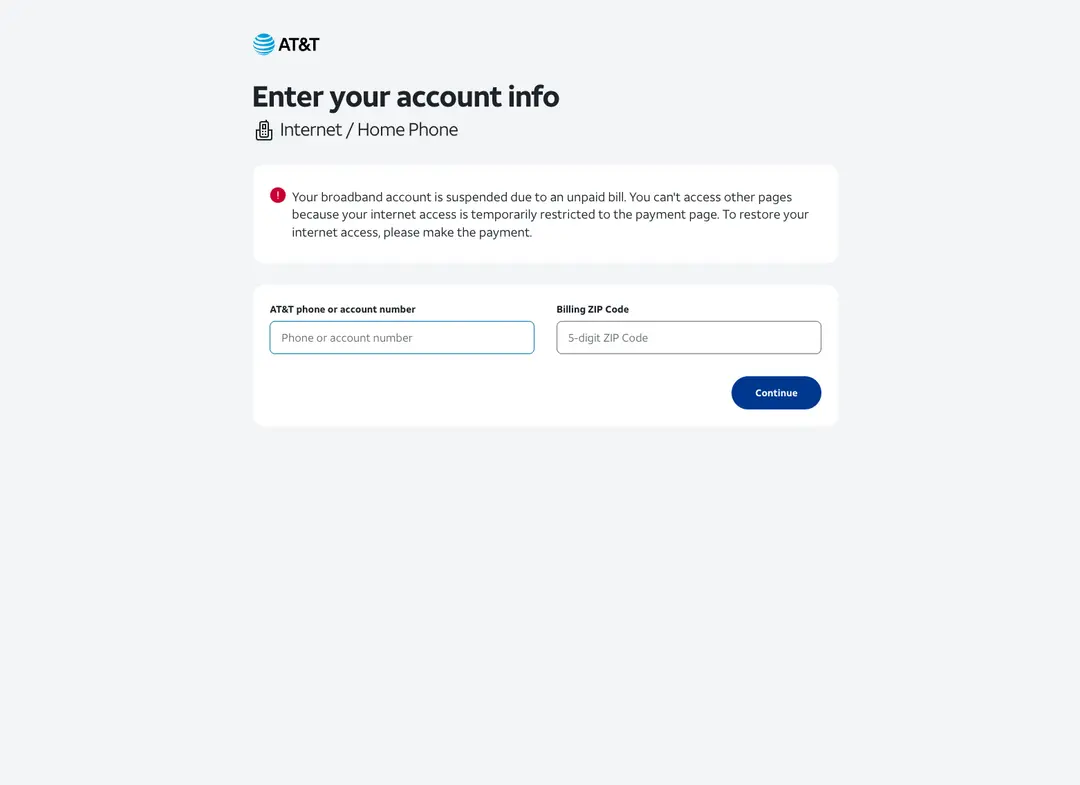
- What the page saysTitle "Pay without signing in", heading "Enter your account info": "Your broadband account is suspended due to an unpaid bill. You can't access other pages because your internet access is temporarily restricted to the payment page. To restore your internet access, please make the payment."
- What it asks forTwo fields, "AT&T phone or account number" and "Billing ZIP Code", and a Continue button. We did not press it.
- Notifications and service workerNo notification prompt appeared and the permission stayed at "default"; no service worker was registered.
- Pop-ups and extra tabsNone on this one visit; only one tab existed afterwards.
- Third-party hostsBesides AT&T's own hosts the page loaded
adobedc.demdex.net,dpm.demdex.net,att.demdex.net,assets.adobedtm.com,cdn.quantummetric.com,ingestusipv4.quantummetric.com,bf03987fss.bf.dynatrace.comandfls.doubleclick.net: eleven hosts in all. We did not inspect what was sent to them. - Not testedA real restricted connection at an AT&T home, a phone, other countries, a second visit, a click on Continue, or the sign-in and payment pages that follow.
Quiet on one visit: AT&T's payment page On this one visit the address did nothing but forward to an AT&T payment page that asked for an account number and ZIP code and opened nothing else. One visit from outside AT&T's network does not show what a restricted customer sees, and pages can behave differently by country, device, referrer or a second visit, so this is not a clearance of every page that might use the name. It is a reason to check the address bar, below.
What changed since our 2020 guide
April 1986
The att.com domain is registered
The registry record (RDAP) for
att.comshows registration on 25 April 1986, expiry on 26 April 2027 and a last change on 22 April 2026; its status flags forbid transfer, update and deletion without the registrar (CSC Corporate Domains, Inc.). It is a very old company domain, not a throwaway address.November 2016
The first question we found
A Windows user wrote on Microsoft's support forum that opening Windows Live Mail sent the browser to
myattwg.att.com/UverseAccount.html. The page said "Important Message from AT&T. Your account needs immediate attention", gave a myAT&T login and two phone numbers, and did not mention a bill. The question shows more than 700 people with the same problem; the one answer calls it "a legitimate AT&T page".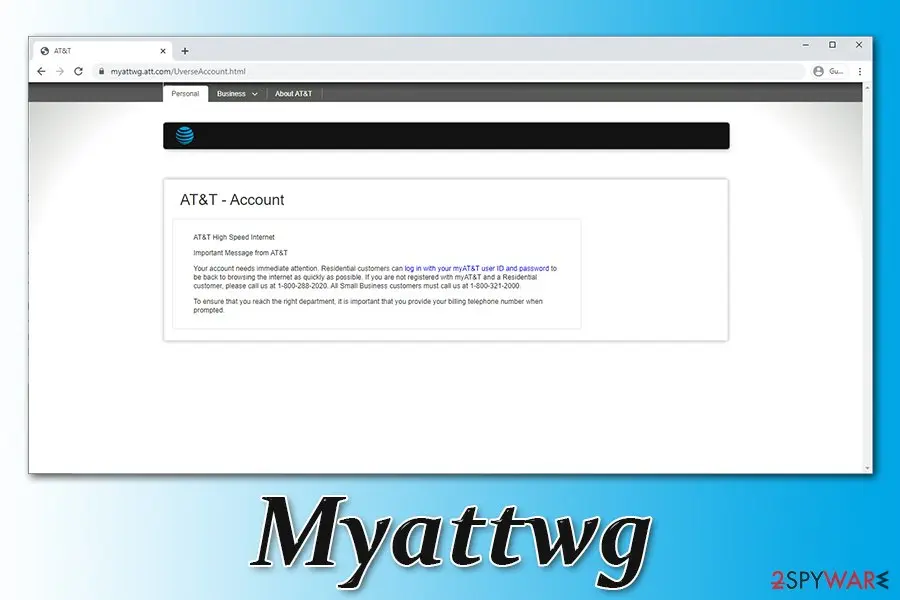
From our 2020 guide: the notice page as it looked then, at myattwg.att.com/UverseAccount.html, with the "Your account needs immediate attention" text and no word about a bill. April 2020
Our first guide
We reported it as a redirect that readers met on every site and in every browser, explained that the page belonged to AT&T and that an overdue bill was the cause, and listed ways to avoid unwanted programs. Readers had reacted in two ways: some took it for a scam because of the phone numbers and the urgent wording, and some tried new DNS settings, a browser reset, a malware scan and a router reset without effect, which fits a restriction applied by the provider.
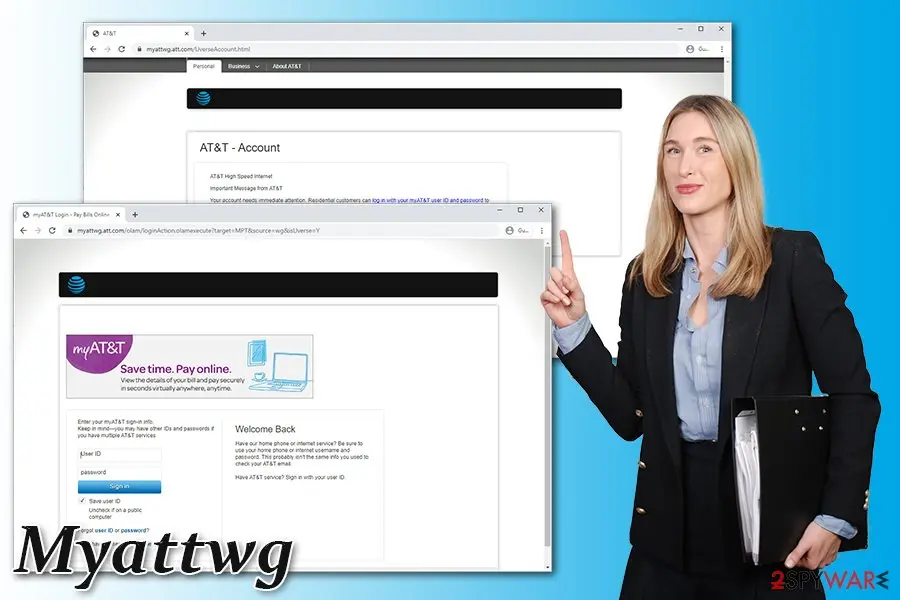
From our 2020 guide: the notice page (behind) and the myAT&T sign-in page it linked to (in front), where a customer could log in and pay. The stock photo of a woman in the picture is decoration, not part of the AT&T pages. September 2023 and April 2025
AT&T's help pages describe the fix
AT&T's article on restoring service after a nonpayment suspension (last updated 28 September 2023) says to pay the full past-due balance, either signed in or without signing in, and wait five minutes. Its article on late payment fees (last updated 30 April 2025) says AT&T may charge a late fee and suspend service until the balance is paid. Both are general billing articles; neither names the Myattwg address.
October 2026
Our new check: a clearer page on a new address
The address still works, but it now forwards to
fastpay.att.com, and the page says outright that the broadband account is suspended due to an unpaid bill and that access is limited to the payment page. The 2016 and 2020 wording that confused readers, "your account needs immediate attention", is gone from what we saw. We cannot say whether every restricted customer sees the new page.What myattwg.att.com/UverseAccount.html sent us to on 6 October 2026: AT&T's "Pay without signing in" page at fastpay.att.com. The red notice says the broadband account is suspended due to an unpaid bill and that internet access is restricted to the payment page. Nothing was typed into it.
Why you land on it, and how to tell the real page
Because the redirect comes from the network, it hits every device and every browser in the house at once. A problem on one computer only is a different problem. Only the first row below is the AT&T restriction, and AT&T's own page names the unpaid bill as its reason.
| What you see | What it most likely means |
|---|---|
Every site on every device at home sends you to att.com or fastpay.att.com, and the address bar shows att.com | AT&T has restricted the connection. Its page says this is for an unpaid bill; payment, or a call to AT&T, is the way out. |
Only one browser or one computer does it, or the address bar shows a name that is not att.com | Not this restriction. Look for a changed DNS setting, an extension, a proxy or adware on that device (see the checks below and the browser steps). |
| The same page appears on your phone while you are on mobile data | Unlikely to be this restriction, which belongs to the home line. Check that the phone is not on the home Wi-Fi, and read the address bar before anything else. |
| The page looks like AT&T's but arrived through an email, a text or a pop-up | Treat it as unknown. The FTC says phishing messages copy a real brand and ask for passwords or payment details; open att.com yourself instead of following the link. |
A page asks for your myAT&T password and a card number and the address is not an att.com address | Close it. The real page we saw asked only for a phone or account number and a billing ZIP code at an att.com address. |
The address myattwg.att.com is public, so anyone can open it, as we did, without being a customer; seeing it on a visit you chose yourself says nothing about your account. It matters when it replaces every site you try to open. If you are not an AT&T customer and still land there on every site, the redirect is coming from somewhere else on your network, and the AT&T name should not be trusted until you have read the address bar.
The real risks, from most to least serious
The AT&T page is not a danger. The risks come from copies of it and from the panic it causes.
- High
A fake copy of the notice
Our 2020 guide said that the real page being legitimate did not stop someone from making a fake one where adware- or malware-infected users land. A copy can ask for a card number, a myAT&T password or a phone call. Check the address bar and open
att.comyourself. - High
Calling a number from a message you did not ask for
Fraudsters copy urgent bill messages and put their own phone numbers in them or in emails with links. Users who hesitated to call the number on the old page were right to be careful, and the safe number is the one printed on your bill or on
att.com. - Medium
Adware that redirects to other sites
If tabs open on other addresses or ads fill every site, a program or extension on the device is the likely cause, not AT&T. Adware can also change the start page or search engine and collect browsing details.
- Medium
Losing access for longer
A suspended connection stays suspended until the balance is paid. Time spent on virus scans and browser resets does not restore it, and waiting can add fees as AT&T's articles describe.
- Low
Trackers on the payment page
The page we opened loaded analytics and advertising hosts (listed below). That is common on large company sites; it is not a sign of infection, and we did not test what was sent.
What the AT&T page loaded in our test
The page we reached is a payment page, so it is worth knowing which outside services it contacted. The names below are the hosts the page requested in our one visit; their roles are judged by the host names and are not confirmed by AT&T.
Hosts requested besides AT&T's own att.com hosts
- adobedc.demdex.net
- dpm.demdex.net
- att.demdex.net
- assets.adobedtm.com
- cdn.quantummetric.com
- ingestusipv4.quantummetric.com
- bf03987fss.bf.dynatrace.com
- fls.doubleclick.net
The names point to audience and tag management from Adobe, session analytics from Quantum Metric, performance monitoring from Dynatrace and a Google advertising host. We did not open the AT&T privacy policy for this rewrite, did not type any number into the page and did not look at what the requests carried. If you pay on the page, the practical protection is the usual one: confirm the att.com address, and block third-party cookies if you prefer.
How adware reaches a device
Our 2020 guide added a warning about potentially unwanted programs because readers who see redirects often suspect them. They are not behind Myattwg, but they are behind many other redirects, and they usually get in with the user's own click.
- 1
A free program is downloaded
A converter, a player, a driver tool or a cracked program from a page that is not the maker's.
- 2
The installer hides a choice
The fast path, named Recommended, Quick or Express, accepts extra apps, browser extensions and toolbars that were already ticked for you.
- 3
The extra program starts working
It shows ads, opens tabs, changes settings and can watch what you browse. Even an annoyance of this kind is a privacy risk, and some adware has weakened the security of the computer it ran on.
Free software bundles are legal when the installer discloses them, which many do only in small print. A page that says your browser or Windows needs updating is the same trick, because a web page cannot update either.
How to remove Myattwg
How to stop the Myattwg redirects
Work in this order and test a few links after each step, so you know which one was the cause.
Which browser shows the ads?
Delete extensions you did not add
Type
chrome://extensionsin the address bar and press Remove under anything you did not install yourself. This matters only if non-AT&T addresses also open.Full procedure with screenshots: Remove a browser extension
Clear cookies and cached files
Press Ctrl + Shift + Delete (on Mac Cmd + Shift + Delete), set the time range to All time, tick Cookies and other site data and Cached images and files, then press Delete data. On a phone use Chrome's menu > Delete browsing data. It will not end the AT&T restriction; it is a cheap check.
Reset Chrome
Open Settings > Reset settings > Restore settings to their original defaults and press Reset settings. Extensions are switched off and the start page and search engine return to default; bookmarks and saved passwords stay.
Full procedure with screenshots: Reset a browser and fix a hijacked search engine
Delete extensions you did not add
Type
edge://extensionsin the address bar and press Remove under anything you did not install yourself.Full procedure with screenshots: Remove a browser extension
Clear cookies and cached files
Go to Settings > Privacy, search, and services > Delete browsing data > Choose what to clear, pick All time, tick Cookies and other site data and Cached images and files, then press Clear now.
Reset Edge
Open Settings > Reset settings > Restore settings to their default values and press Reset. Extensions are disabled and the start page returns to default; favourites, history and saved passwords stay.
Full procedure with screenshots: Reset a browser and fix a hijacked search engine
Delete add-ons you did not add
Type
about:addonsin the address bar, open Extensions, and use the three-dot menu to choose Remove for anything you did not install yourself.Full procedure with screenshots: Remove a browser extension
Clear cookies and cached web content
Open the menu > Settings > Privacy & Security > Cookies and Site Data > Clear Data, tick Cookies and Site Data and Cached Web Content, and press Clear.
Refresh Firefox
Open the menu > Help > More troubleshooting information and press Refresh Firefox. Add-ons and custom settings are removed and the home page returns to default; bookmarks, history and passwords stay.
Full procedure with screenshots: Reset a browser and fix a hijacked search engine
Uninstall extensions you did not add
Open Safari > Settings > Extensions, select anything you did not install yourself and press Uninstall.
Clear the site data
Open Safari > Settings > Privacy > Manage Website Data and remove the data of the sites you want, or choose History > Clear History > all history.
Look for apps that came with the ads
Only if non-AT&T addresses also open: in Finder > Applications drag anything unknown to the Bin, and in System Settings > General > Login Items & Extensions remove unknown items.
Then, whichever browser you use
Step 1: Scan the PC if you downloaded anything from the ads
If you only saw the notifications and clicked nothing, you can stop before this step. If a notification led you to download or run something, delete that file, then scan Windows.
In Windows Security > Virus & threat protection > Scan options, run a Full scan, then choose Microsoft Defender Antivirus (offline scan) and Scan now. The offline scan restarts the PC and takes about 15 minutes on Windows 11 and Windows 10.

Windows 11: Windows Security > Virus & threat protection > Scan options. Full procedure with screenshots: Run a Microsoft Defender Offline scan
What to do, in order
- 1
Read the address bar
The page you are on should have an address that ends in
.att.com, such asfastpay.att.com. If it ends in something else, do not type anything and go to the checks for an infection further down. - 2
Check whether the bill is overdue
Look at your latest bill or sign in at
att.comyourself (type the address, do not follow a link). The old guide's advice stands: first make sure the internet is paid for. If you cannot reachatt.combecause of the restriction, use a phone or mobile data. - 3
Pay the full past-due balance
AT&T's help article on restoring service says to pay the full past-due balance, signed in or without signing in (have your account number and ZIP Code ready), and then wait five minutes. It adds that the next bill will contain a reconnection fee and that you may have to turn the device off and on again. That article is AT&T's general one for a nonpayment suspension, so a home line may differ in detail.
- 4
Restart the modem or gateway
Unplug its power for half a minute and plug it back in. Our 2020 guide said to press the reset button; on many gateways that button restores factory settings, which can erase your Wi-Fi name and password, so keep it for the last, and read the maker's instructions first.
- 5
Call AT&T if it is still there after paying
The old notice gave 1-800-288-2020 for residential customers and said to have the billing telephone number ready. AT&T's billing support page currently lists 800.288.2020 for internet, phone and TV. The old notice also gave 1-800-321-2000 for small business accounts; we did not confirm that number in 2026, so use the number on your bill or AT&T's business support. Call numbers from your bill or from
att.com, never from an email or a pop-up. - 6
Only then look at the PC
If the redirect continues after the service is restored, or it leads to addresses that are not AT&T's, work through the section on what to check if you clicked an ad or ran a file, and the browser steps.
Do
- Pay or sign in only on an address you typed yourself or read in the address bar as ending in
.att.com. - Keep your latest bill at hand: the phone number and the account number on it are the safe ones to use.
- Restart the modem before you reset it.
Don't
- Do not install a "Myattwg remover": there is nothing to remove, and the page is AT&T's.
- Do not change your DNS settings, reset the browser and scan the PC over and over: our 2020 readers tried these and nothing changed, because the cause was the account.
- Do not give a card number or password to a page you reached through a pop-up or an email that quotes the message.
After removal: keep the ads from coming back
If other addresses open too, or you ran a file
If the only thing you see is the AT&T page, the steps above are enough and nothing on the PC needs cleaning. Add the steps below when the redirects lead to addresses that are not AT&T's, ads multiply on every site, or you downloaded or opened something a page gave you.
- 1
Remove the programs that arrived with it
No program carries the Myattwg name, so look at dates. In Windows 11 open Settings > Apps > Installed apps (Windows 10: Apps & features), sort by Install date, and uninstall what you do not remember choosing, starting with the day the redirects began (Uninstall a program or app in Windows On uGetFix).
- 2
Scan twice with the tools Windows has
Start a Microsoft Defender Full scan, and afterwards the Microsoft Defender Antivirus (offline scan), which restarts the PC and checks it before Windows starts, where stubborn malware has fewer places to hide. A scan cannot undo a changed start page or search engine, so the browser steps still apply.
- 3
Reset the browser
Programs that come from ads usually leave a changed start page, search engine or extension behind. Use the tab for your browser above.
- 4
Secure the accounts you touched
A password typed on a page that arrived by an ad or a look-alike address is a password to replace, on every account that shares it. A card number typed there is a reason to call your bank today.
How to keep unwanted programs away
Do
- Take programs from their makers, the Microsoft Store, the Mac App Store or Chrome Web Store, rather than from pages that merely offer a file.
- Pick Custom or Advanced in an installer and clear every extra program, extension and ready-ticked box.
- Watch for pre-ticked boxes, small print and misplaced buttons: they are how optional installs are hidden.
- Keep Windows, macOS and your browser up to date, and leave Microsoft Defender or the Mac's built-in protection switched on.
- Back your files up regularly with File History or OneDrive on Windows, or Time Machine on a Mac, so a bad install never costs you them.
- On a public network a VPN keeps your IP address from the sites you visit; it does not filter ads, and it cannot lift a restriction on your home line.
Don't
- Install a player, update, cleaner or extension because a page insists.
- Click an ad or a "your account needs attention" message you did not expect; open the company's site yourself.
- Assume a page that was quiet once will stay quiet: what ads and redirects show changes with country, device and time.
Questions about Myattwg
What is myattwg.att.com?
Myattwg.att.com is an AT&T web address that shows a message about the customer's account instead of the site you asked for.
It belongs to AT&T, the telecommunications company: its certificate names AT&T Services, Inc. of Dallas, and att.com has been registered since 1986. In 2016 and 2020 it showed "Important Message from AT&T" with a myAT&T login and phone numbers.
When we opened it on 6 October 2026 it forwarded to fastpay.att.com, a page titled "Pay without signing in" that says the broadband account is suspended due to an unpaid bill. It is not a program, so nothing on your computer carries the name.
Is Myattwg a virus?
No, Myattwg is not a virus: it is a page on AT&T's own domain, and nothing is installed when you see it. People searched for a "Myattwg virus" because it replaced every website they tried to open, which is how browser hijackers behave. The difference is where the redirect comes from.
A hijacker works from inside one computer or browser; this one comes from the network and hits every device on the line at once. If only one device does it, or the address bar does not end in att.com, treat it as a different problem and check that device for adware and changed settings.
Why am I redirected to myattwg.att.com?
You are most likely redirected because AT&T has restricted your home internet connection, and its own page names an unpaid bill as the reason. On 6 October 2026 the page said you cannot reach other pages because internet access is temporarily restricted to the payment page, and that you restore it by paying.
Our 2016 and 2020 sources showed the same redirect with vaguer wording. We could not test from a restricted AT&T line, so we cannot say why your account in particular was restricted; your bill or AT&T's support can. A redirect on one device only is a separate case.
How do I remove the Myattwg redirect?
You end the redirect by fixing the account, not by removing software. Check that your AT&T bill is paid; if it is overdue, pay the full past-due balance on an att.com address you typed yourself, wait five minutes and restart the modem or gateway, as AT&T's help article on restoring service describes.
If the page stays after you have paid, call AT&T on the number printed on your bill. Scans, DNS changes and browser resets did not help our 2020 readers, because the cause was never on the computer. Check the PC only when other, non-AT&T addresses also open.
Is the Myattwg message a scam?
The AT&T page itself is not a scam, though scammers copy this kind of message. Our 2020 readers found it suspicious because it was urgent, gave phone numbers and did not say why the account needed attention. The real page sits on an att.com address with a certificate issued to AT&T Services, Inc.
The FTC says phishing messages copy a real brand and ask for passwords or payment details. So read the address bar, type att.com yourself instead of following a link, and take phone numbers from your bill rather than from a message that arrived by email, text or pop-up.
Will clearing cookies or resetting the router fix Myattwg?
Clearing cookies will not fix it, and resetting the router is rarely needed. In our test the redirect carried headers telling the browser not to store it, so it is not a stale browser memory, and our 2020 readers who cleared data, reset browsers and rebooted gear saw no change.
A plain restart of the modem is worth doing after you pay, because AT&T says a device may need turning off and on to reconnect. Avoid the reset button unless the maker's guide says so: on many gateways it erases the Wi-Fi name and password.
I paid my bill but still see the Myattwg page. What now?
Wait five minutes, restart the modem, then call AT&T if the page remains. AT&T's article on restoring service after a nonpayment suspension says service comes back within about five minutes of paying the full past-due balance, and that you may need to turn the device off and on.
A partial payment or one that has not posted yet can leave the restriction in place. Phone the number printed on your bill, give your billing telephone number as the old notice asked, and ask whether the payment posted. Do not install a cleaner: the cause is the account, and it cannot be removed from the computer.
Does Myattwg happen on Mac, Android or iPhone?
Yes, it happens on any device on the restricted connection, because the redirect is applied by the network rather than by the device. Our 2020 guide listed Windows, Mac, Android and iPhone, and readers reported it on both Mac and Windows.
A phone on mobile data should not be affected; if it is, or if only one device shows the page, suspect that device's settings or a look-alike page and read the address bar. The fix is the same everywhere:
- sort out the AT&T account
- then restart the modem
- use the browser steps on this page only if other addresses also appear
How can I tell the real AT&T page from a fake one?
Look at the address bar: the real page we saw sat on an att.com address, fastpay.att.com, and used a certificate issued to AT&T Services, Inc. Type att.com yourself rather than following a link from an email, text or pop-up.
The real page asked only for an AT&T phone or account number and a billing ZIP code; one that also wants your myAT&T password, a card number or a download is not the page we saw.
The FTC advises not to give personal details to a message you did not expect, and to contact the company using a number you already trust.
Will Fortect remove Myattwg?
Fortect scans Windows for malware and unwanted programs and repairs the system files and settings they change, and its free scan shows what it finds on your PC before you decide anything.
For Myattwg, follow the plan above as well: the browser steps take back permissions and settings that no scanner treats as a threat, and uninstalling the program that brought it removes the source.
Run Microsoft Defender's full scan and, if anything was found, its offline scan as a second opinion. If the symptoms are gone after the plan and both scans are clean, there is nothing more to do.
Sources
- Verisign RDAP: att.com registration record (read October 6, 2026)
- Microsoft Q&A: Redirected to AT&T page telling me that "Your account needs immediate attention" (question of 17 November 2016) (read October 6, 2026)
- AT&T: Restore service after a nonpayment suspension (updated 28 September 2023) (read October 6, 2026)
- AT&T: Get details on late payment fees (updated 30 April 2025) (read October 6, 2026)
- AT&T: Billing & payment support (read October 6, 2026)
- FTC Consumer Advice: How to recognize and avoid phishing scams (read October 6, 2026)
- Microsoft Support: Virus and threat protection in the Windows Security app (offline scan) (read October 6, 2026)
- Google Chrome Help: Delete browsing data in Chrome (no longer online) (read October 6, 2026)
- Microsoft Support: Manage cookies in Microsoft Edge (read October 6, 2026)