

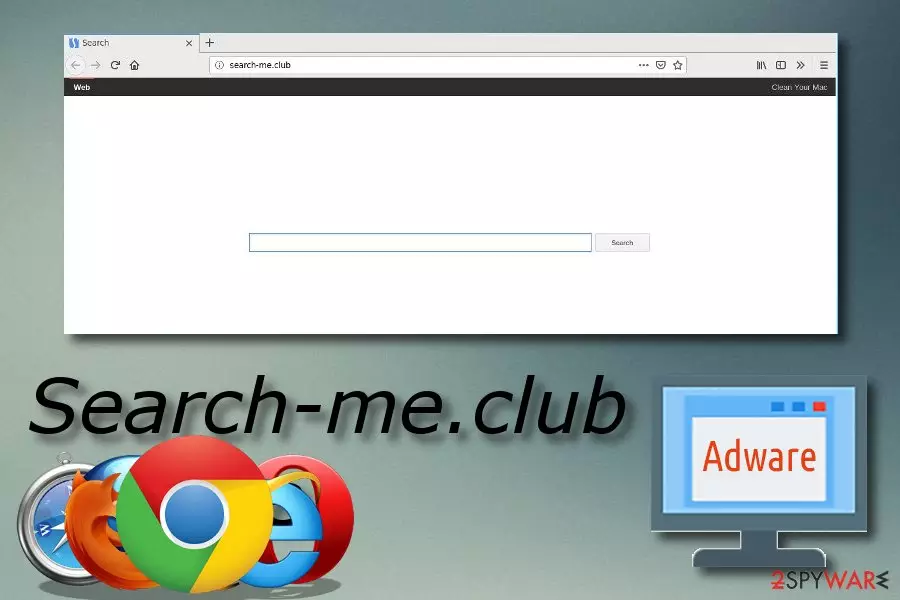
Search-me.club – a browser hijacker which mostly affects Mac computers and promotes quesrtionable removers
| Name | Search-me.club |
|---|---|
| Type | Browser hijacker |
| Sub-type | Potentially unwanted program |
| Target | Mac computers mostly |
| Browsers affected | Chrome, Edge, Firefox, Explorer |
| Purpose | To infect web browsers and modify them to be able to perform rogue activities such as redirecting and similar |
| Signs | Browser changes, frequent redirecting, an increased amount of ads, browser struggles, etc. |
| Distribution sources | Bundled freeware/shareware, rogue web pages |
| Elimination | Use FortectIntego to detect all PUP-related components |
If your Mac computer is infected with Search-me.club, there is a possibility that you will experience these symptoms:
- the browser's homepage has been changed without your permission;
- the default search engine and new tab URL have also been modified;
- infected web browsers are filled with adware-related components;
- redirects have been taking you to developer-sponsored pages;
- web browsers are struggling due to the hijacking activity.
If you see these signs on your computer, note that you have some work to do. You need to remove Search-me.club virus from the system and web browsers. The removal is a necessary process if you want to get rid of the redirecting and annoying advertising activity and bring your browser back to its starter position. For such purpose, you can use reliable tools such as FortectIntego. For manual instructions look below this article.
Furthermore, if you do not perform the Search-me.club removal and do not get rid of the annoying redirecting, you might one day land on a malware-laden page, and we guess you definitely do not want that to happen. So, take care of your computer as soon as you spot the first browser hijacker-related signs. Moreover, note that every single component needs to be completely removed, otherwise, the cyber threat might still remain in the system.
Additionally, note that Search-me.club has another tricky feature. Once it hijacks your web browser and modifies the main page, you can see “Clean your Mac” text written in the upper right corner of your browser's homepage. If you click on it, you will be offered to download and install Mac Keeper in order to “fix all system issues”. However, this system tool is known for displaying annoying pop-ups, so you should really overthink is it worth installing such software.
Also, browser hijackers such as Search-me.club can collect browsing-related information and use it for some not really good purposes. Potentially unwanted programs gather data such as IP addresses, pages visited, saved bookmarks, and similar components. After that, the developers use this information to create beneficial advertisements which helps them to gain income from the pay-per-click method. As you can see, only the owners benefit from such programs.

Unwanted programs can be found in software bundles
According to cybersecurity experts from Virusai.lt website,[3] browser-hijacking applications can be spread via bundling. That means, the potentially unwanted program can show up together with regular software after an installation. Prevent this from happening by paying attention to all of your downloads. Moreover, you should use the Custom/Advanced installation mode only. It will allow you to take care of all incoming downloads and deselect all objects you do not want to overcome on your computer.
Additionally, a browser hijacker can appear in your computer system after a visit to a rogue website. What you need to do is stop visiting third-party websites which might easily include unwanted content. Make sure you eliminate all suspicious sites you enter and do not return to them again. For further protection, do not hesitate to invest in a reliable anti-malware program that has the ability to protect computers manually. To work properly, such software needs to be updated once in a while.
Get rid of Search-me.club
If you have discovered that your Mac computer is infected with this specific browser-hijacking program, you should take actions to remove Search-me.club virus from the system and clean web browsers such as Google Chrome, Mozilla Firefox, Internet Explorer, Microsoft Edge, and Safari. There is a possibility to complete the elimination by using a reputable computer tool that will find all rogue components in the system and delete them instantly.
However, you also can perform the Search-me.club removal manually if you are likely to. Just remember that you will need to get rid of adware-added components such as browser extensions and add-ons. What is more, you will need to refresh and bring your browser back to its starter position by yourself. Furthermore, do not forget to take all possible steps to avoid browser hijackers and similar PUPs[4] in the future.
Delete from macOS
Remove the unwanted application:
- From the menu bar, select Go > Applications.
- In the Applications folder, look for any suspicious entries, then drag them to Trash (or right-click and pick Move to Trash).


Delete leftover files and folders:
- Select Go > Go to Folder.
- Enter /Library/Application Support and remove any suspicious folders related to the unwanted program.
- Repeat the same check in the /Library/LaunchAgents and /Library/LaunchDaemons folders, deleting any suspicious entries.

- Finally, empty the Trash to permanently remove the leftovers.

Reset Internet Explorer
Remove dangerous add-ons:
- Open Internet Explorer, click on the Gear icon (IE menu) on the top-right corner of the browser
- Pick Manage Add-ons.
- You will see a Manage Add-ons window. Here, look for suspicious plugins. Click on these entries and select Disable.


Change your homepage if it was altered:
- Open IE and click on the Gear icon.
- Select Internet Options.
- In the General tab, delete the Home page address and replace it by your preferred one (for example, Google.com).
- Click Apply and then select OK.


Delete temporary files:
- Press on the Gear icon and select Internet Options.
- Under Browsing history, click Delete...
- Select relevant fields and press Delete.


Reset Internet Explorer:
- Click on Gear icon > Internet options and select Advanced tab.
- Select Reset.
- In the new window, check Delete personal settings and select Reset.


Remove from Microsoft Edge
Delete unwanted extensions from MS Edge:
- Select Menu (three horizontal dots at the top-right of the browser window) and pick Extensions.
- From the list, pick the extension and click on the Gear icon.
- Click Remove.


Clear cookies and other browser data:
- Click on the Menu (three horizontal dots at the top-right of the browser window) and select Settings > Privacy, search, and services..
- Under Clear browsing data, pick Choose what to clear.
- Select Cookies and other site data and Cached images and files. (apart from passwords, although you might want to include Media licenses as well, if applicable) and click on Clear.


Restore new tab and homepage settings:
- Click the menu icon and choose Settings.
- Then find On startup section.
- Click Remove next to any suspicious startup page.
Reset MS Edge if the above steps did not work:
- Press on Ctrl + Shift + Esc to open Task Manager.
- Click on More details arrow at the bottom of the window.
- Select Details tab.
- Now scroll down and locate every entry with Microsoft Edge name in it. Right-click on each of them and select End Task to stop MS Edge from running.


Instructions for Chromium-based Edge
Delete extensions from MS Edge (Chromium):
- Open Edge and click select Settings > Extensions.
- Delete unwanted extensions by clicking Remove.


Clear cache and site data:
- Click on Menu and go to Settings.
- Select Privacy, search and services.
- Under Clear browsing data, pick Choose what to clear.
- Under Time range, pick All time.
- Select Clear now.


Reset Chromium-based MS Edge:
- Click on Menu and select Settings.
- On the left side, pick Reset settings.
- Select Restore settings to their default values.
- Confirm with Reset.
- This will disable extensions and reset startup pages but will not delete bookmarks, saved passwords, or browsing history.


Remove from Mozilla Firefox (FF)
Remove dangerous extensions:
- Open Mozilla Firefox browser and click on the Menu (three horizontal lines at the top-right of the window).
- Select Add-ons.
- In here, select the unwanted extension and click Remove.


Reset the homepage:
- Click three horizontal lines at the top right corner to open the menu.
- Choose Settings.
- Under Home, set your preferred homepage and new tab settings.
Clear cookies and site data:
- Click Menu and pick Settings.
- Go to Privacy & Security section.
- Scroll down to locate Cookies and Site Data.
- Click on Clear Data...
- Select Cookies and Site Data and Temporary cached files and pages, then click Clear.


Reset Mozilla Firefox
If clearing the browser as explained above did not help, reset Mozilla Firefox:
- Open Mozilla Firefox browser and click the Menu.
- Go to Help and then choose Troubleshooting Information.

- Under Give Firefox a tune up section, click on Refresh Firefox...
- Once the pop-up shows up, confirm the action by pressing on Refresh Firefox.



Remove from Google Chrome
Delete malicious extensions from Google Chrome:
- Open Google Chrome, click on the Menu (three vertical dots at the top-right corner) and select More tools > Extensions.
- In the newly opened window, you will see all the installed extensions. Uninstall all suspicious extensions related to the unwanted program by clicking Remove.


Clear cache and web data from Chrome:
- Click on Menu and pick Settings.
- Under Privacy and security, select Clear browsing data.
- Select Browsing history, Cookies and other site data, as well as Cached images and files.
- Click Clear data.


Change your homepage:
- Click menu and choose Settings.
- Look for a suspicious site in the On startup section.
- Click on Open a specific or set of pages and click on three dots to find the Remove option.
Reset Google Chrome:
If the previous methods did not help you, reset Google Chrome to eliminate all the unwanted components:
- Click on Menu and select Settings.
- In the Settings, scroll down and click Advanced.
- Scroll down and locate Reset and clean up section.
- Now click Restore settings to their original defaults.
- Confirm with Reset settings.


Delete from Safari
Remove dangerous extensions:
- Open Safari, click Safari in the menu at the top-left of the screen, and select Preferences.
- Go to the Extensions tab, look for any suspicious entries, and click Uninstall to remove them.


Clear history and website data:
- Click Safari in the menu and pick Clear History.
- Set Clear to all history and confirm with Clear History.


Reset Safari:
- Click Safari in the menu and select Preferences > Advanced.
- Enable Show Develop menu in menu bar.
- From the menu bar, click Develop and select Empty Caches.


Did this guide help?
Be the first to comment