

Search.searchcpro.com is a browser hijacker used for affiliate marketing
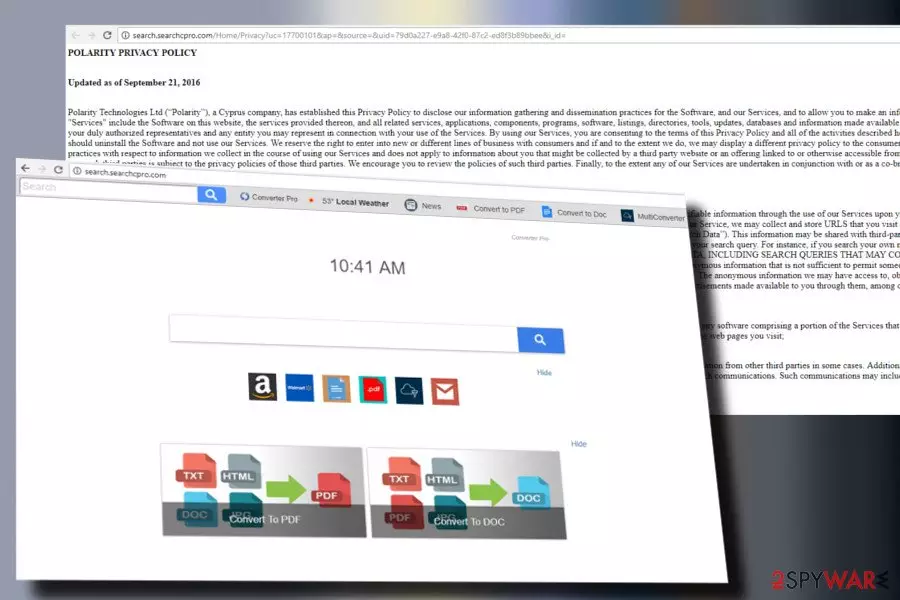
Search.searchcpro.com is a search engine developed by Polarity Technologies Ltd in 2016. Despite the fact that it looks like a useful tool providing an Internet search and document conversion services alongside, it's a tool that is not recommended due to a risk of web browser's redirects to questionable websites. People even refer to Search.searchcpro.com as a virus due to aggressive infiltration and web browser's changes that lead to startup page, search engine, and new tab URL alterations.
| Search.searchcpro.com | |
|---|---|
| Classification | Browser hijacker |
| Developer | Polarity Technologies Ltd |
| Symptoms | Replaces start page, search provider, new tab. Then redirects web browser to partner's websites, generates commercial ads, diminishes web browser's performance |
| Danger level | It's not dangerous. However, some of its ads or links may turn out to be infected. |
| Distribution | Bundling (freeware and shareware packages). |
| Removal process | Download FortectIntego and run a full system scan with it. |
Search.searchcpro.com falls for two malware categories. First of all, it is classified as Potentially Unwanted Program (PUP)[1] as it installs on the system via freeware without asking for the PC owner's permission.
The behavior that it exhibits upon infiltration indicated most of the reputable security vendors assigned it to the group of browser hijackers[2] and included into the virus database. Programs are classified this way due to the following traits:
- Search.searchcpro.com virus installs Converter Pro toolbar without permission;
- It replaces startup page to http://search.searchcpro.com/ and searches engine to Yahoo;
- This doubtful search displays sponsored links in its search results;
- It generates ads that redirect to the websites of its affiliates;
- It may show tech-support or survey pop-ups that may lead people to the installation of other PUPs;
- May use Cookies to collect people's search data;
- Browser helper objects can be used to evade Search.searchcpro.com removal.
These are the signs that immediately indicate the web browser to be hijacked. This particular search engine can settle down on any web browser, be it Google Chrome, Mozilla Firefox or Microsoft Edge. In targets Microsoft Windows OS. Nevertheless, there are quite a lot of Mac OS users who reported Search.searchcpro.com virus on their devices.
Regardless of the OS type or browser, this piece of malware seeks to initiate its advertising campaigns. Unfortunately, no one knows what kind of products, services or programs does it intend to promote. Therefore, clicking on any of the links or ads provided by Search.searchcpro.com poses a high-risk of redirects to potentially dangerous or even phishing sites.
Luckily, search sites by Polarity Technologies Ltd are not that aggressive to redirect to porn or other gambling websites, but Search.searchcpro.com hijacker may be used to promote expensive products and doubtful services.
In addition to intrusive redirects, we recommend you to remove Search.searchcpro.com virus for the sake of your privacy. The usunwirusa.pl[3] research team points out to the fact that this search engine injects tracking cookies and other spying software that harvests browsing-related information, such as search queries, IP address, email address, most visited sites, and similar.
Search.searchcpro.com removal is highly recommended for people who prefer secure web browsing. The procedure can be accomplished manually. For that, you should find malware and eliminate it from the system. Alternatively, you can use FortectIntego, SpyHunterCombo Cleaner or MalwarebytesMalwarebytes tools.

Bundling is the primary source of PUPs
Third-parties learned how to take advantage of the experienced users and make them install the programs that they are not planning to use. More than a decade ago, the developed and represented a software distribution method called “bundling,” which is actively used up until now.
Bundling refers to a software package. Freeware and PUP developers agree to collaborate. Consequently, the freeware is filled with “optional downloads,” which are disguised under Quick or Basic installation steps.
Therefore, people who tend to opt for quick installation can easily fall for downloading PUPs without suspecting that. To avoid such happening, always opt for Advanced or Custom freeware installation method and remove checkmarks saying that you agree to install add-ons or toolbars.
Search.searchcpro.com removal options
Programs installed by bundling typically do not have a destructive effect on PCs. Nevertheless, they can serve third parties and make you download other malware. Thus, we would recommend you not to postpone Search.searchcpro.com removal.
You can get rid of this tool both manually following the guide below or automatically with the help of a trustworthy anti-malware. Both ways are possible, but we approve of automatic Search.searchcpro.com removal as it may have supporting components. Besides, other malware might have been installed alongside it.
Uninstall from Windows
Uninstall from Windows 10/8:
- Type Control Panel into the Windows search box and open the result.
- Under Programs, select Uninstall a program.


Uninstall from Windows 7/XP:
- Click on Windows Start > Control Panel (Windows XP users should click on Add/Remove Programs).
- In Control Panel, select Programs > Uninstall a program.


Remove the unwanted program:
- In the Programs and Features window, look for any recently installed suspicious entries, select them, and click Uninstall.
- If User Account Control appears, click Yes to confirm, then complete the removal.


Delete from macOS
Remove the unwanted application:
- From the menu bar, select Go > Applications.
- In the Applications folder, look for any suspicious entries, then drag them to Trash (or right-click and pick Move to Trash).


Delete leftover files and folders:
- Select Go > Go to Folder.
- Enter /Library/Application Support and remove any suspicious folders related to the unwanted program.
- Repeat the same check in the /Library/LaunchAgents and /Library/LaunchDaemons folders, deleting any suspicious entries.

- Finally, empty the Trash to permanently remove the leftovers.

Reset Internet Explorer
Remove dangerous add-ons:
- Open Internet Explorer, click on the Gear icon (IE menu) on the top-right corner of the browser
- Pick Manage Add-ons.
- You will see a Manage Add-ons window. Here, look for suspicious plugins. Click on these entries and select Disable.


Change your homepage if it was altered:
- Open IE and click on the Gear icon.
- Select Internet Options.
- In the General tab, delete the Home page address and replace it by your preferred one (for example, Google.com).
- Click Apply and then select OK.


Delete temporary files:
- Press on the Gear icon and select Internet Options.
- Under Browsing history, click Delete...
- Select relevant fields and press Delete.


Reset Internet Explorer:
- Click on Gear icon > Internet options and select Advanced tab.
- Select Reset.
- In the new window, check Delete personal settings and select Reset.


Remove from Microsoft Edge
Delete unwanted extensions from MS Edge:
- Select Menu (three horizontal dots at the top-right of the browser window) and pick Extensions.
- From the list, pick the extension and click on the Gear icon.
- Click Remove.


Clear cookies and other browser data:
- Click on the Menu (three horizontal dots at the top-right of the browser window) and select Settings > Privacy, search, and services..
- Under Clear browsing data, pick Choose what to clear.
- Select Cookies and other site data and Cached images and files. (apart from passwords, although you might want to include Media licenses as well, if applicable) and click on Clear.


Restore new tab and homepage settings:
- Click the menu icon and choose Settings.
- Then find On startup section.
- Click Remove next to any suspicious startup page.
Reset MS Edge if the above steps did not work:
- Press on Ctrl + Shift + Esc to open Task Manager.
- Click on More details arrow at the bottom of the window.
- Select Details tab.
- Now scroll down and locate every entry with Microsoft Edge name in it. Right-click on each of them and select End Task to stop MS Edge from running.


Instructions for Chromium-based Edge
Delete extensions from MS Edge (Chromium):
- Open Edge and click select Settings > Extensions.
- Delete unwanted extensions by clicking Remove.


Clear cache and site data:
- Click on Menu and go to Settings.
- Select Privacy, search and services.
- Under Clear browsing data, pick Choose what to clear.
- Under Time range, pick All time.
- Select Clear now.


Reset Chromium-based MS Edge:
- Click on Menu and select Settings.
- On the left side, pick Reset settings.
- Select Restore settings to their default values.
- Confirm with Reset.
- This will disable extensions and reset startup pages but will not delete bookmarks, saved passwords, or browsing history.


Remove from Mozilla Firefox (FF)
Remove dangerous extensions:
- Open Mozilla Firefox browser and click on the Menu (three horizontal lines at the top-right of the window).
- Select Add-ons.
- In here, select the unwanted extension and click Remove.


Reset the homepage:
- Click three horizontal lines at the top right corner to open the menu.
- Choose Settings.
- Under Home, set your preferred homepage and new tab settings.
Clear cookies and site data:
- Click Menu and pick Settings.
- Go to Privacy & Security section.
- Scroll down to locate Cookies and Site Data.
- Click on Clear Data...
- Select Cookies and Site Data and Temporary cached files and pages, then click Clear.


Reset Mozilla Firefox
If clearing the browser as explained above did not help, reset Mozilla Firefox:
- Open Mozilla Firefox browser and click the Menu.
- Go to Help and then choose Troubleshooting Information.

- Under Give Firefox a tune up section, click on Refresh Firefox...
- Once the pop-up shows up, confirm the action by pressing on Refresh Firefox.



Remove from Google Chrome
Delete malicious extensions from Google Chrome:
- Open Google Chrome, click on the Menu (three vertical dots at the top-right corner) and select More tools > Extensions.
- In the newly opened window, you will see all the installed extensions. Uninstall all suspicious extensions related to the unwanted program by clicking Remove.


Clear cache and web data from Chrome:
- Click on Menu and pick Settings.
- Under Privacy and security, select Clear browsing data.
- Select Browsing history, Cookies and other site data, as well as Cached images and files.
- Click Clear data.


Change your homepage:
- Click menu and choose Settings.
- Look for a suspicious site in the On startup section.
- Click on Open a specific or set of pages and click on three dots to find the Remove option.
Reset Google Chrome:
If the previous methods did not help you, reset Google Chrome to eliminate all the unwanted components:
- Click on Menu and select Settings.
- In the Settings, scroll down and click Advanced.
- Scroll down and locate Reset and clean up section.
- Now click Restore settings to their original defaults.
- Confirm with Reset settings.


Delete from Safari
Remove dangerous extensions:
- Open Safari, click Safari in the menu at the top-left of the screen, and select Preferences.
- Go to the Extensions tab, look for any suspicious entries, and click Uninstall to remove them.


Clear history and website data:
- Click Safari in the menu and pick Clear History.
- Set Clear to all history and confirm with Clear History.


Reset Safari:
- Click Safari in the menu and select Preferences > Advanced.
- Enable Show Develop menu in menu bar.
- From the menu bar, click Develop and select Empty Caches.


Did this guide help?
Be the first to comment