

The important information about search.yourpackagetrackernow.com virus
Search.yourpackagetrackernow.com virus might appear on your computer quite unexpectedly. It tends to occupy users’ computer because it is deemed as a browser hijacker. The main activity of this PUP includes redirecting users to specific domains and displaying annoying advertisements. Moreover, it happens to be yet another browsing tool which joined the family of Safer Browser hijackers’ group. All in all, a browser hijacker should not be used as a primary search engine. Remove search.yourpackagetrackernow.com virus from the device.
After entering the official web page of this hijacker you instantly notice additional buttons incorporated into the browsing tool. They are meant to direct you to the email accounts. This utility might look like highly useful. However, if we take into the account the negative aspects of search.yourpackagetrackernow.com browser hijacker, the cons outweigh the pros. You might easily get irritated by not being able to access your destination on time. In short, search.yourpackagetrackernow.com redirect prevents you to. Since the support of third-parties is vital for the owners of this hijacker, they permit them to display their ads to you or redirect you to respective domains.
Usually, these web pages are cheap websites with no valuable commercial information. What is more, the redirect web pages may not always be harmless. If you find yourself in gambling or gaming site, keep mind that it might be supplemented with unwanted and highly damaging stuff – viruses. If they happen to occupy your computer, the consequences might turn out to be greatly troublesome.
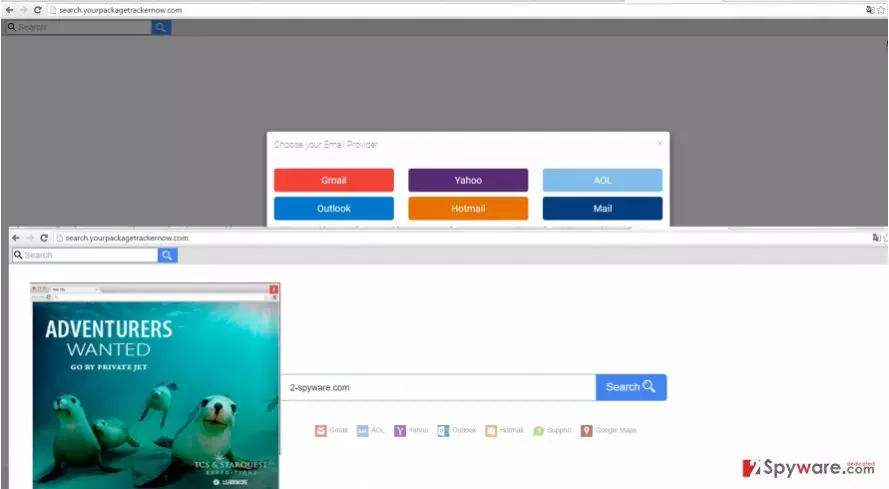
If you decide to put an end to the stay of Your Package Tracker Now hijacker on your computer, you might blow a fuse after finding out to be unable to delete the PUP easily. The cause of this phenomenon lies in “assisting elements.” These minor files are scattered across the registry. They are directly responsible for keeping the hijacker on your computer. Thus, removing the malware solely from the main browser settings might be insufficient. In order to complete search.yourpackagetrackernow.com removal and the elimination of its files, installing a reliable anti-spyware application, for instance, FortectIntego, is a necessity.
The transmission of the PUP
If you didn’t set this hijacker as your main search engine on purpose, you might wonder how it managed to get into your system. The PUP succeeds in doing it quite easily. Like the majority of Internet users, you tend to avoid reading the installation instructions. Thus, the scammers are aware of this flaw and attach the hijacker to the free program. Once you clicked the “Basic” settings, the tiny attachment hid the PUP. Thus, before you even notice search.yourpackagetrackernow.com hijack occurs. If you do not want to experience such negative effects again, change the usual course of actions. After opting for “Advanced” settings, check tall the installation settings for any unwanted tiny attachments.
How should I remove search.yourpackagetrackernow.com?
There are two main solutions how you can eliminate search.yourpackagetrackernow.com virus. The first one includes manual removal. Use the manual elimination instructions for different browser provided by out IT experts. Do not forget that precision and attention are required if you want to finish proper search.yourpackagetrackernow.com removal. If this option is unfavorable by any chance, install malware elimination application. The program will track down all the files of this hijacker within few minutes.
Uninstall from Windows
Uninstall from Windows 10/8:
- Type Control Panel into the Windows search box and open the result.
- Under Programs, select Uninstall a program.


Uninstall from Windows 7/XP:
- Click on Windows Start > Control Panel (Windows XP users should click on Add/Remove Programs).
- In Control Panel, select Programs > Uninstall a program.


Remove the unwanted program:
- In the Programs and Features window, look for any recently installed suspicious entries, select them, and click Uninstall.
- If User Account Control appears, click Yes to confirm, then complete the removal.


Reset Internet Explorer
Remove dangerous add-ons:
- Open Internet Explorer, click on the Gear icon (IE menu) on the top-right corner of the browser
- Pick Manage Add-ons.
- You will see a Manage Add-ons window. Here, look for suspicious plugins. Click on these entries and select Disable.


Change your homepage if it was altered:
- Open IE and click on the Gear icon.
- Select Internet Options.
- In the General tab, delete the Home page address and replace it by your preferred one (for example, Google.com).
- Click Apply and then select OK.


Delete temporary files:
- Press on the Gear icon and select Internet Options.
- Under Browsing history, click Delete...
- Select relevant fields and press Delete.


Reset Internet Explorer:
- Click on Gear icon > Internet options and select Advanced tab.
- Select Reset.
- In the new window, check Delete personal settings and select Reset.


Remove from Mozilla Firefox (FF)
Remove dangerous extensions:
- Open Mozilla Firefox browser and click on the Menu (three horizontal lines at the top-right of the window).
- Select Add-ons.
- In here, select the unwanted extension and click Remove.


Reset the homepage:
- Click three horizontal lines at the top right corner to open the menu.
- Choose Settings.
- Under Home, set your preferred homepage and new tab settings.
Clear cookies and site data:
- Click Menu and pick Settings.
- Go to Privacy & Security section.
- Scroll down to locate Cookies and Site Data.
- Click on Clear Data...
- Select Cookies and Site Data and Temporary cached files and pages, then click Clear.


Reset Mozilla Firefox
If clearing the browser as explained above did not help, reset Mozilla Firefox:
- Open Mozilla Firefox browser and click the Menu.
- Go to Help and then choose Troubleshooting Information.

- Under Give Firefox a tune up section, click on Refresh Firefox...
- Once the pop-up shows up, confirm the action by pressing on Refresh Firefox.



Remove from Google Chrome
Delete malicious extensions from Google Chrome:
- Open Google Chrome, click on the Menu (three vertical dots at the top-right corner) and select More tools > Extensions.
- In the newly opened window, you will see all the installed extensions. Uninstall all suspicious extensions related to the unwanted program by clicking Remove.


Clear cache and web data from Chrome:
- Click on Menu and pick Settings.
- Under Privacy and security, select Clear browsing data.
- Select Browsing history, Cookies and other site data, as well as Cached images and files.
- Click Clear data.


Change your homepage:
- Click menu and choose Settings.
- Look for a suspicious site in the On startup section.
- Click on Open a specific or set of pages and click on three dots to find the Remove option.
Reset Google Chrome:
If the previous methods did not help you, reset Google Chrome to eliminate all the unwanted components:
- Click on Menu and select Settings.
- In the Settings, scroll down and click Advanced.
- Scroll down and locate Reset and clean up section.
- Now click Restore settings to their original defaults.
- Confirm with Reset settings.


Delete from Safari
Remove dangerous extensions:
- Open Safari, click Safari in the menu at the top-left of the screen, and select Preferences.
- Go to the Extensions tab, look for any suspicious entries, and click Uninstall to remove them.


Clear history and website data:
- Click Safari in the menu and pick Clear History.
- Set Clear to all history and confirm with Clear History.


Reset Safari:
- Click Safari in the menu and select Preferences > Advanced.
- Enable Show Develop menu in menu bar.
- From the menu bar, click Develop and select Empty Caches.


Did this guide help?
3 comments
Sally1456
Again annoying browser hijacker? When will they stop?
Aaron
It appeared on my PC out of nowhere!
Jenkins
Now I need to waste time and install the anti-spyware app.