
Skynet ransomware: what it is and how to restore your files
Skynet is Windows ransomware that encrypts your files, adds a random extension such as .br84 and leaves a note called SkynetData.txt. Removing it stops more damage, but only a backup, or a free decryptor if one is ever published, brings the files back.
Facts checked October 13, 2026. Removal steps tested on Windows 11 (26H2) and checked against Microsoft's and the browser makers' current documentation.
Automatic
Get a free scan and check if your PC is infected.
Fortect finds malware, unwanted programs and the Windows damage they leave behind, and repairs it in one pass.
Make sure nothing will rename more files to .br84: an automatic scan checks the PC first.
Do it yourself · free Remove Skynet ransomware yourself 6 steps, about 18 minutes, no software needed.
Start the steps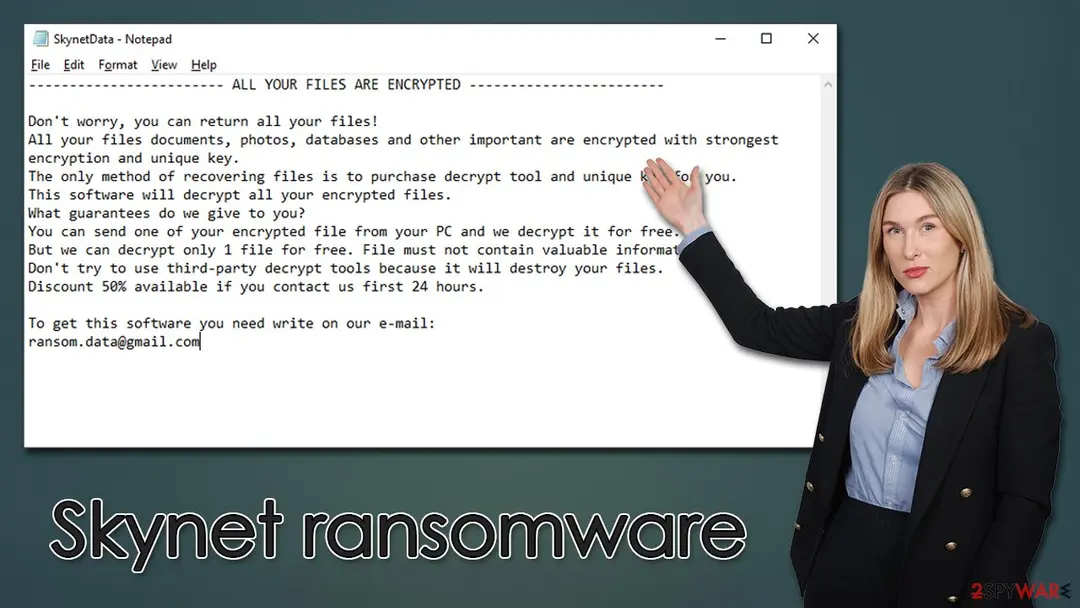
Skynet ransomware: summary
| Type | Ransomware, file encryptor (Chaos builder variant) |
|---|---|
| Risk | High: encrypted files cannot be opened without the attackers' key, and bigger files may be overwritten for good |
| Symptoms | A random extension (for example .br84) on your files, blank file icons, SkynetData.txt opened on the desktop, a red-triangle wallpaper |
| How to get rid of it | Disconnect the PC, run a Microsoft Defender Offline scan, keep copies of the encrypted files, restore from a backup; see the plan |
| Our check | Source check on 6 October 2026 (Trend Micro, Qualys, Broadcom); we did not run the malware and no site is involved |
| First seen | Mid-July 2022 (our report 21 July 2022); later variants listed March 2024 |
| Removal | Scan the PC with security software to find and remove the malware and anything installed with it. Fortect scans Windows for malware and repairs the system files and settings it damaged. Remove it nowTo use the full-featured product, you have to purchase a license for Fortect. The scan is free. |
Show 12 more facts
| Name | Skynet virus (Skynet ransomware) |
|---|---|
| File extension | Random string, e.g. .br84 |
| Ransom note | SkynetData.txt |
| Contact | ransom.data@gmail.com (from the note; do not write to it) |
| Detection names | No Microsoft detection name is known; see the names table |
| Decryptor | No free decryptor is known to us; check No More Ransom (nomoreransom.org) again |
| Distribution | Not documented for this sample; see the entry-points chapter |
| Damage | Encrypted or overwritten files, shadow copies possibly deleted, possible clipboard theft (unconfirmed) |
| Evidence | 0 write-ups by security sites; no sample analysed yet |
| Encrypted files | .br84 |
| Free decryptor | No free decryptor is known (checked 6 October 2026) |
| Facts checked | 6 October 2026 |
Facts checked on 6 October 2026 against Trend Micro's 2021 analysis of the Chaos builder, Qualys's January 2022 analysis, Broadcom's March 2024 bulletin on later Skynet variants and our own July 2022 screenshots of the note and the VirusTotal page. We did not run the malware.
What Skynet ransomware is
Skynet is Windows ransomware: it encrypts your personal files, adds a random extension to each name (our 2022 report showed .br84), leaves a note called SkynetData.txt and asks for Bitcoin. Removing the program does not bring the files back.
Our 2022 report called it a Chaos-family variant. Chaos began in 2021 as a ransomware builder, and the reports we read describe it as closer to a wiper than to real ransomware, because some files it touches are damaged for good.
- Also called
- Skynet virus; a Chaos variant, according to our 2022 report
- First reported
- Mid-July 2022 (our report 21 July 2022); later variants are tracked into 2024
- Extension
- A random string added to each file name, for example
.br84 - Symptoms
- Files with the new extension and a blank icon, a red-triangle wallpaper reading "Skynet Cyberdyne Systems",
SkynetData.txtopened on the desktop - Payment
- Bitcoin, with a 50% discount offered if you write within 24 hours; the address is not printed here
How the Skynet story went
June to August 2021
The Chaos builder, versions 1 to 4
Trend Micro dates version 1 to 9 June 2021. It carried the Ryuk name but shared little with Ryuk, and it overwrote files with random bytes. Version 3 (5 July) added AES and RSA for files under 1 MB, and version 4 (5 August) raised the limit to 2 MB and let users set their own extension, which is why each build has its own, such as
.br84.17 January 2022
Qualys analysis
Qualys wrote that in its tests Chaos encrypted files under 2 MB and overwrote larger ones, so "it is more accurate to call it a wiper".
18 July 2022
SkynetLocker.exe on VirusTotal
Our report's screenshot shows a 723 KB file named
SkynetLocker.exe, scanned on 18 July 2022 and flagged by 50 of 70 security vendors.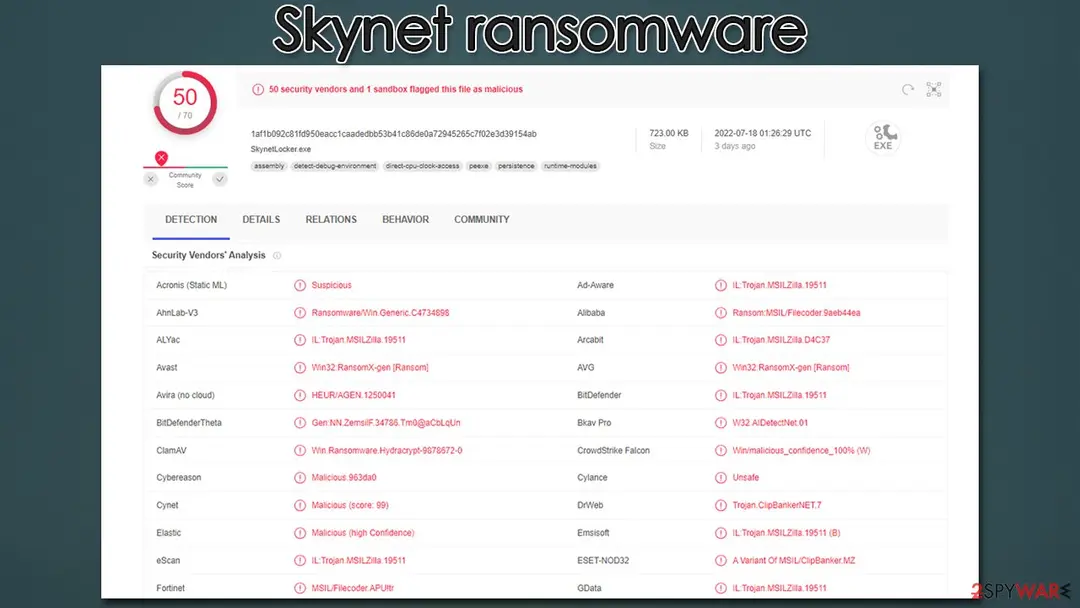
VirusTotal page for SkynetLocker.exein our July 2022 report: 50 of 70 vendors flag it.21 July 2022
Our first report
We published the guide for the version that adds a random extension, leaves
SkynetData.txtand asks for Bitcoin.13 March 2024
Payuranson and Payuransom
Broadcom's bulletin names
.payuransonand.payuransomas the newest Skynet variants, with notesSkynetData.txtorReadMeForDecrypt.txtand contact by e-mail and Telegram.6 October 2026
Our recheck
We rewrote the guide from the published analyses. We did not run the malware.
What we checked and what we did not
There is no website to test and we did not run the Skynet file, so this is a check of sources.
Skynet ransomware · source check · 6 October 2026
- Ransom noteRead from our own July 2022 screenshot of
SkynetData.txt. - Family behaviourTrend Micro (2021), Qualys (2022) and Broadcom (2024) describe the Chaos builder and later Skynet variants.
- DecryptorNone known to us. The No More Ransom list changes, so check it again before you decide.
- This exact sampleIts size limit, wallpaper and shadow copy commands are not confirmed by any source we read.
- Clipboard theftTwo vendors name the file "ClipBanker", which could mean it swaps copied crypto addresses. Nothing we read confirms it.
Treat the encrypted files as lost for now Without the attackers' key the encrypted files cannot be opened, and larger files may be overwritten. This is a check of sources, not a test of the file, so more may be possible than what is listed.
- File extension:
.br84 - Note file:
SkynetData.txt
What antivirus programs call it
Detection names change from week to week, so use them only to confirm that a scan found the right family.
| Who | Name | Where it comes from |
|---|---|---|
| Bitdefender, Ad-Aware, Emsisoft, GData | IL:Trojan.MSILZilla.19511 | VirusTotal page in our July 2022 report |
| Avast, AVG | Win32:RansomX-gen [Ransom] | The same page |
| Fortinet | MSIL/Filecoder.APU!tr | The same page |
| Dr.Web, ESET | Trojan.ClipBankerNET.7, MSIL/ClipBanker.MZ variant | The same page |
| Symantec | Trojan.Gen.MBT, WS.Malware.1 | Broadcom's 2024 bulletin on later variants |
| Microsoft Defender | No name known | We found none in public sources |
Is skynet@mailum.com the Skynet ransomware contact address?
Most likely yes, if you found skynet@mailum.com in a ransom note or in a message about locked files.
Our reading is that it is a contact address of the people behind a Skynet ransomware note. We could not confirm this address in any vendor report we read, so treat that as our reading, not a proven fact.
Do not write to that address and do not send money. Ransomware crews use throwaway mailboxes to start a negotiation, and anything you write tells them that a real person is reading and may pay. A reply also gives them your email address and your wording to use against you later.
The part after the at sign points to Mailum, which we understand to be a privacy focused mail service that anyone can sign up for. Our reading is that the service itself is not the attacker. A criminal simply opened a free mailbox there. We have no proof either way, so do not contact the provider with demands.
If a note on your PC names this address, follow the plan on this page. Disconnect the PC, run a Microsoft Defender Offline scan, keep copies of the encrypted files and restore from a backup. Also check the note for the exact file extension, because a different extension can mean a different ransomware family with a different outcome.
How Skynet ransomware behaves
What it does on the PC, step by step
The steps come from published analyses of the Chaos builder that Skynet is said to be built on (Trend Micro, 2021; Qualys, 2022). We did not run the Skynet file, so each step is what the Chaos code does, not something we saw on a Skynet infection.
- 1
It copies itself and starts the copy
Qualys saw a Chaos sample drop a copy named
svchost.exein the user'sAppData\Roamingfolder. A realsvchost.exelives inC:\Windows\System32, so one inRoamingis a warning sign. - 2
It searches every drive for known file types
It touches only files whose extension is on a built-in list. Trend Micro's list for version 1 includes
.docx,.xlsx,.jpg,.pdf,.mp4,.sqland.zip. - 3
Small files are encrypted, bigger ones are damaged
Qualys saw files under about 2 MB encrypted with AES, a new key for each file, locked with RSA. Files over about 2 MB were filled with random bytes, which Qualys said "makes these files completely useless". This is not confirmed for the Skynet sample.
- 4
It leaves a note and changes the wallpaper
A note is dropped in the encrypted folders. Our 2022 report named it
SkynetData.txt. - 5
It tries to remove your way back
The Chaos code deletes shadow copies, clears the backup catalog and turns off Windows recovery mode (Qualys). Broadcom's bulletin of 13 March 2024 says the latest Skynet variants delete Volume Shadow Copies. For the 2022 sample this is not confirmed.
What the note says and what it means
The note offers one free test file, a 50% discount for a quick reply and a warning against other tools. We checked each claim against what the Chaos analyses show.
| The note says | What it means |
|---|---|
| "Encrypted with strongest encryption and unique key" | Probably true for small files (AES, per Qualys). Bigger files may have been overwritten, so even a paid key may not bring them back. |
| "We decrypt one file for free" | A test file proves nothing about the rest, and a small file is the easy case. |
| "Discount 50% if you contact us in the first 24 hours" | A pressure tactic that stops you from checking backups first. |
| "Don't use third-party decrypt tools, it will destroy your files" | A scare line. A wrong tool usually just fails, but work on copies anyway. |
| "Write to our e-mail" | The only contact is a free mailbox with nobody accountable behind it. |
How it reaches PCs
No source we read documents how this sample reached its victims.
Trend Micro wrote in 2021 that the Chaos builder was offered for testing on an underground forum, so each attacker who uses it picks their own route. These are the usual ones.
- Medium
E-mail attachments and links
CISA's StopRansomware guidance lists phishing as a common way in: an unexpected invoice or delivery notice with an attachment.
- Medium
Cracks and pirated downloads
Qualys's advice on Chaos warns against cracked software and peer-to-peer or torrent downloads.
- Medium
Exposed remote desktop
Qualys and CISA both name Remote Desktop (TCP port 3389) open to the internet with a weak password.
Similar names and lookalikes
Several names get mixed up with this one, and the wrong instructions can waste days.
| Name | How it relates | What to do |
|---|---|---|
| Chaos, Ritzer, BlackToxic, Odaku | The builder and earlier family members named in our 2022 report | The Chaos analyses here apply, but a given sample may differ |
| Payuranson, Payuransom | The "latest Skynet" variants in Broadcom's March 2024 bulletin, with extensions .payuranson and .payuransom | Same advice; expect shadow copies to be gone |
| Skynet botnet (2012) | A Tor-based botnet from a modified ZeuS bot and a bitcoin miner, described by Rapid7 in December 2012 | Unrelated: this page is about the ransomware only |
Was anything stolen?
Nothing we read says Skynet copies files out, but two vendors name the 2022 file "ClipBanker", so be careful with anything you copy and paste until the PC is clean.
- Medium
Crypto addresses may be swapped
A clipboard banker replaces a wallet address you copy with the attacker's. Whether this sample does it is not confirmed. Check the first and last characters of any address you paste, on a clean computer.
- Low
No leak site
The note only asks for payment for the files, and the sources we read mention no leak site for this family.
- Medium
Passwords
Change your e-mail, banking and other main passwords from a different, clean device.
What to do in the first hour
Cut the PC off from the network first. Our 2022 report said the first job is to make sure the virus cannot talk to a remote command-and-control server, which attackers use to send commands and, sometimes, further payloads.
- 1
Unplug the cable or turn off Wi-Fi
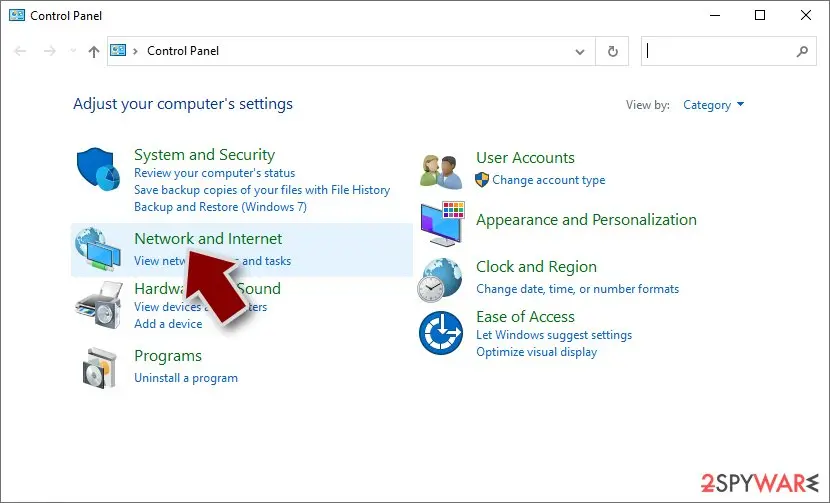
That is the fastest way. Or open the Start menu, type Control Panel and press Enter.
- 2
Go to Network and Internet
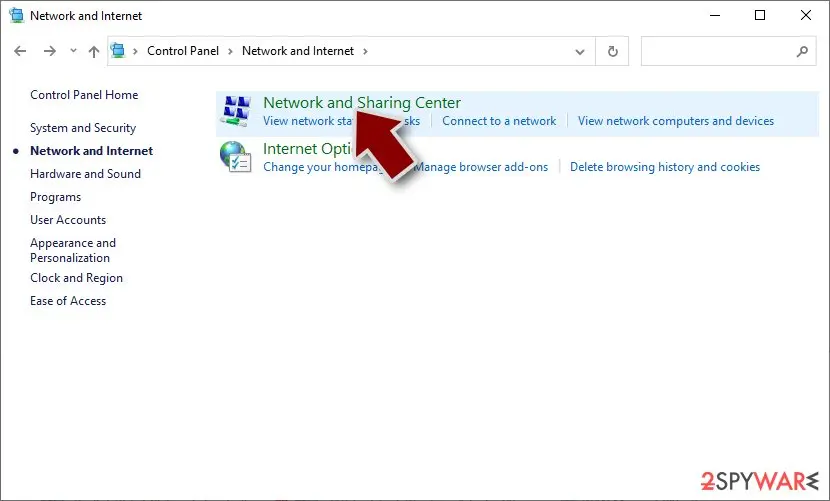
In Control Panel (Category view) click Network and Internet, then Network and Sharing Center.
- 3
Open Change adapter settings and disable the connection
It is in the left column (shortcut: Windows + R, type
ncpa.cpl). Right-click your connection, such as Ethernet or Wi-Fi, choose Disable and confirm with Yes. - 4
Photograph the note and leave the files alone
Keep
SkynetData.txtand do not rename or delete anything.
The Skynet ransomware note
------------------------ ALL YOUR FILES ARE ENCRYPTED ------------------------
Don't worry, you can return all your files!
All your files documents, photos, databases and other important are encrypted with strongest encryption and unique key.
The only method of recovering files is to purchase decrypt tool and unique key for you.
This software will decrypt all your encrypted files.
What guarantees do we give to you?
You can send one of your encrypted file from your PC and we decrypt it for free.
But we can decrypt only 1 file for free. File must not contain valuable information
Don't try to use third-party decrypt tools because it will destroy your files.
Discount 50% available if you contact us first 24 hours.
To get this software you need write on our e-mail:
ransom.data@gmail.com
Can Skynet ransomware files be decrypted?
Can the encrypted files be restored?
Not by removing the virus and, as far as we know, not with a free tool: the attackers hold the key, and larger files may have been overwritten. That is why backups matter more than anything else here.
| What you see | What it probably is | What to try |
|---|---|---|
| A small file (under about 2 MB) with the random extension | Encrypted with AES, the key locked with RSA | Keep a copy and check No More Ransom now and then for a decryptor |
| A big file (video, database) with the extension | Possibly overwritten with random bytes, per Qualys | Do not expect to open it; look for an older copy |
| A file with no new extension | Not on the program's list, or not reached | Open it; if it opens, copy it away |
| No file with that name | Deleted or never saved | Backups, Previous Versions, a recovery program |
- 1
Copy the encrypted files first
Put them on a USB drive or a second disk. A decryptor may appear years later, and you will want the originals then.
- 2
Look for a free decryptor
Upload the note and one encrypted file to Crypto Sheriff on No More Ransom (nomoreransom.org). The Emsisoft and Kaspersky decryptor pages, which our 2022 report linked, are also worth a look. Ransomware sometimes has bugs that researchers turn into a free tool, but it might never happen, or take years.
- 3
Test any tool on copies
A tool for another family will not work, and a tool from a stranger can be malware.
Should you pay the ransom?
No. Our 2022 report said ransomware makers do not care whether you get the files back, and the Chaos analyses make the point stronger: some files may have been overwritten, so even a key could not bring them back. The No More Ransom project also advises against paying.
- High
A key may open only some files
Qualys saw Chaos overwrite files over about 2 MB with random bytes. Nothing brings those back.
- High
You deal with an anonymous mailbox
There is no company, no refund and no way to complain.
- Medium
You mark yourself as a payer
The 50% discount is meant to rush you, and people who pay are often targeted again.
How to remove Skynet ransomware
Tools you'll need
All of these are free except where noted. Download them on a clean device if the infected PC is offline.
- A USB stick: to keep the ransom note, two or three encrypted files and screenshots off the infected PC.
- Microsoft Defender Offline: built into Windows 11 and Windows 10; scans before Windows starts, so running malware cannot hide.
- Microsoft Safety Scanner: a second, portable scanner with current signatures; each download works for 10 days.
- ID Ransomware: identifies the family from the note and one encrypted file and says whether a decryptor exists.
- No More Ransom: the free decryptors from police and security companies; check it again every few months.
- Fortect (optional): scans Windows for malware and repairs the system files and settings it damaged. The free scan is in the box above.
How to remove Skynet ransomware and get your files back
Work in this order.
Disconnecting comes first, removal comes before any restore, and nothing here asks you to contact the attackers.
Step 1: Disconnect the PC and unplug backup drives
Unplug the network cable or turn off Wi-Fi, and disconnect USB drives, external disks and network shares, so Skynet ransomware cannot reach more files. Pause OneDrive, Google Drive or Dropbox sync, because synced folders upload the encrypted copies over the good ones.
Leave the PC on but offline while you read the next steps, since a restart can let the ransomware run again. This applies to Windows 11 and Windows 10 alike.
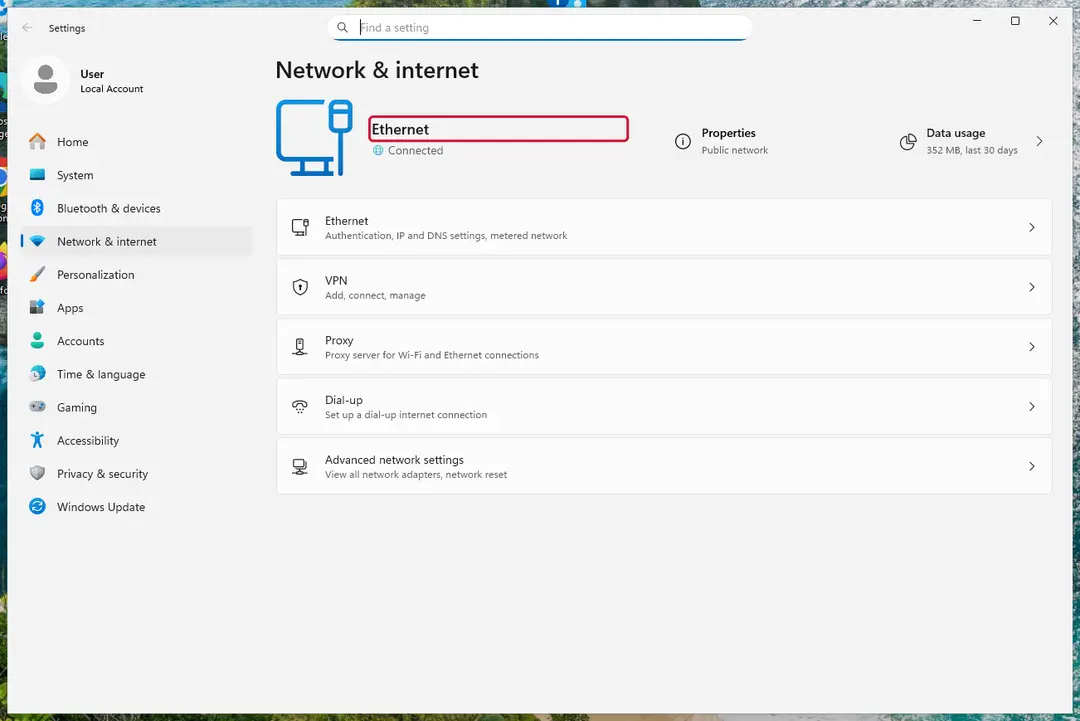
Windows 11: turn off Wi-Fi to take the PC offline. Full procedure with screenshots: Ransomware: first steps, finding a decryptor and recovering files
Step 2: Save the ransom note and confirm the family
Your files now end in
.br84and the instructions are inSkynetData.txt. Save both to a USB stick, a copy of the note and two small encrypted files, before anything else.On another device, check them with ID Ransomware or Crypto Sheriff: the family name decides which decryptor, if any, can help. Keep the note's ID and contact line for your report.
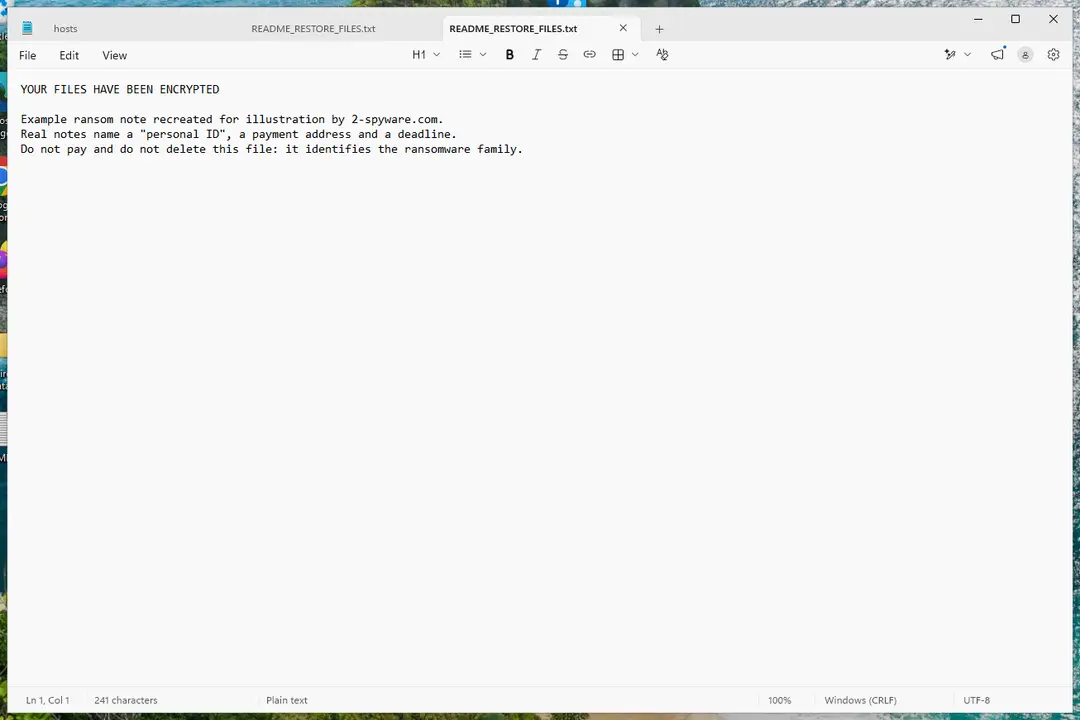
Windows 11: the ransom note and encrypted files to copy for identification. Full procedure with screenshots: Ransomware: first steps, finding a decryptor and recovering files
Step 3: Check for a free decryptor
Our last check found that for Skynet ransomware, no free decryptor is known (checked 6 October 2026). Look again yourself in the No More Ransom list and the free decryptor pages of Emsisoft, Avast and Kaspersky, which add new families every year.
A decryptor needs the ransomware gone first, or it encrypts the files again. Keep at least one copy of the encrypted files on an external drive, even if no tool works yet.
Full procedure with screenshots: Ransomware: first steps, finding a decryptor and recovering files
Step 4: Remove the ransomware before you restore or decrypt
Removing Skynet ransomware does not bring the files back, but it has to come first. Start with Defender's Full scan, then the offline scan from the same Scan options page, which checks the disk before Windows loads.
If the scan cannot start, use Safe Mode with Networking. Delete the ransom notes only after you have saved a copy, because removal tools sometimes leave them behind on Windows 11 and Windows 10.
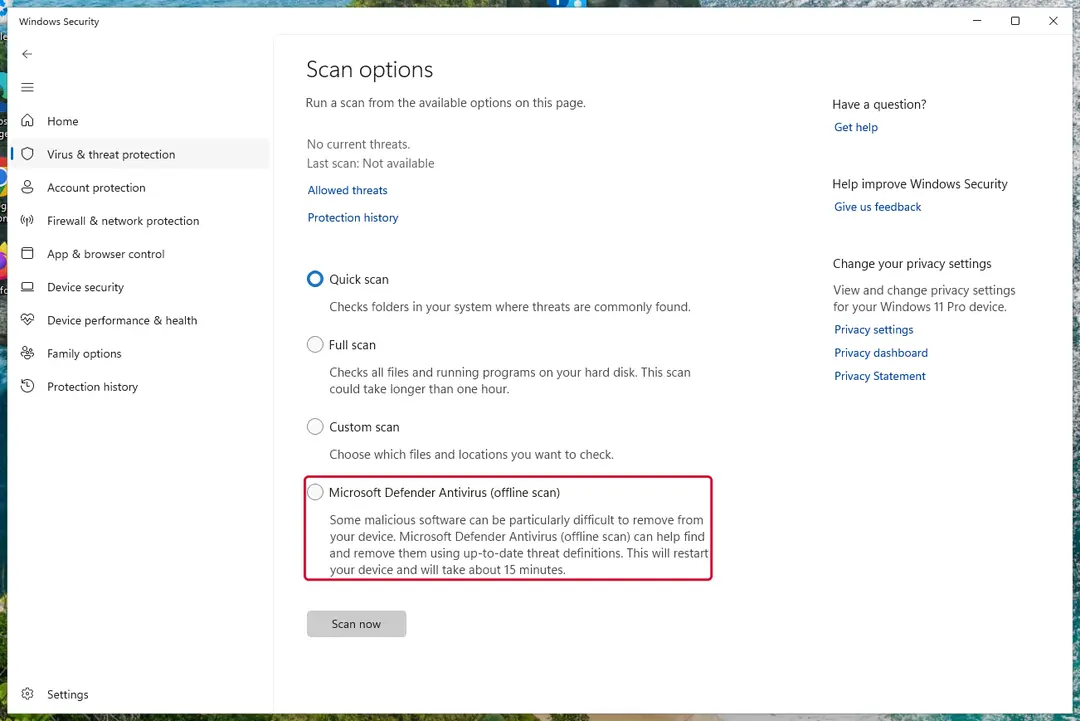
Windows 11: Windows Security > Virus & threat protection > Scan options. Full procedure with screenshots: Run a Microsoft Defender Offline scan
Step 5: Look for shadow copies of the files
Windows keeps shadow copies for restore points and backups, and some ransomware fails to delete them.
vssadmin list shadowsin an administrator Command Prompt tells you at once whether any exist.If they do, right-click the folder that held your files, open Properties > Previous Versions, select a version from before the attack, and click Open to check it before you Restore or copy the files out. Windows 11 and Windows 10 both have the tab.
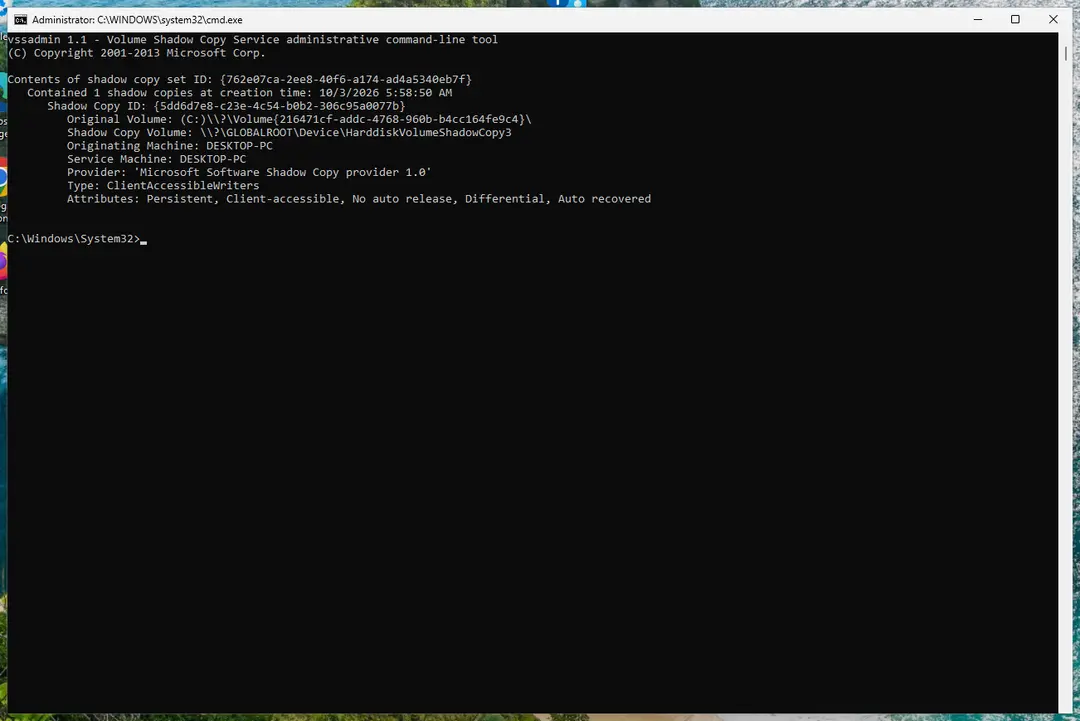
Windows 11: vssadmin list shadows shows whether shadow copies exist. Full procedure with screenshots: Ransomware: first steps, finding a decryptor and recovering files
Step 6: Restore the files from a backup or recover deleted originals
A backup made before the attack is the surest way back. Connect it only once the PC is clean, then restore from File History, Windows Backup, OneDrive's Restore your OneDrive or your own external copies.
Without a backup, try file recovery: the originals that Skynet ransomware deleted may still be on the disk until something overwrites them. Install nothing new on the drive you want to recover from on the Windows 11 or Windows 10 PC.
Full procedure with screenshots: Recover deleted files (Recycle Bin, backups, OneDrive) On uGetFix
Scan the PC once it is offline
Run a full scan so that every malicious part, and any second program that was downloaded, is found.
Encryption stays after the program is gone, so scan first and restore later, or the restored files may be locked again.
- 1
Run a Microsoft Defender Offline scan
Open Windows Security > Virus & threat protection > Scan options, choose Microsoft Defender Antivirus (offline scan) and click Scan now. The PC restarts and scans before Windows loads (Microsoft Learn describes this scan).
- 2
Check where the malware keeps itself
Look in
%AppData%\Roamingfor a file namedsvchost.exe, and in Task Manager > Startup apps for things you did not install. Delete nothing before the scan has finished and your encrypted files are copied away. - 3
Reconnect only when the scan is clean
Enable the network adapter again, run Windows Update and change your passwords from another device.
Report it and recover your files
Report it
Report the attack even if you do not expect the files back: insurers and banks ask for the report number, and police use the contacts in the note to link cases.
- United States
- FBI IC3 · FTC ReportFraud
- United Kingdom
- Report Fraud (formerly Action Fraud) · NCSC
- Australia
- ReportCyber (ASD)
- EU countries
- Europol: national reporting sites
Give the victim ID, the note and the date the files were encrypted. A business that holds personal data may also have to notify its data protection authority, in the EU within 72 hours.
Other ways to get files back
Check these in order, before you save anything new to the disk.
We have not tested them on a Skynet infection, and each may find nothing.
- 1
Your own backups
A copy on an external drive, a NAS or cloud storage such as OneDrive, iCloud or Dropbox is the only secure way back. Connect it only after the PC is clean.
- 2
Previous Versions
Right-click a folder, choose Properties > Previous Versions (Windows 11: Show more options first). Expect it to be empty, because the Chaos code deletes shadow copies.
- 3
Shadow copies
Run
vssadmin list shadowsin an administrator Command Prompt (a Microsoft-documented command). If nothing is listed, the copies were deleted. - 4
Data recovery software
A deep scan can sometimes find deleted originals. Install the program on a different disk, scan the affected disk, pick what you need and save it to another drive. Files overwritten in place cannot be found this way.
- 5
Windows repair, if the system misbehaves
Ransomware can leave damaged system files, with crashes and slowdowns. In an administrator Command Prompt run
sfc /scannow; if it cannot fix something, runDISM /Online /Cleanup-Image /RestoreHealthand thensfc /scannowagain. Reinstalling Windows is the safe choice if the PC still acts strangely.
Back up with the 3-2-1 rule
Our 2022 report ended with the advice to prepare backups of your personal files.
The 3-2-1 rule, which CISA's ransomware guidance recommends, turns it into a plan.
| Number | Rule | Example |
|---|---|---|
| 3 | Three copies of every important file | The working file plus two backups |
| 2 | Two different kinds of storage | Your disk and a USB drive |
| 1 | One copy away from the PC | An unplugged drive, or cloud storage with version history |
Do
- Unplug a USB drive after each backup: a connected drive can be encrypted too
- Open a file from the backup now and then to check it works
Don't
- Do not leave the only backup plugged in all the time
How to prevent Skynet ransomware and the next attack
Habits that cover how Chaos-built ransomware and most other ransomware get in.
Do
- Keep Windows, your browser and Microsoft Defender updated
- Close Remote Desktop (TCP port 3389) to the internet, or protect it with a strong password and two-step sign-in
- Use a standard account, not an administrator account, day to day
- Turn on file extensions in File Explorer (View > Show > File name extensions) to spot a fake
.txt.exe
Don't
- Do not install cracks, keygens or peer-to-peer downloads
- Do not open attachments you did not expect
Questions about Skynet ransomware
How do I open .br84 files?
You cannot open them: .br84 is the example extension our 2022 report gave for files that Skynet encrypted, and each build adds its own random one. The content is locked with a key that only the attackers hold.
Do not rename the files, and keep copies of them. Files without the new extension were not touched, and those you can open. The only reliable way back is a backup made before the attack, restored after the PC is clean.
Is there a decryptor for Skynet ransomware?
None that we know of. Our 2022 report pointed to the free decryptor lists of No More Ransom, Emsisoft and Kaspersky, and none of them is a sure answer for this family.
Ransomware sometimes has bugs that researchers turn into a free tool, but it might never happen or take years, so keep copies of the encrypted files and the note. Qualys also saw the Chaos code overwrite files over about 2 MB with random bytes, which nobody can recover, with or without a key.
Should I pay the Skynet ransom?
No. The note asks for Bitcoin and offers a 50% discount if you write within 24 hours, which is a pressure tactic. Our 2022 report said ransomware makers do not care whether you get your files back, and Chaos analyses show some files may be overwritten, so even a key may not help.
The only contact is a free mailbox, so there is no refund or complaint route. Do not write to it. Report the attack to the police and use a backup.
Do paid decryption services or data recovery companies work?
Only for deleted files, not for encrypted ones. A company cannot guess a key that only the attackers hold, so be careful with any service that promises to decrypt Skynet files for a fee.
Some of them just pay the attackers and add a margin. A recovery program or company can sometimes find deleted originals on the disk, but files overwritten in place by the Chaos code are gone. Try your backups and Previous Versions first.
How did Skynet get on my PC?
No source we read documents it for this sample. Trend Micro wrote in 2021 that the Chaos builder was being tested on an underground forum, so each attacker who uses it picks their own route.
CISA lists phishing e-mails, exposed Remote Desktop and unpatched software as common ways in, and Qualys warns against cracks and torrent downloads. Think back to what you opened or installed shortly before the files changed.
Was my data stolen?
We found no source saying Skynet copies files out, and no leak site is mentioned for it. Two vendors on the VirusTotal page name the 2022 file "ClipBanker", which can mean it swaps copied cryptocurrency addresses, but this is not confirmed.
As a precaution, change your main passwords from a clean device and check the first and last characters of any wallet address you paste.
Is Skynet the same as Chaos or the Skynet botnet?
It is not the same as the botnet. The 2012 Skynet botnet that Rapid7 described was a Tor-based network built from a modified ZeuS bot, and it shares only the name.
Our 2022 report said the ransomware stems from Chaos, a builder first seen in June 2021. Trend Micro found Chaos shares little with Ryuk, so our statement that it derives from Ryuk was wrong. Later variants, .payuranson and .payuransom, are also called Skynet (Broadcom, March 2024).
How do I remove Skynet ransomware?
Disconnect the PC from the network, then run a Microsoft Defender Offline scan from Windows Security under Virus & threat protection, Scan options. Do not delete the encrypted files.
Removing the program stops new files from being locked but does not unlock the old ones, because the key is held by the attackers. Copy the encrypted files to a USB drive, clean the PC, and restore from a backup if you have one.
Will Fortect remove Skynet ransomware?
Fortect scans Windows for malware and unwanted programs and repairs the system files and settings they change, and its free scan shows what it finds on your PC before you decide anything.
For Skynet ransomware, follow the plan above as well: the browser steps take back permissions and settings that no scanner treats as a threat, and uninstalling the program that brought it removes the source.
Run Microsoft Defender's full scan and, if anything was found, its offline scan as a second opinion. If the symptoms are gone after the plan and both scans are clean, there is nothing more to do.
Sources
- Trend Micro: Chaos Ransomware, A Proof of Concept With Potentially Dangerous Applications (read October 6, 2026)
- Qualys: The Chaos Ransomware Can Be Ravaging (read October 6, 2026)
- Broadcom Symantec: Payuranson/Payuransom, latest Skynet ransomware variants (read October 6, 2026)
- Rapid7: Skynet, a Tor-powered botnet straight from Reddit (read October 6, 2026)
- No More Ransom (read October 6, 2026)
- CISA: StopRansomware (read October 6, 2026)
- Microsoft Learn: Microsoft Defender Offline (read October 6, 2026)
- Microsoft Learn: vssadmin list shadows (read October 6, 2026)
- Microsoft Support: Use the System File Checker tool (read October 6, 2026)