

Reasons to avoid Timesearchnow.com search:
Timesearchnow.com virus is one of those unpleasant extra programs that mess up your regular browsing sessions[1] without even asking for user’s permission in a direct way. Therefore, it causes dissatisfaction and forces the victim to start looking for Timesearchnow.com removal methods. This computer infection can be defined as a browser hijacker, browser redirect virus or a potentially unwanted program (PUP). The thing is, Time Search Now is a suspicious search engine that might show up on your browser uninvited and seriously mess up your day. If you think that the Yahoo search engine this site uses to display the search results is a sign of reliability, you might just have to change your opinion. Looking for some relevant information on this search service you will soon make you realize that its creators had no other intentions than to make your browser into a convenient platform for affiliate advertising[2].
To make matters worse, the program will try to maintain its stance on the system with the help of the so-called “helper objects”[3] which might be installed on the computer during Timesearchnow.com hijack. Don’t get tricked! These helper objects may seem useful at first: they may provide quick search links, price comparison tools, and other additional browser functions, but in reality work on behalf of the hijacker. In case you notice some new applications on your computer, investigate them thoroughly. No legitimate applications appear on the system without explicitly asking the device owner’s permission. Thus, you most probably will have to delete them from your computer if your computer’s health is important to you. To perform a more precise Timesearchnow.com removal, we suggest scanning the system with FortectIntego anti-malware which, in addition to the virus elimination will also take care of other potentially unwanted programs that might exist on your computer.
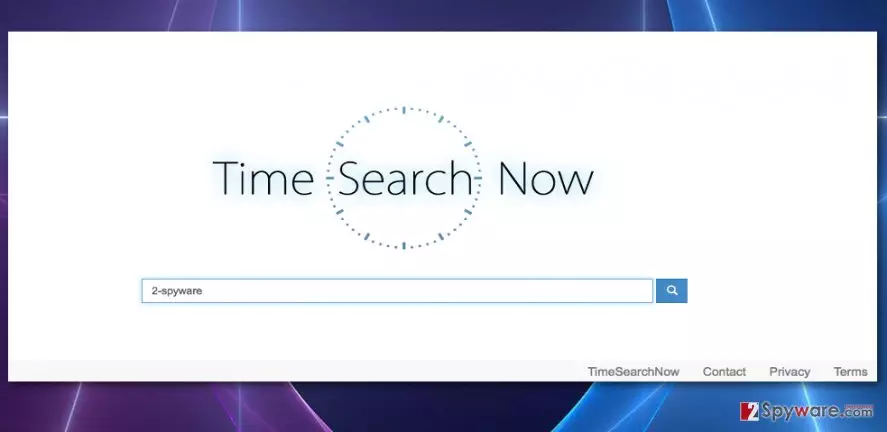
Looking from the technical point of view, Timesearchnow.com is dangerous for the Windows and Mac OS X users alike. On the site, the app creators provide instructions on how to remove Timesearchnow.com redirect virus from Mac, but they are actually useless, whereas the instructions for Windows are not provided at all. That does not mean that you will not see Timesearchnow.com on your Internet Explorer or Edge one day, though. Besides, though it has not been officially confirmed, Windows users have reported a couple of such incidents already. Nevertheless, it does not really matter what operating system does this virus infect because it works on them identically: it may track your browsing patterns, display ads generated according to your preferences or redirect you to affiliate websites against your will. Needless to say, such shady activity is really unsafe, so we suggest you to remove Timesearchnow.com from your PC before it accidentally drops you off on some infectious domain that installs malicious software on your PC. Remember – third party websites have different intentions, and this browser hijacker is not reliable for them. It just seeks to generate pay-per-click revenue[4], but hardly cares about its users’ well-being.
Methods of dissemination
Browser hijackers are generally rather simple infections. Thus, they do not employ sophisticated techniques to get into target computers either. Though they may be very deceptive and try to trick you into downloading them on your computer unknowingly. This can be done via corrupt pop-ups pretending to be software updates or the technique called software “bundling[5]” which allows potentially unwanted programs to be distributed alongside legitimate freeware and shareware applications. Both of these distribution strategies can be curbed using your attention skills. Don’t make your way through the web blindly clicking on random ads or downloading unknown software. Spare some time to investigate whether the content you are interacting with is safe and whether it is really worth installing on your computer.
Ways to remove Timesearchnow.com
The first encounter with a browser hijacker virus may be frightening: you don’t know where to begin and are not sure whether your course of actions will actually help remove the virus. That is why we have prepared Timesearchnow.com removal instructions below. But the manual elimination is just one of the strategies you can go for. In fact, the automatic approach is a preferable option and is highly suggested by the experts. The antivirus software will remove Timesearchnow.com without leaving any unwanted, infectious or junk components on your PC, so you will be able to stay certain that the virus will not bounce back to your browser after you reboot your computer.
Uninstall from Windows
Uninstall from Windows 10/8:
- Type Control Panel into the Windows search box and open the result.
- Under Programs, select Uninstall a program.


Uninstall from Windows 7/XP:
- Click on Windows Start > Control Panel (Windows XP users should click on Add/Remove Programs).
- In Control Panel, select Programs > Uninstall a program.


Remove the unwanted program:
- In the Programs and Features window, look for any recently installed suspicious entries, select them, and click Uninstall.
- If User Account Control appears, click Yes to confirm, then complete the removal.


Delete from macOS
Remove the unwanted application:
- From the menu bar, select Go > Applications.
- In the Applications folder, look for any suspicious entries, then drag them to Trash (or right-click and pick Move to Trash).


Delete leftover files and folders:
- Select Go > Go to Folder.
- Enter /Library/Application Support and remove any suspicious folders related to the unwanted program.
- Repeat the same check in the /Library/LaunchAgents and /Library/LaunchDaemons folders, deleting any suspicious entries.

- Finally, empty the Trash to permanently remove the leftovers.

Reset Internet Explorer
Remove dangerous add-ons:
- Open Internet Explorer, click on the Gear icon (IE menu) on the top-right corner of the browser
- Pick Manage Add-ons.
- You will see a Manage Add-ons window. Here, look for suspicious plugins. Click on these entries and select Disable.


Change your homepage if it was altered:
- Open IE and click on the Gear icon.
- Select Internet Options.
- In the General tab, delete the Home page address and replace it by your preferred one (for example, Google.com).
- Click Apply and then select OK.


Delete temporary files:
- Press on the Gear icon and select Internet Options.
- Under Browsing history, click Delete...
- Select relevant fields and press Delete.


Reset Internet Explorer:
- Click on Gear icon > Internet options and select Advanced tab.
- Select Reset.
- In the new window, check Delete personal settings and select Reset.


Remove from Microsoft Edge
Delete unwanted extensions from MS Edge:
- Select Menu (three horizontal dots at the top-right of the browser window) and pick Extensions.
- From the list, pick the extension and click on the Gear icon.
- Click Remove.


Clear cookies and other browser data:
- Click on the Menu (three horizontal dots at the top-right of the browser window) and select Settings > Privacy, search, and services..
- Under Clear browsing data, pick Choose what to clear.
- Select Cookies and other site data and Cached images and files. (apart from passwords, although you might want to include Media licenses as well, if applicable) and click on Clear.


Restore new tab and homepage settings:
- Click the menu icon and choose Settings.
- Then find On startup section.
- Click Remove next to any suspicious startup page.
Reset MS Edge if the above steps did not work:
- Press on Ctrl + Shift + Esc to open Task Manager.
- Click on More details arrow at the bottom of the window.
- Select Details tab.
- Now scroll down and locate every entry with Microsoft Edge name in it. Right-click on each of them and select End Task to stop MS Edge from running.


Instructions for Chromium-based Edge
Delete extensions from MS Edge (Chromium):
- Open Edge and click select Settings > Extensions.
- Delete unwanted extensions by clicking Remove.


Clear cache and site data:
- Click on Menu and go to Settings.
- Select Privacy, search and services.
- Under Clear browsing data, pick Choose what to clear.
- Under Time range, pick All time.
- Select Clear now.


Reset Chromium-based MS Edge:
- Click on Menu and select Settings.
- On the left side, pick Reset settings.
- Select Restore settings to their default values.
- Confirm with Reset.
- This will disable extensions and reset startup pages but will not delete bookmarks, saved passwords, or browsing history.


Remove from Mozilla Firefox (FF)
Remove dangerous extensions:
- Open Mozilla Firefox browser and click on the Menu (three horizontal lines at the top-right of the window).
- Select Add-ons.
- In here, select the unwanted extension and click Remove.


Reset the homepage:
- Click three horizontal lines at the top right corner to open the menu.
- Choose Settings.
- Under Home, set your preferred homepage and new tab settings.
Clear cookies and site data:
- Click Menu and pick Settings.
- Go to Privacy & Security section.
- Scroll down to locate Cookies and Site Data.
- Click on Clear Data...
- Select Cookies and Site Data and Temporary cached files and pages, then click Clear.


Reset Mozilla Firefox
If clearing the browser as explained above did not help, reset Mozilla Firefox:
- Open Mozilla Firefox browser and click the Menu.
- Go to Help and then choose Troubleshooting Information.

- Under Give Firefox a tune up section, click on Refresh Firefox...
- Once the pop-up shows up, confirm the action by pressing on Refresh Firefox.



Remove from Google Chrome
Delete malicious extensions from Google Chrome:
- Open Google Chrome, click on the Menu (three vertical dots at the top-right corner) and select More tools > Extensions.
- In the newly opened window, you will see all the installed extensions. Uninstall all suspicious extensions related to the unwanted program by clicking Remove.


Clear cache and web data from Chrome:
- Click on Menu and pick Settings.
- Under Privacy and security, select Clear browsing data.
- Select Browsing history, Cookies and other site data, as well as Cached images and files.
- Click Clear data.


Change your homepage:
- Click menu and choose Settings.
- Look for a suspicious site in the On startup section.
- Click on Open a specific or set of pages and click on three dots to find the Remove option.
Reset Google Chrome:
If the previous methods did not help you, reset Google Chrome to eliminate all the unwanted components:
- Click on Menu and select Settings.
- In the Settings, scroll down and click Advanced.
- Scroll down and locate Reset and clean up section.
- Now click Restore settings to their original defaults.
- Confirm with Reset settings.


Delete from Safari
Remove dangerous extensions:
- Open Safari, click Safari in the menu at the top-left of the screen, and select Preferences.
- Go to the Extensions tab, look for any suspicious entries, and click Uninstall to remove them.


Clear history and website data:
- Click Safari in the menu and pick Clear History.
- Set Clear to all history and confirm with Clear History.


Reset Safari:
- Click Safari in the menu and select Preferences > Advanced.
- Enable Show Develop menu in menu bar.
- From the menu bar, click Develop and select Empty Caches.


Did this guide help?
Be the first to comment