
W32.aidetectvm.malware: what it is and how to remove it
W32.aidetectvm.malware is the infection that makes your computer running slow and crashing more than usual. All the frequent shutdowns and unwanted pop-ups, errors, even system alerts should indicate that there is something wrong.
Facts checked October 7, 2026. Removal steps tested on Windows 11 (26H2) and checked against Microsoft's and the browser makers' current documentation. Sections marked as our earlier report are the original text: they describe the threat as it was then and have not been reviewed since. The 2026 status, the removal steps and the questions are current.
Automatic
Get a free scan and check if your PC is infected.
Fortect finds malware, unwanted programs and the Windows damage they leave behind, and repairs it in one pass.
Programs like W32.aidetectvm.malware usually arrive in groups; a free scan lists the companions that are easy to miss.
Do it yourself · free Remove W32.aidetectvm.malware yourself 5 steps, about 15 minutes, no software needed.
Start the steps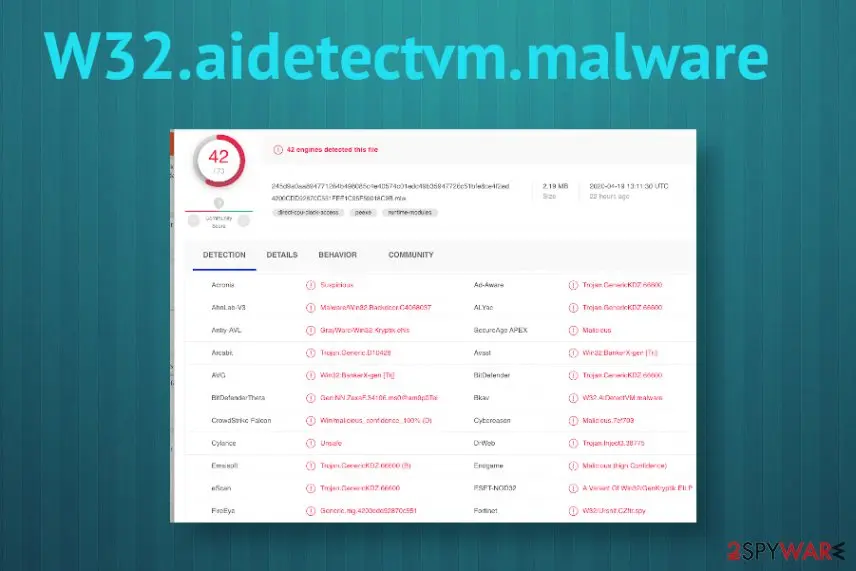
W32.aidetectvm.malware: summary
| Distribution | Many malicious websites can trigger downloads of these intruders and files attached to spam emails can drop the code of the malware. There are many ways to deliver these kinds of files because malware can run in the background without causing any symptoms after a visit on the shady domain or insecure freeware download |
|---|---|
| Name | W32.aidetectvm.malware |
| Type | Malware/ AV detection result |
| Possible outcome | This detection can be falsely positive and lead to anything besides compromised files or programs. However, the detection indicates trojans or different type of computer virus that may modify system files or open backdoors for remote attackers, install additional threats like ransomware and so on |
| Danger | This program can be designed to drop additional script or malware directly on the machine and furthermore infect the system. malware can open backdoors to remote attackers that directly control your machine and uses the device as a tool for different campaigns |
| Detection names | No Microsoft detection name is known |
| Removal | Scan the PC with security software to find and remove the malware and anything installed with it. Fortect scans Windows for malware and repairs the system files and settings it damaged. Remove it nowTo use the full-featured product, you have to purchase a license for Fortect. The scan is free. |
Show 5 more facts
| Damage | Not recorded in the old report |
|---|---|
| Symptoms | An unknown program in Installed apps |
| Evidence | 4 write-ups by security sites; details still limited |
| First seen | 21 April 2020 |
| Facts checked | 7 October 2026 |
What W32.aidetectvm.malware does on an infected PC
From our report of Apr 2020 · not reviewed since
Stay away from suspicious materials to avoid malware infections
Most of the threats that are based on stealthy infiltration and silent background processes get distributed with the help of malicious files.
However, malware-laced file distribution techniques also can differ. Various web pages and sites that are harmful replicas of legitimate pages and sites designed exceptionally for malware distribution can drop files with malicious scripts on your device and lead to serious issues immediately after that.
Also, stay away from spam emails and notifications received from unknown sources, senders that resemble companies or services that you don't use or rely on. Such emails include links to those malicious pages or direct files like documents or executables that rigger the launch of a virus script. Always scan the attachment with the malware protection tool before loading it on the machine.
You should also pay attention to the content you visit willingly, sites that you rely on for software downloads, and other purposes. Read the license agreements and privacy statements of sites that become the source of your applications. downloading anything from operating services and untrustworthy sites can lead to serious problems with the machine and even result in identity theft or money loss.
From our report of Apr 2020 · not reviewed since
W32.aidetectvm.malware infection need to get terminated using proper AV tools
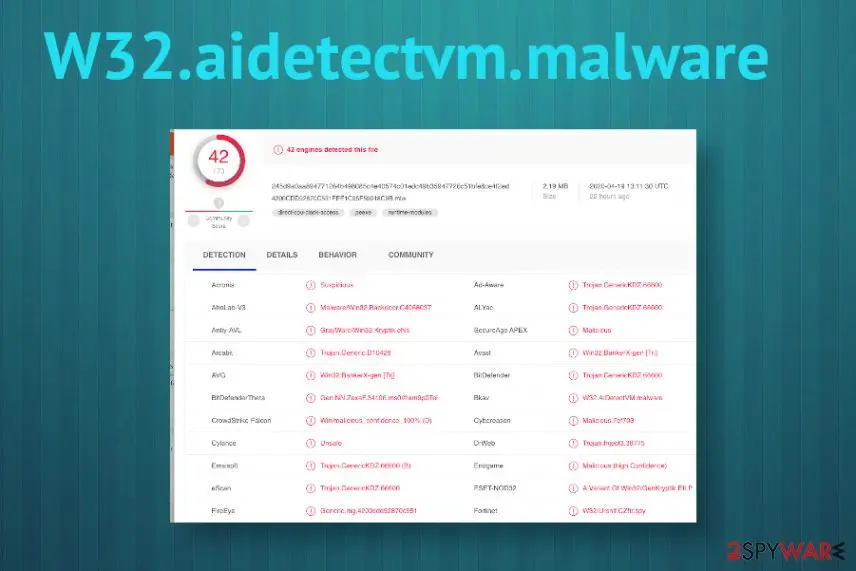
You may think that the W32.aidetectvm.malware virus is damaging your machine the minute you receive an alert with the name of this intruder, but the infection might not even happen when the detection is falsely showing up on the computer screen. This is the threat that can possibly infect Windows devices, but there are not many symptoms that users can notice.
The first reason that should be a red flag and make you want to remove W32.aidetectvm.malware is the general performance of the machine that gets affected by the trojan because the computer starts running slow and crash from time to time. You need to be cautious and pay attention to any system performance changes, so run the AV tool to found out what is wrong.
If you use professional anti-malware tools already, W32.aidetectvm.malware removal shouldn't be difficult or cause any issues for you. The detection with this particular name can indicate various threats, so when you run or , and the result shows up, you need to follow the steps and clean the machine from the malware yourself.
After all these processes, you should also use for the help with possible damage or corrupted files that may be the initial reason why you see the alert about a possible security issue that may not even exist.
[GI=method-1]System reboot in Safe Mode with Networking can make a huge difference in this W32.aidetectvm.malware removal process
[GI=method-2]W32.aidetectvm.malware trojan can get terminated with the help of System Restore feature
From our report of Apr 2020 · not reviewed since
W32.aidetectvm.malware is the generic identification that states about malicious computer threat that can introduce malware to the system
W32.aidetectvm.malware is the infection that makes your computer running slow and crashing more than usual.
All the frequent shutdowns and unwanted pop-ups, errors, even system alerts should indicate that there is something wrong. This name of the threat, in most cases, is the result of the AV detection-based program because the anti-malware program spotted a suspicious file or activity that possibly can be associated with internet criminals or malware.
Various vendors can show the same detection result due to different reasons because some of them indicate the suspicious software or a web browser-based virus, domain. This is the result that appears on the Windows operating system and indicates that 32 bit is the type of OS in particular.
Users, have no idea why the alert is displayed because these errors occur out of nowhere. This is normal, because sometimes these detections may be falsely positive and indicate non-existent issues.
W32.aidetectvm.malware is possibly a false positive result that is not related to any intruder or issues on your device, but AV tools are designed to detect and indicate possibly dangerous or even malicious programs, files, and even sites where user can get exposed to malware-laced material.
However, detection results and pop-up alerts with results like this can appear all the time, if that is the case, you should react and try to remove W32.aidetectvm.malware as soon as possible.
The best results can be achieved with a tool that warned you about the danger, in the first place. Your machine may perform poorly due to occurring pop-up alerts alone, so the sooner you find a solution, the better.
If W32.aidetectvm.malware virus appears to be a trojan or a different type of dangerous computer virus, it can:
W32.aidetectvm.malware may run in the background and reinstall itself to keep the persistence up. Such stealthy threats aim to take advantage of the system, exploiting various flaws, and once important parts get affected, the virus can spy on victims directly or execute any codes without the indication that there is an intruder. This fact that trojan can run undetected for a while makes it more dangerous and damaging.
You should consider that when you focus on W32.aidetectvm.malware removal because when the threat has its roots deep in the system, all associated applications and files need to be deleted to remove the infection fully.
For this purpose. experts always recommend going for proper system tools like that can also repair damaged files, affected or corrupted programs for you when the detection is falsely positive due to incompatibility issues, for example.
W32.aidetectvm.malware can be set to do a handful of processes and have many features that usually are affecting the system significantly, but cannot be noticed in time. Malware like trojans or worms can execute commands that expose the machine to a malicious actor or run the additional script of threats like ransomware and cryptomining viruses.
The name of the trojan virus comes from the ability to invade the system silently, so the infection can run for a long time until you notice anything disturbing or the AV tool that you use indicates W32.aidetectvm.malware as a possible issue. Malicious actors behind the threat can aim yo gain access to sensitive information stored on your device or even target passwords, credentials, other login details. banking account data.
Personal information is one of the more valuable things that malware creators may design their products to gather. W32.aidetectvm.malware can be a tool used to achieve particular tasks of cybercriminals. Since cryptocurrency is the second thing that malicious actors may focus on, you may receive a virus that runs on the resources of the machine and generates Bitcoins for the creator.
Once trojans end up on the computer, it is possible to get a ransom-demanding malware that directly blackmails money from you. The most important thing is to react as soon as possible and clean the machine fully from all the threats, so there is no opportunity for W32.aidetectvm.malware or any other virus to repeat the infection in the future.
- execute files and run or stop programs from running;
- install malware;
- shut the system down;
- cause errors randomly;
- steal personal information;
- obtain files or different data stored on the machine.
From our report of Apr 2020 · not reviewed since
More from our earlier report on W32.aidetectvm.malware
- W32.aidetectvm.malware removal should be the best when you delete the intruder using a particular AV tool that detected this malware in the first place
- For the proper system cleaning, you should repair corrupted files and get rid of the virus damage or any associated files and programs, so run the or a similar PC utility that can indicate files in need for fixing
How to remove W32.aidetectvm.malware
A loader's job is to install other malware, so treat the PC as infected with more than one program until the scans are clean.
Step 1: Delete scheduled tasks that bring it back
Programs like W32.aidetectvm.malware add a scheduled task so they return after an uninstall or reopen a page at every sign-in. Start Task Scheduler, open Task Scheduler Library and sort by Last Run Time to see what ran recently.
On the Actions tab, a program in a user folder, a script or a web address is a warning sign; right-click such a task and choose Delete.
Tasks with names copying Google, Edge or Windows updaters but pointing to an odd folder are typical. The tool looks the same in Windows 11 and Windows 10.
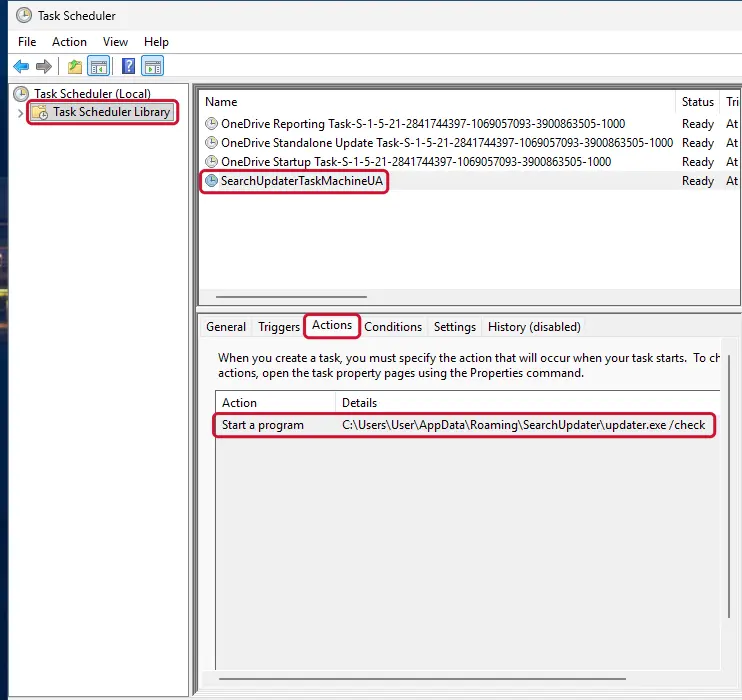
Windows 11: Task Scheduler Library, the task selected, the Actions tab shows the file it runs. Full procedure with screenshots: Remove what malware leaves behind in Windows
Step 2: Remove it from startup
Press Ctrl + Shift + Esc to open Task Manager and select Startup apps (Windows 11) or the Startup tab (Windows 10). Disable entries you do not recognise, especially ones with no publisher or with a name that copies a Windows component.
Right-click an entry and choose Open file location to see where it runs from: programs in
%AppData%or%Temp%deserve a closer look. Some entries are not listed there but in the registry Run keys, which the procedure below shows how to check.Full procedure with screenshots: Stop apps from opening at startup On uGetFix
Step 3: Delete the folders left behind
Uninstalling often leaves the program's folders, and some threats reinstall themselves from them.
Press Windows + R, type
%LocalAppData%and press Enter, then do the same for%AppData%and %ProgramData%, and look for folders named after W32.aidetectvm.malware, its publisher or created on the day the problem started. Delete those folders, and check C:\Program Files and C:\Program Files (x86) too.If Windows says a file is in use, end it in Task Manager or delete the folder after a restart in Safe Mode. The folders are the same in Windows 11 and Windows 10.
Full procedure with screenshots: Remove what malware leaves behind in Windows
Step 4: Scan the PC, then run the offline scan
A scan finds the parts of W32.aidetectvm.malware that the manual steps cannot see. In Windows Security > Virus & threat protection > Scan options, start a Full scan and quarantine what it reports.
Follow it with Microsoft Defender Antivirus (offline scan) > Scan now, which restarts the PC and checks the disk while Windows and the malware are not running.
It takes about 15 minutes and works the same in Windows 11 and Windows 10. If either scan finds something, run the full scan again after removal until it comes back clean.
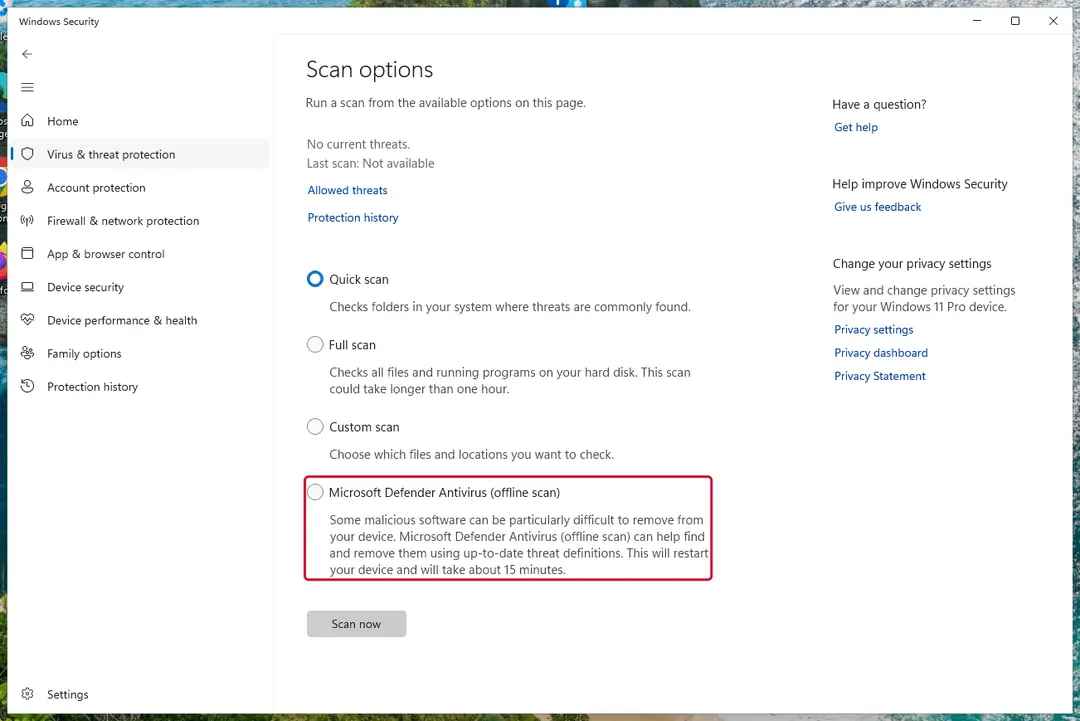
Windows 11: Windows Security > Virus & threat protection > Scan options. Full procedure with screenshots: Run a Microsoft Defender Offline scan
Step 5: Change passwords from another device and sign out other sessions
W32.aidetectvm.malware can copy saved passwords, cookies and session tokens and send them out in seconds, so cleaning the PC does not undo the theft.
Change your passwords on a device that was never infected, starting with the e-mail account, since every other reset goes through it. On each account, end all other sessions and check the recovery e-mail, phone number and forwarding rules.
Then turn on two-step verification. Sign in on the Windows 11 or Windows 10 PC again only after the offline scan is clean.
Full procedure with screenshots: Turn on two-step verification / secure a hacked account
Instructions for each browser and system
The detailed steps for every browser and system this guide covers. Open the one you use.
Manual removal using Safe Mode
Important! →
Manual removal guide might be too complicated for regular computer users. It requires advanced IT knowledge to be performed correctly (if vital system files are removed or damaged, it might result in full Windows compromise), and it also might take hours to complete. Therefore, we highly advise using the automatic method provided above instead.
Step 1. Access Safe Mode with Networking
Manual malware removal should be best performed in the Safe Mode environment.
Windows 7 / Vista / XP
- Click Start > Shutdown > Restart > OK.
- When your computer becomes active, start pressing F8 button (if that does not work, try F2, F12, Del, etc. - it all depends on your motherboard model) multiple times until you see the Advanced Boot Options window.
- Select Safe Mode with Networking from the list.
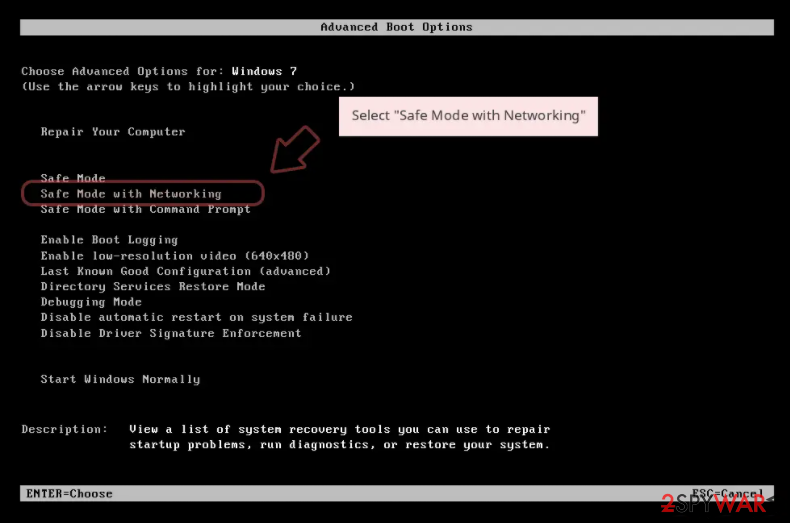
Windows 10 / Windows 8
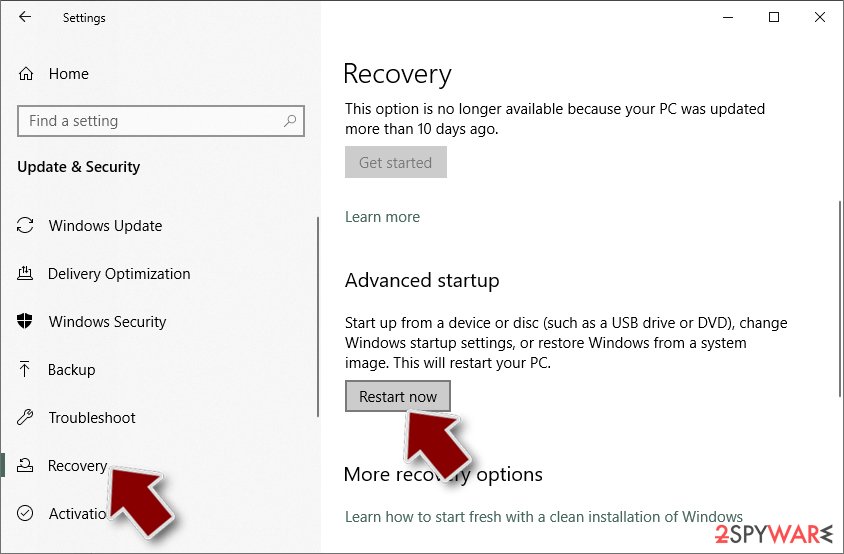
- Right-click on Start button and select Settings.
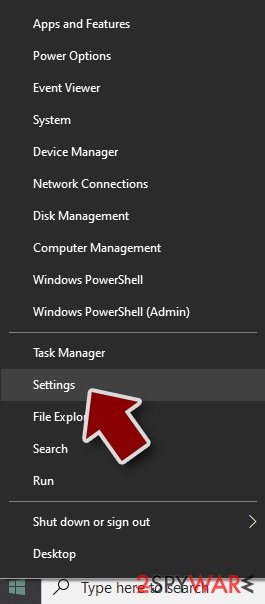
- Scroll down to pick Update & Security.
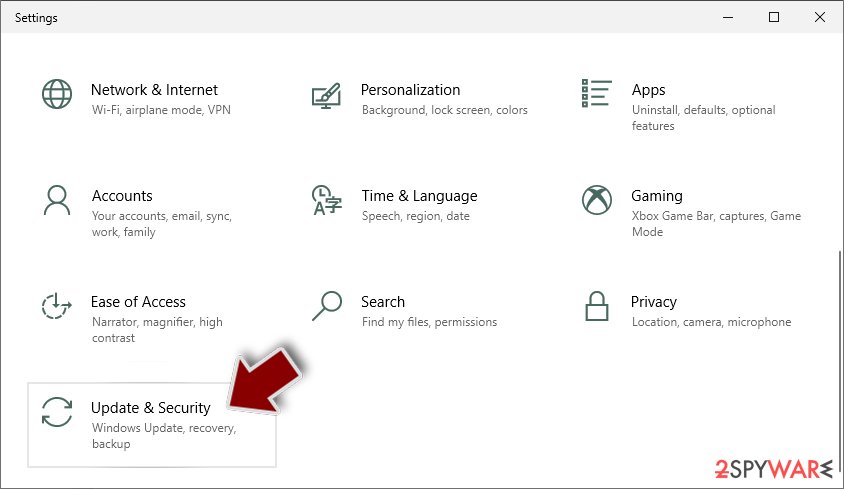
- On the left side of the window, pick Recovery.
- Now scroll down to find Advanced Startup section.
- Click Restart now.
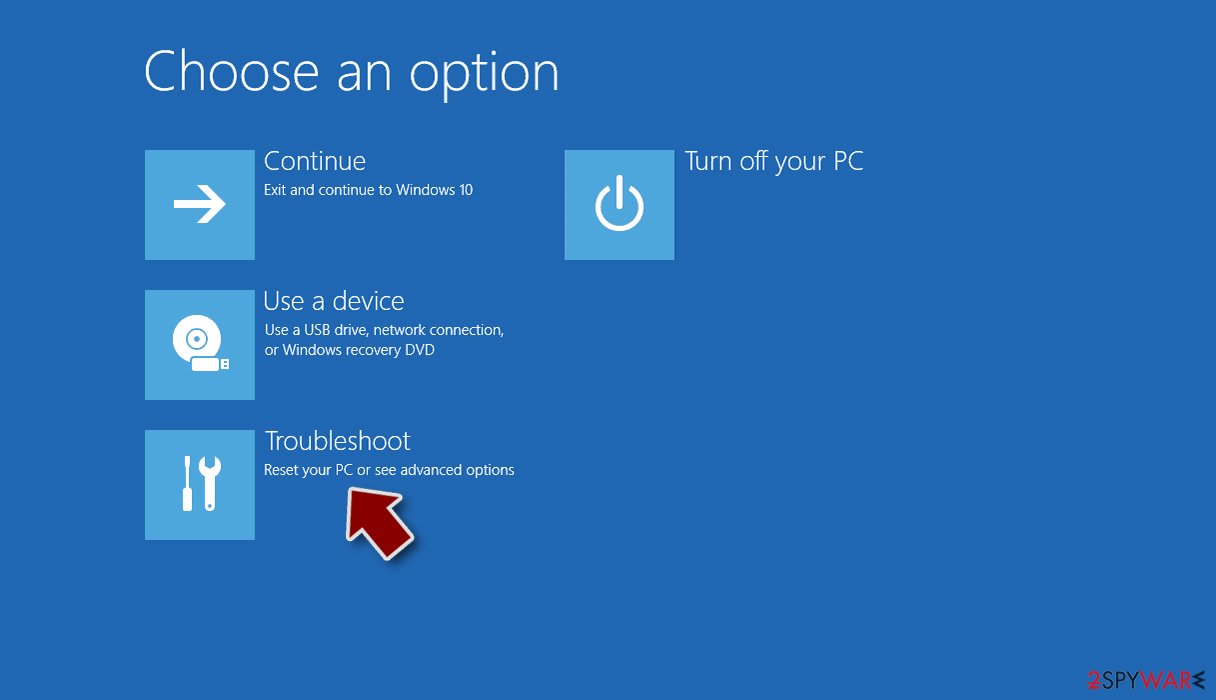
- Select Troubleshoot.
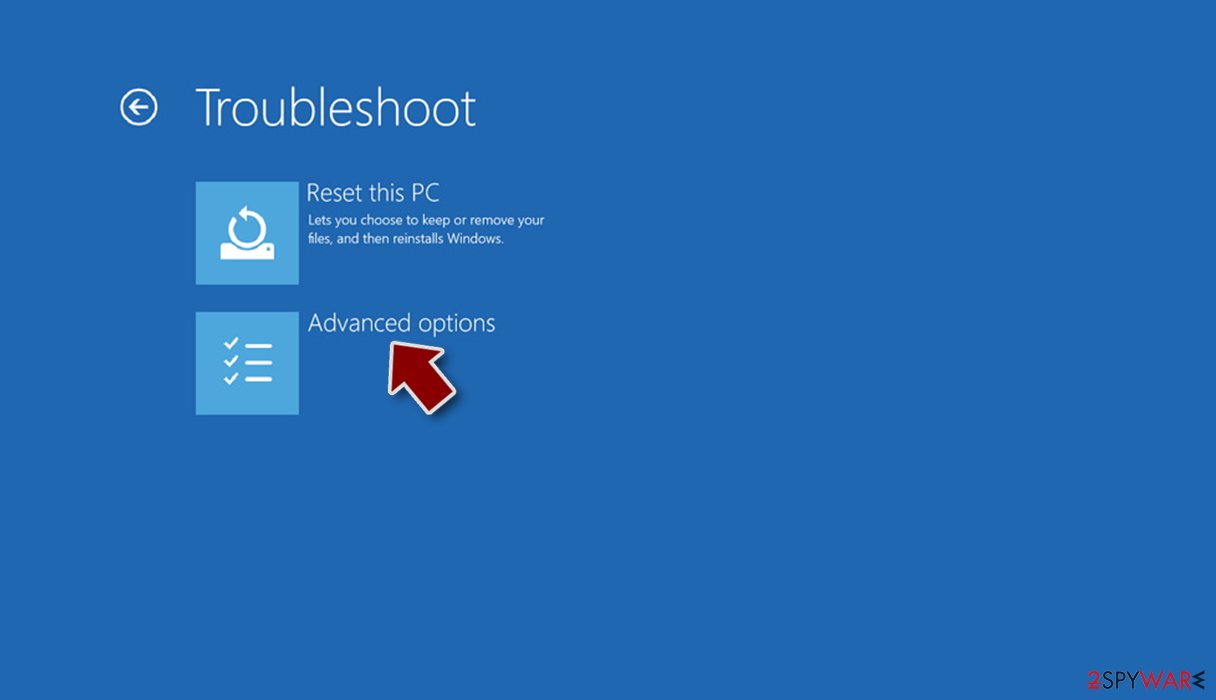
- Go to Advanced options.
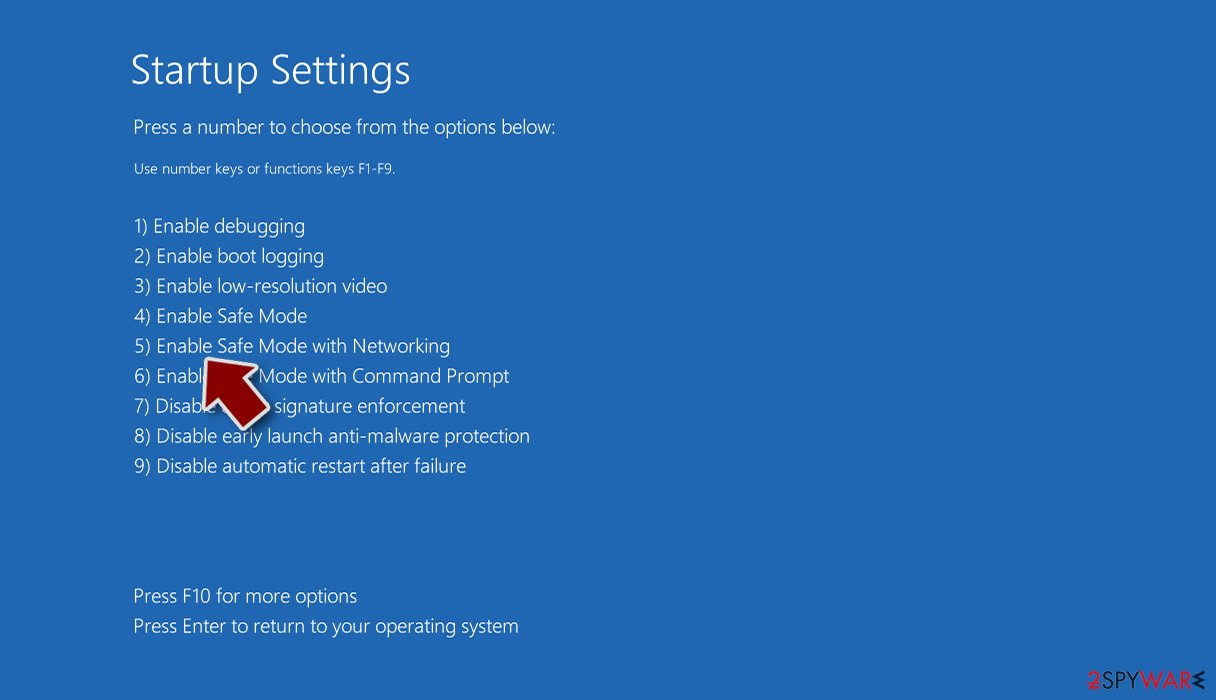
- Select Startup Settings.
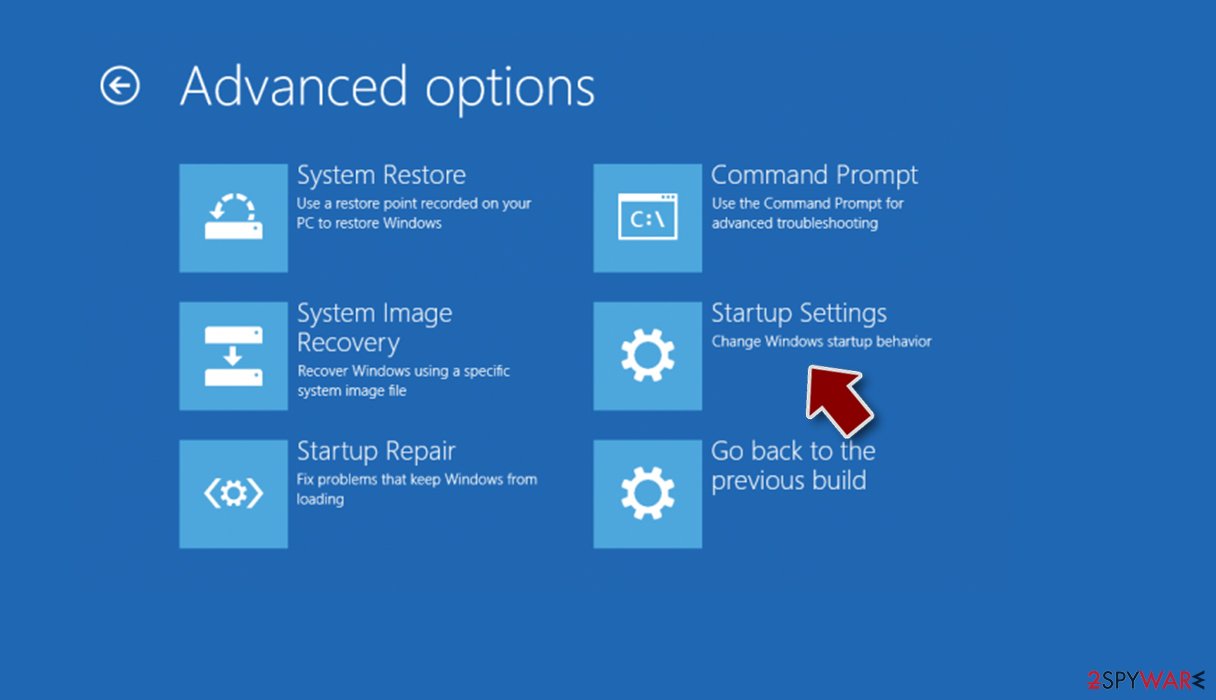
- Press Restart.
- Now press 5 or click 5) Enable Safe Mode with Networking.
Step 2. Shut down suspicious processes
Windows Task Manager is a useful tool that shows all the processes running in the background. If malware is running a process, you need to shut it down:
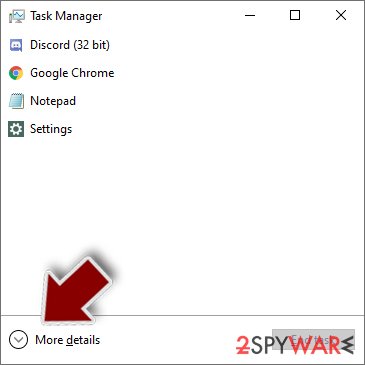
- Press Ctrl + Shift + Esc on your keyboard to open Windows Task Manager.
- Click on More details.
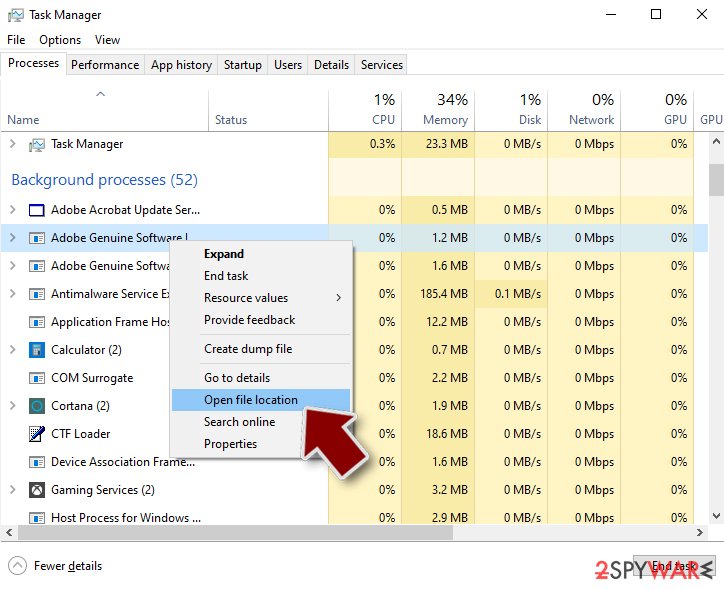
- Scroll down to Background processes section, and look for anything suspicious.
- Right-click and select Open file location.
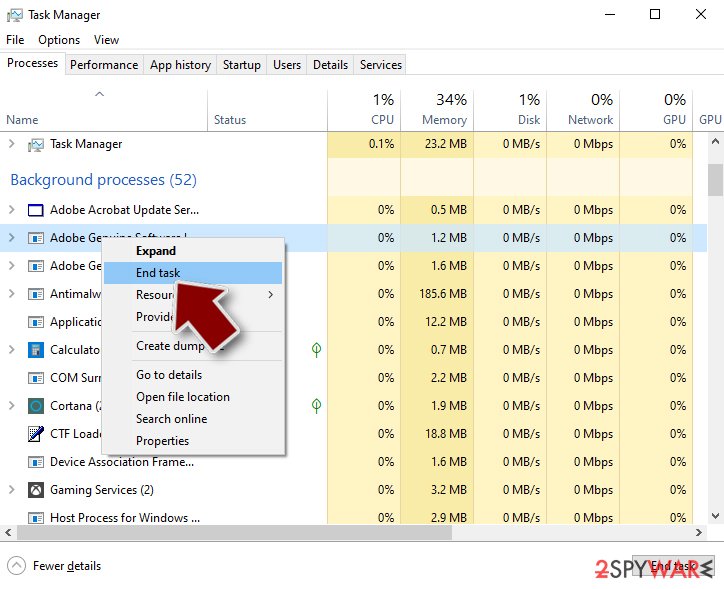
- Go back to the process, right-click and pick End Task.
- Delete the contents of the malicious folder.
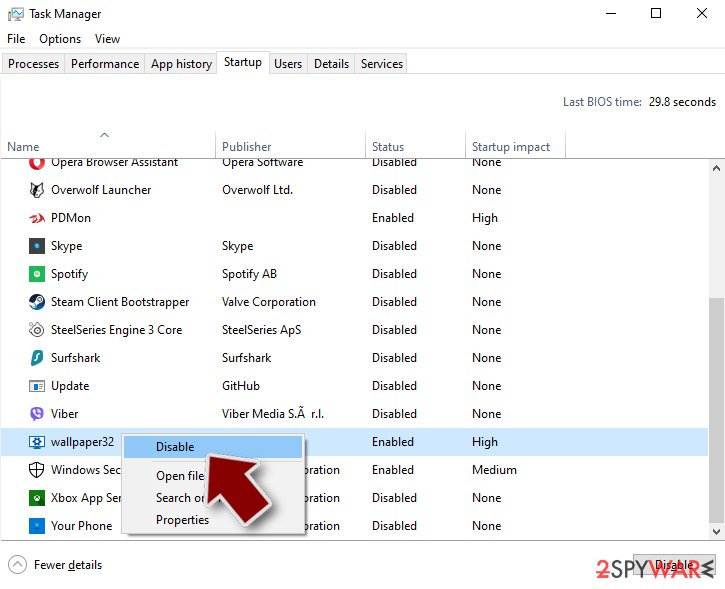
Step 3. Check program Startup
- Press Ctrl + Shift + Esc on your keyboard to open Windows Task Manager.
- Go to Startup tab.
- Right-click on the suspicious program and pick Disable.
Step 4. Delete virus files
Malware-related files can be found in various places within your computer. Here are instructions that could help you find them:
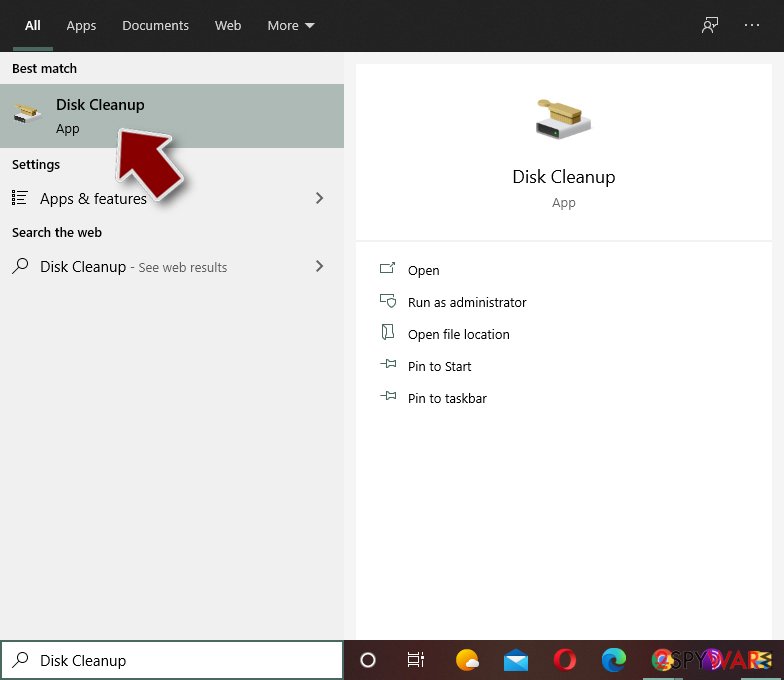
- Type in Disk Cleanup in Windows search and press Enter.
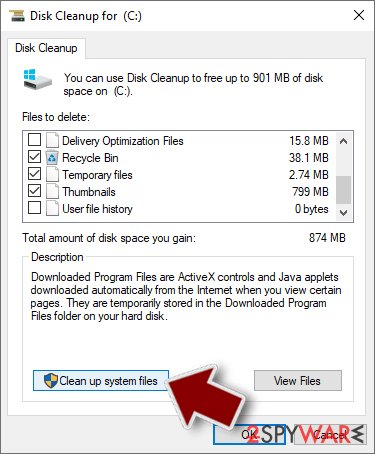
- Select the drive you want to clean (C: is your main drive by default and is likely to be the one that has malicious files in).
- Scroll through the Files to delete list and select the following:
Temporary Internet Files
Downloads
Recycle Bin
Temporary files - Pick Clean up system files.
- You can also look for other malicious files hidden in the following folders (type these entries in Windows Search and press Enter):
%AppData%
%LocalAppData%
%ProgramData%
%WinDir%
After you are finished, reboot the PC in normal mode.
After removal: passwords, accounts and prevention
Your passwords after W32.aidetectvm.malware
Removing W32.aidetectvm.malware does not undo what it may already have sent out while the PC showed W32.aidetectvm.malware in the list of installed apps.
Treat saved browser passwords and logged-in sessions on this PC as known to the attacker.
From another device, change the e-mail password first and end all its sessions. Then do the same for the bank, PayPal, Microsoft, Google and Apple accounts. Stolen session cookies keep working after a password change until you sign out everywhere.
Move crypto to a new wallet created on a clean device. A step-by-step order for every kind of account is in our guide to account security after an infection.
Do not let government spy on you
The government has many issues in regards to tracking users' data and spying on citizens, so you should take this into consideration and learn more about shady information gathering practices.
Avoid any unwanted government tracking or spying by going totally anonymous on the internet.
You can choose a different location when you go online and access any material you want without particular content restrictions. You can easily enjoy internet connection without any risks of being hacked by using VPN.
Control the information that can be accessed by government any other unwanted party and surf online without being spied on. Even if you are not involved in illegal activities or trust your selection of services, platforms, be suspicious for your own security and take precautionary measures by using the VPN service.
Backup files for the later use, in case of the malware attack
Computer users can suffer from data losses due to cyber infections or their own faulty doings.
Ransomware can encrypt and hold files hostage, while unforeseen power cuts might cause a loss of important documents. If you have proper up-to-date backups, you can easily recover after such an incident and get back to work. It is also equally important to update backups on a regular basis so that the newest information remains intact - you can set this process to be performed automatically.
When you have the previous version of every important document or project you can avoid frustration and breakdowns. It comes in handy when malware strikes out of nowhere. Use for the data restoration process.
Questions about W32.aidetectvm.malware
Is W32.aidetectvm.malware a virus?
Most programs that appear the way W32.aidetectvm.malware did are not viruses in the strict sense. They are potentially unwanted programs:
- real software that arrives bundled with other downloads and then shows offers
- changes browser settings
- starts with Windows
Some are harmless, some are annoying and a few carry adware. What makes it worth removing is that you did not choose it.
Uninstall it from Installed apps and check the startup list and the browsers for anything added the same day. If it refuses to uninstall or returns after a restart, treat it as more serious and run a Microsoft Defender offline scan.
W32.aidetectvm.malware came back after I uninstalled it. Why?
Something else is reinstalling it. Common causes are a second program from the same publisher, a scheduled task that downloads it again, or a browser extension that keeps prompting for it. Sort Installed apps by install date and uninstall each entry from the same day that you did not choose.
Then open Task Scheduler and look in the Task Scheduler Library for tasks with updater-style names that you do not recognise. Check Startup apps in Task Manager too. If W32.aidetectvm.malware still returns, start Windows in Safe Mode, uninstall it there and run a Microsoft Defender offline scan, which looks for loaders that ordinary scans can miss.
How dangerous is W32.aidetectvm.malware?
Treat it as serious until proven otherwise. The visible sign is W32.aidetectvm.malware in the list of installed apps, and programs that behave this way often have more abilities than they show:
- copying passwords
- downloading other malware
- giving remote access
Its family is not known yet, so nobody can say which of these it uses. The good news is that the response is the same in every case and takes about an hour:
- cut the network
- remove the startup entry
- run an offline scan
- change passwords from a clean device
If someone had remote control, a full reset is safer.
How do I know if my PC has W32.aidetectvm.malware?
Often you do not, which is the point of a trojan. Possible signs are an antivirus alert naming W32.aidetectvm.malware or a generic trojan detection, unknown programs or scheduled tasks, processes with random names in Task Manager, browser extensions you did not add, security settings turned off, slower performance, or account alerts about logins from unknown places.
The reliable check is a full scan followed by Microsoft Defender's offline scan. If you recently ran a crack, a fake installer or a command a website told you to paste, scan even without symptoms.
Why can't I find W32.aidetectvm.malware in antivirus databases?
Because it is new or because it is listed under a different name. Antivirus companies name threats after the family they belong to, and a program that appears as W32.aidetectvm.malware on your PC may carry a generic or unrelated label in their databases.
Many new samples are first detected only by behaviour, without a family name. What you saw, W32.aidetectvm.malware in the list of installed apps, is enough to act on:
- end the program
- remove its startup entry
- run a Microsoft Defender offline scan
- secure your accounts
A detection name from a scan is worth noting for later.
I found AnyDesk or ScreenConnect that I did not install. Is that W32.aidetectvm.malware?
Not necessarily W32.aidetectvm.malware, but it is a warning sign. These are legitimate remote support tools, and criminals use them as ready-made backdoors, especially after tech support scams or fake invoice calls.
If you did not install it and no one you trust set it up, uninstall it, change passwords from a clean device and check your bank account. If someone connected to your PC through it, follow the steps for remote access trojans and consider a Windows reset. Installed apps sorted by date shows when it appeared.
My antivirus was on. How did a trojan get past it?
Antivirus programs see a file only when it is written or run, and criminals test each new build against popular scanners before release. Detection catches up within hours or days, which is often after the first victims ran it.
Archives with passwords, installers that fetch the malware later, and scripts run through PowerShell make the job harder. That is why behaviour such as downloading cracks or pasting commands matters more than any setting. Keep Windows and Defender updated, and turn on Reputation-based protection in App & browser control.
Should I check my other computers too?
Yes, it takes little time and removes doubt. W32.aidetectvm.malware itself usually stays on one PC, but the download that carried it may have been copied to other computers, shared drives may hold the same installer, and an attacker who had access could have tried saved passwords on other devices.
Run a full scan on every Windows PC in the home or office, check shared folders for the original download, and change Wi-Fi and router passwords if they were stored on the infected machine.
Should I report W32.aidetectvm.malware?
Report it if you lost money, if accounts were taken over, if you are a business, or if the trojan came through a scam call. A police or national cybercrime report gives you a reference number for your bank and insurer and helps link cases.
You do not need to report a trojan that antivirus blocked before it ran. Before reporting, write down the dates, the detection name, file names and any messages or transactions linked to the attack; screenshots of antivirus alerts are useful evidence. The country list is in the report section above.
Will Fortect remove W32.aidetectvm.malware?
Fortect scans Windows for malware and unwanted programs and repairs the system files and settings they change, and its free scan shows what it finds on your PC before you decide anything.
For W32.aidetectvm.malware, follow the plan above as well: the browser steps take back permissions and settings that no scanner treats as a threat, and uninstalling the program that brought it removes the source.
Run Microsoft Defender's full scan and, if anything was found, its offline scan as a second opinion. If the symptoms are gone after the plan and both scans are clean, there is nothing more to do.
Sources
- VirusTotal: malware detection results with W32.aidetectvm.malware on the list (read October 7, 2026)
- Reddit: what is win32:malware-gen (read October 7, 2026)
- Virusai: Virusai (read October 7, 2026)
- FTC: How to recognize, remove and avoid malware (read October 7, 2026)
- Microsoft Learn: Microsoft Defender Offline (read October 7, 2026)