

Things you should know about Websearchthis.com
Websearchthis.com is shady search service provider which characteristics fit the description of a browser hijacker [1]. First, we don’t know anything about its creators. The About Us section of the page claims that WebSearchThis is a “privately owned company based in ASIA” but that’s as little information as we get about the people behind it. This is undoubtedly a strange thing, considering that the website is promoted as a “global leader” in the search-based marketing. Indeed, Web Search This, or whatever you call it, is not a regular web search provider. The site’s description explicitly states that this site is focused on promoting third-party websites, boosting their traffic and helping them generate revenue. What they forget or purposefully refuse to disclose is that this service is based on a pay-per-click [2] model which means that Websearchthis creators also gain profit from carrying out these advertising campaigns. It may seem like a fair exchange if not for the users who are left with no explanation why this unfamiliar website has replaced their default search engine and homepage, and why their web browsing is being interrupted with annoying ads and redirects to random websites. If you have ended up with this unwanted program on your computer too, you should not hesitate to remove Websearchthis.com and opt for some other search engine instead. Trust us; you won’t lose anything. On the opposite, your web browsing will become incomparably smoother and you will be able to enjoy your favorite websites without pesky pop-ups overlaying their content. Just launch the PC scan with FortectIntego or some other malware detection utility and wait for it to clean up your system.

Websearchthis.com hijack often becomes a headache for the users of Google Chrome, Mozilla, IE and Microsoft Edge. The parasite may inject these browsers with additional content, such as toolbars, extensions, search bars, etc., to have more control over the infected computer. Typically, these additional browser helper objects will have unauthorized permissions to monitor your web browsing habits, keep a record of them on their own secret servers and share the collected data with unknown third-parties. Websearchthis will undoubtedly make use of this information as well and replenish your web browsing with more ads tailored according to your interests. Don’t get hooked on the offers that just seem too good to be true — these are probably well thought-through traps that the hijacker has set up in order to redirect you to some of its promoted websites which may not always be very safe. As soon as you notice suspicious behavior on your PC, don’t ignore it and be prepared to perform Websearchthis.com removal.

Actions you can take to prevent PUP infiltration
Before you can implement some security precautions to prevent the potentially unwanted program from entering your computer, you should first get acquainted with ways Websearchthis.com carry out the attacks. In fact, these attacks deviate far from the associative meaning of the word. Computers are not broken into. On the contrary, the users install malware on their computers themselves when choosing wrong settings for setting up new software on the PC. The truth is, you can easily prevent Websearchthis.com infiltration by opting for Advanced or Custom modes in the installation wizard. During the following steps of the installation, you will be able to see what additional items have arrived with your downloaded software and opt out their installation if you find them suspicious.
Automatic malware removal tools will not let you go wrong with Websearchthis.com removal
Indeed, the most guaranteed solution to Websearchthis.com removal is the application of automatic malware detection software. Users often forget about this option and try to roll back their default search engine and homepage through the browser’s settings. Unfortunately, this will stop the redirects for one browsing session at best, and the hijacker will bounce back to your browser the next time you launch it. If you want to remove Websearchthis.com for good, you should either scan your PC with antivirus or try to locate the PUP responsible for the Web Search This redirect problem manually. We provide step-by-step instructions for the latter approach below.
Uninstall from Windows
Uninstall from Windows 10/8:
- Type Control Panel into the Windows search box and open the result.
- Under Programs, select Uninstall a program.


Uninstall from Windows 7/XP:
- Click on Windows Start > Control Panel (Windows XP users should click on Add/Remove Programs).
- In Control Panel, select Programs > Uninstall a program.


Remove the unwanted program:
- In the Programs and Features window, look for any recently installed suspicious entries, select them, and click Uninstall.
- If User Account Control appears, click Yes to confirm, then complete the removal.


Delete from macOS
Remove the unwanted application:
- From the menu bar, select Go > Applications.
- In the Applications folder, look for any suspicious entries, then drag them to Trash (or right-click and pick Move to Trash).


Delete leftover files and folders:
- Select Go > Go to Folder.
- Enter /Library/Application Support and remove any suspicious folders related to the unwanted program.
- Repeat the same check in the /Library/LaunchAgents and /Library/LaunchDaemons folders, deleting any suspicious entries.

- Finally, empty the Trash to permanently remove the leftovers.

Reset Internet Explorer
Remove dangerous add-ons:
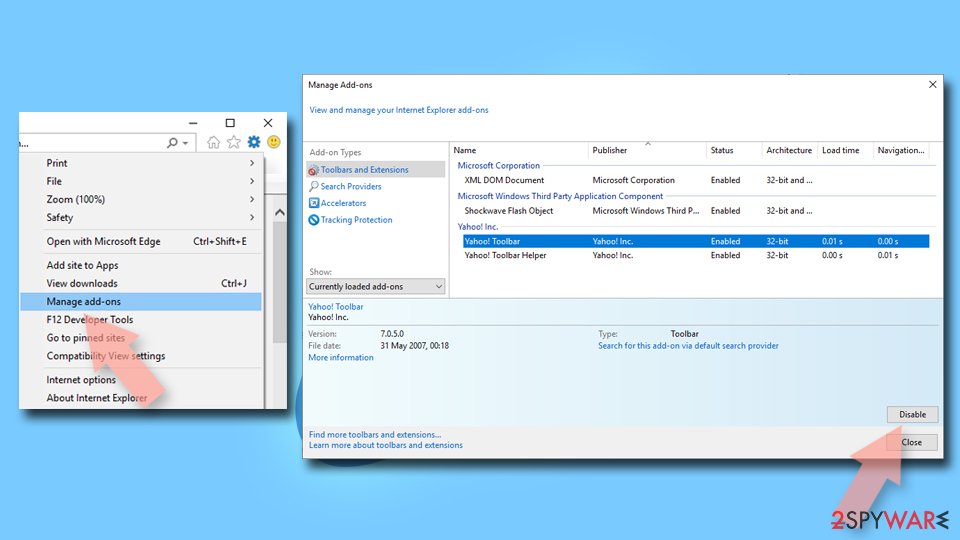
- Open Internet Explorer, click on the Gear icon (IE menu) on the top-right corner of the browser
- Pick Manage Add-ons.
- You will see a Manage Add-ons window. Here, look for suspicious plugins. Click on these entries and select Disable.

Change your homepage if it was altered:
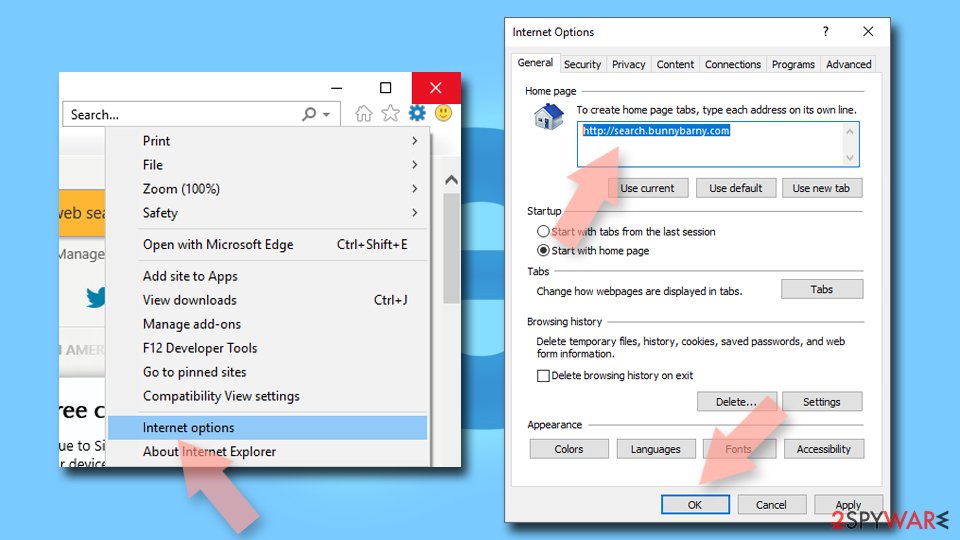
- Open IE and click on the Gear icon.
- Select Internet Options.
- In the General tab, delete the Home page address and replace it by your preferred one (for example, Google.com).
- Click Apply and then select OK.

Delete temporary files:
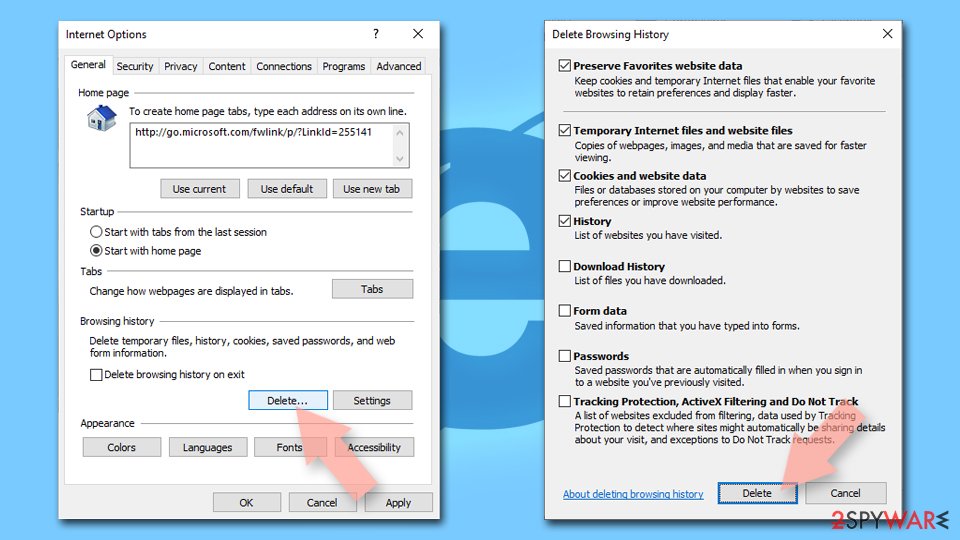
- Press on the Gear icon and select Internet Options.
- Under Browsing history, click Delete...
- Select relevant fields and press Delete.

Reset Internet Explorer:
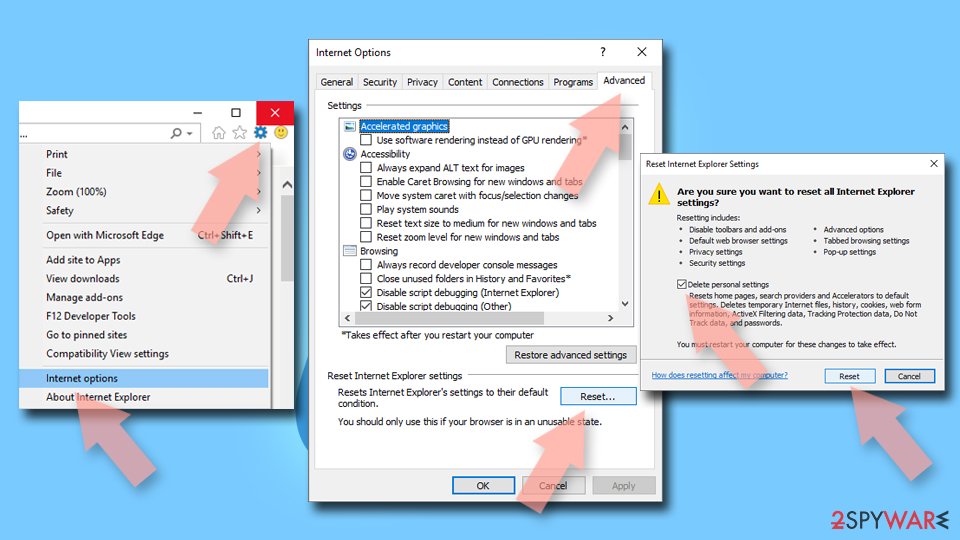
- Click on Gear icon > Internet options and select Advanced tab.
- Select Reset.
- In the new window, check Delete personal settings and select Reset.

Remove from Microsoft Edge
Delete unwanted extensions from MS Edge:
- Select Menu (three horizontal dots at the top-right of the browser window) and pick Extensions.
- From the list, pick the extension and click on the Gear icon.
- Click Remove.


Clear cookies and other browser data:
- Click on the Menu (three horizontal dots at the top-right of the browser window) and select Settings > Privacy, search, and services..
- Under Clear browsing data, pick Choose what to clear.
- Select Cookies and other site data and Cached images and files. (apart from passwords, although you might want to include Media licenses as well, if applicable) and click on Clear.


Restore new tab and homepage settings:
- Click the menu icon and choose Settings.
- Then find On startup section.
- Click Remove next to any suspicious startup page.
Reset MS Edge if the above steps did not work:
- Press on Ctrl + Shift + Esc to open Task Manager.
- Click on More details arrow at the bottom of the window.
- Select Details tab.
- Now scroll down and locate every entry with Microsoft Edge name in it. Right-click on each of them and select End Task to stop MS Edge from running.


Instructions for Chromium-based Edge
Delete extensions from MS Edge (Chromium):
- Open Edge and click select Settings > Extensions.
- Delete unwanted extensions by clicking Remove.


Clear cache and site data:
- Click on Menu and go to Settings.
- Select Privacy, search and services.
- Under Clear browsing data, pick Choose what to clear.
- Under Time range, pick All time.
- Select Clear now.


Reset Chromium-based MS Edge:
- Click on Menu and select Settings.
- On the left side, pick Reset settings.
- Select Restore settings to their default values.
- Confirm with Reset.
- This will disable extensions and reset startup pages but will not delete bookmarks, saved passwords, or browsing history.


Remove from Mozilla Firefox (FF)
Remove dangerous extensions:
- Open Mozilla Firefox browser and click on the Menu (three horizontal lines at the top-right of the window).
- Select Add-ons.
- In here, select the unwanted extension and click Remove.


Reset the homepage:
- Click three horizontal lines at the top right corner to open the menu.
- Choose Settings.
- Under Home, set your preferred homepage and new tab settings.
Clear cookies and site data:
- Click Menu and pick Settings.
- Go to Privacy & Security section.
- Scroll down to locate Cookies and Site Data.
- Click on Clear Data...
- Select Cookies and Site Data and Temporary cached files and pages, then click Clear.


Reset Mozilla Firefox
If clearing the browser as explained above did not help, reset Mozilla Firefox:
- Open Mozilla Firefox browser and click the Menu.
- Go to Help and then choose Troubleshooting Information.

- Under Give Firefox a tune up section, click on Refresh Firefox...
- Once the pop-up shows up, confirm the action by pressing on Refresh Firefox.



Remove from Google Chrome
Delete malicious extensions from Google Chrome:
- Open Google Chrome, click on the Menu (three vertical dots at the top-right corner) and select More tools > Extensions.
- In the newly opened window, you will see all the installed extensions. Uninstall all suspicious extensions related to the unwanted program by clicking Remove.


Clear cache and web data from Chrome:
- Click on Menu and pick Settings.
- Under Privacy and security, select Clear browsing data.
- Select Browsing history, Cookies and other site data, as well as Cached images and files.
- Click Clear data.


Change your homepage:
- Click menu and choose Settings.
- Look for a suspicious site in the On startup section.
- Click on Open a specific or set of pages and click on three dots to find the Remove option.
Reset Google Chrome:
If the previous methods did not help you, reset Google Chrome to eliminate all the unwanted components:
- Click on Menu and select Settings.
- In the Settings, scroll down and click Advanced.
- Scroll down and locate Reset and clean up section.
- Now click Restore settings to their original defaults.
- Confirm with Reset settings.


Delete from Safari
Remove dangerous extensions:
- Open Safari, click Safari in the menu at the top-left of the screen, and select Preferences.
- Go to the Extensions tab, look for any suspicious entries, and click Uninstall to remove them.


Clear history and website data:
- Click Safari in the menu and pick Clear History.
- Set Clear to all history and confirm with Clear History.


Reset Safari:
- Click Safari in the menu and select Preferences > Advanced.
- Enable Show Develop menu in menu bar.
- From the menu bar, click Develop and select Empty Caches.


Did this guide help?
Be the first to comment